http://dx.doi.org/10.4236/ojs.2016.63043
Spatial Modeling and Mapping of
Tuberculosis Using Bayesian
Hierarchical Approaches
Abdul-Karim Iddrisu1, Yaw Ampem Amoako2
1Department of Statistical Sciences, University of Cape Town, Cape Town, South Africa
2Department of Medicine, Komfo Anokye Teaching Hospital, Kumasi, Ghana
Received 21 February 2016; accepted 19 June 2016; published 22 June 2016
Copyright © 2016 by authors and Scientific Research Publishing Inc.
This work is licensed under the Creative Commons Attribution International License (CC BY).
http://creativecommons.org/licenses/by/4.0/
Abstract
Global spread of infectious disease threatens the well-being of human, domestic, and wildlife health. A proper understanding of global distribution of these diseases is an important part of disease management and policy making. However, data are subject to complexities by hetero-geneity across host classes. The use of frequentist methods in biostatistics and epidemiology is common and is therefore extensively utilized in answering varied research questions. In this pa-per, we applied the hierarchical Bayesian approach to study the spatial distribution of tuberculo-sis in Kenya. The focus was to identify best fitting model for modeling TB relative risk in Kenya. The Markov Chain Monte Carlo (MCMC) method via WinBUGS and R packages was used for simula-tions. The Deviance Information Criterion (DIC) proposed by [1] was used for models comparison and selection. Among the models considered, unstructured heterogeneity model perfumes better in terms of modeling and mapping TB RR in Kenya. Variation in TB risk is observed among Kenya counties and clustering among counties with high TB Relative Risk (RR). HIV prevalence is identi-fied as the dominant determinant of TB. We find clustering and heterogeneity of risk among high rate counties. Although the approaches are less than ideal, we hope that our formulations provide a useful stepping stone in the development of spatial methodology for the statistical analysis of risk from TB in Kenya.
Keywords
1. Introduction
The global spread of infectious diseases threatens the well-being of human population as well as that of domestic and wild animals. Therefore, a proper understanding of the pathways and global spread of communicable and infectious diseases is an important aspect of disease management and policy making. However, the data collected with the object of understanding these patterns are subjected to complications brought about by heterogeneity that can be of spatial or non-spatial in nature [2][3]. Ignoring these complexities is likely to mislead inference which may results in erroneous conclusion [2][3]. Disease data can be case-event or counts from non-over- lapping regions. Since the data provided for this study only have county level spatial resolution, the approach will be to analyses the data as regional or county specific count data.
There exists a vast amount of literature concerning the development and application of disease mapping approaches [4]-[8]. Spatial distribution of a disease is often understood through application of statistical methods to the data and creating maps that visually describes spatial variation of disease risk [3]. However, disease counts maps are subjected to numerous problems. One such problem is the Modifiable Areal Unit Problem (MAUP), which occurs when inference at the areal level differs from that which is observed at the basic observational unit. This is likely to change conclusions drawn from a study of a count data. The MAUP can be addressed by scaling up to ensure smoothing or averaging of data and making inference at high aggregate level than that used in the analysis. MAUP can also be addressed by scaling down to enable inference at lower level than that used in the analysis. Multi-scale Analysis can also be used to addressed MAUP. This analysis concerns spatial units that are completely matched when aggregated [9]. Also differences in population between regions result in differences in variance of regional estimates. This problem is addressed by employing a hierarchical Bayesian model that smooths the risk from neighboring regions and clearly accounts for population difference by using a Poisson distribution for outcomes.
Bayesian methods are widely used in disease mapping. [10] applied the the Empirical Bayes (EB) methods for smoothing a map of lip cancer rates. They assumed a multivariate normal for the log relative risks and allowed for spatial correlation via conditional autoregressive model. Their model could not be considered to be a “fully Bayesian”, since a quadratic approximation was used for the likelihood and this did not account for the uncertainty in the estimates of the hyper-parameters. [11] was the first example of fully Bayesian disease mapping. They used the convolution prior model described in Section 6.1 to model the log relative risk. They found that the model shrunk extreme disease rates towards the mean and detected spatial association that was apparent in the raw data. According to [11], the fully Bayesian model produced more accurate estimates than that produced by Clayton and Kaldor approach.
[12] ecological study applied Bayesian hierarchical regression model to evaluate the urban spatial and spatio- temporal distribution of TB in Rilirão Preto, state of São Paulo, Southeast Brazil between 2006-2009 and to evaluate TB risk determinants. The study reveals that TB rates are correlated with measures of income, education and social vulnerability. They state that complex relationship may exist between TB incidence and a wide range of environmental and intrinsic factors, which need to be studied in future research. [13] applied both the Bayesian approach and the generalized mixed model to produce smooth relative risk maps of TB and to model relationship between TB new cases and national TB control program indicators. Their study discovered that high TB risk areas were clustered and TB distribution found to be associated with the number of patients lost to follow-up and the number house holds with more than one case. [14] study on assessing the prevalence of TB in New York from 1970-2000 using Bayesian analysis approach stated that decline in TB incidence could probably be as a result of good control programs and raised in TB prevalence could be attributed to social disruptions such as homelessness, drug abuse, poverty, and overcrowding. Their study confirmed that increase in TB is mainly due to HIV epidemic. [15] study of TB pattern in India, using the Bayesian conditional autore- gressive model revealed that north-eastern states have high risk of TB than other regions.
In this paper our focus is to propose best fitting Hierarchical Bayesian approaches for modeling and mapping relative risk tuberculosis in Kenya. Specifically, we determine suitable spatial and non-spatial models for modeling TB in Kenya.
2. Data Description
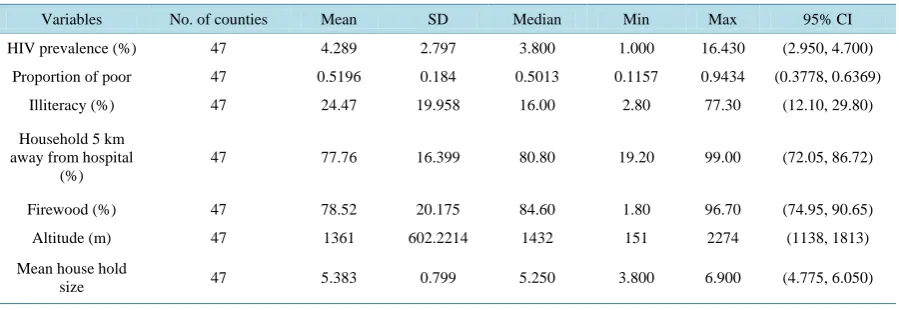
The data used in this study is routine data from Kenya Demographic and Health Surveys (DHS). The data contain records of Kenya’s population size, tuberculosis cases, and some suspected determinants of tuberculosis for each period from 2002-2009 and for each 67 districts. To study the risk of TB infection in each county, the data from the 67 districts were aggregated to provide county level summaries. Some of the determinants of TB that were recorded are: HIV prevalence, poverty prevalence, illiteracy, population less then 5 km to health facility, firewood, altitude and mean house hold size. Summary Statistics for these determinants of TB are shown in Table 1.
3. Bayesian Modeling Framework
Bayesian methods define the posterior distribution which is the distribution of the parameter(s) given the observed data. This implies that we require a likelihood function for the observed data and a prior distribution for the unknown parameters. Let y ii, =1,,n be a random variable with probability density function
(
i|)
P y ϑ , where ϑ =
(
ϑ1,,ϑp)
is a vector of relative risk parameters. The likelihood function of yi isdefined as
(
)
(
)
1
| | .
n
i i
P P y
=
=
∏
y ϑ ϑ (1)
Equation (1) is based on the assumption that the sample values of y=
(
y1,,yn)
′ given the parameters ϑ are independent [9]. Once the data model (likelihood function) is chosen, a Bayesian analysis requires the assertion of a prior distribution for the unknown model parameters. The prior distribution can be viewed as representing the current state of knowledge, or current description of uncertainty, about the model parameters prior to data being observed. A prior distribution is a distribution assigned to the parameter ϑ before the datai
y are observed [9]. All parameters within the Bayesian models are stochastic and assigned appropriate prior distribution [9]. Given a single parameter, ϑ, the the prior distribution is denoted as P
( )
ϑ , while for a parameter vector, ϑ, the joint prior distribution is denoted as P( )
ϑ .The posterior distribution is a probability distribution of the parameters given the data. The posterior distribution which is proportional to the product of the likelihood function and the prior distribution is defined as
(
)
(
(
|) ( )
) ( )
| ,
| d
p
P P
P
L P
=
∫
y y
y ϑ
ϑ ϑ ϑ
ϑ ϑ (2)
where
(
|) ( )
d pL P
∫
y ϑ ϑ ϑ is called the normalizing constant. It have been shown that posterior distribution of the parameters (2) can be written as(
|)
(
|) ( )
, [image:3.595.89.539.570.725.2]P ϑ y ∝P y ϑ P ϑ (3)
Table 1. Summary statistics for TB determinants.
Variables No. of counties Mean SD Median Min Max 95% CI
HIV prevalence (%) 47 4.289 2.797 3.800 1.000 16.430 (2.950, 4.700)
Proportion of poor 47 0.5196 0.184 0.5013 0.1157 0.9434 (0.3778, 0.6369)
Illiteracy (%) 47 24.47 19.958 16.00 2.80 77.30 (12.10, 29.80)
Household 5 km away from hospital
(%)
47 77.76 16.399 80.80 19.20 99.00 (72.05, 86.72)
Firewood (%) 47 78.52 20.175 84.60 1.80 96.70 (74.95, 90.65)
Altitude (m) 47 1361 602.2214 1432 151 2274 (1138, 1813)
Mean house hold
from which parameter estimates are drawn using Markov Chain Monte Carlo (MCMC) vis Gibbs sampling [16]. True parameter estimates are obtained when the the Markov chain converges. Convergence diagnostics for each parameter estimate under each implementation is shown.
4. Cluster Detection
This section discusses methods used in disease mapping to detect elevated risk. One such methods is the use of the posterior P
(
ϑ|y)
measures in posterior distribution (3). Another approach for risk detection is the use of the exceedence probability which relies on the posterior P(
ϑ|y)
measures for cluster detection [9]. The most commonly criteria for cluster detection method is the exceedence probability in relation with the relative estimates for individual areas or counties [17]. The exceedence probability is defined as the probability that the relative risk ϑ exceeds some threshold level , defined by P(
ϑ >)
. Exceedence probability is computed from the posterior sample values{ }
ϑig{
g=1, 2,,G}
through(
)
(
)
1 1
ˆ G g
i i
g
P I
G =
> =
∑
>ϑ ϑ , where
(
)
1 if0 Otherwise. g
g i
i
I > = >
ϑ
ϑ (4)
In evaluating P
(
ϑi>)
, and the threshold probability must be chosen such that P(
ϑi >)
>k. Byconvention, k can take the values of 0.95, 0.975, 0.99, etc. [18]. According to [9], exceedence probability is only capable of detecting hot spot cluster and does not consider any other information concerning possible forms of cluster or even neighborhood information. [9] defined Hot spot as any area displaying “excess” or “unusual” risk. According [9], Hossain and Lawson have made some attempts to enhance the exceedence probability by inclusion of neighborhoods. They stated that, for the neighborhood of the ith area defined as ai and the
number of neighbors as ni, then
(
)
(
)
(
)
* * * * 0 * 0 where and 1 i n ij ji ij j i i i
i A
A A P j a A P
n
=
= = > ∀ ∈ = >
+
∑
ϑ ϑ (5)
These measures can be used to detect different forms of clustering [9]. However, the usefulness of the execeedence probability depends on the model that has been fitted to the data and that any poorly fitting model will not demonstrate exceedence relate to clustering [9].
5. Bayesian Hierarchical Non-Spatial Models for Disease Mapping
This section presents two non-spatial models used in disease modeling and mapping. These are the Poisson- Gamma (PG) and the Poisson Log-Normal (LN) models. These models are often used to model small area count data and are appropriate when there is relatively low count of disease and the target population is relatively large in each small area. We present the PG model first followed by the LN model.
5.1. The Poisson-Gamma Model (PG)
The Poisson-Gamma model for relative risk estimation uses a gamma prior distribution for the relative risk combines with the Poisson likelihood function for the disease counts which gives a gamma posterior distribution for the relative risk. The Poisson-Gamma model is widely used in disease mapping to account for extra variability in the data through the prior distribution [18].
5.2. Model Description
Suppose that the unknown risk of TB in region i is given as ϑi,i=1, 2,,n. Let yi and Ni denote the
number of TB cases and the population at risk respectively in region i. The expected number of TB cases in
region i can then be written as Ei =rNi, where
1 1 n i i n i i y r N = = =
∑
Under the frequentist paradigm, we assume that yi ~Poisson E
(
iϑi)
. Based on the sample y={
y1,,yn}
, the likelihood function and the corresponding log-likelihood function are expressed as( )
(
)(
)
(
)
1 exp , | ! i y ni i i i i i i E E P y ϑ ϑ ϑ = − =
∏
= y E ϑ (6)
and
( )
(
)
1 1 1
ln ln !
n
n n
i i i i i i i
i i i
E y E y
ϑ ϑ ϑ
= = =
= −
∑
+∑
−∏
(7)
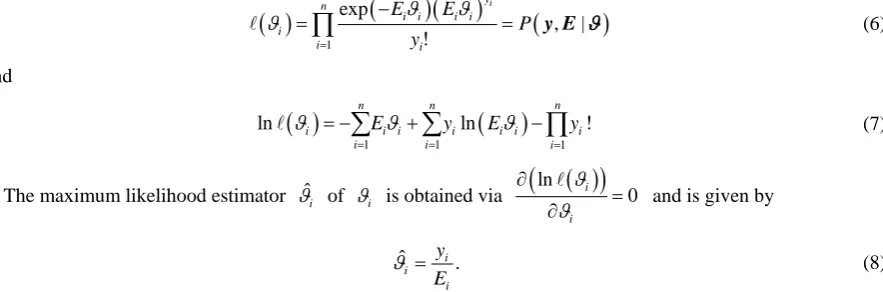
The maximum likelihood estimator ϑˆi of ϑi is obtained via
( )
(
ln)
0 i i ϑ ϑ ∂ = ∂ and is given by
ˆ i.
i i y E
ϑ = (8)
This estimator, ϑˆi is referred to as the standardized mortality ratio in region i. Under the Bayesian paradigm,
assume that yi~ Poisson
(
Eiϑ)
, where µ is µi =Eiϑ is the Poisson mean and ϑ~ Gamma( )
a b, has agamma distribution with shape and scale parameters a and b respectively. The likelihood function for yi is
denoted by
( )
( )
(
)
(
)
1 exp , | . ! i y N i i i i E E P y ϑ ϑ ϑ ϑ = − =∏
= y E (9)
and prior distribution for
ϑ
is denoted by(
| ,) ( )
( )
1 exp(
)
, , , 0. aa
P a b b a b
a b
ϑ
ϑ ϑ ϑ
−
= − >
Γ (10)
5.3. Parameter Estimation
We used Bayesian hierarchical methods for parameters estimation in the Poisson-Gamma model. That is, if in addition, a and b are given prior distributions such that a|ω~P a
(
|ω)
and b|φ~P b(
|φ)
, where P a(
|ω)
and P b(
|φ)
are the hyperprior distribution with hyper-parameters ω and(
φ φ ∈φa, b)
for a and b re- spectively, then we can obtain parameters using Bayesian hierarchical methods. This is a second stage hierarchical modeling using the Poisson-Gamma model.In this paper, we defined P a
(
|ω)
=ωexp(
−ωa)
(as exponential distribution) and P b(
|φ φa, b)
as a gamma distribution. Therefore, the posterior distribution is given by(
, , ,| ,)
(
, | , , ,) ( ) (
|) (
|)
.P ϑ a b y E ∝P y E ϑ a b P ϑ P a ω P b φ (11) Parameters estimation of the Poisson-Gamma model was carried out using MCMC via Gibbs Sampling. Convergence of the Chain occurs at 40,000 iterations after a burnin period of 1000 sample and thinning of every 30th element of the sample. Figure 1 presents the MCMC convergence diagnostics plots.
5.4. Markov Chain Monte Carlo Diagnosis
Figure 1 presents Gelman and Rubin convergence diagnostics of the Poisson-Gamma model: Column-wise from the top left, Figures 1(a)-(j) are trace plots for a, b, the mean and variance respectively. Figures 1(b)-(k) are posterior marginal density plots for b, a, the mean and the variance respectively. Figures 1(c)-(l) are auto- correlation plots for b, a, the mean and the variance respectively. The Gelman and Rubin trace plots show the convergence of the two parallel chains (Chains with different initial values). “Vanishing” autocorrelation function (ACF) plots show that there is low correlation among parameters that constitute the chain. More satis- factory kernel density plots for parameters of interest would more bell-shaped or symmetric. The density plots for the parameters show that convergence of the chain has reached.
[image:5.595.95.537.118.264.2]Figure 1. Poisson-gamma model: convergence diagnosis of Markov Chain Monte Carlo.
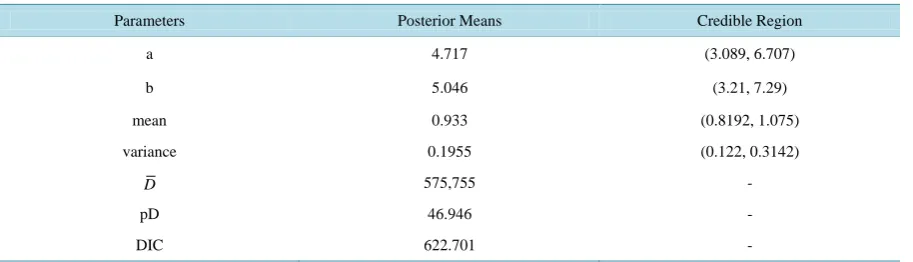
Table 2. Posterior statistics of the poisson-gamma model.
Parameters Posterior Means Credible Region
a 4.717 (3.089, 6.707)
b 5.046 (3.21, 7.29)
mean 0.933 (0.8192, 1.075)
variance 0.1955 (0.122, 0.3142)
D 575,755 -
pD 46.946 -
DIC 622.701 -
the posterior relative risk is 0.93 (95% credible interval = 0.82 - 1.08). The posterior mean is approximately the same as the mean of the standardized mortality ratio 0.93 (95% credible interval = 0.62 - 1.05) (Equation (8)). The standard deviation of the relative risk, 0.42 (95% credible interval = 0.35 - 0.56), is lower than the standardized mortality ratio's standard deviation 0.49 (95% credible interval = 0.62 - 1.05). Thus their standard deviation has been reduced by 82% by the Poisson-Gamma model. The significance of the variance indicates variation in risk among counties. In a situation of rare cases, standard deviation of the Poisson-Gamma model is expected to be much lower than that of the standardized mortality ratio [18].
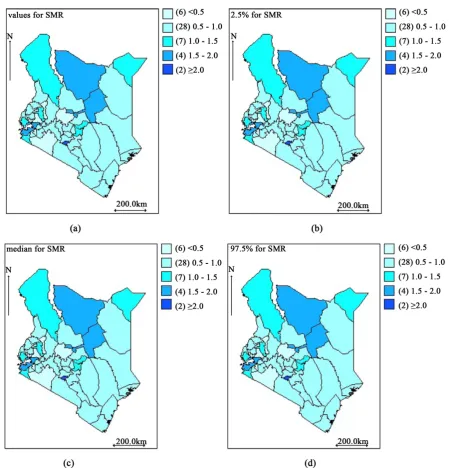
Figure 2. Kenya county level standardized mortality ratio’s maps: (a) The mean of the SMR and its 2.5% quantile (b),
median (c) and 97.5% quantile (d).
SMRs vary around their mean, 0.93 with standard deviation, 0.49 (as discussed in Table 2). There is some suggestion of high TB prevalence in the North, West, North-West and Central counties of Kenya and low TB prevalence in the South-East counties except Mombasa (SMR > 2.0).
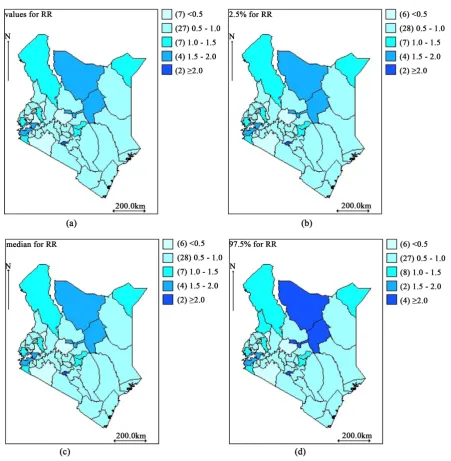
From Figure 3, we observed high risk of TB prevalence in the North, West, North-West and Central counties of Kenya and low risk in the South-East counties except Mombasa. Nairobi and Mombasa have the highest relative risk (RR > 2.0) and Laikipia, Nandi, Narok, Nyamira, and Vihiga have the lowest risk (RR < 0.5). The mean of the posterior relative risk and the SMR are the same. The range of the posterior relative risk of the Poisson-Gamma remains the same as the SMR, each having lowest relative risk estimated at 0.40 and the highest risk at 2.38. Variability in risk remains the same due to abundant of information or data.
[image:7.595.87.539.80.552.2]Figure 3. Kenya county level poisson-gamma posterior mean relative risk maps: (a) The mean of the posterior relative risk
and its 2.5% quantile (b), median (c) and 97.5% quantile (d).
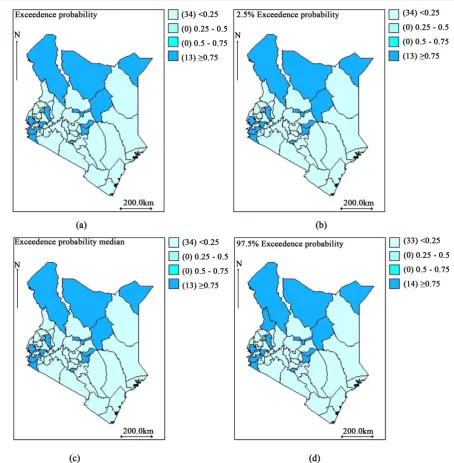
Gishu, Isiolo, Marsabit, Siaya, Tharaka-Nithi, Mandera, and Embu. This map confirms with Figure 3 concern- ing high and low TB prevalence areas.
Despite the fact that assigning a gamma prior distribution for ϑi is mathematically convenient, it is likely to
be restrictive since covariate adjustment is difficult and there is no possibility for allowing spatial correlation between risk in nearby areas [18]. We therefore present models that nullify theses limitations in the next sections.
5.4.1. Poisson-Log-Normal Model
Figure 4. Poisson-Gamma posterior relative risk exceedence probability map: Row-wise from the top left figure: (a) the posterior mean relative risk exceedence probability and (b) its 3 2.5% quantile for relative risk, (c) median for the relative
risk and (d) 97.5% quantile for the relative risk.
heterogeneity in relative risks of TB among counties. The LN mode with the random effect is often refer to as the unstructured heterogeneity (UH) model.
5.4.2 Model Description
Let yi and Ei be the observed number and the expected number of disease counts in region i i, =1, 2,,n
respectively. Further let ϑi be the relative risk of disease in region i. We first consider a situation of a
Poisson LN model with no area-specific random effect ui and covariate. As stated in the previous section,
( )
(
)
~ Poisson exp
i i i
y E η , where ϑi=exp
( )
ηi is the exponential of the linear link function and( )
expi Ei i
µ = η is the Poisson mean. Fitting a generalized linear model with a log-link function, we have
( )
( )
log µi =log Ei +ηi. By Bayesian paradigm, we assumed that
(
)
2
~ ,
i N
[image:9.595.78.533.78.542.2](
6)
~N 0,1 10
µ × −
and 2
(
)
~ Gamma 0.5, 0.05
τ . Parameter estimation was carried out using Bayesin Markov Chain Monte Carlo via Gibbs Sampling. Convergence of the MCMC was reached at 11,000 iteration after a burnin period of 10,000 sample and thinning of every 30th element of the chain. Convergence diagnosis plots are presented in Figure 5 and posterior statistics of parameters are presented in Table 3.
We now consider a Poisson LN model with area-specific random effect or uncorrelated heterogeneity (UH) effect ui and c covariate(s) for region i denoted by Xic. Let X represents the covariates matrix. The
Poisson LN non-spatial model is given by
( )
(
)
| , , ~ Poisson exp , ind
i i ic i i i
y E X η E η (12) where 0
1 P
i p ic i
p
X u
η β β
=
= +
∑
+ is the linear link function, ui are the residual random effects that capture theresidual unexplained log relative risk in region i and 2 u
τ is the precision variance. This implies that
( )
01
log .
P
i i p ic i
p
X u
ϑ η β β
=
= = +
∑
+ (13) [image:10.595.91.532.298.558.2]From Equation (13), we can write the relative risk as
Figure 5. Poisson log-normal model: convergence diagnosis of Markov Chain Monte Carlo.
Table 3. Posterior statistics of Poisson log-normal model without covariate and random effect.
Parameters Posterior Means Credible Region
µ −0.17 (−0.3093, −0.04605)
2
τ 5.012 (3.182, 7.235)
σ 0.4558 (0.3719, 0.5608)
D 575,821 -
pD 47.013 -
[image:10.595.86.537.600.723.2]0 1
exp ,
P
i p ic
p X
ϑ β β
=
= +
∑
(14)where ϑi are the relative risk of region i, β =
(
β0,,β ′p)
are regression parameters and β0 is the interceptor the overall risk effect. Here, the mean µi of the Poisson distribution is
( )
01
exp exp
P
i i i i p ic
p
E E X
µ η β β
=
= = +
∑
. Fitting a generalized linear model with a log-link function, we have( )
( )
01
log log .
P
i i p ic
p
E X
µ β β
=
= + +
∑
(15)5.4.3. Parameter Estimation
Since yi ~ Poisson
(
Eiexp( )
ηi)
, the likelihood function of yi is defined by(
)
(
( )
)
(
( )
)
(
)
1
exp exp exp
, , , | , , , 1, 2, , .
! i y n
i i i i
i i
E E
P i n
y
η η
=
−
=
∏
= = ϑ β u y E β ϑ u (16)
We would need the prior distributions for β and u to obtain the posterior distribution for the parameters of interest. It is assumed that u~N
(
0,σ2)
with mean zero and variance σ2. We assume a conjugate prior of the Gaussian distribution for the parameter β defined as( )
1 1exp 2
p ∝ − ′ β−
Σ
β β β (17)
We now show that the posterior distribution of β has the Gaussian distribution Section 5.2.
5.5. The Likelihood Function of a Regression with Gaussian Random Effect
Consider a response random variable y~N
(
0,Σ)
, where Σ is the variance-covariance matrix. The linearregression function of yi on Xic is defined by 0 1 P
i p ic i
p
y β β X u
=
= +
∑
+ . Therefore, the Gaussian process ofregression density or likelihood function for yi is given by
(
)
( )
(
)
(
)
( )
1 1 2 2 1 1| , exp 0, ,
2 2π N
p = − − ′Σ− − =N
y X y X y X Σ
Σ
β β β (18)
where X is a design matrix of the covariates. Just to simplify analytic calculation, we can alternatively write the Gaussian linear model Equation (18) as
(
)
( )
1 2(
) (
)
2
1 1
| exp ,
2 2π N
P = − − ′ −
y z M z M
Σ
β β β (19)
where 2i i
i y z
σ
= , ci2 ci
i X M
σ
= , and 2 i
σ are the diagonal covariance matrix
{
2 2 2}
1, 2, , nσ σ σ
=
Σ with the
standard model: y=Xβ. Consider a general likelihood function,
( )
β and let us take a second order Taylor expansion of the log-likelihood ln( )
β around its maximum, then we have( )
(
)
( ) (
)
2( ) (
)
22
ln 1 ln
ln ln ,
2
ML ML
ML ML ML
∂ ∂ = + − + − ∂ ∂ β β β β
β β β β β β
β β (20)
where βML is the maximum likelihood estimator of β . Letting
( )
1 22 1 = 2π N Ω Σ
uation (19), we have
(
)
1(
)
ln | ln 2
2
P y β = Ω − z z′ − z M′ β β+ ′ ′M Mβ (21) Finding the derivative of Equation (21), it follows that
(
)
ln | 0 P ∂ ′ ′ ′ = − = ∂ yz M M M
β
β
β (22)
Solving Equation (22), we have
(
)
1. ML
−
′ ′ = M M M z
β (23) Now finding the second derivative of Equation (25), we have:
(
)
(
)
2 2 ln | . P H ′ ′ ∂ ∂ ′ = − = − = ∂ ∂y M M
M M
β β β
β (24)
Hence, we can rewrite Equation (22) as
(
)
1 1. ML
− −
′ ′ ′
= M M M z=H M z
β (25)
From the Taylor’s expansion in Equation (20), and by the Maximum Likelihood Principle (MLP) that
(
)
ln(
|)
0, ML ML P ∂ − = ∂ y β β β β β
it follows that
(
)
(
)
1(
) (
)
ln | ln |
2 ML ML ML
P y = P y M − − ′H −
β
β β β β β β (26)
Taking exponent on both side of Equation (26), we have
(
)
(
)
1(
) (
)
| | exp
2
ML ML ML
P =P − − ′ −
y β y β β β H β β (27)
or
(
)
1(
) (
)
| exp ,
2
ML ML ML
P = − ′ −
y β β β H β β (28)
where
( )
1 2(
) (
)
2
1 1
exp .
2 2π
ML N ML ML
′
= − − −
z M z M
Σ
β β (29)
5.6. Posterior Function of Gaussian Process Regression
Assuming that the prior distribution of β is
( )
1 1exp .
2
p ∝ − ′ β−
Σ
β β β (30)
Then writing only the terms from the likelihood and prior which depend on the weights, and “completing the squares” for Multiple parameters model, the posterior function is defined as
(
)
1(
)
1(
)
1 1| , exp exp
2 2
P ∝ − − ′ ′ − − ′ − ′ β−
X y y X Σ y X Σ Σ
β β β β (31)
Simplifying Equation (31), it follows that
(
)
1(
(
)
)
| , exp 2 ,
2
P ∝ − ′ν − ′ ′ν + ′ ′ν +κ
X y y y X y X X I
where ν= Σ−1 and 1 p
κ= Σ−
are the covariance of the likelihood function and the prior function respectively. The Equation (32) above is indeed Gaussian with the constant term y y′ . In “completing the squares”, we are given a quadratic form defining the exponent terms in a Gaussian distribution, and we need to determine the corresponding mean and covariance. To avoid computational complexity with “completing of squares”, we sort to using “kernel’s trick” TB324. The exponent of a general Gaussian distribution defined as
(
y−µ) (
′Λ y−µ)
, where Λ is the precision matrix can be expressed as(
y−µ) (
tΛ y−µ)
=[
y′Λy−2y′Λμ+ Λ =µ µ′]
y′Λy−2y′Λµ+constant. (33) Comparing Equation (32) with Equation (33), we have1 ,
ν κ µ ν −
′ ′
= X X+ I = X y
Λ Λ (34)
That is
(
)
(
1)
| , ~ | ,
P β y X N β µ Λ− . Note that Λ−1 must be invertible, that is Λ ≠0. The maximiser of the likelihood is the mean µ which is again the mode of the likelihood. Therefore, the Maximum Posterior (MAP) is given by
(
)
1 1(
1 1)
1MAP=ν νX X′ +κI − X y′ = Σ− Σ− X X′ + Σ−β I − X y′. (35) In fact the MAP is similar to the maximum likelihood value ML
(
)
1−
′ ′ = M M M z
β . Therefore, the posterior mean and Covariance are respectively defined by
(
)
1(
)
11 1 1 1 1 1
ˆ and
β β
− −
− − ′ − ′ − − ′ −
= Σ Σ X X+ Σ I X y Λ = Σ X X+ Σ I
β (36)
It follows that the posterior distribution for β is also Gaussian defined by
(
)
1(
ˆ) (
1 ˆ)
| , exp .
2
P ∝ − − ′ − −
y X Λ
β β β β β (37)
Therefore, the prior distribution of β is assumed to be normally distributed as
( )
2 220
1 1 1
exp 2π 2 P P P p p P β β β τ = τ
= −
∑
β (38)
and the prior distribution for the area-specific random effect defined by
( )
2 221
1 1
exp .
2π 2
n n n i i u u u P
τ = τ
= −
∑
u (39)
Therefore, the posterior distribution is defined as
(
2 2)
(
) ( ) ( )
, , , u | , , , | , ,
P β uτ τβ y E ϑ ∝P y E ϑ β u P β P u (40) Hence,
(
2 2)
(
( )
)
(
( )
)
1
1 2
2 2 2 2
2 2 2
0 1
exp exp exp
, , , | , ,
!
1 1 1
exp exp .
2π 2 2π 2
i y n
i i i i
u
i i
P
P P n
p u i
p i u
E E P y u β β β η η
τ τ ϑ
β τ
τ τ τ
= = = − = × − × −
∏
∑
∑
u y E
β
(41)
The prior distribution for the linear regression coefficients is given by
( )
2~N 0,τβ
β . The corresponding conjugate prior distribution for 2
β
τ is the inverse-gamma [16][19] defined as
(
)
( )
( )
( 1)2 2 2
2
| , exp , , , 0.
P
ω ω
β β β
β
φ φ
τ ω φ τ τ ω φ
ω τ
− +
= − >
Γ (42)
The Equation (42) is the hyperprior distribution for 2
β
τ with hyper-parameters
(
ω φ,)
. We defined(
)
2
~ Gamma 0.05, 0.005
β
τ and modeled the random effect ~
( )
0, 2i u
precision parameter 2~ Gamma 0.05, 0.005
(
)
uτ .
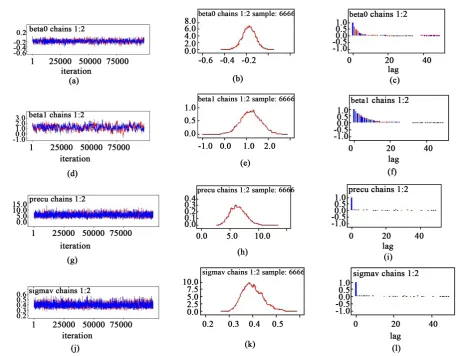
[image:14.595.100.527.250.697.2]We first consider the LN without covariates. Parameter estimation was carried out using Bayesian Markov Chain Monte Carlo via Gibbs Sampling. MCMC convergence was reached at 100,000 iterations after a burnin period of 10,000 sample and thinning of every 30th element in the sample. Figure 5 presents convergence diagnostics plots of this model. Table 3 presents the Posterior statistics of the LN model.
Table 3, revealed that the overall mean of the posterior relative risk is −0.17 (95% credible interval = (−0.31, −0.046). This indicates that the overall TB risk effect in Kenya estimated by the Poisson Log-Normal model decreases keeping all other determinants of TB constants. The standard deviation of the relative risk is 0.46 (95% credible interval = 0.37 - 0.56) with precision variation τ2= 5.01 (95% credible interval = 3.18 - 7.24) indicating significance of variability of TB risk among counties. In a situation of rare TB cases, standard deviation of the Log-Normal model is expected to be much lower than that of the standardized mortality ratio 0.49 [18].
Figure 6, revealed that TB risk is expected to be high in the North,West, North-West and central counties of
Figure 6. Kenya County level TB prevalence counts: Poisson log-normal model without covariate and random effect.
Kenya and low risk in the South-West counties. According to this model, Nairobi and Mombasa are expected to have the highest TB risk (RR > 2.0) and Nandi, Narok, Nyamira, Vihiga, and laikipia are expected to have the lowest TB risk (RR < 0.5). Counties with relative risk above the national risk (RR = 1) are apparent from Figure 7. Again, due to abundant of data or information, the range of the posterior relative risk of the Poisson Log- Normal remains the same to that of the SMR. The lowest estimated risk is 0.40 and highest estimated risk is 2.38. There is no reduction of relative risk range compare to SMR's risk as would be expected in a case of rare information or data.
[image:15.595.97.529.236.697.2]The exceedence probability map Figure 7 confirmed with the Poisson-Gamma model that 13 counties have their TB risk above the national risk. These counties are: Nairobi, Mombasa, Kisumu, Turkan, Migori, Homa bay, Uasin Gishu, Isiolo, Marsabit, Siaya, Tharaka-Nithi, Mandera, and Embu. Figure 7 confirms with Figure 6 that high risk of TB prevalence is observed in the North, West, North-West and central counties and low risk in the South-East counties except Mombasa.
Figure 7. Kenya County level TB prevalence counts: poisson log-normal model without covariate and random effect.
We now present the results of the Poisson log-normal model with with UH and covariates effects. Figure 8 presents the Rubin and Gelman convergence diagnostics plots of this mode. Table 4 revealed that the overall level of relative risk effect estimated is β0 = −0.18 (95% credible interval = (−0.30, −0.06)). The overall risk effect is
significantly different from zero and negative. This indicates that overall TB risk effect would be decreasing keeping all other determinants of TB constants. Among the cova- riates considered as TB determinants, only HIV parameters is significantly different from zero 1.20 (95% credible interval = 0.50 - 2.60) but positive. This indicates that TB risk increases with increasing HIV prevalence. [18] noted that, the higher the τu2, the higher the variability of TB risk among counties and and the lower it is the lower the variability. This means that, a very small τu2 will indicate possibility of risk similarity between neighbouring counties. The precision for the UH 2
5.32 u
τ = (95% credible interval = 3.35 - 7.76) is significant, indicating that there exist variation in risk among counties. The UH revealed high variability of relative risk compare to the Poisson Log-Normal without random and covariate effects τ2=5.01
(95% cre- dible interval = 3.18 - 7.24).
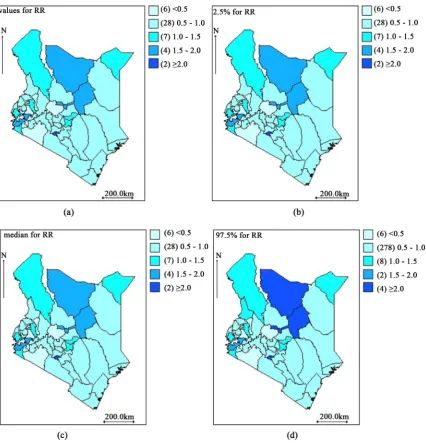
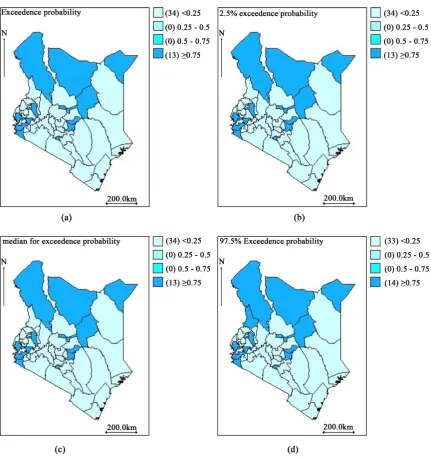
Figure 9 also confirmed that out of the 47 counties in Kenya, 13 exhibit TB relative risk higher than the national risk (RR = 1). Table 5 presents counties in groups according to their relative risk level. High TB risk can again be observed that in the North, West, North-West and central counties of Kenya and low TB risk in the South-East counties except Mombasa.
Table 5 presents the results of the UH model with counties categorised according to their range of relative risk. The results showed that 14 counties have their relative risk above 1 and the lowest risk counties are 5. The exceedence probability map in Figure 10 visually presents counties with risk above 1. Figure 10 shows 14 counties having elevated risk of TB. These maps again confirmed high TB risk in the North, West, North-West and central counties of Kenya and low risk in South-East counties of Kenya except Mombasa.
Figure 11 is the maps of the area-specific random effect
( )
ui , which shows variation of risk among countiesin Kenya. This map captures and displays true TB excess risk surface after covariates and confounding factors are considered TB21. Excess risk of TB is observed in Marsbit, Embu, Migori and Kisumu.
Table 4. Posterior statistics of the poisson log-normal model with UH effect.
Model indicators UH
0
β −0.1765 (−0.2957, −0.05936)
HIV 1.198 (0.4928, 2.571)
Firewood 0.2735 (−2.215, 2.144)
five kilometer distance −1.317 (−3.423, 1.437)
u
σ 0.4409 (0.359, 0.5466 )
2
u
τ 5.324 (3.347, 7.757)
D 575,779
pD 46.973
DIC 622.753
Table 5. UH results indicating counties with high and low TB risk.
RR > 2.0 RR: 1.5 - 2.0 RR: 1.0 - 1.5 RR < 0.5
Nairobi, 2.159 (2.145, 2.174) Homa bay ,1.721 (1.702, 1.74) Embu, 1.199 (1.18, 1.219) Lakaipia, 0.458 (0.4449, 0.4714)
Mombasa, 2.383 (2.36, 2.407) Isiolo, 1.957 (1.906, 2.01) Mandera, 1.044 (1.02, 1.067) Nandi, 0.4033 (0.3941, 0.4127)
- Kisumu, 1.975 (1.955, 1.995) Migori, 1.374 (1.357, 1.392) Narok, 0.482 (0.4715, 0.4928)
- Marsabit, 1.969 (1.93, 2.008) Siaya, 1.401 (1.384, 1.419) Nyamira (Kisii North),
0.4533 (0.4422, 0.4646)
- - Tharaka-Nithi,
1.064 (1.042, 1.086) Vihiga, 0.469 (0.4581, 0.4801)
- - Turkan, 1.068 (1.051, 1.086) -
- - Uasin Gishu,
Figure 8. Poisson log-normal model with UH and covariates effects: convergence diagnostics of Markov Chain Monte
Carlo.
5.7. Summary of the Non-Spatial Models
Though the Poisson-Gamma model provides good information about the TB prevalence in Kenya, one of its shortcomings is that it is unable to handle problem of spatial correlation and incorporation of covariates [18]. The Poisson Log-Normal model provides specifications that allow for incorporation of covariates. The Poisson Log-Normal model also enable us to capture the area random effect and to explain the extend of risk variability among counties through the unstructured random effect term ui.
Though thinning reduces the speed of the MC but it significantly reduces the number of iterations and solves the issue of autocorrelation among parameters that form the chain. Thinning reduces storage demand while preserving the integrity of the MC process [19]. [19] noted that the value of every kth
element to be sampled is determined by the researcher and out most care must be taken since extremely large k value may results in lost of potentially an important information.
The slower the chain to converge, the more careful one should be about the burn-in period. However, it should be noted that there is no standard, systematic or guaranteed way of determining the length of the burn-in period [19]. Nevertheless, considerable work on convergence diagnostics has been done to make specific recommendations and identify tests [19].
Figure 9. Kenya county level TB prevalence counts: UH smooth relative risk map (a) and its 2.5% quantile (b), median (c) and 97.5% quantile (d).
6. Bayesian Hierarchical Spatial Model for Disease Mapping
Figure 10. Kenya county level TB prevalence counts: UH smooth relative risk exceedence probability map (a) and its 2.5%
quantile (b), median (c) and 97.5% quantile (d).
6.1. Conditional Autoregressive (CAR) Model
Though conditional autoregressive models where introduced decades ago by [11], they were not widely used until the 1990s. Since they are defined conditionally, they are particularly suited for use with the Gibbs sampler [21]. The Conditional Autoregressive (CAR) models have been used extensively to identify and detect clustering in diseases risk. In these models, risks of disease at any given area is affected by the risk in the neighbouring areas. These models have been referred to as the structured model or the Correlated Heterogeneity (CH) models. That is, estimation of risk in any given area depends on risk at neighbouring areas [18]. The distances or boundaries between the regions are often used in determine neighbourhood properties within CAR models [22].
Figure 11. Area-specific random effect: the posterior map (a) and its 2.5% quantile (b), median (c) and 97.5% quantile (d).
area to be studied. Let Ni =
{
j∈S i: ∈j}
denote the set of all regions that are neighbouring region i. Let, i
v i∈S be a random variable. We define the corresponding random field v as the vector v=
(
v v1, 2,,vn)
′. In the Gaussian CAR model, we often assume that each observation of the outcome variable vi has aconditional distribution defined by
2
| ~ , .
i j i ij j i i j v v≠ N v τ
≠
Φ
∑
(43)These are full conditionals where Φij is the weight of each observation on the mean of vi and also denotes
neighbourhood set Ni of vi. The 2 i
τ is a potential unique variance for vi. For instance, if state i has M
neighbours and ij 1 M
Φ = for every state that is a neighbour, and Φ =ij 0 otherwise, then the conditional expectation of a state's observation is the mean of all neighbours observations [25]. The Gaussian processes are specified by their mean and covariance function [26]. Assuming that each conditional distribution is Gaussian, we will need the mean and the variance-covariance to define the CAR model. The mean and the variance- covariance are respectively defined as
(
)
2| and var | .
i
i j i i ij j i i j i
j N
E v v≠ µ v µ v v τ
∈
= + Φ − =
∑
(44)Therefore, conditional probability density function of a CAR random variable vi is has the form [25]
(
)
(
)
(
)
2
2 2
1
| exp ,
2π 2
i
i i ij j j
j N i j i
i i
v v
f v v S
µ ρ µ
τ τ
∈ ≠
− − Φ −
∈ = −
∑
(45)where , 2 , 1
i i
µ =∈τ ∈+ ρ <
, Φ ∈( )ij ,Φ( )ij = Φ( )ji , Φ( )ii =0. The conditional joint probability density function of all the observations is
(
)
( )
(
)
(
)
1(
)
1 2
2 1
1
| exp ,
2 2π
i j i n
f v v
det − ≠ − − − = − D D
v B v
B
Σ Σ
µ µ
(46)
where µ∈n×1
(
n-dimensional vector)
, µ=
(
µ µ1, 2,,µn)
′,n n×
∈
B invertible matrix defined as
(
)
( ) ( )1 if
with if ,
0 otherwise
i
ij ij
i j
B j N
ρ ρ
=
= − = − Φ ∈
B I Φ (47)
n n + ×
∈
D
Σ diagonal matrix; ΣD=diag
(
τ12,,τn2)
=τi2 such that ΣD is symmetric. It follows that the joint multivariate Gaussian distribution for vi with µ=0 has covariance matrix1 1
− −
= =
v
D DB B D
Σ Σ Σ which is symmetric such that Φ( )ijτ2j = Φ( )jiτi2, ,i j∈S. Thus, a conditional autoregressive model v in (45) has a pro- bability density function defined as
( )
(
)
2| ~ , ,
i
i j i i ij j j i
j N
v v≠ N µ ρ v µ τ i S
∈
+ Φ − ∈
∑
(48)and the joint probability density function in (46) becomes
(
1)
~N µ, − D .
v B Σ (49) The necessary and sufficient condition for (49) to be a valid joint probability density function is that its covariance matrix should not only be symmetric, but also positive definite (that is, its eigenvalues λi >0, ,i,n) TB223. For vi to be a Gaussian random variable, we need to show that ΣD is symmetric.
To show that ΣD is symmetric, we defined a symmetric weighted adjacency matrix W , where
( )
( )
( )( )
( ) ( )1 if
with , with : , ,
0 otherwise,
i
ij ij ij ji
j i
w w ϕ i j j N i j S w w
=
= = ∈ ∀ ∈ =
W (50)
region i and j. Also, if ϕ
( )
i j, =1, then j is one of the h nearest neighbours of i. Let WD be the diagonal of the adjacency matrix W . The adjacency matrix of normalization or standardization WD is defined as( ) ( ) ( )
(
1 2)
diag w+ ,w +, ,wn+ .
=
D
W (51)
Suppose
( ) ( ), , ,
i
i ij
j N
w + w i j S
∈
=
∑
∈ (52)then we define a matrix of interaction, Θ to be a normalized adjacency matrix defined as
( ) ( )
( ) ( ) ( )
1 2 2
with ij ij , where ij j ji i, , .
i w
i j S
w τ τ
−
+
=W WD Θ = Θ = Θ ∈
Θ (53)
Suppose again that the matrix WD corresponding to a constant diagonal matrix normalized as (53), then we have
α
( )
2
2 1 2 2
with i , , .
i i S w
τ
τ − τ τ +
+
= = ∈ ∈
D D
W W (54)
It follows that the conditional joint probability density function can be rewritten as
(
)
(
)
11 2
1
, , exp ,
2 n
P v v
τ
−
′
∝ − −
Ψ ΣDw W Σ ΨD (55)
where Ψ=
(
v−µ)
and B=(
ΣDw−W)
. Hence, the CAR model structure for vi is defined as2
| ~ ij , v ,
i j i j
j i i
w
v v N v
w w τ ≠ + +
∑
(56)and the Equation (49) can be alternatively defined as
(
)
12 1 ~ , . v τ − −
D
v µ W ρW (57)
The τv2 controls the overall variability of vi, while ρ represents the overall effect of spatial dependence.
The value of ρ is should be chosen appropriately [25].
The row stochasticity of ˆ 1 i diag w+ =
W W indicates that the distribution is improper. This impropriety can
be fixed by the parameter ρ. Redefining Σ−D1v =
(
ΣDw−ρW)
−1 and choose ρ such that1
−
v
D
Σ is non singular,
preferably with 1 1 1 , n ρ λ λ ∈
, where λ1<<λn are the ordered eigenvalues of
1 2 1 2
− −
w w
D W D
Σ Σ . Simplifying
the bounds, we replace W by Wˆ . It follows that
(
)
1 ρ ˆ .
− = −
v w
D D I W
Σ Σ (58)
If ρ <1, then ΣDw
(
I−ρWˆ)
is non singular. Non-singularity is guaranteed if1 1 ,1 ρ λ ∈
where λ1 is
the minimum eigenvalue of Σ−D1 2wWΣ−D1 2w . The bound mostly preferred is ρ ∈
( )
0,1 . This is a proper IntrinsicAutoregressive model which add parametric flexibility and ρ=0 is an indication of independence. ρ is the additional parameter which makes vi independent when it is equal to zero. An improper choice of ρ=1 may
6.2. Parameter Estimation
In this study, we estimate parameters in the CAR model using Bayesian hierarchical methods. In disease mapping, we assumed that disease counts
( )
(
)
( )
~ Poisson exp , where exp is the mean of Poisson distribution.
i i i i i i
y E η µ =E η (59)
The relative risk is defined as
( )
exp , where , and has a CAR structure.
i i i vi vi
ϑ = η η =X′β+ (60)
Fitting the generalized linear model with a log-link function, we have log
( )
µi =log( )
Ei +X′β +vi. Under the Bayesian method, given the likelihood function of ϑ defined as(
)
(
( )
)
(
( )
)
(
)
1
exp exp exp
, , , | , ,
! i y n
i i i i
i i E E P y η η = − =
∏
= β v y Eϑ β υ (61)
the prior distribution for β is
( )
2 220
1 1 1
exp 2π 2 P P P p p P β β β τ = τ
= −
∑
β (62)
and the prior distribution for the CAR random effect is defined by
( )
2 2( )
2| , ~ ij , v ~ 0, .
i j i v j v
j i ij ij
w
P v v N v CAR
w w τ τ τ ≠ ≠ =
∑
v (63)
The posterior distribution is defined as
(
2 2) (
2 2)
( ) ( )
, , , v | , , , , | , , , v .
P β vτ τβ y Eϑ ∝P X Eϑ β vτ τβ P β P v (64) Therefore,
(
2 2)
(
( )
)
(
( )
)
1
2 2 2
2 0
exp exp exp
, , , | , ,
!
1 1 1
exp , .
2π 2
i y n
i i i i
v
i i
P
P P
p ij v
j
p j i ij ij
E E P y w v w w β β β η η τ τ β τ τ τ = = ≠ − = × −
∏
∑
∑
v y E
β ϑ
(65)
The hyperperprior distribution for the precision parameters τv2 and 2
β
τ are 2~ Gamma 0.05, 0.005
(
)
vτ and
(
)
2 ~ Ggamma 0.5, 0.05
β
τ respectively. The linear regression coefficient distribution is defined by β ~N
( )
0,τβ2 . Parameter estimation was carried out using Bayesin Markov Chain Monte Carlo via Gibbs Sampling. Con- vergence of the MCMC was reached at 11,000 iteration after a burnin period of 10,000 sample and thinning of every 30th element of the chain. Convergence diagnosis plots are presented in Figure 12 and posterior statistics of parameters presented in Table 6. We compare these results with the [11] model results in Section 6.3.6.3. The Besag, York and Mollié (BYM) Model
Among the models proposed for performing risk smoothing which have appeared in literature, the [11] model has found most extensive application. The BMY model is divided into two components; the CAR model component vi, and the UH component, ui (discussed in Section 6.1 and Section 5.1.1 respectively). The
BYM model was introduced by [10] and latter developed by [11]. The BYM or convolution model is defines as
i ui vi
η = + +µ (66) As noted earlier, we assume
( )
(
)
( )
~ Poisson exp , where exp is the mean of the Poisson distribution.
i i i i i i
y E η µ =E η (67)
Figure 12. Poisson log-normal model with CAR model: convergence diagnosis of Markov Chain Monte Carlo.
Table 6. Posterior statistics of the CAR and BYM models.
Model indicators CAR BYM
0
β −0.1774 (−0.1805, −0.1743) −0.179 (−0.267, −0.0908)
HIV 1.812 (0.7735, 2.758) 1.41 (0.488, 2.34)
Firewood 0.2764 (−2.44, 2.822) −0.28 (−1.29, 0.793)
five kilometer distance −1.505 (−4.19, 1.18) −0.852 (−1.81, 0.124)
v
σ 0.8298 (0.6751, 1.03) 0.372 (0.156, 0.678)
2
v
τ 1.559 (0.9432, 2.194) 11.3 (2.18, 40.8)
u
σ - 0.298 (0.158, 0.416)
2
u
τ - 13.4 (5.79, 40)
D 578,018 50.969
pD 49.191 77,062
DIC 627.209 630.758
the i area is defined by
(
)
exp .
i ui vi