Open Journal of Applied Sciences, 2016, 6, 560-578
Published Online August 2016 in SciRes. http://www.scirp.org/journal/ojapps http://dx.doi.org/10.4236/ojapps.2016.68056
Stabilizing the Lorenz Flows Using a Closed
Loop Quotient Controller
James Braselton, Yan Wu
Department of Mathematical Sciences, Georgia Southern University, Statesboro, GA, USA
Received 13 June 2016; accepted 28 August 2016; published 31 August 2016
Copyright © 2016 by authors and Scientific Research Publishing Inc.
This work is licensed under the Creative Commons Attribution International License (CC BY).
http://creativecommons.org/licenses/by/4.0/
Abstract
In this study, we introduce a closed loop quotient controller into the three-dimensional Lorenz system. We then compute the equilibrium points and analyze their local stability. We use several examples to illustrate how cross-sections of the basins of attraction for the equilibrium points look for various parameter values. We then provided numerical evidence that with the controller, the controlled Lorenz system cannot exhibit chaos if the equilibrium points are locally stable.
Keywords
Lorenz Equations, Controller, Stability, Routh-Hurwitz Theorem, Chaos, Strange Attractor
1. Introduction
The Lorenz equations are given by
(
)
, x P y x
y R x xz y z xy bz
= −
= − −
= −
(1)
where =d dt, P>0, R>0, and b>0 are positive constants, called the Prandtl, Rayleigh, and Biot numbers, respectively.
J. Braselton, Y. Wu
In what follows, a physical interpretation of x, y, and z is important. We use Lorenz’s Lorenz derives system (1) in [1] from a simplified version of a partial differential equation formed by Saltzman [11]. For system (1), Lorenz states:
In these equations, x is proportional to the intensity of the convective motion, while y is proportional to the temperature difference between the ascending and descending currents, similar signs of x and y denoting that warm fluid is rising and cold fluid is descending. The variable z is proportional to the distortion of the vertical temperature profile from linearity, a positive value indicating that the strongest gradients occur near the boundaries.
The Prandtl number, P, is given by P=ν k, where k is the coefficient of thermal diffusivity and ν is the kinematic viscosity. The Rayleigh number determines whether heat is transferring primarily by conduction or convection and is given by
3 0
, g H T R
kν ∆ =
where g is the acceleration of gravity, is the coefficient of volume expansion, H is the height of fluid, and
0 T
∆ is a temperature contrast (refer to Saltzman [11] and Lorenz [1] for detailed explanations of the derivation of system (1) and meaning of the various parameters and variables). The Rayleigh number is the critical number governing the behavior of the Lorenz equations. Once R reaches a critical value, stable solutions of the system become unstable.
2. Review of Equilibrium Points of the Lorenz System and Local Stability Analysis
Solving(
)
00 0 P y x
Rx xz y xy bz
− =
− − =
− =
(2)
yields the rest points (equilibrium points)
(
)
(
(
)
(
)
)
0 0, 0, 0 and , 1 , 1 , 1 .
E = E+ −= ± b r− ± b r− r−
The Jacobian of system (1) is
0
1 .
P P
R z x
y x b
− = − − − −
J (3)
Evaluated at E0, the Jacobian
( )
00 1 0 0 0 P P E R b − = − −
J has eigenvalues λ = −1 b and
(
)
(
2)
2,3 1
1 1 4 2 .
2 P P P R
λ = − − ± + + −
For E0 to be unstable, we must have that
(
)
2
2 2
1 (4 2) 1
1 4 2 2 1
4 4
1.
P P R P
P P R P P
PR P
R
+ + − > +
+ + − > + +
> >
J. Braselton, Y. Wu
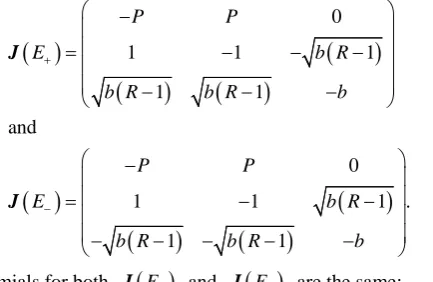
Evaluated at E+ and E−, respectively, the Jacobian is
( )
(
)
(
)
(
)
( )
(
)
(
)
(
)
0
1 1 1
1 1
and
0
1 1 1 .
1 1
P P
E b R
b R b R b
P P
E b R
b R b R b
+ − − = − − − − − − − = − − − − − − − J J (4)
The characteristic polynomials for both J
( )
E+ and J( )
E− are the same:(
)
(
)
(
)
3 2
1 2 1 0.
P b b P R bP R
λ + + + λ + + λ+ − = (5)
The calculations begin to illustrate the complexities of this system. The Lorenz system is often used to illustrate how a very “simple” system can lead to chaotic behavior. Equation (5) shows a dramatic difference between global and local behavior. With simple examples we can show that the stability of E+ −, is truly local (rather than global) and provide numerical evidence that the system does not have any limit cycles.
Because the coefficients of (5) are all nonnegative, the solutions of (5) will all have negative real part by the Routh-Hurwitz theorem if
(
) (
)
(
) (
)
(
)
(
)
3 1 0
3 1 0
1 3 .
bP b P b b p R
P b P b p R
b p R P b P
+ + + + − >
+ + + + − >
+ − > − + +
(6)
For our calculations, we will follow a typical convention and set P=10 and b=8 3. Then, (6) becomes
470 16 24.74
R< ≈ . Under these conditions E+ −, are locally stable. Thus, to induce chaotic behavior in the Lorenz system, it is common to choose R≥25 so that E+ −, are unstable.
2.1. Example: Stable
E+ −,(
R
=
20
)
Before addressing the unstable situation and incorporating a controller to eliminate chaos in system (1) when
25
R> , we begin with an example with an R value so that E+ −, are locally stable. For the example, we choose
20
R= . For this value of R, we have the rest points E0=
(
0, 0, 0)
and E+ −, = ±(
7.11805, 7.11805,19±)
. Theeigenvalues of the Jacobian of (1) evaluated at E0 are −20.3408, 9.34082, and −2.266667. Because of the positive eigenvalue, E0 is unstable. At E+ −, the eigenvalues of the Jacobian are −13.3571, and −0.154792±
8.70867i so E+ −, are locally stable.
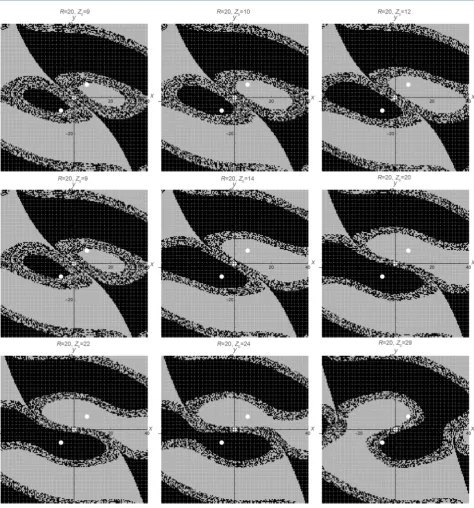
In Figure 1, we illustrate the basins of attraction for E+ −, . For the given value of z
( )
0 =z0, if( ) ( )
(
x 0 ,y 0)
=(
x0,y0)
is in the gray region, the solution satisfying the initial conditions( ) ( ) ( )
(
x 0 ,y 0 ,z 0)
=(
x y z0, 0, 0)
converges to E+. On the other hand, if(
x( ) ( )
0 ,y 0)
=(
x0,y0)
is in the black region, the solution satisfying the initial conditions(
x( ) ( ) ( )
0 ,y 0 ,z 0)
=(
x y z0, 0, 0)
converges to E−.Comment: All graphics and computations in this paper were done using Mathematica 10.0 [12]. If you would
like a copy of the code, send a request to Jim Braselton at [email protected].
Note the “speckled” regions in Figure 1, in these regions we see that system (1) is highly sensitive to initial conditions. For some initial conditions, the solutions converge to E+ but a slight change in the conditions can cause the solution to converge to E− and vice-versa.
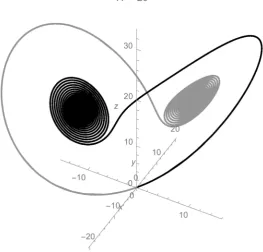
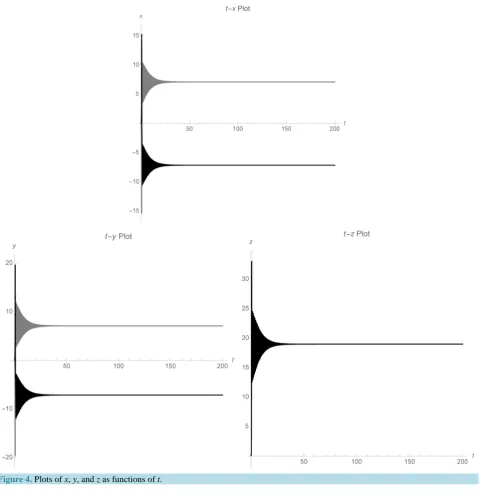
The complexity of how the initial conditions affect the convergence of the solution to E+ or E− is further illustrated in Figures 2-4. Because the z-coordinate of E+ and E− are equal, the plot of z as a function of t in
Figure 4 is the same regardless of whether the solution converges to E+ or E−.
2.2. Example: Stable
E+ −,(
R
=
24.4
) Coexist with a Strange Attractor
[image:3.595.120.531.98.271.2] [image:3.595.200.417.104.245.2]J. Braselton, Y. Wu
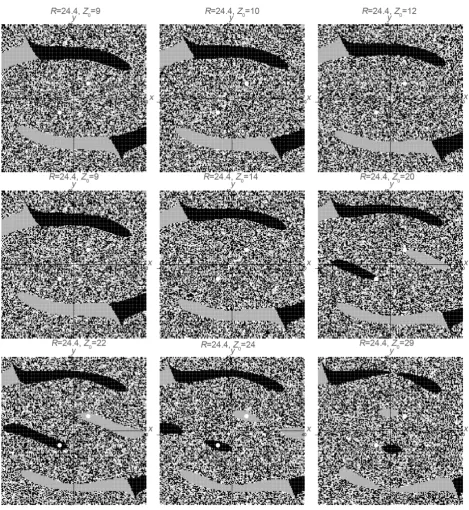
Figure 1. For z0 values approximately between 9 and 29, there is a region around each of E+ −, for which the solution satisfying
( ) ( ) ( )
(
x 0 ,y 0 ,z 0)
=(
x y z0, 0, 0)
converges to E+ −, .For the P=10 and r=8 3 values typically used when studying the Lorenz system, for 24.06< <R 24.74,
,
E+ − are stable and coexist with a single strange attractor [13]. To illustrate the interesting situation, we set
24.4
R= . For this value of R, we have the rest points E0=
(
0, 0, 0)
and E+ −, = ±(
7.89937, 7.89937, 23.4±)
.The eigenvalues of the Jacobian of (1) evaluated at E0 are −21.7558, 10.7558, and −2.266667. Because of the positive eigenvalue, E0 is unstable. At E+ −, the eigenvalues of the Jacobian are −13.6462, and −0.0102336±
9.56315i so E+ −, are locally stable.
J. Braselton, Y. Wu
Figure 2. In three dimensions, depending upon the initial conditions, the solution quickly converges to either the gray region and then to E+ or to
the black region and then E−.
( ) ( )
(
x 0 ,y 0)
=(
x0,y0)
is in the gray region, the solution satisfying the initial conditions( ) ( ) ( )
(
x 0 ,y 0 ,z 0)
=(
x y z0, 0, 0)
converges to E+. On the other hand, if(
x( ) ( )
0 ,y 0)
=(
x0,y0)
is in the black region, the solution satisfying the initial conditions(
x( ) ( ) ( )
0 ,y 0 ,z 0)
=(
x y z0, 0, 0)
converges to E−. However, in the speckled region, the solution satisfying the initial conditions(
x( ) ( ) ( )
0 ,y 0 ,z 0)
=(
x y z0, 0, 0)
converges to the strange attractor which is illustrated in Figure 6.3. A Quotient Controller
The chaos/strange attractors observed in the Lorenz system in the context of a model of the atmosphere are interpreted to mean that over long (and, frequently, short) periods of time, the weather is not predictable. Hence, controlling the solutions to the Lorenz system to eliminate chaos/strange attractors are interpreted there is a means by which to make weather forecasts more accurate over longer (and shorter) periods of time. Shen [14], generalizes the Lorenz equations with two additional modes and analyzes a 5-dimensional Lorenz system. Shen’s 5-dimensional system exhibits strange attractors for larger R values than the original 3-dimensional Lorenz system. In other words, for some R values for which system (1) exhibits chaos, the corresponding 5-dimensional system analyzed by Shen does not. As with Shen, our goal is to eliminate chaos by reducing the value of R via a quotient controller as a perturbation of R. We do this by incorporating a quotient controller into
y-equation of system (1).
We now incorporate a quotient controller of the form
2
, 0,
y
k k
z
− > (7)
J. Braselton, Y. Wu
Figure 3. Projections of Figure 2 into the x-y, y-z, and x-z-planes.
(
)
2
,
x P y x
y
y R k x xz y
z
z xy bz
= −
= − − −
= −
(8)
J. Braselton, Y. Wu
Figure 4. Plots of x, y, and z as functions of t.
3.1. Local Stability Analysis
Solving(
)
2 0
0
0
P y x
y
R k x xz y
z
xy bz
− =
− − − =
− =
(9)
results in the equilibrium points
(
)
(
)
(
)
, 1 , 1 , 1 .
J. Braselton, Y. Wu
Figure 5. For z0 values approximately between 9 and 29, there is a region around each of E+ −, for which the solution satisfying
( ) ( ) ( )
(
x 0 ,y 0 ,z 0)
=(
x y z0, 0, 0)
converges to E+ −, .The Jacobian for (8) is
(
)
2 20
, , 1 2 .
P P
y xy xy
x y z R k z k x k
z z z
y x b
−
= − − − − − +
−
J. Braselton, Y. Wu
Figure 6. In the speckled regions in Figure 5, solutions converge to the strange attractor on the left. On the other hand, in the gray regions, solutions converge to E+ and in the black regions, solutions converge to E− as indicated in the
figure on the right.
after dividing by −
(
R−kb−1)
, the characteristic polynomial of (11) evaluated at the equilibrium points (10) has the form a3λ
3+a2λ
2+a1λ
+a0=0, where(
)
(
)
(
)
(
)
3 2 1 0 1,1 2 1 ,
2 1 ,
and 1 .
a
a k b P
a b R k P
a bP R bk
=
= + + +
= + +
= − −
(12)
If a3, a2, a1, and a0 are all positive and
(
)
(
(
)
)
(
(
)
)
2 1 3 0 2 1 2 1 1 2 1 0,
a a −a a = bP kb− + +R b k+ b+ +p k+ p+r > (13)
then by the Routh-Hurwitz theorem, the real part of the roots of the characteristic polynomial of (11) evaluated at the equilibrium points (10) will all have negative real part and, consequently, E+ −, will be locally stable.
The roots of a3
λ
3+a2λ
2+a1λ
+a0=0 have negative real part under the following conditions. • P>1 and- 0 1
2 1 P b k − < <
+ and
(
)
(
)
(
2)
4 6 1 2 1 3
2 1
P b k k k P P
R
bk b P
+ + + + + +
< −
+ − + or
- 1
2 1 P b k − ≥ + or
• 0 <P≤1.
If these conditions are not satisfied, then the real part of the roots of the characteristic polynomial of (11) evaluated at the equilibrium points (10) will have a positive real part and, consequently, E+ −, will be unstable. If initial conditions x
( )
0 =x0, y( )
0 =y0, z( )
0 =z0 cause system (8) to converge to one of E+ −, , thenbecause of the term 2 y k
z
− in system (8), z0 must be greater than 0 to avoid discontinuities in the solution to
the system.
J. Braselton, Y. Wu
(
2)
10 32 114 47 27
8 or 0
1 2 19 16
k k
R
k k
+ +
≤ < <
[image:10.595.100.537.85.152.2]+ − . (14)
Figure 7 shows a portion of the region where
(
)
2
10 32 114 47 0 19 16 k k R k + + < <
− or
27 8
1 2+ k ≤ For points in
the shaded region, the equilibrium points (10) will be locally stable. Also, if k is sufficiently large, E+ −, will be locally stable, which is not illustrated in Figure 7. However, from a physical interpretation, smaller k values are preferred as they require less energy than larger k values. Large k-values can be interpreted as a “heavy-handed controller:” if enough power is applied to the system to cause it to stop, it will.
3.2. Example:
R
=
30
Using P=10, b=8 3, and R=30, with k=0, we find the rest points E0=
(
0, 0, 0)
and(
)
, 8.7934, 8.7934, 29
E+ −= ± ± . Evaluated at E+ −, , the eigenvalues of the Jacobian of (8) when k=0 are
1 13.9614
λ = − and
λ
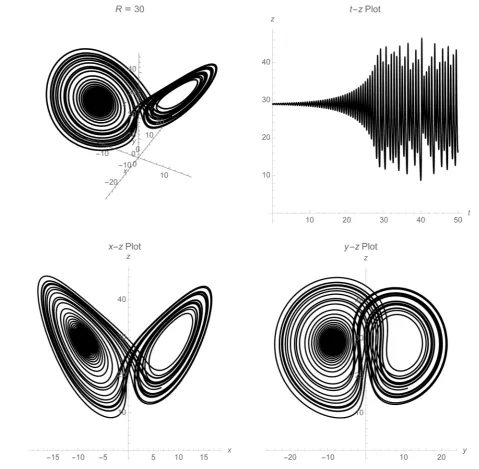
2,3 =0.147368 10.5243± i so that E+ −, are unstable. Evaluated at E0, the Jacobian has eigenvalues λ = −1 23.3955, λ =2 12.3955, and λ = −3 2.66667 so E0 is unstable as well (see Figure 8).To stabilize the system, we first solve
(
)
210 32 114 47 30 19 16 k k k + + =
− , which shows us that if 0.06< <k 1.1875,
,
E+ − will be locally stable (see Figure 9). We set k=0.1. In this case, E+ −, = ±
(
8.75341, 8.75341, 28.7333±)
.Note that the addition of the controller changes the location of the rest points. The eigenvalues of the Jacobian of
(
)
2 10 30 0.1 8 3x y x
y
y x xz y
z
z xy z
= − = − − − = − (15)
Figure 7. For
( )
k R, -values in the shaded region, E+ −, will be locallyJ. Braselton, Y. Wu
Figure 8. Without a control, when R=30, many initial conditions cause the Lorenz system to exhibit chaotic behavior. For
this figure, we used the initial conditions x
( ) ( )
0 =y 0 = −8.7 and z( )
0 =29.evaluated at E+ −, are λ = −1 14.012, and
λ
2,3= −0.0939808 10.4574± i so E+ −, are locally stable (although their location has moved slightly from when their was no controller).Numerically, we see that there is a ball centered at each of E+ −, for which all trajectories starting in the ball converge to E+ −, . However, the basin of attraction for each point is quite complex. Figure 10 shows the plot of
(
x y0, 0)
for various values of z0. First, we solve system (8) using the initial conditions x( )
0 =x0, y( )
0 =y0 and z( )
0 =z0. We then plot(
x y0, 0)
in gray if the solution converges to E+ and in black if the solution converges to E−.The complexity of the basins of attractions are even more apparent when zooming in near one of the equilibria or zooming out as shown in Figure 11.
J. Braselton, Y. Wu
Figure 9. For k-values on the gray line in the shaded region, E+ −, will be locally
stable.
conditions in the black region, the solutions converges to E+ while for those solutions in the gray region, the solutions converge to E−. Of interest is the “speckled” regions. In these regions we see that system (8) is highly sensitive to initial conditions. For some initial conditions, the solutions converges to E+ but a slight change in the conditions can cause the solution to converge to E− and vice-versa.
The initial conditions have a major affect on the convergence of a solution to E+ or E− as is illustrated in
Figures 12-14. Because the z-coordinate of E+ and
E
− are equal, the plot of z as a function of t in Figure 14is the same regardless of whether the solution converges to E+ or E−.
To investigate the existence of a strange attractor as observed in Section 2.2, for each z0 value in Figure 10, we drew a line from slightly before E− to slightly after E+. We then computed solutions satisfying x=x0,
0
y=y , and z=z0 for 50 equally spaced points on each line and graphed them. In every case, the observed solution converged to E+ or E−. For points in the “speckled” region, the solutions varied as to whether they converged to E+ or E−. Thus, for this R value, we were not able to produce a strange attractor as we did in Section 2.2. Our conjecture is that periodic orbits do not exist and that all solutions converge to E+ or E−.
3.3. Example:
R
=
60
with Large
k
Using P=10, b=8 3, and R=60, with k=0, we find the rest points E0=
(
0, 0, 0)
and(
)
, 12.5433, 12.5433, 59
E+ − = ± ± . Evaluated at E+ −, , the eigenvalues of the Jacobian of (8) when k=0 are
1 15.1026
λ = − and
λ
2,3 =0.717961 14.41663± i so that E+ −, are unstable. Evaluated at E0, the Jacobian has eigenvalues λ = −1 30.4048, λ =2 19.4048, and λ = −3 2.66667 so E0 is unstable as well. From Figure 7, we see that we will be able to stabilize the system for k-values greater than approximately 0.35. In Section 3.4 that follows, we chose a small k-value to stabilize the system. In this case, choose a large k-value and choose13.35
J. Braselton, Y. Wu
Figure 10. For z0 values approximately between 19 and 38, there is a region around each of E+ −, for which the solution satisfying
( ) ( ) ( )
(
x 0 ,y 0 ,z 0)
=(
x y z0, 0, 0)
converges to E+ −, .2
lim 24.4
t
y
R k
z
→∞
− =
and for R-values in this range (24.06< <R 24.74), it is possible for E+ −, to be stable and yet the system may have a strange attractor as we saw in Section 2.2. Thus, we expected that this controlled system may have a strange attractor as we saw with the corresponding non-controlled system. For this k-value, we obtain
(
)
, 7.89937, 7.89937, 23.4
J. Braselton, Y. Wu
[image:14.595.187.443.391.625.2]Figure 11. On the left, zooming in near E− if z0=32. On the right, −30≤x0≤30 and −30≤y0≤30 if z0=32.
Figure 12. In three dimensions, depending upon the initial conditions the solution quickly converges to either the gray region
and then to E+ or to the black region and then E−.
2 10.4802
λ = − , and λ = −3 1.63687.
J. Braselton, Y. Wu
Figure 13. Projections of Figure 12 into the x-y, y-z, and x-z-planes.
To investigate the stability of E+ and E−, we followed the exact same procedure as in Section 2. Once again, we were not able to find a strange attractor leading us to believe that the stability of the limit set is global. The numerical evidence suggest that with a controller of this type, solutions will converge to either E+ or E−. Even though R−ky2 z converges to a number in the range where the uncontrolled system can have two stable equilibria and a strange attractor, for the controlled system we were surprised to see that the controlled system did not produce a strange attractor.
3.4. Example:
R
=
60
with Small
k
J. Braselton, Y. Wu
Figure 14. Plots of x, y, and z as functions of t.
Our last example involves a large R-value and a small k-value. We repeat the example in Section 3.4 except we use k=0.4. For this k-value, we obtain E+ −, = ±
(
12.4294, 12.4294, 57.9333±)
. The eigenvalues of theJacobian evaluated at E+ −, are λ = −1 15.357 and
λ
2,3= −0.221503 14.1827± i.The situation appears to be similar to the situation discussed previously with small k-values. In Figure 16, observe the “speckled” region as before where solutions may converge to E+ or E− with slight differences in the initial conditions.
J. Braselton, Y. Wu
Figure 15. If k is large, it appears as though the boundary between the basins of attraction for E+ and E− is well-defined.
solutions converge to E+ or E−.
Note that we were able to produce “almost strange attractors” in the sense that the trajectories appeared to be chaotic at first-but eventually converged to either E+ or E− in all our simulations.
4. Conclusions
In this paper, we revisited the three-dimensional Lorenz system. We illustrated how the Lorenz system can exhibit chaos (or, strange attractors) even when the non-trivial equilibrium points are locally stable.
J. Braselton, Y. Wu
Figure 16. For z0 values approximately between 30 and 60, there is a region around each of E+ −, for which the solution satisfying
( ) ( ) ( )
(
x 0 ,y 0 ,z 0)
=(
x y z0, 0, 0)
converges to E+ −, .controller, the controlled Lorenz system cannot exhibit chaos if the equilibrium points are locally stable.
Our controller controlled the heat source, R. Of course, in the context of Earth’s atmosphere, the design and construction of a controller that could truly control Earth’s R-value would be an engineering miracle.
About the Computations
All computations were carried out using Mathematica Version 10 [12]. Readers can obtain the Mathematica
J. Braselton, Y. Wu
Acknowledgements
We thank the Editor and the referees for their comments.
References
[1] Lorenz, E.N. (1963) Deterministic Non-Periodic Flows. Journal of the Atmospheric Sciences, 20, 130-141.
http://dx.doi.org/10.1175/1520-0469(1963)020<0130:DNF>2.0.CO;2
[2] Robinson, C. (1999) Dynamical Systems: Stability, Symbolic Dynamics, and Chaos. 2nd Edition, CRC Press LLC, Boca Raton, Florida.
[3] Glendinning, P. (1994)Stability, Instability, and Chaos: An Introduction to the Theory of Nonlinear Differential Equa-tions. Cambridge University Press, Cambridge. http://dx.doi.org/10.1017/CBO9780511626296
[4] Jordan, D.W. and Smith, P. (2007)Nonlinear Ordinary Differential Equations: An Introduction for Scientists and En-gineers. 4th Edition, Oxford University Press, New York.
[5] Haken, H. (1975) Analogy between Higher Instabilities in Fluids and Lasers. Physics Letters A, 53, 77-78.
http://dx.doi.org/10.1016/0375-9601(75)90353-9
[6] Tanner, J.S. (2007) State Feedback Control of a Single-Loop Thermosyphon System via a Quotient Controller. Mas-ter’s Thesis, Georgia Southern University.
[7] Hermati, N. (1994) Strange Attractors in Brushless DC Motors. IEEE Transactions on Circuits and Systems I: Funda-mental Theory and Applications, 41, 40-45. http://dx.doi.org/10.1109/81.260218
[8] Cuomo, K.M. and Oppenheim, A.V. (1993) Circuit Implementation of Synchronized Chaos with Applications to Communications. Physical Review Letters, 71, 65-68. http://dx.doi.org/10.1103/PhysRevLett.71.65
[9] Poland, D. (1993) Cooperative Catalysis and Chemical Chaos: A Chemical Model for the Lorenz Equations. Physica D,
65, 86-99. http://dx.doi.org/10.1016/0167-2789(93)90006-M
[10] Tzenov, S. (1994) Strange Attractors Characterizing the Osmotic Instability. arXiv:1406.0979.
[11] Saltzman, B. (1962) Finite Amplitude Free Convection as an Initial Value Problem-I. Journal of the Atmospheric Sciences, 19, 329-342. http://dx.doi.org/10.1175/1520-0469(1962)019<0329:FAFCAA>2.0.CO;2
[12] Wolfram Research (2016) Mathematica 10.0. Champaign, Illinois.
[13] Sprott, J.C. (2013) Tri-Stability in the Lorenz System.Technical Report, Department of Physics, University of Wis-consin, Madison, Wisconsin.http://sprott.physics.wisc.edu/technote/tristab.htm
[14] Shen, B.-W. (2014) Nonlinear Feedback in a Five-Dimensional Lorenz Model. Journal of the Atmospheric Sciences,
71, 1701-1723. http://dx.doi.org/10.1175/JAS-D-13-0223.1
[15] Braselton, J. and Wu, Y. (2016) Applying Linear Controls to Chaotic Continuous Dynamical Systems. Open Journal of Applied Sciences, 6, 141-152. http://dx.doi.org/10.4236/ojapps.2016.63015
Submit or recommend next manuscript to SCIRP and we will provide best service for you:
Accepting pre-submission inquiries through Email, Facebook, LinkedIn, Twitter, etc. A wide selection of journals (inclusive of 9 subjects, more than 200 journals) Providing 24-hour high-quality service
User-friendly online submission system Fair and swift peer-review system
Efficient typesetting and proofreading procedure
Display of the result of downloads and visits, as well as the number of cited articles Maximum dissemination of your research work