http://dx.doi.org/10.4236/jamp.2016.48149
Septic B-Spline Solution of Fifth-Order
Boundary Value Problems
Bin Lin
School of Mathematics and Computation Science, Lingnan Normal University, Zhanjiang, China
Received 8 July 2016; accepted 6 August 2016; published 9 August 2016 Copyright © 2016 by author and Scientific Research Publishing Inc.
This work is licensed under the Creative Commons Attribution International License (CC BY). http://creativecommons.org/licenses/by/4.0/
Abstract
A numerical method based on septic B-spline function is presented for the solution of linear and nonlinear fifth-order boundary value problems. The method is fourth order convergent. We use the quesilinearization technique to reduce the nonlinear problems to linear problems and use B-spline collocation method, which leads to a seven nonzero bands linear system. Illustrative ex-ample is included to demonstrate the validity and applicability of the proposed techniques.
Keywords
Septic B-Spline Function, Fifth-Order Boundary Value Problems, B-Spline Collocation Method, Nonlinear Problems
1. Introduction
Consider the following fifth-order boundary value problem.
( )
( )5( ) ( ) ( )
( )
,
Ly x = y x +p x y x = f x c< <x d (1) With boundary conditions
( )
( )( )
( )( )
( )
( )( )
( )( )
1 2
0 1 2
1 2
3 4 5
, , ,
, ,
y c y c y c
y d y d y d
α α α
α α α
= = =
= = = (2)
where αi
(
i=0,1, 2, 3, 4, 5)
are known real constants, p x( )
and f x( )
are continuous on[ ]
c d, . ThisB-spline functions based on piece polynomials are useful wavelet basis functions, the resulting matrices are sparse, but always, banded. And that possess attractive properties: piecewise smooth, compact support, symme-try, rapidly decaying, differentiability, linear combination, B-splines were introduced by Schoenberg in 1946 [6]. Up to now, B-spline approximation method for numerical solutions has been researched by various researchers [7]-[14].
In this paper, the septic B-spline function is used as a basis function and the B-spline collocation method is studied to solve the linear and nonlinear fifth-order boundary value problems. The method is fourth order con-vergent. We use the quesilinearization technique to reduce the nonlinear problems to linear problems. The present method is tested for its efficiency by considering two examples.
2. Septic B-Spline Interpolation
An arbitrary Nth order spline function with compact support of N. It is a concatenation of N sections of (N-1)th order polynomials, continuous at the junctions or “knots”, and gives continuous (N-1)th derivatives at the junc-tions.
Let
{ }
xi iN=0 be a uniform partition of[ ]
c d, such that xi = +c ih, i=0,1, 2,,N, where h=(
d−c)
N. Let the septic B-spline function φi( )
x with knots at the points xi be given by( )
(
)
[
]
(
)
(
)
[
]
(
)
(
)
(
)
7
4 4 3
7 7
4 3 3 2
7 7
4 3 2
7
,
8 ,
8 28
1
i i i
i i i i
i i i
i
x x x x x
x x x x x x x
x x x x x x
x h φ − − − − − − − − − − − ∈ − − − ∈ − − − + − =
[
]
(
)
(
)
(
)
(
)
[
]
(
)
(
)
(
)
(
)
[
]
(
)
(
)
(
)
7 2 17 7 7 7
4 3 2 1 1
7 7 7 7
4 3 2 1 1
7 7 7
4 3 2 1
,
8 28 56 ,
8 28 56 ,
8 28 ,
i i
i i i i i i
i i i i i i
i i i i i
x x x
x x x x x x x x x x x
x x x x x x x x x x x
x x x x x x x x x
− − − − − − − + + + + + + + + + ∈ − − − + − − − ∈ − − − + − − − ∈ − − − + − ∈
[
]
(
)
(
)
[
]
(
)
[
]
2 7 74 3 2 3
7
4 3 4
8 ,
,
0
i i i i
i i i
x x x x x x x
x x x x x
+ + + + + + + + − − − ∈ − ∈ otherwise (3)
The set of splines
{
φ φ φ φ φ−3, −2, −1, 0, 1,⋅⋅⋅,φ φN, N+1,φN+2,φN+3}
forms a basis for the functions defined over[
c d,]
. The values of φi( )
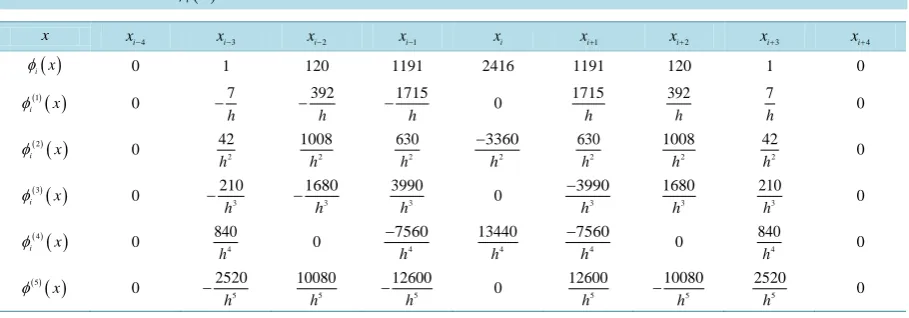
x and its derivatives are as shown inTable 1.We seek the approximation S x
( )
to the exact solution y x( )
, which uses these septic B-splines:( )
3( )
3 N
i i i
S x aφ x
+
=−
=
∑
(4)which satisfies the following interpolation conditions:
( )
( )
(
)
( )
( )
( )( )
( )( )
( )( )
( )( )
( )( )
( )( )
( )( )
1 1 2 2
1 1 2 2
, 0,1, 2, ,
, ,
, ,
i i
s x y x i n
s c y c s c y c
s d y d s d y d
= = = = = = (5)
where ai are unknown real coefficients.
Using the septic B-spline function Equation (3) and the approximate solution Equation (4), the nodal values
( )
jS x and S( )5
( )
xj at the node xj are given in terms of element parameters by( )
j j3 120 j2 1191 j1 2416 j 1191 j1 120 j 2 j3S x =a− + a− + a− + a + a+ + a+ +a+ (6)
( )5
( )
(
)
3 2 1 1 2 3
5 2520
4 5 5 4
j j j j j j j
S x a a a a a a
h − − − + + +
Table 1. The values of φi
( )
x and its derivatives with knots.x xi−4 xi−3 xi−2 xi−1 xi xi+1 xi+2 xi+3 xi+4
( )
i x
φ 0 1 120 1191 2416 1191 120 1 0
( )1( )
i x
φ 0 7
h
− 392
h
− 1715
h
− 0 1715
h
392
h
7
h 0
( )2( )
i x
φ 0 2
42 h 2 1008 h 2 630 h 2 3360 h − 2 630 h 2 1008 h 2 42 h 0
( )3( )
i x
φ 0 3
210 h − 3 1680 h − 3 3990
h 0 3
3990 h − 3 1680 h 3 210 h 0
( )4( )
i x
φ 0 4
840
h 0 4
7560 h − 4 13440 h 4 7560 h −
0 4 840
h 0
( )5( )
x
φ 0 5
2520 h − 5 10080 h 5 12600 h
− 0 5
12600 h 5 10080 h − 5 2520 h 0
From Equations (4)-(7), we have
( )
( )
( )( )
( )( )
( )( )
( )( )
( )( )
( )( )
(
)
5 5 5 5 5 5 5
3 2 1 1 2 3
3 2 1 1 2 3
5
120 1191 2416 1191 120
2520
4 5 5 4 ,
j j j j j j j
j j j j j j
s x s x s x s x s x s x s x
y y y y y y
h
− − − + + +
− − − + − + +
+ + + + + +
= − + − + + (8)
Using operator notations Ey x
( )
= y x(
+h Dy x)
,( )
=y x Iy x′( ) ( )
, = y x E( )
, =ehD, we obtain( )5
( )
3 2 1 1 2 35 3 2 1 1 2 3
2520 4 5 5 4
120 1191 2416 1191 120
j j
E E E E E E
s x y
h E E E I E E E
− − − + + +
− − − + + +
− + − + − +
=
+ + + + + +
(9)
Expanding them in powers of hD, we obtain
( )5
( )
( )5( )
4 ( )9( )
59 6 ( )11( )
259 8 ( )13( )
( )
10240 15120 226800
j j j j j
h h h
s x =y x − y x − y x + y x +O h (10)
Hence we get
( )
j j3 120 j2 1191 j1 2416 j 1191 j1 120 j2 j3y x =a− + a− + a− + a + a+ + a+ +a+ (11)
( )5
( )
(
)
( )
43 2 1 1 2 3
5 2520
4 5 5 4
j j j j j j j
y x a a a a a a O h
h − − − + − + +
= − + − + + + (12)
3. Spline Collocation Method
3.1. Linear Problems
From Equation (1) and Equation (12), we can get
(
)
( )
(
)
4
3 2 1 1 2 3
5
3 2 1 1 2 3
2520
4 5 5 4
120 1191 2416 1191 120
j j j j j j
j j j j j j j j j
a a a a a a O h
h
p a a a a a a a f
− − − + + +
− − − + + +
− + − + − + +
+ + + + + + + =
(13)
Using the boundary conditions and by neglecting the error of Equation (13), we can obtain following linear equations
3 2 1
5 5 5
1 2 3
5 5 5
2520 10080 12600
120 1191
12600 10080 2520
2416 1191 120
j j j j j j
j j j j j j j j j
p a p a p a
h h h
p a p a p a p a f
h h h
Or
Ba=r (15) where
2 2 2 2 2 2 2
4,1 4,2 4,3 4,4 4,5 4,6 4,7
5,2 5,3 5,4 5,5 5,6 5,7 5,8
4 ,1 4 ,2
1 120 1191 2416 1191 120 1 0 0
7 392 1715 1715 392 7
0 0 0
42 1008 630 3360 630 1008 42
0 0
0 0
0 0
0 0 N N N
h h h h h h
h h h h h h h
LB LB LB LB LB LB LB
LB LB LB LB LB LB LB
B
LB+ + LB+ +
− − −
−
=
4 ,3 4 ,4 4 ,5 4 ,6 4 ,7
2 2 2 2 2 2 2
0 0 1 120 1191 2416 1191 120 1
7 392 1715 1715 392 7
0 0 0
42 1008 630 3360 630 1008 42
0 0
N LB N N LB N N LB N N LB N N LB N N
h h h h h h
h h h h h h h
+ + + + + + + + + +
− − −
−
(
)
T3, 2, 1, , 0 1, , N, N1, N 2, N 3
a= a− a− a− a a ⋅⋅⋅a a + a + a +
( )
( )( )
( )( ) ( ) ( )
( ) ( )
( )( )
( )( )
(
)
T1 2 1 2
0 1
, , , , , , ,N , ,
r= y c y c y c f x f x ⋅⋅⋅ f x y d y d y d
where
(
)
( )
4 ,1 5 4 ,2 5 4 ,3 5
4 ,4 4 ,5 5 4 ,6 5
4 ,7 5
2520 10080 12600
, 120 , 1191
12600 10080
2416 , 1191 , 120
2520
, , , 0,1, 2, ,
k k k k k k k k k
k k k k k k k k k
k k k k k k
LB p LB p LB p
h h h
LB p LB p LB p
h h
LB p p p a kh f f x k N
h
+ + + + + +
+ + + + + +
+ +
= − + = + = − +
= = + = − +
= + = + = =
T denoting transpose.
In which B is a square matrix of order N + 7 with seven nonzero bands. Since B is nonsingular, after solving the linear system Equation (15) for a−3,a−2,⋅⋅⋅,aN+2,aN+3, we can obtain the septic spline approximate
solution
( )
( )
3 3 Ni i i
S x aφ x
+
=−
=
∑
with the accuracy being O h( )
4 .3.2. Nonlinear Problems
Consider the nonlinear fifth order boundary value problem
( )5
( )
(
)
, ,
y x =F x y y′ (16) with boundary conditions
( )
( )( )
( )( )
( )
( )( )
( )( )
1 2
0 1 2
1 2
3 4 5
, , ,
, ,
y c y c y c
y d y d y d
α α α
α α α
= = =
= = = (17)
( )
( )
(
)
(
( )
)
( )(
)
( )( )
( )
(
)
5 1 1 1 , , , , , k kk k k k k k
k
x y x y
F F
y F x y y F y y y y y y
y + y +
+ ∂ ∂ ′ ′ ′ ′ = ≈ + − + − ′ ∂ ∂
(18)
Equation (18) can be rewritten as
( )5
( )
( )1( )
( )
1 1 1 ,
k k k k k k
y+ +q x y+ +p x y+ = f x c< <x d (19) where
( )
( )( )
( )( )
(
( )
)
( ) ( )( )
, , , , , , , k k k k k kx y x y
k k k k k
x y x y
F F
q x p x
y y
F F
f x F y y y y
y y ∂ ∂ = − = − ′ ∂ ∂ ∂ ∂ ′ ′ = − − ′ ∂ ∂
Equation (19) once the initial values (k = 0, qk
( )
x , pk( )
x , fk( )
x ) has been computed from the initial conditions, Equation (19) becomes into a linear equations with constant coefficients. Equation (19) can be solved by using iterative method.Subject to the boundary conditions
( )
( )( )
( )( )
( )
( )( )
( )( )
1 2
1 0 1 1 1 2
1 2
1 3 1 4 1 5
, , ,
, ,
k k k
k k k
y c y c y c
y d y d y d
α α α
α α α
+ + +
+ + +
= = =
= = = (20)
Instead of solving nonlinear problem (16) with boundary conditions (17), we solve a sequence of linear prob-lems (19) with boundary conditions (20), we consider yk+1
( )
x as the numerical solution to nonlinear problem(16) with boundary conditions (17).
4. Computation of Error
The relative error of numerical solution is given by
( )
( )
(
)
( )
(
)
2 1 2 1 N i i i r N i iS x y x
E y x = = − =
∑
∑
(21)The pointwise errors are given by
( )
i( ) ( )
i iE x = S x −y x (22) The maximum pointwise errors are given by
( )
( )
0 max N i i i NE y x S x
≤ ≤
= − (23)
5. Numerical Tests
In the section, we illustrate the numerical techniques discussed in the previous section by the following prob-lems.
Example 1. Consider the following equation [15]-[17]:
( )
( ) ( )
( )
( )
(
)
5
, 0 1 15 10 e ,x
y x y x f x x
f x x
− = ≤ ≤
= − +
With boundary conditions
( )
( )( )
( )( )
( )
( )( )
( )( )
1 2
1 2
0 0, 0 1, 0 0,
1 0, 1 e, 1 4e
y y y
y y y
= = =
The exact solution is given by
( ) (
1)
exy x =x −x
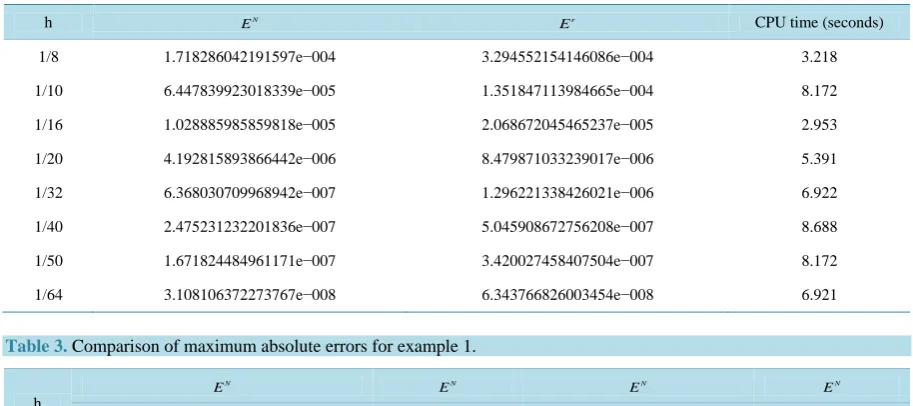
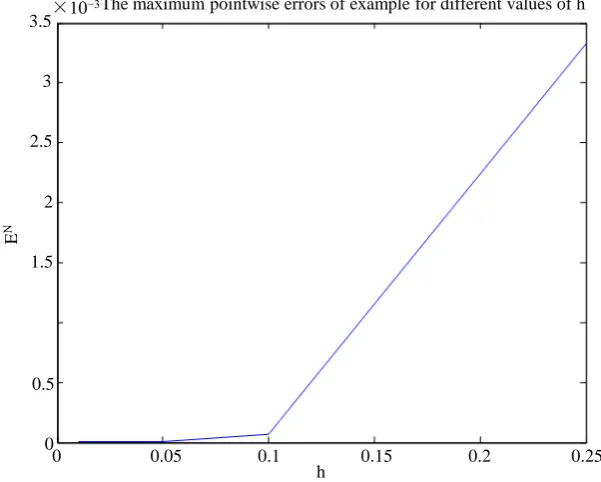
The numerical results are shown inTable 2, the comparison of maximum absolute errors are given byTable 3. The relative errors for different values of h are seen inFigure 1. The pointwise errors of example are given in
Figure 2. The maximum pointwise errors for different values of h are given inFigure 3.
[image:6.595.84.541.200.403.2]Example 2. Consider the following nonlinear equation [15] [18] [19]. Table 2. Maximum absolute errors, relative error for example 1.
h EN Er CPU time (seconds)
1/8 1.718286042191597e−004 3.294552154146086e−004 3.218 1/10 6.447839923018339e−005 1.351847113984665e−004 8.172 1/16 1.028885985859818e−005 2.068672045465237e−005 2.953 1/20 4.192815893866442e−006 8.479871033239017e−006 5.391 1/32 6.368030709968942e−007 1.296221338426021e−006 6.922 1/40 2.475231232201836e−007 5.045908672756208e−007 8.688 1/50 1.671824484961171e−007 3.420027458407504e−007 8.172 1/64 3.108106372273767e−008 6.343766826003454e−008 6.921 Table 3. Comparison of maximum absolute errors for example 1.
h
N
E EN EN EN
Our method Caglar et al. [15] Shahid.et al. [16] Khan et al. [17]
[image:6.595.86.520.210.706.2]1/10 6.447839923018339E−5 0.1570 2.259E−4 4.025E−3 1/20 4.192815893866442E−6 0.0747 1.33E−5 3.911E−3 1/40 2.475231232201836E−7 0.0208 5.2812E−7 1.145E−2
Figure 1. The relative errors of example 1 for different values of h. h
0 0.05 0.1 0.15 0.2 0.25
E
r
×10−3 The relative errors of example for different values of h
[image:6.595.176.458.458.707.2]Figure 2. The pointwise errors of example 1.
Figure 3. The maximum pointwise errors of example 1 for different values of h.
( )5
( )
2( )
e x , 0 1
y x = − y x ≤ ≤x
With boundary conditions
( )
( )( )
( )( )
( )
( )( )
( )( )
1 2
1 2
0 0 0 1
1 1 1 e
y y y
y y y
= = =
= = =
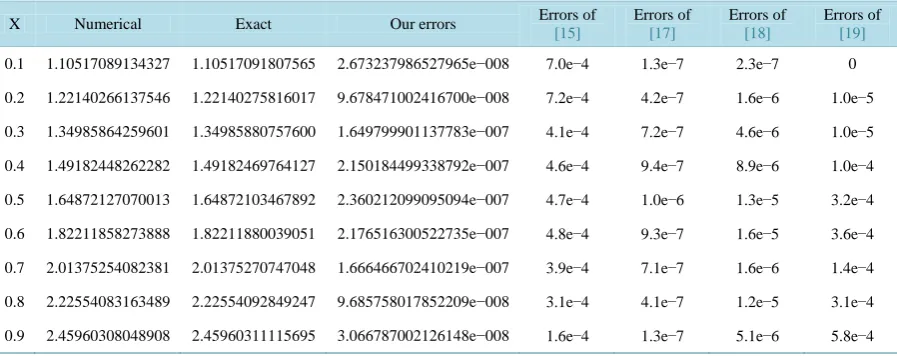
The exact solution is given by y x
( )
=ex.Comparison of numerical results and pointwise errors are given inTable 4. The numerical result is found in good agreement with exact solution.
The pointwise errors of example
exact approximation
0 0.1 0.2 0.3 0.4 0.5 0.6 0.7 0.8 0.9 1 0.45
0.4
0.35
0.3
0.25
0.2
0.15
0.1
0.05
0
−0.05
The maximum pointwise errors of example for different values of h ×10−3
3.5
3
2.5
2
1.5
0.5
0
h
0 0.05 0.1 0.15 0.2 0.25
E
[image:7.595.162.463.326.567.2]Table 4. Example 2. Comparison of results and pointwise errors.
X Numerical Exact Our errors Errors of
[15]
Errors of
[17]
Errors of
[18]
Errors of
[19]
0.1 1.10517089134327 1.10517091807565 2.673237986527965e−008 7.0e−4 1.3e−7 2.3e−7 0 0.2 1.22140266137546 1.22140275816017 9.678471002416700e−008 7.2e−4 4.2e−7 1.6e−6 1.0e−5 0.3 1.34985864259601 1.34985880757600 1.649799901137783e−007 4.1e−4 7.2e−7 4.6e−6 1.0e−5 0.4 1.49182448262282 1.49182469764127 2.150184499338792e−007 4.6e−4 9.4e−7 8.9e−6 1.0e−4 0.5 1.64872127070013 1.64872103467892 2.360212099095094e−007 4.7e−4 1.0e−6 1.3e−5 3.2e−4 0.6 1.82211858273888 1.82211880039051 2.176516300522735e−007 4.8e−4 9.3e−7 1.6e−5 3.6e−4 0.7 2.01375254082381 2.01375270747048 1.666466702410219e−007 3.9e−4 7.1e−7 1.6e−6 1.4e−4 0.8 2.22554083163489 2.22554092849247 9.685758017852209e−008 3.1e−4 4.1e−7 1.2e−5 3.1e−4 0.9 2.45960308048908 2.45960311115695 3.066787002126148e−008 1.6e−4 1.3e−7 5.1e−6 5.8e−4
6. Conclusion
In the paper, the fifth-order boundary value problems are solved by means of septic B-splines collocation me-thod. We use the quesilinearization technique to reduce the nonlinear problems to linear problems and reduce a boundary value problem to the solution of algebraic equations with seven nonzero bands. The numerical results show that the present method is relatively simple to collocate the solution at the mesh points and easily carried out by a computer and approximates the exact solution very well.
Acknowledgements
The authors would like to thank the editor and the reviewers for their valuable comments and suggestions to im-prove the results of this paper. This work was supported by the Natural Science Foundation of Guangdong (2015A030313827).
References
[1] Karageorghis, A., Phillips, T.N. and Davies, A.R. (1988) Spectral Collocation Methods for the Primary Two-Point Boundary Value Problem in Modeling Viscoelastic Flows. International Journal for Numerical Methods in Engineer-ing, 26, 805-813. http://dx.doi.org/10.1002/nme.1620260404
[2] Davies, A.R., Karageorghis, A. and Phillips, T.N. (1988) Spectral Galerkin Methods for the Primary Two-Point Boun-dary Value Problem in Modeling Viscoelastic Flows. International Journal for Numerical Methods in Engineering, 26, 647-662. http://dx.doi.org/10.1002/nme.1620260309
[3] Caglar, H.N., Caglar, S.H. and Twizell, E.H. (1999) The Numerical Solution of Fifth-Order Boundary Value Problems with Sixth-Degree B-Spline Functions. Applied Mathematics Letters, 12, 25-30.
http://dx.doi.org/10.1016/S0893-9659(99)00052-X
[4] Siddiqi, S.S. and Akram, G. (2006) Solutions of Fifth Order Boundary Value Problems Using Nonpolynomial Spline Technique. Applied Mathematics and Computation, 175, 1574-1581. http://dx.doi.org/10.1016/j.amc.2005.09.004 [5] Lamnii, A., Mraoui, H., Sbibih, D. and Tijini, A. (2008) Sextic Spline Solution of Fifth Order Boundary Value
Prob-lems. Mathematics and Computers in Simulation, 77, 237-246. http://dx.doi.org/10.1016/j.matcom.2007.09.008 [6] De Boor, C. (1978) A Practical Guide to Splines. Springer-Verlag, pp. 54, 105.
http://dx.doi.org/10.1007/978-1-4612-6333-3
[7] Saka, B. and Dağ, I. (2007) Quartic B-Spline Collocation Method to the Numerical Solutions of the Burgers’ Equation.
Chaos, Solitons & Fractals, 32, 1125-1137. http://dx.doi.org/10.1016/j.chaos.2005.11.037
[8] Ramadan, M.A., EI-Danaf, T.S. and Alaal, F. (2005) A Numerical Solution of the Burgers’ Equation Using Septic B-Splines. Chaos, Solitons & Fractals, 26, 795-804. http://dx.doi.org/10.1016/j.chaos.2005.01.054
[10] Çağlar, H.,Çağlar, N. and Özer, M. (2009) B-Spline Solution of Non-Linear Singular Boundary Value Problems Aris-ing in Physiology. Chaos, Solitons & Fractals, 39, 1232-1237. http://dx.doi.org/10.1016/j.chaos.2007.06.007 [11] Çağlar, H., Özer, M.and Çağlar, N. (2008) The Numerical Solution of the One-Dimensional Heat Equation by Using
Third Degree B-Spline Functions. Chaos, Solitons & Fractals, 38, 1197-1201. http://dx.doi.org/10.1016/j.chaos.2007.01.056
[12] Saka, B. and Dağ, İ. (2007) Quartic B-Spline Collocation Method to the Numerical Solutions of the Burgers’ Equation.
Chaos, Solitons & Fractals, 32, 1125-1137. http://dx.doi.org/10.1016/j.chaos.2005.11.037
[13] Jain, P.C., Shankar, R. and Bhardwaj, D. (1997) Numerical Solution of the Korteweg-de Vries (KdV) Equation. Chaos,
Solitons & Fractals, 8, 943-951. http://dx.doi.org/10.1016/S0960-0779(96)00135-X
[14] Lin, B., Li, K.T. and Cheng, Z.X. (2009) B-Spline Solution of a Singularly Perturbed Boundary Value Problem Arising in Biology. Chaos, Solitons & Fractals, 42, 2934-2948. http://dx.doi.org/10.1016/j.chaos.2009.04.036
[15] Caglar, H.N., Caglar, S.H. and Twizell, E.N. (1999) The Numerical Solution of Fifth-Order Boundary Value Problems with Sixth-Degree B-Spline Functions. Applied Mathematics Letters, 12, 25-30.
http://dx.doi.org/10.1016/S0893-9659(99)00052-X
[16] Siddiqi, S.S. and Akram, G. (2007) Sextic Spline Solutions of Fifth-Order Boundary Value Problems. Applied Mathe-matics Letters, 20, 591-597. http://dx.doi.org/10.1016/j.aml.2006.06.012
[17] Khan, M. (1994) Finite Difference Solutions of Fifth-Order Boundary Value Problems. Ph.D. Thesis, Brunel Universi-ty, England.
[18] Noor, M.A. and Mohyud-Din, S.T. (2009) A New Approach to Fifth-Order Boundary Value Problems. International Journal of Nonlinear Science, 7, 143-148.
[19] Zhang, J. (2009) The Numerical Solution of Fifth-Order Boundary Value Problems by the Variational Iteration Method.
Computers & Mathematics with Applications, 58, 2347-2350. http://dx.doi.org/10.1016/j.camwa.2009.03.073
Submit or recommend next manuscript to SCIRP and we will provide best service for you:
Accepting pre-submission inquiries through Email, Facebook, LinkedIn, Twitter, etc. A wide selection of journals (inclusive of 9 subjects, more than 200 journals) Providing 24-hour high-quality service
User-friendly online submission system Fair and swift peer-review system
Efficient typesetting and proofreading procedure
Display of the result of downloads and visits, as well as the number of cited articles Maximum dissemination of your research work