Probabilistic Analysis of a Computer System with
Inspection and Priority for Repair Activities of H/W over
Replacement of S/W
Jyoti Anand
Department of Statistics M.D.University,Rohtak-124001
Haryana (India)
S.C.Malik
Department of Statistics M.D.University,Rohtak-124001
Haryana (India)
ABSTRACT
The main aim of this paper is to carry out the probabilistic analysis of a computer system of two identical units in which one is operative and the other is in cold standby. In each unit h/w and s/w components fail independently and work together. A server visits the system immediately to inspect the h/w components at their failure to see the feasibility of repair. If repair of the h/w is not feasible, it is replaced by new one in the unit. However, only replacement of the s/w components is made by new one at their failure. Priority to the replacement and repair of the h/w components is given over the replacement of the s/w components. All the failure time distributions are assumed to be negative exponential while that of inspection, repair and replacement times are taken as arbitrary. Some reliability and economic measures of system effectiveness are evaluated using semi-Markov process and regenerative point technique. The graphs are drawn for a particular case to show the behavior of MTSF, availability and profit of the system models.
General Terms
Reliability and Economic Measures
Keywords
Computer System, Hardware and Software Failures, Feasibility of Repair, Priority for Replacement, Repair and Inspection, Probabilistic Analysis.
1.
INTRODUCTION
In spite of increasing development and availability of new computer technologies, a little work has been dedicated to the probabilistic analysis of a computer system with independent failure of h/w and s/w components. And, most of the research work in the subject of h/w and s/w reliability has been limited to consideration of either h/w subsystem alone or s/w subsystem alone. Friedman and Tran[1] and Wilke et al. [2] tried to establish a combined reliability model for the whole system introducing both h/w and s/w under the assumption that h/w and s/w subsystems are independent to each other. Recently, Malik and Anand et al.[3,4] have suggested some reliability models of a computer system with independent h/w and s/w failures. In these models replacement of the components by new one is made in negligible time if inspection reveals that repair of h/w components is not feasible. However, in paper [4], priority for the replacement at s/w component is also made by new one over repair and replacement activities of h/w failures. But the concept of priority to repair activities of the h/w over replacement of the s/w has not been studied so far by any researcher in the subject of reliability.
In view of above, the present paper deals with the probabilistic analysis of a computer system considering the concepts of priority for the replacement and repair of the h/w components subject to inspection over replacement of the s/w. For this, a probabilistic model is developed by taking two identical units of a computer system. Initially, one unit is operative and other is kept as cold standby. Each unit has direct independent complete failure from the normal mode. There is a single server who visits the system immediately to do inspection. If repair of the defective h/w components is not feasible, it is replaced by new one. However, only replacement of the s/w components is made by new one whenever they fail. The priority is given to replacement and repair of the h/w components subject to inspection over replacement of the s/w components at their failure. The failure, repair and inspection time are taken as independent and uncorrelated random variables. The failure time of the unit follow negative exponential distributions while that of repair, inspection and replacement s/w and h/w are taken as arbitrary. To analyze the system probabilistically in detail, expression for some reliability characteristics such as mean sojourn times, mean time to system failure (MTSF), availability, busy period of the server due to h/w failure or due to s/w failure, expected no. of replacement due to h/w failure or due to s/w failures & expected no. of visits by the server are derived by making use of semi-Markov process and regenerative point technique. The graphs are drawn for a particular case to show the behavior of MTSF, availability and profit of the system models.
2.
NOTATIONS
E : The set of regenerative states
O : The unit is operative and in normal mode
cs : The unit is cold standby
a/b : Probability that the system has hardware /
software failure
1/2 : Constant hardware / software failure rate
p/q : Probability that repair of the unit due to
hardware failure is not feasible / feasible
FHUr/FHUR : The unit is failed due to hardware and is
under repair /under repair continuously from
FHUi/FHUI : The unit is failed due to hardware and is
under inspection/ under inspection
continuously from previous state
FHWi/FHWI : The unit is failed due to hardware and is
waiting for inspection/ waiting for
inspection continuously from previous
state
FSURp/FSURP : The unit is failed due to the software and
is under replacement/under replacement
continuously from previous state
FHWRp/FHWRP : The unit is failed due to the hardware and
is waiting for replacement/waiting for
replacement continuously from previous
state
h(t) / H(t) : pdf / cdf of inspection time of unit due to
hardware failure
f(t) / F(t) : pdf / pdf of replacement time of the
software
g(t) / G(t) : pdf / cdf of repair time of the unit due to
hardware failure
qij / Qij(t) : pdf / cdf of passage time from
regenerative state i to a regenerative
state j or to a failed state j without
visiting any other regenerative state in
(0, t]
qij.kr/Qij.kr : pdf/cdf of direct transition time from
regenerative state i to a regenerative state
j or to a failed state j visiting state k, r
once in (0, t]
mij : Contribution to mean sojourn time (i)
in state Si when system transits
directly to state Sj so that
i ij
j
m
and
mij =
tdQ t( ) q*'(0)Ⓢ/ : Symbol for Laplace-Stieltjes
convolution/Laplace convolution
~ / * : Symbol for Laplace Steiltjes Transform
(LST) / Laplace Transform (LT)
' (desh) : Used to represent alternative result
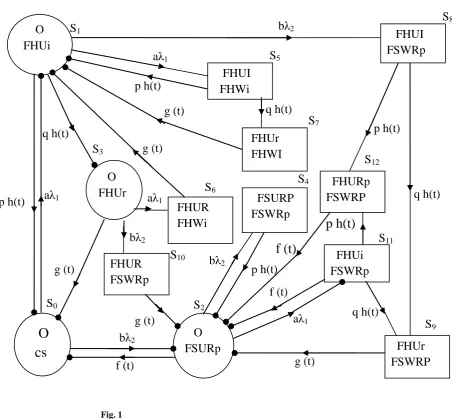
The following are the possible transition states of the system:
The following are the possible transition states of the system:
S0 = (O, cs), S1 = (O, FHUi), S2 = (O, FSURp),
S3 = (O, FHUr), S4 = (FSURP, FSWRp), S5 = (FHUI, FHWi),
S6 = (FHUR, FHWi), S7 = (FHUr, FHWi),
S8 = (FHUI, FSWRp),S9 = (FHUr, FSWRP),
S10 = (FHUR, FSWRp),
The state S0 – S3, S11 are regenerative states while the states S4
– S10, S12 are non-regenerative as shown in figure 1
3.
RELIABILITY INDICES
3.1
Transition Probabilities and Mean
Sojourn Times
Simple probabilistic considerations yield the following
expressions for the non-zero elements
0
(
)
)
(
q
t
dt
Q
p
ij ij ij by taking all distributionsexponential
i.e. h(t) = 1
1
t
e
, f(t) =
e
t and g(t) =
e
t:p01= 1
1 2 a a b
, p02= 1 2 2 b a b
, 1 2 1,1
13
b a q p , 1 2 1 115
b a a p , 1 2 1 1 5 .11
b a pa p , 1 2 1 1 57 .11
b a qa p , 1 2 1 2 12 , 8 .12
b a pb p , 1 2 1 2 89 .12
b a qb p , 2 120
b a p , 1 2 1 2
24
b a b p , 1 2 1 1 11 ,2
b a a p , 1 2 1 2 4 .22
b a b p , 2 1 136
, 2 1 2 10 ,
3
b a b p , 2 1 1 6 .31
b a a p , 2 1 2 10 .32
b a bp
p
11,2
p
,p
11,2.9
q
(1) It can be easily verified thatp01+p02=p10+p13+p15+p18=p20+p24+p2,11=p30+p36+p3,10=p11,2+p1 1,9=p10+p13+p11.5+p11.57+p12.8,12+p12.89=p30+p31.6+p32.10=
p11,2+p11,2.9 = 1 (2)
The mean sojourn times (i) is the state Si are
, 1 2 1 0 b a
1 ,
1 2 1 1 b a , 1 2 1
2
b a , 1 2 1
3
b a , 1 1 11
(3)Also
0 02 0
m
m
,m
10
m
13
m
15
m
18
1,20 24 2,11 2
m
m
m
,m
30
m
36
m
3,10
3, 11 9 , 11 2 ,11
m
m
(4)And
)
(
1 89 . 12 12 , 8 . 12 57 . 11 5 . 11 1010
m
m
m
m
m
say
m
1 20 22.4 21.11 2
(
)
m
m
m
say
1 30 36 32.10 3
m
m
m
(say) (5)For h(t) = 1
1
t
e
, f(t) =
e
t and g(t) =
e
t, we have(
)
(
)
(
)
1 1 2 1 2 1
1 1
1 1 2 1
a b a b
a b
q a l l a l l qq m
q a l l q
+ + + +
=
+ +
,
121
, 1 31
(6)3.2 Reliability and Mean Time to System
Failure (Mtsf)
Let i(t) be the cdf of first passage time from regenerative
state i to a failed state. Regarding the failed state as absorbing
state, we have the following recursive relations for i(t):
(7)
Where j is an un-failed regenerative state to which the given
regenerative stat I can transit and k is a failed state to which
the state I can transit directly.
Taking LST of above relation (7) and solving for
f
0( )
s
We haveR*(s) = 1 0( )s s f
- (8)
The reliability of the system model can be obtained by taking
Laplace inverse transform of (8).
The mean time to system failure (MTSF) is given by
MTSF =
s s o s ) ( ~ 1 lim 0
= 1
1 N D
(9)
where
N1 =
0
p
01
0
p
02
2
p p
01 13
3D1 =
1
p
01
p
10
p p
13 30
p p
02 203.3 Steady State Availability
Let Ai(t) be the probability that the system is in up-state at
instant ‘t’ given that the system entered regenerative state i at
t = 0. The recursive relations for Ai(t) are given as
(10) (10)
Where j is any successive regenerative state to which the
regenerative stste I can transit through n≥1 (natural number)
transitions. Mi(t) is the probability that the system is up
initially in state
S
i
E
is up at time t without visiting toany other regenerative state, we have
1 2
0
( )
a b t
M t
e
, 1 21
( )
( )
a b t
1 2
2
( )
( )
a b t
M t
e
F t
, 1 23
( )
( )
a b t
M t
e
G t
(11)Taking LT of above relations (10) and solving for
A s
0*( )
, the steady state availability is given by* 0( ) lims 0 0( )
A sA s
2
2 N D
(12)
where
N2=p20[p10+p13(p30+p32.10)+p12.8,12+p12.89]
0 +p20p01(
1
p
13
3)
+[ p10p02+p13(p02p30+p32.10)+p12.8,16+ p12.89]
2 andD2=p20[p10+p13(p30+p32.10)+p12.8,16+p12.89]
0+p20p01
(
1
p
13
3
)
+ [p10p02+p13(p02p30+p32.10)+p12.8,16+ p12.89 ] (
2
p
2,11
11
)3.4
Busy Period Analysis for Server
(a) Due to Hardware Failure
Let BiH(t) be the probability that the server is busy
in repairing the unit due to hardware failure at an instant ‘t’
given that the system entered state i at t = 0. The recursive
relations for BiH(t) are as follows:
(11) (13)
where WiH(t) be the probability that the server is busy in state
Si due to hardware failure upto time t without making any
transition to any other regenerative state or returning to the
same via one or more non-regenerative states and so
1 2 1 2
1
( )
( )
1©qh(t)©1
( )
a b t a b
H
W
t
e
H t
a e
G t
) ( ) 1 ) ( (
) ( ) 1 ) (
(b 2e(a1 b2)tqht Gt b 2e(a1 b2)tqht F t
1 2 1 2
3
( )
( )
1©1
( )
a b t a b
H
W
t
e
G t
a e
G t
1 2
2
©1
( )
a b t
b
e
G t
)
(
)
(
11
t
H
t
W
H
(12) (14)(b) Due to replacement of the software
Let
B
iS(t) be the probability that the server is busy due to replacement of the software at an instant ‘t’ given that thesystem entered the regenerative state i at t = 0. We have the
following recursive relations for
B
iS(t):(13) (15)
where WiS(t) be the probability that the server is busy in state
Si due to replacement of the software up to time t without
making any transition to any other regenerative state or
returning to the same via one or more non-regenerative states
and so
)
(
)
1
(
)
(
)
(
2 ( )) ( 2
2 1 2
1
t
F
e
b
t
F
e
t
W
H
ab t
ab t
(14)
Taking LT of above relations (11) and (13) and solving for
* 0
( )
H
B
s
andB
0*S( )
s
, the time for which server is busy due to repair and replacements respectively is given by*
0 0
0
lim
( )
H H
s
B
sB
s
= 32 H
N D
And
*
0 0
0
lim
( )
S S
s
B
sB
s
= 32 S
N D
(15) (17)
where
3 01 20 1 13 3 2,11 10 02 12.8,12
12.89 13 30 02 32.10 11
( (0) (0)) (
( ) (0)
H H H
H
N p p W p W p p p p
p p p p p W
3 2,11 10 02 12.8,12 12.89 13 30 02 32.10 2
(
( ) (0)
S
S
N p p p p p
p p p p W
and D2 is already mentioned.
3.5
Expected Number Of
Replacements Of The Units
(a) Due to Hardware Failure
Let RiH(t) be the expected number of replacements of the
the system entered the regenerative state i at t = 0. The
recursive relations for Ri H
(t) are given as
(16) (18)
Where j is any regenerative state to which the given regenerative state I transits and δj =1, if j is the regenerative
state where the server does job a fresh, otherwise δj =0.
(b) Due to Software Failure
Let RiS(t) be the expected number of replacements of the
failed software by the server in (0, t] given that the system entered the regenerative state i at t = 0. The recursive relations for Ri
S
(t) are given as
(17) (19)
Where j is any regenerative state to which the given regenerative state I transits and δj =1, if j is the regenerative
state where the server does job a fres
Taking LST of relations (16) and (17). And, solving for
0
( )
HR
s
andR s
0S( )
. The expected numbers of replacements per unit time to the hardware and software failures are respective of given by0 0
0
( )
lim
( )
H H
s
R
sR
s
= 42 H
N D
And 0 0
0
( )
lim
( )
S S
s
R
sR s
= 42 S
N D
(18) (20)
where
4
H
N
=p01p20(p10+p12.8,12+p11.5)+p11,2)
(
(
10 02 12.8,12 12.89 13 30 02 32.10 11,
2
p
p
p
p
p
p
p
p
p
)4
S
N
=(p20+p22.4)+ [ p10p02+p13(p02p30+p32.10)+p12.8,16+ p12.89]and D2 is already mentioned.
3.6
Expected Number of Visits by
The Server
Let Ni(t) be the expected number of visits by the server in (0,
t] given that the system entered the regenerative state i at t = 0. The recursive relations for Ni(t) are given as
(19)
Where j is any regenerative state to which the given regenerative state I transits and δj =1, if j is the regenerative
state where the server does job afresh, otherwise δj =0.
Taking LST of relation (19) and solving for
N s
0( )
. The expected number of visit per unit time by the server are given by0 0
0
( ) lim ( )
s
N sN s
= 5
2
N
D
(20) (22)
where
N5 = p20 [ p10+p13 (p30 +p32.10)+ p12.8,12+ p12.89 ]
and D2 is already specified.
4.
PROFIT ANALYSIS
The profit incurred to the system model in steady state can be
obtained as
0 0 1 0 2 0 3 0 4 0 5 0
H S H S
P
K A
K B
K B
K R
K R
K N
(21)
where
K0 = Revenue per unit up-time of the system
K1 = Cost per unit time for which server is busy due to
hardware failure
K2 = Cost per unit time for which server is busy due to
software failure
K3 = Cost per unit replacement of the failed hardware
component
K4 = Cost per unit replacement of the failed software
K5 = Cost per unit visit by the server and
0, 0 , 0 , 0 , 0 , 0
H S H S
A B B R R N are already
defined.
5.
PARTICULAR CASE
Suppose g(t) =
a
e
-at, h(t) = 11
t
e
qq
- , f(t) =q
e
-qt We can obtain the following resultsMTSF (T0) = 1 1 N D
,
Availability (A0) = 2 2 N D
,Busy period due to hardware failure
3 02 H
H N
B D
Busy period due to software failure
3 02 S
S
N
B
D
Expected number of replacements at hardware failure
40 2 H H N R D
Expected number of replacements at software failure
4 0 2 S S N R D Expected number of visits by the server
5 0 2 N N D (24) where
1 21 1 2
1 2 1 2 1 2 1
1 1 1 2 1
2
a
b
N
a
b
a
b
b
a
b
a q
a
b
R
1 1 2 1 1 2
1 1 2 2 1 2
1 1 1 2 1 2 1
-a
D
a
b
a
b
a
a
b
b
a
b
a
b
p a
b
R
1 1 2 1 2 1 2 1
1 2
R
a
b
a
b
a
b
a
b
2 1 2 1 1 1 1 1 2 2 1 1 1 1 2 1 1 1 1
1 2 1 1
D a b p a a a b
a q a b q q
a b R
1 1 1 1 2
2 1 2
1 2
1 1 1 2 1 2 1
2
p
a
a
a
b
N
a
b
b
q
a
a
b
a
b
R
1 1 1 1 2 1 2
2
1 2 1 1 2 1
1 2 1 2 1 1 2
1 2 1 2
3
1 1 2 1
2
1 1 2 1 2 1 2
H
a
a
b
a
b
a
b
q
q a
b
q a
b
a
b
a
b
a
b
a
b
N
a
b
a
b
a
b
a
b
1 1 2
1 2
3
1 2 1 1 2
S a a b b
N
a b a b
1
4 1 2 H pa N a b
,
1 1
2 1 2
4
1 2 1 2 1
S a a b b
N
a b a b
1 1 1 1 2 1 1 2
5
1
a q a b a a b
N
R
6.
CONCLUSION
In the present study, the numerical results
considering a particular case are obtained to carry out the
profit analysis of a computer system by giving the priority to
repair activities of h/w components over replacement of s/w
components. Using these results, the graphs for mean time to
system failure (MTSF), availability and profit are drawn with respect to h/w failure rate (λ2) for fixed values of other
parameters as shown respectively in figures 2nd,3rd and 4th . From these figures, it is concluded that MTSF deceases with
the increase of h/w and s/w failures rates. However, MTSF
goes on increasing as repair rate (α), replacement rate (θ) of the unit at s/w failure and replacement rate (θ1) of the unit at
h/w failure increase. The results obtained for availability and
profit indicate that the value of these measures decrease with
increase of h/w and s/w failure rate (λ1) and (λ2) respectively.
But their values increase if repair rate (α) and replacement rates (θ) and (θ1) increase.
Thus it is concluded that the concept of priority
given to the replacement and repair of h/w components over
replacement of s/w components is not much economically
beneficial as compare to the system in which no such priority
State Transition Diagram
Fig. 1
Up-state
Failed state
Regenerative point
FSURP
FSWRp
FHUi
FSWRp
FHURp
FSWRP
FHUR
FSWRp
FHUr
FHWI
FHUI
FHWi
FHUI
FSWRp
O
FHUr
O
cs
O
FHUi
O
FSURp
S
3S
0S
2S
1aλ
1p h(t)
aλ
1p h(t)
q h(t)
g (t)
S
9S
10S
7S
5S
4bλ
2f (t)
FHUr
FSWRP
bλ
2S
8q h(t)
S
12p h(t)
g (t)
FHUR
FHWi
bλ
2f (t)
g (t)
S
6bλ
2q h(t)
g (t)
g (t)
S
11aλ
1p h(t)
q h(t)
aλ
1p h(t)
GRAPH BETWEEN MTSF AND FAILURE RATE
0 20000 40000 60000 80000 100000 120000 140000
0.01 0.02 0.03 0.04 0.05 0.06 0.07 0.08 0.09
FAILURE RATE (λ1)
M
T
S
F
a=0.3,b=0.7,λ2=0.005,θ=20,
θ1=10,p=0.3,q=0.7,α=2.5 a=0.7,b=0.3,λ2=0.02,θ=20,
θ1=10,p=0.3,q=0.7,α=2.5 a=0.7,b=0.3,λ2=0.005,θ=30,
θ1=10,p=0.3,q=0.7,α=2.5 a=0.7,b=0.3,λ2=0.005,θ=20, θ1=20,p=0.3,q=0.7,α=2.5
a=0.7,b=0.3,λ2=0.005,θ=20, θ1=10,p=0.3,q=0.7,α=2.5
a=0.7,b=0.3,λ2=0.005,θ=20, θ1=10,p=0.7,q=0.3,α=2.5 a=0.7,b=0.3,λ2=0.005,θ=20,
θ1=10,p=0.3,q=0.7,α=3.5
GRAPH BETWEEN FAILURE RATE AND AVAILABILITY
0.999 0.9992 0.9994 0.9996 0.9998 1 1.0002
0.01 0.02 0.03 0.04 0.05 0.06 0.07 0.08 0.09
FAILURE RATE (λ1)
A
V
A
IL
A
B
IL
IT
Y
a=0.3,b=0.7,λ2=0.005,θ=20, θ1=10,p=0.3,q=0.7,α=2.5
a=0.7,b=0.3,λ2=0.02,θ=20, θ1=10,p=0.3,q=0.7,α=2.5
a=0.7,b=0.3,λ2=0.005,θ=20,
θ1=10,p=0.7,q=0.3,α=2.5
a=0.7,b=0.3,λ2=0.005,θ=20, θ1=10,p=0.3,q=0.7,α=3.5
a=0.7,b=0.3,λ2=0.005,θ=20, θ1=20,p=0.3,q=0.7,α=2.5
a=0.7,b=0.3,λ2=0.005,θ=30, θ1=10,p=0.3,q=0.7,α=3.5
a=0.7,b=0.3,λ2=0.005,θ=20, θ1=10,p=0.3,q=0.7,α=2.5
GRAPH BETWEEN FAILURE RATE AND PROFIT
14900 14910 14920 14930 14940 14950 14960 14970 14980 14990 15000
0.01 0.02 0.03 0.04 0.05 0.06 0.07 0.08 0.09
FAILURE RATE (λ1)
P
R
O
F
IT
a=0.7,b=0.3,λ2=0.005,θ=20, θ1=10,p=0.3,q=0.7,α=2.5
a=0.7,b=0.3,λ2=0.02,θ=20, θ1=10,p=0.3,q=0.7,α=2.5
a=0.7,b=0.3,λ2=0.005,θ=20,
θ1=10,p=0.7,q=0.3,α=2.5 a=0.7,b=0.3,λ2=0.005,θ=30,
θ1=10,p=0.3,q=0.7,α=2.5
a=0.7,b=0.3,λ2=0.005,θ=20, θ1=20,p=0.3,q=0.7,α=2.5 a=0.3,b=0.7,λ2=0.005,θ=20,
θ1=10,p=0.3,q=0.7,α=2.5
a=0.7,b=0.3,λ2=0.005,θ=20,
θ1=10,p=0.3,q=0.7,α=3.5
Fig.3
7.
REFERENCES
[1] Friedman, M.A. and Tran, P. 1992: Reliability Techniques for Combined Hardware / Software Systems. Proceedings of Annual Reliability and Maintainability Symposium, pp. 209-293.
[2] Welke, S.R.; Johnson, B.W. and Aylar, J.H. 1995: Reliability Modeling of Hardware Software Systems. IEEE Transactions on Reliability, Vol. 44(3), pp. 413-418
[3] Malik, S.C. and Anand, Jyoti 2010: Reliability And Economic Analysis of a Computer System With Independent H/W and S/W Failures. Bulletin of Pure and Applied Sciences (BPASS), Vol.29E(No.1),pp.141-153
[4] Malik, S.C. and Anand, Jyoti 2011: Reliability Modeling of a Computer System With Priority for Replacement at Software Failure over Repair Activities at H/W Failure.
International Journal of Statistics and System (IJSS), ISSN 0973-2675, Vol. 6(3),pp.315-325.
[5] Malik, S. C. and Ashish Kumar 2011. Profit Analysis of a Computer System with Priority to Software Replacement over Hardware Repair Subject to Maximum Operation and Repair Times, International Journal of Engineering Science & Technology, Vol.3, No. 10, pp. 7452- 7468.
[6] Lai, C.D.; Xie, M.; Poh, K.L.; Dai, Y.S. and Yang, P. 2002: A model for availability analysis of distributed software / hardware systems, Information and Software Technology, Vol. 44, pp. 343-350.