Munich Personal RePEc Archive
Learning in Neural Spatial Interaction
Models: A Statistical Perspective
Fischer, Manfred M.
Vienna University of Economics and Business
2002
Online at
https://mpra.ub.uni-muenchen.de/77788/
Learning in Neural Spatial Interaction Models:
A Statistical Perspective*
Manfred M. Fischer
Department of Economic Geography & Geoinformatics
Vienna University of Economics and Business Administration
Rossauer Laende 23/1, A-1090 Vienna, Austria
Email: [email protected]
* The author gratefully thanks Martin Reismann (Department of Economic Geography
Abstract. In this paper we view learning as an unconstrained non-linear minimization problem in which the objective function is defined by the negative log-likelihood
function and the search space by the parameter space of an origin constrained product
unit neural spatial interaction model. We consider Alopex based global search, as
opposed to local search based upon backpropagation of gradient descents, each in
combination with the bootstrapping pairs approach to solve the maximum likelihood
learning problem. Interregional telecommunication traffic flow data from Austria are
used as test bed for comparing the performance of the two learning procedures. The
study illustrates the superiority of Alopex based global search, measured in terms of
Kullback and Leibler’s information criterion.
Key Words: Maximum likelihood learning, local search, global search, backpropagation
of gradient descents, Alopex procedure, origin constrained neural spatial interaction
1 Introduction
In many spatial interaction contexts, little is known about the form of the spatial
interaction function that is to be approximated. In such cases it is not possible to utilize
a parametric modeling approach where a mathematical model is specified with
unknown coefficients that have to be estimated. Neural spatial interaction models
relieve the model user of the need to specify exactly a model that includes all necessary
terms to model the true spatial interaction function. Two major issues have to be solved
when applying a neural spatial interaction model in a real world context: first the
representation problem, and, second the learning problem. Our interest centers at the
latter problem.
This contribution departs from earlier studies in neural spatial interaction modeling in
three respects. First, current research generally suffers from least squares and Gaussian
assumptions that ignore the true integer nature of the flows and approximate a
discrete-valued process by an almost certainly misrepresentative distribution. To overcome this
deficiency we adopt a more suitable approach for solving the learning problem, namely
maximum likelihood learning [estimation] under more realistic distributional
assumptions of Poisson processes. Second, classical [i.e. unconstrained summation unit]
neural spatial interaction models represent – no doubt – a rich and flexible class of
spatial interaction function approximators to predict flows, but may be of little practical
value if a priori information is available on accounting constraints on the predicted
flows. We focus attention on the only existing generic neural network model for the
case of spatial interaction. Third, we utilize the bootstrapping pairs approach with
replacement to overcome the generally neglected issue of fixed data splitting and to get
a better statistical picture of the learning and generalization variability of the model
concerned.
Succinctly put, the objective of the paper is twofold. First, we develop a rationale for
specifying the maximum likelihood learning problem in product unit neural networks
for modeling origin constrained spatial interaction flows as recently introduced in
Fischer, Reismann and Hlavackova-Schindler (2002). Second, we consider Alopex
in combination with the bootstrapping pairs approach to solve the maximum likelihood
learning problem.
The paper proceeds as follows. The next section sets forth the context in which the
learning problem is considered. Section 3 views learning as an unconstrained non-linear
minimization problem in which the objective function is defined by the negative
log-likelihood and the search space by the parameter space. In the sections that follow we
discuss details how the highly non-linear learning problem can be solved. We consider
two learning procedures in some more detail: gradient descent based local search [the
most widely used technique in unconstrained neural spatial interaction modeling] in
Section 4 and Alopex based global search in Section 5. Section 6 serves to illustrate the
application of these procedures in combination with the bootstrapping pairs approach to
address the issue of network learning. Interregional telecommunication traffic flow data
are utilized as test bed for evaluating the two competing learning approaches. The
robustness of the procedures is measured in terms of Kullback and Leibler’s
information criterion. Section 7 outlines some directions for future research.
2 The Context
Before discussing the learning problem we must specify the context in which we
consider learning. Our attention is focused on learning in origin constrained product
unit neural spatial interaction models. Throughout the paper we will be concerned with
the data generated according to the following conditions.
Assumption A: Observed data are the realization of the sequence
(
)
{
Zu = X Yu, u ,u=1,...,U}
of(
N+ ×1)
1 independent vectors(
N∈)
defined as a Poisson probability space.The random variables Yu represent targets. Their relationship to the variables Xu is of
primary interest. When E Y
( )
u < ∞, the conditional expectation of Yu given Xu exists, denoted as g=E Y X(
u u)
. Defining εu ≡Yu −g X( )
u( )
u u u
The unknown spatial interaction function g embodies the systematic part of the
stochastic relation between Yu and Xu. The error εu is noise, with the property
(
u u)
0E ε X = by construction. Our problem is to learn the mapping g from a
realization of the sequence
{ }
Zu .We are interested in learning the mapping g for the case of origin constrained spatial
interaction. Because g is unknown, we approximate it using a family of known
functions. Of particular interest to us are the output functions of origin constrained
product unit neural spatial interaction models as recently introduced in Fischer,
Reismann and Hlavackova-Schindler (2002).
Assumption B: Model output is given by
(
)
21 2 1
, hn
j H
H
j h h n j
h n j
xβ
Ω ψ γ j
= = −
=
∑
∏
x w (2)
for j=1,...,J with j ψh, h: → , and
2J
x∈ , that is x = (x1, x2,…, x2j-1,..., x2J-1, x2J)
where x2j−1 represents a variable pertaining to destination j
(
j=1,...,J)
and x2j a variable characterizing the separation from region i to region j(
i=1,..., ;I j=1,...,J)
of the spatial interaction system under scrutiny. βhn(
h=1,...,H n; =2j−1, 2j)
are the input-to-hidden connection weights, and γh(
h=1,...,H)
the hidden-to-output weightsin the j-th module of the network model. The symbol w is a convenient shorthand
notation of the (3H)-dimensional vector of all the model parameters. ψj
(
j=1,...,J)
represents a non-linear summation unit and jh
(
h=1,...,H)
a linear hidden product unit transfer function. The model output function is explicitly indexed by the number,H, of hidden units in order to indicate the dependence. Finally, it is worth noting that
models of type (2) utilize a product unit rather than the generally used standard
summation unit neural network framework for modeling interactions over space. The
product units compute the product of inputs, each raised to a variable power.
A leading case that is considered in this paper occurs when jh
( )
⋅ is specified asBradley-Terry-Luce model augmented by a bias unit b( )i to build the a priori information into the model structure (for a mathematical derivation see Fischer,
Reismann and Hlavackova-Schindler, 2002):
(
)
( )2 1 2 1
2 1 1 2 1
, 1, ...,
hn
h n
j H
h n h n j H
i J H j j
h n j h n j
x
b j J
x β β γ Ω γ = = − = = = − =
∑ ∏
=∑∑ ∏
x w ' ' ' ' ' ' (3)for j=1,...,J. b( )i is the bias signal generated by a dummy unit whose output is clamped at the scalar ti⋅, where ti⋅ denotes the observed flow from region i to each of the J regions.
3 The Learning Problem
If we view (3) as generating a family of approximations – as w ranges over W, say – to
a spatial interaction function g, then we need a way to pick the best approximation from
this family. This is the function of network learning (also termed training or parameter
estimation). It is convenient to consider learning as an unconstrained non-linear
minimization problem in which the objective function is defined by a loss (error, cost)
function and the search space by the (3H)-dimensional parameter space. Formally,
( )
min
W
∈ λ
w w (4)
where λ
( )
w represents the loss function measuring the network performance given the parameter w and observation z=(
x y,)
. It is evident that the choice of the loss function plays a crucial role in the determination of the optimal parameter ˆw. We follow Fischerand Reismann (2002b) to specify an appropriate loss function. Hereby, we assume that
the objective is to find that neural spatial interaction model which is the most likely
explanation of the observed data set (Rumelhart et al., 1995). We express this as
( )
(
)
P M(
( )
( )
)
P(
H( )
)
P M
P M
H
H Ω Ω
Ω w = w w (5)
where P M
(
ΩH( )
w)
is the probability that model ΩH( )
w would have produced the observed data M. P(
ΩH( )
w)
represents the unconditional probability density of( )
H
Ω w and P M
( )
that of M.Since sums are easier to work with than products, we will maximize the log of
( )
(
)
P ΩH w M , and since this log is a monotonic transformation, maximizing the log
is equivalent to maximizing the probability itself. In this case we get
( )
(
)
(
( )
)
(
( )
)
( )
lnP ΩH w M =lnP M ΩH w +lnP ΩH w −lnP M (6)
The probabilityP M
( )
of the data is not dependent on ΩH( )
w . Thus, it is sufficient to maximize the first two terms of the right hand side of Equation (6). The first of theseterms represents the probability of the data given the model, and hence measures how
well the network accounts for the data. The second term is a representation of the model
itself; that is, it is a prior probability of the model that can be utilized to get information
and constraints into the learning procedure.
We focus solely on the first term, the performance, and begin by noting that the data
can be broken down into a set of observations, M =
{
zu =(
x yu, u)
u=1,...,U}
, each zu, we will assume chosen independently of the others. Hence we can write the probabilityof the data given the model as
( )
(
)
(
( )
)
(
( )
)
ln ln u ln u
u u
P M ΩH w =
∏
P z ΩH w =∑
P z ΩH w (7)Note that this assumption permits to express the probability of the data given the model
as the sum of terms, each term representing the probability of a single observation
given the model. We can still take another step and break the data into two parts: the
( )
(
)
(
( )
)
( )
ln ln u u and ln u
u
u u
P M ΩH w =
∑
P y x P xΩH w +∑
(8)Since we assume that xu does not depend on the model, the second term of Equation
(8) will not affect the determination of the optimal model. Thus, we need only to
maximize the first term of the right-hand side of Equation (8).
Up to now we have – in effect – made only the assumption of the independence of the
observed data. To proceed further, we have to specify the form of the distribution of
which the model output is the mean. In line with Assumption A that the observed data
are the realization of a sequence of independent Poisson random variables we can write
the probability of the data given the model as
( )
(
and)
( )
exp(
( )
)
!
u
y
u u
u
u u u
u
P y x
y H H H Ω Ω Ω − =
∏
w w w (9)and, hence, define a maximum likelihood estimator as the parameter that maximizes the
log-likelihood function
( )
(
( )
( )
)
max max uln u u
u
L y ΩH ΩH
∈ = ∈
∑
−w W w w W w w
(10)
Instead of maximizing the log-likelihood it is more convenient to minimize the negative
log-likelihood function λ
( )
w( )
( )
( )
min min uln H u H u
uy Ω Ω
∈ λ = ∈ −
∑
− w W w w W w w (11)
The function λ is called the loss, cost or objective function. w is a (3H)-dimensional
vector called the design vector. The point ˆw is a global minimizer for λ
( )
w if( )
wˆ ≤( )
wλ λ for all ∈ 3H
w . A parameter vector ˆw is a strict local minimizer of
( )
w( )
2
ˆ 0
T ∇ >
w λ w ]. λ is typically a highly non-linear function of the parameters. As a
consequence, it is in general not possible to find closed-form solutions for the minima.
In the sections that follow we discuss how the learning problem (11) can be solved. We
seek a solution to what is typically a highly non-linear optimization problem. We first
consider the gradient descent based search and then the Alopex based global search
procedures.
4 Gradient Descent Based Search
The most prominent procedures solving the learning problem (11) are gradient descent
techniques. These methods transform the minimization problem into an associated
system of first-order ordinary differential equations which can be written in compact
matrix form (see Cichocki and Unbehauen, 1993) as
(
,)
w( )
ds
d = − ∇
w
w w
s µ λ (12)
with
3 1, ...,
T H
dw
d dw
d ds ds
=
w
s (13)
( )
w
∇ λ w represents the gradient operator of λ
( )
w with respect to the (3H )-dimensional parameter vector w. µ(
w,s)
denotes a 3H×3H positive definite symmetric matrix with entries depend on time s and the vector w( )
s .In order to find the desired vector ˆw that minimizes the loss function λ
( )
w we need to solve the system of ordinary equations (12) with initial conditions. Thus, the minima of( )
wλ are determined by the following trajectory of the gradient system with
( )
ˆ lim
s→∞ s
=
But it is important to note that we are concerned only with finding the limit rather that
determining a detailed picture of the whole trajectory w
( )
s itself. In order to illustrate that the system of differential equations given by (12) is stable let us determine the timederivative of the loss function
( )
(
)
( )
3 1
0
H
T k
w w
k k
d
,s
ds = s
∂ ∂
= = − ∇ ∇ ≤
∂ ∂
∑
ww w w
w
λ λ λ µ λ
(15)
under the condition that the matrix µ
(
w,s)
is symmetric and positive definite. Relation (15) guarantees under appropriate regularity conditions that the loss function decreasesin time and converges to a stable local minimum as s→ ∞. When dw/ds=0 then this
implies ∇λ
( )
w =0 for the system of differential equations. Thus, the stable point coincides either with the minimum or with the inflection point of the loss function (seeCichocki and Unbehauen, 1993).
The speed of convergence to the minimum depends on the choice of the entries of
(
w,s)
µ . Different choices for µ implement different specific gradient based search
procedures: In the simplest and most popular procedure, known as gradient descent, the
matrix µ
(
w,s)
is reduced to the unity matrix multiplied by a positive constant η that is called the learning parameter. It is interesting to note that the vectors dw/ds and( )
∇λ w are opposite vectors. Hence, the time evaluation of w
( )
s will result in the minimization of λ( )
w as time s goes on. The trajectory w( )
s moves along the direction which has the sharpest rate of decrease and is called the direction of steepestdescent.
The discrete-time version of the steepest descent [also termed gradient] procedure can
be written in vector form as
(
s+ =1)
( ) ( )
s −η s ∇w(
( )
s)
w w λ w (16)
that the sometimes extreme local irregularity ('roughness', 'ruggedness') of the function
λ over W arising in neural spatial interaction models may require the development and
use of appropriate modifications of the standard procedure given by (16).
We utilize the simplest version of (16), that is, η
( )
s =η [η sufficiently small] in combination with the technique of backpropagation popularized in a paper byRumelhart, Hinton and Williams (1986) for evaluating the derivatives of the loss
function with respect to the parameters. This technique provides a computationally
efficient method for evaluating such derivatives. It corresponds to a propagation of
errors backwards through the spatial interaction network. Because of the relative
familiarity of this evaluation technique we do not go into details regarding the specifics
of implementation. Those not familiar with backpropagation are referred to Bishop
(1995) for further information.
5 Alopex-Based Global Search
Although computationally efficient, gradient based minimization procedures, such as
backpropagation of gradient errors, may lead only to local minima of λ
( )
w that happen to be close to the initial search point w( )
0 . As a consequence, the quality of the final solution of the learning problem is highly dependent on the selection of the initialcondition. Global search procedures are expected to lead to optimal or 'near-optimal'
parameter configurations by allowing the network model to escape from local minima
during training. Genetic algorithms and the Alopex procedure are attractive candidates.
We utilize the latter as described in Fischer and Reismann (2002b).
The success of global search procedures in finding a global minimum of a given
function such as λ
( )
w over w ∈ W hinges on the balance between an exploration process, a guidance process and a convergence-inducing process (see Hassoun, 1995).The exploration process gives the search a mechanism for sampling a sufficiently
diverse set of parameters w in W. The Alopex procedure performs an exploration
process that is stochastic in nature. The guidance process is an implicit process that
evaluates the relative quality of search points and utilizes correlation guidance to move
solution ˆw. The convergence-inducing process is realized effectively by a parameter T,
called temperature in analogy to the simulated annealing procedure, that is gradually
decreased over time. The dynamic interaction among these three processes is
responsible for giving the Alopex search procedure its global optimizing character.
Alopex is a correlation-based method for solving the learning problem (see Bia, 2000;
Unnikrishnan and Venugopal, 1994; Harth and Pandya, 1988). The loss function λ is
minimized by means of weight changes that are calculated for the s-th step (s>2) of
the iteration process as follows:
( )
(
1)
sgn(
( )
)
k k k
w s =w s− +δ s −p s (17)
where δ is the step size that has to be chosen a priori, and s is an uniformly
distributed random value with s∈
[ ]
0,1 . The probability of change of the parameter iscalculated as
( )
(
(
( ) ( )
)
)
11 exp /
k k
p s = + C s T s − (18)
with Ck
( )
s given by the correlation( )
k
C s =wk
(
s− −1)
wk(
s−2)
λ(
wk(
s−1)
)
−λ(
wk(
s−2)
)
(19)( )
(
( )
)
k k
w s w s
= ∆ ∆λ
The weight will be incremented in a given fixed magnitude δ , when ∆wk
( )
s >0, and the opposite when it is less than zero. The sign of Ck indicates whether λ varies in the same way as wk. If Ck >0, both λ and wk will be raised or lowered. If Ck <0, one will be lowered and the other one raised. If T is too small, the algorithm gets trapped( )
( )
(
)
1
if is a multiple of 3
1 otherwise
s k k s S
C s s S
HS T s
T s
δ −
= −
=
−
∑ ∑
s'
'
(20)
where 3H denotes the number of parameters. The annealing schedule controls the
randomness of the algorithm. When T is small, the probability of changing the
parameter is around zero if Ck is negative and around one if Ck is positive.
If T is large, then pk ≅0.5. This means that there is the same probability to increment or decrement the weights and that the direction of the steps is now random. In other
words, high values of T imply a random walk, while low values cause a better
correlation guidance (see Bia, 2000). The effectiveness of Alopex in locating global
minima and its speed of convergence critically depend on the balance of the size of the
feedback term ∆wk ∆λ and the temperature T. If T is very large compared to ∆wk ∆λ
the process does not converge. If T is too small, a premature convergence to a local
minimum might occur.
The algorithm has three control parameters: the initial temperature T, the number of
iterations S over which the correlations are averaged for annealing, and the step size δ .
Setting the temperature high initially, say T =1, 000, one may escape from local
minima. The temperature is lowered at an appropriate rate so as to control the
probability of jumping away from relatively good minima. The correlations need to be
averaged over a sufficiently large number of iterations so that the annealing does not
freeze the algorithm at local minima. S =10 has been found to be appropriate. δ is a
critical control parameter that has to be chosen with care.
It is worth noting that Alopex based global search is similar to the method of simulated
annealing (see Kirkpatrick, Gelatt and Vecchi, 1983), but differs in three important
aspects: first, the correlation
(
∆ ∆λ w)
is used instead of the change in error ∆λ for parameter updates; second, all parameter changes are accepted at every iteration step;6 Experimental Environment and Performance Tests
To analyze the performance of the learning procedures discussed in the previous
sections in a real world context we utilize the interregional telecommunication traffic
flow data from Austria as test bed.
The Data Set
The data set was constructed from three data sources: a
(
32, 32 - interregional flow)
matrix( )
tij , a(
32, 32 -distance matrix)
( )
dij , and gross regional products gj for the 32telecommunication regions. It contains 992 3-tuples
(
g d ti, ij, ij)
where the first two components represent the input variables x2j−1 and x2j of the j-th module of thenetwork model, and the last component the target output. Input data were preprocessed
to lie in [0.1, 0.9]. The telecommunication data stem from network measurements of
carried telecommunication traffic in Austria in 1991, in terms of erlang, which is
defined as the number of phone calls (including facsimile transmissions) multiplied by
the average length of the call (transfer) divided by the duration of the measurement.
Data Splitting, Bootstrapping and Performance Measure
The main goal of network learning is to minimize λ
( )
w while ensuring good model generalization. Thus, we monitor model performance during training to assure thatfurther learning improves generalization as well as reduces the loss function λ. For this
purpose an additional set of internal validation data, independent from the training data,
is used. In our implementation of the learning procedures network learning will be
stopped when κ =40, 000 consecutive iterations are unsuccessful. κ has been chosen
so large at the expense of the greater training time, to ensure more reliable estimates. Of
course, setting the number of unsuccessful iterations to 40,000 (or more) does not
guarantee that there would be any successful steps ahead if training continued. At some
stage a learning algorithm may recover from some local attractor and accomplish
further error minimization, but we require it should occur within a certain number of
One of the simplest methods for assessing the learning and generalization abilities of a
model is, thus, data splitting. This method simulates learning and generalization by
partitioning the total data set M =
{
(
x yu, u)
,u=1,...,U}
into three separate subsets: the training set M1={
(
xu1,yu1)
, 1 1,...,u = U1}
, the internal validation set(
)
{
}
2 u2, u2 , 2 1,..., 2
M = x y u = U and the test set M3 =
{
(
xu3,yu3)
, 3 1,...,u = U3}
. M1 is used for learning only, M2 for stopping the learning process and M3 for measuring thegeneralization performance. In our study U1=496,U2 =U3 =248.
It is common practice to use random splits of the data. The simplicity of this approach
is appealing. But recent experience has found this approach to be more sensitive to the
specific splitting of the data (see Fischer and Reismann, 2002a). In order to overcome
this problem we use the learning algorithms in combination with the bootstrapping pairs
approach with replacement
[
B=60]
(see Efron, 1982) to address the issue of networklearning. This approach combines the purity of splitting the data into three disjoint data
sets with the power of a resampling procedure and, thus, allows to get a better statistical
picture of both the learning and prediction variability.
Performance is measured in terms of Kullback and Leibler’s information criterion (see
Kullback and Leibler, 1951), that reflects the conditions under which ML learning is to
be evaluated
( )
(
)
(
)
1 ' ' 1 1 1 ' '' 1 ' 1
ln , , U u u U u u U U u
u u u
u u
y y
y KLIC M
y ΩH x ΩH x − = − = = = =
∑
∑
∑
w∑
w(21)
where
(
x yu, u)
denotes the u-th pattern of the data set M. The performance measure hasa minimum at zero and a maximum at positive infinity when yu >0 and
(
x ,u)
0 HΩ w = for any
(
x yu, u)
-pair.Performance Tests
point in both cases. The solutions to the learning problem may vary as the initial
parameter settings are changed. Despite recent progress in finding the most appropriate
parameter initialization to determine near optimal solutions, the most widely adopted
approach still uses random parameter initialization. In our experiments random
numbers were generated from [-0.3, 0.3] using the rand_uni function from Press et al.
(1992). The order of the input data presentation was kept constant for each run to
eliminate its effect on the result.
For concreteness, we consider the learning problem in a series of increasingly complex
neural spatial interaction models {ΩH
(
x w,)
, H = 2, 4, 6, 8, 10, 12 ,14} permitting the complexity of the product unit neural network to grow at an appropriate rate. Statisticaltheory may provide guidance in choosing the control parameters of the learning
algorithms for optimal tracking, but this is a difficult area for future research. In this
study the Alopex parameters T and S were set to 1,000 and 10, respectively. In order to
do justice to each learning procedure, the critical Alopex control parameter δ [step
size] and the critical gradient descent control parameter η [learning rate] were
systematically sought for each ΩH . Extensive computational experiments with
η ∈{0.0000025, 0.0000050, 0.0000100, 0.0000250, 0.0000500, 0.0001000,
0.0002500} and δ ∈{0.0005, 0.0010, 0.0025, 0.0050, 0.0075, 0.0100, 0.0250, 0.0500,
0.1000} have been performed on DEC Alpha 375 MHz to address the issue of learning
in the above models.
POSITION TABLE 1 ABOUT HERE
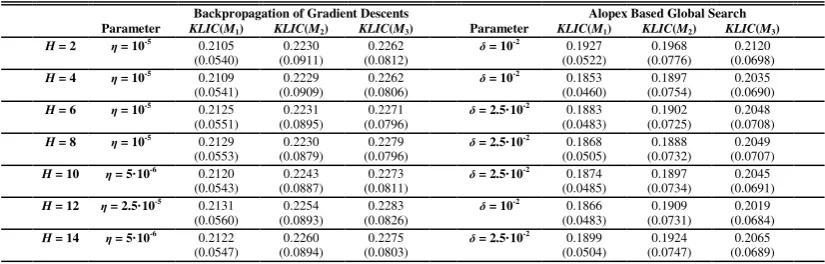
Table 1 shows the best solutions of both procedures for ΩH with H = 2, 4, 6, 8, 10, 12
and 14. Learning [in-sample] performance is measured in terms of KLIC M
( )
1 ,validation performance in terms of KLIC M
( )
2 and generalization [out-of-sample] performance in terms of KLIC M( )
3 . The performance values represent the mean of60
B= bootstrap replications, standard deviations are given in brackets. The results
achieved illustrate that Alopex based global search outperforms backpropagation of
gradient descents in all cases, in terms of both learning and generalization performance.
There is also strong evidence of the robustness of the algorithm, measured in terms of
standard deviation. We attribute Alopex superiority in finding better local minima to its
7 Conclusions and Outlook
Learning neural spatial interaction parameters is like solving an unconstrained
continuous non-linear minimization problem. The task is to find parameter assignments
that minimize the given negative log-likelihood function. Product unit neural spatial
interaction network learning is a multimodal non-linear minimization problem with
many local minima. Local minimization algorithms such as backpropagation of
gradient descents have difficulties when the surface of the search space is flat [that is,
gradient close to zero], or when the surface is very rugged. When the surface is rugged,
a local search from a random starting point generally converges to a local minimum
close to the initial point and to a worse solution than the global minimum.
Global search procedures such as Alopex based search, as opposed to local search, have
to be used in learning problems where reaching the global optimum is at premium. But
the price one pays for using global search procedures in general and Alopex search in
particular is increased computational requirements. The intrinsic slowness of global
search procedures is mainly due to the slow but crucial exploration process employed.
An important lesson from the results of the study and an interesting avenue for research
is, thus, to make global search more speed efficient. This may motivate the
development of a hybrid procedure that uses global search to identify regions of the
parameter space containing promising local minima and gradient information to
References
Bia, A. (2000): A study of possible improvements to the Alopex training algorithm,
Proceedings of the VIth Brazilian Symposium on Neural Networks, pp. 125-130.
IEEE Computer Society Press
Bishop, C.M. (1995): Neural networks for pattern recognition. Clarendon Press,
Oxford.
Cichocki, A. and Unbehauen, R. (1993): Neural networks for optimization and signal
processing. John Wiley, Chichester.
Efron, B. (1982): The jackknife, the bootstrap and other resampling plans. Society for
Industrial and Applied Mathematics, Philadelphia
Fischer, M.M. and Reismann, M. (2002a): Evaluating neural spatial interaction
modelling by bootstrapping, Networks and Spatial Economics [in press]
Fischer, M.M., and Reismann, M. (2002b): A methodology for neural spatial
interaction modeling, Geographical Analysis 34(2) [in press]
Fischer, M.M., Reismann, M. and Hlavackova-Schindler, K. (2002): Neural network
modelling of constrained spatial interaction flows: Design, estimation and
performance issues, Journal of Regional Science 42 [in press]
Harth, E. and Pandya, A.S. (1988): Dynamics of ALOPEX process: Application to
optimization problems. In Ricciardi, L.M. (ed.): Biomathematics and related
computational problems, pp. 459-471. Kluwer, Dortrecht.
Hassoun, M.M. (1995): Fundamentals of neural networks. MIT Press, Cambridge and
London.
Kirkpatrick, S., Gelatt, C.D. and Vecchi, M.P. (1983): Optimization by simulated
annealing, Science 20, 671-680.
Kullback, S. and Leibler, R.A. (1951): On information and sufficiency, Annals of
Mathematical Statistics 22, 78-86
Press, W.H., Teukolsky, S.A., Vetterling, W.T. and Flannery, B.P. (1992): Numerical
recipes in C: The art of scientific computing. Cambridge University Press,
Rumelhart, D.E., Hinton, G.E. and Williams, R.J. (1986): Learning internal
representations by error propagation. In Rumelhart, D.E., McClelland, J.L. and the
PDP Research Group (eds.): Parallel distributed processing: Explorations in the
microstructure of cognition, pp. 318-362. MIT Press, Cambridge [MA]
Rumelhart, D.E., Durbin, R., Golden, R. and Chauvin Y. (1995): Backpropagation: The
basic theory. In Chauvin, Y. and Rumelhart, D.E. (eds.): Backpropagation: Theory,
architectures and applications, pp. 1-34. Lawrence Erlbaum Associates, Hillsdale
[NJ]
Unnikrishnan, K.P. and Venugopal, K.P. (1994): Alopex: A correlation-based learning
algorithm for feedforward and recurrent neural networks, Neural Computation 6,
Table 1.
Approximation to the Spatial Interaction Function Using Backpropagation of Gradient Descents versus Alopex Based Global Search.
Backpropagation of Gradient Descents Alopex Based Global Search Parameter KLIC(M1) KLIC(M2) KLIC(M3) Parameter KLIC(M1) KLIC(M2) KLIC(M3)
H = 2 η = 10-5
0.2105 0.2230 0.2262 δ = 10-2
0.1927 0.1968 0.2120 (0.0540) (0.0911) (0.0812) (0.0522) (0.0776) (0.0698)
H = 4 η = 10-5
0.2109 0.2229 0.2262 δ = 10-2
0.1853 0.1897 0.2035 (0.0541) (0.0909) (0.0806) (0.0460) (0.0754) (0.0690)
H = 6 η = 10-5
0.2125 0.2231 0.2271 δ = 2.5·10-2
0.1883 0.1902 0.2048 (0.0551) (0.0895) (0.0796) (0.0483) (0.0725) (0.0708)
H = 8 η = 10-5
0.2129 0.2230 0.2279 δ = 2.5·10-2
0.1868 0.1888 0.2049 (0.0553) (0.0879) (0.0796) (0.0505) (0.0732) (0.0707)
H = 10 η = 5·10-6
0.2120 0.2243 0.2273 δ = 2.5·10-2
0.1874 0.1897 0.2045 (0.0543) (0.0887) (0.0811) (0.0485) (0.0734) (0.0691)
H = 12 η = 2.5·10-5
0.2131 0.2254 0.2283 δ = 10-2
0.1866 0.1909 0.2019 (0.0560) (0.0893) (0.0826) (0.0483) (0.0731) (0.0684)
H = 14 η = 5·10-6
0.2122 0.2260 0.2275 δ = 2.5·10-2
0.1899 0.1924 0.2065 (0.0547) (0.0894) (0.0803) (0.0504) (0.0747) (0.0689)
Note: KLIC-performance values represent the mean (standard deviation in brackets) of B = 60 bootstrap replications differing in both the initial parameter values randomly chosen from [-0.3; 0.3] and the data split. KLIC(M1): Learning performance measured in terms of average KLIC;KLIC(M2): Validation performance
measured in terms of average KLIC;KLIC(M3): Generalization performance measured in terms of average