Volume 43- No.21, April 2011
An Improved Byzantine Agreement Algorithm for
Synchronous Systems with Mobile Faults
Nazreen Banu, Samia Souissi, Taisuke Izumi and Koichi Wada
Graduate School of Engineering, Nagoya Institute of Technology, Gokiso-cho,
Showa-ku, Nagoya, Aichi, 466-8555, Japan. Phone: +81-52-735-5438, Fax: +81-52-735-5408
Email: [email protected] (or) [email protected]
{
souissi.samia,t-izumi,wada
}
@nitech.ac.jp
ABSTRACT
We study the problem of Byzantine agreement in synchronous systems where malicious agents can move from one process to another and try to corrupt them. This model is known as mobile Byzantine faults. In a previous result [10], Garay has shown that n >6t (nis the total number of processes, and t is the number of mobile faults) is sufficient to solve this problem even in the presence of strong agents. These agents can move at full speed (in the sense that each agent can take a movement in every round) and can make corrupted processes forget that they run the algorithm (as a result, after recovery a process must learn the current state of computation including the code from other processes). Many following results [3] have improved the above result but with some additional assumptions such as a corrupted process must recover and learn the current state of computation before another process can fail instead of it. The question, whether the result of Garay can be improved without any additional assumption, remains open. In this paper, we answer this question by providing an algorithm MBA that works with n >4t.
General Terms
Distributed Systems, Fault Tolerance Algorithms
Keywords
Synchronous Systems, Agreement(Consensus) Problem, Mobile Byzantine Adversary
1.
INTRODUCTION
Thedistributed consensus (agreement) problem
is a fundamental and important problem that has to be solved in designing fault-tolerant distributed systems. This problem can be stated informally
as: how to ensure that a set of distributed pro-cesses achieve agreement on a value or an action despite a number of faulty processes. This prob-lem is interesting both in theoretical and practical aspects. From theoretical point of view, the sig-nificance of the consensus problem derives from several other distributed systems problems being reducible or equivalent to it. Examples are atomic broadcast [6, 8, 9], non-blocking atomic commit [11], group membership [11] and state machine replication[18]. From a system perspective, repli-cation of components and services is an impor-tant paradigm that can be employed for informa-tion protecinforma-tion in critical applicainforma-tions, and con-sensus plays a fundamental role in many replica-tion algorithms. Some example solureplica-tions based on these ideas are: Bessani et al. [2] and Yin et al. [21] use replication to implement fault- and intrusion-tolerant firewall devices; Cachin et al. [4] and Castro and Liskvo [5], Chun et al. [7] and Veronese et al. [20] propose replication algo-rithms to implement highly resilient services, like data historians or DNS (essential for the Inter-net).
Algorithms that solve consensus vary much de-pending on the assumptions that are made about the system. This paper considers the systems that experienceByzantine faults[13], more destructive faults which do not put any constraints on how processes fail. Algorithms based on this system model are expected to work correctly no matter how faulty processes behave. Byzantine consen-sus algorithms are highly essential for practical systems to deal with malicious attacks or situa-tions where faults are difficult to characterize.
International Journal of Computer Applications (0975 - 8887) Volume 43- No.21, April 2011
common output value (Agreement property) that has to be related to the set of input values ( Va-lidity property). However, in many situations, reaching a common agreement among the cor-rect processes in the presence of moving mali-cious agents, such as mobile viruses, is highly re-quired. This problem is referred to as the mobile Byzantine agreement(consensus) problem. Reis-chuk [15] worked on a model with malicious faults covering a fraction of the network, and designed a Byzantine agreement protocol which tolerates them as long as they remain immobile for a given interval of time. However, the model which we fo-cus in this paper was initiated by Ostrovsky and Yung [14]. They used randomization and infor-mation theoretic security methods to provide mo-bile virus protection at run time. They worked on means to tolerate mobile viruses which can be viewed as transient faults. They used the no-tion of a mobile adversary. In the static adver-sary model, a constant fraction of processes may be faulty and the static adversary is not allowed to move faults once it has chosen a set of faulty processes. However, in the case of mobile adver-sary, the adversary is said to be infinitely powerful and can inject and distribute faults into the sys-tem at a constant rate in every round. Unlike its static counterpart the mobile adversary is allowed to change the position of the faults. We can as-sume that only a constant fraction of processes may be infected in a round. But, we also allow every process to be infected in some round. We also need the capacity to reboot the infected ma-chine on detection of fault. Another requirement is the property that fault detection can proceed at the same rate as infection. This can be justified for a general setting by the results of Kepphart and White [12] . Ostrovsky et al. [14] were able to show that a weak fault detection capacity is sufficient to make computation robust in this sce-nario.
Garay [10] investigated the mobile fault envi-ronment for solutions to the problem of Byzan-tine agreement. He studied the power of disrup-tion of malicious agents as a funcdisrup-tion of the speed with which they can traverse the network (called roaming pace). Specifically, the roaming pace ρ denotes the minimal amount of time (i.e., the number of rounds) that has to elapse between the time at which an agent leaves a process, and the time at which it starts to corrupt another process. For example,ρ= 3 means that an agent takes at least 3 rounds to hop from one process to another. In particular, Garay [10] proposed two protocols for solving Byzantine agreement problem in syn-chronous systems with mobile adversary. He as-sumed that at least one process remains
uncor-rupted forO(n) rounds, since a discouraging im-possibility result [16] proved that consensus is not solvable without restrictions even with a single mobile failure. The first protocol is for agents that move at full speed (i.e., ρ= 1). It requires n >6t. The second protocol assumesn >4t, but it deals with agents that move at half-speed (i.e., ρ= 2). These protocols run in O(n) communica-tion rounds.
Later on, Burhman et al. [3] proposed an opti-mal Byzantine consensus algorithm withn > 3t for full speed agents. However, they added the assumptions that agents can move from one pro-cess to another only through messages (i.e., the migration of the agents is possible only during the send operations), and a faulty process must recover and learn the current state of computa-tion before another process can fail instead of it. In a recent work, Biely et al. [1] proposed a mo-bile Byzantine agreement algorithm for partially synchronous systems forn >3t, with the same as-sumption that a faulty process must recover and learn the current state of computation before an-other process can fail instead of it. However, this algorithm guarantees termination only when all faulty processes have recovered. In a different work, Schmid et al. [17] presented impossibility results and lower bounds on the required number of processes and rounds for synchronous systems under mobile link failure model.
The question that remains open is, can the result of Garay [10](n > 6t) be improved with-out adding any additional assumptions? In other words, what is the required number of processes to solve mobile Byzantine agreement problem in synchronous systems where malicious agents move at full speed and corrupt new processes be-fore the previously corrupted processes recover?
This paper answers this question by providing an algorithmMBA that solves mobile Byzantine agreement problem in Garay’s model withn >4t. The remainder of this paper is structured as follows. Section 2., introduces the system model and the mobile Byzantine agreement problem we are interested in. Section 3., provides our algo-rithm MBA that solves this problem under the requirement ofn >4tand proves its correctness. Section 4. presents the discussion, and the con-clusion is given in Section 5..
2.
PRELIMINARIES
2.1
System Model
oc-2.3 Notations Volume 43- No.21, April 2011
curs. Our system is synchronous. This means that its execution is organized by a sequence of rounds during which each process can send mes-sages to other processes, receive mesmes-sages, and perform some local computation. Also, a message that is sent in some round is necessarily received within in the same round.
We assume that the system is interfered by a powerful computationally unbounded adversary which can inject up totmalicious agents into the system. These agents can move from processes to processes at full speed (means, it takes an agent at least one round to migrate from one process to another) and corrupt them in a dynamic fashion. In the worst case, they do erase the local mem-ories of the processes. Because of the mobility of agents, any process can be corrupted during the course of the algorithm. However, we assume that at least one process remains uncorrupted for O(n) rounds. Since each agent can corrupt one process at a round, the total number of corrupted processes in any round is at mostt. A corrupted process may behave arbitrarily, which means that even it is allowed not to follow the deployed algo-rithm. In addition, we assume that a corrupted process can recover and rejoin the on-going exe-cution after the corrupting agent left it. The se-mantics of rejoining is as follows: Let us assume that an agent leaves a processpin roundr; Pro-cess precovers in round r+ 1; After recovery, it learns the code and the current state of compu-tation from other processes by receiving messages that were sent in roundr+ 1; Then,pstarts par-ticipating in the on-going execution from round r+ 2.
We refer the processes that are corrupted in the current round as faulty or infected, and the pro-cesses that were faulty in the previous round, but no longer ascured. Also, we use the termcorrect
to refer the processes that are neither faulty nor cured in the current round.
2.2
Problem Definition
In mobile Byzantine agreement problem, each correct processphas an initial valuevp from the
set V of all possible initial values, and decides a valuevaccording to the following rules.
• Termination: Each non-faulty process eventually irreversibly decides a valuev.
• Agreement: The non-faulty processes de-cide on the same value.
• Unanimity: If all non-faulty processes have the same initial valuev, then no non-faulty process decides a value different fromv.
• Consistency maintenance: Once agree-ment is reached among currently noninfected
processes, it must be maintained among the (possibly different) noninfected processes.
Note that, any algorithm that solves the above problem is responsible not only for reaching the agreement, but for preserving the agreement among all correct processes forever. This is re-quired, since even if agreement is reached at some point, the mobile agents can move to corrupt the correct processes and make the agreement disap-pear.
2.3
Notations
LetV be an ordered set of all possible proposal values. We introduce the default value ⊥ such that ⊥∈ V/ and ⊥< min(V). Let I be an vector in (V ∪ {⊥})n. The number of occurrences of a
valuev inI is denoted by #v(I).
3.
AN
IMPROVED
MOBILE
BYZANTINE
AGREEMENT
ALGORITHM
3.1
Algorithm
MBA
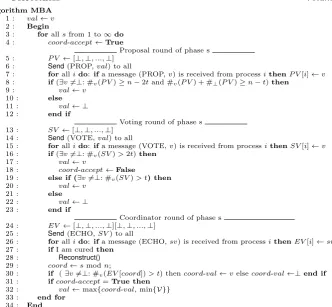
In this subsection, we present a mobile Byzan-tine agreement algorithmMBAfor synchronous systems. The algorithm is described in Fig. 1. It requires n > 4t and at least one process re-mains uncorrupted for at least 3n rounds. This algorithm consists of phases, each phase is made of three rounds, namely, Proposal round, Voting round, and Coordinator round during which the processes exchange messages. Each message con-sists of values and a message tag (such asPROP,
VOTE and ECHO) that indicates the name of the round in which it is sent. These messages also include the algorithmic code and the current state of computation, etc., that help the recov-ering processes to correctly reintegrate into the on-going execution, but they are omitted for the sake of clarity. Remember that, in our model the cured processes do not send messages but they can receive messages. The three rounds are de-tailed as follows, where in the description, just ’process’ means correct or cured one.
• Proposal round: The aim of this round is to end up in a situation where there is a single value v (v ̸=⊥), such that each process adopts either v or ⊥. To attain this goal, each process sends a message < P ROP, val > to provide the other processes with its valuevaland stores the received val-ues in vector P V. Note that, since cured processes (if any) are silent, the entries that correspond to them inP V contain⊥. A pro-cesspadopts a valuevif only if it appears at leastn−2ttimes inP Vpand the sum of the
3.2 Correctness
International Journal of Computer Applications (0975 - 8887) Volume 43- No.21, April 2011
Algorithm MBA
1 : val←v
2 : Begin
3 : forallsfrom 1 to∞do
4 : coord-accept←True
Proposal round of phase s 5 : P V ←[⊥,⊥, ...,⊥]
6 : Send(PROP,val) to all
7 : forallido: ifa message (PROP,v) is received from processithenP V[i]←v
8 : if(∃v̸=⊥: #v(P V)≥n−2tand #v(P V) + #⊥(P V)≥n−t)then
9 : val←v
10 : else
11 : val← ⊥
12 : end if
Voting round of phase s 13 : SV ←[⊥,⊥, ...,⊥]
14 : Send(VOTE,val) to all
15 : forallido: ifa message (VOTE,v) is received from processithenSV[i]←v
16 : if(∃v̸=⊥: #v(SV)>2t)then 17 : val←v
18 : coord-accept←False
19 : else if (∃v̸=⊥: #v(SV)> t) then 20 : val←v
21 : else
22 : val← ⊥
23 : end if
Coordinator round of phase s 24 : EV ←[⊥,⊥, ...,⊥][⊥,⊥, ...,⊥]
25 : Send(ECHO,SV) to all
26 : forallido: ifa message (ECHO,sv) is received from processithenEV[i]←sv
27 : ifI am curedthen
28 : Reconstruct() 29 : coord←smodn;
30 : if (∃v̸=⊥: #v(EV[coord])> t) thencoord-val←velsecoord-val←⊥end if
31 : ifcoord-accept=True then
32 : val←max{coord-val,min{V}} 33 : end for
[image:4.595.85.418.55.362.2]34 : End
Figure 1: Algorithm MBA
at leastn−t. Since any two sets ofn−t val-ues will intersect at a correct process’s value, it is ensured that there exists a single value v and all processes that do not adopt⊥will adopt the same valuev.
• Voting round: In this round, each process checks for the existence of a unique value v. If such a value v exists, it adopts v and chooses not to adopt the coordinator value in the next round. To do this, each pro-cess sends its value val in a VOTE message < V OT E, val > to all processes and stores the received values in a vector SV. If more than 2t of the votes are for some value v, then it adopts v and chooses not to accept the coordinator value by setting its variable coord-acceptas ”F alse”. Otherwise, if more thantof the votes are forv, it adoptsv, else it adopts⊥. In these cases, it chooses to ac-cept the coordinator value in the following round.
• Coordinator round: The aim of this round is to try to make all processes have the same value. In this round, each process echoes the votes that it has received in the vot-ing round through an ECHO message <
ECHO, SV >in order to help the cured pro-cesses to reconstruct their variables. Since all correct processes send their vectors, each cured process can compute the correct val-ues of its variables by reconstructing the pre-vious voting round using the procedure Re-construct, given in Fig. 2, and each process correctly computes the current coordinator value. Then, only the processes that chose to accept the coordinator value adopt the coor-dinator value, the remaining processes omit that value . The secret hidden here is, when the coordinator is correct, all processes adopt the same value v regardless of whether they accept or ignore the coordinator value.
3.2
Correctness
In the following, for a given phasel, letNv c(l)
andNv
cu(l) respectively be the number of correct
processes and the number of cured processes that adoptv (v̸=⊥) at the end of the phasel.
Lemma 1 (Agreement) The non-faulty pro-cesses decide on the same value.
3.2 Correctness Volume 43- No.21, April 2011
Procedure Reconstruct()
35 : Begin
36 : forallido
37 : if∃v̸=⊥such that|{j|EV[j][i] =v}| ≥n−2tthen 38 : SV[i]←v
39 : else
40 : SV[i]← ⊥ 41 : end if
42 : end for
43 : if(∃v̸=⊥: #v(SV)>2t)then
44 : val←v
45 : coord-accept←False
46 : else if (∃v̸=⊥: #v(SV)> t) then
47 : val←v
48 : else
49 : val← ⊥
50 : end if
51 : End
Figure 2: Procedure Reconstruct
the same value v, i.e., the condition Nv c(l) +
Nv
cu(l)≥n−tholds.
Remember that, we have assumed that at least one process, say k, remains uncorrupted for at least 3nrounds. Letl be the phase in which pro-cesskis the coordinator. Since,kis correct, it will send the same vectorSVk to all processes. There
are two cases to consider at line 31 of algorithm
MBA:
• (Case 1) coord-acceptis T rue for each pro-cess p (it meansp chooses to adopt the co-ordinator value). Since all processes get the same vector SVk from k, they compute the
same valuevat line 32 and adopt it. Hence, Nv
c(l) +Ncuv(l) ≥ n−t holds. The lemma
follows.
• (Case 2)coord-acceptisF alsefor some pro-cessp(it means thatpdoes not adopt the co-ordinator value while other processes adopt that value). Since coord-accept is F alse at p, it follows that there exists some value v such that #v(SVp)>2t, and hencepadopts
v. Note that, in voting round, if two correct processes vote for v /∈⊥ and v′ ∈⊥/ respec-tively, then v =v′. Also, since there are at most t Byzantine processes, and cured pro-cesses do not cast vote, it is guaranteed that at the coordinator process k, #v(SVk) > t
and #v′(SVk) ≤ t holds for any value v′
(v′ ∈ {/ v,⊥}). Hence, at each process, the coordinator value is v. Consequently, all processes (correct and cured) have the same valuev regardless of whether they accept or ignore the coordinator value. The lemma fol-lows.
2
Lemma 2 (Consistency maintenance)
Let n ≥ 4t + 1. If at the end phase l,
Nv
c(l) +Ncuv(l) ≥ n−t holds for some value v,
thenNv
c(m) +Ncuv(m)≥n−tholds at all phases
m(m > l).
Proof Assume that at the end of phase l, Nv
c(l) +Ncuv (l) ≥ n−t holds for some value v.
In the proposal round of phase l + 1, at most t new faults can occur. Hence, at least n−2t processes certainly send v. Note that, for each new fault there is a cured process, and cured pro-cesses do not send any messages (by definition). Hence, at any process p, the entries that corre-spond to cured processes in P Vp contain ⊥. As
a result, the condition #v(P Vp) ≥ n−2t and
#v(P Vp) + #⊥(P Vp) ≥n−t holds. Also, since
there are at mosttfaulty processes, #v′(P Vp)≤t
for any value v′ (v′ ∈ {/ v,⊥}). Hence, all cor-rect and cured processes (at leastn−tprocesses) adoptv.
In the voting round, since at mostt new faults can occur, at leastn−2t≥2t+ 1 processes can vote for v. Hence, p can collect at least n−2t votes forv(i.e., #v(SVp)>2t). Since there are at
mosttByzantine faults,pcan get at mosttvotes for any value v′(v′ ∈ {/ v,⊥}). As a result, each correct and cured process (at leastn−t) adoptsv and choose not to adopt coordinator value in the next round.
Among these processes, at mosttprocesses can become faulty in the coordinator round and the remaining (at leastn−2t) processes havev and do not adopt the coordinator value. Again, for each new fault there is a cured process. Since, all correct processes broadcast their vote vec-tor SV, each cured process p correctly recon-structs the previous voting round using procedure
Reconstruct, and finds #v(SVp) > 2t.
There-fore, it adopts v and and ignores the coordina-tor value. As a result, at the end of phasel+ 1, Nv
c(l+1)+Ncuv (l+1)≥n−tholds. The situation
REFERENCES
International Journal of Computer Applications (0975 - 8887) Volume 43- No.21, April 2011
Lemma 3 (Unanimity) If all non-faulty pro-cesses have the same initial valuev, then no non-faulty process decides a value different fromv.
Proof All non-faulty processes (at least n-t) have the same initial valuev at the beginning of phase1. This statement can be interpreted as at least n-t processes have the same value v at the end of phase0. By using the same arguments as in lemma 2, we can show that at the end of phase1, Nv
c(1) +Ncuv (1)≥n−t holds and this situation
continues in all the following phases. Hence, the
lemma holds. 2
Lemma 4 (Termination) Each non-faulty process eventually irreversibly decides a value.
Proof From lemma 1, we can prove that all pro-cesses (correct and cured) certainly decide on the same value v (v ∈ V) at the end of the correct coordinator phase l (l ≤n). Then, from lemma 2, we can show that the decision value will not change after phasel. Hence, the lemma holds. 2
Theorem 1 Let n > 4t. The algorithm MBA described in Fig. 1 solves the mobile Byzantine agreement problem.
Proof The proof follows from lemmas 1, 2, 3,
and 4. 2
4.
DISCUSSION
We conjecture that we can not improve the resilience more than n > 4t, since in a previ-ous result [19], Thambidurai et al. have proved that, even in static failure models (strong mod-els),n >4t is the necessary assumption to solve consensus witht benign failures andt Byzantine failures. Note that, benign failures are less se-vere than Byzantine failures. An example for be-nign failures is omission failure. When a process fails by omission, it forgets to send or receive mes-sages. In our model, we may consider the cured processes as omission failures since they do not send any messages. Hence, we can say that our model also suffers fromtbenign andt Byzantine failures. Moreover, our model is a weak model the sense that the set of faulty processes dynamically changes in every round.
5.
CONCLUSION
[image:6.595.313.522.102.152.2]In this paper, we studied the Byzantine agree-ment problem with mobile faults. We have pre-sented an algorithm MBA for synchronous sys-tems where there aretmalicious agents that move at full speed to corrupt and destroy the memory of processes. Our algorithm improves the result
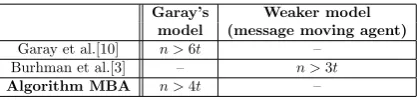
Table 1: Performance comparison of Algorithm MBA with previous works.
Garay’s Weaker model
model (message moving agent)
Garay et al.[10] n >6t – Burhman et al.[3] – n >3t
Algorithm MBA n >4t –
of Garay[10], namely it requires n >4t in stead ofn >6t[10].
Table 1 compares our algorithm MBA with pre-vious ones. One drawback of our algorithm is, it requires 3n communication rounds while the al-gorithm of Garay[10] requires 2nrounds.
REFERENCES
[1] M. Biely and M. Hulte: ”Consensus When All Processes may be Byzantine for Some Time”, In Proc. 11th International Sympo-sium on Stabilization, Safety, and Security of Distributed Systems (SSS ’09), vol.5873, pp.120–132, 2009.
[2] A.N Bessani and P. Sousa and M. Correia and N.F. Neves and P. Verissimo: ”The CRUTIAL way of critical infrastructure pro-tection”, IEEE Security and Privacy, vol. 6(6), pp. 44-51, 2008.
[3] H. Buhrman, J. A. Garay and J.Hoepman: ”Optimal Resiliency Against Mobile Faults”,
In Proc. 25th International Symposium on Fault-Tolerant Computing (FTCS’95), 1995.
[4] C. Cachin and K. Kursawe and F. Pet-zold and V. Shoup: ”Secure and efficient asynchronous broadcast protocols (extended abstract)”, Kilian, J., editor, Advances in Cryptology: CRYPTO 2001, vol.2139 of LNCS, pp. 524-541, 2001.
[5] M. Castro and B. Liskov: ”Practical Byzan-tine fault tolerance and proactive recovery”,
ACM Transactions on Computer Systems, vol.20(4), pp. 398-461, 2002.CMS07,
[6] T. Chandra and S. Toueg: ”Unreliable fail-ure detectors for reliable distributed sys-tems”, Journal of the ACM, vol.43(2), pp.225-267, 1996.
REFERENCES
Volume 43- No.21, April 2011[8] M. Correia and N.F. Neves and P. Veris-simo: ”From consensus to atomic broad-cast: Time-free Byzantine-resistant proto-cols without signatures”, ”Computer Jour-nal, vol. 41(1), pp. 82-96, 2006.
[9] V. Hadzilacos and S. Toueg: ”A modular ap-proach to fault-tolerant broadcasts and re-lated problems”, Technical Report TR94-1425, Cornell University, Department of Computer Science, 1994.
[10] J.A. Garay: ”Reaching (and Maintaining) Agreement in the Presence of Mobile Faults”,
In Proc. 8th International Workshop on Dis-tributed Algorithms, LNCS. No.857, pp.253– 264, 1994.
[11] R. Guerraoui and A. Schiper: ”The generic consensus service”, IEEE Transactions on Software Engineering, vol. 27(1),pp. 29-41, 2001.
[12] Kepphart and White: ”Directed graph epi-demiological models of computer viruses”,
IEEE symposium on Security and Privacy, 1991.
[13] L. Lamport and R. E. Shostak and M. C. Pease: ”The Byzantine Generals Problem”,
ACM Transactions on Programming Lan-guages and Systems (TOPLAS), vol.4(3), pp. 382–401, 1982.
[14] R. Ostrovsky and M. Yung: ”How to with-stand mobile attacks”In Proc. of tenth an-nual ACM symposium on Principles of dis-tributed computing(PODC’91), 1991.
[15] R. Reischuk: ”A new solution for Byzantine generals problem”,Information and Control, vol. 64, 1985.
[16] N.Santoro and P.Widmayer: ”Time is not a healer”, In Proc. 6th Annual Sympo-sium on Theor. Aspects of Computer Sci-ence(STACS89), LNCS.No.349, pp.304-313, 1989.
[17] U. Schmid, B. Weiss and I. Keidar: ”Impos-sibility Results and Lower Bounds for Con-sensus under Link Failures”, SIAM Journal on Computing”, vol.38, pp. 1912–1951, 2009.
[18] F.B. Schneider: ”Implementing faul-tolerant services using the state machine approach:
A tutorial”, ACM Computing Surveys,
vol.22(4), pp. 299-319, 1990.
[19] P. Thambidurai and You-Keun Park: ”In-teractive Consistency with Multiple Failure Modes”, In Proc. Reliable Distributed Sys-tems, pp.93–100, 1988.
[20] G.S. Veronese and M. Correia and A.N. Bessani and L.C. Lung: ”Highly-resilient ser-vices for critical infrastructures”, In Proc. of the Embedded Systems and Communica-tions Security Workshop, 2009.