Multi-user Detection Schemes for TH PPM UWB
System using LDPC Codes
M. Jayasheela
Assistant Professor ECE Department SNS College of Technology
Vazhiyampalayam Coimbatore-641035
Dr. A. Rajeswari
Associate Professor&Head ECE Department Coimbatore Institute of
Technology Coimbatore-641014
D. Prabha
II ME Communication Systems ECE Department SNS College of Technology
Vazhiyampalayam Coimbatore-641035
ABSTRACT
In multiuser environments, multi access interference (MAI) is occurred in UWB System.To overcome above problems Multiuser Detection Schemes (MUD) are used in wireless UWB System. Channel coding is another technique to reduce the multiuser access interference (MAI). One such code is LPDC codes for robust image transmission . Proposed system employs channel coding(LDPC Codes) with MUD schemes over UWB channel with TH PPM modulation in order to reduce multi access interference and leads to capacity increase for Bio-medical image transmission which is used Telemedicine application.Telemedicine provides medical information and services using telecommunication technologies .It includes systems for remote clinical case and consultation through the use of electronic imaging equipment. This paper presents BER performance of UWB system and capacity using LDPC code over TH-PPM UWB system with MUD schemes for data/ image transmission.
General Terms
Performance Analysis
Keywords
TH PPM UWB, Multiuser detection schemes, LDPC Codes, SV Channel Model,ZCZ Sequences.
1.
INTRODUCTION
Ultra wide band transmission is suitable for low power indoor applications where there is high clutter that is the surrounding environment causes large amounts of multipath.UWB system based on impulse radio concepts. Impulse radio is the generation of a series of very short pulses.one type of pulse is the Gaussian monocycle which is based on the first derivative of gausssian function. The wave form of the Gaussian
monocycle is given by
2
6
t exp
t A ) t ( v
(1)
Where A is an amplitude scale factor and is the time constant of the pulse. It consists of a positive lobe followed by a negative lobe with a total pulse width of approximately.
Time Hopping Pulse Position Modulation Ultra Wideband systems (TH PPM UWB) employs a key role in the 4G wireless communications applications because of their
efficient use of the channel. In this modulation randomly generated TH code used for time hopping. The modulated data sequence is converted into UWB pulses by multiplying with the second derivative Gaussian monopulse..Hence recent
literatue [3] proposes the improvement in the capacity of TH-PPM UWB systems. In Multiuser environments mobile communication systems employ with Multiple-Access Interference (MAI), since it is impossible to maintain orthogonal spreading codes in mobile environments. MAI limits the capacity of Conventional detectors and brings on strict power control requirements to alleviate the Near-Far problem. Multi-user Detector (MUD) techniques exploit the character of the MAI by removal of the Multi-User Interference from each user‟s received signal before making data decision, and offer better gains in capacity.
A binary ZCZ code based on m-sequences, called m-ZCZ code. Its length can be flexibly selected to match the maximum time delay with the great degree-of-freedom, such that constructed interference resistant UWB system can support more users than that using conventional binary ZCZ codes[8].
The literature [5] suggests that LDPC codes have a significantly lower complexity than Turbo codes at the code lengths, and high S/N ratio. An advantage with LDPC codes is decoding process is easy and it suits for transmitting biomedical images which is used in telemedicine environment.
The objective of this paper is to compare the performance of TH PPM UWB receiver using m-ZCZ sequences which uses MUD schemes and to compare its BER Performance of TH PPM UWB system for single user and multi user system is compared using SV channel models.
2.
LITERATURE SURVEY
Current UWB systems utilizes low-density parity-check codes(LDPC) because it surpass turbo codes in terms of Bit Error rate and performance in the high coding gain , leaving turbo codes better suited for the lower code rates[4]
.
In 2007 TH PPM UWB system of image transmission is presented and analyzed for AWGN channel[10].In 2008 The performance of multi access interference cancellations for the asynchronous M-ary pulse position modulation time hopping UWB systems are investigated. Iterative interference cancellation is introduced in this paper[11].The performance of these interference cancellation scheme compared with SIC and PIC interms of the symbol error rate for asynchronous M-ary PPM TH UWB systems.The new IIC scheme achieves good trade off between the performance and processes complexity than the PIC and SIC.In 2010 the performance of binary double error correcting code for UWB communication for a specific application of image transmission[12].
In our proposed work LDPC decoding is used at the MMSE receiver side in TH PPM UWB System in order to mitigate the multiple access interference in muti user environments.
3.
LOW DENSITY PARITY CHECK
CODES
LDPC Codes are designed by constructing a sparse parity check matrix first and then determing a generator matrix for the code.In regular LDPC code parity-check matrix (Wc, Wr)
bit is contained in a fixed number, Wc of parity checks and
each parity-check equation contains a fixed number, Wr of
code bits. For an irregular parity-check matrix the fraction of columns of weight is vi and the fraction of rows of weight is
hi .LDPC codes represents in graphical form by a Tanner
graph [1].The Tanner graph consists of two sets of vertices: n vertices for the codeword bits called as bit nodes and m vertices for the parity-check equations called as check nodes . An edge joins a bit node to a check node if that bit is included in the corresponding parity-check equation and so the number of edges in the Tanner graph is equal to the number of ones in the parity-check matrix.
3.1LDPC ENCODING
To achieve the desired bit error rate(BER), longer LDPC codes with higher code rate are preferred.
H=
A systematic LDPC code generator matrix for a code with parity-check matrix H can be found by performing Gauss-Jordan elimination on H to obtain it in the form
A
,
I
n k
H
(2)where A is a (n − k) × k binary matrix and In−k is the size n − k
identity matrix.
The generator matrix is then
T
k
,
A
I
G
(3)In LDPC Encoding fixed bits positions has to be identified. In Systematic LDPC codes the value of transmission code word must be same as values of H matrix„s message word.
Let H
hi,j m×n is the check matrix of LDPCcode,C
C1,C2,C3...CN
the encoder‟s code word andfixed bit set is S
Ci1,Ci2,...Cij...Cik
n ij
0 ,order Cij=0 or Cij=1 then encoded output is
C C Ci Ci Cij Cij CiK CN
C 1, 2... 1, 1... , 1,... ...
that is the message of bit nodes and check nodes are not translated but translated only the fixed number of „0‟s or „1‟s.The decoder can use the value of fixed bits which lead to improve the accuracy of decoding [16].
3.2LDPC DECODING
Decoding is done by using hard message passing algorithm of LDPC Codes known as bit flipping algorithm.
3.2.1 Bit Flipping Algorithm
A binary (hard) decision about each received bit is made by the detector and this is passed to the decoder. For the bit-flipping algorithm the messages passed along the Tanner graph edges are also binary: a bit node sends a message declaring if it is a one or a zero, and each check node sends a message to each connected bit node, declaring what value the bit is based on the information available to the check node. The check node determines that its parity-check equation is satisfied if the modulo-2 sum of the incoming bit values is zero. If the majority of the messages received by a bit node are different from its received value the bit node changes (flips) its current value. This process is repeated until all of the parity-check equations are satisfied, or until some maximum number of decoder iterations has passed and the decoder gives up [1].
4. MINIMUM MEANSQUARE ERROR
MULTI USER DETECTION
A multiuser detector that is closely related to the decorrelating detector is the linear minimum mean square error detector (MMSE). The goal is to minimize the mean-square-error (MSE) between the user kth bit and the output of the kth linear transformation. The probability of error analysis based on the Gaussian approximation has been proposed. The important references to MMSE detectors are Xie et al (1990); Madhow et al (1994); Poor et al (1997;Miller et al (1995); Madhow et al (1992); Poor et al (1997); Rapajic et al (1994) and Honig et al (1997) [14].
The MMSE detector is a linear detector which considers both the thermal noise and MAI Madhow U. (1994). It performs a
transformation LMMSE which minimizes
2
y
L d
E , the
mean square error between the actual data and the soft output of the MAI.
2 2
1
R
N
A
The hard estimate of the MMSE detector output is
)
Y
L
(
sign
d
mmse
mmse (6)The MMSE detector approaches the matched filter as NB
tends to infinity and converges to the decorrelating detector as signal to noise ratio goes to infinity.
5. UWB CHANNEL MODEL
The IEEE 802.15.3a Standard Model defined four different measurement environments, namely CM1, CM2, CM3 and CM4 [9].
CM1: line-of-sight (LOS) model for 0-4 m
CM2: Non-LOS (NLOS) model for 0-4 m
CM3: NLOS for 4-10 m
CM4: NLOS for 4-10 m, with extreme multipath channel condition
.
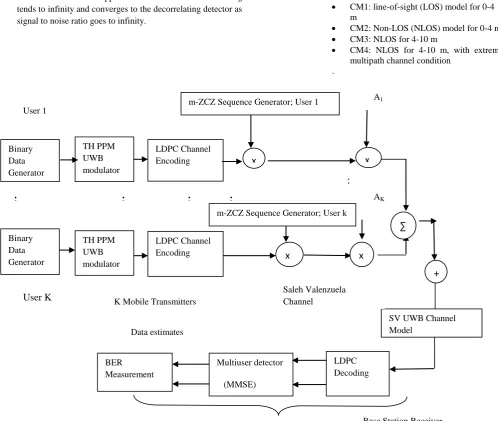
Fig. 1 Proposed TH PPM UWB Model using LDPC Codes
The channel model should consist of a definite set of Impulse response realizations. In the simulation, the impulse response of the channel is convolved with the time hopped PPM sequence which results in the faded output. Characteristics of the channel model has a strong influence on the system performance assessment. For example, channel CM1 has LOS component and considered for a range 0-4m. Hence it has less interference and less multipath components which contributes to its low bit error rate. While channel CM2 is considered in the same range but with NLOS environment. Channel CM3 and channel CM4 having the longer delay spread (several nanoseconds) compared to CM1 and CM2 have higher bit error rate. Channel CM4 has longer delay spread compared to CM3.
6. SIMULATIONMODELOF PROPOSED
TH PPM UWB SYSTEM
The performance comparisons of the MMSE based TH PPM under UWB Channels conditions are done using Monte Carlo simulations. Figure 1. shows the block diagram of the simulation model of the proposed system. The binary data for the different users are generated using Bernoulli sequence generator. The random sequence binary of 0‟s and 1‟s are fed into TH PPM modulator to get the time shifting of sequence and it is applied to Pulse shaper to get UWB Gaussian pulses.Each Gaussian pulses are transmitted through the LDPC Encoder. Each users‟ encoded output is multiplied by the m-ZCZ sequence of the corresponding user. The spreaded sequences are multiplied by the amplitude of each user. The amplitude values decide the power of each user. The transmitted sequences of different users are summed to represent the transmitted signal from different multiple mobile
:
Base Station Receiver
x
∑
A1
AK
Multiuser detector
(MMSE)
x
+
m-ZCZ Sequence Generator; User 1 User 1
SV UWB Channel Model
Binary Data Generator
LDPC Channel Encoding
:
:
:
:
User K
LDPC Decoding Data estimates
BER Measurement
x
K Mobile Transmitters
Saleh Valenzuela Channel TH PPM
UWB modulator TH PPM UWB modulator
m-ZCZ Sequence Generator; User k
Binary Data Generator
LDPC Channel
[image:3.595.37.536.126.547.2]users. This signal is transmitted through Saleh Valenzuela channels CM1, CM2, CM3 and CM4 under different fading conditions.Then the received signal is fed into LDPC decoder and the decoded outputs are fed into MMSE detector and BER performance is calculated.
7. RESULTS AND DISCUSSION
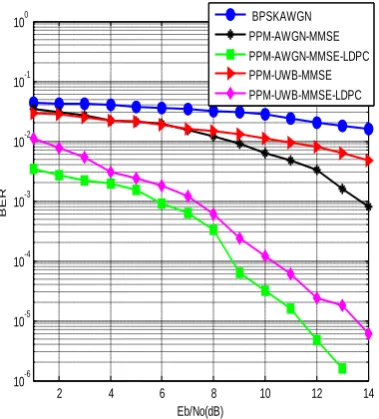
[image:4.595.329.519.78.288.2]BER Performance of the TH PPM UWB system of fig 2-3 , is performed using Monte Carlo Simulations. Gaussian UWB pulse is PPM modulated, coded and transmitted over AWGN as well as over UWBchannel. A MMSE detector is used in the receiver without any channel estimation.
Table 1.Input Parameters
Output Parameter
The output parameter is the Bit Error Rate for varying number of Energy to Noise Density Ratio and for varying number of users. The BER is calculated using the following equation:
ed transmitt er of bits
Total Numb
in error No of bits
BER
(6)
Fig 2-3 shows BER of TH PPM with and without error correcting code over AWGN and UWB channel along with theoretical BER of BPSK. From the figure. 2 for CM1 it can be observed that BER of 10 E-4 is achieved at SNRvarying from 10 to 14 dB when LDPC is used along with interference cancellation scheme MMSE and BER is increased to 10 E-2 when LDPC codes not employed with MMSE using PPM Modulation techniques.
From the figure.3 for CM4 it can be observed that BER of 0.009 is achieved at SNR is equal to 10 dB when LDPC is employed with interference cancellation scheme MMSE when UWB pulse is PPM modulated and BER is increased to 0.095when LDPC codes not used with MMSE .
2 4 6 8 10 12 14
10-6 10-5 10-4 10-3 10-2 10-1 100
Eb/No(dB)
BER
BPSKAWGN PPM-AWGN-MMSE PPM-AWGN-MMSE-LDPC PPM-UWB-MMSE PPM-UWB-MMSE-LDPC
Fig2 .BER perfomance of TH PPMUWB MMSE Using LDPC (CM1)
2 4 6 8 10 12 14
10-6 10-5 10-4 10-3 10-2 10-1 100
Eb/No(dB)
BER
BPSKAWGN PPM-AWGN-MMSE PPM-AWGN-MMSE-LDPC PPM-UWB-MMSE PPM-UWB-MMSE-LDPC
Fig3 .BER perfomance of TH PPMUWB MMSE Using LDPC (CM4)
8. APPLICATIONS
8.1Input as Image (Biomedical)
Based on the analysis of the multiuser TH-PPM UWB system, it may be used for indoor and outdoor signal propagation. One such application would be in telemedicine. Future applications in the area of telecommunications are being driven by the concept of being connected or able to communicate anywhere and at anytime. This type of scenario is also envisioned in medical healthcare area. Wireless medical telemetry has been experiencing continuous developments and improvements during recent years [18]. In this application a patient‟s health is remotely monitored through the use of radio technology. As a result of this wireless technology patients gain more mobility and comfort by not having to be physically connected to several pieces of medical equipment. In addition to improve the quality Pseudorandom Code m-ZCZ Sequences
Number of users 100
Channel AWGN/UWB Channel
Coding LDPC Codes
Inteference Cancellaion MMSE
[image:4.595.324.536.314.543.2]of patient care, wireless medical telemetry has also the potential to reduce the costs by decreasing the need to have medical personal in close proximity to patients at all times. Remote monitoring of patients enables a very efficient and timely use of doctors, nurses, and specialized medical equipment. Recent advances in wireless technology have led to the development of wireless body area networks (WBAN), where a set of communicating devices are located around the human body [17]. For the case of medical applications these devices are connected to sensors that monitor vital body parameters and movements. Among the vitals that are commonly measured we have electrocardiograms (EKG), blood oxygen saturation, blood pressure, and temperature. By measuring these vitals and wirelessly transmitting them to a control node or station a WBAN allows for the continuous monitoring of the patients‟ health status without the burden of physical wires attached to their bodies or frequent visits by medical personal.
In this section bio medical image is transmitted using TH PPM UWB system after coding by LDPC. Various images are tested and their PSNR values are calculated after passing through the UWB channel model 1.
10 20 30 40 50 60 10
20 30 40 50 60 70 80 90 100
Figure.6.Inputimage
10 20 30 40 50 60 10
20 30 40 50 60 70 80 90 100
Figure.7 PSNR=25. 8 after passing through CM1 in TH PPM MMSE without coding(LDPC
)
10 20 30 40 50 60
10 20 30 40 50 60 70 80 90 100
Figure.8 PSNR=28. 2 after passing through CM1 in TH PPM MMSE LDPC
9. CONCLUSION
In this paper Performance of UWB system and capacity using LDPC code over TH-PPM UWB system with MUD schemes for data/ image transmission is presented. In this proposed work the biomedical images are transmitted and tested .It gives better PSNR value when compared with TH PPM MMSE System without using LDPC codes. When data is transmitted it can be seen that LDPC codes improves the UWB system and makes it energy efficient by reducing required SNR, by the factor of 3 to 4 dB to achieve reasonably good BER. It is also found that BER Performance of CM1 is better than CM4 channel.
10. REFERENCES
[1]. Gallager, R. G. 1963 Low Density Parity Check Codes, Monograph, M.I.T. Press.
[2]. Richardson.T.2003 “Error floors of LDPC codes,” in Proc. 41st Allerton Conf. Comm., Control, and Comput., Monticello, IL..
[3].Michal M.Pietrzyk, 2010 “Error Control Coding Schemes for Ultra-wideband Impulse Radio Systems,” magister inzynier elektrotechniki,Kielce University of Technology geboren te Kielce, Polen, February.
[4]. Thomas J. Richardson and Rüdiger L. Urbanke, 2001 "Efficient Encoding of Low-Density Parity-Check Codes," IEEE Transactions in Information Theory,(Feb.2010) 47(2).
[5]. Ahmed Ebain, Mona Shokair, and Kamal Awadalla, 2009 “Comparison between Turbo code and Covolutional Product Code (CPC) for Mobile WIMAX” World Academy of Science, Egineering and Technology 51.
[6]. Ganlin Ye,Jing Li, Aiping Huang Hsiao-Hwa Chen,2007, “A Novel ZCZ code based on m-sequences and its applications in CDMA systems”, IEE Communication Letters,(Jun.2007)11(6).
[7]. M.Fadlee.,A.Rasid and Woodward.B.2005, “Blue tooth Telemedicine Processor for multichannel Biomedical Signal Transmission via Mobile Cellular Networks”, IEEE Trans Inf.Tech.Biomed.(Mar .2005),Vol 9.
[8]. Jayasheela.M,Rajeswari.A.2009 “Performance of CDMA using m-ZCZ sequences” ACM proceedings of 5th International ICST Mobile Multimedia Communications MOBIMEDIA Conference .
[9]. Moez Hizem and Ridha Bouallegue .2009, “Performance of a TH-PPM Ultra Wideband System in Different Scenarios Environments” IJCSNS International Journal of Computer Science and Network Security,(Nov.2009) VOL.9 No.11.
[10].Yang Jie,Weng Li.na.2007 “Performance analysis and simulation of TH-PPM UWB System in image transmission” Journal of Communication and Computers (Mar2007 )vol 4.No.3.
[11] Wen-Jun Lin,Szu-Lin Su and Ye-shun Shen,2008 “Multiuser Detections for Asynchoronous M-ary PPM TH _UWB Sytem”IEEE Proceedings.
[13] .R.Sudha Rani et al. 2011, „Analysis and Design of Spreading code using ZCZ‟International Journal of Engineering Science and Technology,vol 3. no.7.
[14]. Bayestehand.T.and Nasiri-Kenari.T. 2003, "Iterative interference cancellation and decoding for a coded UWB-TH-CDMA system in multipath channels using MMSE filters,"Personal Indoor and Mobile Radio Communications, (Sep.2003)Vol. 2, pp. 1555-1559.
[15] Tadashi Wadayama, et al,. 2010, "Gradient descent Bit Flipping Algorithms for decoding LDPC codes," IEEE transactions on Communications, Vol. 58, No.6,pp. 1610-1614.
16] Jagadeeswari.P,Rajaram.M.2011”PerformanceComparison of LDPC codes and Turbo Codes”European Journal of Scientific Research”Vol 53,No.3,,2011.
[17] Jung Nam Bae, et al.2011 “Efficient Interference Cancellation Scheme for Wireless Body Area Networks,” Journal of Communications and Networking .
[18]. Pattichis.C.S. et al. 2002 “Wireless Telemedicine