5
IV
April 2017
Technology (IJRASET)
Distributed Arithmetic Based 2D Discrete Wavelet
on SPIHT Architecture for Lossless Video Codecs
Sankara Gomathi J. G.1, Mohan. B2, Kalimuthu. T3 1,2,3
Department of ECE, SCADCET, Tamil Nadu, India
Abstract: In this paper, an implementation of the video compression standard using SPIHT based on codec design is
implemented. Here distributed arithmetic technique is used for pipelined bit-sequential operation as a multiply-accumulate operation. Discrete Wavelets decompose at one level of approximation and gives detailed information at the next level. These subsequent levels can add more details to the information content. For the encoder, dependences that prohibit parallel execution are resolved and a pipelined schedule is proposed. For higher order compression ratio, we use SPIHT for our lossless image compression technique. A major objective of our proposed compression algorithm is to select the information which give up the largest possible resolution reduction is to be transmitted first. To reduce design complexity, Distributed arithmetic based 2D Discrete wavelet SPIHT compressor is proposed in this paper. This hybrid architecture can achieve more frames transmission compared to bit plane techniques.
Keywords: Discrete wavelet transform, compression, SPIHT algorithm, decomposition, spatial orientation trees I. INTRODUCTION
Video compression is the important tool in transmission. It is done to reduce memory and to process large amount of data. Video codecs used are MPEG-2, MPEG-4, H.264 [1] for 3D processing, motion detection and estimation, feature extraction and analysis, multispectral processing, interpolation and super resolution, video segmentation and tracking process. As raw data without compression has high memory traffic and takes longer time for memory access cycles. For progressive transmission [2] and easy bit rate control, frame compression algorithm is proposed. In this paper, Set partitioning in hierarchical trees (SPIHT) algorithm [3] is applied for video applications. This algorithm has hardware utility architecture and less arithmetic coding is required. The distributed arithmetic provides real time manipulation of videos. Discrete Wavelet transform [4] analyze the frames at multiresolution and reduces computational redundancy. It decomposes into subbands and gives higher flexibility and performs well in low bit rates. As it is a pipelined architecture, 2D DWT [5] does not require frame memories in every step. The 2D DWT divides the input image in two stages as row wise followed by column wise. The frame compression is to compress the video frames which are independent in size before being stored into external memory.
The objective of SPIHT algorithm is to compress video frames and provides clear picture quality and increased throughput. SPIHT process multiple bit-planes in a single cycle. The following features of SPIHT are high encoding/decoding speed, optimized embedded coding, high compression ratio, fine image quality, exact bit rate specification. The memory access time for both encoder and decoder is less. The redundant pixels are removed and most significant pixels are transmitted first. Thus space and bandwidth is reduced such that hardware cost is also reduced. It achieves high speed and compression ratio. Therefore small memory size and latency is obtained.
II. OVERVIEW OF DISTRIBUTED ARITHMETIC AND DWT
Distributed arithmetic is an efficient technique for bit level rearrangement and computational efficiency is increased. The total gate count also reduced by less than 50 percent. By shift and add operation, accumulators increases the accuracy by upgrading the least significant bits that are lost during sorting passes. The bit-by-bit operation reduces the error path. The bit pairing or partitioning converts into most significant half and least significant half and introduces inner product generation. The power consumption is low with high compression rate. It needs precalculation of partial sum-of-product in the form of sequential accumulation. The output of inner product type operation Y can be denoted as sum-of-product expression
=
Technology (IJRASET)
= [ ]2 − [ −1]2
Here [ ] represents 0 or 1. can be given as
= [ [ ]2 − [ −1]2
The bracket term may have 2 possible values with minimum carry delay time and high speed operation for transform functions. Discrete wavelet transform transforms discrete time signal into discrete wavelet representation. It converts the input data into high pass and low pass coefficients. The discrete wavelet compression system transforms the entire image into a single data. It degrades the blocking artifacts which destructs the compressed image. It has higher scalability in resolution. From the wavelet coefficients, lossless compression with no significant information lost is done in lower bit rate. In 2D DWT, row-column decomposition is done for the effective real time processing applications.
III. SPIHT ALGORITHM
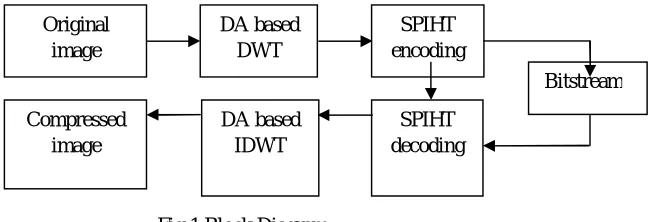
SPIHT codes in descending order from upper bit to lower bit and gives high lossless compression efficiency. The input is given by Distributed arithmetic based Discrete wavelet transform (DWT) coefficients. This coefficient divides as high pass and low pass coefficients. It converts the wavelet decomposition into 2D blocks of coefficients. In SPIHT encoding, these coefficients are divided as significant and insignificant partitions. In the execution path, ordering information is received in the form of magnitude when encoder information is equal to the decoder. The encoded bits are then allocated first more in higher level and few in lower level by pipeline process. After sorting and refinement pass, the output bitstream is obtained. The output bitstream is correlated in horizontal and vertical direction. The SPIHT decoding process decodes the bitstream and transmit to distributed arithmetic based inverse DWT. By inverse transformation, compressed image is produced.
[image:3.612.185.512.382.493.2]
Fig 1 Block Diagram
There are three lists in SPIHT encoding process. They are
LIP (List of Insignificant Pixels) - It has individual elements in which magnitudes are lesser than thresholds. LIS (List of Insignificant Sets) - It has wavelet elements in which magnitudes are lesser than thresholds. LSP (List of Significant Pixels) - It has pixels in which magnitudes are lesser than thresholds.
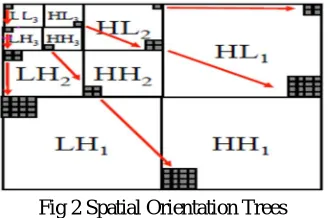
The passes are two types. They are Sorting pass and Refinement pass. In sorting pass, threshold value is decreased in the encoding coefficients. In the previous pass, coefficients are insignificant and in latter pass, coefficients are significant. The output will be significant and it is stored in LSP with sign bit. In refinement pass, output will be stored in LSP as significant pixels in earlier pass. In the next pass, process is continued till reconstruction is completed by all pixel elements. From the transformed wavelet coefficients, hierarchical tree called spatial orientation tree (SOT) is formed by SPIHT algorithm. SOT is found to have four splitting subband with root node and its descendants. The root node is in top level of tree and its offspring are adjacent pixels of order 2x2 in encoding steps. The coordinates are mentioned as
L(i, j) = D(i, j) - O(i, j) Here L(i,j)-It consists of coordinate set of root node.
D(i, j)-It consists of coordinate set of descendant. O(i, j)-It consists of coordinate set of offspring.
Technology (IJRASET)
Fig 2 Spatial Orientation Trees
The threshold value initially chosen as n=| | where is maximum magnitude of encoded coefficients.
A. SPIHT Compression
SPIHT algorithm is given independently to sub-band decomposition and this decomposition is divided into spatial blocks. Spatial block has one or more hierarchical trees with a subset of coefficients. The coefficients are chosen as 64 by 64 or 128 by 128 or 512 by 512 based on the number of trees. The progressive selection of coefficients is given in below equation.
| , |≥2 , = , ,−1, ,−2, ….
It sort the transform coefficients by identifying efficient groups of MSB. The remaining bits are sent in the order of importance of larger MSB. The significance test is to select partitions of pixels as follows
(U)=
1 , max , ≥2
( , ) 0, otherwise
For each = , ,−1, ,−2, …. If ( )=0, then set is insignificant and disregard the pixels in . If ( )=1, then set is
significant and partition pixels in .The test sets until all significant coefficients are found. Lossless compression is continued until n=0 pass gets completed. The bits are then placed in encoder based on the bit budget. Bit budget is a bit bank which consists of number of bits to reproduce a compressed image by given bit rate. SPIHT encoding is processed in cache memory at 2.5 or 3 times rate in a particular pixel. It avoids the unneeded coefficients and generates a bitstreams. The intermediate layer stores this sub-bitstream in a packet for each spatial block. The sub-sub-bitstream combined together and transmitted as a single final sub-bitstream. Bit allocation is done implicitly. The size of transform block determines the memory usage by full image for wavelet. The memory usage is rate dependent and <1/4 block size for LIS, LIP and less than block size for LSP. The binary tests of MSB are sent to decoder. The decoder is enabled to duplicate encoder’s execution path.
B. Algorithm
STEP 1: Initialization process is performed. Here output is considered as = [ ( , ) ( , ) }]. Empty list of LSP is set
and coordinates (i, j) H can be added to LIP and with the destination to LIS as entries of type A.
STEP 2: Sorting pass is performed. Here the coordinates in LIP output be ( , ). If ( , )=1 move (i, j) to LSP and sign of
( , ) is produced as output. If LIS coordinates entry (i, j) is type A, output will be ( ( , )).
If ( ( , ))=1, then for each (k, l) (i, j) gets an output (k, l). If (k, l)=1 output can be given as , and add (k, l) to LSP. If
(k, l)=0 then add (k, l) to the end of LIP. LIS can be moved to end if L(i, j)≠0. If type B entry is used, go to next step otherwise remove entry (i, j) from the LIS.
In type B entry, output be ( ( , )). If ( ( , ))=1 LIS is added with (k, l) (i, j) as type A entry and removes (i, j) from LIS. STEP 3: Refinement pass is performed. For each entry (i, j) output the nth most significant bit of ( , ) except in the lost sorting
pass.
STEP 4: Quantization step- update is performed. Here decrement n by 1 and go to Step 2.
IV. RESULTS AND DISCUSSION
Technology (IJRASET)
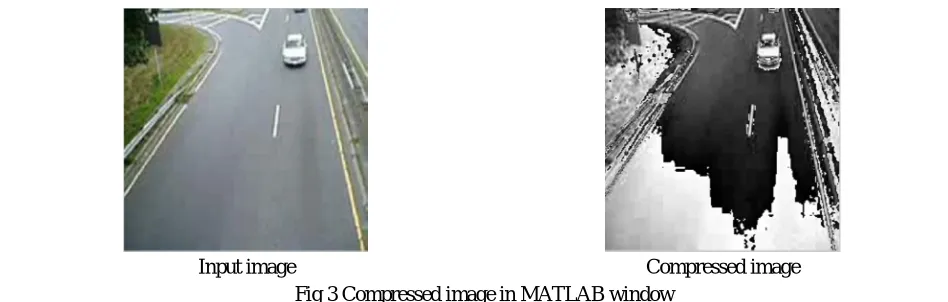
represents Low and H represents H. Distributed arithmetic eliminates explicit multiplications and it produces serial bits. These bits undergo inverse DWT and compressed image is obtained. Fig 3 shows the input image (frame 1) and after simulation process compressed image is produced as output in MATLAB window.
[image:5.612.64.538.125.276.2]Input image Compressed image
Fig 3 Compressed image in MATLAB window
[image:5.612.190.423.324.422.2]Various values are calculated from the compressed image and are shown in below TABLE I.
TABLE I Specifications
Sl. No Specifications Values
1 SNR 159.27dB
2 Memory bits 0/119.808(0%)
3 Power dissipation 31.08mW
4 Area(logic elements) 9/4,608(<1%)
V. CONCLUSION
In this paper, SPIHT based on lossless video compression is efficient method for transmission of images and gives best visual quality. It works with very low memory and better scalability is produced. Here signal to noise ratio, memory spacing, power, area are analyzed. The compressed image obtained is better than original SPIHT algorithm with reduced time in a faster rate. The future work extension is about enhancing the color components of compression in reconstructed video by increasing the speed of encoder and decoder. Result will be better by increasing the decomposition levels.
REFERENCES
[1] Yiqi Tew, Kokshiek Wong, “An Overview of Information Hiding in H.264/AVC Compressed Video”, IEEE Transactions on Circuits and Systems for Video
Technology,Vol.24, No.2,pp. 305-319, Feb. 2014.
[2] Said Amir and Pearlman William A., “A New Fast and Efficient Image Codec Based on Set Partitioning in Hierarchical Trees” IEEE Transactions On Circuits and Systems For Video Technology, Vol.6,pp. 243-250, June 1996.
[3] Sunwoong Kim, Donghyeon Lee, Jin-Sung Kim, and Hyuk-Jae Lee,”A High-Throughput Hardware Design of a One-Dimensional SPIHT Algorithm”, IEEE Transactions on multimedia,Vol.18,No.3,pp.392-404,Jan. 2016.
[4] Huang C., Seng P., and Chen L., “Analysis and VLSI Architecture for 1-D and 2-D Discrete Wavelet Transform,” IEEE Transactions on Signal Processing, vol. 53, no. 4, pp. 1575-1586,2005.
[5] Y. Hu and C. C. Jong, “A memory-efficient high-throughput architecture for lifting-based multi-level 2-D DWT,” IEEE Trans. SignalProcess., vol. 61, no. 20, pp. 4975–4987, Oct. 2013.
[6] T. Y. Lee, “A new frame-recompression algorithm and its hardware design for MPEG-2 video decoders,” IEEE Trans. Circuits Syst. Video Technol., vol. 13, no. 6, pp. 529–534, Jun. 2003.
[7] Sonja Grgic, Mislav Grgic, Yuen Cheng, “Performance Analysis of Image Compression using Wavelets”, IEEE transactions on Industrial Electronics, Vol.48, No.3,pp. 682-695, June 2001.
[8] I. Venkata Anjaneyulu, P. Rama Krishna, “FPGA Implementation of DWT-SPIHT Algorithm for Image Compression”, International Journal of Technology Enhancements and Emerging Engineering Research, 2015.
[9] Athar Ali Moinuddin, Ekram Khan, and Mohammed Ghanbari, “Low Complexity, Efficient and Embedded Color Image Coding Technique”, IEEE Transactions on Consumer electronics, Vol.54, No.2, pp. 787-794, July 2008.