5
IV
April 2017
Technology (IJRASET)
Digital Watermarking on Multimedia Application
Prof. Mayank Mangal1, Rupali Vide2, Madhuri Chande3, Deepali Gaikar4 1
HOD, 2,3,4UG Engineering Students, Department of Information Technology Alamuri Ratnamala Institute Of Engineering And Technology, Mumbai University
Abstract: This paper incorporates the detail investigation of Digital watermarking clarification, idea and the principle commitments in this field, for example, classes of watermarking procedure that show which watermarking technique ought to be utilized. Advanced watermarking is the demonstration of concealing a message identified with a computerized flag( i.e., an image, song and video) within the flag itself.
It is an idea firmly identified with steganography, in that they both shroud a message inside a computerized flag. Watermarking tries to conceal a message identified with the genuine substance of the computerized flag, while in steganography the advanced flag has no connection to the message, and it is only utilized as a cover to shroud its reality. So, in this paper we proposed an Effective Digital Watermarking Technique that we are applying in different Multimedia Application to ensure and secure our mixed media application. Also, this paper incorporates usage of a few watermarking calculations and inspects them in the terms of how they meet the necessities of various application and general prerequisites of watermarking.
Keywords: Steganography, Digital Watermarking, Multimedia.
I. INTRODUCTION
The fast development of the Internet in the previous years has quickly expanded the accessibility of advanced information, for example, sound, pictures and recordings to general society. As we have seen in the previous few months, the issue of securing mixed media data turns out to be increasingly essential and a lot of copyright proprietors are worried about ensuring any illicit duplication of their information or work. Some genuine work should be done in order to keep up the accessibility of interactive media data however, in the meantime, the business must think of approaches to secure licensed innovation of creators, distributors or straightforward proprietors of such information. This is a fascinating test and this is likely why so much consideration has been drawn toward the advancement of computerized pictures insurance plans. Of the many methodologies conceivable to ensure visual information, computerized watermarking is likely the one that has gotten most intrigue .The possibility of vigorous watermarking of pictures is to implant data information inside the picture with a torpid frame for human visual framework however in a way that shields from assaults, for example, normal picture handling operations.
As the PCs are increasingly incorporated by means of the network, the appropriation of advanced media is ending up plainly speedier, simpler, and requiring less push to make precise. One of the real hindrances is the absence of compelling licensed innovation insurance of computerized media to demoralize unapproved replicating and dissemination. Likewise alluded to as essentially watermarking, an example of bits embedded into an advanced image, audio or video record that distinguishes the document' s copyright data (creator , rights, and so on ) . The motivation behind computerized watermarks is to give copyright security to licensed innovation that is in advanced organization.
Not at all like printed watermarks, which are proposed to be to some degree visible, digital watermarks are intended to be totally imperceptible, or on account of sound clasps, indiscernible. In addition , the real bits speaking to the watermark must be scattered all through the document in with the end goal that they can't be recognized and controlled. Lastly, the advanced watermark must be sufficiently hearty so it can withstand typical changes to the record, for example, decreases from lossy pressure calculations.
II.RELATEDWORK
We depict various utilizations of advanced watermarking and the analyzes the basic properties of heartiness, tempered resistance, fidelity ,computational cost and false positive rate we watch that this properties change significantly relying upon the application. We finish up the assessment of watermarking calculation is troublesome without first showing the setting in which it is to be connected.
Technology (IJRASET)
advances that can ensure copyright proprietorship and robbery of sight and sound question . There are numerous information concealing advances that have been presented like steganography and cryptography . The steganography is one strategy for conceal data in sight and sound application. This technique reason for a large number of computerized watermarking procedures right now being created. Because of late exercises in computerized copyright insurance plans it has raised awesome intrigue.
In Digital Watermarking an examples of bits embedded into sight and sound application, for example, picture, sound, video records that distinguishes the documents copyright information. The motivation behind computerized watermark is to give the assurance to protected innovation that is in an advanced shape.
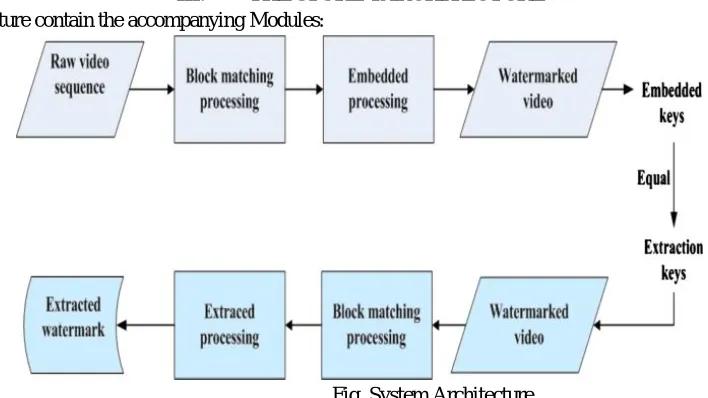
III. THESYSTEMARCHITECTURE
[image:3.612.126.480.186.385.2]The System Architecture contain the accompanying Modules:
Fig. System Architecture
A. Module 1- Raw Video Sequence
1) The Windows AVI library is an arrangement of capacities in avifil32.dll. Before it is prepared to use,it must be introduced with AVIFileInit. AVIFileOpen opens the document, AVIFileGetStream finds the video stream.
2) We are utilizing underneath documents for AVI related functions:
a) Avi.cs
b) Avireader.cs
c) Aviwriter.cs
d) Aviutility.css
B. Module 2-Block Matching Processing
1) The filenames are picked by the client. The bearer is perused from Source File Name, changed and spared to Destination File Name.
C. Module 3-Embedded Processing
1) We utilize a key stream to avoid various bearer units (samples/pixels), grab one transporter unit ,put one piece of the message into the least piece of the transporter unit ,and compose the changed unit to the goal stream.
2) When the whole message has been shrouded that way, we duplicate whatever is left of the bearer stream.
D. Module 4-Extracted Watermarked
1) Again, we utilize the key stream to find the correct specimens, similarly as we did while concealing the message.
2) Then we read the last piece of the specimen and move it into the present byte of the message.
3) When the byte is finished, we compose it into the message stream and proceed with the next one.
IV. PROPOSEDSYSTEM
Technology (IJRASET)
qualities of digitization get critical hangs copyright issues, which make an earnest need to licensed innovation assurance on the carefully recorded data. Computerized watermarking has been proposed as an approach to guarantee the responsibility for source and proprietor .Unlike encryption, watermarking does not limit access to the data. Once the scrambled information is decoded, the licensed innovation rights are did not ensure anymore. A lot of research endeavors has been centered around computerized picture watermarking as of late. The systems proposed so far can be partitioned into two gatherings as indicated by the installing domain. One gathering is spatial domain approach. The other gathering is frequency domain approach.
A. Spatial Domain Approach
The most punctual watermarking systems are principally this kind and the easiest illustration is to insert the watermark into slightest noteworthy bits( LSBs) of the picture pixels. Be that as it may ,this strategy has moderately low data concealing limit and can be effectively deleted by lossy picture pressure.
B. Frequency Domain Approach
Another approach to create amazing watermarked picture is by first changing the first picture into the recurrence space by the utilization of Fourier, Discrete Cosine or Wavelet changes for instance. What's more, it can install more data bits and is generally Robust to assault. With this technique, the imprints are not added to the powers of the picture but rather to the estimations of its change coefficients. At that point reverse changing the stamped coefficient frames the watermarked picture. The utilization of recurrence based changes permits the immediate comprehension of the substance of the image; therefore, qualities of the human visual framework ( HVS) can be considered all the more effortlessly when the time has come to choose the force and position of the watermarks to be connected to a given picture.
C. Input Design
In the information design, user situated sources of info are changed over into a PC based framework arrange. It likewise incorporates deciding the record media, strategy for information, speed of catch and passage on to the screen. Online information passage acknowledges charges and information through a console. The significant way to deal with information configuration is the menu and the provoke outline. In each alternative, the client " s choices are predefined. The information stream graph shows consistent dataflow, data stores, source and goal. Input information are gathered and sorted out into a gathering of comparative information. Once distinguished information media are chosen for preparing. In this product, significance is given to create Graphical User Interface(GUI ), which is a vital calculate creating effective and easy to use programming.
In this software, importance is given to create Graphical User Interface (GUI ), which is a critical calculate creating effective and easy to understand software. For contributing client data, attractive structures are planned. Client can likewise choose coveted alternatives from the menu, which gives all conceivable offices.
Technology (IJRASET)
2) Select Source & Target for Hide Message in AVI and Save:
3) Screen will Appear Add Message in the Text Box to Embed in the AVI File and Press Button Start Watermarking:
D. Output Design
In the output design, the accentuation is on delivering a printed version of the data asked for or showing the yield on the CRT screen in a foreordained configuration. Two of the most yield media today are printers and the screen. Most clients now get to their reports from a printed version or screen show. PC's yield is the most critical and direct wellspring of data to the client, effective, legitimate, yield configuration ought to enhance the frameworks relations with the client and help in basic leadership.
As the yields are the most critical wellspring of data to the client, better plan ought to enhance the framework's connection and furthermore ought to help in basic leadership. The yield gadget's capacity, print ability, print capability, response time prerequisites and so forth ought to likewise be considered frame configuration explains the way yield is displayed and format accessible for catching data. It's extremely useful to create the reasonable, exact and rapid data for end clients.
E. Extract Message
Technology (IJRASET)
V. PERFORMANCESTUDIES
A. Discrete Wavelet Transform(DWT)
Discrete Wavelet change (DWT)is a numerical apparatus for progressively breaking down a picture. The essential thought of discrete wavelet change (DWT) in picture process is to multi separated decay the picture into sub-picture of various spatial area and free recurrence region. After the first picture has been DWT changed, the picture is decayed into four sub-band pictures by DWT: three high recurrence parts (HL, LH and HH, named detail sub pictures) and one low recurrence part(LL, named surmised sub picture). In fig level wavelet change procedure of the picture is appeared, HL, LH, HH are the flat high recurrence , the vertical high recurrence and the corner to corner high recurrence part individually and LL is the estimate low recurrence part. The vitality of the high-recurrence part (horizontal, vertical and askew part) is less, which speak to the data of A Digital Image Watermarking Algorithm Based on DWT, DCT and SVD. The first picture, for example, the surface, edge, and so forth. The low recurrence part focuses the majority of the vitality of the picture and speaks to a critical segment and it can be decayed persistently. The vitality of the picture is diffused better and the more grounded picture power can be installed, with the more levels the picture is disintegrated by wavelet change. Hence, the wavelet breaking down levels received in the calculations can be picked beyond what many would consider possible.
LL1 HL1
LH1 HH1
Fig.1. Wavelet decomposition
B. Discrete Cosine Transform
The Discrete Cosine Transform is an exceptionally famous change work that changes a flag from spatial space to recurrence area and it has been utilized as a part of JPEG standard for picture pressure because of good execution. As a genuine change, DCT changes genuine information into genuine range and along these lines stays away from the issue of excess. The prevalent piece based DCT change portions a picture non-covering square and applies DCT to each square. This bring about giving three recurrence sub-groups: low recurrence sub band, mid-recurrence sub and high recurrence sub-band. DCT construct watermarking is situated in light of two fundamental actualities. The first is that the vast majority of the flag vitality lies at low-frequencies sub band which contains the most vital parts of the picture and second one is that high recurrence segments of the picture are typically expelled through pressure and commotion assaults. There are four set up sorts of DCT's, i.e., DCTI, DCTII, DCT-III, and DCTIV. The DCTII is generally connected in flag preparing in light of the fact that it is asymptotically equal to the Karhunen–Loeve Transform(KLT) for Markov-1 signals with a relationship coefficient that is near one. For example, JPEG picture pressure is likewise in light of the DCTII. The two dimensional DCT is normally utilized as a part of computerized picture handling. Given a picture An of size N×N.
C. Algorithm of DCT 1) Read the first Input Image.
2) Resize the watermark picture.
3) Resize the first picture and watermark picture for proficient parcel in pieces.
4) Retrieve the 8×8 sub-pieces of unique picture and apply DCT to each of them.
5) Apply the watermark into each of these sub pieces and apply opposite change.
VI. CONCLUSION
Technology (IJRASET)
REFERENCES
[1] I J Cox, M L Miller and J A Bloom , “Watermarking Applications and their Properties”, Information Technology: Coding and Computing, 2000. Proceedings. International Conference on. IEEE 2000.
[2] A H Piquet, R K Ward, “Wavelet Based Digital Watermarking”,MIT International Journal of Electronics and Communication Engineering Vol . 3, No. 1 Jan 2013.
[3] G Voyatzis and I Pitas, “the Use Of Watermarks in the Protection of Digital Multimedia Products”, International Journal Of Engineering And Computer Science ISSN:23197242 Volume 3 Issue 7 July , 2014.
[4] H Y Lo, S Topiwala and J Wang, “ Wavelet Based Steganography and Watermarking”, e-ISSN: 1694-2329| p-ISSN:1694-2345GV/ICRTEDC-2014. [5] http://www.webopedia.com/TERM/D/digital_watermark.html