Technology (IJRASET)
Improving Quality of a Video through an
Optimization Technique
A.Priyanka1, Mrs.P.Lakshmi Devi2
1
M.Tech Student, Dept. of E.C.E, Annamacharya Institute of Technology and Sciences, Rajampet, Andhra Pradesh
2
Associate Professor, Dept. of E.C.E, Annamacharya Institute of Technology and Sciences, Rajampet, Andhra Pradesh
Abstract: This paper presents a novel approach for video enhancement by the fusion approach using Edge weighted optimization concept. In this we perform the fusion of low resolution source with high resolution (texture) source based on dictionary entries. It is mainly useful in surveillance, fire smoking areas, Robotic Navigation, and segmentation, 3DTVs, floods etc. We consider an enhancement technique for degraded video that relies on examples, i.e based on codebooks containing examples of, how non degraded images should look like'. The solutions presented in previous works avoid an ill -posed problem by using key frames as example. In those dictionaries are constructed as examples of high resolution images. Patches of low resolution images are then matched to the low resolution version of dictionary entries. Once a match is found the low resolution image is super resolved with the aid of full resolution entry. Such a method is here extended and adopted to general repeatable forms of image degradation. In this process we use three weights. These forms three weighting strategies for TOF (Time of flight) super resolution. In this paper we propose a fusion of high resolution video with the TOF video for video quality enhancement than the previous methods. The objective and subjective evaluation results improve the depth accuracy and viewer preference.
Keywords: Depth video enhancement, TOF sensor, depth map up scaling, Sensor fusion, Edge weighted optimization concept (EWOC).
I. INTRODUCTION
We current the strategy for your enlargement of degraded video tutorials determined by case primarily based tactic. The technique relies on developing a thesaurus with no degraded aspects of online video and utilizes a real thesaurus to enhance the particular degraded elements. The image wreckage has to result from some sort of 'repeatable' procedure, in order that the thesaurus image patches(blocks) are generally just as degraded in addition to coming some sort of thesaurus with degraded prevents in addition to residues(differences in between degraded in addition to initial blocks). The moment some sort of complement can be found involving the degraded obstruct inside online video in addition to degraded obstruct inside thesaurus, the particular associative deposit with the other is actually delicate included in the particular obstruct with the past. The technique is usually a generalization with the method for case primarily based extremely quality.
Video enhancement can be done by the TOF super resolution. It can overcome the short comings of stereo analysis. It produces the erroneous results. Those can be overcome by the TOF super resolution but it has limited spatial resolution and suffer from sensor noise. so we propose a depth upscaling concept by the fusion of high resolution video with low resolution TOF video. It uses the Edge weighted optimization concept and it uses the edge information of full resolution video frames as guidance for upscaling process. JBU(Joint bilateral upscaling) filter combines texture and depth information based on bilateral filter by Tomasi and Manduchi[1].An earlier proposal of Diebel and Thrun[2] uses MRF(Markov random fields).But it has complex optimization techniques. Various guidance sources such as, different color spaces and texture preprocessing are investigated. In this the low resolution data is treated as sparse representation of full resolution texture information. Due to highest active brightness gives to erroneous depth values leads to depth leakage. The three weights Edge weight, Error weight, and Temporal weights are used for depth upscaling. The missing depth values are then filled by error energy minimization, weighted by texture edges.
The reminder of this paper is organized as follows: Section II specifies the related work, proposed method is mentioned in section III, the experimental results are in section IV, and finally, the paper is concluded in section V.\
depth[3].The bilateral filter is an edge preserving blurring filter, based on the nonlinear combination of surrounding pixel values I(x,y) in an image I. Some of the existing methods of super resolution are Temporally coherent super resolution of textured video via dynamic texture synthesis this addresses the problem of assuming the missing high resolution (HR) details of low resolution video while maintaining the temporal coherence of reconstructed low resolution video.
But most of the multi frame based super resolution techniques suffer from the of limited reconstructed visual quality because of inaccurate sub-pixel motion estimation in between the low resolution video frames. Super resolution by using web images and FFT based image registration by this we can avoid the problems of having different focal length and size of retrieved images using SIFT(scale-invariant feature transform). Super resolution based on local invariant features matching in this the matching of these key points from different frames in a video allows us to infer high-frequency information. If motion compensated error is small then low resolution frame is super resolved.
III. PROPOSED METHOD
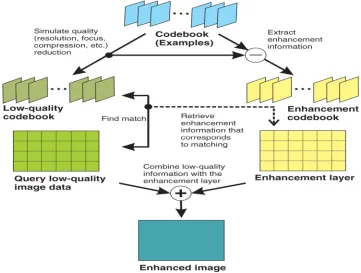
[image:3.612.125.486.327.600.2]Within this we all current a good example primarily based method to common enlargement of degraded online video support frames. The technique relies on developing a thesaurus with no degraded aspects of online video and utilizes a real thesaurus to enhance the particular degraded parts (low quality aspects of TOF frames). The moment complement can be found in between some sort of degraded obstruct inside online video in addition to degraded obstruct inside thesaurus, the particular associative deposit with the other is actually soft-added on the obstruct with the past. The case of generalized case can be as found down below.
Fig 1: Generalized example based enhancement scheme
A. Proposed Algorithm
Technology (IJRASET)
Fig 2: Overview of TSR algorithm
Applying three weights consecutively they form three weighting strategies. The overview of TSR algorithm and interaction with different weights is as shown below. There exist three sets of input sources: upscaled result of previous frames, video and Time of flight camera video. The low resolution depth map from the TOF camera is mapped on the frame corresponding to the texture resolution of high resolution video. The mapping results sparse depth map D. The textured frame I is filtered for edges masked with low resolution frame used for edge weighting. Active brightness A from TOF camera is used for error weighting. The temporal weighting utilizes upscaling results from the previous frame D(t-1) together with the difference between current and previous texture frame. The weights are used in an optimization process to fill the missing values in D, giving a dense full resolution depth map. By the Edge weighted optimization we predict the quality improvement of upscaled depth map due to more coherent edge detection on the video frame. The three weights obtained as follows:
1) Edge Weight: Depth maps consists the uniform areas and sharp depth transitions at object boundaries. It
Fig 3: Example for edge weight generation
requires spatial similarity between depth pixels. The Edge weight function ( , ) reduces the requirement of similarity between neighboring pixels.
obtain sharp edge transitions. This masking process is necessary, since quality of upscaling is highly dependent on cohesive edges from the texture.
2) Error Weight: The over saturation effects leads to the erroneous depth values[4].To reduce this we use error weight. Sensor noise is inversely proportional to the active brightness A.
( , ) = 1− ( , ) max( ) 3) Temporal Weight
Temporal inconsistency in depth maps leads to "flickering artifacts" [5],[6] and visual discomfort for 3D viewing [7].This can be reduced by temporal weighting. It is expressed as
( , ) = 1−
( , )
max( )
a) Optimization: Optimization process includes the process of minimizing each energy term in a weighted non-linear least square fashion and weighted with the three weights. For this implementation we use block active solver [8], implemented in MATLAB2013a. By applying three we obtained upscaled/enhanced video. Each strategy has its own energy.
b) Fusion: In computer vision, multi sensor image fusion is the process of combining relevant information from two or more images into a single image. The resulting image will be more informative than the input image. The fusion is performed after optimization process, by using bit wise transformation. The TOF camera has a resolution of 64x64 pixels and machine vision camera is set to 800x600 resolutions. The low resolution image is treated as sparse representation of high resolution image[9]. Here we are considering avi format video. After performing fusion we got improved video quality.
IV. RESULTS
By considering the fusion we can enhance the super resolution of an depth video. it is also used in videos of floods to detect distant objects or persons. the below figures shows the improved upscaled results using three weighting strategies with the comparison of different upscaling algorithms. for this we consider objective and subjective evaluation results.
A. Objective Evaluation Results
The objective analysis shows in above Tab. I. the objective evaluation results improvement in depth accuracy for video enhancement .In this we are calculated the PSNR,MSE, RMSE, Universal image quality index and Pearson correlation coefficients are tabulated above.
TABLE-I
Method Parameters
PSNR MSE RMSE UQI
Pearson correlation coefficient
Existing
method 24.6 224.9 14.9 0.56 56334.08
Proposed
Technology (IJRASET)
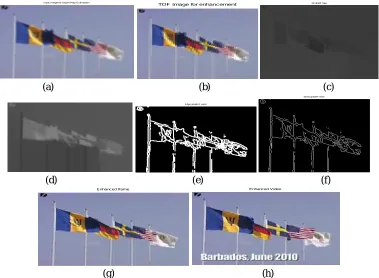
B. Subjective Evaluation ResultsThe subjective evaluation depth upscaling results by considering four HRCs examples are shown below. For this we consider the 20 subjects aged between 20-55.They gave the results as better than the previous methods in some considerations, like clarity, noisy, visual acuity and color vision. The enhanced results are as shown below.
(a) (b) (c)
(d) (e) (f)
[image:6.612.118.497.139.417.2](g) (h)
Fig 4: Examples for the four HRCs . Depth upscaling and video enhanced results after fusion.(a) Input image (b) TOF image (c) Full resolution depth map (d) Low resolution depth map (e) Edge gradient masking (f) Binary gradient masking (g) Enhanced video frame of existing method (h) Enhanced video
V. CONCLUSION AND FUTURE WORK
In this paper we propose a binary masking for edge weight. For this edge weighted optimization approach we can increase in video quality. The three weights are used here for optimization and then improve the quality of an video .Mainly by the temporal weight we can reduce the flickering artifacts in the 3DTV vision. In future we can perform the multiple object resolution at a time.
REFERENCES
[1] C.Tomasi and R.Manduchi "Bilateral filtering for gray and color",in proc.6th Int.conf comput. visjan.1998 pp.839846. [2] J.Diebel and S.Thrun ,"An application of markov random field to range sensing" in prop.conf.NIPS
[3] P.Didyk, T.Ritschel, E.Eisemann,K.Myskoeski and H.P Seidel,"A perceptual model for disparity", ACM Trans. Graph. Vol.30.no. 4pp.9696.10,2011. [4] S.May, B.Wemer , H.Sumann and K.Peryolz,"3D time of flight cameras for mobile Robotics" in proc IEEE/RS JInt.Confin Intell Robot sys oct.2006,pp. 790–
795.
[5] E.Gelasca, T. Ebrahimi, M. Farias, M.Carli,and S.Mitra "Annoyance of spatio-temporal artifacts in segmentation quality assesment [video sequences],” in Proc. ICIP ,vol. 1. Oct.2004, pp.345–348.
[6] W.-S. Kim, A. Ortega, P. Lai, D. Tain, and C. Gomila, “Depth map distortion analysis for view rendering and depth coding',in Proc16th IEE EICI P ,Nov. 2009, pp. 721,724.
[7] M.Lambooij, , M.Fortuin, I.Heynderickx, an W.IJsselsteijn"Visual discomfort and visual fatigue of stereoscopic displays: A review,"J.I-ma review,"J.Imaging sci, Technol., vol. 53, no.3,pp.30201-13020114,2009.
[8] L.F. Portugal, J.J.Judice, and L.N. Vicente,"A comparison of block pivoting and interior-point algorithms for linear least square problem with nonnegative
input Image for Dept h Map Estimation
TOF Image for enhancement ful l depth map
Edge gradient mask
binary gradient mask
BIOGRAPHY
Priyanka received degree in Electronics and Communication Engineering from jawaharlal Nehru Technological
University(JNTUA),Ananthapur in 2013.S he is persuing M.Tech with Department of Digital Electronics and Communication Systems in Annamacharya Institute of Technology and Sciences, Rajampet. Her research interests in 3D video processing.
Lakshmi Devi received post graduation degree in Electronics and Communication Engineering. She is currently