THE EQUALITY OF FREE ENERGY AND MUTUAL INFORMATION
Thesis by David I. Feinstein
In Partial FnlfiJJment of the Requirements for the Degree of
Doctor of Philoeophy
California Institute of Technology Puadena, California
1986
Acknowledgment
As a graduate student at Caltech I have been supported financially by several different eources. The Department of Applied Mathematics funded
me 88 a teaching aMistant during my first year. I W88 awarded an ffiM
fellowship for the next two yea.rs under the auspices of the Department of
Computer Science. During the last two yea.rs I have been a research aMistant in the laboratory of Professor Carver Mead; the funding for this
period W88 provided by System Development Foundation. My than.b to all
of these sources.
I wish al8o to thank Profel!l80r Carver Mead, Professor John Hopfield
and John Platt for many interesting diacussions on the subject of this thesis
and other topics 88 well. These individuals have contributed substantially to
my graduate education at Caltech. My education, (and the rest of me 88
well), owe a special note of thanks to my parents; their support h88 always
been essential.
On the subject of this thesis, the less said the better! However, I
gratefully acknowledge the assistance of my brother Jonathan. Without his
aid, I probably would never have started writing. Also, I would never have finished writing, but for the sympathetic support of Carver Mead.
I would like to express my very sincere appreciation to Carver for all
that he h88 done on my behalf. Carver h88 been a mentor to me. He has
shown me, first-hand, the process whereby science happens. Meanwhile, he
h88 taught me about exponentials and positive-sum games. These things
Abstract
In this thesis we uncover a new relation which links thermodynamics and information theory. We consider time as a channel and the detailed
state of a physical system as a message. As the system evolves with time,
ever present noise insures that the "message" is corrupted. Thermodynamic free energy measures the approach of the system toward equilibrium.
Information theoretical mutual information measures the loes of memory of
initial state. We regard the free energy and the mutual information as
operators which map probability distributions over state space to real
numbers. In the limit of long times, we show how the free energy operator
and the mutual information operator asymptotically attain a very simple
relationship to one another. This relationship is founded on the common
appearance of entropy in the two operators and on an identity between
internal energy and conditional entropy. The U8e of conditional entropy is
what distinguishes our approach from previous efforts to relate
Table of Contents
ACKNOWLEDGMENT . . . ill
ABSTRACT . . . • . . . • . . . . .. . . . .. . . .. . . iv
LIST OF FIGURES. . • . . . . . . . . . . . . . . . . . . . . . . . . . . . . . . . . . . . . . . . vi
CHAPTER I . . . 1
Thesis Introduction. . . . . . . . . . . . . . . . . . . . . . . . . . . . . . . 1
Statistical Mechanics. . . . . . . . . . . . . . . . . . . . . . . . . . . 2
Classical thermodynamics. . . . . . . . . . . . . . . . . . . . . . . . . . . . . 13
The principle of maximum entropy . . . 22
Information Theory. . . . . . . . . . . . . . . . . . . . . . . . . . . . . . . . 26
The relation between thermodynamics and information theory. . . . . . 33
CHAPTER II. . . . . . . . . . . . . . . . • . • . . . . . . . . . . . . . 42
Relating free energy and mutual information. . . . . . . . . . . . . . . 42
Markov p1'0Ce81!1e8 in the spectral repreeentation. . . . . . . . . . . . . . . . . 69
Expanding if(n)r-0 around equilibrium The 2x.2 case . . . 66
The rereferencing theorem. . . . . . . . . . . . . . . . . . . . . . . . 71
if(n)r-0 in the general cue. . . . . . . . . . . . . . . . . . . . . . . . . . . . . . . 76
A composition law for Hln)r-n . . . 81
CONCLUSION. . . . . . . . . . • • . . . . . . . . • . . . . . . . . . . . . 87
[image:5.542.54.499.88.541.2]List of Figures
Figure 1. . . . . . . . . . . . . . . . . . . . . . . . . . . . . . . page 48
H(q) is the log of the number of messages which account for a total probability q. The graph suggests that the log of the number of reasonably probable messages is independent of the definition of reasonably probable for long messages.
Figure
2.
.
.
.
...
....
.
...
.
...
.
.
..
.
..
....
.
.
...
..
54
The horizonal line depicts the difference of state energies in units of kT. The curve is the difference of the components of if(n)r0 versus time n. Asymptotically, the curve merges with the line. Thus the rereferenced conditional entropy is related to the rescaled internal energy.
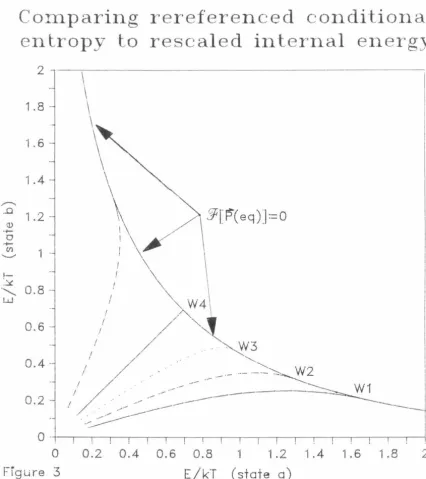
Figure 3. . . . . . . . . . . . . . . . . . . . . . . . . . . . . . . . . . . . . . . . 56
The coordinates of a point in the plane are the components of if(n)r0
• By sweeping n for any particular matrix
r,
we generate a curve. n= infinity is a point on this curve. Consider the locus of points, generated by taking n= infinity for all poesible matrices. This locus is also the locus of state energy assignments for which the free energy of equilibrium is 0. Thus the rescaled internal energy and the rereferenced conditional entropy are identical at n= infinity.Figures 4 and 5 . ... .. . .. . .. . . .... . . .. . . .. 78
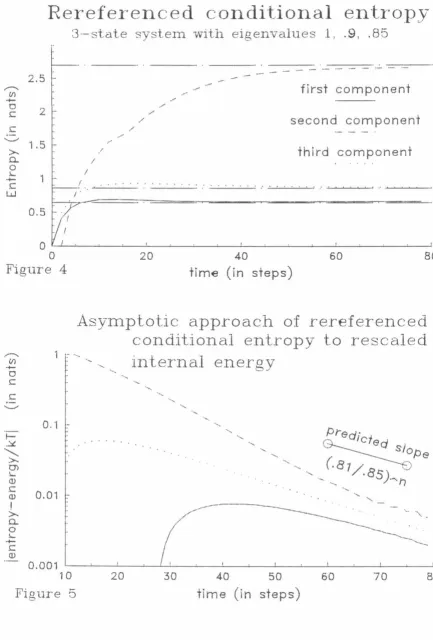
See that the limit of if(n)rn exists for all 3 components. The log scale shows that the approach to the limit is as predicted. (The slight ripple in the curves is caused by calculating with too few significant figures.)
Figures 6 and 7. . . . . . . . . . . . . . . . . . . . . . . . . . . . . . . . . 80
Thesis Introduction
In this thesis we uncover a new relation which links information theory to thermodynamics. This relation is suggested by a structural simile
which we draw between these two subjects. We find that free energy of
thermodynamics, and mutual information of information theory are related to
one another in a simple way. This relation follows from an asymptotic
identity, which also is new, between conditional entropy and internal energy. These findings are best appreciated in a context which emphasizes the
structure and organization of thermodynamics and information theory.
Accordingly, we have devoted chapter I to a di8CUMion of these two subjects;
at the close of this chapter we outline the current undemanding of the
relation between them. AOO, at the end of this chapter we sketch what we
have done and how it augments this understanding. Chapter IT contains the
detailed presentation of our original work in this area.
At its moet fundamental, thermodynamics introduces heat,
temperature, entropy and the law dQ<=TdS. One can arrive at these
precepts of thermodynamics from three different directions. The line of
development currently in vogue is that of statistical mechanics. Statistical mechanics owes its aecendancy partly to the current popularity of quantum
mechanics and partly to the deep insights that have come from its integration of thermodynamica with the rest of theoretical physics. In the
nineteenth century, thermodynamics enjoyed a finely reasoned, cl888ical
development; this was the handiwork of the old masters. In I!IOme respects this claseical line still provides the best explanation for the general success of
thermodynamics and its sweeping applicability. Somewhat more recently the
principle of maximum entropy. Th.UJ principle constitutes a third and
somewhat leas well known line of development. We tum now to an
extended di8cW!II8ion of these three linea of development.
Statistical Mechanics
The notion of a state space is employed throughout theoretical physics.
In non-statistical physics, systems are described by specifying the point m
state space corresponding
to
their condition. It would be very arduousto
exactly specify the state of a macroscopic system having of order Avogadro's
number degrees of freedom. The essential comprom.i!le of statistical
mechanics is to relinquish exact specification of system state. In practice we
effect this compromise by working only with parameters that we can
macroscopically measure. H we confine our attention to the macroscopic level, then the development of thermodynamics from mechanics proceed8
quite simply; we will sketch th.UJ development first. An excellent introduction
to statistical physics at th.UJ level is found in [Reif]. When we consider
systems in microscopic detail (but still in the classical limit), the task of
relating the precepts of thermodynamics to the foundations of mechanics
becomes quite challenging. The basic idea m
to
consider the probabilitydistribution over state space, p, defined by an eiU!Iemble of macroecopically
identical systems.1 We introduce this deeper view of statistical mechanics second; here [Tolman] has been an invaluable source.
Equilibrium: state is independent of past history.
A system that ha.e evolved for a sufficiently long time ultimately
approaches equilibrium. In equilibrium the state of a system is independent
of all pa.et history; it is decoupled from its initial configuration. A neceeaary
(but not sufficient) condition for equilibrium is that the system be
macl"'8Copically t'ltationary. Microecopically, equilibrium happeu when the
system ha.e made enough tra.n.sitiou to have sampled a repret'lentative fraction
of its acceeaible state space. Equilibrium is thus a statistical concept; it
tends to defy a preciee physical definition. Traditionally the defmition of
equilibrium ha.e been something of a tautalogy: an equilibrium system is one
which is coll8istent with the predictioll8 of equilibrium thermodynamics.
EntroPY mea.eures state space volume.
A heat bath is an equilibrium system which is sufficiently large that it
poeseseee a huge number of degrees of freedom, 2 typically of order
Avogadro's number. Note that
almost
any macroecopic system which is inequilibrium can qualify a.e a heat bath. The eeeence of statical mechanics
lies in estimating the volume of state space 0 which is acceeaible to the heat
bath, given that the bath has an energy which is known to lie in some small
interval around E. The typical result, which always emerges, is that 0 is
roughly proportional to
E',
where f is of order the number of degrees offreedom of the heat bath. Since the exponent f is of order 1o28, the volume
2The number of degrees of freedom of a ~tem ia the dimeuion of the etate space in
of accessible state space is an exceedingly rapidly varying function of the energy. It 18 rea.sonable to employ logarithms in such circumstances. The
entropy H is defined a.s the log of the volume of state space which is accessible to the heat bath; thWJ H=
lnrn.
The parameter {j is defmed as the partial derivative of entropy with respect to energy; in taking this derivative the heat bath is 888umed to be dynamically isolated, so E lB varied becaWJe of heat exchanged and not becaWJe of work performed. {j 18the proportional rate of change of 0 with respect to E on account of heat flow; this partial derivative works out to be {j= f/E. The reciprocal of {j
ha.s units of energy; it is defined to be kT. kT= E/f and is approximately the energy per degree of freedom. Thus thermodynamics introduces H which is dimensionless and {j which ha.s dimensions of reciprocal energy. These two WJeful quantities summarize the state of systems for which our information is otherwise incomplete. 3
Entropr & heat. The 2nd law.
We can exactly calculate the change in entropy which accompanies the flow of heat into a system which is at equilibrium. Using the definition of {j
as the partial derivative of entropy with respect to energy on account of heat flow, it is easy to see that dH= {j dQ (or equivalently, dS= dQ/T). {j is defined for a heat bath at equilibrium. What is the relationship between dH and dQ for a non equilibrium system? The 2nd law of thermodynamics postulates that for any system, the change in entropy dH is never less than
~n the early daya when thermodynamics wu hom there happened an unhappy confusion of units; the two primary quantities were t&ken to be the physical entropy, S, and the temperature, T, where S= kH and T =1/('k{J). This hapleae choice foreed phyaic:a to accept
& new unit, the degree, which had no relation to any other commodity except through
(J dQ} Thu dH>= (J dQ (or equivalently, dS>= dQ/T). We would like
to
deduce this inequality from a more intuitive starting point; unfortunately, wiih ihe methods of siaiiaiical mechanics we cannot easily do 80. This difficulty is a shortcoming of the statistical mechanical approach to thermo-dynamics.The Boltzmann distribution.
The canonical quedion of thermodynamics couples a small sysiem
to
a heat bath and asb how a fixed energy shared between them is apportioned. The small sysiem and heat bath are thermally iaolated from· the rest of the univeree eo that their total energy is conaerved. The heai bath is assumed to remain at 80me constant temperature T. The Boltzmann distribution answers the question: what is the probability P(E) for the small sysiemto
be in a particular state which has energy e? The derivation of the Boltzmann distribution P(E) 88115U11le& the equipariition principle; this principle aseeri8that, in equilibrium, the composition of heat bath
+
small system is equally likely to be found at any of the pointe in state space thai are consistent with them sharing together a total energy of E. H the small system is to have an energy E and the total energy isto
be E, then the energy of the heat bath mu.ei be E-E. The probability that the small system is in a state with energy E, P(E), is proportionalto
the volume of state space which is acceeeible to the heat bath when the latter hu an energy near E-E. Thus P(E) is proportional to (E-e)1 which equals E1(1-E/E)1; 80 the dependence of P(E) on E goes lite (1-E/E)1. Now we recall that E, which is very nearly the energy of the heat bath, is equal to f/(J; thus P(E) is proportionalto
4 A ~em which ia out of equiBbrium ia a 8)"1tem in which irrevenible proc...- are
b&ppeoins. For the.e 8)"1tema, the dlrectton in which time tlowa Ia liplificant. The aecond law appUee to ch&n~ee in entropy which occur u & 8)"1tem movee forward throqb time, i.e.,
(1-{3€/f{ Since f is huge, this reduces to the familiar re8ult: w:},,(-{3€).
Thus the Boltzmann distribution follows readily from the methods of
statistical mechanics; notice how few 888umptions are required. This economy of aMumption gives insight to the wide applicability of the
Boltzmann distribution.
Heat & entroPY in theoretical mechanics
In the world of Newtonian physics, heat appear8 when energy is lost
to friction. Unfortunately, friction has no place in the elegant theoretical
world of Lagrangian (or Hamiltonian) physics. Rather, what appears as
friction is actually some small interaction whoee only significance .18 to
provide a coupling between otherwise orthogonal modes of a system. Heat
manifests it8eH in such a system as the incoherent spread of energy from one
mode into many.6
Consider, for example, the frictional heat that is generated when a
moving block of material scrapes against a rough surface and slows to a halt.
A cl888ical analysis of this situation models the block as a collection of
m888e8 interconnected with springs. Suppoee that before the block interacts
with the rough surface, all of its component masees are moving with the
same velocity, and the springs connecting the masees are unstretched. Thus
the block is quiescent internally; all of its energy 18 due to the velocity of its
6yn mechanics the detailed state of a system c&n be specified in either of two ways. For one of the ways the detailed state corresponds to a point in state apace, where the coordinate. of the point are the poatitions a.nd velocities of each particle in the system. Alternatively, for linear systems, the detailed state c&n tJao be regarded u corresponding to a point in eigen-state apace where the coordinates of the point are the amplitudes a.nd phases of each normal mode of the system. The two specifications carry equivalent information in that a conata.nt, linear, nonaingular transformation carries one into the other.
Thus, a probability distribution over the amplitudes a.nd phases of the normal modes of a system corresponds uniquely to a probability distribution over the positions a.nd velocities of
the particles of the system. The entropies of these two probability distributions will agree with one a.nother to within a conata.nt additive factor having to do with the log of the
center of maBB. We can model the rough surface as a collection of little
rigid posts. As some of the m888e8 of the block impact with these posts,
internal vibrations of the block are established. The continued action of the
rough surface ultimately leachee away nearly all the kinetic energy of the
center of mass, converting it into energy of vibration about the center of
mass. Thus the energy of the block gets distributed among all of its
vibrational modes. Macroscopically, we see the block come to a quivering
halt.
The example of the block shows us that heat and entropy are related.
Initially, the distribution over mode amplitudee of the block is tightly
confined to the zero frequency modes of uniform translation. As the block
slows, the distribution over mode amplitudee widens; its entropy increases.
A flow of heat (or, more properly, a conversion of mechanical energy to
heat) accompaniee this increase in entropy. The heat flow is the funneling of
energy from the zero frequency modes to the multitude of higher frequency
modes. Thus the flow of heat and the widening of the distribution over
mode amplitudes are directly connected; in a sense, the increase of entropy
describes the flow of heat.
The relative nature of entropY. Quantum physics & heat.
Entropy measures the volume of state space in which a system may
be found. This volume depends critically on any constraints which the
system is known to satisfy. For example, if the total energy of the system
is known, then the system must be on the hyper-plane in state space which
corresponds to that energy. If in addition to the energy, the momentum of
the system is known, then the system is even more tightly constrained and
the region of state space which is acceesible to it becomee even smaller.
system. Aa we measure more and more parameters of a system, ita entropy
becomes smaller and smaller.
The obeervation that the entropy of a system depends on our
meuurement skilla is conaistant with our interpretationa of heat and work.
Energy which is exchanpd via a mechanism which we caa. obeerve is work,
energy which is exchanpd via a mechanism which we can not obee"e is
heat. For example, consider the block made of manes aa.d springs. Suppoee
that in addition
to
the sero frequency mode of uniform translation, we arealao able
to
measure the amplitude of the next higher frequency mode.With theee meuurement skills we would eee changes in the amplitudes of
either of the lowest two modes as being work exchanpd aad we would
interpret chaagee in the net excitation eneJ'SY of all of the other modee
together as being the flow of heat.
Ia entropy ever abeolute? Yee, in quaa.tum mechanics entropy aUaine
aD abeolute definition. A. systems become larger, the
eaerv
BpKing of theirquantum states, dE, becomes smaller. Physical procee~ee (traa.sitiou between
quantum states) take eome finite time
to
happen; call this minimum time M.When a physical p1'0C8118 taking time M happena in a system which .is larp
enough eo that the dE of ita quaa.tum states is Ieee than h/b.t, then8 the
uncertainty principle demaada that qU.&Dtum mechanical phue illformation be
lost. This phue raa.domisation is the quantum mechanical repneentatioll of
heat. [Feymnaa - penonal communication). 7 Thus, quantum mechanical
uncertainty places limite on meuurement skill and eetabliahee aa abeolute
lower limit for entropy.
~ Ia Planck'• coDI&Ult.
7'1'hll inqht underli• the 10-c.lled •Nuter Equalioo•
approach to dlermodynamic:a. The maHer equa&ioD is what ODe pU by c:arefully &Yenciol over phue in the itanclard
Finding a well-behaved eairopY. The Boltzmann H theorem.
The eecond law impliee that the entropy of an ieolated system (or,
more properly, an en&emble of ieola~ systems) cannot decreue with time.
~ an ieolated system evolvee toward equilibrium, ita entropy will increue
monotonically. This time behavior of eniropy holds even thoqh the system
is governed on a m.icroec:opic ecale by dynamical laws which are invariant
under time revenal. The Bolbman.n H theorem attempts
to
show howmicroecopically reversible laws caa imply macroecopically irreversible
behavior.8 The H theorem can be better appreciated if we try tint on our
own
to
define an entropy which evolves in the way we expect and which illcomputable in terms of microecopic quantities. Simply computing the
integral over state space of p
tn,{p),
where p is the state spt~Ce probabilitydensity, doee not do the job; we will shortly see that this 'fine-grained'
eniropy doee not evolve, it is a constant of the motion. The Boltml&llll H
theorem, u interpreted by Gibbe and modified by P. and T. Ehrenfeet,
succeeds in deftnlng a qll&lltity H whkh behaves corredly. Glbbe intel'preU
H in the context of an enaemble of systema. He sugpete that an eD8811lble
flows through state space much u ink mixee with water when the two are
stirred. The Ehrenfeets inject Gibbe' interpreU.tion into the definition of H.
They introduce a •coume graining' procedure which allows the calculation of
H in terms of the probability density p.
Recall that the detailed configuration of a system corresponds to a
point in state space. ~ the system evolves with time, its detailed
configuration changes and the point in state space corresponding to the
system moves. Now consider the time evolution of a small element of state
space volume. A way to keep track of the volume element is to follow the points which comprise its boundary as they move.9 As time goes by, we see
the volume element stretch into a long and complex filament which wraps
round and round the state space. Note that in spite of this stretching we
know, by Liouville's theorem, that the volume of the little element will be
conserved. Suppose that all of the members of an ensemble of systems have
initial configurations which correspond to points in this little volume element.
The ensemble is described by a probability density which is initially quite simple. The density is uniform inside of the volume element and it is zero outside. After a while the volume element has become a convoluted
filament; this filament still includes the configurations of all of the members
of the ensemble. The probability density of the ensemble is uniform inside
the filament and it is zero outside of the filament. Liouville's theorem implies that inside the filament this density has the same value as it had
initially.
Now consider an ensemble of systems with a probability distribution
over state space described by some density function p. Conceptually we can
partition the state space with a grid of very fine (differential sized) volume
elements. The density function p can be taken to be uniform within any
one of these differential volume elements. Now we let the ensemble evolve.
The differential volume elements all stretch into convoluted filamentary
shapes; these shapes never actually intersect one another, but they do
become mutually entwined in very complicated ways. Within any filament
the density p retains the same value as it had initially. Since the fine grid
9Recall
partitioned the space initially, the unruly collection of filamentary shapes
which the grid has become still does manage to partition the space. The constancy of the density p within a filament, coupled with the space partitioning property of the filaments implies a remarkable fact: the integral of p or of any function of p over the entire state space will remain constant over time. Thus the entropy, which is the integral of p im-(p) over the space, will remain constant in time.
Consider the behavior of the filaments. They become increasingly disordered and jumbled as time progresses. The course graining procedure of the Ehrenfests captures the essence of this fllamenta.ry behavior. At time zero partition the state space with a small (but not differential sized) grid. This grid is fixed once and for all; it does not change with time. Form a
new di8tribution function P (capital p) which is constant within each cell and which in each cell is equal to the average of p over that cell. The quantity H of the Boltzmann H theorem is the entropy of the di8tribution P. We may suppoee that at time zero the function p has been chosen so that the two functions p and P agree with one another very nearly. Now let time evolve. Each cell is invaded by a jumbled mixture of filaments; the
filaments began life in other cells and so each carries a (generally) different, constant density. Thus each cell, which initially contained but a single density, now contains a jumbled mixture of densities. The function P is the average of these densities on a cell by cell basis. It is obvious (or anyway it
12
hypothesis of the Boltzmann H theorem is that the mixing of the filaments
does become ever more fine.10
How ensembles predict single systems. Ergodicity.
Notice that a probability distribution over state space only attains a
predictive value in the context of a large ensemble of systems.
Unfortunately, in statistical mechanics, we usually work with only a single
system. At any instant of time our system occupies only a single point in
state space; one cannot do statistics on a single point! The usual remedy for
this deficiency is to replace the set of points in state space which the
ensemble would have provided with the set of points occupied over time by
the single system under investigation. The replacement of ensemble averages
by time averages produces results which agree with experiment.
Experimental verification aside, nobody has ever been able to prove
the validity of this replacement without introducing some hypothesis in
addition to the known laws of physics. Such hypotheses have usually been
called "ergodic hypotheses." The first of them was advanced by Boltzmann
who also was the first to use the current terminology. Boltzmann
conjectured that each surface of constant energy consists of a single
trajectory. In other words, no matter what is the state of the system at a
given time, it will pass (or has already passed) through any other state with
the same value of the total energy. Using this hypothesis, it is possible to
establish the coincidence of time averages with ell8emble averages on surfaces
of constant energy. Unfortunately, subsequent to Boltzmann, mathematicians
have pointed out that this ergodic hypothesis is self contradictory; since a
trajectory cannot have multiple points, it cannot fill a multidimensional
volume. The ergodic hypothesis is associated with the most profound questions of statistical mechanics. These questions have been much studied
in the decades since Boltzmann introduced them, [Khinchin 1] is a readable review. They have not been resolved completely even yet.
Classical thermodynamics
The classical approach to thermodynamics starts with the first and
second laws and from them coll8tructs an elegant chain of reasoning along
which the entire subject is developed. The fJI'St of the classical laws is
conservation of energy. This law, which really is more a defmition than a
law, defines heat and work as the two form8 in which energy can occur.
The second law states that the natural direction in which heat flows is
always from wanner bodies to cooler bodies. This law is supported by years
and years of accumulated experience. From these two laws and one
ingenious construct, the reversible cyclic engine, the old masters were able to
define abeolute temperature and to deduce the existence of entropy. They
then defined a useful quantity, the free energy, and U8ed this quantity to
characterize the nature of equilibrium. Thus they deduced the whole subject
from two laws. [Fermi] is an excellent expoeition of this approach to
thermodynamics. [Callen] contains a more modem treatment, but one that is
still very much in the classical tradition.
Energy can be neither created nor destroyed: dU=dQtdW.
This law can be regarded as the definition of heat: the amount of heat
dQ which flows into a system is always that exact quantity which makes up the difference between the change in internal energy dU and the mechanical
experimentally by calibration against a phenomenological scale of temperature.
One assumes that the unknown heat dQ is equal to that work dW which produces an equivalent chan~ in temperature.
The poesible transformatiou of energy & the second law.
Coll8ervation of energy, the first law of thermodynamics, places no
limitations on the possibility of transforming energy from one form into
another. Both empirically and theoretically there appear to be no limitations
on the transformation of work into heat; mechanical work can always be
converted totally into heat by means of friction. There are very definite
limitations however, to the possibility of transforming heat into work. Heat
flows spontaneously from warmer bodies to cooler bodies when the bodies are
in contact.11 Clausius postulates that it is impossible to find a transformation whose only fmal result is to transfer heat from a body at a
given temperature to a body at a higher temperature. Lord Kelvin
postulates that it is impossible to find a transformation whose only final result is to transform into work heat extracted from a source which is at the
same temperature throughout.
Either of these postulates can be taken as the classical version of the
second law of thermodynamics; we can show that the two are equivalent.
This equivalence is proved by showing that if the Clausius postulate were
not valid, then neither would be the Kelvin postulate, and vice versa. H the
Kelvin postulate were not valid, then we could perform a transformation
whose only final result would be to transform completely into work a definite
amount of heat taken from a single source at the temperature t1. But we
could then convert this work by means of friction into heat, with which we
raise the temperature of some other body. If this other body initially was at a. higher temperature t2, then the only final result of this process would be the transfer of heat from a. body a.t a. given temperature to a. body at a higher temperature. This would be a. violation of the Cla.U8ius postulate. On the other hand, suppose that the Cla.usi\18 postulate were invalid. Then we could transfer some heat Q2 from a. body at temperature t1 to a. body at the higher temperature t
2 in such a way that no other change in the state of
the system occurred. But then, with the aid of a heat engine (to be discU8Sed shortly), we could absorb this same heat
Q
2 and extract work as we cooled back down to the temperature t1. Since the source at thetemperature t2 receives and gives up the same amount of heat, it suffem no net change. But this would violate the Kelvin postulate, since we have succeeded in transforming into work, heat extracted from a. source which is a.t the same temperature t1 throughout.
Work from heat via. Carnot cycle. The efficiency !}
If we have two sources of heat a.t different temperatures, then we can
transform heat into work via. an elegant process known as a Ca.rnot cycle. This revemible process consists of an alternating sequence of isothermal and adiabatic transforma.tiou cleverly arranged so that the engine performing the transformations ends the cycle in the same maci'08Copic state as when it began. The ftmt isothermal transformation absorbs an amount of heat Q2 from a. source a.t temperature t2, while the second isothermal transformation surrenders an amount of heat
Q
1 to a source a.t a. lower termperature t1.The purpose of the first adiabatic transformation is to cool the engine from the temperature t2 down to t1; since no heat flows during this phase, some
absorbed. Since the engine begins and ends in the same state, it must be
that the total work performed during one cycle is W= Q2-Q1. The efficiency of the Carnot cycle is defined as the ratio of the work performed
to the heat extracted from the high temperature source. Thus the efficiency
1J= W /Q2= 1-Q1/~. Whatever limitations attend the transformation of
heat into work must show up as limitations on the ratio Q1/Q2.
!}(irreversible)<= 1}(Camot)= !}(reversible).
If all the transformations comprising the Carnot cycle are reversed
then we have a refrigerator. The net effect of a reversed Carnot cycle is to
absorb the work W instead of producing it; also,
Q
1 is absorbed at temperature t1 and Q2 is surrendered at temperature t2. Using the Kelvinpostulate and the idea of a reverse Carnot cycle, it is po88ible to prove that
of all cyclic engines operating between the temperatures t1 and t2, the
reversible ones all have the same efficiency and this efficiency exceeds that of
any nonreversible engine. The old masters prove this fundamental result by
devising an ingeneous "null" process whereby an arbitrary heat engine and a
reversed Carnot engine exactly cancel out one another's effect on the heat
source at the higher temperature t2.
Specifically, N reverse cycles of the Carnot engme follow N' cycles of
the arbitrary engine where N and N' are chosen so that N'Q2
'=
NQ2; in this defining relationQ
2 ' is the unsigned heat absorbed per cycle by the arbitraryengine from the source at the higher temperature t2, and Q2 is the unsigned
heat surrendered to this source by a reverse Carnot cycle. The Kelvin
postulate then implies that the total work W total accomplished by this
combination of engines musi be nonpositive, since the entire process
exchanges net heat only with a source at a single temperature t1. Since
-Ql,totaJ• Thus the Kelvin poetulate implies Ql,total>= 0. But Ql,total= N'Q1'-NQ1, since the process consists of N' cycles of the arbitrary engine surrendering the unsigned heat Q1' per cycle followed by N reverse Carnot cycles, each absorbing the unsigned heat Q1. Thus N'Q1'-NQ1>= 0. Substitute in this last relation the expression N'=N*~/Q2', obtained from the defining relation of N and N'. The result is N(Q2Q1'/Q2'-Q1)>= 0. In this last relation we can divide by the factor NQ2 without altering the sense of the inequality since, by hypothesis, N> 0 and Q2> 0 on account of it being an unsigned quantity. Thus we obtain the fundamental result: Q1 '/Q2'>= Q1/~. The fundamental result implies directly that 1]'<=1};
thus the efficiency of the arbitrary engine can never be greater than the efficiency of the Carnot engine. Finally, consider the ca.ee where the arbitrary engine is itself reversible. In this case we can interchange the roles of the two engines in our construction and obtain an inequality oppoeite in sense to that which we had previously. Both inequalities must hold and so we conclude that the arbitrary reversible engine has the same efficiency a.s the Carnot engine.
The absolute temperature. T 2/T 1 Q2
/Q
1 of a reversible cyclic engine. The fundamental theorem shows that the ratio ~/Q1 is the same for all reversible engines operating between the empirical temperatures t1 and t2. Thus Q2/Q1=f(tpt2 ). We now deduce a key property of the function f via another tricky construction of the clll88ical line - this time a "null" processinvolving three heat sources. Imagine two reversible cyclic engines R1 and
~· R1 operates between the temperatures t0 and tl' thus f(t0,t1)= Q1/Q0.
classic trick: consider the reversible process consisting of a direct cycle of ~
and a reverse cyclic of R1. This compound process exchanges no net heat with the t0 source; it absorbs
Q
2 from the source at t2, and expellsQ
1 to the source at t1. Thus, from the definition of the function f, Q2/Q1 = f(t11t2). Equating the two expressions for ~/Q11 we obtain f(t11t2)= f(t0,t2)/f(t0,t1). Since t0 is arbitrary, we conclude that f(t11t2)= T(t2)/T(t1), where T is some function which depends upon the choice of empirical temperature scale. The scale of temperature is arbitrary; a very convenient choice is to use T itself instead of t. T is called the absolutethermodynamic temperature. Notice that T is determined to within a constant multiplicative factor; we are thus free to ch0015e the units of the
new temperature scale; conventionally the difference between the boiling and
freezing temperature of water at one atmosphere of pressure is taken to be 100 degrees. It is poesible to show that this absolute thermodynamic scale
of temperature coincides with the empirical temperature as determined by a gas thermometer.
Entropy.
The discovery of the state function entropy 18 the crownmg
achievement of cl888ical thermodynamics.
Sum of Q/Ti<= 0.
Consider a system running a cycle which exchanges heat with several different sources. Suppose the system exchanges the signed heat
Q
1 with the source at temperature Ti;Q
1 is positive if the system absorbs the heat from the source i, otherwise it is negative. Now introduce one last source atadjust each
q
so that it absorbs from the source i the heat -Qi. Thusafter a complex cycle consisting of one cycle of the system and one cycle of
each of the Carnot engines, we find that no net heat has been exchanged
with any of the sources i. However, the source at temperature T has
surrendered an amount of heat Q equal to the sum over the other sources i
of TQ/Ti. Thus the net effect of the complex cycle has been to transform
into work an amount of heat Q received from a source at a uniform
temperature T. The Kelvin postulate requires that Q<= 0. Thus, for any cyclic process the sum of Qi/Ti is always<= 0.
Integral dQ/T= 0 around any reversible cyclic transformation.
In deriving the result that the sum of Qi/Ti<= 0 for an arbitrary
cyclic system, we assumed that the system exchanged heat with a finite
number of sources. Instead, the system might exchange heat with a
continuous distribution of sources; then the sum over the sources becomes an
integral around the cycle and the heat received by the system from any
single source at a temperature T becomes the infinitesimal dQ. Thus, for an
arbitrary system exchanging heat with a continuous distribution of sources,
we know that the integral of dQ/T around a cycle is<= 0. Notice that if
the system is reversible, then by running it in reverse we conclude that the
integral of -dQ/T around the cycle is<= 0. Thus we conclude that the
integral of dQ/T around a reversible cycle is identically zero.
State function S: dS= dQ/T for reversible dQ.
Consider now the integral of dQ/T along some reversible tran.sformtion
which takes the system from a standard initial state 0 to some fmal state
A. Let the value of this integral be S. We could make a complete cycle
transformation from A back to 0. Thus the integral along any reversible transformation from A to 0 must be -S. Evidently for a fixed initial state 0, the integral S depends only on the final state A; thus S= S(A). S is a state function; it is called the entropy. More generally, the integral of dQ/T from A to B along any reversible transformation 18 S(B)-S(A). Differentiating the integral relation, we see that dS= dQ/T along any
reversible infinitesimal transformation.
dS>= dQ/T for general dQ.
Suppoee we take our system from some state A to soiQ.e other state B via an irreversible transformation I, and back to A again via a reversible transformation R. I and R together form an irreversible cycle. We know
that the integral of dQ/T around this cycle is <=0. But this integral consists of two pieces: the integral along I and the integral along R. The
integral from B to A along the reversible transformation R, by definition just gives the entropy of A relative to B, S(A)-S(B). The integral around the entire cycle, which we know is <=0, equals the integral along the irreversible transformation I plU8 S(A)-S(B). Thus the integral along the irreversible
transformation I <= S((B)-S(A). The differential form of this result is that dS>= dQ/T for an arbitrary infinitesimal transformation involving a heat fiow dQ from a heat bath at temperature T.
Thermodynamic potentials. The free energy.
The work L performed by a purely mechanical system 18 always equal to minus the variation of its energy ~U. ThU8 L= For thermodynamic systeiD8 there is no such simple relationship between the work performed and the variation in energy, because the energy can be
21
first law of thermodynamics correctly accounts the relationship between heat,
work and energy. This la.w takes the form L= -aU+Q. Suppose tha.t a.
system is in thermal contact with its environment (to be modeled as a heat
bath), which remains at a constant temperature T as the system is
transformed from an initial state A to a final state B. We know that the
integral of dQ/T is lese than the change in entropy aseociated with the
transformation from A to B. Because T is a.ssumed constant, we even know
that the integral of dQ from A to B is<= T[S(B)-S(A)]. We thus obtain
an upper bound on the amount of heat which the system can receive from
the environment. Combining this bound with the first law, we conclude that
the work L perfomed by the system during the transformation from A to B
is<= U(A)-U(B) + T[S(A)-S(B)]. This motivates the defmition of the
state function F where F= U-TS. F is called the free energy and evidently
the work L<=F(A)-F(B) = -aF. Compare the thermodynamic result L<=
-aF with the corresponding identity from mechanics L= -aU; this is what
motivates the name free energy, the work performed is bounded above by
minus the change in the energy that is free.
Equilibrium & the minimum of free energy.
Consider a system S, which can exchange heat but not work with its
environment. Systems such as S are said to be dynamically isolated. For
any transformation of S, we know that L= 0; if the environment of S is at a
constant temperature, then we can conclude that 0<= F(A)-F(B) and hence
that F(B)<= F(A). So we see that the free energy of a dynamically isolated
system is always decreasing, or at least is always nonincreasing. A
consequence of this fact is that, if the free energy 18 a minimum, then the
The principle of maximum entropy
The combined use of probability theory and the Boltzmann distribution makes possible a natural and mathematically clean formulation of thermo-dynamics.12 However, probability theory alone can not generate the Boltzmann distribution; arriving at this distribution requires some sort of
additional assumption. The principle of maximum entropy provides such an assumption in a simple and usable way. A drawback of this line of development is its blindness to some of the really fundamental issues of statistical mechanics; issues like ergodicity and generally the question of the extent to which an ensemble average represents the behavior of any one
particular system. On the other hand, the maximum entropy principle has a strong foundation in statistics. In fact, if maximum entropy based inference should fail, then one can draw some very powerful conclusions. The original
references on maximum entropy are the pair of papers [Jaynes 1] and
[Jaynes 2]. More recently, the text [Tribus] does a very credible job of developing thermodynamics from the hypothesis of maximum entropy.
Statistical estimation & maximum entropy.
The generic problem which the principle of maximum entropy
addresses is that of estimating some parameter of a probability distribution when this distribution is only partially specified. The problem is ill-posed; its solution requires some extra principle of statistical estimation, such as one of "minimum bias," or equivalently, "maximum uncertainty." A great advance provided by information theory lies in the discovery that there is a unique, unambiguous criterion for the "amount of uncertainty" represented by a discrete probability distribution. Shannon has proved that entropy can be
uniquely characterized as that quantity which is positive, which increases
with increasing uncertainty and which is additive for independent sourcee of
uncertainty. The generic problem becomes one of finding a probability
assignment which maxim.izee entropy while agreeing with whatever constraints
are implied by the partial specification of the distribution.
The Boltzmann distribution from maximum entropy
+
constraints.The canonical example of the application of maximum entropy to
thermodynamics is its derivation of the Boltzmann distribution. The problem
is to find the probability distribution over state space which has maximum
entropy, and which satisfiee two constraints: the sum over the probabilitiee so
deduced should be unity, and the expected energy of the distribution should
agree with a particular given value U. Lagrange's method of undetermined
multipliers is used to solve this problem of constrained extremization.
P
isthe Lagrange multiplier associated with constraint of fixed expected energy.
1m-
Z is the Lagrange multiplier associated with the constraint of a unity sumover the assigned probabilities. The result is the familiar Boltzmann
distribution.
A general identity 8880Ciated with this method of constrained
extremization is that the partial derivative of the extremized quantity
(entropy) with respect to the value of the constraint (U) equals the value of
the Lagrange multiplier ({3). In taking this partial derivative, the variations
are confined to those quantities over which the extremization has been taken.
In the case at hand, this identity says that the partial derivative of entropy
with respect to (mean) energy is
p.
In this partial derivative, the probabilityassignments are varied, not the state energiee. Since changes in U on
account of probability variations do constitute heat fiow, we see that {3 as a
the
fJ
defined in statistical mechanics. In each case {3 is the partialderivative of H with respect to U, and in each case the variation in U is to be accomplished by means of heat flow alone.13
B's are equal in equilibrium.
A nice feature of the definition of
fJ
with maximum entropy is that itallows us to readily deduce that the (j's of two systems in thermal contact
must agree if the two are to be mutually in equilibrium. We suppose that entropy is additive (extensive), so that the entropy of two systems in thermal
contact is just the sum of their separate entropies. This extensivity of entropy will be true if the interaction of the two systems occurs only
through mechanisms that already have been operating in each syetem alone,
i.e., no surface interactions. Now we consider maximizing the combined
entropy of the two syetems. Suppose that the
fJ
of syetem one is less than thefJ
of system two. Then by taking a. little energy in the form of heat,dQ, from system one, and adding that energy as heat to system two, we
would increase the joint entropy of the two syetems by the amount
dQ({J2-{J1). We could effect this flow of heat by appropriately diddling the
state occupation probabilities of the two systems. Similarly, if the (3 of
system one is larger then the (3 of system two, then by moving heat in the opposite direction we could again increase the total entropy. So we see that
in order for the entropy of the combination to be at a. maximum, it must be that the (j's throughout agree uniformly.
1
3w
25
Any failure of maximum entropy uncovers new physics.
The maximum entropy principle leads to the broadest distribution that is consonant with the initial data. It follows that any sharp predictions of the principle must be consistant with the vast majority of states to which any appreciable weight is aseigned. In a similar vein, it is reasonable to aseume that experimentally reproducible results must be consistant with the vast majority of states that are compatible with the conditions of an experiment. Suppose that maximum entropy inference, based on knowledge of experimentally imposed conditions, makes a prediction which is refuted by further experiments. Then there must be a serious discrepancy between the fraction of states in the maximum entropy distribution that are consistant with the prediction, and the fraction of physically allowed states that are consistant with the prediction. A similar discrepancy will be revealed if a phenomenon is found which is experimentally reproducible, but which is not predictable by maximum entropy inference.
"In either case there must exist new physical states, or new constraints on the physically accessible states, not contained in the presently known laws of physics. Thus if it can be shown that the class of phenomena predictable by maximum entropy differs in any way from the claM of experimentally reproducible phenomena, that fact would demonstrate the existence of new laws of physics, not presently known.nl4
Information Theory
In 1948 Claude Shannon published a seminal article in which he developed a mathematical theory of communication. The fundamental problem of communication, according to Shannon, "is that of reproducing at
one point either exactly or approximately a mestage selected at another point." The message
m
generated by an information source; this source selects the message from a large set of possible messages. The messagem
tranmnitted from one point to another via an imperfect channel; on account of noise, the message received at the output of the channel may not exactly correspond to the message that was transmitted. Information theory, as Shannon's theory has come to be called, quantifies and compare8 the rate of information production of a source, with the information carrying capacity of a channel.15 [Shannon] remains, in many respects, the best exposition of information theory. [McEliece] is a modem textbook on information theory which contaiu, among other thingl!l, a compendium of all the inequalities around which the subject is built. [Pierce]m
a readable and thoughtful text which develope information theory and traces its connection to other disciplines. [Khinchin 2] diecU88e8 the mathematical foundatiou ofinformation theory; his treatment of entropy
m
especially significant.Insight into entroPY
m
the eseence of information theory.Shannon propoees that the amount of information in a message depends on how much "choice" is involved in the selection of the message. The selection process chooees the message from a set of possible messages in a random way. Our uncertainty about the outcome of the selection process measures the amount of information in the mestage. Shannon proves that any internally consistant measure of choice or uncertainty must necessarily be based on entropy. H all the messages in the set of possible messages are equally likely' then the entropy
m
just the logarithm of the number of27
messages. If all the meMages are not equally likely, then the entropy i.8 proportional to the logarithm of the number of "reuonably probable" meseages. The number of reasonably probable meMages would appear to be
a somewhat subjective quantity. Surprisingly, when the set of po88ible
meMages is sufficiently large, this seemingly qualitative definition of entropy
actually does manage to specify a precise quantity. The notion of a set of "reasonably probable" alternatives, where the size of the set somehow
manages to be independent of one's precise interpretation of the words
"reasonably probable" is subtle and difficult to appreciate.16 This notion
motivates a powerful understanding of entropy which Shannon WJe8 very
effectively; it is perhaps his moet significant contribution.
The entropy of an information source
We can think of a discrete source as generating a meMage, symbol by
symbol. One model of a discrete source might be that the succeMive
symbols of a meMage are choeen at random from some probability
distribution over the set of pot!l8ible symbols. A slightly more sophisticated model for a source would take into account the probabilities of pairs of symbols. Here the source would be modeled as a Markoff proceM, so that
the probability distribution governing the ith symbol i.8 conditional upon the (i-1)8t symbol. The point at issue is the statistical structure of the source.
We can generate a more and more accurate statistical approximation to any
source, if we let the probability distribution of a symbol depend on more and more of the preceeding symbols.
We want to know the number of messages of length n, N(n), which
such a source might produce. Clearly this number will be variable since the
meMage generation process involves chance. Shannon directs our attention to long messages for which we expect the statistical variability to be proportionately Ieee significant. He proves the remarkable fact that, in the limit as n goes to infmity, the log of the number of "reasonably probable meeeages", ~N(n), is independent of the precll!le definition of "reasonably probable." He shows that, as n becomes large, the measure (1/n)~N(n) approaches a fixed limit H, where H depends only on the statistical properties of the source.
The quantity H measures the information content of the source. H is known as the entropy of the source. Typically H will have dimensions like bits per symbol. Fortunately, H can be calculated without resorting
to
the difficult technique of counting N(n). In the simple case where the source produces symbols as though they are independent random draws of some probability distribution, Shannon shows that H is just the entropy of the probability distribution. H can al8o be calculated for the more complicated case, where the probability distribution of the ith symbol is conditional upon some number of preceeding symbols. Here Shannon introduces a new kind of entropy: conditional entropy. The conditional entropy is just the entropy of a conditional probability distribution. H is the expected value of the conditional entropy of the (conditional) probability distribution which govei'Il8 the generation of symbom by the source.17The capacity of a channel & mutual information.
A meeeage is transmitted acl'088 a channel one symbol at a time. Different symbom may take different amounts of time to transmit. The capacity C of a discrete noll!leleee channel is defined as C= (1/n)Log N(n),
17
where N(n) is the number of poesible messages of duration n; C is to be evaluated in the limit where n is taken to infmity. This limit is intere8ting because the number of different messagee of duration n invariably grows exponentially with n.
A noisy channel is one which corrupts symbols so that the received message doee not necessarily reflect the message that is transmitted. A
reasonably general model of a channel with noise is the so called discrete memoryless channel.18 Discrete memoryless channels are th08e for which the probability that any transmitted symbol x is corrupted, so that it is received as some other symbol y, depends only on x and y, and not on the symbols preceeding x which already have passed through the channel. The behavior
of a discrete memoryless channel is thus completely specified by the set of
conditional probabilitiee p(ylx).
Channel noise is significant only insofar as it makee it impo88ible for us to distinguish, on the basis of the received signal alone, between similar but distinct transmitted messages. Shannon suggeets that the relevant measure of the information carrying capacity of a noisy channel is given by
(1/n)~N(n); here N(n) is the number of reasonably probable distinct
transmittable messages of length n which can be reliably distinguished at the
output of the channel. This information measure, which has come to be known as the mutual information, I, can be expret!ISed as a difference of entropiee. The entropy H(y) is the logarithm of the number of reasonably
probable meesages that can happen at the output of the channel. The conditional entropy H(ylx) is the logarithm of the number of reasonably probable output messages to which a single typical input message may give rise. The mutual information is given by their difference; thus I=
H(y)-18
H(yjx). We can understand this expreseion for I by noticing that the number of a distinguishable messages N(n) can be estimated as: (# output messages)
1
(#output messages that may arise from a single input message). I is just the logarithm of this quotient.In general, the mutual information depends on both the symbol corruption probabilities of the channel p(ylx) and on the statistical composition of the messages we transmit p(x). The maximum of the mutual information I is defmed as the capacity C of the noisy channel. In finding this maximum we are to search over the space of all po88ible statistical sources of messages. Thus C= maxover p(x) of I.
Comparing source entropY & channel capacity: the fundamental theorem. The justification, ultimately, for Shannon's defmition of the channel capacity C and the source entropy H is that they can be meaningfully
intercompared. Shannon proves a fundamental theorem: when H is less than C it is poesible to transmit long messages acroes the channel and have them be received with a negligible probability of error. When H is greater than C, such error-free reception is not possible, even in principle. Shannon's
theorem rests upon two obeervatiou. The first is that for a channel with capacity C, there exists a set of about 2°C messages of length n which can be sent acroes the channel and be reliably distinguished upon reception. The aecond obeervation is that a source with entropy H will produce no more than about 2°H distinct messages of length n. The theorem is really just the statement that error-free transmission is possible only when the set of messages produced by the source is smaller in number than the set which can croes the channel and remain distinguishable.
Even when error-free performance is allowed by Shannon's theorem,
source will not be the same as the set of messages which can be reliably distinguished after transmission across the channel. In order to use the channel effectively, we must transmit only messages of the distinguishable set. On the other hand, our whole purpose for using the channel 18 to
communicate arbitrary messages. The resolution to this dilemma. 18 to
encode the messages produced by the source so that they appear to be messages of the distinguishable set. In other words, we must concoct a. transformation which carries each element of the set of poesible source messages into a. unique element of the set of distinguishable messages. This transformation should have an inverse so that upon reception, the original message of the source can be recovered. Shannon's theorem is the statement that when H<C such a. transformation exists; conversely, when H>C such a. transformation doee not exist. Finding the transformation in any particular case is usua.lly extemely difficult; this is the province of coding theory.
The fundamental theorem & coding theory.