Technology (IJRASET)
Text Encryption and Decryption using Triple Keys
Symmetric Cryptography
Ritu1, Girija Srikanth2
1
M.Tech Scholar, 2Assistant Professor, Dept. of CSE, BSAITM, Faridabad, India
Abstract: Interchange of information over the network is increasing very rapidly. Transferring any information on internet arises with the biggest issue that is security. Surety must be provided at any cost. Cryptography plays an important role in achieving security. For any type of business our primary focus is mainly on the security of information for that we require a robust and unbreakable process that provides great safety. When we transmit sensitive information over an insecure medium then various types of attacks like Brute force and Cryptanalytic attacks are possible in which message and key can be recovered. In recent years, many encryption technologies have taken advancements to secure the information that is transmitted over the network. In this paper, we proposed an algorithm, which uses triple keys for encryption and decryption of text to secure the information.
Keywords: ASCII value, Inverse key, Encryption, Authentication, Cryptography, Triple Keys, EEA.
I. INTRODUCTION
We are living in the information age. We need to keep information about every aspect of our life. In other words, information is a possession that needs to be secure from attacks. To be secured, information needs to be hidden from unauthorized access, protected from unauthorized change, and available to an authorized entity when it is needed. To provide security some security mechanism must be implemented. Cryptography, a word with Greek origin means “secret writing”. Cryptography is a technique that is associated with scrambling plaintext (ordinary text, also known as cleartext) into ciphertext (a process called encryption), then back again (known as decryption) into the original form i.e. plaintext. Encryption and Decryption are the synonyms of cryptography. Encryption converts plaintext into ciphertext and decryption performs reverse operation. There are mainly two categories of cryptography named as Symmetric key cryptography and asymmetric key cryptography. Symmetric key exercises similar key for encryption and decryption whereas asymmetric key exercises dissimilar or separate keys. The aim of cryptography is to achieve confidentiality, integrity, authenticity, non-repudiation. This paper presents a powerful encryption and decryption approach that uses triple keys for text protection against Brute force and cryptanalytic attacks. The whole architecture of this paper is organized as: section 1 includes introduction about cryptography. The literature survey is described in section 2. Section 3 describe the problem definition. Proposed technique is described in section 4. The practical implementation is carried out in section 5. The work is concluded with conclusion and future work in section 6.
II. LITERATURE SURVEY
S.No. Paper Title Author Analysis Findings 1. A survey on
cryptography techniques
Vikrant M.Adki, Shubhanand S.Hatkar
This paper includes a comparison of mostly used symmetric algorithms based on performance.
Technology (IJRASET)
2. Text encryptionand decryption with EEA combining with Linear Congruence Generator Solanki Pattanayak, Dipankar Dey
This paper gives an algorithm which was designed for text encryption and decryption with the help of Extended Euclidean Algorithm combining the features of Linear Congruence Generator.
The proposed algorithm is encrypting the text which can be used for further research in cryptography. This method is so easy but third party cannot hack this algorithm.
3. A new approach for complex encrypting and decrypting data
Obaida Mohammad Awad Al-Hazaimeh
The proposed algorithm is based on parallel programming to achieve higher speed with higher level of security. The proposed algorithm consists of combination of Public key infrastructure for hybrid system and RC6 algorithm. The speed of the algorithm can be characterized by measuring the time required for encryption and decryption.
The result of this paper shows that the proposed algorithm has less average time as compared to AES.
4. An Efficient Cryptographic Scheme for Text Message
Protection against Brute Force and Cryptanalytic Attacks
Abhishek Joshi, Mohammad Wazid, R.H Goudar
This paper presents an efficient encryption and decryption technique. The proposed technique focus mainly on reducing the length of encrypted message hence increasing the complexity of decryption performed by the attacker.
The proposed algorithm will have no effect of Brute Force and Cryptanalytic attacks. The algorithm proposed will take lesser time compared to existing algorithms.
5. An Efficient Symmetric Cipher Algorithm for Data Encryption
Prosper kandabongee yeng, joseph kobinapanford, james Bens Hayfron-Acquah, Frimpong Twum
This paper presents an efficient algorithm for a symmetric cipher named “YC1” that employs key space of varying length to encrypt and decrypt a plaintext.
A symmetric key algorithm is presented in this paper and simulation results indicate that the new algorithm, YC1, is good in terms of security and performance.
III. PROBLEMDEFINITION
The current algorithm is having less effect on keys; as the new key is generated and transferred for every message. In spite of transferring a key for every message sent, still message length remains as of original size. That is the reason, the proposed work is proceeding with triple keys in order to achieve the secure communication.
IV. PROPOSEDWORK
Technology (IJRASET)
A. Enhanced Cryptographic Algorithm
The algorithm follows procedure
1) Encryption:
a) Step 1: Enter the plain text from the user.
Add the ASCII value of plain text starting from first alphabet with last alphabet i.e. moving right from first and left from last. If message is of odd length, then write the ASCII value of middle alphabet as it is.
b) Step 2: Store these values in an array and take modulus of these values from 26 i.e. (%26) and store the result in another array.
c) Step 3: To obtain the value of PTK1 i.e. (plain text encrypted with the help of key1) we perform the following steps:
Add the ASCII value of first half of message with the values stored in Array 2.
Now perform further calculations i.e. values obtained in step 1 – key1-ASCII value of first half of the message.
d) Step 4: Now PTK1 is considered as plaintext for rest of the two keys (K2, K3) in order to achieve triple keys algorithm.
e) Step 5: By entering encryption keys (K2, K3) from the user, encrypt the
PTK1using the given formulae, CT= ((PTK1* K2) +K3) mod 26
f) Step 6: Thus the CT (Cipher text) is obtained using the above formulae.
2) Decryption:
a) Step 1: Before proceeding the decryption, perform an algorithm for calculating modulo inverse of a number (MODINV),
MODINV is used to calculate the inverse of K2 (one of the encryption key).
This algorithm is performed using Extended Euclidean Algorithm (EEA); EEA is explained at step6. Now K2 is given to EEA to get the output as INVK2.
b) Step 2: Decryption is done by using Ciphertext, (INVK2, and K3) pair.
For getting the plaintext, apply the formulae PTK1= (INVK2 (Ct-K3)) mod 26 Store the ASCII value of PTK1 in an array.
c) Step 3: Add the ASCII value of First + K1+ (n/2+1)th positions elements and perform this operation in right direction to obtain
the array 3.
d) Step 4: Array 4 is equal to ASCII value of alphabets of Array2 from position first to n/2 th position- Array 3 mod 26.
e) Step 5: Array 5 can be computed by the expansion of Array 4. Fill the ASCII value up to n/2 th position as it is. Calculate the
remaining values of the message by n th element of Array 3- n th element of Array 4 and store it in (n/2 + 1)th the position of Array 5 and so on.
f) Step 6: EEA: The Extended Euclidean Algorithm is used to calculate the modular multiplicative inverse of an integer a modulo
m. The Euclidean Algorithm determines the greatest common divisor (gcd) of two integers say, a and m. If a has a multiplicative inverse modulo m, this gcd must be 1. The algorithm of EEA is described below.
g) The EEA Algorithm:
Step 7: By doing all above steps, we will get back the Plaintext or original message.
3) Example:
a) Encryption:
r1 a; r2 b; t1 0; t21; while (r2>0) {
qr1/r2; rr1-q*r2; r1r2; r2r1; tt1-q*t2; t1t2; t2t; }
Technology (IJRASET)
Enter the plain text from the user. Say “Symmetry” for this example.Array 1:
S+y=204 y+r=235 m+t=225 m+e=210
STEP 2: Array 2= Array 1%26
22 1 17 2
STEP 3: To obtain the value of PTK1 the steps are as follows.
PTK1= Add ASCII value of first half of message with the values stored in Array 2. Remaining values are calculated by (values stored in Array 1 – key 1 – right half of values obtained for PTK1)
105 122 100 111
83 97 109 83
STEP 4: PTK1= value obtained by performing encryption to the plaintext with the help of key1. PTK1 is considered as plaintext for the rest of the two keys in order to achieve triple key algorithm.
PTK1= “izdoSamS”
STEP 5: Enter the encryption keys (k2, k3) from the user. Now the ciphertext is obtained by using the formulae CT= ((PTK1* K2) +K3) mod 26
104 119 121 120 80 100 106 80
H w y x P d J P
STEP 6:
CT= “hwyxPdjP”
b) Decryption:
STEP 1: Before proceeding the decryption process, we perform an algorithm for calculating the module inverse of K2 i.e. one of the encryption key. This algorithm is performed using EEA (Extended Euclidean Algorithm)
INVK2= MODINVK2 by using EEA. STEP 2:
Decryption is done by using following pair (CT, INVK2, K3) to get the PTK1. For getting PTK1 apply the formulae PTK1= (INVK2 (Ct-K3)) mod 26
After applying the formulae, the value of PTK1 is obtained and store in an array. Array 1:
Technology (IJRASET)
Array 2= ASCII value of PTK1 stored in array 1.105 122 100 111
83 97 109 83
STEP 3: Array 3= Add ASCII values of (1st to n/2)th + K1+ (n/2+1)th in right direction and so on.
204 235 225 210
STEP 4: Array 4: ASCII value of alphabets of Array 2 from first to n/2 position – Array 3 mod 26
83 121 109 109
STEP 5: Array 5: Array 5 can be computed by the expansion of Array 4. Place the ASCII value up to n/2th position as it is. Remaining values are calculated by nth element of Array 3 – nth element of Array 4 and store these values in n/2+1th position of array 5 and so on.
83 121 109 109
101 116 114 121
Hence by doing all above steps we are able to achieve the plaintext which is entered by the user i.e. “Symmetry”..
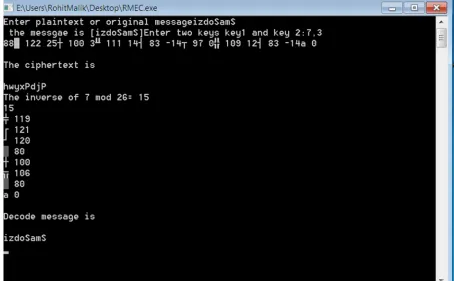
V. PRACTICAL IMPLEMENTATION
[image:6.612.76.535.498.697.2]Technology (IJRASET)
Fig 2. C++ console screen taking above encrypted message and key as plaintext and producing the same as decoded message.
VI. CONCLUSION
A symmetric key algorithm is presented in this paper. This algorithm provides security of transmitted message by making use of triple keys and the simulation results are shown in the paper which shows that the new algorithm is good in terms of security. Although it has some weakness just like other algorithms do. In future we concentrate on more security with less time and less power consumption and also including the schemes and techniques over different data types such as sound, video and rising a stronger encryption algorithm with high speed and minimum energy consumption.
REFERENCES
[1] Cryptography and Network Security Principles and Practices, Fourth Edition By William Stallings. [2] Atul kahate “Cryptography and Network Security”, tata McGraw-Hill Companies, 2008
[3] Vikrant M.Adki, Prof.. Shubhanand S.Hatkar,”A Survey on Cyptograpjhic Techniques”International Journal of Advanced Research in Computer Science and Softwaew Engineering. Volume 6, Issue 6, June 2016, ISSN:2277128X
[4] Solanki Patnayak and Dipankar Dey,”Text Encryption and Decryption with Extended Euclidean Algorithm and Combining the Features of Linear Congruence Generator”, International journal of Development Research, Vol. 06, Issue, 07, July 2016, ISSN:2230-9926.
[5] Obaida Mohammad Awad Al-Hazaimeh,”A New Approach For Complex Encrypting And Decrypting Data”, International Journal of Computer Network & Communications(IJCNC) Vol 5, No 2, March 2013
[6] Abhishek Joshi, Mohammad Wazid, R.H Goudar,”An Efficient Cryptographic Scheme for Text Message Protection against Brute Force and Cryptanalytic Attacks”, International Conference on Intelligent Computing, Communication & Convergence(ICCC-2015)
[7] Prosper Kandabongee Yeng, Joseph KobinaPanford, James Ben Hayfron-Acquah, Frimpong Twum,”An Efficient Symmetric Cipher Algorithm for Data Encryption”, International Research Journal of Engineering and Technology(IRJET), Vol 03,Issue:05, May 2016
[8] Karthik,.S, Muruganadam. A,”Data Encryption and Decryption by using Triple DES and Performance Analysis of Crypto System”, International Journal of Scientific Engineering and Research (IJSER), Vol 2, Issue 11, November 2014
[9] Om Prakash Verma, Ritu Agarwal, Dhirai Dafouti,Shobha Tyagi, “Peformance analysi of data encryption algorithms”, 3rd IEEE International Conference on
Electronics Computer Technology (ICECT), 2011.
[image:7.612.77.531.77.358.2]