Secured Aadhar Based Electronic Voting System
D. M. Ujalambkar1, Kashinath Raut2, Kiran Chavan3, Ashish Bhingardive4, Yogesh Kolape5 1, 2, 3, 4, 5
Department of Computer Engineering, Savitribai Phule Pune University
Abstract: Now a days fake voting is still major problem in elections. In this paper we attempt to solve this problem using existing
Aadhar card database and fingerprint of voter. This paper proposes a secure electronic voting machine (EVM) using Aadhar card database and fingerprint authentication. This system authenticates voters by matching fingerprint and eligibility is checked by verifying the age that allows only eligible candidates to vote. Time required for authentication is reduced by using the Aadhar number and 1:1 fingerprint matching(i. e. authentication will be done by checking whether the entered Aadhar number and fingerprint is matching or not without comparing it with whole fingerprint database to increase speed of authentication). The counting of votes will be done automatically so that time will be reduced and result can be announced in less amount of time. The improvisations aim at increasing the security, flexibility, reliability, scalability of the system.
Keywords: EVM, Aadhar card, fingerprint .
I. INTRODUCTION
After getting the freedom from British government, Indian Government provide a right to Indian people to elect their leader. India having the largest democracy in the world. So, to achieve the transparency in voting system is challenging task of election commission. The objective of voting is to allow voters to choose their government and political representatives. The election is the basic process of democracy in which people show their opinions by selecting their candidates. India is spending huge money to improve our voting system to provide a better government to citizens. The voting system should be honest, translucent and fully secure for the better democracy. The current system is used to less transparency because there could be chance of rigging at voting time. The security of the voting process, authentication of voters, protecting the voted data these are the important factors of current election system. Therefore it is necessary to generate a secure voting system [1].
The objective of voting is to allow voters to exercise their right to choose their government and political representatives. Technology is being used more and more as a tool to assist voters to cast their votes. To allow the exercise of this right, almost all voting systems around the world include the following steps: Voter identification and authentication, Voting and recording of votes cast, Vote counting, Publication of election results. Voter identification is required during two phases of the electoral process: first for voter registration in order to establish the right to vote and afterwards, at voting time, to allow a citizen to exercise their right to vote by verifying if the person satisfies all the requirements needed to vote (authentication) [9].
In this Project we are using minutiae based algorithm for fingerprint matching. This algorithm is reliable ,accurate and most popular fingerprint matching algorithm. In this algorithm, Fingerprint image is enhanced and converted to binary image for further processing. In second step, image is thinned and minutiae are extracted. Finally, minutiae pairs of two fingerprints are matched to get matching score. This method has the ability to find the similarity between input minutiae sample and the stored minutiae sample without using the tiring investigation [10].
II. LITERATURESURVEY
In the traditional voting system, a ballot paper was used to cast the votes. At the polling station, the election commission officers check identity proof (election ID card) of voters and allocated a ballot paper to a voter. The voter votes by marking the ballot paper with candidates name and symbol by rubber stamp, inside a voting compartment in the polling booth. Then the voters fold the ballot paper and insert it into a ballot box.
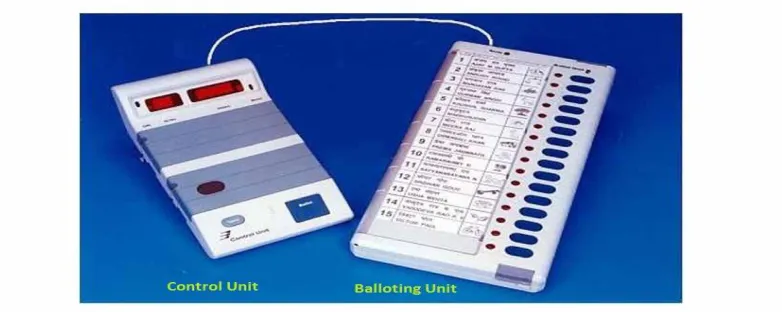
The following figure shows the Electronic voting machine components [4].
Fig. 1 Components of EVM
The online voting system has several important steps. The system is approachable from two sides: (i) From the Election Commission of India side who is also the Administrator. (ii) From the voter sides. It consists of E-Ballot paper for voters to cast the votes [1]. The biometric voting system using Aadhar card is designed, according to this system casting voting process is much speedy and most of the tasks are done automatically by the system. They are correlation-based fingerprint matching technique to improve the performance and to get much reliable fingerprint recognition [7]. An Endeavour to improve the easy usage of the voting machine with authentication and an acknowledgment slip will provide for every polling which occurs. And a touch screen is used to give input so it is so very easy to overcome the button problem. GSM module is used for sending the result to the corresponding authorized persons [5]. An E-voting system using Aadhar's face and fingerprint biometric is proposed, they used different biometrics traits for EVM to cast the votes. Illiteracy is the main hurdle in this project to come true because for an illiterate person it is not easy to work with machine interface. [8]. An Electronic voting system is developed that has fingerprint and Hex keypad. A database consisting of the details like name, address, age, gender, the fingerprint of the people should be updated every time before the election. This system affords additional security by allowing the voter to vote only once by imparting unique identification [9]. of a biometric voting machine using Aadhar card working system is explained in two modes First one is enrolment mode and another one is punching and identification mode. In the enrolment mode, we enrol the fingerprint of the user by sending appropriate command. When the user put the fingerprint on the fingerprint scanner, generate the Image file of the finger. Again, put the fingerprint on fingerprint scanner for confirmation of valid fingerprint. Then generate another Image files. And During punching and identification mode the fingerprint of the user is compared with the fingerprints already enrolled in the memory of the algorithm which is embedded in microcontroller [2]. The hex keypad is designed for the electronic voting machine. This system consists of tamper-proof card wherein all records about the persons were stored. Based on the features of fingerprint it gets matched with the person who cast his/her vote. Fingerprint matching will be done using the Aadhar card database. The voter's finger is matched with the database. The voters get an OTP through GSM modem. If OTP and fingerprint are matched then only voters are allowed to cast their votes [3].
A. Problems with existing system
1) Do not guarantee transparency: A voter could not check what happened to his/her vote i.e., whether it has been properly
recorded in the system database or not.
2) Since the EVMs move through different hands therefore they are susceptible to manipulations by fraudulent.
3) Since the structure and composition of the EVM are very simple so substituting a Look-Alike fake EVM with the real one can be done easily.
4) Susceptible to manipulations: by attaching additional hardware to the control unit’s circuit board, an attacker could directly read
and write the EEPROM chips that record the votes
III.PROPOSEDSYSTEM
In the proposed system we are using Aadhar Database as a backbone of our project for authentication and for checking the eligibility of the voter. In the project, we are using the UID number and 1:1 fingerprint matching that will reduce the time required for authentication( i. e. authentication will be done by checking whether the entered UID number and fingerprint is matching or not without comparing it with whole fingerprint database to increase the speed of authentication).
The proposed system is the AADHAR based electronic voting system with a biometric fingerprint. It determines the particular voter by his/her UID number and fingerprint whether he/she is a valid voter or not. The biometric voting system uses Aadhar card to retrieve the complete details about the voter.
We propose a system that will accept voters Aadhar id and asks for a fingerprint for verification of correct voter. We have a fingerprint scanner and a GUI that accepts voters UID number, provides an interface to vote and display confirmation, status and error messages. The GUIs will only act on events from the server and feedback of the voter without any extra processing. When any new voter votes successfully his Aadhar number will be added to voted list. For new coming voter his UID number will be compared with voted list if it is already present in the list that means that user has already done voting, therefore, he will not be allowed to vote. This will reduce the time required for validating the voter by comparing UID number with voted list instead of comparing it with whole Aadhar database. After validating system will checks if the voter is eligible to vote by using his date of birth. If the voter is eligible then the system will ask for the fingerprint to verify that voter is authorized. After meeting all the conditions successfully voter is allowed to vote.
IV.SYSTEMARCHITECTURE
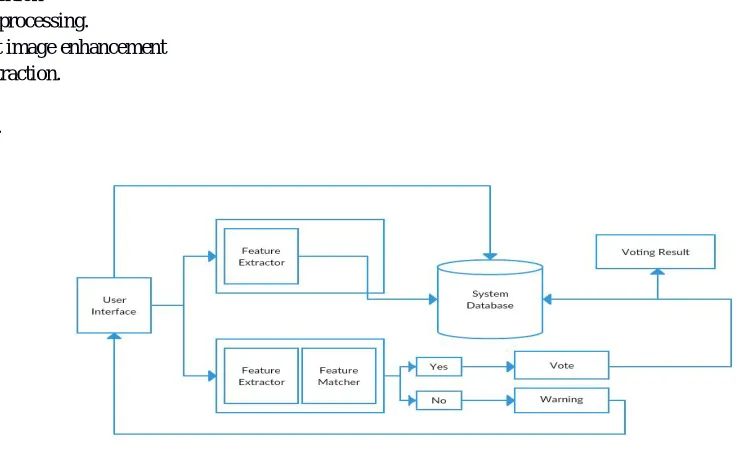
The overall system design consists of following modules
A. Data acquisition
B. Image pre-processing.
C. Fingerprint image enhancement
D. Feature extraction.
E. Matching.
F. processing.
[image:4.612.103.471.346.575.2]G. Database.
Fig. 2 System Architecture
The system has two modes, the enrolment and authentication modes. The enrolment mode handles the registration process in order to register the users in the system; the output of the enrolment mode will be stored in the database of the system. The second mode which is the authentication mode handles the process of checking the eligibility of the user by taking the users Aadhar number and fingerprint and matches it with the databases fingerprints; if the system found any similar fingerprint in the database then the user is eligible to cast his vote. The vote of the user will be count and store in the database. At the end of the voting process, the user can check the election result by clicking the result button.
V. FINGERPRINTMATCHINGALGORITHM
feature vectors will be the base of the identification mode. At the beginning and as a first step must determine the fingerprint’s centre point as well as the region of interest. The (ROI) which is the region of interest will be located around the reference point. Sectorization and normalization will be applied to the fingerprint image.
Fingerprints of every person are unique and remain unchanged during the whole life. A Fingerprint comprises of curvilinear patterns called ridges. Minutiae are discontinuities in ridges, which are used as a feature for identification. Space between two adjacent ridges is termed as a valley. According to National Institute of Standards and Technology (NIST), standard representation of a fingerprint is based on minutiae and it includes minutia location and orientation [10] .
Two most important minutiae are ridge termination and ridge bifurcation. Ridge termination is a point on the ridge where it terminates. Whereas the point at which a single ridge splits into two ridges is called ridge bifurcation [10,11].
Fig. 3 Ridge Ending Fig. 4 Ridge Bifurcation
These minutiae of fingerprints of a human have sufficient details. We can use these non-trivial details as identification marks to verify the fingerprints [10].
VI.CONCLUSIONS
This system can be used for voting since it overcomes all the drawbacks of the ordinary voting machine and also provides additional security. This system checks the voter's age is 18 or not by using Aadhar database to identify invalid voters. One voter cannot vote more than once since system marks voters Aadhar id as Voted after he cast his vote. This system uses Aadhar id, therefore, there is no need for voter id.
For further verification, this system uses a fingerprint of the voter. Since fingerprint of every person is unique and hence system completely reduces the chances of rigging. This is the main advantage of this system. Transparency, security, accuracy, of voting, can be achieved.
REFERENCES
[1] H.Agarwal and G.N.Pandey, "Online Voting System For India Based On Aadhar Id," 2013 Eleventh International Conference on ICT and Knowledge Engineering, Bankok,2013.
[2] Gowri,Guruprasanth, Jaya Surya. D, Krishnan. S, Dhanasekaran.S.,"Imphilementation of Biometric Voting Machine Using Aadhar Card," IJSRSET, Volume 2, Issue 2, 2016.
[3] G.Valarmathy, V.Saranya, Riya Rose Cherian, K.Poovizhi,"Smart Voting System Using Aadhar", published in IJRE, Volume: 04 Issue: 01 2017.
[4] Ankita R. Kasliwal, Jaya S. Gadekar. Manjiri A. Lavadkar, Pallavi K. Thorat, Dr. PraptiDeshmukh., " Aadhar Based Election Voting System", IOSR Journal of computer engineering.
[5] Anandaraj S, Anish R, Devakumar P.V, "Secured Electronic Voting Machine Using Biometric", ICIIECS 2015.
[6] Murali R Prasad, PolaiahBojja, and MadhuNakirekanti, "Aadhar Based Electronic Voting Machine Using Arduino", International Journal of Computer Applications 145(12):39-42, July 2016.
[7] SoumyajitChakraborty, Siddhartha Mukherjee, BhaswatiSadhukhan, KaziTanviYasmin,"Biometric Voting System Using Adhar Card in India", Published in IJIRCCE Vol. 4, Issue 4, April 2016.
[8] SaurabhYadav and Ajay Kr. Singh, "A Biometric Traits based Authentication System for Indian Voting System", International Journal of Computer Applications (0975 – 8887) Volume 65– No.15, March 2013
[9] Prof.R.L.Gaike, Vishnu P. Lokhande, Shubham T. Jadhav and Prasad N. Paulbudhe, "Aadhar Based Electronic Voting System", Volume 1, Issue 2 May 2016, ISSN (Online) 2456-0774 International Journal Of Advance Scientific Research and Engineering Trends.
[10] W. Chen and Y. Gao, "A Minutiae-Based Fingerprint Matching Algorithm Using Phase Correlation," 9th Biennial Conference of the Australian Pattern Recognition Society on Digital Image Computing Techniques and Applications (DICTA 2007), Glenelg, Australia, 2007, pp. 233-238.doi: 10.1109/DICTA.2007.4426801