Reading Material Personalization Searching in E-Learning
Liyana Shuib1, Nur Baiti ‘Afini Normadhi1, Nor Atiqah Mohd Shuib2
1
Department of Information Systems, Faculty Science Computer and Information Technology, University Malaya, Malaysia.
2
Faculty of Business Management, Universiti Teknologi MARA (UiTM) (Arau), Perlis, Malaysia.
Abstract
A student’s ability to grasp new concepts or knowledge from reading material is crucial and dependent on their personalization. Personalization can be identified using learning style. In e-learning, identifying learning style, and matching reading material based on learning style, is critical for students; as it may affect their learning progress and their rate of absorbing information. Therefore, it is crucial for students to be able to locate reading material that best matches their particular learning style. The objective of this paper is to develop a tool that can help retrieve reading material based on personalization. By using a collaborative filtering method, this tool will be able to help students locate reading material that best matches their learning style in e-learning. The architecture and components of the tool are discussed.
1. Introduction
be defined as a web-based system that is designed to support learning and teaching processes to the user. Reading material is one of the most commonly used learning materials in e-learning. Reading is a fundamental skill that each person needs to develop during early childhood and continue to enhance into adulthood (Cechinel et. al, 2013). Students need reading material to carry out activities, such as solving problems, making decisions, reducing uncertainties, resolving conflicts, answering questions and satisfying curiosities. It helps them understand their courses. Students should read suitable reading material in order to become effective readers.
However, most students have difficulty finding suitable reading material due to information overload and differentiation in reading material presentations. Reading materials differ due to the differentiation of levels and forms of how authors present their information. A student’s ability to grasp new concepts or knowledge from reading material is crucial and dependent on their personalization or learning style (Honey & Mumford, 1992; Fleming, 1995). Students experience difficulty if reading materials do not match their particular learning style; because each individual has a different type of learning style. The mismatch of reading material with student learning style causes student to lose interest in their learning progress. Students usually depend on teachers or tutors to select their reading material. There is currently no e-learning software that can help with recommending suitable reading material based on personalization. This paper aims to develop a tool that can help retrieve reading material based on personalization. The tool will be upgraded from the existing Learning Style based Information Seeking tool (Shuib & Abdullah, 2013), by using collaborative filtering method technology, in order to assist students in finding their reading material. Personalization can be identified using learning style. Several studies have revealed that learning can be enhanced through the presentation of materials that are consistent with a student’s particular learning style (Budhu, 2002; Pen˜a et al., 2002; Stash et al., 2004).
2. Literature Review
demonstrates their information in reading material to readers. The appropriate presentation of information in reading material plays an important role; because it enhances the reader’s ability to understand and effectively gain more knowledge for them to apply in a learning activity. Most reading material can be found online (Ghauth & Abdullah, 2010). Many organizations and publishers today have digitized the printed their reading material, to give easy access to users anywhere and anytime.
With increasing access to the internet, the amount of information is growing exponentially; thus leading to information overload problems. For this reason, students are faced with difficulties of obtaining suitable reading material. This is largely because students are unaware of their own learning style. To compound this problem, reading materials are not classified according to the way authors present their information.
Personalization can be applied via learning style. In this study, we use the VARK learning style by Fleming and Mill (1992), because it uses sensory modality. Sensory modality involves the merging of perception and memory, with due consideration to the way the mind receives and accumulates information. With the utilization of sensory modality, the elements that constitute the four learning style preferences, which are Visual (for learners who prefer information presented in a visual form), Aural (for learners who prefer information that is listened to or verbalized), Read/write (for learners who prefer information presented in a text form) and Kinesthetic (for learners who prefer learning by example, action, practice and experience), can be differentiated and appropriately mapped to the reading material.
2.1 E-learning
Formative assessment - short tests and quizzes, questions and answering the lesson, assignments, homework, and so on
Learning content - topic of the course
Learning object - entities that can be used to support learning
Learning path – a defined path to follow learning content
Learning strategies – type of learning object that the student should learn
Table 1: Personalized e-learning
Author Learning Resources System Output Learning Style Klašnja-Milićević et. al
(2011)
Formative Assessment Learning Path Yes Yaghmaie and
Bahreininejad (2011)
Learning Content Learning Strategies Yes Yang et. al (2009) Learning Content and
Formative Assessment
Learning Path Yes Baribi et al (2009) Learning Object Learning Strategies Yes
Cheng (2009) Learning Object Learning Strategies Yes
Hassan (2009) Learning Object Learning strategies Yes
Rogers (2009) NA Learning strategies Yes
Savic and Konjovic (2009) Learning Content Learning strategies Yes Apriyani and Hasibuan
(2008)
Learning Object Learning strategies Yes
Rafe and Manley (2008) NA Learning strategies Yes
Graf et al. (2007) Learning Object NA Yes
2.2 Recommender system
Recommender system has been a very active research topic for two decades (Cleger-Tamayo, Fernández-Luna & Huete, 2012; Bobadilla et al., 2013). It is used widely in various domains, such as business and education (Liao et al., 2010; Shuib et al., 2015). With the increase of learning objects in e-learning, recommender systems have become an important component of personalized e-learning services and are essential for e-learning providers to remain competitive (Wan, Jamaliding & Okamoto, 2011). The most popular method in recommender system is collaborative filtering. The collaborative filtering method is user-to-user correlation that uses group opinions to recommend items to individuals. This method computes similarities between user preferences and recommends items based on ratings provided by users whose preferences are similar to those of the given user and recommends items that they liked. The collaborative filtering method can be broken down into three categories according to their algorithmic techniques, which are memory based, model based and hybrid based (Bobadilla, Serradilla & Bernal, 2010; Shuib et al., 2015). The collaborative filtering technique is used widely in the business domain (Shendage, 2014).
The knowledge based method recommends items based on their functional knowledge. This functional knowledge contains knowledge about how a particular item meets a particular user’s needs (Burke, 2000). This approach solves early rater and scarcity problems, because it does not depend on user ratings. The early rater problem is when new items, that have not had many ratings, cannot be easily recommended (Burke, 2002). Therefore, this approach complements the others (Burke, 2000). However, there is no recommender system in e-learning that implements this method.
3. Method
Figure 1: Research Methods
Identifying learning style model
The VARK learning style, by Fleming and Mill (1992), was used because it uses sensory modality and the suitability of preferences with reading material primitive elements. VARK consists of Visual, Audio Read/Write and Kinesthetic preferences (Fleming, 2010).
Mapping reading material onto learning style
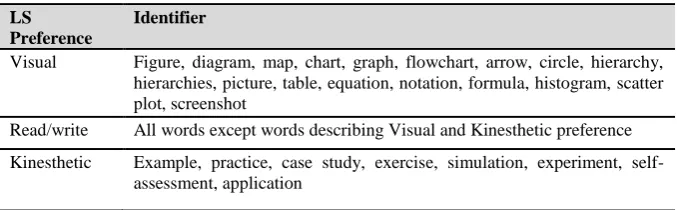
Primitive elements in reading material are mapped onto learning style preferences (as shown in Table 2). For the audio preference, other preference components are used.
Table 2: Mapping reading material onto learning style preference Identifying
Learning Style model
Mapping Reading Material Onto Learning
Style
Designing and Developing
the tool
Evaluating the tool
LS Preference
Identifier
Visual Figure, diagram, map, chart, graph, flowchart, arrow, circle, hierarchy, hierarchies, picture, table, equation, notation, formula, histogram, scatter plot, screenshot
Read/write All words except words describing Visual and Kinesthetic preference Kinesthetic Example, practice, case study, exercise, simulation, experiment,
[image:6.595.129.468.515.620.2]Designing and developing the tool
The system was designed and developed using a web base system. Figure 2 shows the architecture of the system. The architecture has five components, which are Input, Output, Database, LS based Search and Feedback. Each component is discussed in the next section.
Input
Student Admin
LS based Search
Keyword based Search Student
RM
Database
Output
RM Retrieved
Figure 2: Proposed architecture in Book Spot
Evaluating the tool
4. Book Spot!
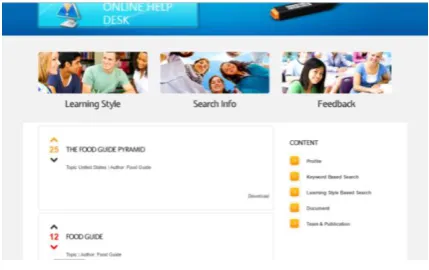
[image:8.595.155.443.267.456.2]The tool’s name is Book Spot! In this section, each of the modules shown in Figure 2 will be discussed:
Figure 3: Book Spot! Home Page
Input module
This module receives information from user’s profile, such as learning style test and search query. This input is used to develop a user model for learning style based search and is stored in the user’s database. Furthermore, the input module also receives the reading material data, such as title, author, pdf file, topic and learning style category from the administrator.
LS based search module
between learning style components in reading material and the students’ preferences using knowledge based method.
Output module
Reading materials that match the students’ search query and have a high similarity with the students’ preferences will appear in the results. Each reading material can be evaluated by the student.
Database module
The database module has two types of database, namely the student database and the reading material database. The student database consists of student profile, learning style record and evaluation. The reading material database contains the documents and ratings from the user.
Feedback Module
[image:9.595.190.405.471.606.2]Feedback is based on user-user rating. This module recommends the best reading materials to the new user based on ratings from previous users that had similar preferences.
5. Evaluating the Tool
In this study, a TAM was used to evaluate the usability of the study. Perceived ease of use, perceived usefulness and user satisfaction for Book Spot were evaluated. Evaluation forms were distributed to users. The TAM was applied to evaluate the Book Spot system to measure system performance.
Ease of use - The functionalities of user interface interaction are, ease to use, friendly user interface, effectively saving the users’ time finding suitable reading materials, and selecting reading material quickly, based on users’ preferences.
Usefulness - Effective use of the Book Spot system in progress learning, improve the users’ understanding in reading and increase awareness of the student’s learning style.
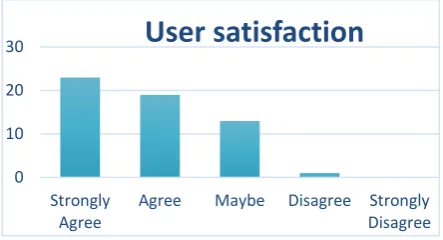
User satisfaction - Quickly accomplishes student tasks and gain student confidence in learning progress.
Figures 5 to 7 show the results from the user’s evaluation of the Book Spot system.
Figure 5: Perceived ease of use book spot 0
10 20 30
Strongly Agree
Agree Maybe Disagree Strongly
Figure 6: Perceived usefulness book spot
Figure 7: User satisfaction on book spot
The results show that users agreed that Book Spot is easy to use, useful and has satisfactory tools.
6. Conclusion
In e-learning, identifying learning style and matching reading material based on learning style is critical for students, as it may affect their learning progress and their rate of absorbing information. It is therefore crucial for students to be able to locate
0 20 40
Strongly Agree
Agree Maybe Disagree Strongly
Disagree
Perceived usefullness
0 10 20 30
Strongly Agree
Agree Maybe Disagree Strongly
[image:11.595.187.409.348.468.2]reading material that best matches their learning style. Using the knowledge based and collaborative filtering method can help students to locate reading materials that best match their learning style in e-learning. This will improve their e-learning efficiency.
7. Acknowledgement
This research is funded by University Malaya Research Fund Assistance (BK045-2013).
8. References
Apriyani, T. I., & Hasibuan, M. S. (2008). Sistem E-Learning Dengan Pendekatan Gaya Belajar Vark. Konferensi Nasional Sistem dan Informatika, 19–23.
Baribi, S., Benbouna, A., Eladnani, M., El hassan, A., & Chraibi, S. (2009). Learning style appropriate to the personal character of a learner: Pedagogical indexing learning object . In Third International Conference on Research Challenges in Information Science (pp. 103–112).
Bobadilla, J., Ortega, F., Hernando, a., & Gutiérrez, a. (2013). Recommender systems survey. Knowledge-Based Systems, 46, 109–132. http://doi.org/10.1016/j.knosys.2013.03.012
Bobadilla, J., Serradilla, F., & Bernal, J. (2010). A new collaborative filtering metric that improves the behavior of recommender systems. Knowledge-Based Systems, 23(6), 520–528. http://doi.org/10.1016/j.knosys.2010.03.009
Budhu, M. (2002). Interactive web-based learning using interactive multimedia simulations. International Conference on Engineering Education (ICEE 2002) .
Burke, R. (2002). Hybrid recommender systems: Survey and experiments. User Modeling and User-Adapted Interaction, 12(4), 331–370.
Cechinel, C., Sicilia, M. Á., Sánchez-Alonso, S., & García-Barriocanal, E. (2013). Evaluating collaborative filtering recommendations inside large learning object repositories. Information Processing and Management, 49(1), 34–50. http://doi.org/10.1016/j.ipm.2012.07.004
Cleger-Tamayo, S., Fernández-Luna, J. M., & Huete, J. F. (2012). Top-N news recommendations in digital newspapers. Knowledge-Based Systems, 27, 180– 189. http://doi.org/10.1016/j.knosys.2011.11.017
Cheng, Y. (2009). A Cognition Inference-Based Approach for Learning Object Recommendation in E-Learning. International Symposium on Computer Networkand Multimedia Technology (pp. 1–4). Shanghai, China.
Fleming, N. (2010). The VARK Questionnaire. Retrieved January 1, 2010, from http://www.vark-learn.com/english/page.asp?p=questionnaire
Fleming, N. D., & Mills, C. (1992). Not another inventory, rather a catalyst for reflection. To Improve the Academy. Retrieved January 7, 2013, from
http://digitalcommons.unl.edu/cgi/viewcontent.cgi?article=1245&context=podimpro veacad
Ghauth, K. I., & Abdullah, N. A. (2010). Measuring learner’s performance in e-learning recommender systems. Australasian Journal of Educational Technology, 26(6), 764–774.
Hassan, R. (2009). How Learners Respond to Computer Based Learning Material Based on Modality Learning Style? Teaching And Learning Open Forum 2009. Curtin University of Technology Sarawak.
Honey, P., & Mumford, A. (1992). The Manual of Learning Styles (3rd ed.). Maidenhead: Peter Honey Publications.
Klasnja-Milicevic, A., Vesin, B., Ivanovic, M., Budimac, Z., Klašnja-Milićević, A., & Ivanović, M. (2011). E-Learning personalization based on hybrid
recommendation strategy and learning style identification. Computers & Education, 56(3), 885~899. doi:10.1016/j.compedu.2010.11.001
Liao, I.-E., Hsu, W.-C., Cheng, M.-S., & Chen, L.-P. (2010). A library recommender system based on a personal ontology model and collaborative filtering technique
for English collections. The Electronic Library, 28(3), 386–400.
http://doi.org/10.1108/02640471011051972
Masrom, M. (2007). The Technology Acceptance Model and the E-Learning, 12th International Conference on Education, Sultanah Hassanal Bolkiah Institute of Education, Universiti Brunei Darussalam.
Pen˜a, C.I. et al. (2002). Intelligent agents in a teaching and learning environment on the Web. ICALT 2002.
Shuib, N.L.M (2013). Learning Style Based Information Seeking Tool. PhD Thesis. University of Malaya.
Shuib, NLM. & Abdullah, R. (2013). LSIST: Learning Style Based Information Seeking Tool. In 8th International Conference on Intelligent Information Processing, 1-3 April 2013, Seoul, Republic of Korea
Rogers K.M.A. (2009). A preliminary investigation and analysis learning style preferences in further and higher education. Journal of Further and Higher Education. 33(1): pp.13-21
Rafe, G., and Manley, J. H. (1997).Learning style and instructional methods in a graduate level engineering program delivered by video teleconferencing technology .Frontiers in Education 27th Annual Conference Proceedings: Teaching and Learning in an Era of Change (pp. 1607-1612). Retrieved May 13,2008, from http://fie.engrng.pitt.edu/fie97/papers/1172.pdf.
Shendage, P. N. (2014). Review on Collaborative Filtering and Web Services Recommendation, 2(6), 912–916.
Stash, N. et al. (2004). Authoring of learning styles in adaptive hypermedia: problems and solutions. The 13th International Conference on World Wide Web.
Savic, G., Konjovic, Z. (2009). “Learning style based personalization of SCORM e- learning courses” 7th International Symposium on Intelligent Systems and Informatics (SISY 2009), p 349-53, 2009 IEEE.
Sun, J., & Xie, Y. (2009). A Recommender System Based on Web Data Mining for Personalized E-Learning. International Conference on Information
Engineering and Computer Science (pp. 1–4). ICIECS 2009.
Trika, I. K., Ana, A., & Singaraja, S. A. H. (2002). Teaching Reading through E-learning Website, 554–563.
Wan, X., Jamaliding, Q., & Okamoto, T. (2011). Analyzing learners’ relationship to improve the quality of recommender system for group learning support.
Journal of Computers, 6(2), 254–262. http://doi.org/10.4304/jcp.6.2.254-262