© 2016, IRJET |
Impact Factor
value
: 4.45|
ISO 9001:2008 Certified Journal | Page 1025
MULTI PULSE RECTIFIER USING DIFFERENT PHASE SHIFTING
TRANSFORMERS AND ITS THD COMPARISON FOR POWER QUALITY
ISSUES
Komal Gamit
1, Khushbu Chaudhari
21
Assistant Professor, Electrical Engineering Department, CGPIT, Gujarat, India
2Student (M.TECH), Electrical Engineering Department, CGPIT, Gujarat, India
---***---Abstract -
The converters which are also known asrectifiers are generally fed from three phase ac supply have problems of power quality in terms of harmonics injected into the supply which cause poor power factor, ac voltage distortion and rippled dc outputs. To eradicate these problems, multipulse converters can be used. Multi pulse converters are converters providing more than six pulses of DC voltage per cycle or the converter is having more steps in AC input current than that of six pulse rectifier supply current. In this paper multipulse converter with 6, 12, 18, 24 and 36 pulse rectifier are designed using different topologies of three phase star-delta, delta-star, star-star, delta-delta, and ziz-zag connection of transformer for different phase shifts. It has been proved that these topologies provide less harmonics and good voltage regulation with proper comparisons of their THD levels.
Key Words: phase shifting transformers, multi pulse
rectifier, total harmonic distortions (THD), fast
Fourier transforms (FFT).
1. INTRODUCTION
Now days the harmonic distortion is the big issue for the power quality, harmonics create a serious problem in the electronics world. The harmonics in the power system cause serious problem due to the wide application of the power electronics equipments based industrial process in which the AC-DC converters are normally used. The power factor and the harmonic distortion can be improved by increasing the pulse number of AC-DC converters. This harmonic current injection is mainly due to the non linear nature of loads connected to electrical utility, e.g. industrial electrical equipment. The low power factor of the electric installation is responsible for a series of problems caused in electrical system. This results in increased losses in conductor, error introduced in
measuring equipment, malfunction of other equipment connected to mains due to distortion of line voltage. Many techniques have been proposed to solve the harmonic current problem like active filtering (STATCOM) to supply load reactive power and harmonics. Passive Current Shaping method include both the utilization of harmonic taps to attenuate certain frequencies as well as multiple configuration like 6, 12, 18, 24, 36, pulse diode/thyristors (uncontrolled/controlled) configuration. Some applications have stringent power quality specification, so it is suggested that higher pulse AC-DC converter must be used to meet standard requirements. The harmonics in input current and output voltage of conventional multi pulse controlled rectified fed from delta/star transformer can be reduced by using filters. But these filters are bulky and loss. Moreover some applications have stringent power quality specification and it is advisable to use multi pulse AC-DC converter system configuration. Therefore, it is suggested that higher pulse AC-DC converters have to be used.
© 2016, IRJET |
Impact Factor
value
: 4.45|
ISO 9001:2008 Certified Journal | Page 1026 improving the power quality. The designed AC-DC
converter system is modeled and simulated in MATLAB to demonstrate its power quality improvement at AC mains.
2. PHASE SHIFTING TRANSFORMERS
Phase shifting transformer provides a three main functions like required phase displacement between primary and secondary line-line voltage for harmonic cancellation, proper secondary voltage, and an electrical isolation between the rectifiers and the utility supply.
Phase shifting transformers are classified in two categories: Y/Z and Δ/Z where the primary winding can be connected in to Y or Δ where the secondary winding is normally connected in Z. Both configurations can be equally used in multi pulse rectifier. And also other transformer connections can be used in multi pulse rectifier like Y/Y, Y/Δ, Δ/Y, and Δ/Δ.
[image:2.595.309.514.110.294.2]2.1 Y/Y & Y/Δ connection of transformer:
Figure 1 Phasor Diagram of Y/Y transformer
[image:2.595.40.285.332.522.2]2.2 Y/Z -1 phase shifting transformer:
Figure 2: Phasor diagram of Y/Z-1 transformer
2.3 Y/Z-2 phase shifting transformer:
Figure 3: Phasor Diagram of Y/Z-2 transformer
Table 1 Turns Ratio for Y-Z Transformer
Y/Z-1
(δ)
Y/Z-2
(δ)
Applicati ons
1.0 12,18 and
24- pulse rectifiers
15° -15° 0.366 24-pulse
[image:2.595.311.523.335.542.2] [image:2.595.56.555.588.793.2]© 2016, IRJET |
Impact Factor
value
: 4.45|
ISO 9001:2008 Certified Journal | Page 1027
20° -20° 0.277 18-pulse
rectifiers
30° -30° 0 12 and
24-pulse rectifier
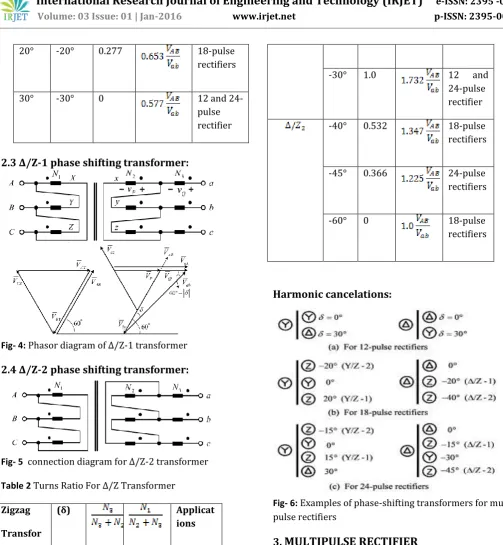
[image:3.595.35.539.55.601.2]2.3 Δ/Z-1 phase shifting transformer:
Fig- 4: Phasor diagram of Δ/Z-1 transformer
2.4 Δ/Z-2 phase shifting transformer:
[image:3.595.309.534.346.548.2]Fig- 5 connection diagram for Δ/Z-2 transformer
Table 2 Turns Ratio For Δ/Z Transformer
Zigzag
Transfor mer
(δ) Applicat
ions
0 12,18
and 24- pulse rectifiers
-15° 0.366 24-pulse
rectifiers
-20° 0.532 18-pulse
rectifiers
-30° 1.0 12 and
24-pulse rectifier
-40° 0.532 18-pulse
rectifiers
-45° 0.366 24-pulse
rectifiers
-60° 0 18-pulse
rectifiers
Harmonic cancelations:
Fig- 6: Examples of phase-shifting transformers for multi pulse rectifiers
3.
MULTIPULSE RECTIFIER
[image:3.595.37.247.419.510.2]© 2016, IRJET |
Impact Factor
value
: 4.45|
ISO 9001:2008 Certified Journal | Page 1028 3.1 Six pulse rectifier:
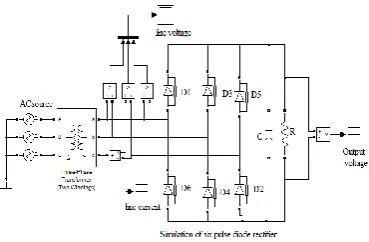
The six pulse rectifier is also popularly known as the three phase bridge rectifier which uses diodes for converting ac to dc. Power circuit diagram for a 3-phase bridge rectifier using six diodes is shown in the figure. The diodes are arranged in three legs. Each leg has two series-connected diodes. Upper diodes D1, D3, D5 constitute the positive group of diodes.
The lower diodes D2, D4, D6 form the negative group of diodes. The three-phase transformer feeding the bridge is connected in delta-star. This rectifier is also called 3 phase 6-pulse diode rectifier, 3-phase full wave diode rectifier.
[image:4.595.314.518.103.288.2]Positive group of diodes conduct when these have the most positive anode. Similarly, negative group of diodes would conduct if these have the most negative anode. In other words, diodes D1, D3, D5, forming positive group, would conduct when these experience the highest positive voltage. Likewise, diodes D2, D4, D6 would conduct when these are subjected to the most negative voltage. The figure of 6 pulse diode rectifier is shown in figure [7].
Fig- 7: six pulse diode rectifier
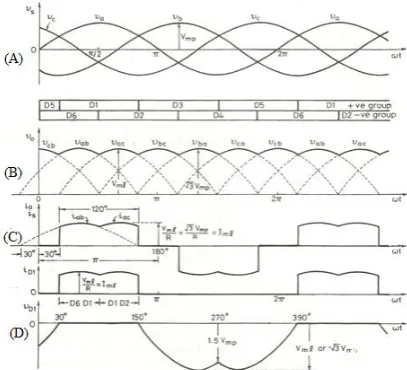
It is seen from the source voltage waveform vs of fig. (A) From ωt=30°to 150°, voltage va is more positive than the voltages vb, vc. Therefore, diode D1 connected to line ‘A’ conducts during the interval ωt = 30° to 150°.
Likewise, from ωt=150° to 270°, voltage Vb is more positive as compared to va, vc; therefore, diode D3 connected to line ‘B’ conducts during this interval.
Similarly, diode D5 from the positive group conducts from ωt = 270° to 390° and so on. Note also that from ωt = 0 to 30°, vc is the most positive, therefore, diode D5 from the positive group conducts for this interval. Conduction of positive group diodes is shown in fig (B) as D5, D1, D3, D5, D1, etc
Fig-8: I/P, O/P voltage and current wave forms
Voltage vc is the most negative from ωt = 90° to
210°. Therefore, negative group diode D2 connected to line ‘c’ conducts during this interval. Similarly, diode D4 conducts from 210° to 330° and diode D6 from 330° to 450° and so on. Not also that from ωt = 0° to 90°, vb is the most negative, therefore diode D6 conducts during this interval. Conduction of negative group diodes is shown as D6, D2, D4, D6, etc. in fig (B).
During the interval ωt = 0° to 30°, it is seen from fig (B) that diode D5 and D6 conduct. The figure shows that conduction of D5 connects load terminal P to line terminal c; similarly, conduction of D6 connects load terminal Q to line terminal b. As a result, load voltage is vpq = v0 = line
voltage vcb from ωt = 0° to ωt = 30°. Likewise, during ωt = 30° to 90°, diodes D1 and D6 conduct. Conduction of diode D1 connects P to a and D6 to b.
Therefore, load voltage during this interval is v0 =
line voltage vab. Similarly, for interval 90° to 150°, diodes
D1 and D2 conduct and v0 = line voltage vac; for interval
150° to 210°, diodes D3 and D2 conduct and v0 = line
voltage vbc and so on. Output, or load, voltage waveform is
drawn by a thick curve in fig (C).
Average value of load voltage,
V
0= ab .d ( t)It is seen from fig (c) that the value of vab at t = 0 is Vml .sin 30 and its periodicity is 60 or rad.
[image:4.595.44.247.410.483.2]© 2016, IRJET |
Impact Factor
value
: 4.45|
ISO 9001:2008 Certified Journal | Page 1029 =3. = =
Fig- 9: Secondary voltage phasor diagram
[image:5.595.77.278.90.313.2]At full load conditions, the input current THD can exceed 100% with no harmonic filter with the 5th and 7th harmonics being the dominant harmonic components. The input current is combination of 5th and 7th harmonic. Harmonic spectrum also shown in fig [8]
Fig- 10: Harmonic Spectrum for 6 Pulse Rectifiers
[image:5.595.79.285.432.556.2]Simulations & Results:
Fig- 11: Simulation of six pulse diode rectifier
Figu- 12: Output Voltage Waveform
Fig- 13: Input line current waveform
Figure 14 Harmonic Spectrum
3.2 Twelve Pulse Rectifier:
The twelve pulses AC to DC converter are also popularly known as three-phase twelve pulse rectifier. As the number of pulses per cycle is increased, the output DC waveform gets improved. So, with twelve pulses per cycle, the quality of output voltage waveform would definitely be improved with low ripple content.
Figure [15] the circuit diagram for a 3-phase 12-pulse rectifier using a total of twelve diodes. A 3-phase transformer with two secondary and one delta-connected primary feeds the diode rectifier current. One secondary winding is connected in star and the other in delta. Star-connected secondary feeds the upper 3-phase diode bridge rectifier 1, whereas the delta-connected secondary is connected to lower 3-phase diode bridge rectifier 2. Each bridge rectifier uses six diodes as shown. The two bridges are series connected so that the net output, or load, voltage vo = (output voltage of upper rectifier, v01)+
(output voltage of lower rectifier v02).
If Va1 , Vb1 , Vc1 are phase for the upper star, then upper
line voltage Vab1 would lead Va1 by 30o as in a three-phase
bridge rectifier of the figure. Similarly, line voltages Vbc1,
Vca1 would lead by 30o their corresponding phasevoltages
[image:5.595.77.262.618.739.2]© 2016, IRJET |
Impact Factor
value
: 4.45|
ISO 9001:2008 Certified Journal | Page 1030 line voltages Vab1, Vac1 , Vbc1 , Vba1 , Vca1 , Vcb1 for the upper
star-connected secondary.
Fig- 15: Diagram for 12 Pulse Diode Rectifier
Fig-16: Phasor diagram for Twelve Pulses
Phase voltage Va1 of upper star must be in phase with
primary line, or phase voltage Va1 as per the transformer
principle. Likewise, line, or phase, voltage Vab2 of the
delta-connected secondary must be in phase with Va1. All the
secondary line voltages Vab2 , Vac2 , Vbc2 , Vba2 , Vca2 , Vcb2 for
the delta-connected secondary as shown in figure [16]. The line voltages Vab1 for upper rectifier and Vab2 for lower
rectifier are phase-displaced by 30o with Vab1 leading Vab2
by 30o. In case input line voltages to upper rectifier 1 and
lower rectifier 2 are superimposed ; line voltages Vab1 , Vab2
, Vac1 , Vac2 etc. would be obtained ; these line voltages
would be phase-displaced from each other by 30o. Six
pulse dc output voltage v01 obtained from upper rectifier.
Lower rectifier 2 also gives six- pulse dc output voltage v02.As Vab2 lags Vab1 by 30o, peak of vab2 of v02 is also shown
lagging peak of vab1 of v01.
Since the two rectifiers are series connected, net output, or load voltage vo = v01 + v02 is obtained by adding
the corresponding ordinates of v01 and v02are phase-
shifted from each other by 30o, therefore, waveform of
output voltage v0 consists of twelve pulses per cycle of
supply voltage.
Simulations & results:
Fig- 17: Simulation of six pulse diode rectifier
Fig-18: Output Voltage Waveform
Fig-19: Input line current waveform
Fig-20: Harmonic Spectrum
3.3 Eighteen Pulse Rectifier
© 2016, IRJET |
Impact Factor
value
: 4.45|
ISO 9001:2008 Certified Journal | Page 1031 from a standard pulse diode rectifier if the
six-pulse drive has its DC bus terminals available or permits access to one side of the DC This transformer is connected in star-star and the other one is connected in delta in order to provide 15o phase shift.
The operation of conventional 18 pulse converter result in the absence 17th and 19th harmonic in input
line current.
18-pulse converter is composed of three six pulse bridge rectifier and phase shifting transformer. As six phases supply is needed for feeding three six pulse bridge. But the 150 shifting voltage is needed which
accomplished by different connection of transformer. Bridge can be connected in an way in series or in parallel as the application But have nearly sinusoidal input current so low THD than 6 pulse converter. The THD of the input current is 4.84%. Simulation shows the series connected bridge with star-delta 18 pulse is generated per AC cycle of input. AC line current is shown in fig below.
Fig-21: Simulation diagram of 18 pulse diode rectifier
Fig-22: Output voltage waveform
Fig- 23: Input line current waveform
Fig-24: Harmonic Spectrum
3.4 Twenty four pulse rectifier
Fig-25: Simulation diagram of 24 pulse diode rectifier
Fig-26: Output voltage waveform
Fig-27: Input current waveform
© 2016, IRJET |
Impact Factor
value
: 4.45|
ISO 9001:2008 Certified Journal | Page 1032
3.5 Thirty Six Pulse Rectifier
This system reduces THD in the a source current from IEEE standard of 519 and the THD is less than 5 % and lower ripple in the dc output voltage with the advantage of simple, lower source voltage, THD, size and cost. Harmonic distortion caused by nonlinear loads is becoming a growing problem as nonlinear loads continue to become prevalent in many commercial and industrial applications. This all techniques have been proposed to solve the harmonic current problems.
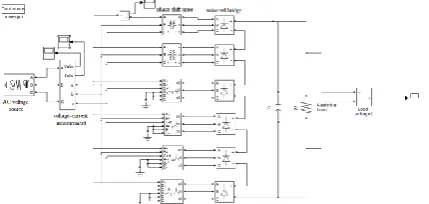
Thus, finally the realization of the 36-pulse rectifier involves obtaining four 3-phase systems with a defined phase shift between them from a single 3-phase system using interconnection of three-phase and single-phase transformers. For this we are using special transformer called phase-shifting transformer. Before understanding this 36 pulse uncontrolled rectifier we already studied the 6 pulse rectifier and 12, and18 pulse rectifier and there simulations and comparison of each multi pulse rectifier. Below figure shows the basic block diagram of the 36 pulse diode rectifier.
Fig-29: Simulation diagram of 36 pulse diode rectifier
Fig-30: Waveform of input current
[image:8.595.308.522.97.213.2]Fig-31: Output voltage waveform
Fig-32: Harmonic Spectrum
Table 3 THD Comparison for Multi pulse Rectifiers
SR No.
No. of pulses
THD for R load
1
6
6.52
2
12
5.73
3
18
4.84
4
24
3.02
5
36
2.79
3. CONCLUSIONS
Multi pulse uncontrolled rectifier can designed using different types of phase shifting transformer with different phase shifting angle like 0o, 30o, 20o, 15o and 10o and
because of it the THD of multi pulse rectifier can decrease by increasing the number of pulse.
REFERENCES
[1] Deependra Singh, Prof. Hemant Mahala, Prof. Paramjeet Kaur, “Modeling & Simulation of Multi-Pulse Converters for Harmonic Reduction”, International Journal of Advanced Computer Research, Volume-2 Number-3 Issue-5 September-2012.
[2] K.Srinivas, “Analysis and Implementation of Multi Pulse Converters for HVDC System”, International Journal of Emerging Technology and Advanced Engineering, Volume 2, Issue 4, April 2012.
[3] Maryclaire Peterson and Brij N. Singh, “Modeling and Analysis of Multi pulse Uncontrolled/Controlled AC-DC Converters”, IEEE ISIE 2006, July 9-12, 2006, Canada. Comparative analysis of three phase ac-dc controlled multi pulse converter
[image:8.595.41.256.404.506.2]© 2016, IRJET |
Impact Factor
value
: 4.45|
ISO 9001:2008 Certified Journal | Page 1033 on Electrical Energy Systems, 978-1-61284-379-
7/11$26.00_c 2011 IEEE.
[5] Bin Wu, “High Power converters and ac drives”, IEEE Press 2006.
[6] Dr. P. S. Bhimara, “Power Electronics”, Khanna Publishers. 4th Ed., 2006.
BIOGRAPHIES
Assistant Professor, Electrical Engineering Department, CGPIT, Gujarat, India.
Student (M.TECH), Electrical Engineering Department, CGPIT, Gujarat, India.