USING AREA MODELS TO VISUALIZE THE DIFFERENCE OF SQUARES
Enes Akbuga
Doctoral Research Assistant Texas State University
Zach Hurdle
Assistant Professor of Mathematics Southern Arkansas University
Introduction
The influence of visualization in aiding the process of understanding has been documented across many fields. We take a more focused look at using area models to construct the difference of squares formula. Rather than gaining conceptual knowledge through strict memorization, numerous examples help to lead students in the direction of understanding. If the formula is simply written in front of students with the expectation that they know the where it comes from and why it works, generally they have a harder time learning the subject, because students tend to immediately search for a pattern rather than represent the formulas for their own understanding (Zazkis et al, 2008). Knuth (2002) and Schoenfeld (1994) both agree that proof of a mathematical concept should not be separated from the practice itself, and that having students develop formulas visually will help them avoid memorization. For example, according to Gallin (2011), one discussion with educators found that some teachers believe the quadratic formula is too complicated to expect their K-12 students to derive, but he believes the quadratic formula is advanced enough that it should be provided and proven by the algebra teacher. We believe that figures and diagrams help students to understand the fundamentals by creating the structure of the formula. This way, students can feel more confident using that knowledge at future points in mathematics, because research supports that students’ learning through modeling is important in many ways for long-term understanding (Iszak, 2000).
Classic Foil Method Instruction
A useful tool that many teachers use to illustrate the idea of binomial squaring, or (𝑎 + 𝑏)2,
Figure 1
We take a square and show that (𝑎 + 𝑏)2 = (𝑎 + 𝑏)(𝑎 + 𝑏). Once we do this, we can
illustrate that two squares and two rectangles are what makes up the square. When adding these up to create the new area of the square, we get 𝑎2+ 𝑎𝑏 + 𝑏𝑎 + 𝑏2, which simplifies
to 𝑎2 + 2𝑎𝑏 + 𝑏2. With this visualization, students can then use it to model the FOIL (first,
outer, inner, last) method. Also, in addition to the positive binomial, teachers can assign the students to perform the same task idea for (𝑎 − 𝑏)2 = 𝑎2− 2𝑎𝑏 + 𝑏2 which would be
similar to our illustration. While this is a helpful tool, these distribution visual aids are generally limited past this type of example. Using algebra tiles, teachers can assign a lesson using the above model for various factoring problems, such as (𝑥 + 𝑎)(𝑥 + 𝑏) = 𝑥2 +
(𝑎 + 𝑏)𝑥 + 𝑎𝑏2. For students that are already familiar with algebra tiles, teachers can
[image:2.612.88.441.270.358.2]provide these tiles as an alternative method to help visualize the multiplication of binomials, using white tiles to represent positive terms and red tiles to show negative terms, as shown below in Figure 2.
Figure 2
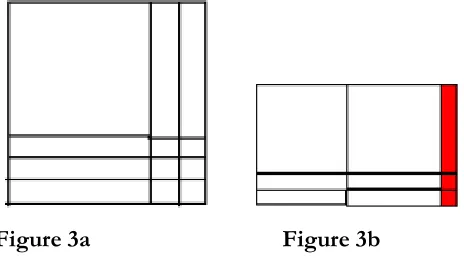
[image:2.612.93.325.432.562.2]Here is an example of using these, for teachers that may be unfamiliar with this method. In figure 3a, the illustration shows a quadrilateral with dimensions (𝑥 + 2) and (𝑥 + 3), while figure 3b shows a quadrilateral with dimensions (2𝑥 − 1) and (𝑥 + 2). In both cases, the FOIL method is shown by the process of finding the area of these figures.
Figure 3a Figure 3b
What if we applied the same ideas to another difficult formula to grasp: the difference of squares?
Illustration of the Difference of Squares
The difference of squares formula, 𝑎2 − 𝑏2 = (𝑎 − 𝑏)(𝑎 + 𝑏), can be represented
by an area model as well. We provide instructions on how to represent this situation, and complement this information with dialogue from an actual student interaction while performing the activity. Start with a square with side length of 𝑎, and then form another small square inside that has side length of b.
O: Well, you’d draw [mimes a square] in it?
Z: Okay so we’d make an extra piece, and what would we do with it eventually? O: Take it away.
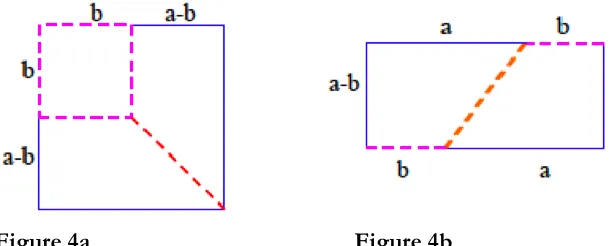
The smaller one can be embedded into any corner of the bigger square as in figure 8a. Then, the small square can be removed from the bigger square, in order to satisfy a visualization of the left-hand portion of the equation, 𝑎2− 𝑏2.
Z: How long is this suddenly shorter side now that you cut the square out? How long is that suddenly shorter side?
O: A minus B squared.
Z: Not, not, not the area, just the length of the side. O: Oh.
Z: It’s...what was it when it was full? What was this? O: A.
Z: Now, it’s out, what is this? O: A minus 1B.
Z: So let’s label that so we don’t forget.
Afterward, the leftover part can be cut into two pieces (by the red lines in figure 4a) so that it produces two trapezoids. By rotating and flipping one of the trapezoids, we can connect the trapezoids by their diagonal legs (represented by the red line in the figure 4b).
Z: Okay, now we have our two pieces, yeah? O: They’re perfectly the same.
Z: Can we make another rectangle, somehow, with these two pieces? Is there any way to do it? Because for us, the easiest way to find area is by rectangle, right?
O: [assembles the pieces]
Z: Okay good, so you put them together like that. O: I flip one over and then…
Z: Flip one over and put it together. O: And that’s the area.
This produces a rectangle with sides lengths (𝑎 + 𝑏) and (𝑎 − 𝑏). Z: So, how long is this again? [points to one side of new rectangle] O: A minus B.
Z: How long is this? [points to other side] O: A...plus B?
Figure 4a Figure 4b
Before this activity, we had explained the concept of visualizing quadratics such as Figure 1 with a drawing on the board. Now that our full activity was completed, we asked this particular student which was more helpful, comparing the original drawing of (𝑎 + 𝑏)(𝑎 + 𝑏) to the recent example of (𝑎 − 𝑏)(𝑎 + 𝑏).
Z: Good. Did, uh, does it help to see it?
O: Well for me, since I’m visual, it helps me picture, like, how they, how it equals that.
Z: Because if, so if, so if I just told you that…
O: Yeah I would never picture that they would be the same.
Z: Like you, I mean I could say they’re the same, but would you know they’re the same or would you just be taking my word for it?
O: [immediate answer] I would just be taking your word, because I wouldn’t, like, understand how to get there. But now with this I can.
Z: Which one is easier? This first one I did, the A+B thing [points to the original (A+B)(A+B) example] or this one? [points to recently-completed activity for (A+B)(A-B)]
O: This one.
Z: You think that one is easier? The minus one is easier? O: Yeah.
Z How come?
O: Well, since we did it like this.
Z: Ah, okay, so if I had had, if I had had tiles, for that one, you think it would have made more--
O: --yeah--
Z: --of an impact? Okay so it’s better when you’re messing with it, not just-- O: Because when you’re physically, like, doing it…
[image:4.612.93.399.78.201.2]Conclusion
REFERENCES
Gallin, P. (2011). The Quadratic Equation – this is a topic to be taught in an inquiry-based way after all. In Baptist, Miller, Raab (Eds.), SINUS International, 5: 4-9.
Iszak, A. (2000). Inscribing the Winch: Mechanisms by Which Students Develop Knowledge Structures for Representing the Physical World with Algebra. The Journal of the Learning Sciences, 9(1): 31-74.
Knuth, E. (2002). School Mathematics Teachers’ Conceptions of Proof. Journal for Research in Mathematics Education, 33(5): 379-405.
Schoenfeld, A. (1994). What do we know about mathematics curricula? Journal of Mathematical Behavior, 13: 55-80.