R E S E A R C H A R T I C L E
Open Access
The reliability of WorkWell Systems Functional
Capacity Evaluation: a systematic review
Sebastian Bieniek and Matthias Bethge
*Abstract
Background:Functional capacity evaluation (FCE) determines a person’s ability to perform work-related tasks and is a major component of the rehabilitation process. The WorkWell Systems (WWS) FCE (formerly known as Isernhagen Work Systems FCE) is currently the most commonly used FCE tool in German rehabilitation centres. Our systematic review investigated the inter-rater, intra-rater and test-retest reliability of the WWS FCE.
Methods:We performed a systematic literature search of studies on the reliability of the WWS FCE and extracted item-specific measures of inter-rater, intra-rater and test-retest reliability from the identified studies. Intraclass correlation coefficients≥0.75, percentages of agreement≥80%, and kappa coefficients≥0.60 were categorised as acceptable, otherwise they were considered non-acceptable. The extracted values were summarised for the five performance categories of the WWS FCE, and the results were classified as either consistent or inconsistent.
Results:From 11 identified studies, 150 item-specific reliability measures were extracted. 89% of the extracted inter-rater reliability measures, all of the intra-rater reliability measures and 96% of the test-retest reliability measures of the weight handling and strength tests had an acceptable level of reliability, compared to only 67% of the test-retest reliability measures of the posture/mobility tests and 56% of the test-retest reliability measures of the locomotion tests. Both of the extracted test-retest reliability measures of the balance test were acceptable.
Conclusions:Weight handling and strength tests were found to have consistently acceptable reliability. Further research is needed to explore the reliability of the other tests as inconsistent findings or a lack of data prevented definitive conclusions.
Keywords:Functional capacity evaluation, Assessment, Reliability, Systematic review, WorkWell Systems, Isernhagen
Background
To prevent health-related early retirement and to pro-mote participation in working life, social security agen-cies in many Western countries provide rehabilitation services for persons with limited work ability if they are expected to return to work after rehabilitation. In Germany, two types of rehabilitation services are pro-vided to different groups of working aged persons according to the degree of limitation of functioning: general medical rehabilitation and work-related medical rehabilitation (WMR). The objectives of both rehabilita-tion strategies are to achieve long-term improvements in work capacity and reduce the risk of disability pensions [1,2]. Patients with severe limitations of work-related
functioning receive WMR [3-7], which comprises multi-modal rehabilitation programs that follow the principles of functional restoration [8] and work hardening [9].
The recently published German WMR guideline [10] recommends a job-specific mini functional capacity evaluation (FCE) at the beginning of work-related med-ical rehabilitation to objectively measure the patients’ ability to perform functional work activities. These data supplement the medical history and provide information on treatment requirements, return to work or functional capacity-based workplace configuration. The WorkWell Systems (WWS) FCE (formerly known as Isernhagen Work Systems FCE) [11] is currently the most com-monly used FCE tool in German rehabilitation centres. It was developed by Susan Isernhagen in the 1980s as a systematic method to objectively assess a subject’s ability to perform work-related tasks. The complete test battery * Correspondence:[email protected]
Department for Rehabilitation Medicine, Hannover Medical School, Carl-Neuberg-Straße 1, 30625 Hannover, Germany
© 2014 Bieniek and Bethge; licensee BioMed Central Ltd. This is an Open Access article distributed under the terms of the Creative Commons Attribution License (http://creativecommons.org/licenses/by/2.0), which permits unrestricted use, distribution, and reproduction in any medium, provided the original work is properly credited.
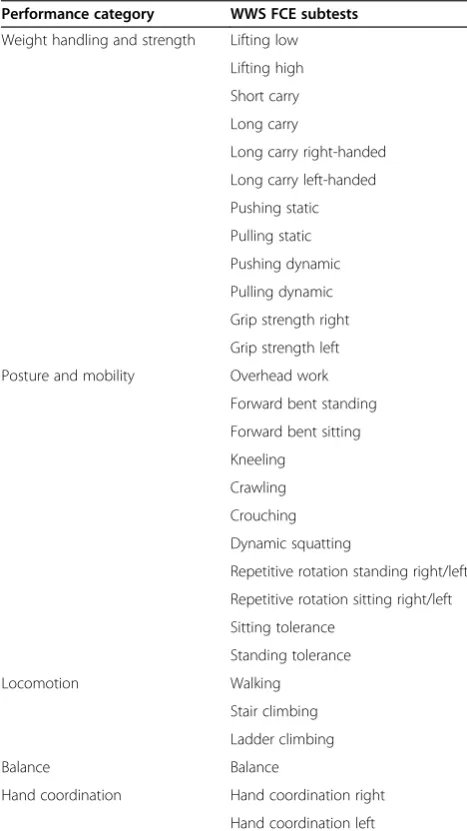
consists of 29 items related to five performance categor-ies (weight handling and strength, posture and mobility, locomotion, balance, hand coordination) (Table 1). For the six weight handling tests, the tasks must be repeat-edly performed whilst the load is gradually increased to the level of maximal safe performance. Usually, this is done in six steps. In each step, the therapist assigns the subject one of four effort levels (light, moderate, heavy and maximal safe performance), which are defined by standardised observation criteria. Other tests are charac-terised by criteria or ceilings. Tests with a criterion are fulfilled if a specified criterion is met, e.g., a person is able or unable to push a weighted cart over a distance of 20 m safely. Tests with a ceiling are fulfilled if the ceiling is reached, which means that a subject has met the
defined maximal time of performance, e.g., the working overhead test is terminated if a person has reached 15 min even though the person might have not per-formed to her or his maximal ability [12]. Additionally, there are some other tests without criteria or ceilings which directly assess the safe maximum or average per-formance capacity (i.e. pushing or pulling static, shuttle walk). Additional information on materials, training, cer-tificates, and costs of the WWS FCE have been reported by Genovese and Galper [13].
Despite increasing use of the WWS FCE in rehabilita-tion, its inter-rater, intra-rater and test-retest reliability have been critically discussed in the scientific literature [14-16]. Inter-rater reliability is the consistency of mea-sures or scores by different examiners on the same phenomenon, whereas intra-rater reliability describes the consistency between repeated assessments, assuming that the characteristic of interest does not change over time. In this review, inter-rater and intra-rater reliability refer to the effort level or the observation of safe performance. This is a major concern in the first six weight handling tests in Table 1 because the performance of these has to be judged by the evaluator whilst using standardised ob-servation criteria. Test-retest reliability in this review re-fers to the consistency of the tested capacity. This capacity of the individual under evaluation can be expressed as a continuous measure, e.g. in kg or N, or as the achievement or non-achievement of a criterion or ceiling.
Three previous reviews have examined the reliability of the WWS FCE. In 2004, Gouttebarge and colleagues [15] found that the WWS FCE has moderate to good inter-rater reliability but could not reach a definitive conclusion about its intra-rater reliability due to meth-odological shortcomings of the identified studies. In 1999, Innes and Straker [14] also rated its inter-rater re-liability as acceptable but had doubts about the method-ology of intra-rater reliability studies. In a more recent paper, Innes [16] concluded from a narrative summary that most of the available studies have reported acceptable inter-rater, intra-rater and test-retest reliability. Since then, new studies on the reliability of the WWS FCE have been published which permit a more differentiated view of the reliability of single subtests. Therefore, we conducted a systematic literature review to summarise the existing study results on the inter-rater, intra-rater and test-retest reliability of the WWS FCE. We used the PRISMA state-ment as a guide for transparent reporting of our findings [17]. We did not register our study protocol.
Methods
Inclusion criteria
Studies focusing on inter-rater, intra-rater or test-retest reliability of the WWS FCE were considered for inclu-sion. All studies providing quantitative data on the inter-Table 1 Workwell Systems Functional Capacity Evaluation
subtests
Performance category WWS FCE subtests
Weight handling and strength Lifting low
Lifting high
Short carry
Long carry
Long carry right-handed
Long carry left-handed
Pushing static
Pulling static
Pushing dynamic
Pulling dynamic
Grip strength right
Grip strength left
Posture and mobility Overhead work
Forward bent standing
Forward bent sitting
Kneeling
Crawling
Crouching
Dynamic squatting
Repetitive rotation standing right/left
Repetitive rotation sitting right/left
Sitting tolerance
Standing tolerance
Locomotion Walking
Stair climbing
Ladder climbing
Balance Balance
Hand coordination Hand coordination right
Hand coordination left
WWS FCE, WorkWell Systems Functional Capacity Evaluation.
Bieniek and BethgeBMC Musculoskeletal Disorders2014,15:106 Page 2 of 13
[image:2.595.56.290.305.721.2]rater, intra-rater or test-retest reliability in adults (at least 18 years of age) were included.
Systematic search strategy
A systematic literature search was performed using the PubMed, Scopus and Web of Science electronic data-bases in May 2012. Only studies published in English or German since 1 January 1990 were included. An update of this search was performed in February 2014.
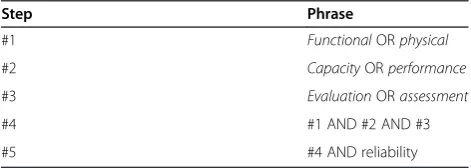
Using a five-step search strategy, we generated
key-words by decomposing the term “functional capacity
evaluation” into single components. A synonym was
chosen for each component. Components and synonyms
were connected by “OR” (steps 1 to 3), and these
phrases were concatenated by “AND” (step 4). Finally, the resulting phrase was connected with “reliability” by “AND”(step 5) (Table 2).
Furthermore, references were checked from three pre-viously published systematic reviews on the reliability and validity of FCE [14-16] and from the reference lists of the identified studies. We also screened all abstract volumes of the German Rehabilitation Research Con-gress for potentially relevant articles.
Study selection
The first author and another scientific colleague inde-pendently screened the titles of the identified references for potential relevance. All titles that were identified as potentially relevant by at least one researcher were checked by the first author for relevance based on their abstracts. Then, the first author applied the inclusion criteria to the full text of the selected articles.
Assessment of methodological quality
The methodological quality of the included studies was assessed using the COSMIN checklist [18]. This check-list is increasingly used in systematic reviews of studies on measurement properties like reliability. The original COSMIN checklist for reliability studies consists of 14 items. Two items that refer to ordinal rating scores were omitted. One item that refers to the number of measure-ments which were available was omitted as inter-rater, intra-rater and test-retest reliability studies always need at least two measurements. Three items of the COSMIN checklist which refer to the time interval between
measurements were only applied to intra-rater and test-retest reliability studies. If a paper reported on more than one type of reliability, we appraised the methodo-logical quality of these study arms separately. The item that refers to the time interval in case of repeated mea-surements was specified according to Gouttebarge and colleagues [15]. Time intervals from 3 to 21 days were rated as appropriate.
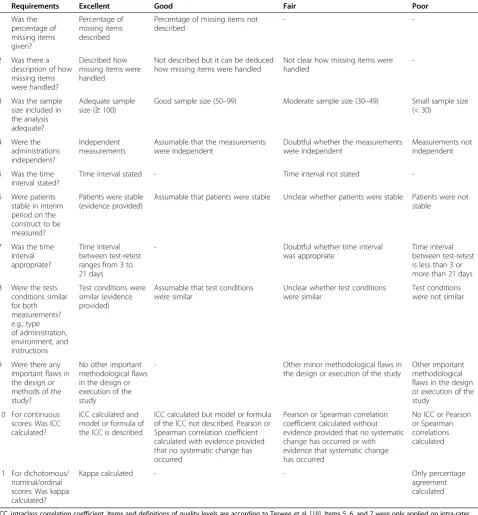
We used the COSMIN checklist version with four re-sponse options [18]. This version defines excellent, good, fair and poor levels for each item of the checklist. Table 3 shows the modified version, which we used for our qual-ity assessment. For some items, only two or three levels are defined, e.g. there are only two levels defined for the reporting of kappa in the case of dichotomous or nom-inal scores (kappa calculated is rated excellent vs. only percentage agreement calculated is rated poor). As recommended, the overall methodological quality of a study was obtained by taking the lowest rating of all of the items which were assessed, i.e. the worst score determined the study’s overall methodological quality. Consequently, if one item was scored as poor, the methodological quality of a reliability study was rated as poor. As recommended, we do not present quality ratings on an item level, but only the overall quality rating and the reason for that rat-ing, i.e. the lowest scored items. Both authors independ-ently scored all studies; in cases of disagreement on study items, consensus was reached by discussion.
Synthesis of primary studies
We extracted intraclass correlation coefficients (ICC) as re-liability statistics for continuous measures and percentages of agreement (POA) and kappa coefficients (κ) for binary measures. Item-specific reliability measures were rated as acceptable if ICC≥0.75, POA≥80%, orκ≥0.60, otherwise they were considered non-acceptable [14,15]. Data were extracted by the first author in Microsoft Excel sheets sep-arately for inter-rater, intra-rater and test-reliability and the three reliability measures. Each of the sheets comprised a matrix of the included studies by the 29 items. All of the extracted values were checked by the second author. Dis-agreement was dissolved by discussion. The extracted values were pooled for five performance categories: strength and weight handling, posture and mobility, loco-motion, balance, and hand coordination. The consistency of the results was rated on two levels (consistent vs. incon-sistent). We rated the results for one performance category to be consistent if at least 75% of the extracted values of agreement coincided; otherwise, inconsistency was stated.
Results
Literature search
Our literature search yielded 5403 hits (PubMed: n = 1787; Scopus: n = 1730; Web of Science: n = 1886). The inter-Table 2 Electronic search strategy
Step Phrase
#1 FunctionalORphysical
#2 CapacityORperformance
#3 EvaluationORassessment
#4 #1 AND #2 AND #3
#5 #4 AND reliability
Bieniek and BethgeBMC Musculoskeletal Disorders2014,15:106 Page 3 of 13
[image:3.595.56.292.649.733.2]sectionality of the primary references identified through the respective databases was poor; the highest agreement was between PubMed and Scopus (26%), followed by PubMed and Web of Science (19%). The inter-sectionality between Scopus and Web of Science was only 16%.
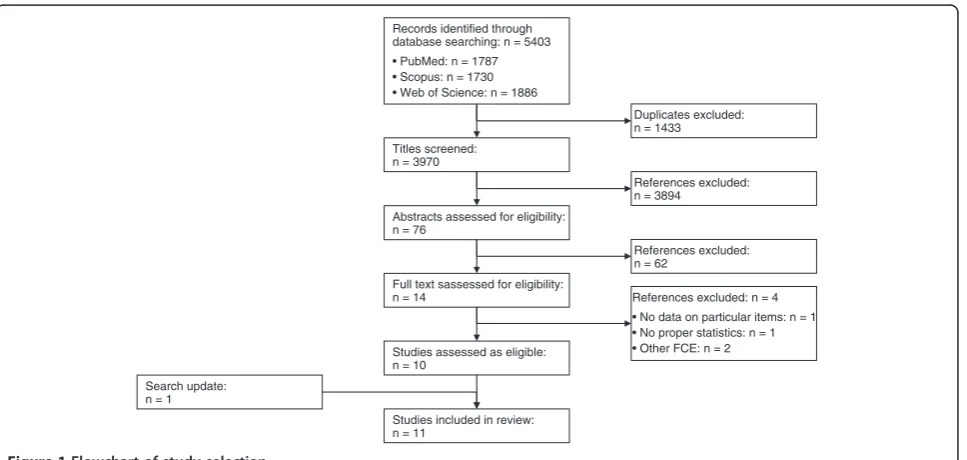
After eliminating duplicates (exclusion: n = 1433), two researchers independently screened the remaining 3970 references by applying the inclusion criteria to the titles.
[image:4.595.59.538.101.617.2]This led to the exclusion of 3894 articles. Titles consid-ered potentially relevant by at least one researcher were again reviewed for relevance of the abstract by the first author (n = 76). Among these articles, 62 did not meet the inclusion criteria and were therefore excluded. The first author applied the inclusion criteria to the full texts of the remaining 14 articles [12,19-31]. Four references were excluded: one [21] because it did not report any Table 3 Modified COSMIN checklist for methodological quality assessment
Requirements Excellent Good Fair Poor
1 Was the
percentage of missing items given?
Percentage of missing items described
Percentage of missing items not described
-
-2 Was there a description of how missing items were handled?
Described how missing items were handled
Not described but it can be deduced how missing items were handled
Not clear how missing items were handled
-3 Was the sample size included in the analysis adequate?
Adequate sample size (≥100)
Good sample size (50–99) Moderate sample size (30–49) Small sample size (< 30)
4 Were the administrations independent?
Independent measurements
Assumable that the measurements were independent
Doubtful whether the measurements were independent
Measurements not independent
5 Was the time interval stated?
Time interval stated - Time interval not stated
-6 Were patients stable in interim period on the construct to be measured?
Patients were stable (evidence provided)
Assumable that patients were stable Unclear whether patients were stable Patients were not stable
7 Was the time interval appropriate?
Time interval between test-retest ranges from 3 to 21 days
- Doubtful whether time interval
was appropriate
Time interval between test-retest is less than 3 or more than 21 days
8 Were the tests conditions similar for both measurements? e.g., type of administration, environment, and instructions
Test conditions were similar (evidence provided)
Assumable that test conditions were similar
Unclear whether test conditions were similar
Test conditions were not similar
9 Were there any important flaws in the design or methods of the study?
No other important methodological flaws in the design or execution of the study
- Other minor methodological flaws in
the design or execution of the study
Other important methodological flaws in the design or execution of the study
10 For continuous scores: Was ICC calculated?
ICC calculated and model or formula of the ICC is described
ICC calculated but model or formula of the ICC not described. Pearson or Spearman correlation coefficient calculated with evidence provided that no systematic change has occurred
Pearson or Spearman correlation coefficient calculated without evidence provided that no systematic change has occurred or with evidence that systematic change has occurred
No ICC or Pearson or Spearman correlations calculated
11 For dichotomous/ nominal/ordinal scores: Was kappa calculated?
Kappa calculated - - Only percentage
agreement calculated
ICC, intraclass correlation coefficient. Items and definitions of quality levels are according to Terwee et al. [18]. Items 5, 6, and 7 were only applied on intra-rater and test-retest reliability studies. Specification of appropriate time intervals follows Gouttebarge et al. [15].
Bieniek and BethgeBMC Musculoskeletal Disorders2014,15:106 Page 4 of 13
data on the reliability of specific items, two because the investigators tested FCE systems other than the WWS FCE [27,31], and one because relevant statistics were not reported [22]. Our search update in February 2014 iden-tified two potentially relevant studies [32,33]. We in-cluded one of the studies in our review [32]. We excluded the other study as the low number of observed performances (1 to 4) per item was considered to be in-adequate for a reasonable item-specific analysis [18]. Fi-nally, 11 articles [12,19,20,23-26,28-30,32] were deemed eligible for inclusion in our review. Figure 1 shows a flowchart of the study selection process.
No additional references were identified by checking the reviews by Innes and Straker [14], Gouttebarge and colleagues [15] and Innes [16] or by screening the refer-ence lists of the included papers and searching in the ab-stract volumes of the German Rehabilitation Research Congress. We identified nine additional studies com-pared to the review by Innes and Straker [14], six add-itional studies compared to the review by Gouttebarge and colleagues [15], and four additional studies com-pared to the narrative review by Innes [16]. Table 4 shows the main characteristics of the 11 studies included in the review.
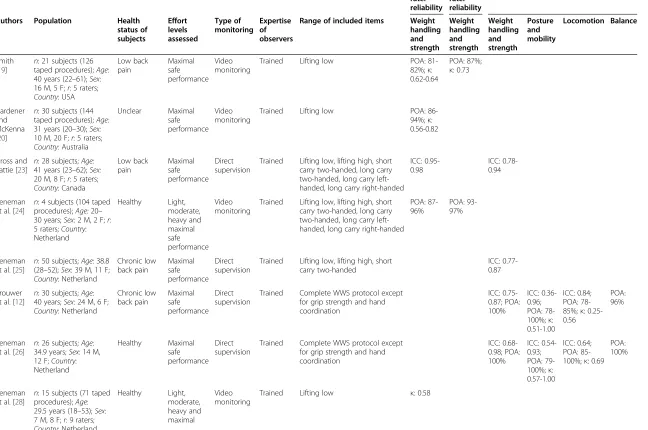
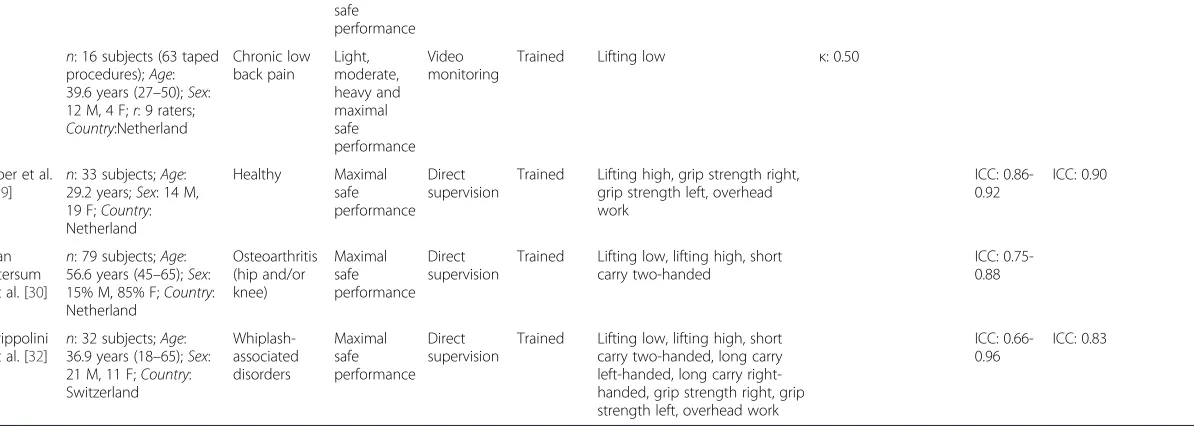
Five of the studies analysed subjects with musculoskel-etal disorders [12,19,23,25,30]. One study assessed healthy persons as well as patients with chronic musculoskeletal pain [28]. One study focused on persons who had suffered whiplash injuries [32]. Three studies [24,26,29] evaluated healthy subjects; in one study the health status of the sub-jects was unclear [20]. Only one study [24] distinguished between all four effort levels (light, moderate, heavy, max-imal), while the others focused on submaximal vs. safe
maximal performance. All assessments were performed by trained observers. The items were rated under direct supervision in seven studies [12,23,25,26,29,30,32], and by video monitoring in four studies [19,20,24,28]. Only two of the studies assessed the complete battery of items ex-cept for grip strength and hand coordination [12,26]. Of the remaining nine studies, one evaluated eight items [32], two tested six items [23,24], one evaluated four items [29], two tested three items [25,30], and three assessed only one item [19,20,28].
Methodological quality assessment
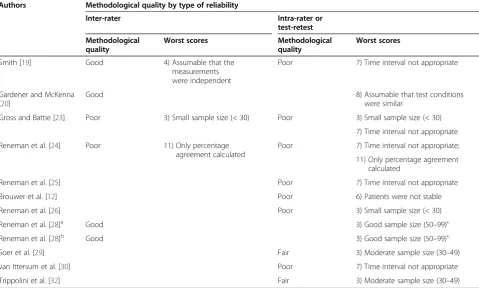
Both authors independently assessed the methodological quality by type of reliability of all 11 studies; overall rat-ings were completely consistent. Methodological quality of inter-rater reliability studies was rated as good three times [19,20,28] and otherwise as poor [23,24]. Meth-odological quality for intra-rater or test-retest reliability was rated as fair two times [29,32] and otherwise as poor [12,19,23-26,30] (Table 5). The major methodological limitations were insufficient sample size and inappropri-ate time intervals in the case of studies on intra-rinappropri-ater or test-retest reliability.
Inter-rater reliability
We extracted 28 inter-rater reliability measures for the various tests of weight handling and strength. None could be identified for the other tests.
Weight handling and strength
The inter-rater reliability of lifting low assessment was evaluated in five studies [19,20,23,24,28]. Gross et al. [23] reported acceptable intraclass correlation (ICC = 0.98) for
Titles screened: n = 3970
Records identified through database searching: n = 5403 • PubMed: n = 1787 • Scopus: n = 1730 • Web of Science: n = 1886
Abstracts assessed for eligibility: n = 76
Full text sassessed for eligibility: n = 14
Studies assessed as eligible: n = 10
Duplicates excluded: n = 1433
References excluded: n = 3894
References excluded: n = 62
References excluded: n = 4 • No data on particular items: n = 1 • No proper statistics: n = 1 • Other FCE: n = 2
Studies included in review: n = 11
[image:5.595.59.543.493.723.2]Search update: n = 1
Figure 1Flowchart of study selection.
Bieniek and BethgeBMC Musculoskeletal Disorders2014,15:106 Page 5 of 13
Table 4 Characteristics of the included studies Inter-rater reliability Intra-rater reliability Test-retest reliability
Authors Population Health status of subjects Effort levels assessed Type of monitoring Expertise of observers
Range of included items Weight handling and strength Weight handling and strength Weight handling and strength Posture and mobility Locomotion Balance Smith [19]
n: 21 subjects (126 taped procedures);Age: 40 years (22–61);Sex: 16 M, 5 F;r: 5 raters;
Country: USA
Low back pain Maximal safe performance Video monitoring
Trained Lifting low POA: 81-82%;κ: 0.62-0.64
POA: 87%;
κ: 0.73
Gardener and McKenna [20]
n: 30 subjects (144 taped procedures);Age:
31 years (20–30);Sex:
10 M, 20 F;r: 5 raters;
Country: Australia
Unclear Maximal safe performance
Video monitoring
Trained Lifting low POA: 86-94%;κ: 0.56-0.82
Gross and Battie [23]
n: 28 subjects;Age:
41 years (23–62);Sex:
20 M, 8 F;r: 5 raters;
Country: Canada
Low back pain Maximal safe performance Direct supervision
Trained Lifting low, lifting high, short carry two-handed, long carry two-handed, long carry left-handed, long carry right-handed
ICC: 0.95-0.98
ICC: 0.78-0.94
Reneman et al. [24]
n: 4 subjects (104 taped procedures);Age:20– 30 years;Sex:2 M, 2 F;r: 5 raters;Country: Netherland Healthy Light, moderate, heavy and maximal safe performance Video monitoring
Trained Lifting low, lifting high, short carry two-handed, long carry two-handed, long carry left-handed, long carry right-handed
POA: 87-96%
POA: 93-97%
Reneman et al. [25]
n: 50 subjects;Age: 38.8 (28–52);Sex: 39 M, 11 F;
Country: Netherland
Chronic low back pain Maximal safe performance Direct supervision
Trained Lifting low, lifting high, short carry two-handed
ICC: 0.77-0.87
Brouwer et al. [12]
n: 30 subjects;Age: 40 years;Sex: 24 M, 6 F;
Country: Netherland
Chronic low back pain Maximal safe performance Direct supervision
Trained Complete WWS protocol except for grip strength and hand coordination ICC: 0.75-0.87; POA: 100% ICC: 0.36-0.96; POA: 78-100%;κ: 0.51-1.00
ICC: 0.84; POA: 78-85%;κ: 0.25-0.56
POA: 96%
Reneman et al. [26]
n: 26 subjects;Age: 34.9 years;Sex: 14 M, 12 F;Country: Netherland Healthy Maximal safe performance Direct supervision
Trained Complete WWS protocol except for grip strength and hand coordination ICC: 0.68-0.98; POA: 100% ICC: 0.54-0.93; POA: 79-100%;κ: 0.57-1.00
ICC: 0.64; POA: 85-100%;κ: 0.69
POA: 100%
Reneman et al. [28]
n: 15 subjects (71 taped procedures);Age: 29.5 years (18–53);Sex: 7 M, 8 F;r: 9 raters;
Country: Netherland
Healthy Light, moderate, heavy and maximal Video monitoring
Trained Lifting low κ: 0.58
Table 4 Characteristics of the included studies(Continued)
safe performance
n: 16 subjects (63 taped procedures);Age: 39.6 years (27–50);Sex: 12 M, 4 F;r: 9 raters;
Country:Netherland
Chronic low back pain
Light, moderate, heavy and maximal safe performance
Video monitoring
Trained Lifting low κ: 0.50
Soer et al. [29]
n: 33 subjects;Age: 29.2 years;Sex: 14 M, 19 F;Country: Netherland
Healthy Maximal safe performance
Direct supervision
Trained Lifting high, grip strength right, grip strength left, overhead work
ICC: 0.86-0.92
ICC: 0.90
van Ittersum et al. [30]
n: 79 subjects;Age: 56.6 years (45–65);Sex: 15% M, 85% F;Country: Netherland
Osteoarthritis (hip and/or knee)
Maximal safe performance
Direct supervision
Trained Lifting low, lifting high, short carry two-handed
ICC: 0.75-0.88
Trippolini et al. [32]
n: 32 subjects;Age: 36.9 years (18–65);Sex: 21 M, 11 F;Country: Switzerland
Whiplash-associated disorders
Maximal safe performance
Direct supervision
Trained Lifting low, lifting high, short carry two-handed, long carry left-handed, long carry right-handed, grip strength right, grip strength left, overhead work
ICC: 0.66-0.96
ICC: 0.83
n, number of subjects; M, male; F, female; r, number of raters (only for studies on inter-rater reliability); ICC, intraclass correlation coefficient; POA, percentage of agreement;κ, kappa coefficient.
Bieniek
and
Bethge
BMC
Musculosk
eletal
Disorders
2014,
15
:106
Page
7
o
f
1
3
http://ww
w.biomedce
ntral.com/1
maximal effort determinations by two independent raters. Three studies showed an acceptable percentage of agree-ment (81%≤POA≤90%), i.e. consistency between per-formance assessments by different observers [19,20,24]. Kappa coefficients for inter-rater reliability were not con-sistently acceptable [19,20,26,28]. Results on the reliability of five other subtests of weight handling and strength (lift-ing high, short carry(lift-ing, long carry two-handed, long carry right-handed and left-handed) were also available. Gross et al. [23] reported a high intraclass correlation for these items (0.95≤ICC≤0.96). Percentages of agreement of 87% and higher were reported by Reneman et al. [24].
Synthesis of results
Six intraclass correlations, 16 percentages of agreement and 3 of 6 kappa coefficients showed an acceptable level of inter-rater reliability. Thus, 25 out of 28 measures (89%) reported values which indicated that the inter-rater reliability of lifting and carrying assessments was acceptable. No inter-rater reliability data for the other items of the WWS FCE could be found.
Intra-rater reliability
We extracted eight intra-rater reliability statistics for the weight handling and strength tests.
Weight handling and strength
Two studies evaluated the intra-rater reliability of lifting low [19,24]; both showed an acceptable percentage
of agreement between repeated measurements (78%≤
POA≤94%) and one [19] showed an acceptable kappa
coefficient (κ= 0.73). One study showed an acceptable percentage of agreement for lifting high, short and long carry both-handed, as well as long carry right- and left-handed (93%≤POA≤97%) [24].
Synthesis of results
The extracted data indicated that the intra-rater reliabil-ity of the subtests of strength and weight handling was acceptable, as determined by the seven extracted per-centages of agreement and one kappa coefficient. Thus, the eight reported intra-rater reliability measures for the weight handling and strength items were consistently acceptable.
Test-retest reliability
[image:8.595.58.538.102.390.2]We extracted 48 test-retest reliability statistics for the weight handling and strength tests, 55 for the posture/ mobility tests, nine for the locomotion tests, and two for the balance test. No studies examining the test-retest reliability of hand coordination assessments could be identified.
Table 5 Methodological quality assessment
Authors Methodological quality by type of reliability
Inter-rater Intra-rater or
test-retest
Methodological quality
Worst scores Methodological
quality
Worst scores
Smith [19] Good 4) Assumable that the
measurements were independent
Poor 7) Time interval not appropriate
Gardener and McKenna [20]
Good 8) Assumable that test conditions
were similar
Gross and Battie [23] Poor 3) Small sample size (< 30) Poor 3) Small sample size (< 30)
7) Time interval not appropriate
Reneman et al. [24] Poor 11) Only percentage
agreement calculated
Poor 7) Time interval not appropriate;
11) Only percentage agreement calculated
Reneman et al. [25] Poor 7) Time interval not appropriate
Brouwer et al. [12] Poor 6) Patients were not stable
Reneman et al. [26] Poor 3) Small sample size (< 30)
Reneman et al. [28]a Good 3) Good sample size (50–99)c
Reneman et al. [28]b Good 3) Good sample size (50–99)c
Soer et al. [29] Fair 3) Moderate sample size (30–49)
van Ittersum et al. [30] Poor 7) Time interval not appropriate
Trippolini et al. [32] Fair 3) Moderate sample size (30–49)
a
Healthy subjects;b
Patients with chronic low back pain;c
Number of taped observations were appraised.
Bieniek and BethgeBMC Musculoskeletal Disorders2014,15:106 Page 8 of 13
Weight handling and strength
Six studies [12,23,25,26,30,32] showed acceptable intra-class correlation for repeated measurements of lifting low (0.78≤ICC≤0.95). Six studies showed acceptable intraclass correlation for lifting high (0.75≤ICC≤0.92) [12,23,25,26,29,30], while one did not (ICC = 0.66) [32]. Six studies showed acceptable intraclass correlation for short carry both-handed assessments (0.77≤ICC≤0.96) [12,23,25,26,30,32]. Intraclass correlation between long carry both-handed (0.81≤ICC≤0.90) [12,23,26], long carry left-handed (0.81≤ICC≤0.91) [12,23,26,32] and long carry right-handed assessments (0.81≤ICC≤0.98) [12,23,26,32] was also acceptable.
We also found acceptable intraclass correlation be-tween pulling static scores (0.78≤ICC≤0.89) [12,26]. For pushing static scores, the intraclass correlation was acceptable in one study (ICC = 0.75) [12], and not ac-ceptable in another study (ICC = 0.68) [26]. Additionally, for pulling and pushing dynamic, all results for percent-ages of agreement were acceptable [12,26]. Two of the identified studies assessed the test-retest reliability of the grip strength test to be consistently acceptable (right: 0.86≤ICC≤0.92; left: 0.88≤ICC≤0.89) [29,32].
Synthesis of results
The extracted data indicated that the test-retest reliabil-ity of the subtests of strength and weight handling was acceptable, as determined based on 42 of 44 (95%) intra-class correlation coefficients and all four of the extracted percentages of agreement. In total, 46 of 48 (96%) re-ported values were acceptable. Thus, the test-retest reli-ability for the weight handling and strength items was consistently acceptable.
Posture and mobility
Overhead work Two studies reported unacceptable intraclass correlations for working overhead assessments (0.36≤ICC≤0.58) [12,26], but two further studies assessed acceptable intraclass correlation (0.83≤ICC≤ 0.90) [29,32]. Percentages of agreement were acceptable in two studies (96%) [12,26], and one of these studies re-ported an acceptable kappa coefficient (κ= 0.78) [26].
Forward bend standing and sitting The reliability of the two subtests of forward bent posture was quiet vari-able. For forward bend standing, two studies [12,26] showed acceptable intraclass correlations (0.93≤ICC≤ 0.96) and percentages of agreement (POA = 100%) [12,26], and one [26] reported an acceptable kappa coefficient (κ= 1.00). For forward bend sitting, however, these studies reported unacceptable intraclass correlation (ICC = 0.72) [12] and both acceptable and unacceptable percentages
of agreement (79%≤POA≤89%) and kappa coefficients (0.57≤κ≤0.60) [12,26].
Kneeling, crawling, crouching, dynamic squatting Percentages of agreement (78%≤POA≤96%) and kappa coefficients (0.57≤κ≤0.65) for kneeling assessments were determined as acceptable in one study [11] and un-acceptable in another [10]. Acceptable percentages of agreement and kappa coefficients were reported for crouching and crawling [12,26]. Acceptable percentages of agreement (96%≤POA≤100%) and, in one case, an acceptable kappa coefficient (κ= 0.91) were reported for dynamic squatting [12,26]. However, intraclass correla-tions were quiet variable (0.54≤ICC≤0.82) [12,26].
Repetitive rotation standing and sitting Two studies reported unacceptable intraclass correlations for repeti-tive rotation standing and sitting of left and right side [12,26]. According to Brouwer et al. [12], kappa coeffi-cients for repetitive rotation standing were unacceptable (left: κ= 0.58; right: κ= 0.51), but those for repetitive rotation sitting were acceptable (left: κ= 0.78; right: κ= 0.87) [12]. Percentages of agreement were acceptable for all items in both studies (85%≤POA≤100%) [12,26].
Sitting and standing toleranceThe only study examin-ing sittexamin-ing and standexamin-ing tolerance reported acceptable percentages of agreement (93%≤POA≤96%) [12].
Synthesis of results Only five of 17 (29%) intraclass correlation coefficients compared to 22 of 24 (92%) per-centages of agreement and 10 of 14 (71%) kappa coeffi-cients reported for the analysed posture and mobility subtests were determined to be acceptable. Overall, only 37 of 55 (67%) reported values were acceptable. Accord-ingly, the results of the identified studies are considered inconsistent.
Locomotion One of two studies [12] reported an accept-able intraclass correlation coefficient (ICC = 0.84) for walk-ing assessments, whereas the other did not (ICC = 0.64) [26]. The reported percentages of agreement (78%≤POA≤ 85%) and kappa coefficients (0.56≤κ≤0.69) for stair climbing were acceptable in one [26] and unacceptable in another study [12]. Regarding ladder climbing assessments, the percentage of agreement (85%≤POA≤100%) was ac-ceptable in both studies [12,26]; the extracted kappa coeffi-cient was not at an acceptable level (κ= 0.25) [12].
Synthesis of results Three of the four (75%) percent-ages of agreement, but only one of three (33%) kappa coefficients and one of two (50%) intraclass correlation coefficients showed acceptable intra-rater reliability for the locomotion subtests. Overall, only five of nine (56%)
Bieniek and BethgeBMC Musculoskeletal Disorders2014,15:106 Page 9 of 13
reported values demonstrated acceptable test-retest reli-ability. Therefore, the results of the existing studies are considered inconsistent.
Balance Two studies reported acceptable agreement (POA = 96%) between balance assessments [12,26].
Overall reliability
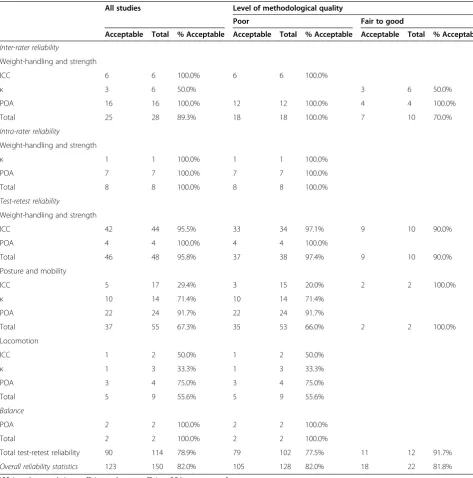
Table 6 summarises all of the extracted reliability statis-tics. In total, 25 of 28 (89%) inter-rater reliability mea-sures, all eight intra-rater meamea-sures, and 90 of 114 (79%) test-retest reliability measures were found to be at an ac-ceptable level. Overall, 123 of 150 (82%) reliability statis-tics were at an acceptable level. Most of the extracted reliability statistics came from poor quality studies ac-cording to the COSMIN criteria [18] (poor: 128 reliabil-ity measures; fair to good: 22 reliabilreliabil-ity measures). There were no serious differences in reliability statistics be-tween poor and fair to good quality studies. Reliability statistics were acceptable for the extracted intraclass cor-relation coefficients (54 of 69; 78%) and percentages of agreement (54 of 57; 95%) but not for the extracted kappa scores (15 of 24; 63%).
Discussion
Five studies [19,20,23,24,28] examined the inter-rater re-liability of one or more weight handling subtests. Over-all, 25 of 28 (89%) reported values were at an acceptable level. Consequently, the reliability measures were con-sistently acceptable [19,20,23,24,28]. Intra-rater reliabil-ity was also consistently acceptable for these tests, as indicated by eight reliability statistics from two studies [19,24]. Additionally, 46 of 48 (96%) reliability statistics that were extracted from seven test-retest reliability studies [12,23,25,26,29,30,32] were acceptable, consist-ently suggesting an acceptable test-retest reliability of the weight handling tests. However, the results of the posture/mobility and locomotion subtests were incon-sistent. The reliability of the balance subtest was consist-ent, but there were only two studies available. The reliability of the hand coordination subtest has not been analysed in any study to date.
The methodological quality of the included studies was appraised using the COSMIN checklist [18]. Our objective was to determine the risk of bias during the re-liability assessment. Some of the studies were originally performed to investigate different research questions, e.g. if a second day of testing is needed as recom-mended in the original WWS FCE protocol [25]. In such a study, a time interval of one day was certainly appropri-ate to answer the original research question. However, this short time interval will likely introduce bias in the deter-mination of the test-retest reliability of a procedure. Ac-cordingly, the result of our quality assessment of this
study is a consequence of our decision to include this study in our review. We therefore emphasize, that our ap-praisal of the methodological quality is limited to the scope of this review and should not be understood as an appraisal of current FCE research. Moreover, though the COSMIN checklist is increasingly used to appraise the methodological quality of reliability studies, the applica-tion of some items for the purpose of this review is debat-able. As previously stated by Terwee et al. [18], the appraisal of the sample size given by the COSMIN authors is only a rule of thumb. Larger samples increase the preci-sion of estimates, and therefore the results of studies using larger samples have a lower risk of bias. Nonetheless, small samples might also produce precise estimates and small confidence intervals, especially if homogenous sam-ples were recruited. In this case, however, this could in-dicate a strong risk of selection bias. What is more important is that our separate analyses of poor and fair to good quality studies have not indicated serious dif-ferences in the reliability statistics. We therefore have concluded that the identified shortcomings of the stud-ies have not effectively biased their findings, and de-cided to base our summary and final interpretation of the data equally on all identified studies.
Another important finding of our analysis is that the extracted percentages of agreement are more favourable than the extracted kappa scores. If the reaching of ceil-ings or criteria results in very differing proportions, e.g. when a test is too easy for the population under ob-servation, high percentages of agreement (due to a large proportion of participants reaching the ceiling) will nevertheless result in low kappa scores. Similarly, kappa scores of inter-rater reliability will be low if proportions of maximal and submaximal test performances differ markedly. From a statistical point of view, high percent-ages of agreement but low kappa scores might indicate shortcomings in the study design that could be easily overcome, e.g. by the inclusion of a stratified sample that includes equal proportions of maximal and submaximal test performances.
Although FCE is of increasing importance in German rehabilitation settings, especially in work-related medical rehabilitation, and the WWS FCE is the most common assessment currently used, we could not identify any relevant German study. Though we do not assume major differences across countries, this certainly indi-cates a major lack of performance-related diagnostic re-habilitation research in Germany compared to the Netherlands, Canada and the United States. One reason is that the academic development of physiotherapy is in its infancy in Germany. As high-quality FCE research can contribute to improve the quality of rehabilitation services [34], we see this field as a major challenge for German rehabilitation research.
Bieniek and BethgeBMC Musculoskeletal Disorders2014,15:106 Page 10 of 13
The WWS FCE was designed to assess the individual capacity to perform typical work-related tasks; it is used in rehabilitation, job placement decisions, and disability benefit evaluation. Thus, test results have significant consequences for patients, rehabilitation providers and insurance agencies. To rely on these results, reliability as well as validity needs to be demonstrated. However, only two of the eleven studies included examined almost the entire WWS FCE protocol [12,26]. The other nine stud-ies mainly analysed weight handling and strength sub-tests, most frequently the lifting low task. Similarly,
[image:11.595.57.531.99.578.2]studies on the validity of the WWS FCE have focused on these procedures [35,36]. As these subtests achieve ac-ceptable reliability and also appear to be predictive for time to return to work [35,36], shorter FCE protocols might be appropriate for several patients. For instance, Gross and colleagues [35] proposed a short-form FCE including lifting low, crouching and standing, which achieved comparable predictive ability like the complete WWS FCE. However, if complete assessment of a sub-ject’s capability to work is required, the entire test proto-col has to be performed, e.g. if an FCE supports a job Table 6 Overall synthesis of reliability statistics
All studies Level of methodological quality
Poor Fair to good
Acceptable Total % Acceptable Acceptable Total % Acceptable Acceptable Total % Acceptable
Inter-rater reliability
Weight-handling and strength
ICC 6 6 100.0% 6 6 100.0%
κ 3 6 50.0% 3 6 50.0%
POA 16 16 100.0% 12 12 100.0% 4 4 100.0%
Total 25 28 89.3% 18 18 100.0% 7 10 70.0%
Intra-rater reliability
Weight-handling and strength
κ 1 1 100.0% 1 1 100.0%
POA 7 7 100.0% 7 7 100.0%
Total 8 8 100.0% 8 8 100.0%
Test-retest reliability
Weight-handling and strength
ICC 42 44 95.5% 33 34 97.1% 9 10 90.0%
POA 4 4 100.0% 4 4 100.0%
Total 46 48 95.8% 37 38 97.4% 9 10 90.0%
Posture and mobility
ICC 5 17 29.4% 3 15 20.0% 2 2 100.0%
κ 10 14 71.4% 10 14 71.4%
POA 22 24 91.7% 22 24 91.7%
Total 37 55 67.3% 35 53 66.0% 2 2 100.0%
Locomotion
ICC 1 2 50.0% 1 2 50.0%
κ 1 3 33.3% 1 3 33.3%
POA 3 4 75.0% 3 4 75.0%
Total 5 9 55.6% 5 9 55.6%
Balance
POA 2 2 100.0% 2 2 100.0%
Total 2 2 100.0% 2 2 100.0%
Total test-retest reliability 90 114 78.9% 79 102 77.5% 11 12 91.7%
Overall reliability statistics 123 150 82.0% 105 128 82.0% 18 22 81.8%
ICC, intraclass correlation coefficient;κ, kappa coefficient; POA, percentage of agreement.
Bieniek and BethgeBMC Musculoskeletal Disorders2014,15:106 Page 11 of 13
placement decision or is performed as a prelude to a claim settlement. Therefore, further studies should be performed to evaluate the reliability of subtests that have been less frequently considered to date. Additional re-search is also needed as the results of posture/mobility and locomotion subtests are inconsistent. Interestingly, Soer et al. [29] have indicated that minor modifications of the original WWS FCE protocol, e.g. the use of cuff-weights in the case of overhead work, might improve the reliability of some other test procedures.
A critical discussion of our work must consider the following limitations of our review. Firstly, although we performed a systematic literature search, potentially rele-vant studies may have been overlooked. Our search terms may not have represented the complete range of relevant keywords. Moreover, our search was limited to articles published in English or German.
Secondly, we relied on three reliability statistics (intra-class correlation, kappa, percentage of agreement). We are aware that other statistics are also available. For the statistics used, however, references are available that could be used to categorize the extracted measures as indicating an appropriate or an inappropriate level of re-liability (e.g. an ICC≥0.75 is usually interpreted to indi-cate an appropriate reliability level) [14,15].
However, these limitations are accompanied by the fol-lowing strengths.
Firstly, our comprehensive search strategy included three different electronic databases, and identified a set of new studies which were not included in previous re-views [14-16].
Secondly, we extracted item-specific reliability statis-tics and chose a more differentiated approach to data synthesis than previous reviews. Consequently, our ana-lyses provide a comprehensive overview of the reliability of the WWS FCE. At the same time, we avoided the mistake of overgeneralising the acceptable reliability of some tests, e.g. lifting low, to the complete WWS FCE.
Thirdly, we assessed the methodological quality of the included studies according to the COSMIN checklist [18] and identified major limitations across studies that should be considered in future research, especially sam-ple sizes that were too small and inappropriate time in-tervals in the case of intra-rater and test-retest reliability studies.
Conclusions
Our analysis confirmed that the inter-rater, intra-rater and test-retest reliability of the strength and weight handling subtests of the WWS FCE are acceptable. The results for the other subtests (posture/mobility and loco-motion) are inconsistent or provide insufficient data for definitive conclusions (balance, hand coordination). Fur-ther research with improved methodological quality is
necessary to strengthen the scientific basis of the meas-urement properties of the WWS FCE.
Abbreviations
FCE:Functional Capacity Evaluation; WWS: WorkWell Systems; WMR: Work-related medical rehabilitation; ICC: Intraclass correlation coefficients; POA: Percentages of agreement.
Competing interests
The authors declare that they have neither financial nor non-financial competing interests.
Authors’contributions
SB and MB corporately developed the search strategy. SB screened the search results and identified eligible references for this review. Both authors determined the quality criteria and performed the data extraction. SB and MB contributed equally in interpretation and discussion of the results and in drafting the manuscript. Furthermore, SB and MB finally read and approved the manuscript for submitting. Both authors read and approved the final manuscript.
Acknowledgements
This research was funded by the German Pension Insurance Fund according to Article 31 (1) No. 5 of the German Social Security Code (SGB VI). We would like to thank Juliane Briest for her assistance in checking the results of our electronic literature search and Christoph Gutenbrunner for his valuable comments on our first draft. We also thank the four reviewers for their effort and hints to improve our paper. Open access publication was funded by the Deutsche Forschungsgemeinschaft.
Received: 11 July 2013 Accepted: 19 March 2014 Published: 27 March 2014
References
1. Raspe H:Need for rehabilitation services: theoretical considerations in “needs assessment”.Rehabilitation2007,46:3–8.
2. Deutsche Rentenversicherung:Reha-Bericht Update 2012. Die medizinische und berufliche Rehabilitation der Rentenversicherung im Licht der Statistik.
Berlin: Deutsche Rentenversicherung Bund; 2012.
3. Bethge M:Success factors of work-related orthopaedic rehabilitation.
Rehabilitation2011,50:145–151.
4. Bethge M, Herbold D, Trowitzsch L, Jacobi C:Work status and health-related quality of life following multimodal work hardening: a cluster randomised trial.J Back Musculoskelet Rehabil2011,24:161–172. 5. Streibelt M, Buschmann-Steinhage R:A profile of requirements for the
performance of work related medical rehabilitation from the perspective of the statutory pension insurance.Rehabilitation2011,50:160–167. 6. Streibelt M, Thren K, Müller-Fahrnow W:Effects of FCE-based multidisciplinary
rehabilitation in patients with chronic musculoskeletal disorders - results of a randomized controlled trial.Phys Med Rehab Kuror2009,19:34–41. 7. Lukasczik M, Wolf HD, Gerlich C, Löffler S, Vogel H, Faller H, Neuderth S:
Current state of vocationally oriented medical rehabilitation–a German perspective.Disabil Rehabil2011,33:2646–2655.
8. Gatchel RJ, Mayer TG:Evidence-informed management of chronic low back pain with functional restoration.Spine J2008,8:65–69.
9. Schaafsma F, Schonstein E, Whelan KM, Ulvestad E, Kenny DT, Verbeek JH: Physical conditioning programs for improving work outcomes in workers with back pain.Cochrane Database Syst Rev2010(1):CD001822. doi:10.1002/14651858.CD001822.pub2.
10. Deutsche Rentenversicherung Bund:Anforderungsprofil zur Durchführung der Medizinisch-beruflich orientierten Rehabilitation (MBOR) im Auftrag der Deutschen Rentenversicherung. 3., überarbeitete Auflage.Berlin: Deutsche Rentenversicherung Bund; 2012.
11. Isernhagen SJ:Functional capacity evaluation: rationale, procedure, utility of the kinesiophysical approach.J Occup Rehabil1992,2:157–168. 12. Brouwer S, Reneman MF, Dijkstra PU, Groothoff JW, Schellekens JM, Goeken
LN:Test-retest reliability of the isernhagen work systems functional capacity evaluation in patients with chronic low back pain.J Occup Rehabil2003,13:207–218.
Bieniek and BethgeBMC Musculoskeletal Disorders2014,15:106 Page 12 of 13
13. Genovese E, Galper JS (Eds):Guide to the evaluation of functional ability: how to request, interpret, and apply fuctional capacity evaluation.Chicago: American Medical Association Press; 2009.
14. Innes E, Straker L:Reliability of work-related assessments.Work1999, 13:107–124.
15. Gouttebarge V, Wind H, Kuijer PP, Frings-Dresen MH:Reliability and validity of functional capacity evaluation methods: a systematic review with reference to Blankenship system, Ergos work simulator, Ergo-Kit and Isernhagen work system.Int Arch Occup Environ Health2004,77:527–537. 16. Innes E:Reliability and validity of functional capacity evaluations: an
update.Int J Disab Manag Res2006,1:135–148.
17. Liberati A, Altman DG, Tetzlaff J, Mulrow C, Gotzsche PC, Ioannidis JP, Clarke M, Devereaux PJ, Kleijnen J, Moher D:The PRISMA statement for reporting systematic reviews and meta-analyses of studies that evaluate health care interventions: explanation and elaboration.PLoS Med2009, 6:e1000100.
18. Terwee CB, Mokkink LB, Knol DL, Ostelo RW, Bouter LM, De Vet HC: Rating the methodological quality in systematic reviews of studies on measurement properties: a scoring system for the COSMIN checklist.
Qual Life Res2012,21:651–657.
19. Smith RL:Therapists’ability to identify safe maximum lifting in low back pain patients during functional capacity evaluation.J Orthop Sports Phys Ther1994,19:277–281.
20. Gardener L, McKenna K:Reliability of occupational therapists in determining safe, maximal lifting capacity.Aust Occup Ther J1999, 46:110–119.
21. Isernhagen SJ, Hart DL, Matheson LM:Reliability of independent observer judgments of level of lift effort in a kinesiophysical functional capacity evaluation.Work1999,12:145–150.
22. Reneman MF, Bults MM, Engbers LH, Mulders KK, Goeken LN:Measuring maximum holding times and perception of static elevated work and forward bending in healthy young adults.J Occup Rehabil2001,11:87–97. 23. Gross DP, Battie MC:Reliability of safe maximum lifting determinations of
a functional capacity evaluation.Phys Ther2002,82:364–371. 24. Reneman MF, Jaegers SM, Westmaas M, Goeken LN:The reliability of
determining effort level of lifting and carrying in a functional capacity evaluation.Work2002,18:23–27.
25. Reneman MF, Dijkstra PU, Westmaas M, Goeken LN:Test-retest reliability of lifting and carrying in a 2-day functional capacity evaluation.J Occup Rehabil2002,12:269–275.
26. Reneman MF, Brouwer S, Meinema A, Dijkstra PU, Geertzen JH, Groothoff JW:Test-retest reliability of the Isernhagen work systems functional capacity evaluation in healthy adults.J Occup Rehabil2004,14:295–305. 27. Marmer KS, Velasquez EM, Cifu DX:Measuring reliability of effort in
functional capacity evaluations using digital video analysis.J Back Musculoskelet Rehabil2002,16:169–175.
28. Reneman MF, Fokkens AS, Dijkstra PU, Geertzen JH, Groothoff JW:Testing lifting capacity: validity of determining effort level by means of observation.Spine (Phila Pa 1976)2005,30:E40–E46.
29. Soer R, Gerrits EH, Reneman MF:Test-retest reliability of a WRULD functional capacity evaluation in healthy adults.Work2006,26:273–280. 30. van Ittersum MW, Bieleman HJ, Reneman MF, Oosterveld FG, Groothoff JW,
van der Schans CP:Functional capacity evaluation in subjects with early osteoarthritis of hip and/or knee; is two-day testing needed?J Occup Rehabil2009,19:238–244.
31. Schapmire DW, St James JD, Townsend R, Feeler L:Accuracy of visual estimation in classifying effort during a lifting task.Work2011, 40:445–457.
32. Trippolini MA, Reneman MF, Jansen B, Dijkstra PU, Geertzen JH:Reliability and safety of functional capacity evaluation in patients with whiplash associated disorders.J Occup Rehabil2013,23:381–390.
33. Trippolini MA, Dijkstra PU, Jansen B, Oesch P, Geertzen JH, Reneman MF: Reliability of clinician rated physical effort determination during functional capacity evaluation in patients with chronic musculoskeletal pain.J Occup Rehabil. [Epub ahead of print], doi:10.1007/s10926-013-9470-9. 34. Staal JB, Hlobil H, Twisk JW, Smid T, Koke AJ, van Mechelen W:Graded
activity for low back pain in occupational health care: a randomized, controlled trial.Ann Intern Med2004,140:77–84.
35. Gross DP, Battie MC, Asante A:Development and validation of a short-form functional capacity evaluation for use in claimants with low back disorders.J Occup Rehabil2006,16:53–62.
36. Gross DP, Battie MC, Cassidy JD:The prognostic value of functional capacity evaluation in patients with chronic low back pain: part 1: timely return to work.Spine (Phila Pa 1976)2004,29:914–919.
doi:10.1186/1471-2474-15-106
Cite this article as:Bieniek and Bethge:The reliability of WorkWell Systems Functional Capacity Evaluation: a systematic review.BMC Musculoskeletal Disorders201415:106.
Submit your next manuscript to BioMed Central and take full advantage of:
• Convenient online submission
• Thorough peer review
• No space constraints or color figure charges
• Immediate publication on acceptance
• Inclusion in PubMed, CAS, Scopus and Google Scholar
• Research which is freely available for redistribution
Submit your manuscript at www.biomedcentral.com/submit
Bieniek and BethgeBMC Musculoskeletal Disorders2014,15:106 Page 13 of 13