2018 International Conference on Computer, Electronic Information and Communications (CEIC 2018) ISBN: 978-1-60595-557-5
Statistical Analysis of Improved Bit-stuffing Method Based on CAN Bus
Yu LIU
1,*and Yue YIN
21
School of Mechanical Engineering & Automation Northeastern University Shenyang 110819 China
2
School of Mechanical and Electronic Engineering Shenyang City University Shenyang 110112 China
*Corresponding author
Keywords: CAN bus, Bit-stuffing, Improved XOR method, Statistical characteristics.
Abstract.The stuffing bit of the CAN bus is closely related to the transmission performance of the bus system. Therefore, it is very important to reduce the stuffing bit to improve the performance of the bus. In this paper the stuffing mechanism of CAN bus was analyzed, and the XOR stuffing method proposed by previous researchers was drew on, then the necessary correction was made to improve the XOR stuffing method to reduce the stuffing bit more reasonably. Through the modeling and analysis about the improved XOR method, it is found that the stuffing bit based on improved XOR stuffing method is a random variable, and the probability distribution maps of stuffing bit were obtained through programming simulation. Combined with the simulation probability distribution curves and related formulas, we deduced the statistical characteristics of the stuffing bit with the improved XOR stuffing method, which will provide a reasonable theoretical basis for further research and analysis of CAN bus system.
Introduction
CAN, the full name of "Controller Area Network", is currently one of the most widely used fieldbus in the world. CAN was originally developed by BOSCH in Germany to adapt to the modern automotive application, leading to a multi-master local network[1].
CAN bus adopts asynchronous serial communication. This communication method does not transmit the clock synchronization signal, each receiver according to their own internal clock to sample. But the clocks of each receiver can not be exactly the same, and communication errors will occur after a period of time error accumulating. As mentioned above, it is necessary to adopt the method of external synchronization, which stipulates that the maximum period of synchronization is 5 bits. But the data content in transmission can't be changed every 5 bits. Therefore, the CAN bus is further standardized: If there are 5 consecutive same polarity bits in the transmitted data, an opposite polarity bit will be inserted, that is stuffing bit[2]. Due to the stuffing bit, the number of bits transmitted by the bus is random, whereas in the past a large number of studies had been based on the fact that the stuffing bit of a message was worst-case. This calculation of bus worst-case performance is too conservative, so in recent years, scholars have been paying more and more attention to how to reduce stuffing bit and treating the stuffing bit as a random variable in order to get better and more accurate transmission results[3,4].
Based on the bit stuffing mechanism in CAN bus, some problems in previous XOR method were further modified and improved, and then we used the improved XOR method to reduce the stuffing bit. By simulation, we got the probability distribution maps of the stuffing bit with the improved XOR method, and used the above probability distribution maps to calculate the stuffing bit statistical characteristics with the improved XOR method.
Analysis of Stuffing Bit Model in CAN Bus
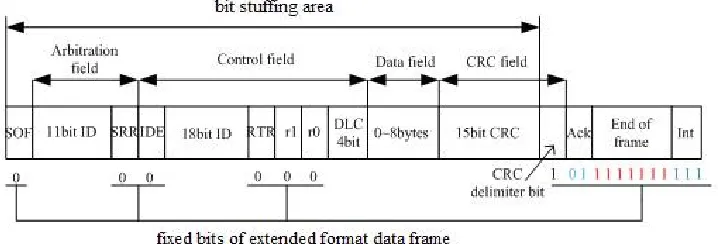
control field, data field, and CRC sequence, while the rest are not bit stuffed. CAN protocol stipulates that when the controller detects five consecutive same polarity bits in the bit-flow from the frame start to the CRC sequence, it will automatically insert a bit of the opposite polarity. Figure of bit stuffing is shown as Figure 1.
Figure 1. Figure of bit stuffing.
The total length of a CAN message(Lm) when no bit stuffing is done is:
8 13
m m
L = d +g+ (1) In the formula(1) dm indicates data bytes in the transfer message, and takes 0-8. 8dm+g indicates
the total bits stuffed in the message(g=34 in standard format; g=54 in extended format). The remaining 13 bits including CRC delimiter, acknowledge field, end of frame field, and interframe space do not participate in bit stuffing.
When the bit stuffing is completed, the total length of the CAN message becomes:
8 13
m m
[image:2.612.145.471.350.465.2]L′ = d +g+ +x (2) In the formula(2) x is the total stuffing bit.
[image:2.612.130.489.496.618.2]Construction and Simulation of Improved XOR Stuffing Bit Model
In fact, the stuffing bit is very difficult to achieve the worst-case. In the references [5] and [6], the stuffing bit was analyzed from probability, and the stuffing bit probability distribution curves of different data bytes were obtained by different methods. However, from the analysis of section 1, we know that there are several bits in the data frame filling area whose values and positions are fixed. So it is necessary to be considered comprehensively when analyzing the stuffing bits.
Take the standard format data frame as an example. From the analysis in section 1, we know that 4 bits in the filling area of the standard format data frame are fixed. Moreover, the data frame control field has a 4-bit data length code (DLC), and the DLC value of data frames for a specific bytes is also determined.
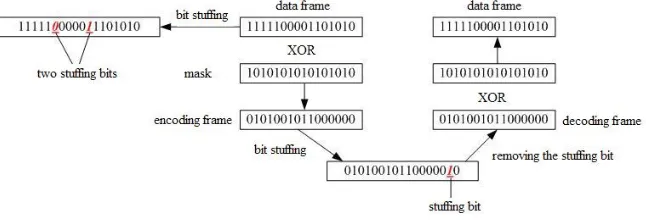
[image:3.612.145.468.313.423.2]In the CAN bus, there are five consecutive bits that are inserted in one opposite polarity bit. If we can reduce the number of five consecutive bits, we can reduce the stuffing bit. For example, for consecutive "00000", one stuffing bit "1" must be inserted later. but if we do XOR operation with "10101" and "00000" to get "10101", we do not need to fill bit (fig. 4: XOR operation illustration). XOR can effectively reduce the stuffing bit[7,8], but after analysis, we find that a simple XOR operation may change the priority of the data frame and thus affect the bus transmission performance. Therefore, it is necessary to improve the XOR method, that is, the identifier of the data frame can not be caused to change priority by participating in the XOR operation.
Figure 4. XOR operation illustration.
Based on the analysis above, we constructed a CAN bus bit stuffing model P(Si,l) to study the
improved XOR method. The model consisted of n binary bitstreams Si randomly generated, and l
was the length of bitstream Si. The generation of each bit flow must meet the following three
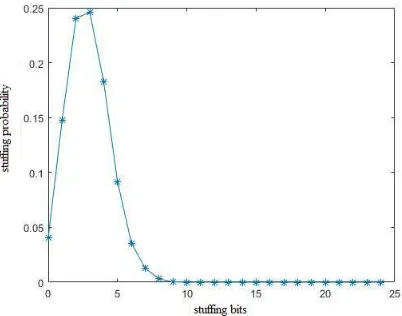
Figure 5. The stuffing bits probabilities distribution curve of CAN standard format 8 bytes messages with improved XOR method.
Analysis of Stuffing Bit Statistical Characteristics with Improved XOR Method
The analysis of the previous section shows that the stuffing bit of the standard frame based on the improved XOR stuffing method is a random variable (expressed as X). For a random variable, we often use its mean, moment to characterize it. According to the simulation curves in section 2, the mean (µx,unit: bit), variance (σx2,unit: bit2), third moment (θx,unit: bit3), and fourth moment (ηx,unit:
bit4) of message stuffing bit X were calculated by formula (3) - (6), and shown as Table(1).
( )
x E X
µ = (3)
(
)
( )
2 2 2
x E X E X
σ = − (4)
(
3)
3( )
(
2)
2 3( )
x E X E X E X E X
θ = − × + × (5)
(
4)
3 4( )
6 2( )
(
2)
4( )
(
3)
x E X E X E X E X E X E X
[image:4.612.199.400.75.233.2]η = − × + × × − × × (6)
Table 1. Stuffing bit statistical characteristics with improved XOR method.
Bytes
SC
0 1 2 3 4 5 6 7 8
µx 0.7500 1.0711 1.4867 1.5509 1.8250 2.5637 2.4288 2.6289 2.8810 σx
2
0.6187 0.8958 1.2320 1.2938 1.5386 1.9153 2.0037 2.1678 2.3382
θx 0.4055 0.6087 0.8081 0.8980 1.0863 1.1427 1.2146 1.5516 1.4320 ηx 1.2263 2.6098 4.7629 5.3507 7.8096 11.4534 11.7644 15.0037 16.3820
we analyzed the XOR stuffing method and made some necessary improvements to XOR stuffing method in order to reduce the stuffing bit reasonably. By analyzing the model of improved XOR stuffing method, it is found that the stuffing bit using XOR stuffing method is a random variable, and the probability distribution maps of stuffing bit were obtained through programming simulation. Combined with the simulation probability distribution curves and the related formulas, we deduced the statistical characteristics of the stuffing bit with improved XOR stuffing method, which will provide a reasonable theoretical basis for further research in CAN bus system.
Acknowledgements
We would like to express our appreciation to National Science and Technology Support Program Project (2015BAF07B07).
References
[1] Cao Wanke. Research on Certain Key Thoeries of CAN Protocol for Automotive Network [D].
Northeastern University, 2008.
[2] Navet N, Song Y, Simonot-Lion F, Wilwert C. Trends in Automotive Communication Systems[J]. Proceedings of the IEEE, 2005, 93(6): 1204-1223.
[3] Tindell K. Calculating controller area network message response time [J]. Control Engineering Practice, 1995, 3:87-94.
[4] T. Nolte, H. Hansson, C. Nǒrstom. Using bit-stuffing distributions in CAN analysis [J], IEEE
Real-Time Embedded Systems Workshop, 2001.12:102-108.
[5] Chen Xi. Research on Real-time Performance and Reliability of CAN Bus [D]. Tianjin University, 2010.
[6] Li Fang. CAN Communication Experiment Platform & Scheduling Analysis Based on Probabiliy stuff-bits [D]. Tianjin University, 2005.
[7] K. Park, M. Kang, D. Shin, Mechanism for Minimizing Stuffing-bit in CAN Messages[J], The 33rd Annual Conference of the IEEE Industrial Electronics Society (IECON), 2007, Nov. 5-8, 735-737.