2019 2nd International Conference on Informatics, Control and Automation (ICA 2019) ISBN: 978-1-60595-637-4
Study on the Characteristics of Insulator Leakage Current in Haze Based
on FCM Clustering Algorithm
Ruo-bing HAN, Yu-hang GUO and Yun-zhi XU
*School of Electric and Power engineering, China University of Mining and Technology, Xuzhou, Jiangsu Province, 221116, China
*Corresponding author
Keywords: Clustering algorithm, Insulator, Leakage current.
Abstract. Among the climate problems caused by industrial pollution, haze is particularly serious. Haze not only brings inconvenience to normal life but also brings a lot of problems to the insulation level of the power system. Insulator leakage current reflects all the states in the flashover process of insulators and is an important parameter to evaluate the insulation level of insulators. Different haze conditions were simulated in the laboratory to measure the leakage current of insulators under various haze components. The leakage current of insulators is analyzed by clustering algorithm, and the characteristic values were extracted to obtain the different characteristics of the leakage current of insulators under various haze components. And for the analysis of the results of the clustering algorithm to improve the measures.
Introduction
The fundamental reason for the frequent occurrence of haze is the irrationality of China's energy structure. Following the principle of ‘balance in place ’of coal for a long time, the consumption of raw coal in the central and eastern regions of China has reached saturation and exceeded the carrying capacity of the environment.
To completely solve the occurrence of haze, the construction of ultra-high voltage power grid to transmit electric energy and the optimization of the national power resources are the methods to solve the problem.
Insulators are the largest number of external insulation equipment in the transmission lines of ultra-high voltage lines which are hundreds of kilometers long. Most pollution flashover accidents are related to insulators. Because haze is regional weather, if pollution flashover occurs to insulators in UHV lines, then flashover may occur to all insulator groups in the adjacent lines.
At present, the main measures to prevent insulator pollution flashover in haze weather are to increase line patrol personnel and carry out manual cleaning of insulators and other inefficient methods. In this paper, the working conditions of insulators are simulated in the high-voltage laboratory, and the clustering algorithm is used to process and analyze the detected insulator leakage current data set.
The Influence of Haze on Insulators
Analysis of the Composition and Causes of Haze
The particles emitted by raw coal burning, automobile exhaust, buildings,and other human activities are combined with specific natural climatic conditions to form a sol mixture of non-fixed components after A series of chemical reactions.
The main conductive salt ions in haze include SO2- 4,NH+ 4,NO- 3,Ca2+,Cl-,etc.However, due to different sources of haze, the contents of various components are also different.
Therefore, the composition of haze is very complex, and the impact on insulators should be further analyzed.
The Influence of Haze on Insulators
The influence of haze on insulators is as follows[1]:
(1) The salt particles in haze components increase the equivalent salt deposit density(ESDD) of insulators in haze environment and increase the pollution level of insulators.
(2) Water mist in haze and salt particles combine to form an acidic aerosol, which increases the dielectric constant of air near the insulator and speeds up the development process of pollution flashover.
Experiment on Leakage Current Measurement of Insulators in Fog and Haze
Simulated Haze under Laboratory Conditions
At present, it has not formed a unified standard for haze content all over the world. The purpose of this experiment is to discuss the difference in the operating state of insulators under different haze conditions. Therefore, given the different haze generated by different pollution sources, the method of extracting its main components is used to simulate the haze weather.
According to the main pollution sources of haze, nitrate and sulfate are used to simulate haze weather for automobile exhaust and raw coal burning, which are serious sources of haze.
As shown in table 1, the corresponding composition of fog water is configured to simulate the haze weather.
Table 1. Simulation of different haze water composition. Experimental group Composition of the mist
1 Distilled water/cleaning fog
2 NaNO3:Na2SO4=16:1,add three parts water
3 NaNO3:Na2SO4=16:1,add one part water
4 NaNO3:Na2SO4=1:16,add one part water
Where the ratio of substances is molar ratio, groups 3 and 4 have the same concentration of salt ions, only the salt added is different. The nitrate concentration in group 3 was three times that in group 2.
‘One part water’ and ‘part’ represent a multiple of the amount used.
Measure the Leakage Current of the Insulator
The experimental steps are as follows:
(1) Clean insulator with distilled water and hang it to dry. The type parameters of insulators tested are shown in the table below:
Table 2. U160FC02 insulator technical parameters. Insulator type D/mm S/cm2 L/mm
U160FC02 280 2317 400
Where D is the diameter, S is the surface area, and L is the climb distance of the insulator
(2) The atomized water configured in table 1 is mixed with quantitative diatomite, and the measured insulator is treated with quantitative coating method so that each group of insulators to be tested has the same ESDD and the surface gray value.
voltage regulator
T
C1
C2
Measuring resistance protective
resistance
Protective gap
[image:3.595.173.426.68.237.2]Scope Insulators
Figure 1. Experimental schematic diagram.
The sampling frequency was 5MHz, and about 130,000 leakage current sample points were collected in 30ms.
Wavelet Threshold Denoising
In the experiment, leakage current signal is collected by oscilloscope connected with voltage and current transformer. In the process of signal acquisition, it is inevitable to add equipment to electromagnetic noise and other interference signals. The noise-containing leakage current signal will make the result of clustering analysis deviate, thus causing errors. Even because the clustering characteristic value of the signal is affected by the noise, the clustering cannot be carried out.
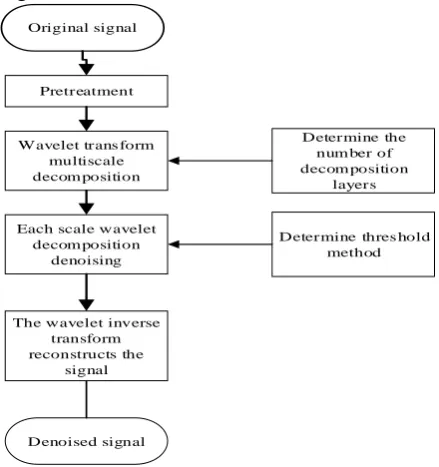
Wavelet denoising has been widely used to remove white noise and achieved good results. Wavelet threshold denoising method is adopted for denoising the leakage current signal[2].
The main flow is shown in figure 2:
Original signal
Pretreatment
Wavelet trans form multiscale decom position
Each scale wavelet decomposition
denoising
The wavelet inverse transform reconstructs the
signal
Denoised signal
Determine thres hold method Determine the
num ber of decom position
layers
Figure 2. Flow chart of wavelet denoising steps.
Wavelet threshold denoising method can be divided into Fixed form threshold method, Rigorous SURE, Heuristic SURE, and Minimax method[2]. According to the threshold processing mode whether to make the waveform mutation. It can be divided into soft threshold and hard threshold processing methods.
[image:3.595.199.419.438.672.2]Table 3. Comparison of effects of different threshold selection methods. Methods Standard dev. of the residual
Soft Hard
Fixed form threshold 0.006263 0.005127 Rigorous SURE 0.002288 0.001385 Heuristic SURE 0.002288 0.001385
Minimax 0.005562 0.00431
It can be seen that the standard dev. of the fixed form threshold denoising method under the soft threshold is significantly larger than that of other methods. The residual between the denoising signal and the original signal is the removed Gaussian white noise. It can be obtained from the white noise characteristic that obeys the Gaussian distribution. The more dispersed the residual distribution is, the better the denoising effect will be.
The standard deviation of the residual is the largest, and the removed white noise is the most dispersed.
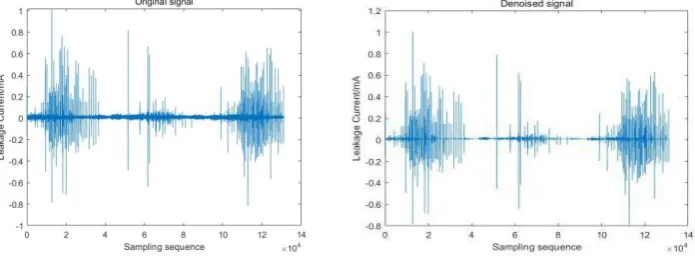
[image:4.595.121.469.331.459.2]Take the insulator treated only by clean fog as an example, DB6 is selected as the mother wavelet, the number of layers is selected as 5, and the fixed form threshold method of the soft threshold is adopted for denoising. The current comparison before and after denoising is shown in figure 3:
Figure 3. Comparison of leakage current before and after denoising with cleaning fog.
Analyze the Leakage Current by FCM
As an unsupervised learning algorithm, the clustering algorithm is mainly used in data mining and other fields to extract effective information for big data.
In recent years, with the construction of the smart grid and the emergence of high-dimensional and large-scale data, the clustering algorithm has also been applied in the electrical field.
Principle of Fuzzy C-means Clustering Algorithm
Fuzzy C-Means (FCM) is an unsupervised clustering algorithm based on partition[9]. The difference between this algorithm and the traditional hard partition clustering algorithm is that the membership function of the algorithm sample is 0~1 continuous value[4], while the hard partition algorithm is 0 or 1 discrete value. Thus the flexible partition of data set can be realized.
The Principle of the FCM algorithm is to divide a data set X {x1,x2,x3,...,xn}into class C
according to the minimum sum of Euclidean distances between all points in the category and the clustering center. The space divided is as follows:
U
R
i
k
n
i
M
n
k ik ik
cn
fcm
,
0
;
,
],
1
,
0
[
1
(1)2
1 1
)] (
[ i j
k j n i b i j
f x x m
J
(2)
When the clustering loss function Jf reaches the minimum, the following conditions shall be met:
k s b b i j ms xi mj xi x 1 ) 1 /( 2 ) 1 /( 2 ) ( (3)
n i b i j n i i b i j j x x x m 1 1 )] ( [ )] ( [
(4) The formula (3), (4) are iterated until the convergence conditions are satisfied and the accurate clustering results are obtained.Cluster Leakage Current by FCM
When the insulator flashover occurs, when there is a wet, dirty layer, the leakage current mainly refers to the current in the wet, dirty layer with conductivity, also known as arcing current. When the surface of the insulator is dry band, it mainly refers to the arc current of the dry band to the air.
When the flashover begins, the leakage current is the current of the dirty layer on the surface of the insulator.
With the development of the pollution flashover process, the dry zone begins to appear, and the leakage current starts to include the arc current of the dry zone to the air and the current of the dirty layer.
When pollution flashover develops to a certain extent, the humid layer on the surface of the insulator is dried and the arc generated on the air continues to burn. At this time, the leakage current pulses are the arc discharge current of the dry zone to the air.
From the development process of leakage current in pollution flashover, the leakage current can be divided into two categories:
(1) The current of wetting dirty layer; (2) The current of air arc in the drying belt;
Make clustering class number C=4, cluster analysis is carried out for leakage insulator current under different haze conditions, and nitrate water mist with different concentrations is taken as an example:
Figure 5. FCM clustering with a high concentration of nitrate water mist and C=4.
From the clustering results, FCM divides the leakage current pulse data into four categories: The pulse amplitude of the two types of data is near 0, and the amplitude is small. The clustering centers are as follows:
] 118 . 0 , 009 . 0 [ 1
center ; center2[0.034,0.01]
There is only a gap between these two clusters in terms of time dimension characteristic quantity, which can be regarded as the leakage current of the wet, dirty layer.
(2) The other two kinds of leakage current pulses have some symmetry due to their positive and negative effects. The main difference with the former two types is that the leakage current pulse amplitude is larger.
It can be seen that the classification results of leakage current pulse by the FCM algorithm are consistent with the composition of leakage current in the actual development process of pollution flashover. The clustering results of leakage current analysis by the FCM algorithm correspond to the leakage current composition in the actual development process of pollution flashover, which is consistent with the actual situation.
However, because the Fuzzy C-Means Clustering algorithm is based on the membership value of sample points, the actual leakage current pulse amplitude contains smaller humid contamination layer and larger air arc current. Aiming at the boundary of two kinds of currents, the FCM does not give a distinguishable demarcation boundary, and it is unable to eliminate the interference of noise clearly.
Analysis of FCM Clustering Results
The characteristic values extracted from the clustering results are shown in table 4. The sample number of insulator leakage current pulse for different categories is different, and the clustering center is also different. The variation trend of the proportion of samples in the clustering results can be used as the characteristic value of the working state of insulators under different haze conditions. The following conclusions can be drawn by comparing the data.
Table 4. Sample number of clustering results under different haze conditions.
The current of wetting dirty layer The current of air arc in the drying belt Clustering categories Index1 Index2 proportion Index3 Index4 proportion
Clean and dry 28648 30660 45.25% 36129 35635 54.75%
Clean and water mist 30588 50237 61.66% 16210 34047 38.34% Low concentration nitrate 48680 46199 72.39% 16535 19658 27.61% High concentration nitrate 68179 43574 85.26% 9514 9805 14.74%
[image:6.595.70.526.683.780.2]the same category is different after the clustering of the leakage current of insulators under different haze conditions, which can be used as the characteristic value to distinguish different haze conditions. (2) Compared with the clean and dry insulator, the sample number of current in the wet and dirty layer of the insulator sprayed with clean water mist is larger, which contains more energy and accelerates the drying process of the wet layer. However, the dry insulator is its surface air arc discharge, the amplitude is large, cannot make wet, dirty layer into the dry zone. Moreover, in the experiment, the flashover voltage of the dry insulator obtained by the uniform boost method was higher than that of the insulator sprayed with clean mist. The clustering analysis showed that the dry insulator had no wet pollution layer, and they were all arc discharge with a large amplitude, which was consistent with the actual situation.
(3) Under the condition of haze with the same working voltage and different concentrations, compared with the pollution of low concentration nitrate, the pollution of high concentration nitrate has more leakage current pulses in the humid pollution layer, and the leakage current energy of the humid layer is larger. It is easier to promote the development of insulator pollution flashover.
Conclusion
In this paper, the leakage current of insulators is tested under the condition of artificial haze. The fuzzy c-means algorithm was used to cluster the insulator leakage current, and the clustering results with certain practical significance were obtained. The characteristic quantity that can reflect the working state of insulators is obtained from the clustering results, which provides a basis for the possibility of preventing pollution flashover accidents of insulators in haze weather. Considering the poor effect of fuzzy clustering algorithm on clustering boundary, it also provides some ideas to improve the performance of the FCM algorithm by using the practical significance of data sets.
References
[1] Y. Xu, H. Zheng, K.Zhao, N. Bian, Analysis of Insulator Leakage Current under Fog and Haze Conditions Based on Fractal Theory [J]. Colliery Mechanical & Electrical Technology, 2018(06): 33-37.
[2] Y. Xu, X. Xu, N. Bian. Analysis of Insulator Leakage Current under Fog and Haze Based on Support Vector Machine[J],Colliery Mechanical & Electrical Technology, 2018(05):21-25.
[3] Y. Xu, B. Jiang, N. Bian. Study on Insulator Fault Diagnosis Model in Haze Based on ARMA Algorithm[J], Research and Exploration In Laboratory 2018, 37(08): 20-24+28.
[4] Han Xiaohui, Du Songhuai, Li Zhen, Sun Lihua. Diagnosis of electric shock fault based on time-frequency singular value spectrum of leakage current and fuzzy clustering[J], Transactions of the Chinese Society of Agricultural Engineering , 2018, 34(4): 217-222.
[5] X. Jiang, Y. Liu, etc. Effect of Fog-haze on AC Flashover Performance of Insulator [J], High Voltage Engineering, 2014, 40(11):3311-3317.
[6] C. Zhang. Research on Clustering Algorithm for Insulator Leakage Current[J], Insulators and Surge Arresters, 2013(05):19-25.
[7] B. H, H. Lin. Clustering and Discriminating of Typical Characteristics of High Voltage Contaminated Insulator During Flashover[J], High Voltage Apparatus, 2006(03): 172-175+178.