2018 International Conference on Computational, Modeling, Simulation and Mathematical Statistics (CMSMS 2018) ISBN: 978-1-60595-562-9
Improvement and Performance Analysis of DSR Protocol in MANET
Yi ZHU
1, Li-heng ZHAO
2, Jun LU
1and Shi-qi DENG
11Dept. of Software Engineering, Chengdu University of Information Technology, Chengdu, Sichuan 610225, China
2Dept. of Computer Science & Technology, Chengdu University of Information Technology, Chengdu, Sichuan 610225, China
Keywords: Mobile ad hoc network, DSR, Network simulator version 2, Routing introduction.
Abstract. The characteristics and shortcomings of dynamic source routing protocol (DSR) in mobile Ad hoc network are analyzed in detail. For the DSR protocol did not consider the network load, node energy and optimal path problems etc. proposed a new and improved DSR protocol, LEBDSR (Load and Energy Balanced Dynamic Source Routing) protocol, it increased the node congestion factor and energy coefficient based on the original protocol, and improved routing strategy under the new constraint parameters. By comparative analysis of NS-2 simulation, performance of the proposed DSR protocol such as the delivery rate, routing load, network minimum survival time were improved in the same network environment.
Introduction
Mobile Ad Hoc network is a multi-hop autonomous system, it is formed by a group of wireless transmitters and receivers mobile nodes [1], it has some characteristics, such as easy-to-network, the node randomly moving, dynamic topology, the host of energy is limited and survival time is short and so on [ 2].
In 1996, Professor David B. Johnson of Carnegie Mellon University made the Dynamic Source Routing Protocol [3], it is a typical on-demand reactive routing protocol, and it is a simple and efficient routing protocol for mobile Ad Hoc network. The advantages of DSR protocol is that: nodes do not need to periodically send routing broadcast packets only need to maintain the routing of the communicating nodes; protocol overhead low, saving energy and network bandwidth; it uses route caching to reduce the cost of routing discovery, a route discovery process may have multiple routes to the destination node, this will contribute to routing; it can completely eliminate the routing loop.
But the DSR protocol cannot provide QoS support, routing is only based on the shortest path, without considering the load of intermediate nodes, node residual energy, the vitality of the network, chain scission, and network congestion issues. To solve these problems, combined with the characteristics of Ad Hoc network, presented a LEBDSR protocol. This new protocol improves the process of route discovery and route maintenance, through increasing the constraint parameter in the routing table, considering the network conditions, choosing the best path, so making that the network congestion and node premature death and other issues have a certain ease.
Principles of DSR Protocol
DSR protocol-specific routing caching mechanism [3], that is, each node maintains a routing list, when gets new link information, saves this information to the routing cache. According to the business needs, protocol discovery and maintenance route, this including two processes: route discovery and route maintenance.
Route Discovery
node begins route discovery process, use the flooding method to send route request (RREQ) packet, RREQ packet contains the source node address, destination address, request ID and the route record list. Intermediate node receives the RREQ packet, check the data packet, if it is repeat then discard the route request packet; If the destination node for RREQ packet is this node itself or the node has a route to the destination node, then the node send the route reply (RREP) packet to the source node, RREP packet contains the route from the source node to the destination node; otherwise the node add his own address to the route record list of the RREQ and forward this information until the source node received RREP packet of the destination node.
Route Maintenance
In DSR protocol, when route is established, if a route is ongoing data transfer, route maintenance program will monitor its operation situation. If an intermediate node on the data packet transmission path finds errors or link failure, then it will return a route error (RERR) packet, the error message contains the both ends address of the error hop, node delete the route that contain the error link when it received or heard RERR packet. After sending the RERR packet, the node checks its routing cache whether has effective route to the destination node, if has, the routing in cache replace the source routing in group to repair the data packet. When the source node receives RERR packet, it starts to find other available route in cache, if not, it will trigger a new route discovery process.
LEBDSR Protocol
Considering the characteristic of Ad Hoc network and DSR protocol, for network congestion, node load, energy balance and the shortest path problems, improvements the original DSR protocol, LEBDSR (Load and Energy Balanced Dynamic Source Routing) protocol. First, adding the node congestion coefficient threshold C in the RREQ packet table, the intermediate node forward the RREQ packet only if its congestion coefficient is less than the threshold C; second adding node energy coefficient field in route record list of RREQ and RREP packet, used to record the intermediate node energy state. Among them, the node congestion coefficient value is the ratio of the queue length of queued packet and total queue length for the node MAC layer interface cache, the value of the source node initial packet is taken as 0; energy coefficient values is the ratio of the residual energy and initial energy, the value of the source node initial message is taken as 1.
Route Discovery Process
The source node starts route discovery process, and sends RREQ packet using the flooding method, this RREQ packet added the node congestion coefficient threshold and the energy coefficient record list. Intermediate node receive the RREQ packet, check the data packet, if it is repeat then discard the route request packet; or else, calculate their own congestion coefficient and compare with the threshold value of C , if greater than C while the node do not participate in forwarding; Otherwise, if the destination node for RREQ packet is this node itself or the node has a route to the destination node, then the node sends the RREP packet to the source node, the RREP contains the route and the energy coefficient record list from the source node to destination node; otherwise, the node puts its address and energy coefficient to the route record part of the RREQ packet and forwards this information, until the source node received RREP packet of the destination node.
Routing Policy
( i) (1 ) i j i
H C
P R M i n E
H C 1 N i i H C H C N 1 N i j i
M i n E N
Where, Ri on behalf of a route in the candidate routing table R, α is the weighting factor, HCi on
behalf of hops for route Ri, HC
——
on behalf of the average hops number of all the routes in the routing table R, Eij in behalf of the energy coefficient of intermediate nodes in route Ri, MinEij on behalf of
the minimum energy coefficient of intermediate nodes in route Ri,N on behalf of the number of
candidate route in the routing table R. Weighting factor α determined by the minimum energy coefficient of nodes in each route of routing table R, when the energy of the node for each route in good condition, the algorithm tends to select fewer hops route in the candidate routing table, otherwise, select the energy factor in the relatively well but may be slightly more hops route in the candidate routing table.
NS-2 Simulation and Performance Analysis
Simulation Parameters
NS-2 is an easily extensible, easy configuration, based on discrete event-driven, object-oriented open-source network simulation software, mainly used to solve the problem of network research. It provides TCP, routing, multicast, and other protocol simulation in wireless or wired network [5], in addition to the existing network element simulation analysis, but also the development of new protocol.
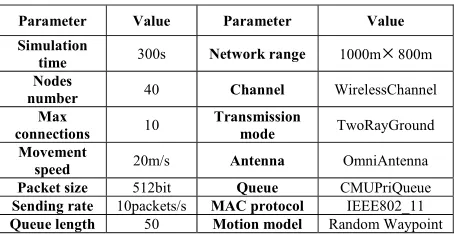
[image:3.612.193.420.454.571.2]In order to validate the performance of the LEBDSR protocol, using NS-2 simulation of the original protocol and the LEBDSR protocol, then comparative analysis of the performance. The LEBDSR protocol congestion coefficient threshold C value of 0.5, the simulation environment parameters in TABLE I [6], testing performance parameters of the two protocols in the case of residence time is 0s, 25s, 50s, 100s, 150s, 200s, 250s, 300s.
Table 1. Simulation parameters.
Parameter Value Parameter Value Simulation
time 300s Network range 1000m800m Nodes
number 40 Channel WirelessChannel Max
connections 10
Transmission
mode TwoRayGround Movement
speed 20m/s Antenna OmniAntenna Packet size 512bit Queue CMUPriQueue
Sending rate 10packets/s MAC protocol IEEE802_11
Queue length 50 Motion model Random Waypoint
Performance Evaluation
Performance evaluation mainly based on the following six indicators [7]:
Packet delivery rate: the ratio of the destination node receives packet number and the source node sends packet number, reflecting the reliability of network transmission, the higher delivery rate the higher reliability.
Packet delivery rate = the number of destination node receive data packets /the number of source node sent data packets
Average end to end delay: includes the route discovery delay, waiting delay of data packet in the interface queue, transmission delay and the retransmission delay in MAC layer, reflecting the routing effectiveness.
Normalized routing load: Each receives a data packet required number of routing control packets, including RREQ, RREP and RERR. Reflecting the routing protocol scalability, the ability to adapt to network congestion and protocol efficiency, large overhead protocol, the probability of congestion is great, and the data packets sent maybe delay in the interface queue.
Normalized routing load = number of route discovery and route maintenance control packets / number of data packets received
Mean hops: in the simulation process, the average number of hops through the data packets from the source node to destination node, which reflect the network topology, node communication range and route efficiency.
Mean hops = (number of data packets transmitted + number of data packets sent) / number of data packets sent
Network minimum life time: the time from the simulation beginning to the first node energy run out, reflecting the network load and energy balance conditions [8].
Network minimum life time = the time of the first node death
The number of dead nodes: at the end time of the simulation, the number of the node which energy is zero in the network. Reflecting the system's maximum survival time, the less the death node, the longer the system effective survival.
[image:4.612.226.385.407.519.2]Performance Comparison
Fig. 1 reflects the packet delivery rate of two protocols at different node retention time, compared with the original DSR protocol, the LEBDSR protocol increase to a certain extent in packet delivery rate. This is because the new protocol route bypass the heavy load nodes through setting the congestion threshold coefficient, avoid packets loss caused by serious network congestion, and the new routing strategy can protect the low energy nodes, avoid its premature death, so that in the effective network survival time have enough nodes to participate in packet forwarding, ensure high packet delivery rate.
Figure 1. Packet delivery rate.
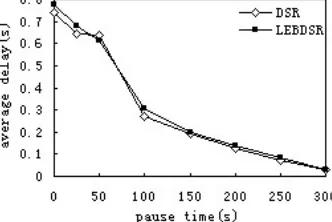
[image:4.612.223.389.607.718.2]Shown in Fig. 2, average delay of the LEBDSR protocol on a slight increase over the original protocol, although high coefficient congestion node does not participate in routing in the LEBDSR protocol, that can reduce the packet waiting delay, but because of the new routing policy consideration of the node residual energy, the increase in the average number of hops lead to increase transmission delay, so the overall delay performance is slightly worse.
It can be seen from Fig. 3, normalized routing load of the LEBDSR protocol is decreased compared with the original protocol, it is because the added congestion coefficient threshold limit a certain amount of nodes participate in route discovery process, thus reducing the number of route discovery control packets; the same time full account of the load and the residual energy of nodes when routing, routing quality is better, high success rate forwarding, since forwarding failure to start a new route discovery probability lower, so the routing load is lower.
[image:5.612.219.389.195.461.2]Fig. 4 shows the average number of hops of the LEBDSR protocol more than the original protocol’s, mainly due to the new routing function is not only taken into account the number of hops but also increases residual energy parameters, resulting in an increase in the average number of hops.
Figure 3. Normalized routing load
Figure 4. Mean hops.
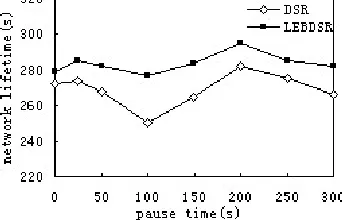
[image:5.612.221.392.525.635.2]Fig. 5 and Fig. 6 clearly show that the LEBDSR protocol load balancing and node energy conservation strategy can be avoid the premature death of individual nodes, the numbers of dead nodes significantly reduced in simulation time, so that network lifetime can be extend to a large extent.
Figure 6. The number of dead nodes.
Conclusion
Based on the research and analysis of the original DSR protocol, this article proposed a LEBDSR protocol, which increases the congestion coefficient threshold and node energy record list in the route discovery packets, its routing policy is based on residual energy and hops factors. NS-2 simulation results show that the improved DSR protocol in packet delivery rate, routing load and network lifetime are better indicators of performance, but the average end to end delay and the average number of hops performances are general, in the whole the network performance is improved. This experiment analyses the improvement protocol performance only for network topology changes status, the node mobility speed, number of data sources, the network density and other factors influence on the performance of the new protocol does not take into account, that pending further study.
References
[1] Yu Hongyi, et al. Wireless Mobile Ad Hoc Networks [M]. Beijing: Posts and Telecommunications Press, 2005. 4 [in Chinese].
[2] IETF. Mobile ad hoc networks charter [EB / OL]. http://www.ietf.org/html.charters/manet-charter.html,1999-07-31.
[3] David B. Johnson, David A. Maltz, Yih-Chun Hu. The Dynamic Source Routing Protocol for Mobile Ad Hoc Networks (DSR) [S]. IETF, draft-ietf-manet-dsr-10.txt, July 2004.
[4] Chen Yong. Ad Hoc Networks Energy Efficient Routing Algorithm [D]. Hangzhou: Zhejiang University, 2008.
[5] Yu Bin, Sun Bin etc. NS2 and network simulation [M]. Beijing: People's Posts and Telecommunications Press, 2007. 4: 1-2.
[6] Ke Zhi-Heng, Cheng Rong-Xiang, Deng De-juan. NS2 simulation experiment - multimedia and wireless network communication [M]. Beijing: Electronic Industry Press, 2009, 3: 318-324.
[7] S. Corson, J. Macker. Mobile Ad Hoc Networking (MANET): Routing Protocol Performance Issues and Evaluation Considerations. RFC2501, January 1999.