2018 3rd International Conference on Information Technology and Industrial Automation (ICITIA 2018)
ISBN: 978-1-60595-607-7
Prediction of Tool Life in Digital Workshop
Based on Particle Swarm Optimized BP
Neural Network Algorithm
Xiaoqiang Wu, Chunyou Zhang and Lihua Wang
ABSTRACT
In the machining process of modern digital workshops, the tool life is an important parameter index that influences the development of tool demand planning, cost accounting, and cutting parameter setting. In view of the highly nonlinear relationship between tool life factors and tool life, particle swarm optimization BP neural network technology was used to predict tool life. Firstly, the relationship between tool life and tool wear, the influence factors of tool life and the significance of tool life prediction are analyzed. Then, a tool life prediction algorithm based on particle swarm optimization BP neural network was established. Finally, the proposed algorithm is simulated and tested. Experimental results show that compared with the original BP neural network prediction algorithm, the proposed algorithm has fast convergence rate and high prediction accuracy.1
KEYWORDS
Particle Swarm Optimization, Bp Neural Network, Tool Life, Prediction
INTRODUCTION
T With the rapid expansion of the scope of application of numerical control machine tools, workshop automation, flexibility has continued to increase [1-2]. The number and types of tools in machining centers have also increased significantly. At the same time, the extensive application of high-speed cutting technology is more demanding on the cutting performance and reliability of tools. Tool life is a very
1
critical issue for the normal use of CNC machine tools. This is because if the tool is worn out or damaged and cannot be diagnosed in time, the work-piece or processing equipment may be damaged. Therefore, the tool life must be effectively predicted and managed [3-4].
In the automated production line of the digital workshop, there may be frequent scheduling of tools [5]. In other words, the tool may be in a different machining state. The machining status of the tool is different, and the work-piece material, cutting speed, feed amount, and cutting depth are also different. These factors determine the degree of wear of the tool, which determines the tool life [6]. At present, the cumulative tool equivalent cutting time is commonly used in the production workshop to evaluate the tool life. This traditional life prediction method will result in the conservative use of a large number of tools, making the resources seriously wasted. Therefore, there is an urgent need to study new intelligent tool life prediction methods.
This paper presents a BP neural network model for tool life prediction. This model provides an effective method for predicting tool life. The prediction results have higher prediction accuracy and convergence speed than traditional predictions.
TOOL LIFE MODEL
Tool Life and Tool Wear
The life of a tool represents the total actual cutting time of a new tool from when it is put into cutting to when it is scrapped. The tool life is equal to the knife sharpening times the tool life. In actual production, the tool life is usually understood as the actual cutting time of the tool from the beginning of production to bluntness, i.e. the tool life. Tool durability refers to the total cutting time that a new sharpened tool will reach from the start of cutting to the tool wear limit. The durability of the tool is generally expressed as T, and the unit is min.
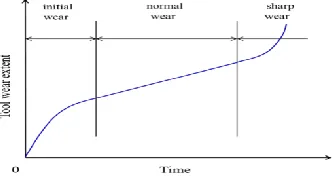
[image:2.612.224.390.574.664.2]During the use of the tool, the tool cuts the chips, but the tool itself also wears. According to the cutting experiment, the curve of the tool wear process is shown in Figure 1. The tool wear process can be divided into three stages, the initial wear stage, the normal wear stage, and the sharp wear stage.
The initial wear stage is the presence of micro-cracking, oxidation, decarburization, or rough inequality defects in the new tool. In addition, the cutting surface of the cutting tool has a small contact area and a large stress. Therefore, wear will soon occur within a short time after starting the cutting.
The normal wear stage means that after the initial wear, the tool surface has been flattened and the tool has entered the normal wear stage. This is a wear stability zone. The wear width increases uniformly with the cutting time and is an effective area for the tool to work.
When the tool enters the sharp wear stage, the tool has been bluntly worn. Tool wear is increasing, resulting in increased cutting force and increased cutting temperature. The continued use of the tool at this stage will result in a change in cutting color and even vibration. The cutting performance of the tool dropped sharply. At the same time, the machining quality of the work-piece may be due to the excessive wear of the tool. At this point, the tool must be regrinded or replaced with a new tool to ensure the quality of the work-piece and the normal production of the workshop.
Tool Life Factors
After the tool wear limit is determined, the tool life is related to the tool wear speed. The faster the wear rate, the shorter the tool life is. Therefore, factors that affect the tool wear rate will affect the tool life. The tool life is directly related to the production and the use and maintenance of the tool. It is an important basis for determining the tool change time. It is also an important indicator of whether the tool geometry parameters and cutting amount selection are reasonable. Therefore, by studying and analyzing the factors that affect the tool life, find out the relationship between these factors and effectively control it, it is very important to obtain a reasonable tool life and maintain the good cutting performance of the tool. There are many factors affecting the tool life, which can be summarized into five aspects: work-piece material, tool material and geometric parameters, cutting amount, sharpening quality of tool, lubrication and cooling conditions.
Tool Life Prediction Significance
In the production planning process, the tool demand and scheduling is a key issue. Only by accurately determining the number of knives required for production can the production plan be carried out smoothly [11]. Tool demand calculation formula is
(1)
Where S is the actual demand for the tool, SP is the tool plan demand, SS is the tool safety stock, Sc is the current inventory of the tool.
p s c
The high efficiency of production requires equipment to be produced as much time as possible. The tool change is an essential step in the production process. Only by making a reasonable and accurate prediction of the tool life can the tool be changed in time in the production process to ensure smooth production. Timely replacement also avoids the impact of excessive tool wear on product quality.
The cutting amount is defined to determine the depth of cut, feed, cutting speed, and tool life for a specific cutting operation. When specifying the amount of cutting, a comprehensive consideration of productivity, processing quality, and processing cost is required. The establishment of the cutting amount has a great influence on the cutting productivity, the tool life and the processing quality. Therefore, the tool life will directly affect the formulation of the cutting amount.
Start
Population initialization
Sample extraction
Sample training
If reach the maximum number of iterations?
Calculate fitness
If meet the accuracy requirements?
End
Calculate the next generation population
N Y
N
[image:4.612.156.469.261.638.2]Y
PARTICLE SWARM OPTIMIZED BP NEURAL NETWORK ALGORITHM
Particle swarm optimization algorithm is a swarm intelligence optimization algorithm in the field of computer intelligence [12]. The method was first proposed by Kennedy and Eberhart in 1995. The PSO algorithm is inspired by the biological phenomena of each bird in the bird's predation process searching for the bird's surrounding area closest to the current food, and gradually develops applications to solve practical problems. Each particle in the PSO algorithm represents a potential solution, and each particle corresponds to a fitness value determined by the fitness function. The speed of the particles determines the direction and distance the particles move, and the speed is dynamically adjusted with the experience of the movement of the particles themselves and other particles.
Combining the particle swarm algorithm with the BP neural network algorithm cannot only overcome the defect of the local optimal of the BP neural network, but also improve the convergence speed.
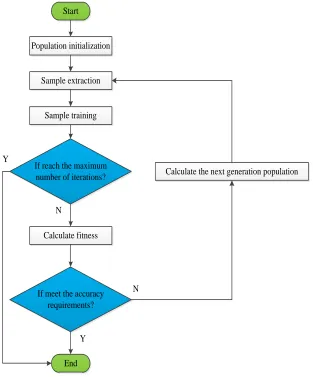
Particle swarm optimized the BP neural network algorithm uses a particle swarm optimization algorithm to optimize the weights of the BP neural network to train the neural network [13]. On the basis of determining the structure of the neural network, the weights of the BP neural network are arranged into a vector element in a uniform order. The error of the forward propagation process of the BP neural network is used as the fitness function of the PSO algorithm. BP neural network and PSO algorithm loop iteration to find the best BP network weights. The flow of particle swarm optimization algorithm to optimize BP neural network algorithm is shown in Figure 2.
milling cutter diameter
number of teeth
milling width
milling depth
feed amount
cutting speed
[image:5.612.149.451.452.659.2]Tool life prediction result
PROPOSED TOOL LIFE PREDICTION MODEL
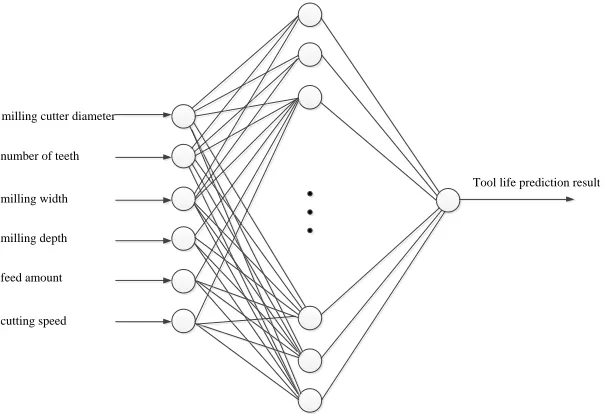
Taking the tool life prediction in the cutting process as an example, the YT1_5 carbide disc cutter is selected as the tool life prediction object. The influencing factors of milling cutter diameter, number of teeth, milling width, milling depth, feed amount and cutting speed were chosen as input layers of the model. The number of hidden layer nodes is repeatedly measured using the trial and error method. The number of selected hidden layer nodes is 11. There is one output node, which is the tool's predicted lifetime.
In the tool life prediction process, all neurons use the activation function sigmoid function.
(2)
RESULTS AND ANALYSIS
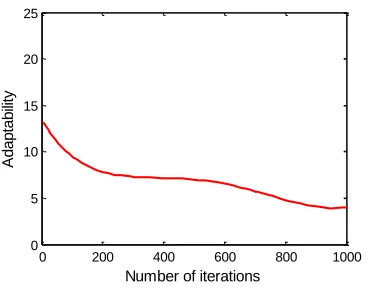
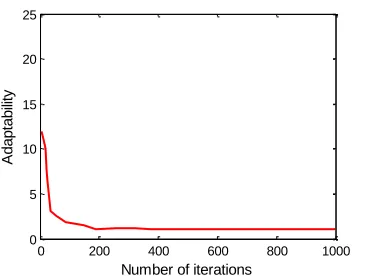
[image:6.612.212.404.508.652.2]The fitness convergence curves of the training using the standard BP neural network algorithm and the particle swarm optimization BP neural network algorithm are shown in Figure 4 and Figure 5, respectively. The horizontal axis is the training period and the vertical axis is the fitness of the network. The results show that compared with the standard BP neural network algorithm, the convergence speed of the particle swarm optimization BP neural network algorithm is significantly faster, and the convergence performance is greatly improved. The generalization ability of the standard BP algorithm is poor, the predictive value of the tool life is extremely unstable, and the error is large. The generalization ability of BP neural network trained by particle swarm optimization algorithm has been greatly improved. The prediction error is mostly within 10%, and it has good stability and accuracy.
Figure 4. Standard BP neural network convergence curve. 1
( )
1 x
f x
e
0 200 400 600 800 1000
0 5 10 15 20 25
Number of iterations
Ad
a
p
ta
b
ili
Figure 5. Convergence curve of the algorithm in this paper.
CONCLUSIONS
With the rapid expansion of the scope of application of CNC machine tools, workshop automation, flexibility has also been continuously improved. Tool life is a critical issue in the operation of the digital shop. Because the tool cannot be diagnosed in time if it is worn or damaged, it can cause damage to the work-piece or processing equipment. In this paper, the particle swarm optimization BP neural network has the ability to approximate the arbitrarily complex nonlinear system well. Combined with the existing tool life data, the tool life can be predicted more accurately. The particle swarm optimization BP neural network proposed in this paper can effectively predict tool life. Compared with the standard BP neural network, the prediction results have higher prediction accuracy and convergence speed.
ACKNOWLEDGMENTS
This work was supported by the project of the special fund on the Inner Mongolia University for the Nationalities scientific research project (NMDYB1730) Inner Mongolia Autonomous Region Science and Technology Innovation Guide Project in 2018: KCBJ2018028.
REFERENCES
1. Jamuna R, Natarajan U, Elango A, et al. Investigation of Spindle Thermal Expansion in CNC Machine[J]. Journal of Advanced Manufacturing Systems, 2016, 15(1):27-34.
2. K Liu, Y Liu, M Sun, et al. Comprehensive Thermal Compensation of the Servo Axes of CNC Machine Tools[J]. International Journal of Advanced Manufacturing Technology, 2016, 85(9):2715-2728.
0 200 400 600 800 1000
0 5 10 15 20 25
Number of iterations
Ad
a
p
ta
b
ili
3. G Yuan, J Bao, X Zheng, et al. Tool Life Prediction in Titanium High Speed Milling Processes Based on CNC Real Time Monitoring Data Driven[J]. China Mechanical Engineering, 2018.
4. J Wu, Y Su, Y Zhu, et al. Real-Time Remaining Useful Life Prediction of Cutting Tool Based on Information Fusion[J]. Journal of Huazhong University of Science & Technology, 2017, 45(4):1-5.
5. H J Kim, J H Lee, T E Lee. Noncyclic Scheduling of Cluster Tools with a Branch and Bound Algorithm[J]. IEEE Transactions on Automation Science & Engineering, 2015, 12(2):690-700.
6. Zhengwei Li, J Chen, Qinglong An. Study on Coated Tool Wear in High-Speed MQL Machining of TC4 Titanium Alloy[J]. Aeronautical Manufacturing Technology, 2018. 7. Z Liang, J Gao, H Jiang, et al. A Similarity-Based Method for Remaining Useful Life