On the Value of Quality Attributes for Refactoring
Model Transformations Using a Multi-Objective
Algorithm
Bader Alkhazia, Chaima Abida, Marouane Kessentinia, Manuel Wimmerb
aUniversity of Michigan, USA
bJohannes Kepler University Linz, CDL-MINT, Austria
Abstract
Context: Model transformations play a fundamental role in Model-Driven
En-gineering (MDE) as they are used to manipulate models and to transform them
between source and target metamodels. However, model transformation
pro-grams lack significant support to maintain good quality which is in contrast to
established programming paradigms such as object-oriented programming. In
order to improve the quality of model transformations, the majority of existing
studies suggest manual support for the developers to execute a number of
refac-toring types on model transformation programs. Other recent studies aimed to
automate the refactoring of model transformation programs, mostly focusing on
the ATLAS Transformation Language (ATL), by improving mainly few quality
metrics using a number of refactoring types. Objective: In this paper, we
pro-pose a novel set of quality attributes to evaluate refactored ATL programs based
on the hierarchical quality model QMOOD. Method: We used the proposed
quality attributes to guide the selection of the best refactorings to improve ATL
programs using multi-objective search. Results: We validate our approach on
a comprehensive dataset of model transformations. The statistical analysis of
our experiments on 30 runs shows that our automated approach recommended
useful refactorings based on a benchmark of ATL transformations and compared
to random search, mono-objective search formulation, a previous work based on
a different formulation of multi-objective search with few quality metrics, and
a semi-automated refactoring approach not based on heuristic search.
Conclu-sion: All these existing studies did not use our QMOOD adaptation for ATL
which confirms the relevance of our quality attributes to guide the search for
good refactoring suggestions.
Keywords: Search based software engineering, model transformations, quality
attributes, refactoring.
1. Introduction
Model-driven engineering (MDE) is a methodology using models as the
pri-mary development artifacts [1]. MDE is becoming recently more popular in
industry within diverse domains [2, 3]. This approach helps to create high-level
abstractions in which they later can be executed or transformed using model
5
transformations [4, 1]. Due to the evolution of languages and metamodels,
model transformations–like any regular software–continuously adapt to changes.
Therefore, evolving model transformation programs become more complex, less
readable, less comprehensible, and less maintainable, leading to a possible
in-crease in the maintenance activities both in time and cost [5]. In fact, most
10
existing model transformation programs are still written in one module
con-taining all the complex transformation rules despite their large number [6, 7].
One of the most popular model transformation languages is the ATLAS
Transformation Language (ATL) which is broadly used in both academia and
industry [8]. ATL is a hybrid language, extensively used to write model
transfor-15
mation programs. Yet, few studies have proposed refactoring techniques for ATL
are mainly proposing a manual selection process to apply refactoring types such
as extract rule and merge rule to improve only a few metrics such as Fan-in and
Fan-out [9, 10, 11, 12, 13, 14, 15]. However, manual refactoring is error-prone,
20
time-consuming and not scalable [16] which may explain the current low quality
of existing model transformations programs [6]. Moreover, the existing
object-oriented (OO) refactoring catalogs such as proposed in [17] cannot be reused as
they are for model transformation programs [12, 14, 18, 19]. Model
transfor-mation programs, such as ATL, are a combination of rules between source and
25
target metamodels. While some of the OO code refactoring types can be reused
to refactor models or metamodels [20, 21] such as UML diagrams (e.g., extract
class, move method, etc.), the refactoring of model transformations programs
require different types of refactorings to deal with the structure of
transforma-tion rules such as extract rules, extract helper, merge rules, etc. Moreover, the
30
semantics of rule inheritance and other concepts require a specific treatment in
the refactoring process as they may only partially overlap with what is known
from OO programming languages [22].
Recently, there are some attempts to automate the refactoring of ATL
pro-grams [14, 23] including our MODELS 2016 paper “Automated refactoring of
35
ATL model transformations: a search-based approach” [24]. We proposed an
automated approach for refactoring ATL programs that finds a trade-off
be-tween four different objectives related to fan-in, fan-out, reducing the number
of rules and suggested refactorings. Thus, the search is guided based on those
metrics. While the results are promising on refactoring ATL programs, our
pre-40
vious work was still limited to few basic metrics and refactoring types to mainly
improve the modularity of ATL programs similar to [23].
In this paper, we are extending our previous work [24] by (i) defining a new
hierarchical quality model QMOOD [25] to consider important quality attributes
45
beyond just the use of coupling and cohesion. We first select the most affected
quality attributes by the design of an ATL program before adapting the formula
associated with each attribute, following the same model as detailed in [25]; (ii)
we adapted our multi-objective formulation to consider the new ATL-based
quality metrics and refactoring types as detailed in Section 3. To find the
50
optimal trade-off between the various–and possibly conflicting–objectives and
to deal with this large search space of possible refactoring solutions, we propose
to use a multi-objective formulation based on NSGA-II [26]; (iii) we extended
our validation with seven case studies from the ATL Zoo [27] to evaluate the
performance of our approach. We compared our approach with our previous
55
multi-objective formulation not based on QMOOD [24], and also an existing
semi-automated refactoring approach not based on heuristic search [14].
Statistical analysis of our experiments showed that our proposal performed
significantly better than random search, our previous multi-objective work not
based on QMOOD [24], a mono-objective formulation and [14] with an average
60
precision and recall of 89% and 95% respectively when compared to manual
solu-tions provided by a set of developers. The software developers, who participated
in our experiments, confirmed also the relevance of the suggested refactorings
as an outcome of a survey study.
The remainder of this paper is structured as follows. Section 2 provides
65
the background and challenges addressed in this paper. Section 3 describes our
approach to automated ATL refactoring while the results obtained from our
experiments are presented and discussed in Section 4. Threats to validity are
discussed in Section 5. Section 6 provides the related work. In Section 7, we
summarize and present some ideas for future work.
2. Background, Motivating Example, and Challenges
In this section, we introduce the background for our work, present a
moti-vating example, and discuss the challenges of refactoring ATL transformations.
2.1. Background
ATL transformations are rule-based programs which are executed on fixed
75
input models to produce output models from scratch. For this process, matches
in the input model are computed based on theinput patterns of the
transfor-mation rules which trigger the creation of output elements based on theoutput
patterns of the transformation rules. In addition, Object Constraint Language
(OCL) expressions may be employed forfilter conditionsto restrict the matches
80
in the input model as well as for computing values with so-calledbindings for
setting features of the produced output elements. In essence, two kinds of rules
are provided by ATL. First, matched rules are rules which are automatically
executed by the transformation engine. Second,lazy rulesandcalled rules have
to be explicitly triggered from matched rules similar to calling operations or
85
methods in programming languages. Besides rules, ATL transformations may
containhelpers which allow reusing OCL expressions to compute values by
sim-ply calling the helper definitions. Furthermore, ATL transformations are typed
by the input and output metamodels, i.e., the input and output pattern elements
have to refer to existing elements in the involved metamodels. An additional
90
feature of ATL is themodule concept which acts as a container for
transfor-mation rules. Thus, each ATL transfortransfor-mation corresponds to a main module
which may also compose other modules based on superimposition [28].
2.2. Motivating Example
To further introduce ATL as well as to motivate the need of automatically
95
example is shown in Listing 1. The transformation has been extracted from
the ATL transformation zoo [27] which is a public repository for collecting ATL
transformations frequently used for research purposes [6, 29, 7]. The
transfor-mation is, in essence, a simple copy transfortransfor-mation that converts MOF-based
100
metamodels into KM3-based metamodels. The input metamodel excerpt for this
transformation excerpt is shown in Figure 1 and the output metamodel excerpt
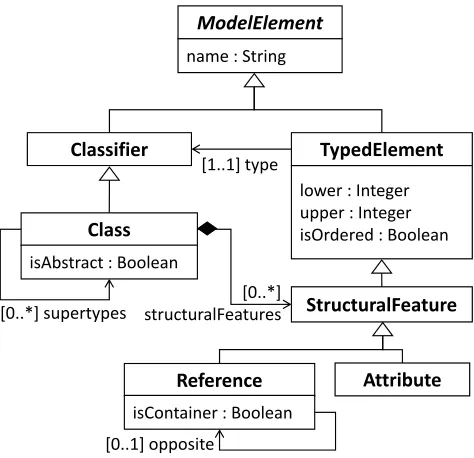
is illustrated in Figure 2. As can be seen in the figures, the input metamodel and
the output metamodel have the same class structure and inheritance hierarchy
with slight name differences as can be also observed in the ATL transformation
105
shown in Listing 1. The reader can find the details about the ATL language
syntax and descriptions in the following references [30, 8]. As can be further
seen in the transformation presented in Listing 1, several duplicated bindings
for the rules transforming attributes and references are used. The reason for
this is simple. The two concepts share many common features which are defined
110
by common superclasses.
Similar to using inheritance between classes in metamodels, ATL also allows
to use rule inheritance to introduce abstract rules for defining, for instance, the
bindings for setting the features of theTypedElement class, namely for setting
thetype, lower bound, upper bound, andordered features. Furthermore, it can
115
be also observed that thename binding is occurring for all three rules in the
transformation excerpt which could be also defined for theModelElement class
by introducing a top rule for the transformation definition from which all other
rules directly or indirectly inherit. Rule inheritance is then used to build a
hi-erarchy of transformation rules whereas the subrules inherit theinput pattern
120
elements including the filter conditions as well as the output pattern elements
including thebindings of the superrules. Listing 2 gives an idea on how rule
rules. In particular, the refactoring operations as shown in Table 1 are applied to
produce the new transformation design. The refactoring operations are reused
125
from previous work and the full refactoring catalog for ATL can be found in [14]
and additional refactorings concerning the module concept of ATL are presented
in [23]. The refactorings presented in [14] are classified into renaming,
restruc-turing, inheritance-related, and OCL-related. In the motivating example, we
focus on two inheritance-related refactoring operations-–see Table 1.
[image:7.612.132.474.288.496.2]130
Table 1: List of considered refactorings for our motivating example based on [14]
Refactoring Description
Extract Superrule Rules may have several commonalities which should be
extracted in one unique definition. The precondition for extracting a superrule is to have common supertypes for the input and output pattern elements of the selected rules. The postcondition is to have a new rule which is becoming the superule for the selected set of rules sharing the commonalities.
Pull Up Binding A binding which is duplicated in all subrules of a
super-rule can be pulled up to the supersuper-rule in order to elimi-nate duplicates. The precondition is to have the feature which is computed as well as the features used in the value computation defined as features of the types used in the superrule. The postcondition is to have the bind-ing presented in the superrule and the bindbind-ing deleted in all subrules.
By using rule inheritance, the binding duplicates can be removed. On the
one hand, this has a positive impact on certain design metrics which have been
discussed for ATL in [14]. The average number of bindings per rule is reduced
135
as several feature bindings are pushed to the superrules. On the other hand, it
has also a negative impact on other design metrics. For instance, the number
Listing 1: Excerpt of the initial Ecore 2 KM3 transformation
1 m o d u l e E c o r e 2 K M 3 ;
2 c r e a t e OUT : KM3 f r o m IN : MOF ; 3
4 r u l e C l a s s {
5 f r o m i : MOF ! E C l a s s
6 to o : KM3 ! C l a s s (
7 n a m e < - i . name ,
8 s t r u c t u r a l F e a t u r e s < - i . e S t r u c t u r a l F e a t u r e s , 9 s u p e r t y p e s < - i . e S u p e r T y p e s ,
10 i s A b s t r a c t < - i ."a b s t r a c t"
11 )
12 } 13
14 r u l e A t t r i b u t e {
15 f r o m i : MOF ! E A t t r i b u t e 16 to o : KM3 ! A t t r i b u t e (
17 n a m e < - i . name ,
18 t y p e < - i . eType ,
19 l o w e r < - i . l o w e r B o u n d , 20 u p p e r < - i . u p p e r B o u n d , 21 i s O r d e r e d < - i . o r d e r e d
22 )
23 } 24
25 r u l e R e f e r e n c e {
26 f r o m i : MOF ! E R e f e r e n c e 27 to o : KM3 ! R e f e r e n c e (
28 n a m e < - i . name ,
29 t y p e < - i . eType ,
30 l o w e r < - i . l o w e r B o u n d , 31 u p p e r < - i . u p p e r B o u n d , 32 i s O r d e r e d < - i . ordered , 33 o p p o s i t e < - i . e O p p o s i t e , 34 i s C o n t a i n e r < - i . c o n t a i n m e n t
35 )
ENamedElement name : String EClassifier ETypedElement EStructuralFeature EReference EAttribute lowerBound : Integer upperBound : Integer ordered : Boolean EClass abstract : Boolean containment : Boolean [1..1] eType [0..*] eStructuralFeatures eSuperTypes [0..*] [0..1] eOpposite ModelElement name : String Classifier TypedElement StructuralFeature Reference Attribute lower : Integer upper : Integer isOrdered : Boolean Class isAbstract : Boolean isContainer : Boolean [1..1] type [0..*] structuralFeatures [0..*] supertypes [0..1] opposite
[image:9.612.185.425.132.359.2](b) KM3 (a) Ecore
Figure 1: Input metamodel of the transformation example: The Ecore metamodel.
ENamedElement name : String EClassifier ETypedElement EStructuralFeature EReference EAttribute lowerBound : Integer upperBound : Integer ordered : Boolean EClass abstract : Boolean containment : Boolean [1..1] eType [0..*] eStructuralFeatures eSuperTypes [0..*] [0..1] eOpposite ModelElement name : String Classifier TypedElement StructuralFeature Reference Attribute lower : Integer upper : Integer isOrdered : Boolean Class isAbstract : Boolean isContainer : Boolean [1..1] type [0..*] structuralFeatures [0..*] supertypes [0..1] opposite
(b) KM3
[image:9.612.186.423.411.640.2]Listing 2: Excerpt of the refactored Ecore 2 KM3 transformation
1 m o d u l e E c o r e 2 K M 3 ;
2 c r e a t e OUT : KM3 f r o m IN : MOF ; 3
4 a b s t r a c t r u l e M o d e l E l e m e n t { 5 f r o m i : MOF ! E N a m e d E l e m e n t 6 to o : KM3 ! M o d e l E l e m e n t ( 7 n a m e < - i . n a m e
8 )
9 } 10
11 r u l e C l a s s e x t e n d s M o d e l E l e m e n t { 12 f r o m i : MOF ! E C l a s s
13 to o : KM3 ! C l a s s (
14 s t r u c t u r a l F e a t u r e s < - i . e S t r u c t u r a l F e a t u r e s , 15 s u p e r t y p e s < - i . e S u p e r T y p e s ,
16 i s A b s t r a c t < - i ."a b s t r a c t"
17 )
18 } 19
20 a b s t r a c t r u l e T y p e d E l e m e n t e x t e n d s M o d e l E l e m e n t { 21 f r o m i : MOF ! E T y p e d E l e m e n t
22 to o : KM3 ! T y p e d E l e m e n t (
23 t y p e < - i . eType ,
24 l o w e r < - i . l o w e r B o u n d , 25 u p p e r < - i . u p p e r B o u n d , 26 i s O r d e r e d < - i . o r d e r e d
27 )
28 } 29
30 r u l e A t t r i b u t e e x t e n d s T y p e d E l e m e n t { 31 f r o m i : MOF ! E A t t r i b u t e
32 to o : KM3 ! A t t r i b u t e () 33 }
34
35 r u l e R e f e r e n c e e x t e n d s T y p e d E l e m e n t { 36 f r o m i : MOF ! E R e f e r e n c e
37 to o : KM3 ! R e f e r e n c e ( 38 o p p o s i t e < - i . e O p p o s i t e , 39 i s C o n t a i n e r < - i . c o n t a i n m e n t
40 )
understanding how a particular rule may be executed by considering the exact
rule inheritance semantics of ATL.
140
The need for improving the quality of ATL-based model transformations
has been also highlighted in previous studies which focused on analyzing
exist-ing model transformations stored in the largest collection of ATL-based model
transformations, the model transformation zoo [6, 7]. In particular, these
stud-ies show that model transformations can grow to complex and large artefacts
145
consisting of thousands of lines of code, having hundreds of different
transforma-tion rules, and having a low applicatransforma-tion rate of modularizatransforma-tion and abstractransforma-tion
features such as rule inheritance and transformation superimposition although
the metamodel structures would allow for such applications [6]. Just to give
one example, out of 168 transformations, only 4% use rule inheritance and not
150
a single transformation is using superimposition. One explanation for these
re-sults is that these concepts for transformation reuse and modularization have
been proposed in later language versions of ATL.
2.3. Challenges
This simple example and previous studies [6, 29, 7] already point out the
155
main challenges of refactoring ATL transformations. Optimizing the different
design metrics which have been proposed for ATL [14, 9, 10, 23] may lead to
different, potentially conflicting, decisions on how to refactor a particular ATL
transformation [25, 31, 32]. Even more challenging, there may not only exist
one refactoring solution, but a huge set of possible refactoring solutions that are
160
associated with different design metrics configurations. As ATL transformations
may become large containing over 100 rules and several helper definitions [6]
as well as a large set of ATL refactoring operations has been proposed [14, 23],
the refactoring space of ATL transformations is enormous and enumerative
ap-proaches may fail to successfully explore this space efficiently. Therefore, we
propose in the next section a search-based approach to refactor ATL
trans-formations. Before introducing the search-based approach, a comprehensive
quality model is required for ATL in order to extend existing work on design
metrics for ATL in our search-based framework.
3. Search-Based Refactoring of the Model Transformations
170
In this section, we start introducing an adaptation of the QMOOD model
for model transformations, then we give an overview of our approach, followed
by a detailed description of how we formulated the refactoring recommendation
process as a objective optimization problem in addition to the
multi-objective algorithm’s (NSGA-II) adaptation.
175
3.1. QMOOD for Model Transformations
The quality of a software heavily relies on its design. In software,
assess-ing quality means measurassess-ing several conflictassess-ing attributes. The quality value,
however, depends on multiple factors and circumstances. For instance, what is
considered very critical to one developer or designer might be less important for
180
others since people have different preferences when they are designing or
imple-menting a system. For instance, when the requirements of the transformations
are not very clear (e.g., some rules need to be added or deleted), the flexibility
attribute could be very important. When we are close to the release date, other
attributes might be more critical to maintain. Thus, it is useful to somehow be
185
able to quantify the quality of model transformations in order to make it easier
for developers to compare and select between multiple refactoring paths. If we
know where we stand–in terms of design quality—-then we would be able to
make better decisions as to where to move forward and what corrective steps
need to be performed to improve the model transformation programs.
In this regard, the authors in [25] linked object-oriented design properties to
quality attribute to measure the quality of the software’s design formally and
validated the QMOOD model empirically on many projects [32]. In this paper,
we are adapting their QMOOD approach to assist in computing the quality of
model transformations (i.e., ATL). It is important to note that model
trans-195
formation languages are different from object-oriented programming languages,
thus, some design properties and metrics need to be mapped to their closest
equivalent counterparts in the context of ATL. In other words, we are using the
hierarchical model, QMOOD, as a foundation for the quality attributes
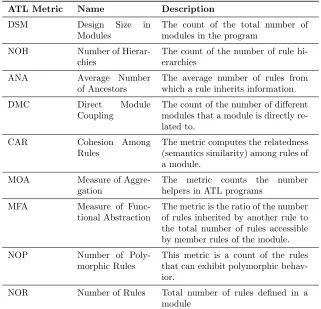
compu-tation formulas (Table 2), ATL design metrics (Table 3) and the relationships
200
between them (Table 4).
We did a mapping of the low-level OO metrics into ATL metrics by taking
inspiration from existing work [9, 10, 33, 34] while keeping the high-level
defi-nitions of the quality attributes. For instance, ATL programs are composed by
a set of rules instead of methods and its syntax and semantic reflects that
pos-205
sible analogy between methods and rules. As described later in the validation
section, the experiments confirmed our hypothesis and choices during that
map-ping phase by generating correct and useful refactorings as manually validated
Table 2: Computation Formulas for Quality Attributes. [25]
Quality Attribute Index Computation Equation
Reusability 0.415 * Cohesion – 0.085 * Coupling + 0.67 * Design
Size
Flexibility 0.583 * Composition – 0.166 * Coupling + 0.583 *
Polymorphism
Understandability 0.385 * Cohesion – 0.275 * Abstraction – 0.275 *
Cou-pling – 0.275 * Polymorphism – 0.275 * Complexity – 0.275 * Design Size
Functionality 0.175 * Cohesion + 0.275 * Polymorphism + 0.275 *
Design Size + 0.275 * Hierarchies
Extendibility 0.5 * Abstraction – 0.5 * Coupling + 0.5 * Inheritance
+ 0.5 * Polymorphism
Effectiveness 0.25 * Abstraction + 0.25 * Composition + 0.25 *
Table 3: Design Metrics Description.
ATL Metric Name Description
DSM Design Size in Modules
The count of the total number of modules in the program
NOH Number of Hierar-chies
The count of the number of rule hi-erarchies
ANA Average Number of Ancestors
The average number of rules from which a rule inherits information. DMC Direct Module
Coupling
The count of the number of different modules that a module is directly re-lated to.
CAR Cohesion Among Rules
The metric computes the relatedness (semantics similarity) among rules of a module.
MOA Measure of Aggre-gation
The metric counts the number helpers in ATL programs
MFA Measure of Func-tional Abstraction
The metric is the ratio of the number of rules inherited by another rule to the total number of rules accessible by member rules of the module. NOP Number of
Poly-morphic Rules
This metric is a count of the rules that can exhibit polymorphic behav-ior.
NOR Number of Rules Total number of rules defined in a module
Table 4: Relationship Between Design Properties and Design Metrics.
Design Property Derived Design Metric
Design Size Design Size in Modules (DSM)
Hierarchies Number of Hierarchies (NOH)
Abstraction Average Number of Ancestors (ANA)
Coupling Direct Module Coupling (DMC)
Cohesion Cohesion Among Rules (CAR)
Composition Measure of Aggregation (MOA)
Inheritance Measure of Functional Abstraction (MFA)
Polymorphism Number of Polymorphic Rules (NOP)
[image:15.612.132.478.497.667.2]The equations of Table 2 provide explanations on how the different quality
210
attributes are calculated. The details regarding how we are going to use this
QMOOD model in practice to improve the quality of model transformation
programs, in our automated ATL refactoring endeavors, will be described in
the following sub-sections.
3.2. Approach Overview
215
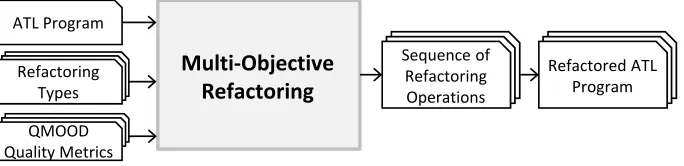
The approach can be illustrated in the high-level overview shown in Figure 3.
An ATL Analyser is applied to the ATL code in order to compute the various
design metrics listed in Table 3. These values are used later to measure the
quality attributes shown in Table 2, which will eventually be used in the fitness
function. The other input of the algorithm is the possible refactoring operations
220
along with their pre- and post-conditions. The main target of the approach is
to find the best sequence of refactorings that meets the following optimization
objectives: (1) Maximize the quality attributes values (Table 2), (2) minimize
the number of rules, and (3) minimize the number of changes.
The objectives mentioned above are not necessarily proportional. In fact,
225
most of them are contrasting with each other. What makes the matters more
complicated is the fact that there are multiple refactoring routes. In other words,
the order in which we apply the refactoring operations makes a significant
dif-ference. Thus, with the substantial number of possible refactorings routes, and
the conflicting objectives, we use a multi-objective genetic algorithm (NSGA-II)
230
which will be detailed along with its adaptation to our refactoring problem in
the subsequent sections.
3.3. NSGA-II
Most real-world optimization problems encountered in practice involve
mul-tiple criteria to be considered simultaneously. These criteria, also called
objec-235
ATL2 Module ATL Unit ATL Units Module Model [optimized] Module Model [initial]
Search‐based Modularization Module2 ATL ATL2 Module ATL Unit ATL Units Module Model [optimized] Module Model [initial]
Search‐based Modularization Module2 ATL ATL2 Types Fitness Evaluation Types Model ATL2 Module ATL Unit ATL Units Module Model [optimized] Module Model [initial]
Search‐based Modularization Module2 ATL ATL2 Types Fitness Evaluation Types Model
Many
‐
Objective
Modularization
with
NSGA
‐
III
Number of ModulesMin/Max Difference
Coupling
Cohesion
Sequence of applied transformations
Multi
‐
Objective
Refactoring
ATL Program
QMOOD Quality Metrics
Refactoring Types
Sequence of Refactoring Operations
Refactored ATL Program
Figure 3: Overview of the multi-objective ATL refactoring approach.
with respect to all these objectives at the same time, but rather many
differ-ent designs exist which are incomparable per se. Consequdiffer-ently, contrary to
Single-objective Optimization Problems (SOPs) where we look for the solution
presenting the best performance, the resolution of a Multi-Objective
Optimiza-240
tion Problem (MOP) yields a set of compromise solutions presenting the optimal
trade-offs between the different objectives. When plotted in the objective space,
the set of compromise solutions is called the Pareto front.
The resolution of a MOP yields a set of trade-off solutions, called Pareto
optimal solutions or non-dominated solutions, and the image of this set in the
245
objective space is called the Pareto front. Hence, the resolution of a MOP
consists in approximating the whole Pareto front.
In this paper, we adapted one of the widely used multi-objective algorithms
called NSGA-II [26]. It is a powerful search method stimulated by natural
selec-tion that is inspired by the theory of Darwin. Hence, the basic idea of NSGA-II
250
is to make a population of candidate solutions evolve toward the near-optimal
solution in order to solve a multi-objective optimization problem. NSGA-II is
designed to find a set of optimal solutions, called non-dominated solutions, also
Pareto set. A non-dominated solution is the one which provides a suitable
com-promise between all objectives without degrading any of them. As described
255
in Algorithm 1, the first step in NSGA-II is to create randomly a population
populationQ0 is generated from the population of parentsP0using genetic
op-erators such as crossover and mutation (line 2). Both populations are merged
into an initial populationR0 of size N (line 5). Consequently, NSGA-II starts
260
by generating an initial population based on a specific representation that will
be discussed later, using an exhaustive list of ATL refactoring types given as
input. Thus, this population stands for a set of possible solutions represented
as sequences of refactorings that are selected and combined.
To summarize, the main NSGA-II loop goal is to make a population of
candi-265
date solutions evolve toward the best sequence of refactoring, i.e., the sequence
that minimizes the number of rules, number of recommended refactorings
(so-lutions size) and maximize the quality attributes values. During each iteration
t, an offspring population Qt is generated from a parent population Pt
us-ing genetic operators (selection, crossover, and mutation). Then, Qt and Pt
270
are assembled to create a global populationRt. Then, each solution Si in the
population Rt is evaluated using three fitness functions described in the next
subsection.
Algorithm 1NSGA-II overview [26]
1: Create an initial populationP0
2: Generate an offspring populationQ0
3: t= 0
4: whilestopping criteria not reached do
5: Rt=Pt∪Qi
6: F = fast-non-dominated-sort (Rt)
7: Pt+1 =φandi=1;
8: while|Pt+1|+|Fi|≤N do
9: Apply crowding-distance-assignment(Fi);
10: Pt+1=Pt+1∪Fi;
11: i=i+ 1
12: end
13: Sort(Fi,< n)
14: Pt+1=Pt+1∪Fi[1 : (N− |Pt+1|)];
15: Qt+1 = create-new-pop(Pt+1);
16: t=t+ 1;
Listing 3: Specification of the Pull Up Binding refactoring
1 r e f a c t o r i n g P u l l U p B i n d i n g ( b : Binding , sub : Set ( R u l e ) , s u p e r : R u l e ) 2 pre: sub - > f o r A l l( r | r . c o n t a i n s B i n d i n g ( b ) and r . s u p e r r u l e = s u p e r ) and
3 not s u p e r . c o n t a i n s B i n d i n g F o r F e a t u r e ( b . f e a t u r e T o S e t ) and
4 s u p e r . o u t p u t E l e m e n t s - > e x i s t s ( oe | oe . t y p e . c o n t a i n s F e a t u r e ( b . f e a t u r e T o S e t ,→) ) and
5 s u p e r . i n p u t E l e m e n t s - > e x i s t s ( ie | b . f e a t u r e s O f V a l u e C o m p - > f o r A l l( f | ie . ,→t y p e . c o n t a i n s F e a t u r e ( f ) )
6 p o s t: sub - > f o r A l l( r |not r . c o n t a i n s B i n d i n g ( b ) ) and s u p e r . c o n t a i n s B i n d i n g ( b )
3.4. Search-Based Formulation
3.4.1. Solution representations
275
A solution consists of a sequence ofn refactoring operations involving one
or multiple rules/modules of the ATL program to refactor. The vector-based
representation is used to define the refactoring sequence. Each vector’s
dimen-sion has a refactoring operation and its index in the vector indicates the order
in which it will be applied. For every refactoring, pre- and post-conditions are
280
specified to ensure the feasibility of the operation as detailed in [14]. In
List-ing 3, we illustrate the pre- and post-conditions for the refactorList-ing operation
Pull Up Binding specified in the Object Constraint Language (OCL) . We
uti-lize OCL for the specification of the refactoring operations as OCL provides a
general means to specify pre- and post-conditions for operations. More details
285
about the adapted pre- and post-conditions for refactorings can be found in [14].
The initial population is generated by randomly assigning a sequence of
refactorings to a randomly chosen set of rules or modules. The different types
of refactorings considered in our experiments are Extract Helper/Rule, Inline
290
Helper/Rule, Merge Rule, Split Rule, Extract Superrule, Eliminate Superrule,
Pull Up Binding, Pull Up Filter, Push Down Binding, Push Down Filter [14],
Extract Module, Merge Modules, and Move Rule/Helper [23]. We also use a
placeholder concept as an additional possibility to the given refactorings in order
to simulate random length of the solution vectors. The placeholder concept is
ExtractSuperrule(„TypedElement“, [Attribute, Reference])
PullUpBinding(type, [Attribute, Reference], TypedElement)
[image:20.612.184.424.195.253.2]PullUpBinding(type, [Attribute, Reference], TypedElement)
Figure 4: Example of a simplified solution representation.
ExtractSuperrule(„TypedElement“,
[Attribute,
Reference])
PullUpBinding(type,
[Attribute,
Reference],
TypedElement)
PullUpBinding(type,
[Attribute,
Reference],
TypedElement)
Refactoring
operations
used:
refactoring
ExtractSuperrule
(
name,
InputType,
OutputType,
subrules )
refactoring
PullUpBinding
(
binding
:
Binding,
subrules :
Set(Rule),
superrule :
Rule)
pre
:
subrules
‐
>
forall(r|r.containsBinding(binding)
AND
subrules
‐
>
forall(s|s.extends =
superrule)
AND
f
not
superrule.containsBindingForFeature(binding.featureToSet)
AND
superrule.outputElements
‐
>
exists
(o|o.type.containsFeature(binding.featureToSet))
AND
superrule.inputElements
‐
>
exists
(i |binding.featuresOfValueComp
‐
>
forall(f|i.type.containsFeature(f))
post
:
subrules
‐
>
forall(r|not r.containsBinding(binding))
AND
superrule.containsBinding(binding)
T0 T1 T2 T3 …
…
Tn
r1 r2 r3 r… rn
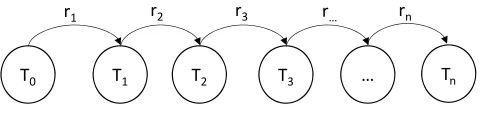
Figure 5: Computing a refactored transformation version (Tn) from its initial version (T0) by
applying a sequence of refactoring operations (r1−rn) step-by-step.
equivalent to the no-operation instruction.
The size of a solution, i.e., the vector’s length is randomly chosen between
upper and lower bound values. The determination of these two bounds is
sim-ilar to the problem of bloat control in genetic programming where the goal is
to identify the tree size limits. Since the number of required refactorings
de-300
pends mainly on the size and quality of the ATL program, we performed, for
each target project, several trial and error experiments using the HyperVolume
(HP) performance indicator [26] to determine the upper bound after which, the
indicator remains invariant. For the lower bound, it is arbitrarily chosen. The
experiments section will specify the upper and lower bounds used in this study.
305
Figure 4 shows a simplified example of a solution including three
refactor-ings applied to the ATL program described in Listrefactor-ings 1 and 2. The solution
includes two refactoring types with the following controlling parameters:
Ex-tractSuperrule(name, subrules),PullUpBinding(binding, subrules, superrule).
The solution representation is computed by applying the refactoring
opera-310
tions step-by-step on the initial transformation version as it is shown in Figure 5.
By following this process, for each refactoring step, the pre- and post-conditions
of the refactoring can be check on the predecessor version and successor version
Parent A
Parent B
R1 R4 R5 R3 R6 R2
1 2 3 4 5 6
R5 R6 R3 R1 R2 R4
1 2 3 4 5 6
K=4 Crossover Splitting
Point
Child A
Child B
R1 R4 R5 R3 R2 R4
1 2 3 4 5 6
R5 R6 R3 R1 R6 R2
[image:21.612.136.482.126.227.2]1 2 3 4 5 6
Figure 6: Example of the crossover operation.
Please note that we are only computing an initial population of refactoring
315
solutions which are not representing all possible refactoring solutions (this would
be computationally too expensive) but a subset of these which are subsequently
further modified by the evolutionary search to compute new, potentially better,
solutions.
3.4.2. Solution variation
320
In each search algorithm, the variation operators play the key role of moving
within the search space with the aim of driving the search towards optimal
solutions.
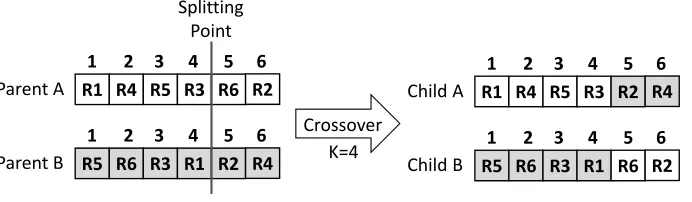
For the crossover, we use the one-point crossover operator. It starts by
selecting and splitting at random two parent solutions. Then, this operator
325
creates two child solutions by putting, for the first child, the first part of the
first parent with the second part of the second parent, and vice versa for the
second child. This operator must ensure the respect of the length limits by
eliminating randomly some refactoring operations. It is important to note that
in multi-objective optimization, it is better to create children that are close to
330
their parents in order to have a more efficient search process. An example of
this operation is illustrated in Figure 6.
probabilis-Parent
A
Parent
B
R1 R4 R5 R3 R6 R2
1
2
3
4
5
6
R5 R6 R3 R1 R2 R4
1
2
3
4
5
6
K=4
Crossover
Splitting
Point
Child
A
Child
B
R1 R4 R5 R3 R2 R4
1
2
3
4
5
6
R5 R6 R3 R1 R6 R2
1
2
3
4
5
6
Parent
R1 R4 R5 R3 R6 R2
1
2
3
4
5
6
m=2
Mutation
R1 R3 R5 R3 R6 R2
1
2
3
4
5
6
Figure 7: Example of the mutation operation.
tically one or more refactoring operations from its or their associated sequence
and replaces them by other ones which are applicable on the current state of the
335
transformation from the list of possible refactorings types as shown in Figure 7.
When applying the changed refactoring sequences, the different pre- and
post-conditions of the refactoring operations (such as exemplarily shown in
List-ing 3) are checked to ensure the applicability of the newly generated refactorList-ing
solutions. We also apply a repair operator that randomly computes new
refac-340
toring applications to replace existing refactorings which are no longer applicable
n the computed refactoring sequence because of invalid pre- and post-conditions.
3.4.3. Solution evaluation
The generated solutions are evaluated using three fitness functions as
de-tailed in the following.
345
Maximize the quality attributes values: the formulas listed in Table 2 gives us
the advantage of calculating the values of the various quality attributes easily.
Worth mentioning that we are treating the quality attributes equally in this
paper. Whereas in some practical situations, the developer might want to give
more weight to one or more attributes depending on the circumstances and the
350
objective of the refactoring operations.
FF1: Max(x)where x is the sum of Reusability, Flexibility,
Understand-ability, Functionality, Extendibility, and Effectiveness.
Minimize the number of recommended refactorings: The application of a specific
suggested refactoring sequence may require an effort that is comparable to that
of re-implementing part of the system from scratch. Taking this observation into
account, it is essential to minimize the number of suggested refactorings in the
solution since the designer may have some preferences regarding the percentage
of deviation with the initial ATL program design. In addition, most developers
prefer solutions that minimize the number of changes applied to their design
360
and rules modification. Thus, we formally defined the fitness function as the
number of recommended refactorings.
FF2: Min (n)where n is the number of recommended refactorings.
Minimize the number of rules: the metric can be easily calculated on ATL
programs. The reason to use this metric is to avoid that some refactorings
365
such as split rule or extract rule will generate a high number of new rules when
optimizing the remaining objectives.
FF3: Min(r)where r is the number of rules.
In fact, the use of multiple quality attributes to guide the search for relevant
refactorings may increase dramatically the number of rules such as intensive use
370
of extract rules to improve the extendibility quality attributes.
4. Validation
In order to evaluate the ability of our automated refactoring approach to
generate good refactoring recommendations for ATL programs, we conducted
a set of experiments based on several transformation programs available in the
375
ATL Zoo [27]. Since metaheuristic algorithms are stochastic optimizers, they
can provide different results for the same problem instance from one run to
another. Thus, we executed our the search algorithms 30 times on each of the
7 ATL transformation programs, and the obtained precision and recall results
are subsequently statistically analyzed.
In the following, we first present our research questions and the pilot study,
and then describe and discuss the obtained results.
4.1. Research Questions
We defined five research questions that address the applicability,
perfor-mance, and usefulness of our refactoring approach. The five research questions
385
(RQs) are as follows:
RQ1: Search validation (sanity check). To validate the problem
for-mulation of our approach, we compared our multi-objective forfor-mulation with a
random search algorithm (RS). If RS outperforms an intelligent search method,
we can conclude that there is no need to use a metaheuristic search.
390
RQ2: To what extent can the proposed approach improve the
quality of ATL programs using the combination of multi-objective
search and QMOOD?In particular, is it possible with our approach to find
refactoring solutions which improve the quality of the transformations and are
relevant for transformation developers.
395
RQ3: How does our multi-objective QMOOD-based refactoring
approach for ATL programs perform compared to our previous
multi-objective refactoring work published in MODELS 2016 [24] and a
mono-objective approach aggregating all the three objectives used in
this paper? A multi-objective algorithm provides a trade-off between the four
400
objectives where developers can select their desired refactoring solution from the
Pareto-optimal front. A mono-objective approach uses a single fitness function
that is formed as an aggregation of the four normalized objectives and generates
as output only one refactoring solution. This comparison is required to ensure
that the solutions provided by NSGA-II provide a better trade-off between the
405
three objectives than a mono-objective approach. Otherwise, there is no benefit
performance of our new multi-objective QMOOD formulation to our previous
multi-objective work of MODELS2016 [24] to evaluate the relevance of
consid-ering new quality attributes on the relevance of refactoring recommendations.
410
RQ4: How does the proposed multi-objective QMOOD-based
refac-toring approach for ATL programs perform compared to an existing
semi-automated ATL refactoring approach [14] not based on heuristic
search? While it is interesting to show that maybe our proposal outperforms
random search or a mono-objective refactoring approaches, developers will
con-415
sider our approach useful, if it can outperform other existing tools that are
not based on optimization techniques. Thus, we compared our approach to the
semi-automated refactoring approach proposed in [14]. In this approach, the
developers first have to manually select the required refactoring operations and
their application points. Subsequently, the refactoring execution, i.e., rewriting
420
the transformation, is automatically performed.
The last research question is related to the benefits of our approach for
software engineers.
RQ5 (Insight): Can our ATL refactoring approach be useful for
software developers in practice? We conducted a post-study questionnaire
425
with the subjects of our experiments that collects their opinions of our tool.
4.2. Case Studies
Our research questions are evaluated using the following seven case studies.
Each case study consists of one model transformation and all the necessary
artifacts to execute the transformation, i.e., the input and output metamodels
430
and a sample input model. Most of the case studies have been taken from
the ATL Zoo [27], a repository where developers can upload and describe their
ATL transformations. We briefly describe in the following the different ATL
Ecore2Maude: This transformation takes an Ecore metamodel as input
435
and generates a Maude specification. Maude is a high-performance reflective
language and system supporting both equational and rewriting logic
specifica-tion and programming for a wide range of applicaspecifica-tions.
OCL2R2ML: This transformation takes OCL models as input and produces
R2ML (REWERSE I1 Markup Language) models as output.
440
R2ML2RDM: This transformation is part of the sequence of
transforma-tions to convert OCL models into SWRL (Semantic Web Rule Language) rules.
In this process, the selected transformation takes a R2ML model and obtains
an RDM model that represents the abstract syntax for the SWRL language.
XHTML2XML: This transformation receives XHTML models conforming
445
to the XHTML language specification version 1.1 as input and converts them
into XML models consisting of elements and attributes.
XML2Ant: This transformation is the first step to convert Ant to Maven.
It acts as an injector to obtain an XMI file corresponding to the Ant metamodel
from an XML file.
450
XML2KML: This transformation is the main part of the KML (Keyhole
Markup Language) injector, i.e., the transformation from a KML file to a KML
model. Before running the transformation, the KML file is renamed to XML
and the KML tag is deleted. KML is an XML notation for expressing geographic
annotation and visualization within Internet-based, two-dimensional maps and
455
three-dimensional Earth browsers.
XML2MySQL:This transformation is the first step of the MySQL to KM3
transformation scenario, which translates XML representations used to encode
the structure of domain models into actual MySQL representations.
We have selected these case studies due to their difference in size, structure
460
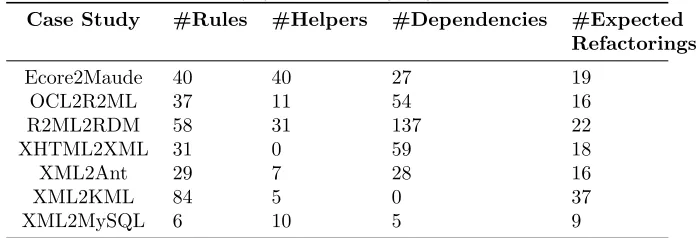
and helpers. Table 5 summarizes the number of rules, the number of helpers
and the number of dependencies between rules.
To answer RQ1, RQ2, RQ3, and RQ4, it is important to validate the
pro-posed refactoring solutions. We evaluated the improvements in the different
465
quality metrics used by our approach before and after refactorings. Since the
metrics improvement evaluation is not sufficient, we asked a group of
develop-ers, as detailed later, to manually identify several refactoring opportunities and
apply several refactorings to fix the detected possible quality improvements on
the selected transformation programs. Table 5 summarizes the number of
ex-470
pected refactorings for every ATL program. Then, we calculated precision and
recall scores to compare between refactorings recommended by our approach
and those suggested manually by the subjects:
RCRecall=
suggested operations∩expected operations
expected operations ∈[0,1] (1)
P RP recision= suggested operations∩expected operations
suggested operations ∈[0,1] (2)
We also asked the group of potential users of our tool to evaluate, manually,
whether the suggested refactorings are feasible and efficient at improving the
475
ATL program quality and achieving their maintainability objectives. We define
the metric Manual Correctness (MC) to mean the number of
meaningful/rele-vant refactorings divided by the total number of suggested refactorings. MC is
given by the following equation:
M C= #coherent applied refactorings
#proposed refactorings (3)
To avoid the computation of the MC metric being biased by the developer’s
feedback, we asked the developers to manually evaluate the correctness of the
recommended refactorings on the ATL programs that they did not refactor using
our tool.
To answer the first research question RQ1, a random multi-objective
al-gorithm was implemented where at each iteration the population is randomly
485
created without the use of change operators. The random search used the same
fitness functions of our QMOOD formulation but without the use of the change
operators. The obtained best refactoring solution was compared for statistically
significant differences with NSGA-II using PR, RC, MC and the execution time
(CT). To answer RQ2, we evaluate the results of our NSGA-II algorithm using
490
all the above evaluation metrics. To answer RQ3, we compared our approach to
a mono-objective Genetic Algorithm where all the objectives were normalized in
the range [0..1] and aggregated into one objective to minimize. To answer RQ4,
we compare NSGA-II to an existing semi-automated ATL refactoring approach
[14] where the refactoring operations have to be explicitly triggered by the user
495
and only the execution of the manually identified refactorings is automated. We
used all the above evaluation metrics to perform the comparisons in RQ3 and
[image:28.612.137.485.503.622.2]RQ4 as well.
Table 5: Statistics of the Case Studies.
Case Study #Rules #Helpers #Dependencies #Expected Refactorings
Ecore2Maude 40 40 27 19
OCL2R2ML 37 11 54 16
R2ML2RDM 58 31 137 22
XHTML2XML 31 0 59 18
XML2Ant 29 7 28 16
XML2KML 84 5 0 37
XML2MySQL 6 10 5 9
Our study involved 27 participants from the University of Michigan.
Partici-pants include 21 master students and 8 Ph.D. students in Software Engineering.
All the participants are volunteers and familiar with ATL and model
transfor-mations. All the graduate students have a strong background in refactoring
and software quality since they all took a graduate course on Software Quality
Assurance extensively covering these topics. The experience of these
partici-pants on programming and refactoring ranged from 2 to 16 years in industry.
505
Eleven out the twenty-seven participants are active programmers in software
companies.
To answer RQ5, we used a post-study questionnaire that collects the opinions
of developers on our tool. Participants were first asked to fill out a pre-study
questionnaire containing five questions. The questionnaire helped to collect
510
background information such as their programming experience, their
familiar-ity with software refactoring and ATL. In addition, all the participants attended
one lecture about ATL and software refactoring, and passed six tests to
eval-uate their performance to evaleval-uate and suggest refactoring solutions for ATL
programs.
515
Each participant in the study received a questionnaire, a manuscript guide
to help them to fill the questionnaire, the tools and results to evaluate, and
the ATL source code of the studied transformations. Since the application of
refactoring solutions is a subjective process, it is normal that not all the
devel-opers have the same opinion. In our case, we considered the majority of votes to
520
determine if suggested solutions are correct or not. Each participant evaluates
different refactoring solutions for the different techniques and systems. We
con-ducted this manual validation since a correct refactoring in terms of behavior
preservation may not mean that programmers will apply it. The refactoring
process is subjective and it is impossible to validate the recommendations
with-525
out human studies to see if programmers find these refactorings relevant or not.
after refactorings to estimate the benefits of the refactoring and not only the
correctness that is checked with the pre/post conditions. We consider that a
sequence of refacorings has benefits if it is accepted by the programmers during
530
the manual validation process.
We asked every participant to manually suggest and apply refactorings to
improve the quality of the ATL programs. As an outcome of this first scenario,
we calculated the differences between the recommended refactorings and the
expected ones (manually suggested by the developers). In the second scenario,
535
we asked the developers to manually evaluate the best recommended solution by
our algorithm and the remaining techniques. We performed a cross-validation
between the participants to avoid the computation of the MC metric being
bi-ased by their manual recommendations. In the third scenario, we asked the
participants to use our tool during a period of two hours on the different
pro-540
grams and then we collected their opinions based on a post-study questionnaire
that will be detailed later. The participants were asked to justify their
evalu-ation of the solutions and these justificevalu-ations are reviewed by the organizers of
the study.
For each case study and algorithm, we select one solution using a knee point
545
strategy [35]. The knee point corresponds to the solution with the maximal
trade-off between all fitness functions, i.e., a vector of the best objective values
for all solutions. In order to find the maximal trade-off, we use the trade-off
worthiness metric proposed by [35] to evaluate the worthiness of each solution in
terms of objective value compromise. The solution nearest to the knee point is
550
then selected and manually inspected by the subjects to find the differences with
an expected solution. While the knee point selection may not be the perfect
way, it is the only strategy to ensure a fair comparison with the mono-objective
refactorings) as output. Subjects were aware that they are going to evaluate the
555
quality of our solutions, but were not told from which algorithms the produced
solutions originate.
4.3. Experimental Setting
Parameter setting influences significantly the performance of a search
algo-rithm on a particular problem. For this reason, for each algoalgo-rithm and each ATL
560
program, we perform a set of experiments using several population sizes: 50,
100, 200, 300 and 500. The stopping criterion was set to 100,000 evaluations for
all algorithms in order to ensure fairness of comparison. The other parameters’
values were fixed by trial and error and are as follows: crossover probability =
0.7; mutation probability = 0.4 where the probability of gene modification is
565
0.2. Each algorithm is executed 30 times with each configuration and then the
comparison between the configurations is done using the Wilcoxon test. The
upper and lower bounds on the chromosome length used in this study are set
to 10 and 50 respectively.
We note that it is not required to make 30 runs to find the knee-point.
570
The 30 runs are executed for the automated evaluation metrics (e.g., precision
and recall) to make sure that the results are statistically significant due to
the randomness involved in computational search algorithms. For the manual
correctness, we just selected the median execution for the comparison with the
remaining algorithms. Thus, it is not required that the user should run the
575
multi-objective algorithm 30 times to obtain the best solutions since we just did
these runs only for the statistical tests purpose of these experiments.
4.4. Statistical Test Methods
Since metaheuristic algorithms are stochastic optimizers, they can provide
different results for the same problem instance from one run to another. For
this reason, our experimental study is based on 30 independent simulation runs
for each problem instance and the obtained results are statistically analyzed by
using the Wilcoxon rank sum test with a 95% confidence level (α= 5%). The
latter tests the null hypothesis,H0, that the obtained results of two algorithms
are samples from continuous distributions with equal medians, against the
al-585
ternative that they are not,H1. The p-value of the Wilcoxon test corresponds
to the probability of rejecting the null hypothesis H0 while it is true (type I
error). A p-value that is less than or equal toα(≤0.05) means that we accept
H1 and we reject H0. However, a p-value that is strictly greater than α (>
0.05) means the opposite. In fact, for each problem instance, we compute the
590
p-value obtained by comparing the results of the different algorithms with our
approach. In this way, we determine whether the performance difference
be-tween our technique and one of the other approaches is statistically significant
or just a random result. The results presented were found to be statistically
significant on 30 independent runs using the Wilcoxon rank sum test with a
595
95% confidence level (α < 5%). The Wilcoxon rank sum test verifies whether
the results are statistically different or not; however, it does not give any idea
about the difference in magnitude. Thus, we used the Vargha-Delaney A
mea-sure which is a non-parametric effect size meamea-sure. In our context, given the
different performance metrics (e.g., PR and RC), the A statistic measures the
600
probability that running an algorithm B1 (NSGA-II based on QMODD) yields
better performance than running another algorithm B2 (such as RS,
Mono-objective GA, etc.). If the two algorithms are equivalent, then A = 0.5. More
details can be found in the statistical tests guildline discussed in [36].
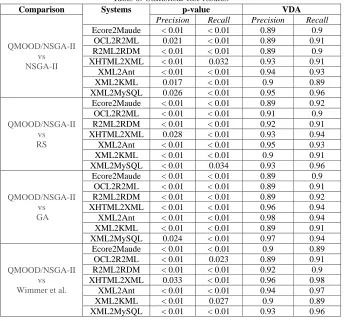
As described in Table 6, we have found the following results: a) on small scale
605
ATL programs (XML2MySQL, XHTML2XML, and XML2Ant) our approach is
A effect size higher than 0.92; and b) on medium and large scale ATL programs
(XML2KML, Ecore2Maude, OCL2R2ML, and R2ML2RDM), our approach is
better than all the other algorithms with an A effect size higher than 0.89.
[image:33.612.135.479.202.523.2]610
Table 6: Statistical test results.
Comparison Systems p-value VDA
QMOOD/NSGA-II vs NSGA-II
Precision Recall Precision Recall
Ecore2Maude < 0.01 < 0.01 0.89 0.9
OCL2R2ML 0.021 < 0.01 0.89 0.91
R2ML2RDM < 0.01 < 0.01 0.89 0.9
XHTML2XML < 0.01 0.032 0.93 0.91
XML2Ant < 0.01 < 0.01 0.94 0.93
XML2KML 0.017 < 0.01 0.9 0.89
XML2MySQL 0.026 < 0.01 0.95 0.96
QMOOD/NSGA-II vs RS
Ecore2Maude < 0.01 < 0.01 0.89 0.92
OCL2R2ML < 0.01 < 0.01 0.91 0.9
R2ML2RDM < 0.01 < 0.01 0.92 0.91
XHTML2XML 0.028 < 0.01 0.93 0.94
XML2Ant < 0.01 < 0.01 0.95 0.93
XML2KML < 0.01 < 0.01 0.9 0.91
XML2MySQL < 0.01 0.034 0.93 0.96
QMOOD/NSGA-II vs GA
Ecore2Maude < 0.01 < 0.01 0.89 0.9
OCL2R2ML < 0.01 < 0.01 0.89 0.91
R2ML2RDM < 0.01 < 0.01 0.89 0.92
XHTML2XML < 0.01 < 0.01 0.96 0.94
XML2Ant < 0.01 < 0.01 0.98 0.94
XML2KML < 0.01 < 0.01 0.89 0.91
XML2MySQL 0.024 < 0.01 0.97 0.94
QMOOD/NSGA-II vs Wimmer et al.
Ecore2Maude < 0.01 < 0.01 0.9 0.89
OCL2R2ML < 0.01 0.023 0.89 0.91
R2ML2RDM < 0.01 < 0.01 0.92 0.9
XHTML2XML 0.033 < 0.01 0.96 0.98
XML2Ant < 0.01 < 0.01 0.94 0.97
XML2KML < 0.01 0.027 0.9 0.89
XML2MySQL < 0.01 < 0.01 0.93 0.96
4.5. Results and Discussions
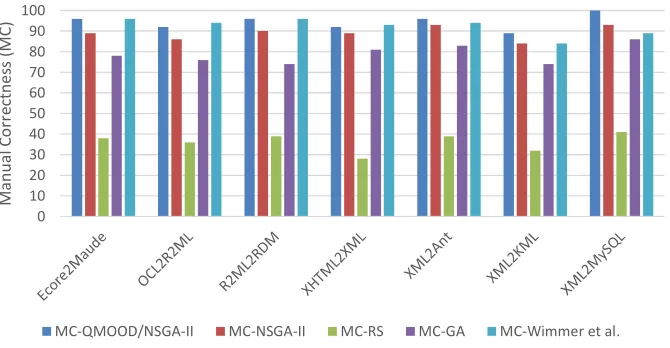
Results for RQ1: The results for the first research questions are
summa-rized in Figures 8, 9 and 10. It is clear that QMOOD-NSGA-II is better than
random search based on the different metrics of PR, RC and MC on all the 7
ATL case studies. The average precision, recall and manual correctness values of
615
0 10 20 30 40 50 60 70 80 90 100
Man
u
al
Co
rr
ectn
es
s
(MC)
[image:34.612.141.476.127.301.2]
MC‐QMOOD/NSGA‐II MC‐NSGA‐II MC‐RS MC‐GA MC‐Wimmer et al.
Figure 8: Median Manual Correctness (MC) over 30 runs on all the 7 ATL programs using the different ATL refactoring techniques.
explained by the huge search space to explore to generate relevant refactorings.
Figure 11 shows that the execution time (CT) of random search is lower than
QMOOD-NSGA-II however the difference is just limited to an average of 15
minutes. Furthermore, ATL refactoring is not requiring strict time constraints
620
unlike real-time application which is not the case here. We do not dwell long
in answering the first research question, RQ1, which involves comparing our
approach based on QMOOD-NSGA-II with random search. The remaining
re-search questions will reveal more about the performance, insight, and usefulness
of our approach. We conclude that there is empirical evidence that our
multi-625
objective formulation based on QMOOD surpasses the performance of random
search thus our formulation is adequate (this answers RQ1).
Results for RQ2: As reported in Figure 8, the majority of the refactoring
solutions recommended by our multi-objective approach were correct and
ap-proved by developers. On average, for all of our seven studied projects, 94% of
630
the proposed ATL refactoring operations are considered as feasible, improve the
0 10 20 30 40 50 60 70 80 90 100
Pr
ec
ision
(P
R)
[image:35.612.138.471.149.340.2]PR‐QMOOD/NSGA‐II PR‐NSGA‐II PR‐RS PR‐GA PR‐Wimmer et al.
Figure 9: Median Precision (PR) over 30 runs on all the 7 ATL programs using the different ATL refactoring techniques with a 95% confidence level (α <5%).
0 10 20 30 40 50 60 70 80 90 100
Re
ca
ll
(RC)
RC‐QMOOD/NSGA‐II RC‐NSGA‐II RC‐RS RC‐GA RC‐Wimmer et al.
[image:35.612.139.477.436.610.2]0 10 20 30 40 50 60 Ecore2Maude
OCL2R2ML R2ML2RDM XHTML2XML XML2Ant XML2KML XML2MySQL
Computation Time (CT) in mins
[image:36.612.138.471.121.318.2]CT‐Wimmer et al. CT‐GA CT‐RS CT‐NSGA‐II CT‐QMOOD/NSGA‐II
Figure 11: Median computation time (CT) in minutes over 30 runs on all the 7 ATL programs using the different ATL refactoring techniques.
The highest MC score is 100% for the XML2MySQL program and the lowest
score is 89% for XML2KML program. Thus, it is clear that the results are
independent of the size of the ATL programs and the number of recommended
635
refactorings. Most of the refactorings that were not manually approved by the
developers were found to be either violating some post-conditions or introducing
design incoherence.
Since the MC metric just evaluates the correctness and not the relevance of
the recommended refactorings, we also compared the proposed operations with
640
some expected ones defined manually by the different participants for several
ATL code fragments extracted from the seven programs. Figure 9 and Figure
10 summarize our findings. We found that a considerable number of proposed
refactorings, with an average of more than 91% in terms of precision and 96%
of recall, were already applied by the software development team and suggested
645
manually (expected refactorings). The recall scores are higher than precision
incomplete compared to the solutions provided by our automated approach and
this was confirmed by the manual evaluation (MC). In addition, we found that
the slight deviation with the expected refactorings is not related to incorrect
650
operations but to the fact that different refactoring strategies are equivalent in
terms of quality even if the applied refactoring types are different. Furthermore,
the use of the fitness function to minimize the number of refactorings may help
to reduce the noise in the recommended solutions and focus mainly on the
refactorings which improved the quality metrics.
655
We decided to evaluate the performance of our approach using evaluation
metrics different than the fitness functions (quality metrics) to ensure a fair
comparison with existing techniques as detailed in the next research questions.
To summarize and answer RQ2, the experimentation results confirm that our
QMOOD based multi-objective approach helps the participants to refactor their
660
ATL programs efficiently by finding the relevant refactorings and improve the
quality of all the five programs.
Results for RQ3: Figures 8, 9 and 10 confirm the average superior
per-formance of our QMOOD multi-objective approach compared to our previous
work based on NSGA-II (and limited to coupling and cohesion) [24] and a
mono-665
objective GA aggregating all the objectives in an equal way. Figure 8 shows that
our approach provides significantly higher manual correctness results (MC) than
NSGA-II (as used in [24]), a mono-objective formulation having MC scores
be-tween 89% and 79% on the different ATL programs. The same observation is
valid for the precision and recall as described in Figures 9 and 10. Thus, it is
670
clear that all the different objectives considered in our formulation are
conflict-ing justifyconflict-ing the outperformance of NSGA-II whether based on QMOOD or
not. Furthermore, the results confirm that the QMOOD metrics formulation
fan-in and fan-out.
675
Since our proposal is based on multi-objective optimization, it is important
to evaluate the execution time (CT). It is evident that both NSGA-II
adap-tations require higher execution time than RS and GA since NSGA-II is
con-sidering a higher number of objectives and change operators. In addition, the
use of QMOOD metrics made the execution time slower comparing to our
pre-680
vious multi-objective work. All the search-based algorithms under comparison
were executed on machines with Intel Xeon 3 GHz processors and 8 GB RAM.
Overall, RS, GA and NSGA-II algorithms were faster than QMOOD-NSGA-II.
In fact, the average execution time for QMOOD-NSGA-II NSGA-II, GA and
RS were respectively 23, 19, 15 and 10 minutes. However, the execution for
685
QMOOD-NSGA-II is reasonable because the algorithm is not executed daily by
the developers and the refactoring of ATL programs is not a real-time problem.
To conclude, our QMOOD multi-objective approach provides better results,
on average, than our previous multi-objective work, a mono-objective
refactor-ing algorithm aggregatrefactor-ing the different o
![Table 1: List of considered refactorings for our motivating example based on [14]](https://thumb-us.123doks.com/thumbv2/123dok_us/113618.1016468/7.612.132.474.288.496/table-list-considered-refactorings-motivating-example-based.webp)
![Table 2: Computation Formulas for Quality Attributes. [25]](https://thumb-us.123doks.com/thumbv2/123dok_us/113618.1016468/14.612.134.480.142.347/table-computation-formulas-for-quality-attributes.webp)