2018 2nd International Conference on Modeling, Simulation and Optimization Technologies and Applications (MSOTA 2018) ISBN: 978-1-60595-594-0
Nonlinear Dynamic Response Analysis of Shallow Conical Shell under
Thermo-magneto-elasticcoupling Interaction
Jia-chu XU and Shen-de CEN
School of Mechanics and Construction Engineering, Jinan University, Guangzhou 510632, China
Keywords: Thermo-magneto-elastic, Shallow conical shell, Nonlinear dynamic response, Galerkin method.
Abstract. The dynamic response study on thermo-magneto-elastic behavior of shallow conical shell in a time-dependent magnetic field is investigated, and the dynamic responses of displacement of shallow conical shell under mechanical loads, electromagnetic fields and temperature field coupling are analyzed. Based on Maxwell's equations, heat conduction equation and nonlinear equations of classical plates and shells, the nonlinear dynamic response governing equations are derived. The electromagnetic field and temperature field equations are solved using variable separating technique, the nonlinear elastic field equations are solved by Galerkin method. The variation of temperature, magnetic field intensity and displacement with time under the coupling effect of the applied magnetic field and the surface uniform load were obtained. The influence of frequency of the applied magnetic field on the displacement wave forms are discussed.
Introduction
With the wide application of electromagnetic structure in the high-tech field, many components work in the environment of temperature change in engineering, the research on the thermos-elastic phenomenon of electromagnetic coupling has a strong engineering background and theoretical value[1,2]. The elastic elements and structures in high energy-varying magnetic field under mechanical loads can produce various stress. In addition to mechanical stress, there are the thermal stress generated by the induced eddy current losses, and the magnetic stress generated by the Lorentz force. These stresses affect each other, and to be high nonlinear. Previous studies on the thermo-magneto-elastic problem of plate and shell were mainly based on the simplified theory and the linear theories. However, in actual situation, most plate and shell structure are in the temperature-varying high-energy electromagnetic fields, which is a highly coupled nonlinearity.
The key to the thermo-magneto-elastic analysis is the solution of the thermo-magneto-elastic equation. Xing[3] studied on the dynamic response and quasi-static response of the rectangular plate thermo-magneto-elastic in the temperature-varying magnetic field with difference method. The curves of temperature, magnetic field intensity, induced current, and thermal elastic stress and displacement with time are obtained. Higuchi et.al[4,5] studied the cylinder effected by the change magnetic field and the thermo-magneto-elastic stress of the hollow cylindrical shell with separation of variables. Wang Ping[6] studied the chaotic motion of the large deflection simple support plate under the coupling effect of mechanical loads, electromagnetic and temperature field. Alberto Milazzo [7] presented a new one-dimensional model for the dynamic problem of magneto-electro-elastic generally laminated beams. Based on the successful validation of the model, new results for free vibrations of functionally graded magneto-electro-elastic beams are presented. Zhang Lang [8] analyzed the buckling and vibration of functionally graded magneto-electro-thermo-elastic circular cylindrical shells .Kattimani [9] studied the Control of geometrically nonlinear vibrations of functionally graded magneto-electro-elastic plates.
and shells, considering the coupling effect of the Lorentz force and temperature stress, nonlinear magneto-elastic heat equations of shallow conical shell are deduced. Applying Galerkin method, the solution of thermo-magneto-elastic equation, the rule of temperature, magnetic field and displacement varying with time under the coupling effect of the applied magnetic field and surface uniform stable mechanical loads are obtained
Basic Equations
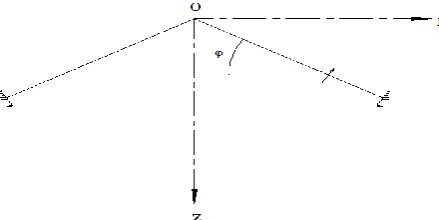
Considering shallow conical shell with thickness h, radium a and pyramid dip , whose neuter plane is showed in Fig.1. Assume that shallow conical shell in alternating magnetic field works under axisymmetric state, whose outer surface is subjected to normal stable mechanical load. The orthogonal curvilinear coordinate ( , , )r z is established in Fig.1, where r,θ,z are radium ,annular and normal coordinate of shallow conical shell respectively. The applied magnetic field intensity isH H( r, 0, 0)and Mechanical load isP(0, 0,Pz). Hris a function of the coordinate z and time t, and Pzis
[image:2.595.187.407.282.392.2]constant.
Figure 1. The diagram of shallow conical shell. Electrodynamics Equations
In the absence of lateral current and the influence of displacement current and volume charge density is not considered, according to Maxwell equation and generalized Ohm’s law, the electrodynamics equations are:
B rotE
t rotH J
J E VB
B H
(1)
where E is electric field intensity, B is magnetic induction intensity, H is magnetic field intensity, J is current density, V is velocity, σ is admittance, μ is permeability, rot is rotation.
Ignoring the mechanical electric effect and considering the axial symmetry, the electrodynamics equations (1) of shallow conical shell can be simplified as
2 2
2
r r
r
H H
t z
H J
z
(2a,b)
Temperature Field
applied magnetic field and current, then the current loss per unit time per volume can be calculated by the following formula:
2 J
Q (3)
Set the initial temperature of shallow conical shell to zero, it is heated by Joule heating effect from t=0, heat exchange exist among the Inner and outer surface and the bottom of the shell and media whose external temperature is zero. According to Fourier heat transfer law and energy conservation law, the control equation of heat conduction is established, which means that the transient temperature field T
z,t of shallow conical shell should satisfy the followed equation:c Q T k t T
2
(4)
Where ρ is material mass density, c is specific heat capacity, k is coefficient of thermal conductivity, 2
is Laplace operator.
In the axial symmetry condition, the control equation of heat conduction of shallow conical shell can be simplified to
c Q z
T k t T
2 2
2 (5)
Based on heat exchange law and the condition that the external temperature of media is zero, the heat balance equation of the current-carrying shell’s internal and external surface can be established. Thus, the boundary condition is
0
T
z T
, at
2
h
z (6) where, is thermal coefficient.
Elastic Field
The shallow conical shell in the time dependent electromagnetic field also suffer the temperature stress induced by Joule heat and Lorentz force in addition to the external mechanical loads P, The Lorentz force can be expressed as
r
z r
H
f H
z
(7)
where fz is z direction component of Lorentz force f.
In the axial symmetry condition, considering the coupling effect of Lorentz force, temperature stress and mechanical load, according to the classical theory of plates and shells, the control equation of shallow conical shell can be derived as follows:
2
2 2
2 2
2 2
4 3 2
2
4 3 2
2
2
2 2 2
2 1
0 2
1 2
1 2
T z z
u u w w w w
r r u r r r w
r r r r r r
w w w w
D r r
r r r r r
u w u w
A r
r r r r
w P F r r N hr
t
(8a,b)
Non-dimensionalization
To facilitate the calculation, the following dimensionless parameters are introduced
2
2 2
0
0
2 4
2 2 2 3
0 0
4 2 2 2
3 2 2 2
0 4
1 2 2 2 5
4 4
, , , ,
2 2 2
, , , ,
2
8
, , / 2,
4
8 4 4 (1 )
, , , ( , ) ( , ), 2 64 , r r z z T T
z z z z r r
n H
r t a
r H u u
a H h h
hJ
w a z
w z J
h h h H
h Q c T a
Q T h h F F
H H Ah
a a h a v
P P N N f f
Ah Ah H h E
a k h D , 2 2 0 3 4 2 4(1 )
, v H a
C h (9)
The non-dimensional forms of Eqs. (2a), (3), (5) and (8a,b) are given as follows
2 2
z H Hr r
(10)
2
J
Q (11)
Q z T T 2 2 1
(12)
2 2 2 2 2 2 2 24 3 2
4 3 2
3 4 3 2
2 2 2 2 2 2 1 0 2 2 1 ( 2 3 ) T z z
u u w
r r u r
r r r
w w w
r r w
r r r
u w u w
N
r r r r
w w w w
r r r r
r r r r r
w w w
r r P F r r
r r (13a,b)
Consider the following boundary conditions and initial conditions of electromagnetic field, temperature field and elastic field
at 1 0 at 10 when 0 r r r H z H z H (14a,b,c)
0 at 1
, 0 when 0
T
hT z
z
T z
(15a,b,c)
0, w 0, 0 at 1
w u r
r
(16a,b,c)
0, is finite at 0
w
u r
r
0
w
w and 0
u
u when 0 (18a,b,c)
Solution
Electromagnetic Field
Eq (10) is solved by separation of variables. In order to make non-homogeneous boundary condition (14a)homogeneous, new unknown function h zr
, is introduced
2 1 ,
, H z z z
hr (19) Substituting formula. (19) into Eq. (10) ,boundary condition (14a,b) and initial condition (14c) can be written as follows
d
d z h
z hr r
2 1
2
(20)
0
r
h at z 1 (21)
2 1 0 0
, z
z
hr when 0 (22) Assume that the solution of Eq. (20) satisfy the boundary condition (21) and (22) is following series form
k zh n n
n
r cos
1
(23)
where
is the function of ,kn is the position root of function cos kn 0,that is
2 1 2
n
kn (n1,2,3,) (24)
Substituting formula (23) in the Eq. (20), both sides of Eq. (20) multipcos kmz , using the orthogonality of trigonometric function, it obtains
0 cos
2 1
1
1
2
k z dz
z d
d k
d d
n
n
(25) with initial condition(22),the solution of Eq.(25) is
n
n n n
k
1
(26)
where
dx dxx d e kn x
0
2
Thus, the expressions of non-dimensional magnetic field intensity Hr, induced current and
1 1 1 1 1 1 1 cos 2 1 1 sin 2 1 1 sin 2 1 1 cos 2 n r n n n n n n m
z m m
m n
n
n n
z
H k z
k
J k z
f k z
z k z k
Temperature FieldBased on the separation of variables, assume that the solution of Eq.(12) which satisfies the boundary condition (15a,b) shows the following form
az b T i i i cos 1
(27)
Where ai is confirmed by
i i
a h a
tan . Both sides of Eq. (12) multiplycos
ajz , using theorthogonality of trigonometric function, it obtains
2 2
1 2
1 2 2 1 , cos 0
i i
i i i
i
b h a
a b Q z a z dz
h h a
(28)The solution of Eq. (28) is
1 1 2 2 2 2 ˆ m n imn imn i ii L b c
a h h
a h
b (29)
Where
2 1 2 12 2 2
2
2 2 2 2
0
4 2 2
1 1
2 2 6 3
1 1
2 cos
2 ˆ
4 1 1 cos 2 2 sin 2
sin
4 4
i
i
m n i imn i
m n m n i a
imn n m
a
i i
i
i i i
k k a
L h a
k k k k a
b e d
e a a
a c
a a a
Substituting expression (40) into expression (38),it obtains
L b c
aza h h a h z T i
i m n
imn imn i i cos ˆ ,
1 1 1
2 2 2
(30)
Elastic Field
Applying Galerkin method, the initial boundary value problem (13a,b) and (16)-(18). Assume that the deflection w
r, satisfies with the boundary condition (16a) and (17a), and has a separable form of time and space as follows
2 4
2
1 r r
f
w (31) Substituting expression(42) into Eq (13a) ,the solution of Eq. (13a) satisfying with boundary condition (16c) and (17c) is
2 4
2 3 5 7
9 16 4 2 1 4
( , ) ( )( )
15 3 15
5 3 10 2 7
v v v
u r f r r
v v v
Applying Galerkin integral to equation (13b), the dynamic response formula expressed by the deflection of shell’s central plane can be obtained
0 2 1 0 3 2 2 2 2
1 a f a f p p p d
f d a
(33) Limited space, coefficients a ii( 1, 2,3), p ii( 0,1, 2)and functions G ri( ) (i1, 2,3)are no longer
given. Numerical solution of the dynamic response formula (45) is obtained by Runge-Kutta method, the response relation of time and deflection of central plane is obtained.
Numerical Example
Considering shallow conical shell shown in Fig.1 which is made of aluminum in the time-varying magnetic field, assume that the expression of the function ( )of time-varying applied magnetic field is shown as follows.
sin (34) Whereis the non-dimensional angular frequency of magnetic field, whose physical parameters are
m H/ 10 4 7
, 3.42107s/m , c2.7103J/kg , 3 3 / 10 9 .
0 kg m
,
s m
k92.6106 2/ , 0.3,E70GPa, 6 1 10 24
k
, h2mm, a0.2m,2041m
According to the above analysis, numerical calculation is obtained by Matlab, the results is shown in Fig 2. to Fig 7. .
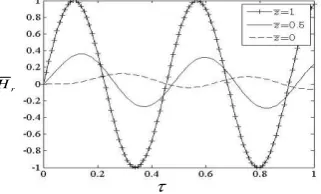
Fig 2. and Fig 3. demonstrate the curve of magnetic fieldHrand induced currentJ in different thickness varying with time in the different thickness. It can be seen from Fig 2. that magnetic fieldHrand induced currentJ show sinusoidal variation. The Hramplitude gradually increases to 1 when z is in the interval
0,1in Fig 2.. However, the induced currentJ amplitude deceases first then increases when z is in the interval
0,1 in Fig3., the outermost surface of shallow conical shell hasthe maximum induced current amplitude. Fig 4 is the curve of Lorentz force fz varying with time in different thickness when r0.5, it can be seen that Lorentz force shows sinusoidal variation, and vibration amplitude of shallow conical shell decreases gradually from surface to central face.
[image:7.595.212.373.504.601.2]Figure 2. Curve of Magnetic field intensity Hr vary with time.
Figure 3. Curve of induced current J vary with time.
J
r
H
[image:7.595.214.372.638.739.2]Figure 4. Curve of Lorentz force fz vary with time.
Figure 5. Curve of temperature T vary with time.
Fig 5 is the curve of temperature T vary with time in different thickness when s 0.5, it can be seen that temperature reaches a steady state when the time is long enough,
Fig 6 shows the curve of deflectionwvary with time in different mechanical load which is expressed by non-dimension mechanical load 3
10
z z
[image:8.595.197.384.232.352.2] [image:8.595.221.369.464.576.2]P P. It can be seen that mechanical load has an effect on the vibration amplitude of deflectionw, but has no effect on vibration frequency. The vibration amplitude of deflection increases as mechanical load increases.
Figure 6. Curve of deflectionvary with time in different mechanical load (r 0, H00.01/).
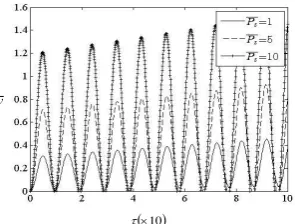
Fig 7 shows the curve of deflection w vary with time in different applied magnetic field intensity which is expressed by non-dimension magnetic field intensity H0100H0. It can be seen that vibration amplitude increases with the increase of the magnetic field strength.
Figure 7. Curve of deflectionvary with time in different magnetic field intensity (r 0, Pz 104N).
z
f
10
T
) 100 (
w
10
w
[image:8.595.208.380.645.749.2]Conclusion
Based on Maxwell's equations, heat conduction equation and nonlinear equations of classical plates and shells, the dynamic response study on shallow conical shell’s thermo-magneto-elastic behavior in a time-dependent magnetic field is presented. Some conclusions can be obtained through the calculation and analysis of shallow conical shell instances:
1. In the condition that other parameters are constant, mechanical load has an effect on the displacement amplitude of shallow conical shell, but has no effect on the vibration frequency.
2. In the condition that other physical parameters are invariable, the strength of applied magnetic field has influence to the displacement, but has no effect on the vibration frequency.
3. The stress and strain of plate and shell can be controlled when the parameters of magnetic field and mechanical load change appropriately. It has a certain reference value to the practical application of magneto-elastic coupling theory.
Reference
[1] Zhou, Y.H. and Zheng, X. J., [Electromagnetic Solid Structural Mechanics], Peking: Science Press, (1999).
[2] Bai, X. Z., [Magnetic Base Plate And Shell Elasticity], Peking: Science Press, (2006).
[3] Xing, Y. F. and Liu, B., "A differential quadrature analysis of dynamic and quasi-static magneto-thermo-elastic stresses in a conducting rectangular plate subjected to an arbitrary variation of magnetic field," International Journal of Engineering Science, 48(12), 1944-1960 (2010).
[4] Higuchi, M., Tanigawa, Y. and Kawamura, R., "Magneto-thermo-elastic stresses induced by a transient magnetic field in a conducting solid circular cylinder," Journal of Thermal Stresses, 44(8), 5316–5335 (2007).
[5] Tanigawa, Y., Higuchi, M. and Kawamura, R., "Dynamic and quasi-static behaviors of magneto-thermo-elastic stresses in a conducting hollow circular cylinder subjected to an arbitrary variation of magnetic field," International Journal of Mechanical Sciences, 50(3), 365-379 (2008).
[6] Tu, J. X., Wang, Z. R., Li, Y. Z. and Wang, P., "Nonlinear random vibration of a current carrying circular plate in a magnetic field," Journal of Mechanical Strength, 36(4), 504-509 (2014). [7] Wang, P., Chen, S. M. and Wang, Z. R., "Bifurcation and chaos of a thin rectangular plate simply supported with large deflection in a coupled environment of heating, force and magnetic field," Journal of Vibration and Shock, 32(7), 129-134 (2013).
[8] Milazzo, A.,"A one-dimensional model for dynamic analysis of generally layered magneto-electro-elastic beams," Journal of Sound and Vibration, 332(2), 465-483 (2013).
[9] Lang, Z. and Li, X., "Buckling and vibration analysis of functionally graded magneto-electro-thermo-elastic circular cylindrical shells," Applied Mathematical Modelling, 37(4), 2279-2292 (2013).