Munich Personal RePEc Archive
Rolling-sampled parameters of ARCH
and Levy-stable models
Degiannakis, Stavros and Livada, Alexandra and Panas,
Epaminondas
Department of Statistics, Athens University of Economics and
Business
2008
Online at
https://mpra.ub.uni-muenchen.de/80464/
R o l l i n g - s a m p l e d p a r a m e t e r s o f A R C H a n d L e v y - s t a b l e
m o d e l s
Stavros Degiannakis, Alexandra Livada, Epaminondas Panas
Department of Statistics, Athens University of Economics and Business
A b s t r a c t
In this paper an asymmetric autoregressive conditional heteroskedasticity (ARCH) model and a Levy-stable distribution are applied to some well-known financial indices (DAX30, FTSE20,
FTSE100 and SP500), using a rolling sample of constant size, in order to investigate whether the values of the estimated parameters of the models change over time. Although, there are
changes in the estimated parameters reflecting that structural properties and trading behaviour alter over time, the ARCH model adequately forecasts the one-day-ahead volatility. A simulation study is run to investigate whether the time variant attitude holds in the case of a
generated ARCH data process revealing that even in that case the rolling-sampled parameters are time-varying.
Keywords: ARCH model, GED distribution, Leverage effect, Levy-stable distribution, Rolling sample, Spill over, Value at risk.
1 . I n t r o d u c t i o n
In the recent literature, regarding the description of the characteristics of financial markets, one can find a vast number of specifications of both ARCH and Stochastic Volatility (SV)
processes that have been considered for. However, the SV models1 are not as popular as the
ARCH processes in applied studies. The purpose of the present study is to apply an asymmetric ARCH model to some well known financial indices, using a rolling sample of
constant size, in order to observe the changes over time in the values of the estimated parameters. A thorough investigation is conducted by comparing the parameters of the
full-sampled estimated model to the parameters of the rolling sub-sample estimated models. We conclude that the values of the estimated parameters change over time, indicating a data set
that alters across time reflecting the information that financial markets reveal. The analysis is extended to simulated time series indicating that the time-varying estimated coefficients
characterize the ARCH data generating process itself.
In ARCH modelling, the distribution of stock returns has fat tails with finite or infinite
unconditional variance and time dependent conditional variance. Estimation of stable distributions is an alternative approach in modelling the unconditional distribution of returns. Thus, we adopt the estimation procedure of McCulloch (1986) and the parameters of the
Levy-stable distribution are estimated at each of a sequence of points in time, using a rolling
sample of constant size. The empirical findings suggest that the parameters of the unconditional distribution are also not constant over time.
Reviewing the relevant literature we notice absence of studies showing that although
the parameters of a well-specified model vary significantly over time, their time varying attitude
does not influence model’s forecasting ability. The main object of our study is to provide evidence that model’s parameters should be re-estimated on a frequent base in order to reflect any changes that have been occurred in the stock market and have been incorporated
in the prices of assets.
The paper is divided in six sections. Section 2 lays out the asymmetric ARCH model
that is applied in the FTSE20, DAX30, FTSE100 and SP500 stock indices. In section 3, the estimated rolling-sampled parameters of the asymmetric ARCH model are discussed. In
section 4, a simulation study examines whether the parameters are time-varying in the case of a generated ARCH process. In section 5, the unconditional distribution of returns is estimated and the phenomenon of time-variant parameters is investigated in the Levy-stable distribution.
Finally, in section 6 we summarize the main conclusions. 2 . A n a s y m m e t r i c A R C H m o d e l
A wide range of proposed ARCH models is covered in surveys such as Andersen and Bollerslev (1998), Bera and Higgins (1993), Bollerslev et al. (1992), Bollerslev et al. (1994),
1 The reader who is interested in SV models is referred to Barndorff-Nielsen et al. (2002), Chib et al. (1998),
Degiannakis and Xekalaki (2004) and Poon and Granger (2003). The Nobel price award to
R.F. Engle for ARCH volatility modeling is the uncontested proof of the contribution of ARCH models in time series and econometric modelling (Diebold 2003). A plethora of studies applied
ARCH models to predict future volatility by updating the available information set at each of a sequence of points in time. Among others, Balaban and Bayar (2005) tested in 14 countries the relationship between stock market returns and their forecast volatility, Blair et al. (2001)
compared the information content of implied volatilities and intraday returns in the context of forecasting S&P100 volatility, Wei (2002) forecast China’s weekly stock market volatility and Yu (2002) predicted stock price volatility using daily New Zealand data. Angelidis et al. (2004), Degiannakis (2004), Brooks and Persand (2003) and Giot and Laurent (2003) predicted
Value-at-Risk (VaR) measures, while Degiannakis and Xekalaki (2001), Engle et al. (1997) and Noh et al. (1994) used rolling ARCH models to forecast volatility of options.
An ARCH process,
t
, can be presented as
, ,...; , ,...; , ,...
, 1 , 0 ~ 2 1 2 1 2 1 2 . . . t t t t t t t t t d i i t t t t g z V z E f z z
1)where
is a vector of unknown parameters,f
.
is the density function of zt,g
.
is a linear or non-linear functional form and
t is a vector of predetermined variables included ininformation set I at time
t
. Since very few financial time series have a constant conditionalmean of zero, an ARCH model can be presented in a regression form by letting
t be theunpredictable component of the conditional mean
At t
tt
A
E
y
I
y
,
,|
1
,2)
where
y
A,t
ln
P
A,tP
A,t1
denotes the continuously compound rate of return from timet
1
to
t
, andP
A,t is the asset price A at timet
. In order to investigate the characteristics of stockmarket A, we apply an ARCH model of the following form:
t t A t A t
A e y
y t A
2 2 3 ,1
, 1 0 , 4 2 , , t A t t z
,
,
v
GED zd i i
t ~ 0,1; . . . ,
t A t t A t t A t t tA
L
E
L
where
GED
0
,
1
;
v
denotes the generalized error distribution (GED), v is the tail thicknessparameter of the GED, L is the lag operator and Nt is the number of non-trading days
preceding the
t
th day. The density function of a GED random variable is given by
vve z
f
v v
z
t
v t
1 2
)
( 1
21
,
4)
for z,
0
v
, where
.
denotes the gamma function and
2 1 2
3 1 2 1
v v v
.5)
The conditional variance specification has the form of the exponential GARCH, or EGARCH model, which is suggested by Nelson (1991). The EGARCH model captures the asymmetric
effect exhibited in financial markets, as the conditional variance,
t2, depends on both the magnitude and the sign of lagged innovations. Assuming GED distributed innovations with EGARCH specification for the conditional variance we take into account that i) theunconditional distribution of innovations is symmetric but with excess kurtosis and ii) their conditional distribution is asymmetric and leptokurtotic. Parameter
allows for the leverageeffect. The leverage effect, first noted by Black (1976), refers to the tendency of changes in stock returns to be negatively correlated with changes in returns volatility, i.e. volatility tends to
rise in response to ‘bad news’ and to fall in response to ‘good news’. Moreover, the logarithmic
transformation ensures that the forecasts of the variance are non-negative. Parameter
0allows us to explore the contribution of non-trading days to volatility. According to Fama (1965) and French and Roll (1986) information that accumulates when financial markets are
closed is reflected in prices after the markets reopen. The conditional mean is modeled such
as to capture the relationship between investors’ expected return and risk2
(
1), thenon-synchronous trading effect3 (
2), and the inverse relation between volatility and serialcorrelation4 (
3).2The relationship between investors’ expected return and risk was presented in an ARCH framework, by Engle et
al. (1987). They introduced the ARCH in mean model where the conditional mean is an explicit function of the conditional variance.
3 According to Campbell et al. (1997), ‘The non-synchronous trading or non-trading effect arises when time
series, usually asset prices, are taken to be recorded at time intervals of one length when in fact they are recorded at time intervals of other, possible irregular lengths.’
4 LeBaron (1992) found a strong inverse relation between volatility and serial correlation for SP500, CRSP and
Dow Jones returns. As LeBaron stated, it is difficult to estimate 4 in conjunction with 3 when using a gradient
Model (3) is expanded in order to take into account the phenomenon of volatility spill
over from one market to the other5:
ln
. ln 1 1 1 ln ln 2 1 , 2 2 1 , 1 , , , 1 1 0 0 2 , t C t B t A t t A t t A t t tA L E L
L N a
(6)where the parameters
1 and
2 account for the volatility spill over from B and C stockmarkets to the A stock market, respectively. In order to account for the volatility spill over
effect from one market to the others, when (6) is estimated for stock market A, the daily conditional volatilities of stock markets B and C are regarded as exogenous variables that
have been estimated according to framework (3)6.
The data set used in this paper consists of the Financial Times Stock Exchange 20
(FTSE20) index for Greece, the Deutscher Aktien Index 30 (DAX30) for Germany, the Financial Times Stock Exchange 100 (FTSE100) index for U.K. and the Standard & Poor's
500 (SP500) index for U.S.A. The period covered for the FTSE20, DAX30, FTSE100 and SP500 is from January 3rd 1996, January 14th 1992, January 9th 1992 and January 7th 1992 to
July 5th 2002, respectively. A thorough investigation is conducted by comparing the
parameters of the full-sampled estimated model to the parameters of the rolling sub-sample
estimated models. Maximum likelihood estimates of the parameters are obtained by numerical maximization of the log-likelihood function using the Marquardt (1963) algorithm.
INSERT TABLE 1 ABOUT HERE
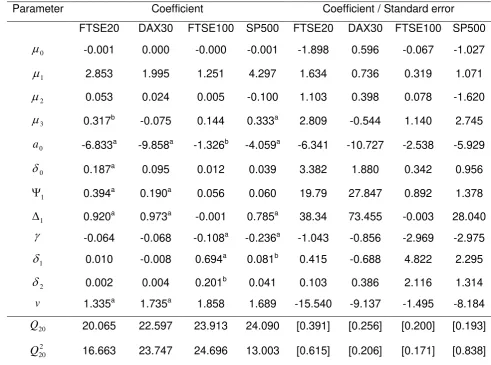
Table 1 presents the estimated parameters of model (6) for each market separately.
The standardized residuals, 1,
t A t
, and their squared values, 2,2 t A t
, from all models obey thestandard assumptions of autocorrelation and heteroskedasticity absence. Indicatively, we present the Ljung-Box Q-statistic for the null hypothesis that there is not autocorrelation up to
20th order computed on
t
A1,t and 2 , 2 t A t
. Briefly discussing the values of the parameters, wenote that i) the relation of the conditional variance with the risk premium, although positive, is
statistically insignificant (coefficient
1), ii) the non-synchronous trading effect is not presentin the estimated models (coefficient
2) and iii) concerning the cases of the FTSE20 andSP500 stock indices, the daily serial correlation is inversely related to its conditional volatility
5 Engle et al. (1990) evaluated the role of the information arrival process in the determination of volatility in a
multivariate framework providing a test of two hypotheses: heat waves and meteor showers. Using meteorological analogies, they supposed that information follows a process like a heat wave so that a hot day in New York is likely to be followed by another hot day in New York but not typically by a hot day in Tokyo. On the other hand, a meteor shower in New York, which rains down on the earth as it turns, will almost surely be followed by one in Tokyo. Thus, the heat wave hypothesis is that the volatility has only country specific autocorrelation, while the meteor shower hypothesis states that volatility in one market spills over to the next. See also Kanas (1998).
6 For example, in the case of the FTSE20 index daily returns, the conditional variance of the DAX30 and SP500
(coefficient
3). Moreover, the leverage effect is not present in the Greek and German stockmarkets. On the contrary, for the SP500 and FTSE100 stock indices, the estimated value of parameter
is statistically significant at 1% level of significance. The volatility spill over effectis statistically significant for the U.K. stock market. Regarding the SP500 index daily returns, there is evidence that volatility spillovers from Frankfurt to Chicago stock market. Finally, for
the FTSE20, DAX30 and SP500 cases, parameter v is statistically different to the value of 2
at any level of significance, justifying the use of a thick-tailed distribution. The estimated value
of
0 is about 0.187 and statistically significant only in the case of the Greek market indicatingthat a non-trading day contributes less than a fifth as much to volatility as a trading day. 3 . R o l l i n g - s a m p l e d p a r a m e t e r s o f t h e a s y m m e t r i c A R C H m o d e l
Our purpose is to examine if the estimated parameters of the asymmetric ARCH model change over time and whether there is any impact of time-varying estimated parameters on
volatility forecasting accuracy. The ARCH process is estimated, at each of a sequence of points in time, using a rolling sample of constant size equal to 1000 trading days, a sample
size that is preferred7 by the majority of applied studies.
We produce one-day-ahead conditional volatility predictions for the trading days of 11th
January 2000 to 5th July 2002. Since the ARCH model is estimated at each point in time, we
use the maximum likelihood estimates at time
t
1
as starting values for the iterativemaximization algorithm at time
t
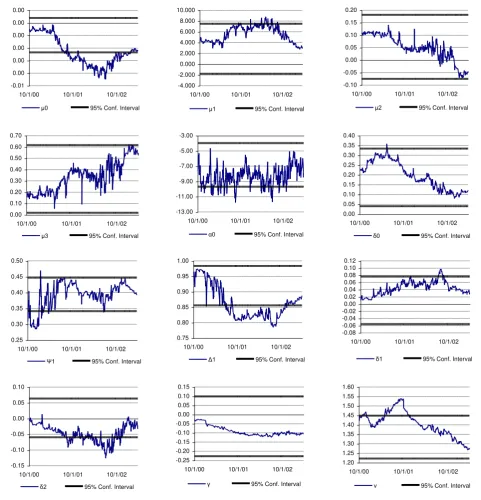
. Figure 1 depicts the rolling-sampled estimated parametersfor the FTSE20 index as well as the
2
.
06
times the conditional standard deviationconfidence interval of the parameters estimated using the full data sample8. From visual
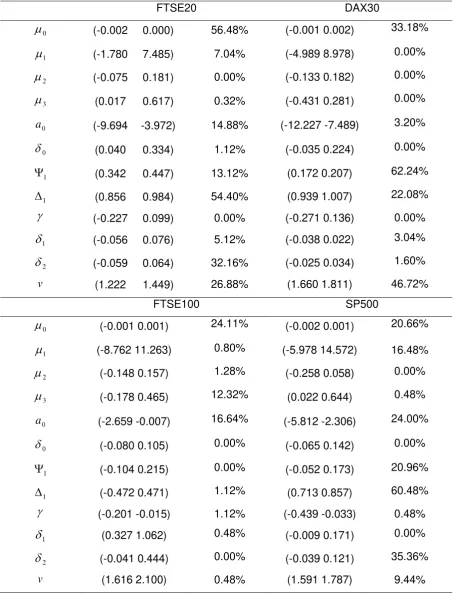
inspection, the estimated rolling parameters are, clearly, out of the confidence interval bounds in many cases. Table 2 presents the percentage of rolling-sampled estimations, which are
outside of the 95% confidence interval of the full-sampled parameters. Characteristic
examples of the change in the parameter values are
1 and v for DAX30 as well as
1 forFTSE20 and SP500. However, there are rolling parameters which do not change significantly
across time, such as
(leverage effect), and
0 (contribution of non-trading days tovolatility). An important characteristic, which is extracted from the rolling-sampled estimated
parameters, is the fact that the estimated values do not fluctuate in a mean reverting form but they change gradually. Sudden changes of the values of the rolling estimated parameters,
which are characterized by a mean reverting form, should indicate an improperly maximum likelihood estimation procedure. On the other hand, gradual changes of the estimated
7 Engle et al. (1993), Engle et al. (1997), Noh et al. (1994), Angelidis et al. (2004) note that the size of the rolling
sample turns out to be rather important while Frey and Michaud (1997), Hoppe (1998) and Degiannakis and Xekalaki (2006) comment that the use of short sample sizes generates more accurate volatility forecasts, since it incorporates changes in trading behaviour more efficiently.
8 Figures of the estimated rolling parameters for the DAX30, FTSE100 and SP500 indices, similar to Figure 1, are
coefficients indicate a data set that alters from time to time, forcing us to believe that the
values of the estimated parameters reflect the information that financial markets reveal. INSERT FIGURE 1 ABOUT HERE
INSERT TABLE 2 ABOUT HERE
The percentage of estimated rolling parameters that are statistically different from the parameter values estimated using the full data sample, as presented in Table 3, is also
indicative for the changes of the estimated values across time. There are four parameters, in the case of the Greek market, whose rolling-sampled estimators differ statistically significant
from their full-sampled estimators in more than 10% of the trading days. Although, in the case
of the FTSE100 index, only the rolling estimators of
1 parameter differ statistically from theirfull data sample estimator, in the case of the SP500 index there are four parameters, which
show a statistically significant difference from their full-sampled estimators in more than 20% of the trading days.
INSERT TABLE 3 ABOUT HERE
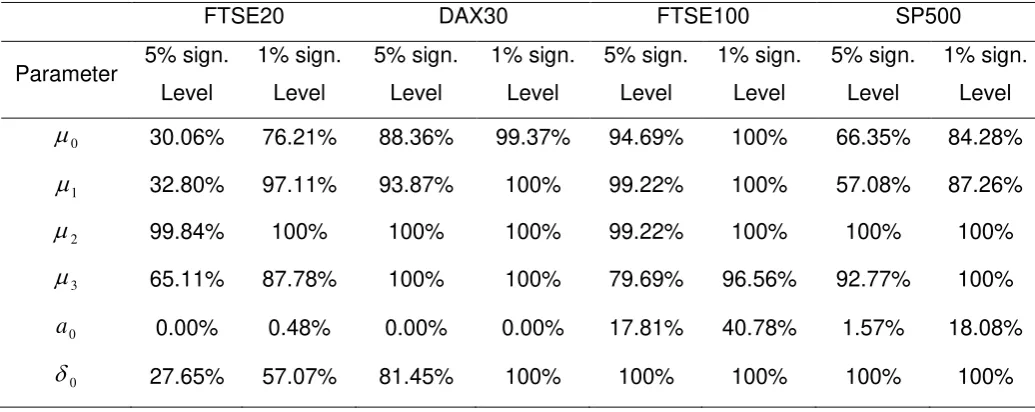
The values of the rolling parameters indicate that the characteristics of the markets change during the examined period. According to Table 4, which presents the percentage of
trading days that the rolling parameters are statistically insignificant, there are parameters
whose rolling-sampled estimations are statistically insignificant while their full-sampled
estimations are significant. For example, parameters
3 and
1 for the SP500 index, as wellas parameter
for FTSE100 index, although they appear to be significant in the full sample,almost all their rolling-sampled estimations are insignificant at 5% level of significance. Therefore, in the full sample, an inverse relation between volatility and serial correlation
characterizes FTSE20 index, but the values of rolling
3 are not different to zero in most ofthe cases. Of course, there are parameters whose estimations are statistically different to zero
in both the full sample and the rolling samples (i.e. the parameter
1 for the FTSE20, DAX30and SP500 indices). Hence, we may infer that the values of the estimated parameters change across time, reflecting the individual features of particular periods that characterize financial
markets.
INSERT TABLE 4 ABOUT HERE
However, although the estimated parameters are time varying, the in-sample and out-of-sample forecasting ability of the model is accurate. There are 31, 19, 17 and 29 cases, or
4.99%, 2.99%, 2.66% and 4.57%, observed returns outside the 95% confidence intervals for the FTSE20, DAX30, FTSE100 and SP500 indices, respectively. In Figure 2.a, the 95%
in-sample confidence interval of the FTSE20 index of daily returns is plotted from 11th January
2000 to 5th July 2002. However, a model that uses a large number of parameters may exhibit
an excellent in-sample fit but a poor out-of-sample performance. Studies such as Heynen and
volatility prediction models with in-sample and out-of-sample data sets. We investigate the
possibility that model over-fitting can be occurred and evaluate the performance of the estimated ARCH model by computing the out-of-sample forecasts. In the sequel, the
one-day-ahead 95% prediction intervals are constructed. Let us compute the one-day-one-day-ahead
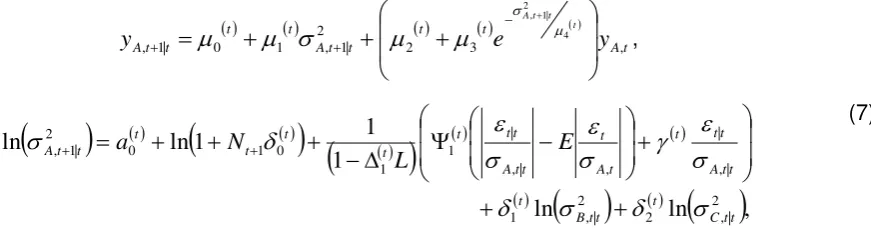
conditional mean, yt1|t E
yt1
t |It
, and conditional variance,
t
t t t
t E |I
2 1 2
|
1
,using the following formulas:
t A t t t t A t t t t
A
e
y
y
t t t A , 3 2 2 | 1 , 1 0 | 1 , 4 2 | 1 ,
,
ln
ln
,1 1 1 ln ln 2 | , 2 2 | , 1 | , | , | , | 1 1 0 1 0 2 | 1 , t t C t t t B t t t A t t t t A t t t A t t t t t t t t t A E L N a
(7)where
t
0 t,
1 t,
2 t,
3 t,
a
0 t,
0 t,
1 t,
1t,
t,
1 t,
2 t,
v
t
is the parameter vector that is estimated using the sample data set which is available at timet
,
t|t
E
t|
I
t
denotes the prediction error conditional on the information set that is available at time
t
, and
t t
t t
A E |I
2 |
,
is the conditional standard deviation which is computed by the ARCHmodel, in equation (6), using the information set available at time
t
. Note that for
v
GEDzt ~ 0,1; , the expected value of its absolute price is equal to
1/21
,
2
1
3
t
t
tt A
t
v
v
v
[image:9.595.95.531.181.296.2]E
.Figure 2.b plots the one-day-ahead 95% prediction interval, which is constructed as the
one-day-ahead conditional mean
2.06 times the conditional standard deviation, bothmeasurable to It information set, or
At t tt t
A GED v
y ,1| 0,1; ,0.025
,1| , where GED
0,1;v t,a
is the
100
1
a
quantile of the GED distribution. Hence, each trading day, (t
), the nexttrading day’s, (
t
1
), prediction intervals are constructed, using only information available atcurrent trading day,
t
. There are 29, 22, 21 and 32 observations or 4.67%, 3.46%, 3.29% and5.04% for the FTSE20, DAX30, FTSE100 and SP500 indices, respectively, outside the 95%
prediction intervals9.
INSERT FIGURE 2 ABOUT HERE
For a more formal method of evaluating forecasting adequacy, we apply two
hypotheses tests that measure the forecasting accuracy in a VaR framework. One-day-ahead
VaR at a given probability level, a, is the next trading day’s predicted amount of financial loss
of a portfolio, or
At tt
t a GED v a
VaR1|11 0,1; ,
,1| . Kupiec (1995) introduced a likelihood9 Figures, similar to Figure 2, that depict the in-sample 95% confidence interval and the one-day-ahead 95%
ratio statistic for testing the null hypothesis that the proportion of confidence interval violations
is not larger than the VaR forecast. The test statistic, which is asymptotically X12 distributed,
is computed as 2[ln(( )n(1 )N n) ln( n(1 )N n]
K n N n N p p
LR , where
n
iN1d
yt1VaRt1|t
a/2
d
y
t1
VaR
t1|t
1
a
/
2
is the number of trading days overthe out-of-sample period
N
that a violation has occurred, ford
y
t1
VaR
t1|t
a
/
2
1
ift t t
VaR
y
1
1| andd
y
t1
VaR
t1|t
a
/
2
0
otherwise, and p is the expected frequency of violations. Christoffersen (1998) developed a likelihood ratio statistic that jointly investigateswhether i) the proportion of violations is not larger than the VaR forecast and ii) the violations
are independently distributed. The statistic is computed as LRC -2ln((1 ) )
n n N
p p
)) )
1 ( )
1 (
2ln( 00 01 10 11
11 11 01
01
n n n
n
, where
j ij ij ij n n
andn
ij is the number ofobservations with value i followed by j, for
i
,
j
0
,
1
. The valuesi
,
j
1
denote that aviolation has been made, while
i
,
j
0
indicate the opposite. Under the null hypothesis, theC
LR is asymptotically chi-squared distributed with two degrees of freedom. The main
advantage of Christoffersen’s test is that it can reject a VaR model that generates either too
many or too few clustered violations. Both tests do not reject the null hypothesis of correct
proportion of violations in all the cases, except for the 95%-VaR of the FTSE100 index. In the
case of Kupiec’s test the p-values are 70.28%, 6.08%, 3.45% and 96.37% for 95%-VaR and
8,15%, 13.63%, 56.56% and 52.70% for 99%-VaR, for the FTSE20, DAX30, FTSE100 and SP500 indices, respectively. Testing the null hypothesis of whether the violations are equal to
the expected ones as well as if they are independent, we observe that the relative p-values are 40.03%, 16.42%, 0.15% and 95.19% in the 95%-VaR case and 17.98%, 32.51%, 7.10%
and 73.92% in the 99%-VaR case, for the FTSE20, DAX30, FTSE100 and SP500 indices, respectively.
Despite the fact that the values of the estimated coefficients change over time, the model adequately forecasts the one-day-ahead volatility. Thus, changes in the values of the estimated parameters do not indicate inadequacy of the model in describing the data. On the
contrary, model’s parameters should be re-estimated on a daily base in order to reflect any changes that have been occurred in the stock market and have been incorporated in the
prices of assets10.
10
4 . R o l l i n g - s a m p l e d p a r a m e t e r s f r o m s i m u l a t e d p r o c e s s e s
A simulation study could shed light in rolling-sampled estimated parameters’ behaviour. A series of simulations is run in order to investigate if the time-variant attitude holds even in the
case of an ARCH data generating process. We generate a series of 32000 values from the
standard normal distribution, ~
0,1. . .
N z
d i i
t . Then an AR(1)GARCH(1,1) process is created,
32000 1
t t
y , where yt 0.00050.15yt1
t, by multiplying the i.i.d. process with a specificconditional variance form
t zt
t2 , for2 1 2
1 2
90
.
0
05
.
0
0005
.
0
t tt
. TheAR(1)GARCH(1,1) model is applied on the
yt 32000t1002 generated data. Dropping out the first1001 data, maximum likelihood rolling-sampled estimates of the parameters are obtained by numerical maximization of the log-likelihood function, using a rolling sample of constant size
equal to 1000. According to Table 5, about 58% of the 30000 conditional variance rolling-sampled parameters are outside the 95% confidence interval of the parameters estimated
using the whole sample set of the 30000 simulated data. The procedure is repeated for an
AR(1)EGARCH(1,1) conditional variance form,
1
211 1
1 1 1 0 2
ln
ln
t
t t t
t
t a a
,but the results are robust to the choice of the conditional variance specification.
A series of 32000 values from the first order autoregressive process are also
produced. The AR(1) process is created as yt 0.00010.12yt1zt, for ~
0,1. . .
N z
d i i
t .
Dropping out the first 1001 data, 30000 maximum likelihood rolling-sampled estimates of the
parameters are also obtained. As far as the case of the AR(1) process is concerned, we infer that the rolling estimated parameters are time-invariant, as on average 5% of the estimated
rolling parameters are outside the 95% confidence levels.
Both the AR(1)GARCH(1,1) and the AR(1) processes were simulated for various sets
of parameters, but there are no qualitative differences to the fore mentioned conclusions. Moreover, a series of simulations were repeated i) for ARCH volatility forms without any
conditional mean specification, ii) based on estimation procedures of the most well known
packages, EVIEWS® 4.1 and OX-G@ARCH® 3.4, iii) for larger rolling samples of 5000 values,
iv) for non-overlapping data samples, but there were no qualitative differences in any of these cases11.
So, the simulation study provides evidence that the time-variant attitude of rolling-sampled parameters estimations characterizes not only the examined data sets but the ARCH
data generating process itself as well.
INSERT TABLE 5 ABOUT HERE
likelihood algorithm at time t. Despite the slight changes occurred in each case, the rolling parameters are time-variant for all cases.
5 . R o l l i n g - s a m p l e d p a r a m e t e r s f r o m a L e v y - s t a b l e d i s t r i b u t i o n In this section, we investigate whether the phenomenon of parameter changing across time is related with the unconditional distribution of returns also. Mandelbrot (1963) and Fama (1965)
made the first re-examination of the unconditional distribution of stock returns. Mandelbrot (1963) concluded that price changes can be characterized by a stable Paretian distribution with a characteristic exponent, a, less than two, thus exhibiting fat tails and infinite variance.
Fama (1965) examined the distribution of thirty stocks of the Dow Jones Industrial Average;
his results were consistent with Mandelbrot’s. Thereafter, it has been accepted that the stock
returns distributions are fat-tailed and peaked. In an attempt to model the unconditional distribution of stock returns several researchers have considered alternative approaches. See
for example, Blattberg and Gonedes (1974), Bradley and Taqqu (2002), Clark (1973), Kon (1984), McDonald (1996), Mittnik and Rachev (1993), Panas (2001), Rachev and Mittnik
(2000).12
The probability density function of a stable distribution cannot be described in a closed
mathematical form. By definition, a univariate distribution function is stable if and only if its characteristic function has the form
t
a
t
t
i
t
t
i
t
exp
a1
,
,8)
where
i
1
,t
R
,
2 tan
,
t a ifa
1
and
t
,
a
2
log
t
ifa
1
. Theparticular distribution represented by its characteristic function is determined by the values of
four parameters: a,
,
and
. The parameter a,0
2
, is called the characteristicexponent. It measures the thickness of the tails of a stable distribution. The smaller the value
a, the higher the probability in the distribution tails. If
a
2
then we have thicker tails than thetails of normal distribution. Thus, stable distributions have thick tails and consequently
increase the likelihood of the occurrence of large shocks. The skewness parameter
,1
1
, is a measure of the asymmetry of the distribution. The distribution is symmetric, if0
. As
approaches one, the degree of skewness increases. The scale parameter
,0
, is a measure of the spread of the distribution. It is similar to the variance of the normaldistribution,
2
. However, the scale parameter
is finite for all stable distributions,despite the fact that the variance is infinite for all
a
2
. The location parameter
,
, is the mean of the distribution, fora
1
, and the median for0
a
1
. The12 De Vries (1991), Ghose and Kroner (1995) and Groenendijk et al. (1995) demonstrate that ARCH models share
case of
a
2
,
0
corresponds to the normal distribution, whilea
1
,
0
correspondsto the Cauchy distribution.
In estimating the parameters of the stable distribution of index returns, we adopt the
estimation procedure suggested by McCulloch (1986). The estimation procedure is a quantile
method and works for
0
.
6
a
2
and any value of the other parameters. Essentially,McCulloch suggests that if we have a random variable x, which follows a stable distribution
and denotes the pth quantile of this distribution by
x
p
, then the population quantile can be estimated by the sample quantilex
ˆ
p
. McCulloch’s estimator uses five quantiles to estimatea and
as
0
.
75
ˆ
0
.
25
ˆ
05
.
0
ˆ
95
.
0
ˆ
ˆ
x
x
x
x
and
0
.
95
ˆ
0
.
05
ˆ
50
.
0
ˆ
2
05
.
0
ˆ
95
.
0
ˆ
ˆ
x
x
x
x
x
. Since
a
ismonotonic in a and
is monotonic in
, we are able to find a and
by inverting
a
and
, thusa
ˆ
g
1
ˆ
a
,
ˆ
and
ˆ
g
2
ˆ
a
,
ˆ
. McCulloch tabulatedg
1 andg
2 forvarious values of
a
and
. A similar procedure is also applied for the scale and locationparameters. An alternative procedure to estimate the parameters of the stable distribution is
the regression method proposed by Koutrouvelis (1980).
Following a procedure similar to that of ARCH modelling, the parameters of the stable
distribution are estimated, at each of a sequence of points in time, using a rolling sample of constant size equal to 1000 trading days. The empirical findings, for the case of the Greek
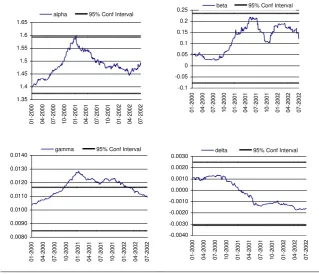
stock market, are graphically summarized in Figure 3, which plots the rolling-sampled estimates of parameters along with the 95% confidence interval of the parameters estimated
using the full data sample. Inspection of Figure 3 shows that the estimates of a are less than
two. The case of FTSE20 reveals that 92% of the a’s rolling-sampled estimates are between
1.44 and 1.55. The parameter
is greater than zero, which implies skewness to the right.The rolling values of
are positive and range from 0.003 to 0.22 but there are not outside the95% confidence interval for any case13.
INSERT FIGURE 3 ABOUT HERE
In Table 6, we present the estimates of the parameters of stable distribution based on all data available as well as the standard deviation of the rolling-sampled estimated parameters. The estimates of a do not approach the value of two in any of the examined
indices. However, there are estimated rolling parameters that are statistically different from the parameter values estimated using the full data sample. For example, the rolling-sampled
estimates of the tail index (a) are statistically different to the full sample estimated parameter
in the 51.46% of the trading days for the case of the SP500 index. The rolling estimates of
13 Figures depicting the rolling-sampled estimates of the parameters for the DAX30, FTSE100 and SP500 indices
parameter
are statistically different to the relevant full-sampled values in 9.59% and 9.42%of the trading days for the DAX30 and FTSE100 indices, respectively, whereas the location ( ) parameters are time-variant in none of the cases. Another important parameter of the stable distribution, from the point of view of portfolio theory, is the scale parameter,
. As faras the FTSE20 index is concerned, the rolling-sampled estimates of the scale parameter differ statistically from its full-sampled value in the 56.48% of the trading days. Hence, the
parameter estimates, using the full data sample are statistically different from the parameter values estimated using the rolling samples of constant size for one parameter in each index.
INSERT TABLE 6 ABOUT HERE 6 . D i s c u s s i o n
We estimated an asymmetric ARCH model using daily returns of the FTSE20, DAX30, FTSE100 and SP500 indices and concluded that although the estimated parameters of the
model change over time, the model does not lose its ability to forecast the one-day-ahead volatility accurately. Furthermore, the rolling parameter analysis was applied to the
unconditional distribution of returns. We observed the phenomenon of parameter changing across time for both the conditional (ARCH process) and the unconditional (Levy-stable) distribution of returns. Even in the case of a simulated ARCH process, the property of time
varying rolling-sampled parameters holds. One possible reason for parameter instability might
be that the behaviour of the market participants has undergone fundamental changes. Parameters instability indicates a change in market behavior but we can not determine the source of that change. The term ‘a data set that alters’, could incorporate a wide range of
possible sources, i.e. financial legislation, market microstructure, market participants’
perspective, technological revolution or even macroeconomic policy.
Gallant et al. (1991), Stock (1988), Lamoureux and Lastrapes (1990) and Schwert (1989) among others have aimed at explaining the economic interpretation of the ARCH
process. As Engle et al. (1990) and Lamoureux and Lastrapes (1990) have noted, the explanation of the ARCH process must lie either in the arrival process of news or in market
dynamics in response to the news. Based on some earlier work by Clark (1973) and Tauchen and Pitts (1983), Gallant et al. (1991) provided a theoretical interpretation of the ARCH effect.
They assumed that the asset returns are defined by a stochastic number of intra-period price revisions and information flows into the market in an unknown rate. As the daily information does not come to the stock market in a constant and known rate, the estimation of the ARCH
stochastic process that explains the dynamics of the stock market could be revised at regular time intervals. In our case the ARCH process is estimated using daily returns. Thus, the
parameters of the model may be revised on a daily base, because of the observed phenomenon of changes in the estimated parameters. If we used data of higher frequency, i.e.
To the best of authors’ knowledge, this is the first study that investigates the
phenomenon of time varying estimated parameters either i) in real-world financial data or ii) in a simulated data generating process. A natural extension of this study would be to analyse the
change and the relative economic interpretation of the estimated values of the parameters in intra-daily high-frequency data sets.
A c k n o w l e d g e m e n t
We would like to thank the editor and an anonymous referee for their constructive comments that helped to improve significantly an earlier version of the paper.
R e f e r e n c e s
Andersen, T. and Bollerslev, T. (1998). ARCH and GARCH Models, Encyclopedia of
Statistical Sciences Vol.II, (eds.) Samuel Kotz, Campbell B. Read and David L. Banks, New York, John Wiley and Sons Inc.
Angelidis, T., Benos, A. and Degiannakis, S. (2004). The Use of GARCH Models in VaR Estimation. Statistical Methodology, 1(2), 105-128.
Balaban, E. and Bayar, A. (2005). Stock returns and volatility: empirical evidence from fourteen countries. Applied Economics Letters, 12, 603-611.
Barndorff-Nielsen, O.E., Nicolato, E. and Shephard, N. (2002). Some Recent Developments in
Stochastic Volatility Modelling. Quantitative Finance, 2, 11-23.
Bera, A.K. and Higgins, M.L. (1993). ARCH Models: Properties, Estimation and Testing. Journal of Economic Surveys, 7, 305-366.
Berndt, E., Hall, B., Hall, R. and Hausman, J. (1974). Estimation and Inference in Nonlinear
Structural Models. Annals of Economic and Social Measurement, 3, 653-665.
Black, F. (1976). Studies of Stock Market Volatility Changes. Proceedings of the American Statistical Association, Business and Economic Statistics Section, 177-181.
Blattberg, R.C. and Gonedes, N.J. (1974). A comparison of the stable and student distributions as statistical models for stock prices. Journal of Business, 47, 244-80.
Blair, B.J., Poon, S.-H. and Taylor, S.J. (2001). Forecasting S&P 100 volatility: the incremental
information content of implied volatilities and high frequency index returns. Journal of Econometrics, 105, 5-26.
Bollerslev, T., Chou, R. and Kroner, K.F. (1992). ARCH Modeling in Finance: A Review of the
Theory and Empirical Evidence. Journal of Econometrics, 52, 5-59.
Bollerslev, T., Engle, R.F. and Nelson, D. (1994). ARCH Models. In: R.F. Engle and D.
McFadden (Eds.), Handbook of Econometrics, Volume 4, Elsevier Science, Amsterdam,
2959-3038.
Bradley, B. and Taqqu, M. (2002). Financial Risk and Heavy Tails. In: S. Rachev (Ed.),
Heavy-tailed distributions in Finance, North-Holland.
Campbell, J., Lo, A. and MacKinlay, A.C. (1997). The Econometrics of Financial Markets. New Jersey. Princeton University Press.
Chib, S., Kim, S. and Shephard, N. (1998). Stochastic Volatility: Likelihood Inference and
Comparison with ARCH Models. Review of Economic Studies, 65, 361-393.
Christoffersen, P. (1998). Evaluating interval forecasts. International Economic Review, 39, 841-62.
Clark, P.K. (1973). A Subordinated Stochastic Process Model with Finite Variance for Speculative Prices. Econometrica, 41, 135-156.
Degiannakis, S. (2004). Volatility Forecasting: Evidence from a Fractional Integrated
Asymmetric Power ARCH Skewed-t Model. Applied Financial Economics, 14, 1333-1342.
Degiannakis, S. and Xekalaki, E. (2001). Using a Prediction Error Criterion for Model Selection in Forecasting Option Prices. Athens University of Economics and Business, Department of
Statistics, Technical Report, 131. Available online at:
http://stat-athens.aueb.gr/~exek/papers/Xekalaki-TechnRep131(2001a)ft.pdf.
Degiannakis, S. and Xekalaki, E. (2004). Autoregressive Conditional Heteroscedasticity
Models: A Review. Quality Technology and Quantitative Management, 1(2), 271-324.
Degiannakis, S. and Xekalaki, E. (2006). Assessing the Performance of a Prediction Error
Criterion Model Selection Algorithm in the Context of ARCH Models, Applied Financial
Economics, forthcoming.
De Vries, C.G. (1991). On the Relation Between GARCH and Stable Processes. Journal of Econometrics, 48, 313-324.
Diebold, F.X. (2003). The ET Interview: Professor Robert F. Engle. Econometric Theory, 19,
1159-1193.
Ding, Z., Granger, C.W.J. and Engle, R.F. (1993). A Long Memory Property of Stock Market
Returns and a New Model. Journal of Empirical Finance, 1, 83-106.
Engle, R.F., Lilien, D.M. and Robins, R.P. (1987). Estimating Time Varying Risk Premia in the
Term Structure: The ARCH-M Model. Econometrica, 55, 391–407.
Engle, R.F., Ito, T. and Lin, W.L. (1990). Meteor Showers or Heat Waves? Heteroskedastic Intra-Daily Volatility in the Foreign Exchange Market. Econometrica, 58, 525-542.
Engle, R.F., Hong, C., Kane, A. and Noh, J. (1993). Arbitrage Valuation of Variance Forecasts
with Simulated Options, Advances in Futures and Options Research, 6, 393-415.
Engle, R.F., Kane, A. and Noh, J. (1997). Index-Option Pricing with Stochastic Volatility and
the Value of Accurate Variance Forecasts. Review of Derivatives Research, 1, 120-144.
Fama, E.F. (1965). The Behaviour of Stock Market Prices. Journal of Business, 38, 34-105.
French, K.R. and Roll, R. (1986). Stock Return Variances: The Arrival of Information and the Reaction of Traders. Journal of Financial Economics, 17, 5-26.
Gallant, A.R., Hsieh, D.A. and Tauchen, G. (1991). On Fitting a Recalcitrant Series: The
Pound/Dollar Exchange Rate 1974-83. In: W.A. Barnett, J. Powell, and G. Tauchen (Eds.), Nonparametric and Semiparametric Methods in Econometrics and Statistics, Cambridge University Press, Cambridge.
Ghose, D. and Kroner, K.F. (1995). The relationship between GARCH and symmetric stable processes: Finding the source of fat tails in financial data. Journal of Empirical Finance, 2, 225–251.
Groenendijk, P.A., Lucas, A. and de Vries, C.G. (1995). A note on the relationship between
GARCH and symmetric stable processes. Journal of Empirical Finance, 2, 253–264.
Ghysels, E., Harvey, A. and Renault, E. (1996). Stochastic Volatility. In: G.S. Maddala (Ed.),
Handbook of Statistics, Vol. 14, Statistical Methods in Finance, 119-191, Amsterdam, North Holland.
Giot, P. and Laurent, S. (2003). Value-at-Risk for Long and Short Trading Positions. Journal of
Applied Econometrics, 18, 641-664.
Heynen, R. and Kat, H. (1994). Volatility Prediction: A Comparison of the Stochastic Volatility,
GARCH(1,1), and EGARCH(1,1) Models, Journal of Derivatives, Winter, 94, 50-65.
Hol, E. and Koopman, S. (2000). Forecasting the Variability of Stock Index Returns with
Stochastic Volatility Models and Implied Volatility, Tinbergen Institute, Discussion Paper No.
104, 4.
Hoppe, R. (1998). VAR and the Unreal World, Risk, 11, 45-50.
Jacquier, E., Polson, N. and Rossi, P. (1999). Stochastic Volatility: Univariate and Multivariate
Extensions. CIRANO, Scientific Series, 99s, 26.
Kanas, A. (1998). Volatility Spillovers Across Equity Markets: European Evidence. Applied Financial Economics, 8, 245-256.
Kupiec, P.H. (1995). Techniques for verifying the accuracy of risk measurement models, Journal of Derivatives, 3, 73-84.
Kon, S.J. (1984). Models of stock returns – A comparison. Journal of Business, 39, 147-165. Koutrouvelis, I.A. (1980). Regression-Type Estimation of the Parameter of Stable Laws.
Journal of the American Statistical Association, 75, 918-928.
Lamoureux, G.C. and Lastrapes, W.D. (1990). Heteroskedasticity in Stock Return Data:
Volume Versus GARCH Effects. Journal of Finance, 45, 221-229.
LeBaron, B. (1992). Some Relations Between Volatility and Serial Correlations in Stock
Market Returns. Journal of Business, 65, 199-219.
Liu, S.M. and Brorsen, B.W. (1995). Maximum likelihood estimation of a GARCH-stable
model. Journal of Applied Econometrics, 10, 273–285.
Marquardt, D.W. (1963). An Algorithm for Least Squares Estimation of Nonlinear Parameters. Journal of the Society for Industrial and Applied Mathematics, 11, 431-441.
McCulloch, J.H. (1986). Simple Consistent Estimates of Stable Distribution Parameters. Communications in Statistics: Simulation and Computation, 15, 1109-1136.
McDonald, J.B. (1996). Probability Distributions for Financial Models. In: G.S. Maddala and C.R. Rao (Eds.), Statistical Methods in Finance, vol. 14, Handbook of Statistics, Elsevier, Amsterdam.
Mittnik, S. and Rachev, S.T. (1993). Modelling Asset Returns with Alternative Stable
Distributions, Economic Review, 12, 261-330.
Mittnik, S., Rachev, S.T., Doganoglu, T. and Chenyao, D. (1999). Maximum Likelihood
Estimation of Stable Paretian Models. Mathematical and Computer Modelling, 29, 275-293.
Nelson, D. (1991). Conditional Heteroskedasticity in Asset Returns: A New Approach.
Econometrica, 59, 347-370.
Noh, K., Engle, R.F. and Kane, A. (1994). Forecasting Volatility and Option Prices of the S&P 500 Index. Journal of Derivatives, 2, 17-30.
Pagan, A. and Schwert, G. (1990). Alternative Models for Conditional Stock Volatility, Journal
of Econometrics, 45, 267-290.
Panas, E. (2001). Estimating Fractal Dimension Using Stable Distributions and Exploring Long
Memory Through ARFIMA Models in Athens Stock Exchange. Applied Financial
Economics, 11, 395-402.
Panorska, A., Mittnik, S. and Rachev, S.T. (1995). Stable GARCH Models for Financial Time
Series. Applied Mathematics Letters, 8, 33-37.
Poon, S.H. and Granger, C.W.J. (2003). Forecasting Volatility in Financial Markets: A Review.
Journal of Economic Literature, XLI, 478-539.
Rachev, S. and Mittnik, S. (2000). Stable Paretian Models in Finance, John Wiley.
Schwert, G.W. (1989). Why Does Stock Market Volatility Changes Over Time. Journal of
Finance, 44, 1115-1153.
Shephard, N. (2004). Stochastic Volatility: Selected Readings, Oxford University Press.
Stock, J.H. (1988). Estimating Continuous Time Process Subject to Time Deformation. Journal
of the American Statistical Association, 83, 77-85.
Tauchen, G. and Pitts, M. (1983). The Price Variability-Volume Relationship on Speculative Markets. Econometrica, 51, 485-505.
Taylor, S.J. (1994). Modelling Stochastic Volatility. Mathematical Finance, 4(2), 183-204. Tsionas, E.G. (2002). Likelihood-Based Comparison of Stable Paretian and Competing
Models: Evidence from Daily Exchange Rates. Journal of Statistical Computation and
Simulation, 72(4), 341-353.
T a b l e s a n d F i g u r e s
Table 1. Parameter estimates for the FTSE20, DAX30, FTSE100 and SP500 index daily returns
(January 3rd, 1996 to July 5th, 2002).
Parameter Coefficient Coefficient / Standard error
FTSE20 DAX30 FTSE100 SP500 FTSE20 DAX30 FTSE100 SP500
0
-0.001 0.000 -0.000 -0.001 -1.898 0.596 -0.067 -1.0271
2.853 1.995 1.251 4.297 1.634 0.736 0.319 1.0712
0.053 0.024 0.005 -0.100 1.103 0.398 0.078 -1.6203
0.317b -0.075 0.144 0.333a 2.809 -0.544 1.140 2.7450
a -6.833a -9.858a -1.326b -4.059a -6.341 -10.727 -2.538 -5.929
0
0.187a 0.095 0.012 0.039 3.382 1.880 0.342 0.9561
0.394a 0.190a 0.056 0.060 19.79 27.847 0.892 1.3781
0.920a 0.973a -0.001 0.785a 38.34 73.455 -0.003 28.040
-0.064 -0.068 -0.108a-0.236a -1.043 -0.856 -2.969 -2.975
1
0.010 -0.008 0.694a 0.081b 0.415 -0.688 4.822 2.2952
0.002 0.004 0.201b 0.041 0.103 0.386 2.116 1.314v 1.335a 1.735a 1.858 1.689 -15.540 -9.137 -1.495 -8.184
20
Q 20.065 22.597 23.913 24.090 [0.391] [0.256] [0.200] [0.193]
2 20
Q
16.663 23.747 24.696 13.003 [0.615] [0.206] [0.171] [0.838]Notes: With v=1.335, v=1.735, v=1.858, v=1.689, the 97.5% point of the generalized error distribution
are 2.06, 2.00, 1.98 and 2.00, respectively. With v=1.335, v=1.735, v=1.858, v=1.689, the 99.5% point
of the generalized error distribution are 2.94, 2.70, 2.65 and 2.72, respectively. For the FTSE20 index,
parameters
1 and
2 present the volatility spillover from the SP500 and DAX30 indices, respectively. Forthe DAX30 index, parameters
1 and
2 present the volatility spillover from the FTSE100 and SP500indices, respectively. For the FTSE100 index, parameters
1 and
2 present the volatility spillover fromthe DAX30 and SP500 indices, respectively. For the SP500 index, parameters
1 and
2 present thevolatility spillover from the DAX30 and FTSE100 indices, respectively. Q20 and
Q
202 are the Q-statistics oforder 20 computed on the standardized residuals and their squared values, respectively. The relative
p-values are presented in brackets.
a
Indicates that the coefficient is statistically significant at 1% level of significance.
b
Table 2. Percentage of rolling-sampled estimated parameters that are outside the 95% confidence interval. (Values in parenthesis present the lower and upper bounds of the 95%
confidence interval).
FTSE20 DAX30
0
(-0.002 0.000) 56.48% (-0.001 0.002) 33.18%1
(-1.780 7.485) 7.04% (-4.989 8.978) 0.00%2
(-0.075 0.181) 0.00% (-0.133 0.182) 0.00%3
(0.017 0.617) 0.32% (-0.431 0.281) 0.00%0
a (-9.694 -3.972) 14.88% (-12.227 -7.489) 3.20%
0
(0.040 0.334) 1.12% (-0.035 0.224) 0.00%1
(0.342 0.447) 13.12% (0.172 0.207) 62.24%1
(0.856 0.984) 54.40% (0.939 1.007) 22.08%
(-0.227 0.099) 0.00% (-0.271 0.136) 0.00%1
(-0.056 0.076) 5.12% (-0.038 0.022) 3.04%2
(-0.059 0.064) 32.16% (-0.025 0.034) 1.60%v (1.222 1.449) 26.88% (1.660 1.811) 46.72%
FTSE100 SP500
0
(-0.001 0.001) 24.11% (-0.002 0.001) 20.66%1
(-8.762 11.263) 0.80% (-5.978 14.572) 16.48%2
(-0.148 0.157) 1.28% (-0.258 0.058) 0.00%3
(-0.178 0.465) 12.32% (0.022 0.644) 0.48%0
a (-2.659 -0.007) 16.64% (-5.812 -2.306) 24.00%
0
(-0.080 0.105) 0.00% (-0.065 0.142) 0.00%1
(-0.104 0.215) 0.00% (-0.052 0.173) 20.96%1
(-0.472 0.471) 1.12% (0.713 0.857) 60.48%
(-0.201 -0.015) 1.12% (-0.439 -0.033) 0.48%1
(0.327 1.062) 0.48% (-0.009 0.171) 0.00%2
(-0.041 0.444) 0.00% (-0.039 0.121) 35.36% [image:21.595.88.546.134.728.2]Table 3. Percentage of rolling-sampled estimated parameters that are statistically different from the parameter values estimated using the full data sample.
FTSE20 DAX30 FTSE100 SP500
Parameter
5% sign.
Level
1% sign.
Level
5% sign.
Level
1% sign.
Level
5% sign.
Level
1% sign.
Level
5% sign.
Level
1% sign.
Level
0
21.86% 1.29% 13.67% 0.80% 4.02% 0.00% 14.15% 4.34%1
0.96% 0.00% 0.00% 0.00% 0.16% 0.00% 8.52% 0.64%2
0.00% 0.00% 0.00% 0.00% 1.13% 0.00% 0.00% 0.00%3
0.00% 0.00% 0.00% 0.00% 3.22% 0.64% 0.00% 0.00%0
a 17.20% 3.86% 16.72% 7.40% 0.48% 0.00% 24.28% 6.59%
0
0.00% 0.00% 0.00% 0.00% 0.00% 0.00% 2.73% 0.00%1
7.40% 0.00% 0.00% 0.00% 0.00% 0.00% 7.56% 0.00%1
18.97% 10.13% 2.57% 0.00% 14.47% 5.79% 31.67% 3.54%
0.00% 0.00% 5.14% 0.00% 4.50% 0.00% 36.17% 10.13%1
0.00% 0.00% 0.00% 0.00% 0.80% 0.32% 0.00% 0.00%2
12.54% 0.16% 0.00% 0.00% 0.16% 0.00% 24.92% 0.00%v 1.29% 0.00% 16.72% 0.32% 0.00% 0.00% 0.00% 0.00%
Table 4. Percentage of the rolling-sampled estimated parameters that are statistically insignificant at 5% and 1% levels of significance.
FTSE20 DAX30 FTSE100 SP500
Parameter 5% sign.
Level
1% sign. Level
5% sign. Level
1% sign. Level
5% sign. Level
1% sign. Level
5% sign. Level
1% sign. Level
0
30.06% 76.21% 88.36% 99.37% 94.69% 100% 66.35% 84.28%1
32.80% 97.11% 93.87% 100% 99.22% 100% 57.08% 87.26%2
99.84% 100% 100% 100% 99.22% 100% 100% 100%3
65.11% 87.78% 100% 100% 79.69% 96.56% 92.77% 100%0
a 0.00% 0.48% 0.00% 0.00% 17.81% 40.78% 1.57% 18.08%
0
[image:22.595.54.572.569.775.2]