Munich Personal RePEc Archive
Evolution of polish E-commerce - main
trends and perspectives
Chodak, Grzegorz
Wrocław University of Technology, Poland
2008
Online at
https://mpra.ub.uni-muenchen.de/34098/
Grzegorz Chodak, PhD
Wroclaw University of Technology, Institute of Management
EVOLUTION OF POLISH E-COMMERCE
–
MAIN TRENDS AND
PERSPECTIVES
Abstract: The aim of this paper is to present main phases of Polish e-commerce development and to show its major trends. The author also tries to predict future directions of its development. The whole e-commerce process of development is divided into five phases. The first part of the paper presents the beginnings of Polish e-commerce. Then the following stages of development are discussed with presentation of some key figures e.g. percentage of individuals who ordered goods or services over the Internet. E-auctions phenomenon is analyzed and it’s influence on market is shown. WEB 2.0 philosophy in e-commerce is shortly described. Internet price comparison services are another occurrence which is analysed and specialization versus diversification of offer in Internet shops is discussed. The author shows the examples of Polish e-shops which changed their range of assortment. The last part of the paper shows future perspectives of Polish e-commerce and discusses probable ways of development into internationalization.
Keywords: e-commerce, Internet shop, Internet market
Introduction
E-commerce in Poland has been growing very rapidly over the last few years. We can indicate some phases of Polish e-commerce development. Presented division, which shows changes in e-commerce is subjective and cannot be treated as a rigid one. This division was inducted to describe stages of development, namely evolution of e-commerce in Poland over last decades. The aim of the article is to present main trends and important events which had the greatest influence on the today’s shape of Polish e-commerce.
The development of Polish e-commerce can be divided into five phases.
1.
Zero Phase
–
from 1991 to 1999
First phase called “Zero Phase” describes processes in 1990s. This period can be named prenatal phase, when e-commerce in Poland was a very rare occurrence.
a computer network in Polish scientific and academic environment. The final and real connection of Poland to Internet took place on 20th December 1991 [Strzałka, 2006].
First years of Polish Internet, like in the other countries, are years of its mainly academic use.
Year 1992 is a very important date for e-commerce development because then the government of USA rescinded the ban on commercial use of the Internet [http://www.sklepy-Internetowe.cogdziekupic.pl/historia_powstania].
First Internet shops started their activity in 1994. Also in Poland the first precursors of e-shops began to exist. They were only poor substitutes of contemporary Internet shops, because the orders were placed usually with electronic mail and the e-shop website was only used to present the offer. As an example is Nepo booke-shop,
which has existed in the Internet since 1994
[http://www.sklepInternetowy.waw.pl/historia.html], [www.nepo.pl].
Another very important date for Polish Internet is year 1996, when Telekomunikacja Polska (Polish Telecommunication) initiated anonymous Internet access service with the dial number 0 202122. This date can be considered as a beginning of Internet proliferation, because everyone who had a telephone line could be connected to the Internet. It is important to mention that accessibility of telephone was rather small – there were only 19,43 telephone lines for 100 inhabitants. This figures located Poland as an eighth from the end in Europe. In Western Europe the average number of telephone lines per 100 inhabitants was about 52; in USA about 64 (data from International Telecommunication Union from 1998) [Rafa, 1999].
In the world two enterprises played the key role in commerce development: e-shop Amazon.com and e-auction service Ebay.com – they both debuted in 1995. The second part of 1990s is the time of very dynamic development of e-commerce in the USA, that lead to the Internet boom, which ended dramatically in year 2000.
Even if the Internet existed in Poland in 1995, the telecommunication infrastructure backwardness was tremendous. The main reason for this was the monopolistic position of Telekomunikacja Polska – Polish national telecommunication operator during the period of communism in Poland. That caused a few years delay of Polish e-commerce development.
Last years of 1990s are the time of proliferation of broadband access to Internet in the developed countries. In Poland the only way of accessing the Internet was very slow modem dial-up access with maximum transmission speed limited to 56Kb/s. The customer had to pay for every impulse (3 or 6 minutes), the same charge as for the local telephone connection. The slow transmission speed and unfavourable way of charging caused that the number of Internet users was small and e-commerce practically did not exist.
This phase is also characterized by the lack of legislation concerning e-commerce. It was often the reason of customers’ problems, for example with refunds.
2.
First Phase from 2000 to 2002
The author put the beginning of the first phase in the moment when Polish legislator noticed that electronic commerce demanded its own laws. Act1 from the 2nd of March 2000 about protection of some customer laws and the responsibility for the harm done by a dangerous product imposes an obligation on an e-shop owner to put on the website the information about: name and address of the owner, the authorities that registered the business activity and the business activity identification number. The Internet shop rules should contain: conditions of shipping, conditions of product return and forms of payment. That was the first important law, which took care about the customers of Internet shops.
This phase is characterized by a dynamic development of telecommunication infrastructure. An important date is July 2001, when Telekomunikacja Polska lost its monopolistic position on intercity phone connections, which caused a rise in competition on the market.
On 15th January 2001 – TP SA introduced a test version of Neostrada – ADSL broadband way of connecting to the Internet. It was very expensive for an average customer, because for example 256Kb/s cost 300 zloty and 1 Mb/s cost 1000 zloty per month. Moreover this service was available only for Telekomunikacja Polska subscribers in Warsaw. On 1st July 2002 Telekomunikacja Polska started with the final version of service called Neostrada Plus. It offered only one connection speed: 512 Kb/s and cost net 179 zloty per month. From that time on this service, even though it was rather expensive, began to spread. First, only the customers from big cities had the ability to use Neostrada, but month after month it spread throughout smaller towns [http://pl.wikipedia.org/wiki/Neostrada].
During this phase most of the Internet users could manage only a few Internet services. They mainly used the Internet to surf through websites and to send/receive e-mails. Researches made by Taylor Nelson Sofres Interactive show, that only a 3% of Polish Internet users bought goods via the Internet in 2000 [http://www.winter.pl/Internet/w1039.html]. In this phase of e-commerce development Internet shops were treated as a technological innovation and customers were rather mistrustful to them. The low level of IT education was the biggest barrier to spreading e-commerce in Poland.
The number of Polish Internet shops was not big, and most of them were just starting their businesses in the Internet. According to I-Metria report, the number of Polish e-shops decreased from 850 in August 2001 to 800 in January 2002 [Augustyniak, 2002]. As it appears from above data that during years 2000-2002 one cannot observe a growing tendency in the Polish e-shops number.
1 USTAWA z dnia 2 marca 2000 r. o ochronie niektórych praw konsumentów oraz o
In this phase customers usually used the option to pay on delivery. This was caused by anxiety for their money. Most of the Internet shops (83,6%) offered payment on delivery. Bank transfers were accepted by 40% of e-shops. The option to pay by credit card was accessible only in 28% e-shops [Augustyniak, 2002].
This period is also the beginning of Internet banking in Poland. More and more banks introduced the accounts with Internet access. As it was mentioned, payment by credit card was not so popular because of a very small number of credit card authorization centres. In those two years only two companies: Polcard and eCard provided authorization of credit card payments in the Internet. As it was a kind of duopoly, the prices and conditions for e-shops were very disadvantageous.
3.
Second Phase - from 2003 to 2006
The next phase can be characterized as a real start of Polish e-commerce. 2003 was the first year when the value of Polish e-commerce sales turnover significantly
exceeded 0,5 mld zł (see Chart 1). It is disputable which year: 2003 or 2004 can be treated as a starting point in this phase, because year 2004 was the first one when we can observe accelerating growth of the percentage of households having access to the Internet. In this year this percentage increased by over 85% (from 14% in 2003 to 26% 2004). In 2003 this increase was only 27% (from 11% in 2002 to 14% in 2003) [Eurostat]. According to the mentioned data year 2003 can be called transitory between the first and the second phase.
In this phase the percentage of Internet shops and bidding services customers grew, because people were encouraged by advantages of that kind of trade such as lower prices or comfort of ordering goods 24h a day. Customers noticed that the range of products grew very rapidly. Internet shops began more often to apply sophisticated sales gimmicks e.g. cross-selling, SEM2 etc.
The number of Internet shops increased which led to bigger competition. The greater number of e-shops had its result in establishing price comparison services (also known as shopping comparison or price engine), which allow individuals to see a lists of prices for a specific product. Usually price comparison services do not sell products themselves, but source prices from retailers from whom users can buy them [http://en.wikipedia.org/wiki/Price_comparison_service].
Electronic shopping malls, which were a part of Polish greater portals, started to notice more and more visits. Also new e-shops wanted to cooperate with such popular e-shopping malls like: pasaz.onet.pl, zakupy.wp.pl.
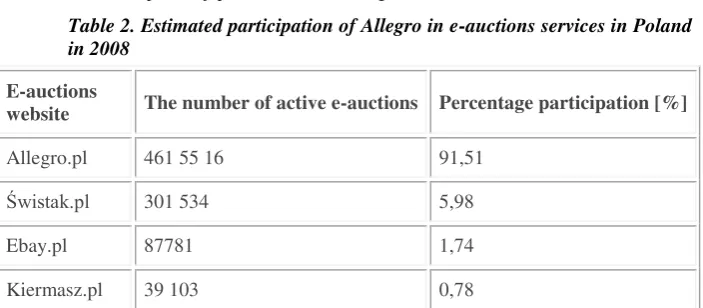
As it is presented in chart 1, from 2003 to 2006 Polish e-commerce market value increased more than 6 times. It’s very important to indicate Polish e-commerce phenomenon – Allegro.pl – the leader of Polish e-auction services. The value of sales turnover in Allegro is bigger than the value of sales turnover in all Polish Internet shops. One can put forward a hypothesis that Allegro outlines development of Polish e-commerce. Of course it is not the only Polish e-auctions service, but it has a great participation in the whole e-auctions market (in August 2006 – 77,56%; in August
2
2008 91,51% - see Table 1 and Table 2). Presenting evolution of Polish e-commerce one should notice the domination of Allegro over other e-auction services and great participation in total e-commerce sales turnover in Poland (see Chart 1).
[image:6.459.52.406.247.432.2]The author of this article regularly tracks Polish blogs concerning e-commerce (e.g. http://ecommerce.blox.pl/html). Reading comments and articles one can come to conclusion that the monopolistic position of Allegro will be weakened, because the market will be shared more evenly between many growing Internet shops. On the other hand, people who sell in the Internet still suspend marketing expenditures on their own e-shops, explaining that Allegro platform is good enough to gain satisfactory profit without taking risk. Expenditures on e-branding, SEM, buying sponsored links can be risky even if they work for greater incomes in the future. Will the year 2008 change the Allegro domination and overall Internet shops sales turnover will exceed e-auction sales turnover? The answer to this question is difficult. The number of professional Internet shops grows, but on the other side e-auctions turnover still increases, especially in Allegro.pl
Table 1. Estimated participation of Allegro in e-auctions services in Poland in 2006
E-auctions
website The number of active e-auctions Percentage participation [%]
Allegro.pl 1 569 930 77,56
Świstak.pl 183 907 9,08
Ebay.pl 182 517 9,01
Kiermasz.pl 45 463 2,24
Aukcje24.pl 42 103 2,08
[image:6.459.56.408.424.578.2]Source: http://aukcjepl.info, (data: 28th August 2006, 17:45)
Table 2. Estimated participation of Allegro in e-auctions services in Poland in 2008
E-auctions
website The number of active e-auctions Percentage participation [%]
Allegro.pl 461 55 16 91,51
Świstak.pl 301 534 5,98
Ebay.pl 87781 1,74
Kiermasz.pl 39 103 0,78
In the analysed phase the popularity of Internet partnership programs had grown. The great example is Allegro partnership program, which attracted many customers to this service. Allegro paid for every click on banner which lead to Allegro.pl. The number of banners which redirected to Allegro site were huge, and a wide stream of new visitors flowed incessantly hour after hour.
The analysed phase is also characterised by a diversification in payment methods in Internet shops. Electronic banking became more and more popular. In this time services like Platnosci.pl and Przelewy24.pl came into existence and offered Internet shops extensive payment services. Until then Internet shops could only cooperate with the earlier mentioned credit card authorization centres: Polcard and eCard. Conditions offered by Platnosci.pl and Przelewy24.pl were much more profitable, so the number of e-shops which cooperated with that services grew very quickly. It is important to mention, that these services offer not only credit card authorization, but also interfaces for electronic banking. If the shop works on popular software (e.g. OsCommerce, SOTEeSKLEP etc.) Platnosci.pl and Przelewy.pl offer ready to use software platform, which can be implemented with no additional IT costs.
In the described phase customers became more trustful to Polish e-commerce. It is the result of more professional customer service in Internet shops. The second important reason was positive atmosphere concerning e-commerce created in the media.
Chart 1 Value of Polish e-commerce market (left values e-shops, right values e-auctions)
Source: Grzechowiak M., Jarosz P., Raport „E-commerce 2007”
4.
Third phase
–
from 2007
comparison services pop up like mushrooms (e.g. www.leku.pl – pharmacy market price comparison service, www.taniachata.pl – building market price comparison service).
Internet shops begin to compete not only with price but also with additional advisory services. The role of Internet shop added value grows - in some trades professional customer service becomes more important than low price.
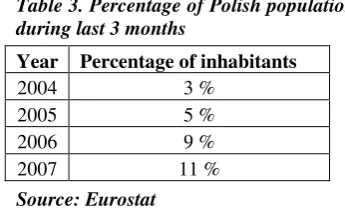
The percentage of Polish population, that buys via the Internet grows. As it is shown in Table 3, in 2007 11% of inhabitants bought goods over the Internet. In the following years this percentage of population will surely grow. As it appears from
Report “E-commerce in Poland”, which was prepared by Gemius SA, 66% of Polish Internet users bought goods over the Internet at least one time. The same report shows, that more than one third (37%), of people who buy over the Internet, do it at least once per month and 41% several times a year [Report „O kondycji polskiego e
[image:8.459.82.255.257.367.2]-commerce”]. It is obvious that considerable percentage of population buys in the Internet rather occasionally. These people probably do not see the advantages of e-commerce.
Table 3. Percentage of Polish population, who bought sth over the Internet during last 3 months
Year Percentage of inhabitants
2004 3 %
2005 5 %
2006 9 %
2007 11 %
Source: Eurostat
The above mentioned report shows that factors which decide of e-shopping popularity are, above all, prices, which are lower than in traditional brick and mortar shops; the possibility to order products 24h a day and the delivery directly to your doors. Internet auctions are more popular than Internet shops – over three quarters of Internet customers buy on e-auctions and 60% in e-shops [Report „O kondycji polskiego e-commerce”]. This data confirms the dominant position of Allegro.pl who is the unquestioned leader of e-auctions market.
It is important to mention about the phenomenon which has a great influence on Polish e-commerce background. One can read in the document published by Ministry of Finance under the title: “The tasks for tax inspectors in year 2007”:
„In 2006 the number of tax inspections concerning Internet trade had grown. Enlarging scale of this occurrence forces the tax inspectors to detailed interest in this part of market and gaining adequate methods of control.” [www.mofnet.gov.pl].
elasticity of demand, because one can immediately compare prices in different shops (e.g. using price comparison services). Therefore the Internet black market has the great influence on the kind of competition in Internet shops. The price competition may not be a good way to attract customers.
New trend in e-commerce is social character of e-shops. Internet shops try to implement WEB 2.03 elements into their websites. This should lead to gathering of the community associated with the e-shop. Some examples of Web 2.0 business models that attempt to generate revenues in online shopping are referred to as social commerce and social shopping. Social commerce creates user-generated marketplaces where individuals can set up online shops and link their shops in a networked marketplace, drawing on concepts of electronic commerce and social networking. Social shopping involves customers interacting with each other while shopping, typically online often in a social network environment [Stephen et al, 2008]. Active clients who take part in creating additional content of Internet shop are often awarded special credit points, extras or sometimes a free delivery.
It is worth to mention two opposite tendencies, which can be observed in Polish Internet shops. The first tendency is product specialization. As an example one can give sectioning off a part of the horizontal shop Avantizakupy.pl into a new vertical shop Skarpetkowo.pl which sells only socks. One can observe the opposite tendency in Merlin.pl, which extended assortment with new product categories: toys, electronics, cosmetics and house and garden equipment. Another example of widening assortment is reorganization of Max24.pl, which sold only audio/video equipment and household appliances, into a hypermarket which has a huge range of products - 2081892 records (data from 03.09.2008).
An important positive factor which has a great influence on e-commerce development is a more advanced software offered in e-shops applications. Currently there are several dozens of e-shop software. Some of them have very extensive functionalities, among others: integration with price comparison services, electronic data interchange with accounting software and inventory control software, generation of many analytical reports. Also the open-source software (e.g. the most popular OsCommerce) are extended with many new functionalities, which can provide advanced software without spending money.
The great competition among hosting services forced lowering of prices. Companies which do not need dedicated servers, but want only a virtual server for a small Internet shop, can find very cheap offers. The prices for standard hosting begins with several dozen zloty, including a domain and an enhanced administration panel with built-in e-shop software. Such solutions do not demand any IT knowledge, so even person who knows nothing about PHP, HTML and Java can run their own Internet shop.
3
Electronic payment systems have become common, and every bank offers Internet access to its account. Popularity of electronic payment systems has a great influence on e-commerce development, because transaction facilitation and decreasing costs of delivery (the cost of sending a pay-on-delivery parcel is higher than the cost of sending a parcel without payment).
Internet shops have collected a considerable database of customers during last few years. This can be treated as a characteristic feature of achieving a mature phase of development. These databases can be used in such Internet marketing tools like mailing to reach customers with new offers.
Very interesting phenomenon which can be described as “from riches to niches” concerns range of assortment offered in Internet shops. Very specialised, niche shops pop up like mushrooms. Also the number of horizontal e-shops offering not only hits, but also the long tail of products is still growing. This is the natural result of the fact that Internet retailers, can aggregate demand on a national or even global scale. With the potential Internet market approaching millions of consumers, even if one has one-in-a million tastes, there are still over a thousand like-minded consumers who share their niche tastes [Brynjolfsson et al, 2006].
It is worth to mention that Internet shops more often buy sponsored links in the Internet search engines like Google. The value of SEM expenditures in 2007 is estimated on 146,3 million PLN [Report IAB Poland]. Sponsored links and search engine positioning are more and more often used to attract customers. It is expected that with the growing competition among Internet shops, prices of sponsored links, which are set by the auction method will increase. Also the possibility to position the Internet shop website well will demand more expenditures.
In this phase e-commerce thrived and its participation in global market began to be noticeable.
5.
Forth phase
–
internationalization
The last shown phase which can proceed parallel with the previous one is internationalization of Internet shops. As more and more e-shops owners will make out the chance of selling products abroad, the number of international e-shop websites interfaces will grow. Also the customers will analyze the offers from foreign Internet shops.
The natural result of internationalization will be a growing number of price comparison services which compare prices from international e-shops. This kind of price comparison services will not only compare prices and automatically convert currencies, but will also calculate costs of international shipping.
an e-shopping mall are much lower than opening the brick and mortar branch in a foreign country.
Internationalization of the Internet trade has great influence on the general structure of international brick and mortar trade. The possibility of buying through the Internet in foreign countries in such an easy way will decrease the role of traditional importers. The major factor which could eliminate some of the brokers is lower cost of retail international shipping. It is very probable that this cost will be reduced because of the growing competition between shipping services and their increasing turnover.
Summary
The phases of Polish e-commerce development presented in this article show its process of evolution. It is very probable that in the nearest future we will observe an Internet shopping boom. In the next years the percentage of Internet users who buy in network will increase. Growing competition forces innovations on Internet shop owners, and that will have a positive influence on e-commerce development. As it was mentioned, in the next few years we will notice an expanding internationalization of click and mortar trade, so Polish e-shops will have a chance to draw customers to their shops. They also should be afraid of international competition.
Summing up, after many years of slow development and technological backwardness, Poland dynamically makes up for lost time. The obvious reason of telecommunication backwardness was monopolistic position of the national operator Telekominikacja Polska. There is hope that in the next few years the high number of IT and economic faculty students and growing competition in telecommunication market will make e-commerce one of the driving forces of Polish economy.
References:
1. „Zadania dla urzędów kontroli skarbowej na rok 2007”, Ministerstwo Finansów, Departament Kontroli Skarbowej I, Warszawa, January 2007, http://www.mofnet.gov.pl/_files_/ks/zadania_na_2007_26_01.pdf
2. Augustyniak Sz., Polski e-handel B2C według I-Metrii, Internet Standard, 25 marca 2002 3. Erik Brynjolfsson, Yu Hu, Michael D. Smith, “From Niches to Riches: The Anatomy of
the Long Tail”, Sloan Management Review, Summer 2006, http://www.heinz.cmu.edu/~mds/smr.pdf
4. Eurostat: electronic database:
http://epp.eurostat.ec.europa.eu/extraction/retrieve/en/theme4/isoc/isoc_ec_ibuy
5. Grzechowiak M., Jarosz P., Raport „E-commerce 2007” electronic version: http://www.Internetstandard.pl/news/143692_1.html
6. http://en.wikipedia.org/wiki/Price_comparison_service 7. http://pl.wikipedia.org/wiki/Neostrada
8. http://www.sklepInternetowy.waw.pl/historia.html 9. http://www.winter.pl/Internet/w1039.html 10. http://www.winter.pl/Internet/zakupin.html
11. Myśliwiec G., Garczyński P., Perspektywy handlu Internetowego w Polsce na przykładzie portalu aukcyjnego Allegro.pl. Wybrane kwestie, e-Mentor, Warszawa, 4/2006, http://www.e-mentor.edu.pl/artykul_v2.php?numer=16&id=322
13. Raport „O kondycji polskiego e-commerce”, http://www.gemius.pl/pl/aktualnosci/2008-07-23/01, 2008-07-23
14. Stephen Andrew T., and Toubia Olivier, “Deriving Value from Social Commerce Networks” (September 21, 2008). Behind Wikipedia.org
15. Strzałka P., „Polski Internet ma 15 lat”, http://www.webdiary.pl/news+art.id+715.htm, publication date: 2006.08.29 , 09:20:31