The London School of Economics and Political Science
S patial aspects o f the economic developm en t process
Massimiliano Cali
UMI Number: U514456
All rights reserved
INFORMATION TO ALL USERS
The quality of this reproduction is dependent upon the quality of the copy submitted.
In the unlikely event that the author did not send a complete manuscript
and there are missing pages, these will be noted. Also, if material had to be removed,
a note will indicate the deletion.
Dissertation Publishing
UMI U514456
Published by ProQuest LLC 2014. Copyright in the Dissertation held by the Author.
Microform Edition © ProQuest LLC.
All rights reserved. This work is protected against
unauthorized copying under Title 17, United States Code.
ProQuest LLC
789 East Eisenhower Parkway
P.O. Box 1346
f
4231
D ecla ra tio n
I certify that the thesis I have presented for examination for the MPhi 1/PhD degree o f the London School o f Economics and Political Science is solely my own work other than where I have clearly indicated that it is the work o f others (in which case the extent o f any work carried out jointly by me and any other person is clearly identified in it).
The copyright o f this thesis rests with the author. Quotation from it is permitted, provided that full acknowledgement is made. This thesis may not be reproduced without the prior written consent o f the author.
Abstract
In recent years the spatial dimension of economic development has attracted increasing interest in the development field. However there is still little analysis and evidence of the ways many spatial dimensions interact with other economic dimensions in the development process. This thesis aims to help filling this gap by bringing a geographical perspective into development economics frameworks. It is empirical in nature and uses data on different sub-national units from India and Uganda. The work is structured around four main papers (divided into six chapters).
The first paper analyses two important aspects o f the Indian urbanisation process. First it finds a U-shaped relation between rural-urban disparities in living standards and income per capita across Indian states in the Post-Independence period. Second, it shows that the urbanisation process in India has been characterised by convergence in the 20th century: smaller towns grow faster than large ones.
The second paper examines the role o f the agricultural sector in influencing the shape of the urban system. The analysis suggests that the elasticity o f rural-urban labour supply increases both urban primacy and the urbanisation rate in Indian states during the Post- Independence period.
The third paper tests for the impact o f urban growth on rural poverty using a sample of Indian districts in the period 1981-1999. It finds that urbanisation reduces poverty surrounding rural areas. This effect is largely attributable to positive spillovers from urbanisation rather than to the movement o f the rural poor to urban areas.
Acknowledgements
Although the thesis is obviously the product o f an inherently individual effort, in a way it is also the result o f a collective process. In fact these pages would not have seen the light without the comments, the suggestions, the dedication and the passion of several people during these long and exciting five years.
I am extremely indebted to my supervisor Henry Overman for his guidance and support throughout the entire PhD. His thorough comments and suggestions have always been spot on and have improved enormously the work in all its aspects. Equally important have been his constant support, encouragement and the speed with which he has examined all the material that I have ever sent him. These factors have made the development o f the thesis a much smoother and more enjoyable (i.e. less painful) process. Henry has not been the only person in the department o f Geography to have contributed to this work. The interactions with the academic staff have improved various parts o f the thesis. In this respect I am particularly grateful to Steve Gibbons, Ian Gordon, Frederic Robert-Nicoud, Andres Rodriguez-Pose and Olmo Silva. Similar thanks also go to my PhD colleagues: my co-author Carlo M enon who I hope will take responsibility for the eventual errors in chapter 4 (;-)), Rosa Sanchis-Guamer, Filipe Lage de Sousa, Roberto Picchizzolu, Jayaraj Sundaresan, Achileas Tsamis.
Pursuing a PhD while working would not have been feasible without the support o f an exceptional team o f colleagues at the Overseas Development Institute (ODI). Not only have they always guaranteed the necessary flexibility, but they have also helped me develop lines o f research relevant to my PhD within the ODI work, often providing useful and pertinent comments. In this respect I am grateful in particular to Dirk Willem te Velde, who has been instrumental to achieve the necessary synergies between my work and the PhD. Thanks also go to Sheila Page, whose thorough (and direct) comments have enhanced the rigour o f my research, and to Edward Anderson for the extensive discussions on the Ugandan chapters. I am also indebted to Kunal Sen, whose passion for development economics (and for the Indian economy) is partly responsible for m y decision o f pursuing a PhD after my Masters.
A special thank you goes to my parents, and to my brother Fabrizio: they have shared quite a bit o f the burden o f the thesis’ process guaranteeing constant enthusiasm and unabated support from day 1. Their support went as far as asking me about specific questions about the pow er o f some o f the instruments used in the thesis! I also would like to thank Scimo not only for his spaghetti carbonara, but possibly more for the passionate discussions (maybe save those on religion) and constant encouragement that contributed to the thesis more than he probably thinks. And I am also grateful to Andres for las hermosas charlas part o f which are embedded in chapters 2 and 3.
Last but by no means least, the biggest thank you goes to m y partner Frenci. She has been a constant source o f inspiration and encouragement: a loving, caring, hilarious, passionate, witty, tough, sweet companion, friend, and adviser. From the intuitions related to urbanisation in India to the patience used in coping with the absence o f my mind lost in PhD related thoughts, her contributions to this work are too many to list here or even remem ber all. This thesis would not have been possible without her presence in m y life. To her go my gratitude and love as well as this thesis, which is dedicated to her.
TABLE OF CONTENTS
A b s tr a c t... ii
A cknow ledgem ents...iii
In tro d u c tio n ... 1
C h a p te r 1. U rb a n isatio n , in equality an d developm ent: E vidence fro m In d ian states an d to w n s... 13
1.1. Introduction and scope o f the w ork... 13
1.1.1. Rural-urban inequality and economic developm ent... 14
1.1.2. Size and growth o f cities...16
1.2. Rural-urban disparities... 19
1.2.1. D ata... 22
1.2.2. Graphical evidence...24
1.2.3. Regression an a ly sis... 27
1.3. Convergence and the determinants of tow ns’ grow th...34
1.3.1 Robustness checks... 38
1.3.2 Urban agglom erations... 41
1.3.3 Fixed effect analysis... 42
1.4 Conclusions...44
Appendix 1 .1 ... 47
Appendix 1 .2 ... 48
C h a p te r 2. O n the connection betw een the a g ric u ltu ra l sector a n d u rb a n isa tio n p a tte rn s in a developing c o u n tr y ...51
2.1. Introduction...51
2.2. Related literature... 52
2.3. A simple theoretical framework...55
2.3.1 Urban labour dem and...57
2.3.2 Urban labour su p p ly ...58
2.3.3 Equilibrium... 60
2.3.4 Comparative statics... 61
2.3.5 Equilibrium with imperfect labour mobility between c itie s ... 65
2.4 Conclusions... 66
C h a p te r 3. A g ric u ltu ra l p roductivity and u rb a n p rim acy: E m p irical evidence from In d ia n states... 68
3.1. Methodological fram ew ork ... 68
3.1.1 The Indian context... 69
3.1.2 The intra-country analysis...70
3.1.3 Specifications...71
3.1.4 Dependent variables... 72
3.1.5 Explanatory v ariab les...74
3.1.6 Instrumental variables...79
3.1.7 D ata... 81
3.2. R esu lts... 83
3.2.1 Cross-state relationship... 83
3.2.2 Urban concentration... 85
3.2.3 U rbanisation... 95
3.2.4 Beyond the upper tail o f the distribution... 99
3.2.5 D iscussion... 104
3.3. Conclusions...106
Appendix 3 .2 ... 110
C h a p te r 4. Does u rb a n isa tio n affect ru r a l poverty? E vidence fro m In d ia n districts . 112 4.1. Introduction...112
4.2. Urbanization and rural poverty: C hannels...116
4.2.1 Second round effects...116
4.2.2. Disentangling first and second round effects...121
4.3. Empirical m ethods... 123
4.4. Data and variables... 126
4.5. R e su lts...133
4.5.1. 1981-1999 period...134
4.5.2. 1981-1993 period...138
4.5.3. Further robustness... 139
4.5.4. IV estim ation... 144
4.6. C onclusions...148
C h a p te r 5. R e tu rn s to education in U ganda in the nineties: n atio n al and regional level a n a ly sis...150
5.1. Introduction...150
5.2. Related literature... 152
5.3. D ata and m ethods... 154
5.3.1 D a ta... 154
5.3.2 Empirical specifications...155
5.4. National level analysis... 159
5.4.1 Robustness checks... 166
5.5. Regional analysis... 172
5.5.1 Convergence... 176
5.6. Conclusions...178
A ppendix 5.1... 179
C h a p te r 6. W hy have re tu rn s to education increased in U ganda over the 1990s? A d istric t level a n a ly sis ...183
6.1. Introduction...183
6.2 M ethodology... 186
6.2.1 D a ta... 186
6.2.2 Specifications and variables...186
6.2.3 Instrumental variables... 191
6.3. Determinants o f returns to education...194
6.4. Trade, economic reforms and returns to education... 199
6.4.1. International trade liberalisation... 200
6.4.2. Domestic trade integration... 207
6.4.3 R esults ;... 209
6.4.4 R obustness... 212
6.4.5 M igration...215
6.5. Conclusions... 219
Appendix 6 .1 ...221
C onclu d in g re m a rk s ...223
Introduction
Development fro m space
Even a cursory look at pictures o f the earth at night from a satellite reveals a
number o f interesting patterns about the spatial distribution o f economic activity in the
development process.1 Some of the patterns that emerge from such an inspection
represent the focus of investigation o f this work. Figure 1.1 shows a satellite picture of
the African continent at night in 2008. Most o f the continent is in the dark. If we
exclude North Africa (whose areas on the coast and around the Nile river are fairly lit),
there are a few scattered bright spots mainly in correspondence with urban areas and
only a handful o f larger areas consistently lit: the Eastern part o f South Africa, the
Western Cape, the oil fields in the coast o f Gabon, the greater Lagos and the mines in
northern Zambia. Sub-Saharan Africa can arguably be considered as the first stage of
economic development in which the level of economic activity is generally low except
in a few (relatively isolated) locations.
Figure 1.1: D evelopm ent part I: B right spots in the dark, A frica at night (2008)
Source: NASA
1 This relies on the assum ption that electricity utilisation is a good approxim ation o f the intensity o f econom ic activity (Henderson et al., 2009 and Sutton et al., 2007).
A jum p ahead of a few decades (and a few US dollar thousands per capita) could
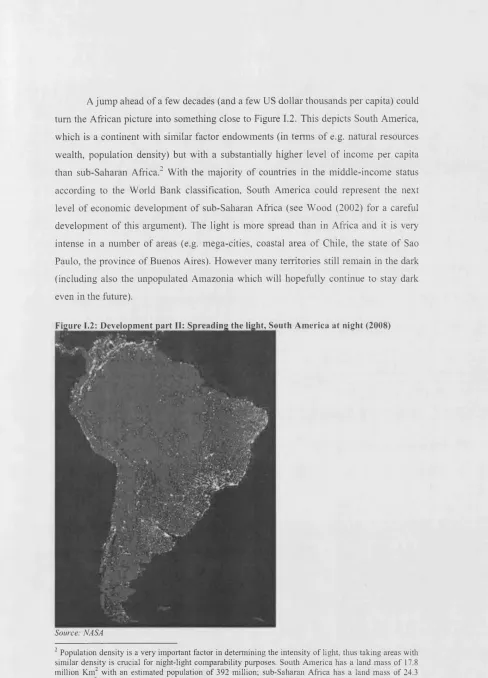
turn the African picture into something close to Figure 1.2. This depicts South America,
which is a continent with similar factor endowments (in terms of e.g. natural resources
wealth, population density) but with a substantially higher level of income per capita
than sub-Saharan Africa.2 With the majority of countries in the middle-income status
according to the World Bank classification, South America could represent the next
level of economic development of sub-Saharan Africa (see Wood (2002) for a careful
development of this argument). The light is more spread than in Africa and it is very
intense in a number o f areas (e.g. mega-cities, coastal area of Chile, the state o f Sao
Paulo, the province of Buenos Aires). However many territories still remain in the dark
(including also the unpopulated Amazonia which will hopefully continue to stay dark
even in the future).
Figure 1.2: D evelop m en t part 11: Spreading the light, South A m erica at night (2008)
Source: NASA
2 Population density is a very important factor in determ ining the intensity o f light, thus taking areas with sim ilar density is crucial for night-light com parability purposes. South A m erica has a land m ass o f 17.8 million K m 2 w ith an estim ated population o f 392 million; sub-Saharan A frica has a land m ass o f 24.3 m illion K m and an estim ated population o f 800 million.
[image:10.595.25.513.35.713.2]While the vast majority of land in sub-Saharan Africa is in the dark, in South
America dark areas coexist with remarkably lit ones. This seems to be consistent with
an uneven pattern of development whereby economic activity and income become
increasingly concentrated as countries progress from low to middle income status (see
evidence in World Bank, 2009). Also, geographic differences in living standards within
countries diverge before converging. These are the stylized facts, based on the
experiences o f successfiil developers over the last two centimes (World Bank, 2009). In
the first stages of development as countries GDP per capita grows, people and
production become concentrated in some parts o f countries, so-called leading areas.
This concentration appears to slow or stop at per capita incomes between US$10,000
and US$15,000 (World Bank, 2009). Both urban economics and New Economic
Geography (NEG) develop models that are consistent at different spatial scales with
such uneven pattern of development (e.g. Henderson, 1988, Venables, 2004). In the
initial stages o f development agglomeration forces (such as urbanisation economies or
demand linkages) induce the clustering of economic activity in a few (or one) locations.
As economies develop, such areas become more congested and activity tends to spread
to other areas as well.
F igure 1.3: D evelop m en t part III: “ E veryth in g is illu m in a ted ”, N orth A m erica at night
Source: NASA
The (spatial) convergence part o f this process is shown in Figure 1.3 depicting
North America, where most land is in the light (“Everything is illuminated” to borrow a
[image:11.595.30.514.32.806.2]title o f a contemporary novel - Safran Foer, 2002). This (spatially) unbalanced pattern
o f development was highlighted already by Williamson (1965), although the literature
has not devoted much attention to it until recently. Chapter 1 o f the thesis tries to help
redress this balance by looking at the relation between development and spatial
inequality from a relatively new angle (see below).
Now take a look at the left hand-side o f Figure 1.4, which is the picture o f South
Asia at night. Light is stronger and more widespread than in the other developing
regions. Nonetheless the region is home to the largest number o f poor people in the
world and its income per capita is lower than any South American countries. This
picture reveals the other dimension (other than income per capita) underlying the
distribution of economic activity across space: the distribution of population. The very
high population density o f South Asia (it has a population 50% larger than Africa with a
land mass almost ten times smaller) rather than its income drives the relatively intensity
o f the light. This high density is reflected in the high density o f towns as well, as shown
in the right-hand side panel of Figure 1.4 where the dots represent the towns of India in
2001. There is a remarkably strong relation between the dots and the light. This relation
provides compelling prima facie evidence of the key role o f urban areas as centres of
economic activity even in a fairly unurbanised country as India. This stylised fact is at
the heart o f this work, a substantial part of which is dedicated to the investigation o f the
causes and consequences o f urbanisation (chapters 2-4).
F igu re 1.4: South A sia at n igh t (2000) and Indian distribution o f tow n s (2001)
Source: NASA and Government o f India (2001)
Although the light in Figure 1.4 is more intense in certain areas (e.g. Indian
mega-cities o f Mumbai, Delhi, Calcutta and Chennai, the Bengali coast) it is
[image:12.595.26.516.28.795.2]substantially more widespread than in the other regions. Still geographical differences
do exist but appear to be more important at lower spatial scales where the darkness o f
rural areas contrasts with the shining large urban ones. This contrast but also the
interconnectedness between urban and rural areas will be the focuses o f the thesis’
analysis on India (chapters 1-4).
These pictures underscore three key spatial dimensions o f the development
process: the unevenness in the spatial distribution o f economic activity, the importance
o f urbanisation in determining such distribution, and the relevance o f the spatial scale to
properly evaluate the inequality o f this distribution. The thesis aims to address all of
these dimensions from different perspectives, using a variety o f quantitative empirical
methods and data (on individuals, urban areas, districts and states). Before turning to its
description it is useful to briefly examine how the economics literature has incorporated
these spatial features in development in order to appreciate the gaps that this thesis
helps to fill.
The Economic geography o f development
Despite the apparent importance o f these spatial features in development the
economics literature on developing countries has been fairly silent on them until very
recently. One reason for this silence is that space has not featured in any major way in
mainstream economics in general until the rise o f New Economic Geography (NEG)
spurred by the seminal work o f Krugman (1991). While recognising the importance of
N EG in m odelling the role o f space in economic development, the thesis is closer to
other strands o f literature, which are more appropriate to capture the types o f spatial
interactions treated here. For example the modelling o f the urbanisation process follows
the urban economics literature in the spirit o f the works o f Henderson (1985, 1988). The
assumptions o f this literature appear to be more relevant than the N EG ones at smaller
spatial scales where local externalities are expected to play a m ajor role (Combes et al.
2005). On the other hand the NEG assumptions make this class o f models better suited
to fairly large spatial units (regions, countries or even groups o f countries) for which
long distance market interactions should play an important role while short distance
effects become o f secondary relevance. These assumptions have oriented the recent
flurry o f N EG based empirical analyses o f developing countries (e.g. Hanson, 1997,
which represents a larger spatial scale than that most o f the thesis is concerned with. In
terms o f the pictures above, this empirical literature addresses questions on which
regions within a country or which macro-regions the light is likely to concentrate m.
The present work departs from these questions and rather focuses on a set of
complementary issues, which need to be addressed at different (usually more refined)
spatial scales. These include the disparities between rural and urban areas, the nature of
the urbanisation process and its relation with the rural sector and the inequality within
sub-national units. Given the focus on the interconnectedness between rural and urban
areas, the thesis draws also on the literature on rural-urban migration inspired by the
traditional development economics literature (e.g. Lewis, 1954, Harris and Todaro,
1970, Lall et al., 2006 for a review).
As such, this work lies at the crossroad between urban and development
economics. It is somewhat complementary to the increasing efforts o f the literature to
fill some o f the analytical and empirical gaps on the ways spatial dimensions interact
with other economic dimensions in development (e.g. the UNU/W IDER research
project on “Spatial disparities in human development” co-ordinated by Ravi Kanbur and
Tony Venable - Kanbur and Venables, 2005 and the W orld Development Report -
W orld Bank, 2009).4 This work aims to help fill these gaps and is guided by three main
general questions: how have welfare related variables been varying across sub-national
units within countries? W hat drives this spatial variation? W hat is the impact o f
government policies on this variation? The following chapters seek to answer these
questions by bringing a geographical perspective into traditional development
economics frameworks. Although empirical in nature, the thesis builds analytical
frameworks in which to ground the results o f the empirical analyses. Some o f the
frameworks developed also introduce innovative elements, which allow the
reconciliation o f the empirical findings with the theory.
3 Examples o f questions addressed by this literature include the effects o f distance to product and factor markets, o f reductions in trade costs on the distribution o f income and production (mainly) across regions within countries.
Looking inside rather than across countries
All o f the chapters in the thesis are based on intra-country rather than (the more
traditional) cross-country analyses. There are two main reasons for this focus. First,
although some spatial features in the process o f development m ay be common across
countries (as highlighted by the pictures above), “the m ost striking pattern that emerges
from the data on the spatial inequality o f developing countries is its varied nature.”
(Kim, 2007). This suggests that national level factors tend to play a disproportionately
large role in shaping the patterns o f spatial inequality in developing countries. These
factors, which may include among others the type o f political system, the factor
endowment and the history o f a country, tend to be deeply embedded in the national
structures and hence are hard to modify in the short run. On the other hand a within
country analysis such as that employed throughout the thesis, allows controlling for
national level variables and isolating the determinants o f the variation o f spatial patterns
across sub-national units. Such determinants are likely to be more easily modifiable in
the short-run and their analysis may be more amenable to policy determination. Second,
and related to the previous point, within country analyses are able to evaluate the effects
o f policies affecting spatial inequalities by exploiting the differential effects across sub
national units.
However this type o f intra-country approach poses also special challenges
especially when it is applied to developing countries. Macro data at the sub-national
level is not often readily available for developing countries. India is an exception in this
respect as it enjoys long-spanning detailed data collection processes on a variety o f
socio-economic variables. I exploit such richness o f data in the subsequent analyses,
using data derived from the national Statistical Census (Government o f India, various
years), from household and agricultural surveys. This allows the thesis to focus on a
number o f different spatial scales, including states, districts and cities, which are
adequate to address different types o f questions (chapters 1-4). But most developing
countries have much less data available for analysis than India, especially among least
developed countries (LDCs). These countries often rely on externally funded data
collection processes that try to fill the data gaps. One such country is Uganda, where the
W orld Bank has carried out two household surveys (Living Standards Measurement
Survey) over the 1990s. I use them by aggregating individuals and community level
This allows me to analyse labour market inequalities in a LDC context from new angles
and through innovative methodologies (chapters 5-6).
Perhaps a more important drawback o f the intra-country analysis is the natural
limitation that such analysis imposes on the researcher in terms o f the number o f
observations. That is the case for instance in the empirical analyses based on Indian
states (chapters 1 and 3), where consistent data is available for the 16 m ajor states. In
the context o f an econometrics framework such as that em ployed throughout the thesis,
this relatively small N has at least two implications. First, a large part o f the variation in
the data comes from the time dimension, unlike in m ost cross-country analyses, which
mainly rely on the large cross-sectional variation for identification. One challenge
related to this is that the instrumental variable estimation eventually employed to correct
for the potential endogeneity o f some regressors needs to rely on time (and cross-
section) varying instruments. This condition rules out the use o f time invariant
geographical instruments, which have proven increasingly popular in the m odem
literature. A further complication is that the use o f datasets with small N does not fulfil
the conditions needed to employ the General M ethod o f M oments (GMM) estimation,
which is another popular way to correct for die endogeneity o f the regressors (Arellano
and Bond, 1991; Blundell and Bond, 1998). This m ethod is only efficient
asymptotically and is therefore suitable for samples w ith large N and small T. Second,
in the absence o f fairly high frequency data (e.g. annual), the overall number o f
observations is relatively small. For instance as population data in India is collected
every ten years, the urbanisation analysis across Indian states relies only on five distinct
periods (chapter 3). This reduces the theoretical m aximum num ber o f observations to 80
(and in practice they are often slightly less). This creates a further challenge in terms o f
the estim ates’ precision, increasing the difficulty o f obtaining significant coefficients
relative to other Indian states’ analyses based on a large num ber o f time series
observations (e.g. D att and Ravallion, 1996, Besley and Burgess, 2000, 2002 and 2004,
Rud, 2009). Despite these challenges I make an effort to seriously tackle the estimation
issues facing the analyses throughout the thesis, without (hopefully) compromising on
the rigour typical o f good quality research.
As mentioned, the testing grounds o f the thesis’ intra-country analyses are two
developing countries representative o f different phases (and possibly types) o f
low level o f urbanisation.5 Given the sheer size o f its population it is the largest
provider o f new urban dwellers, although it is urbanising fairly slowly. Between 1981
and 2001 it has added 126 million urban dwellers and is expected to add a further 280
m illion urban dwellers by 2030 (see Chapter 4). Understanding the causes and
im plications o f such massive urbanisation process is crucial for the future welfare o f the
country (which is also home to the largest nmnber o f poor in the world). The first four
chapters o f the thesis focus on India and address these issues through new types of
em pirical analyses.
Overview o f the thesis
Chapter 1 provides a description o f two important (but under-researched)
aspects o f the urbanisation process using data on Indian states and cities. First it looks at
the evolution o f rural-urban inequality across Indian states in the Post-Independence
period and at its relation with economic development. This analysis departs from
existing ones not only in that it concentrates on sub-national units, but also in that it
seeks to establish a relation between rural-urban disparities and economic development
(m easured by income per capita). This approach tackles one important shortcoming of
m ost existing literature on the relation between inequality and economic growth which
does not separate out the different components o f inequality (i.e. rural-urban, intra
urban and intra-rural). The results o f the analysis support the idea o f a U-shaped relation
betw een rural-urban disparities in socio-economic indicators and income per capita. The
second part o f the chapter examines the urban-counterpart o f the rural-urban inequality
analysis o f the first part, by analysing the (population) growth o f Indian urban areas in
the 20th century. It explores the determinants o f the growth (in size) o f Indian cities,
focusing in particular on the question o f convergence in growth rates. In the context o f
an urbanising country the analysis o f convergence is important as it answers the
question o f whether larger cities grow slower than sm aller ones. As policy-makers are
concerned that large cities especially in developing countries are growing too large, the
absence o f convergence, or even the presence o f divergence may support the idea o f the
state’s intervention to tilt the balance o f the urbanisation process in favour o f smaller
cities. However the evidence suggests a strong non linear pattern o f convergence
process: city size is inversely associated with subsequent growth up to a point after
which the relationship becomes positive.
This may fuel the policy-makers’ concern with respect to the growth o f m ega
cities, which m ay expand beyond their efficient scale, while the forces towards
agglomeration make it difficult to rebalance the growth across urban areas (Venables,
2006). As such there m ay be a case for policy intervention to decentralize activity, “but
we remain woefully ignorant about what works and what doesn’t” {ibid., p. 20). Chapters 2 and 3 try to contribute to fill this gap. They focus on the role o f the
agricultural sector (i.e. the m ain push factor o f the urbanisation process) in influencing
the rate o f urbanisation and the distribution o f urban population across cities, and
particularly in the largest city. Such a focus is novel to the literature in search o f the
determinants o f urban concentration (and urban primacy), e.g. Ades and Glaeser, 1995;
Davis and Henderson, 2003. This literature has tended to concentrate on pull factors
instead (i.e. the factors pulling people into urban areas). This focus is consistent with
urban systems models, which do not pay much attention to rural-urban interaction and
to the structural shift in economic activities from agriculture in rural areas to
manufacturing and services in cities (Kim, 2007).6 For policy makers in developing
countries, these models o f urban inequality are likely to prove inadequate guides for
understanding urban inequality. Chapter 2 develops an analytical framework trying to
incorporate rural-urban migration into an urban economics setting in order to find a
relationship between the elasticity o f rural-urban labour supply and the urbanisation
pattern. The urban economics model determines the urban labour dem and curve while
conditions in the rural sector determine the urban labour supply.
Chapter 3 provides an empirical analysis based on this framework using both the
share o f urban population and measures o f urban concentration as dependent variables.
The analysis is perform ed using an intra-country panel data from India for the Post-
Independence period rather than the traditional cross-country analysis. Such a strategy
allows one to control for the effects o f national level variables and to better isolate the
impact o f agricultural variables on urbanisation. Using Indian states as the unit of
analysis guarantees that the assumption o f inter-state immobility o f labour, a necessary
condition for the analysis, is reasonably realistic. A num ber o f rural variables, including
agricultural land productivity, agricultural wage and the demographic composition of
the rural population are used to proxy the elasticity o f labour supply which is not
observed directly. These variables are also instrumented via rainfall levels and land
reform legislation to address their potential endogeneity to urban variables. The results
support the idea that the elasticity o f rural-urban labour supply has a positive (and
causal) effect on urban primacy and on the urbanisation rate.
Chapter 4 provides a symmetrical perspective to the previous chapters, by
examining the impact o f urbanisation on poverty in surrounding rural areas with a
sample o f Indian districts in the period 1981-1999. Again this is an under-researched
question but a relevant one in a period o f increasing urbanisation in most developing
countries. This analysis becomes more important when considering that most o f the
w orld’s poor reside in rural areas, where the incidence o f poverty is higher than in urban
areas. In particular, with over 316 million o f $1/day rural poor in 2002, India is home to
36% o f the w orld’s rural poor (the largest num ber in the world). The chapter represents
one o f the first efforts to map the channels through which an expanding urban area may
affect poverty in surrounding rural areas. In particular it distinguishes between first and
second-round effects o f urbanisation and tries to disentangle them empirically. The
former involve only a statistical association between urbanisation and changes in rural
poverty due to the change in residency o f some rural poor (who m ay or may not be
lifted out o f poverty in their move to the urban areas). On the other hand, second-round
effects capture the impact o f the urban population growth on the rural rate o f poverty.
Such a relationship is causal in nature and should tell us how good or bad urbanisation
is for rural poverty. The results suggest that urbanisation has a substantial and
systematic poverty reducing impact in surrounding rural areas, which is mainly
attributable to second round rather than first-round effects.
The first chapters concentrate on the spatial distribution o f population and
income across areas, with a special focus on urban areas. In this sense they are related to
spatial disparities between areas. However most (around two third) o f the economic inequality in developing countries is determined within areas rather than between them (Kanbur and Venables, 2005, Elbers et al., 2005 and Demombynes et al., 2003). The
last part o f the thesis (chapters 5 and 6) focuses on this type o f within area inequality by
using one o f its m ost popular measures, i.e. labour m arket inequality (as measured by
empirical setting complementary to the Indian one. Uganda is a LDC with lower levels
o f income per capita than India. It has much smaller population and area. In terms o f the
night light pictures above, this implies that unlike India, Uganda is almost entirely in the
dark. B ut similarly to India Uganda underwent a substantial economic liberalisation
process (and experienced sustained economic growth) during the nineties. This process
has been associated with rising inequality at the national level (as highlighted by the
findings in chapter 5), a result which apparently seems inconsistent with the predictions
o f traditional trade theory. The district level analysis undertaken in chapter 6 helps
reconcile the rising returns to schooling with this trade theory.
Chapter 5 develops the empirical framework to m easure labour market
inequality via returns to schooling, both at national and sub-national levels. This
measure o f inequality is interesting also in relation to the importance given by the
government and the donor community alike to investment in education to raise the rate
o f growth and poverty reduction in many sub-Saharan African countries (including
Uganda). Through the framework the chapter examines the evolution o f disparities in
Uganda in the nineties at the national and regional level showing in both cases a steep
rise in returns to schooling (with substantial variation across regions). Chapter 6 uses
this empirical framework to analyse the inequality within districts in the same period. It
tests for the effects o f both educational supply and demand related factors on the wedge
between skilled and unskilled labour, finding that both factors are important to explain
such wedge. The estimation controls for the likely endogeneity o f the educational
variables, instrumenting them through a set o f variables based on com m unities’ distance
to prim ary and secondary schools. Importantly, the chapter also examines the likely
im pact o f some policy shocks, i.e. the trade liberalisation and the facilitation in cross
district trade, on such inequalities. The results suggest that while trade opening reduced
this wedge (in line with standard H -0 theory), pro-m arket reforms increasing trade
across districts raised it in districts with a relatively larger skilled labour force.
In a world where policy-makers are increasingly interested in spatially focused
policies such as migration restrictions, political decentralisation and development of
export prom otion zones, increasing our understanding o f spatial issues is a key step for
adequate policy formulation. The hope is that this w ork may represent a small
Chapter 1. Urbanisation, inequality and development:
Evidence from Indian states and towns
1.1. Introduction and scope o f the w ork
The process o f economic development is generally accompanied by the
structural transformation o f the economy, whereby the rural population mainly
employed in agriculture turns into an urban one shifting towards industry and eventually
services. Although such a process is a well established fact, we still lack a clear
understanding o f its relations with the spatial dimensions o f inequality. In particular,
two important and complementary aspects o f this inequality in the transition process
have received relatively little attention so far. The first relates to the inequality between
rural and urban areas. W hat changes in welfare do rural and urban areas experience in
the process o f economic development? Is there a systematic relation between rural-
urban inequality and income per capita growth? The urban counterpart o f this question
focuses on the way different urban areas are affected in the rural-urban transition. Are
small and large urban areas differently affected along this transition? Is there a
convergence or a divergence process in cities’ growth rates as a country urbanises?
Answers to these questions are important to gain a better understanding o f the
nature o f both the rural-urban and the within urban transitions. This chapter addresses
both types o f questions empirically by employing different types o f data. I use the
difference in direct measures o f wellbeing between rural and urban areas in order to
examine the relationship between rural-urban disparities and per capita income. As
these direct measures o f welfare are not available for cities, I use population growth as a
proxy o f wellbeing for urban areas, as argued by Glaeser et al. (1995). I investigate the
different questions o f the empirical analysis using Indian states over the Post-
Independence period and Indian towns over the 21st century as the units o f analysis. In
this way I can exploit the richness o f contexts within the Indian sub-continent,
controlling for m any o f country level unobservables that undermine the robustness o f
inferences from cross-countries studies. India is currently experiencing the type o f
structural transformation process mentioned above. Although its rate o f urbanisation is
largest source o f new urban dwellers in the next decade (according to UN, 2008). Thus
the findings from this analysis may be particularly relevant in assessing the possible
implications o f such a massive urbanisation process. This analysis provides also a
characterisation o f this urbanisation process in India, w hich is useful to put the results of
the subsequent chapters in context.
1.1.1. Rural-urban inequality and economic development
The relationship between income distribution and economic development was
first identified by the seminal work o f Kuznets (1955). His work hypothesised an
inverted U shaped relationship between income and inequality: the initial stage o f a
country’s economic development would be associated with rising inequalities up to a
point (during the middle-income stage o f development), after which inequalities would
decrease with income per capita.
I find it useful to split income inequality along a spatial dim ension into a within-sector and a between-sectors component. The latter relates to the income disparity between the rural and the urban sector while the former refers to intra-urban and intra-
rural inequalities. This chapter is concerned with rural-urban inequality, which usually
explains the m ajority o f a country’s inequality in the early stages o f the development
process. For instance Kanbur and Zhang (1999) find that over 70% o f overall inequality
in China was explained by the rural-urban component over the period 1983-1995.7
Frankema (2006) argues that this component o f inequality m imics the relationship
between overall inequality and income growth. In the initial phase o f development the
urban sector expands due to rapid urban labour productivity growth. This widens the
rural-urban income gap as the increase in rural productivity is m ore sluggish. After
peaking, rural-urban dualism declines and eventually dissolves in the long run as rural
labour productivity catches up following rural-urban m igration and technology and
dem and spill-overs from the urban sector. Evidence from Latin American countries in
the 20th century supports this type o f relation (Frankema, 2006).
Such a relation has important similarities with the one between regional
inequality and economic development within a country. The w ork in this area has been
inspired by the analysis o f W illiamson (1965), who found that regional disparities
would bear a typical inverted U shaped relation with income per capita. NEG models
are suitable to provide the theoretical intuition for this pattern (e.g. Fujita et al. 1999;
Venables, 2004). This relies on the tension between centripetal forces towards
concentration o f economic activity and centrifugal forces towards dispersion. The
former can be driven for instance by labour mobility (i.e. a large m arket creates jobs and
workers’ expenditure makes the market larger, as in Krugm an 1991) or input-output
linkages (i.e. firms create the market for other firms, as in Venables 1996). Such
centripetal forces would prevail in the early stages o f development, causing a process o f
cumulative causation which reinforces the initial advantage o f the more advanced
region/location. This concentration process would continue until the level o f economic
activity reaches a threshold, after which the congestion costs from agglomeration
(centrifugal forces) would offset the centripetal forces, dispersing economic activity
again.8 These models may provide some micro-foundations for explaining the
divergence-convergence hypothesis o f the rural-urban model.
W hile the relationship between regional inequalities and economic development
has been the subject o f increasing interest, relatively little empirical evidence is
available on the rural-urban inequality-income relation. Although the analysis o f rural-
urban dualism has enjoyed increasing attention in the recent development literature (as
wished by Bourguignon and M orrison in 1998), this has tended to focus on a handful o f
countries, and particularly China (Park, 2007, Knight et al., 2006). Importantly, the
main focus o f these studies has been the evolution o f rural-urban inequality over time
(e.g. Ravallion and Chen, 2007, Ferreira et al., 2008, Sahn and Stifel, 2003) or its
relation with the urbanisation process (Park, 2007, Lu and Chen, 2006). On the other
hand the relationship between rural-urban inequality and economic development has
received little attention. Arguably, this is also due to the failure to separate the sub
components o f the inequality-income relationship. M ost literature concentrates on the
relation between inequality and economic growth without distinguishing the different
components o f inequality (i.e. rural-urban, intra-urban and intra-mral). This may lead to
overlook countervailing forces hidden in the catch-all income inequality variable, which
may help explain why the inverted U-shaped Kuznets’ hypothesis is still empirically
controversial, although it seems to fit a number o f countries’ development processes,
including the recent growth experience o f China.9
The first part of this chapter analyses the relationship between rural-urban
inequality and economic development in Post-Independence India. It is worth noting
from the outset that there is no presumption to identify any causal relation in this
context, for the main objective is to examine whether a systematic association between
economic development and an important component o f inequality does exist
empirically. Understanding the nature o f this relation would be relevant in order to
assess whether the economic development process has an urban, a rural or a neutral
bias.
1.1.2. Size and growth of cities
The second part o f the chapter examines the urban-counterpart o f the rural-urban
inequality analysis o f the first section, by analysing the (population) growth o f Indian
urban areas in the 20th century. It explores the determinants o f the growth (in size) o f
Indian cities, focusing in particular on the question o f convergence in economic growth.
This question links back to the literature in the tradition o f Baumol (1986) and Barro
(1991). The findings from this literature firmly support the idea o f convergence between
sub-national units (e.g. US States) (Quah, 1996), while the evidence on cross-country
convergence is much weaker. In a neoclassical world, these results may be explained by
the limited mobility o f factors o f production, and capital in particular, across countries,
and by the free factors’ mobility within countries.10 Analysing convergence across cities
in one country, where capital and labour are quite mobile at least within states in one
country, provides an interesting testing ground for the convergence hypothesis. Income
growth is a natural measure of productivity growth across countries as labour is
immobile. In contexts where labour is mobile as across Indian cities (within a state or a
district) the situation is different (Glaeser et al.,1995). To the extent that internal
9 A vivid illustration o f this point is provided by Frankema (2006), who finds that the persistent personal income inequality o f Latin America in the 20th century is also associated to declining rural-urban inequality.
migration responds strongly to growth opportunities, population growth captures the
extent to which cities are becoming increasingly attractive labour markets. On the other
hand Glaeser et al. (1995) show that income growth in a city is associated not only with
productivity growth, but also with a decline in the quality o f life. Therefore according to
this view income growth is a less straightforward measure o f urban success than
population growth. The latter is thus a more natural variable to use when testing for
convergence across cities within a country.
In the context o f an urbanising country the analysis o f convergence is important
as it answers the question o f whether larger cities have grown at a different rate than
sm aller ones. To the extent that policy-makers fear that large cities especially in
developing countries are growing too large, the absence o f convergence, or even the
presence o f divergence may support the idea o f the state’s intervention to tilt the balance
o f the urbanisation process in favour o f smaller cities.11 This has been, for example, the
rationale for the Integrated Development o f Small and M edium Towns programme
(LDSMT), implemented by the Indian government since 1979.12
Despite the potential importance of the question o f convergence in cities’
growth, not much empirical evidence has examined it so far. In general the focus o f the
empirical literature on cities’ growth has rather been on the determinants o f city size,
such as hum an capital, unemployment, natural conditions and the industrial base (e.g.
Glaeser et al., 1995, Glaeser and Shapiro, 2001, Shapiro, 2006, Rappaport, 2007, de
M ata et al., 2007). A recurrent finding o f this literature is that hum an capital enhances
the growth prospect o f a city while unemployment has the opposite effect. In the United
States cities with warmer weather have grown more than average in recent decades
(Glaeser and Shapiro, 2001, Rappaport, 2007), while local government spending -
except on highways - was associated with lower growth. Only a few studies devote
some attention to the question o f convergence. Using a cross-section o f US cities
Glaeser et al (1995) find little evidence o f convergence in population growth rates
between 1960 and 1990 (and somewhat more robust evidence for the period 1950-
1970). Similarly Eaton and Eckstein (1997) find that initial population is unrelated to
11 Scott and Storper (2003: 581) argue for instance that urbanisation patterns in developing countries have generated “macrocephalic urban systems consisting of a few abnormally large cities in each country”.
subsequent city growth in France and Japan. On the other hand da M ata et al. (2007)
find some evidence o f convergence for a sample o f Brazilian cities between 1980 and
2000. The present focus on India is particularly interesting in light o f the existing
literature, as it characterises the growth o f cities during the urbanisation process o f the
country. This provides a rather different context to that o f a fully urbanised country (as
in the studies m entioned above), where the majority o f city growth is driven by inter
city migration. As m uch o f the empirical literature on cities’ growth is based on fully
urbanised countries, generalising its findings to (developing) countries in the midst of
the urbanisation process m ay be problematic. One partial exception to it is the work by
Henderson and W ang (2007), who examine urbanisation patterns across countries
between 1960 and 2000. They find that increasing urbanisation is accommodated by the
growth o f small and medium sized cities. Furthermore, democratisation seems to help
smaller cities grow relative to larger ones as it levels the playing field across cities.
However, as for all cross-country studies, the extent to which these results are driven by
time varying unobservable differences across countries is open to question. By
focussing on an individual country this chapter aims to examine some cities’ growth
determinants isolating national level factors.
Alongside convergence, given the data available it is possible to examine some
other determinants o f city growth as well, such as geography, climate and proximity to
large agglomerations. These factors have been shown to be potentially important
predictors o f city growth in fully urbanised contexts. Glaeser et al. (2001), and Glaeser
and Shapiro (2003) find that warm and dry weather was positively associated with city
population growth in the United States at the end o f the 20* century. As noted by
Rappaport (2007) nice weather in the US has becom e a more important consumption
amenity probably due to broad-based rising per capita income. There are reasons to
expect that weather conditions may not be as important determ inants in the case o f India
as they are in more developed economies. First, average incomes in India are still very
low by international standards and therefore weather may still not be considered as an
important consumption amenity by the majority o f the population. Second, the variation
o f weather conditions across India is not as large as in the US, as the vast majority o f
Indian urban areas are concentrated in tropical and semi-tropical geo-climatic areas.
Another determinant o f city growth that can be tested in the analysis is proximity to
that m arket potential (measured as the distance discounted sum o f incomes o f all
m etropolitan areas for any city) is an important determinant o f city growth in Brazil. In
particular, being close to large urban markets raises the city’s productivity.
Finally, I can also test the extent to which growth rates are persistent over time,
a finding that is consistently supported in the case o f US cities (e.g. Glaeser et al., 1995,
Glaeser and Shapiro, 2001). Section 1.3 will explore these features using a panel o f
Indian cities in the 20th century.
1.2. R ural-urban disparities
The basic idea o f this section is to test w hether a relationship exists between
economic development and rural-urban inequality, and what shape it eventually takes.
To the extent that economic progress is associated with urbanisation this analysis is also
related to that o f Chapter 4, which looks at the impact o f urbanisation on rural poverty.
I use three families o f indices to measure the disparities in welfare between rural
and urban areas across Indian states over time:
1) Poverty based measures
2) Consumption based measures
3) Health based measures
The use o f such indicators rather than income based ones is due to the lack of
data on rural and urban incomes at the state level in India. It is also motivated by
another consideration. Although poverty- and consumption-based indicators o f
inequality are obviously inter-related with more traditional measure o f inequality
(calculated on absolute incomes), their use may add a further interesting angle to die
debate. That is the case to the extent that poverty reduction can arguably be considered a
more important policy objective than inequality per se. For instance, as argued by
Eastwood and Lipton (2000, p. 21) transfers among those above the poverty line that
“reduce inequality without touching poverty should be o f second-order concern”.
Finally, the use o f a health related indicator allows examining the disparities in one of
the key dimensions o f wellbeing.
I construct two different indicators o f rural-urban disparity based on poverty
(Hi=Hrw-H urby, and the difference in the poverty gap (PGi=PGrw-PGurb) - Appendix 1.1 describes the construction o f these indices.13 The rural headcount index measures
the share o f rural people below the rural poverty line in total rural population, and so
does the urban headcount index. Thus their difference is conveying information on the
differential incidence o f poverty between rural and urban areas. However, the index
does not contain any information on the severity o f poverty, as it assigns the same
weight to all poor. The poverty gap instead m easures the m ean distance from the
poverty line as a proportion o f the poverty line, thus taking into account how far from
the poverty line the poor are on average. As argued by Eastwood and Lipton (2001),
indicators using the poverty gap index are better at capturing relative rural poverty than
those using the headcount index.14 This is because the latter does not capture any
changes in the poverty o f persons below the poverty line unless they cross such line. I
find it useful to use both indicators as they convey different insights. The results are
slightly different between the two, especially as far as socio-demographic determinants
are concerned, as shown below.
I also use the ratio o f the rural to the urban m ean per capita monthly expenditure
as the consumption measure (ME2 =MEurb/M Erur). Finally, I proxy the difference in
health conditions with the rural-urban difference in death rates per 1000 people
(Di=Drur-Durb). Death rates convey important information about development in their own right. They are likely to be determined by a large array o f socio-demographic and
economic factors. I try to control for as m any o f these factors as possible. All o f these
indicators except M E2 are based on variables that measure negative attributes, such as
poverty and death rates. I modify ME2 (i.e. rural expenditure is subtracted from the
urban one) so as to make all indicators increasing in the rural-urban gap in living
standards.
13 The rural-urban division is made according to the Census definition o f urban areas. The Census in 1991 classifies towns as all the statutory places with a municipality, corporation, cantonment board or notified town area committee, or, alternatively, places satisfying simultaneously the following three criteria: i) a minimum population o f 5,000; ii) at least 75 per cent o f male working population engaged in non-agricultural pursuits; and iii) a density o f population o f at least 400 per sq. Km. This definition has changed slightly over the time considered but in a consistent way across states, thus year effects control for this potential issue.
The basic approach is to estimate the following panel data model:
K = a s + r, + P\y* + P i y l + A (An, / ) +r x a + e„ ( i . i)
where hst is some measure o f rural-urban disparities as described above in state s at time t, y st is state real income per capita, X st is a vector o f socio-demographic controls, as is state fixed effects and y, is year effects. Since the dependent variable has also negative values, all variables in (1) are in levels (rather than in log). I estimate equation (1.1) for
a panel o f the sixteen m ajor Indian sates (in the 1958-2002 period). The cross-sectional
dimension o f the dataset is relatively small implying that an important part o f the
identification strategy comes from the time variation. Such a strategy has become
increasingly popular in the empirical literature in development economics, a relevant
part o f which uses the same Indian states as in this study (e.g. D att and Ravallion, 1996,
Besley and Burgess, 2000, 2002 and 2004, Rud, 2009). I cannot use all Indian states due
to data limitations but those in the sample account for over 95% o f total Indian
population in 2001.
In such a context fixed effects estimation appears to be more appropriate than
random effects, as the states considered are not randomly selected (they are the largest
ones) and states’ unobservables are not likely to be system atically related to the right
hand side variables.15 Moreover the Hausman test rejects the null o f non-systematic
difference between fixed and random effects estimators. Endogeneity can arguably
affect specification (1.1), especially as far as income per capita is concerned. For
instance both income per capita and rural-urban gap could be driven by the same
unobserved shocks (e.g. monsoon failure or a policy reform). However as mentioned
earlier the analysis does only seek to examine whether a systematic association between
rural-urban disparities and income per capita exist empirically, without establishing any
causality. Nevertheless I try to control for a large array o f factors that may bias the Pi and P2 coefficients in (1), and I also use the lagged values o f income per capita that may
partly reduce the endogeneity bias.
The X vector in (1) includes all those socio-demographic characteristics o f the
rural and urban populations likely to affect both rural and urban welfare measures. In
particular, they include the age structures o f the population and the sex ratio, which may
influence the relative productivity (which in turn affects poverty). The potential effect
o f the sex ratio on productivity is rooted in the differential productivity between males
and females in economies dominated by agriculture. This difference has been one o f the
m ajor social factors to explain the “missing wom en” (Sen, 1992) problem in South
Asia, and in India in particular (Agnihotri et al., 2002, Das Gupta, 2005). The
supposedly lower female productivity in agriculture (relative to males) contributes to
skewing the intra-household allocation o f resources in favour o f males. This includes
food and healthcare provision determining higher infant m ortality rates for females than
males. As such, the sex ratio would be expected to have an effect in rural but not in
urban areas. By the same token, ceteris paribus working age population are usually
m ore productive than older people and infants. The share o f scheduled caste population,
which has historically had above average poverty incidence, is a further control. I also
include the growth rate o f GDP in (1.1) to capture eventual dynamic effects of
economic growth on rural-urban disparities. Finally, I also test whether the land reform
enacted in the Post-Independence period has had any im pact on rural-urban disparities.
As shown by Besley and Burgess (2000) such legislation has had a substantial poverty
reducing effect in rural areas, thus it is expected to reduce the rural-urban poverty gap.
1.2.1. Data
The data for the income and consumption based measures come from the World
Bank dataset prepared by Ozler, Datt and Ravallion (1996), and further updated by the
same authors (see Appendix 1 for a description o f the m ethodology to construct those
indices). The same dataset provides also state-wise income data, which have been
updated until 2002.16 Data for death rates come from various years o f the Indian
Census, and so do the demographic data. Data on land reform legislation come from
Besley and Burgess (2000), who coded all the relevant acts passed by the state
parliaments to implement the land reform since 1957. The reform w as implemented
under the 1949 Indian Constitution, according to which states are granted the powers to
enact (and implement) land reforms. Each state parliament implemented the reform
through autonomous acts. There are significant differences in the intensity with which
states have enacted the various types o f land reform legislation over time. Such
differences have been captured by Besley and Burgess (2000) who construct a yearly
cumulative land reform variable, by adding up individual land reform acts between
1957 and 1992 in the major Indian states. They classify each act into four types o f
legislation: tenancy refonn, abolition o f intermediaries, land ceiling legislation, land
consolidation legislation. Using this cumulative variable, the authors show that land
refonn had a significant impact in reducing poverty (and increasing agricultural wage)
across states over time.
Table 1.1 presents the summary statistics for the rural-urban disparity and
income variables. Interestingly, not all welfare indicators are worse in rural than urban
areas at any point in time, as shown by the negative m inim um values for the headcount,
poverty gap and death rate differences. However the average difference in headcount
poverty rates between rural and urban areas is 8 percentage points (first row, column 2),
indicating a substantial (albeit variable) gap between rural and urban areas across Indian
states.
Table 1.1: Summary statistics for the main variables
Obs. Mean Std. Dev. Min Max
Rural-urban poverty headcount
difference 622 8.06 10.79 -21.14 50.06
Rural-urban poverty gap
difference 562 2.42 4.03 -11.03 14.73
Rural-urban mean consumption
ratio 562 1.38 0.21 0.90 2.41
Rural-urban death rate difference
(per 1000 people) 448 4.13 2.04 -3.90 12.30