2017 International Conference on Electronic and Information Technology (ICEIT 2017) ISBN: 978-1-60595-526-1
Reliability Test Design Method of Reconnected
Fine Cable on EMU Train
Yue-zhen HUANG
1, Gui-huan DUAN
2,*and Zhi-mao MING
31
Research Institute of Guangzhou GRG Metrology and Test Co., Ltd, 163 Pingyun Rd., West of Huangpu Ave., Guangzhou (510656), China
2
Environment & Reliability Test Center of Guangzhou GRG Metrology and Test Co., Ltd, 1F, Building 5, Dazu Enterprise Bay, No.8 Two Street, Liangshuihe,
Yizhuang Economic Development Area, Beijing, China
3
Environment & Reliability Test Center of Guangzhou GRG Metrology and Test Co., Ltd, 163 Pingyun Rd., West of Huangpu Ave., Guangzhou (510656), China
*Corresponding author
Keywords: Reliability test; Fine cable; Reconnect; EMU train.
Abstract. Reconnected program contribute to the maintenance of local aging fine cable on Electric Multiple Unit (EMU) train. But the study of reliability test for the reconnected cable has been lacked. This paper proposed a design method of tests to verify the function, environmental suitability and reliability of reconnected cables. The method was introduced from two aspects: original performance affected and new performance to be considered. Particularly, the reasonability and feasibility of method were discussed as well. Finally, the proposition of reliability test method was applied to a case of reconnected fine cable on EMU train, in which we figured out a series of test.
Introduction
The cables tend to be aging or abraded in the long run of the EMU train. However, it is a waste of time and money to change the whole damaged cables, by reason of their distributions across the body of trains. According to the national standards TB/T 3153-2007 [1], the insulation splice connector could be used to maintain the conductors
which the sectional area is not larger than 6 mm2. Therefore, the damaged parts of the
cables were replaced via reconnection in maintenance. So far there are several methods of cables connection for instance weld, compression splice by copper pipe, compression splice by terminal crimping and connecting box.
There are some testing standards for cables covering German standards, European standards, and national standard. The fire protection requirements are proposed in DIN 5510 [2] and EN 50265 [3]. A series of requirements of railway rolling stock cables having special fire performance thin wall is proposed in EN 50306 [4], including single core cables, single core and multi-core cables (pairs, triples and quads) screened and thin wall sheathed, and multi-core and multi-pair cables standard wall sheathed. The requirements of railway rolling stock power and control cables having special fire performance is proposed in EN 50264 [5]. EN50200-2006 [6] specifies the method of test for resistance to fire of unprotected small cables for use in emergency circuits.
Test standards of cable before delivery outgoing line as the above. Nowadays, the tests for reconnect cables, however, have not been clear.
all) of the performance of reconnected fine cable, the method was introduced from two aspects: original performance which perhaps was affected and new performance which should be considered due to reconnection material. In the analysis of original performance affected, how to determine the influenced original function, environmental suitability and reliability is analyzed. In addition, the environment of storage and used is considered to determine the new function, environmental suitability and reliability, as the leakage and stiffness.
Finally, the proposition of test method was applied to a case of reconnected fine cable on EMU train, in which we figured out a series of reliability test.
Reliability Test Design Method of Reconnected Fine Cable
Analyze the Means and Materials of Reconnect
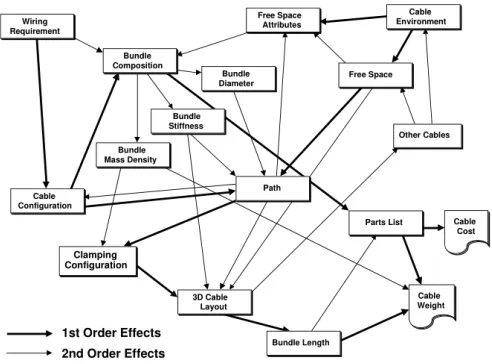
[image:2.612.191.437.290.472.2]Cutkosky regarded the influence factors as connectivity, configuration and geometry while design of cable distribution, in 1992 [7], shown in Fig. 1.
Figure 1. Influence factors of cables.
[image:2.612.137.477.560.697.2]The connection means of wires and wires consist of weld, compression splice by copper pipe, compression splice by terminal crimping and connecting box, shown as Table 1.
Table 1. Connection means of wires and wires.
Connection type
Connection materials
Connection
instrument Insulation protection direct connection copper wire cutter insulated rubber tape
weld
original conductor
material
soldering iron insulating bush
compression splice by
copper pipe connecting pipes press plier insulated filled compression splice by
terminal crimping metal terminals press tool insulated filled compression splice by
The materials of connection and insulation protection should be analyzed. In this article we tend to get those factors which existed in these materials influencing cable’ s performance, For example, what metal material, whether fire retardant, whether high or low temperature resistance and so forth.
Analyze Original Performance Influenced
For each type of cable, relevant tests were accomplished consist of electrical property, environmental suitability and reliability before delivery outgoing line according to standards. Nevertheless the reconnection changed the structure and material of cables. The tests needed to be redone are analyzed to verify performance, based on the analysis results of reconnect means and materials.
Firstly, because the broken part of cable is cut off to connect again through good cables, there would be proper connect or excess material plugging so that cable would be lower connectivity. Secondly, due to the material changed, the structure of cable would be weaker. Thirdly, the fire resistance should be considered because of the increased material. Finally, for the shielded cable, the electromagnetic compatibility (EMC) also should be concerned. Hence all electrical test and material properties test should be conduct repeatedly and tests as fire resistance or EMC will be determined by the reconnect materials and cable type.
Analyze New Performance Considered
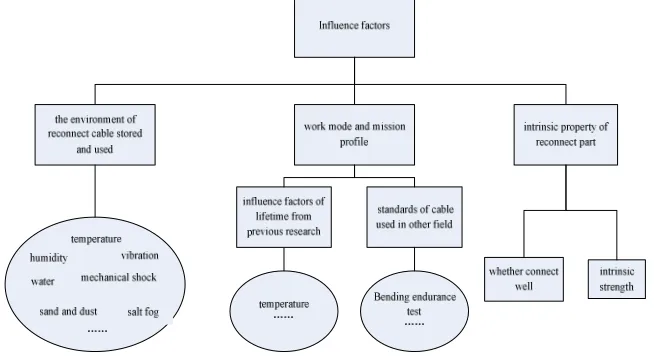
The reconnect as weak parts, it is necessary to design tests to ensure its safety and reliability. The inherent properties of cables have been analyzed as mentioned above, so this section pays close attention to environmental suitability and reliability. The analysis of influencing factors is shown in Fig. 2.
[image:3.612.143.470.400.579.2]
Figure 2. Aanalysis process of new performance considered.
On the one hand, the environment of reconnect cable stored and used should be analyzed in detail, consist of temperature, humidity, vibration, mechanical shock, water, sand and dust, salt fog, ray radiation and so on. The tests could be designed based on the stored and used environment.
temperature and number of bending. The reliability tests could be designed to contain life test and bending endurance test.
In addition, intrinsic property of reconnect part should be also assessed, for instance, whether connect well or good intrinsic strength, because these factors may impact the whole cables’ performance.
Case Study
Introduction of the Fine Cable Reconnected
The cable is marked as GKW/S 600V3G1.5, and its meaning as follows:
3-core cables are screened and thin wall sheathed, with 1 square millimeter of each area
The broken part of cable is repaired by tube with insulating sheath, and then reconnected via specific press tool.
Test for Original Performance Considered
Base on the standards EN50306, these following tests for electrical performance should be executed again, conductor resistance, voltage resistance, bending at low temperature, extension at low temperature, Stress cracking. Due to reconnection material has passed the flame retardant test; flame retardant tests aren’t carried out repeatedly.
Test for New Performance Considered
After analysis of the environment of reconnect cable stored and used, the environment factors which may influent cable’s performance cover temperature, vibration, mechanical shock, water, sand and dust, salt fog. So the tests are designed as follows.
Temperature-vibration Test. The temperature-vibration test aims to verify strength and integrity of connect cable in a comprehensive environment of temperature and vibration.
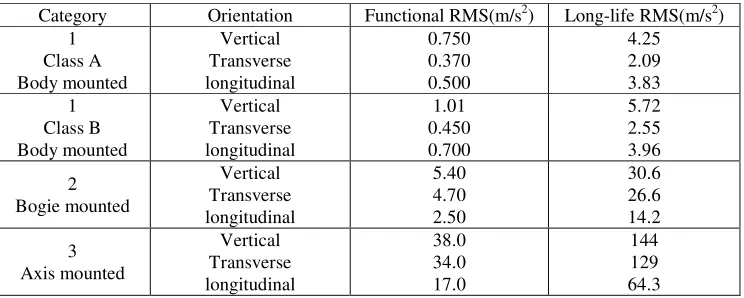
The vibration condition could be conducted according to the standard IEC 61373-2010 [8], as shown is Table 2.
[image:4.612.122.494.518.667.2]The temperature condition could be conducted according to the standard EN 50467-2011 [9], as shown is Table 3.
Table 2. Test severity and frequency range for random vibration tests.
Table 3. Preferred test temperature
Lower limiting temperature ( ) Upper limiting temperature ( )
-10 70
-25 85
-40 100
-55 125
[image:5.612.148.467.204.307.2]Mechanical Shock Test. The mechanical shock test aims to verify strength and integrity of connect cable in impact environment. The test condition could be conducted according to the standard IEC 61373-2010, as shown is Table 4.
Table 4. Test severity for shock tests
Category Orientation Peak acceleration/s2
Nominal duration ms 1
Class A and B Body mounted
Vertical Transverse longitudinal
30 30 50
30 30 30 2
Bogie mounted All 300 18 3
Axis mounted All 1000 8
Salt Spray Test. The salt spray test aims to verify corrosion resistance of connect terminal in the salt environment existed offshore. The test condition could be conducted according to the standard GB/T 10125 [9].
Leakage Test. The leakage test aims to verify sealing property of connect protection in the rainy environment. The test condition could be conducted according to the standard GBT 4208-2008 [10].
Based on analysis of the work mode and mission profile, the following reliability tests are designed.
Long Accelerate Life Experiment. The Long Accelerate life test aims to seek lifetime of reconnect cables. The temperature-stress lifetime experiment could be designed based on the standard EN 50305.
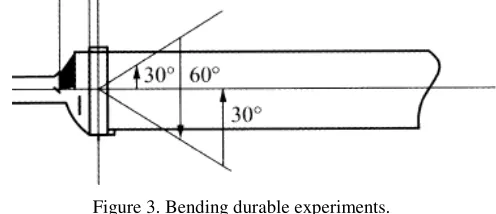
Bending Durable Experiment. The test aims to seek endurance quality of reconnect cables mounted between carriages. The experiment could be designed based on the standard EIA-364-41C [11], shown as Fig. 3.
Figure 3. Bending durable experiments.
Intrinsic property of reconnect part assessed, the tests are designed as follows. Investigation of Section Morphology of Reconnect. The investigation of section morphology of reconnect aims to judge whether the process of pressing part is satisfactory. The investigation and criterion could refer to the standard GB/T18290.2-2000 [12].
[image:5.612.185.433.498.605.2]temperature values of each position in the pressure zone after specific time work at room temperature.
Strength test of Terminal Connection. The aim is to test the force value of terminal damage for use safety. The reconnect terminal is dragged at a specific tensile velocity by the tensile machine with the other part of cable fixed.
Conclusion
The paper proposes a design method of reliability test to verify the function, environmental suitability and reliability of reconnected fine cables. To validate the method, it is illustrated with one fine cable bounded on EMU train. The conclusions drawn based on the analysis include: 1) the method could assist to identify influence factors that should be considered; 2) the tests determined is reasonability and feasibility relatively.
Thus follow-up research efforts are needed to improve the proposed method. In the future work, the influence factors and tests for cables of different functional types will hopefully be developed dividedly further.
References
[1] TB/T 3153-2007, Railway application-Rolling stock-Rules for installation of cabling [S], In Chinese.
[2] DIN 5510-2009, Preventive fire protection in railway vehicles [S]
[3] EN 50265-1998, Common test methods for cables under fire conditions. Test for resistance to vertical flame propagation for a single insulated conductor or cable[S]
[4] EN50306-2002, Railway applications Railway rolling stock cables having special fire performance Thin wall [S]
[5] EN 50264-2008, Railway applications. Railway rolling stock power and control cables having special fire performance. [S]
[6] EN50200-2006, Method of test for resistance to fire of unprotected small cables for use in emergency circuits [S]
[7] Park H, Lee H, Cutkosky M E. Computational Support for Concurrent Engineering of Cable Harnesses[R]. CDR Technical Report, 1992: 1-4
[8] IEC 61373-2010 Railway applications-Rolling stock equipment-Shock and vibration tests. [S]
[9] GB/T 10125-2012, Corrosion tests in artificial atmospheres-Salt spray tests [S], In Chinese.
[10] GB/T 4208-2008, Degrees of protection provided by enclosure (IP code) [S], In Chinese.
[11] EIA-364-41C Cable Flexing Test Procedure for Electrical Connectors[S]