2017 International Conference on Electronic and Information Technology (ICEIT 2017) ISBN: 978-1-60595-526-1
Application of A-Star Algorithm in Robot for Catering Service
Based on Laser Radar Navigation
Hai-fei YU
1and Wei XIANG
a,*College of Electrical and information Engineering, Southwest Minzu University Chengdu, Sichuan, 610041, China
awei.xiang @foxmail.com
*Corresponding author
Keywords: ROS, Laser radar, A-Star Algorithm, General planning path, Robot for catering service.
Abstract: In order to improve performance of robot autonomous job completion, soft and hard architecture of robot for catering service is designed by laser radar based on ROS system in this paper. And method of general planning path is provided for robot for catering service by A-Star Algorithm. Based on established grid map, mobile path of mobile robot is obtained by continuous search for paths approaching to destination, so as to narrow search area and reduce problem complexity. Paths of service robot under static and dynamic obstacles are tested, which finds that robot can avoid obstacles effectively through coordination with laser radar as well as one optimized path can be planned. Such experiments show that A-Star Algorithm testified in robot for catering service path planning has robustness and efficiency.
Introduction
Research on mobile robot navigation control theory and method is key to decide whether intelligent mobile robot can realize autonomization and intellectualization, among which path planning is one of research hotspots. Path planning refers to planning one optimized or sub optimal secure collision free path for robot from start point to object point under environment with obstacles [1]. Generally speaking, path planning is limited by large amount of information and many obstacles. Genetic algorithm, ant colony algorithm, tabu search and other intelligent algorithms are widely used in path planning, however, these algorithm are incomplete. For example, genetic algorithm is characterized by wide range of changes in coding length, low solving efficiency and small solving scale [2]. A-Star Algorithm is one path planning method suitable for known global environment information, which is one artificial intelligence algorithm. It is not necessary to be involved in all nodes but search towards direction beneficial for optimized path based on selected heuristic cost function, therefore, this algorithm is widely used in path planning.
Achievement of A-Star Algorithm
Principle of A-Star Algorithm
A-Star Algorithm is one kind of heuristic search algorithm, which obtains mobile path by continuous search for paths approaching to destination [3]. This method is simple, rapid and heuristic search is much targeted. To narrow search range and reduce problem complexity can be realized only by partial state space for searched problems. Expression of A-Star Algorithm is:
Therein, f(n) is cost estimation from original state n to targeted state, g(n) is actual cost from original state to state n under state space, h(n) is optimized cost estimation from state n to targeted state.
Condition of guaranteeing to find shortest path (optimized) lies in selection of evaluation function f(n) (or selection of h(n)). We express distance from state n to targeted state by d(n), there are three situations for selection of h(n) as follows:
1)If h(n)< d(n) actual distance to targeted state, under such situation, it is characterized by more searched points, large searched scope, low efficiency but optimized solution can be got.
2) If h(n)=d(n), namely distance estimation h(n) is equals to shortest distance, search will be done along the shortest path, search efficiency under this situation is the highest.
3)If h(n)>d(n), it is characterized by less searched points, little searched scope, high efficiency, but optimized solution cannot be got.
Grid Map
A-Star Algorithm is one kind of general planning algorithm based on grid map, which adopts cell to express environment map, instead of depending on object shape to divide environment around robot into a series of square grids [4], and then obtain surrounding environment information to decide information of grid by sensor (laser radar in this paper). Each grid has related probability value, which represents possibility of the grid being occupied, and easy to represent obstacles in the environment.
Implementation Steps of A-Star Algorithm
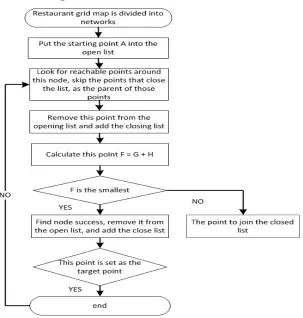
Step 1: Firstly, it is necessary to construct grid map and match according to data points of two frames, and then solve homography matrix, further transfer data to last frame coordinate system. Grid map is formed by continuous split joint.
Step 2: To calculate g(n), h(n) according to start and terminal point of grid map. Step 3: Beginning to search. It starts from start point, firstly, to add start point in opening list, minimum valve in opening list, there is only one node in opening list at initial stage, therefore, to take start point from opening list and add start point into closing list. To take adjacent point to start point and add adjacent point into opening list.
Step 4: To calculate cost score. As for adjacent point, to calculate g_score of each point for one time, h_score, at last, f_score is got.
Step 5: To select minimum valve and search again. To select minimum node for value F in opening list, and we set this node as current node, transfer it from opening list and meanwhile, to add it into closing list.
Step 6: To calculate cost score, and select minimum value, calculate minimum value of F in opening list, to set this node as current node, as for that parallel to value F, press sequence of adding opening list, with the latest adding as optimized one.
Step 7: To repeat search judgment. Search is finished until terminal point is added in opening list. Path produced at this time is not optimized path but one calculated fastest. If standard is changed in that search is finished when adding terminal point in closing list, path got is optimized one, but calculation is larger than that of the former.
When terminal point is not found, and opening list is empty, path can not be searched, search is finished.
Flow chart of A-Star Algorithm Realization
Figure 1. Flow chart of A-Star Algorithm.
Application of A-Star Algorithm in Path Planning of Robot for Catering Service
Hardware Architecture of Robot for Catering Service
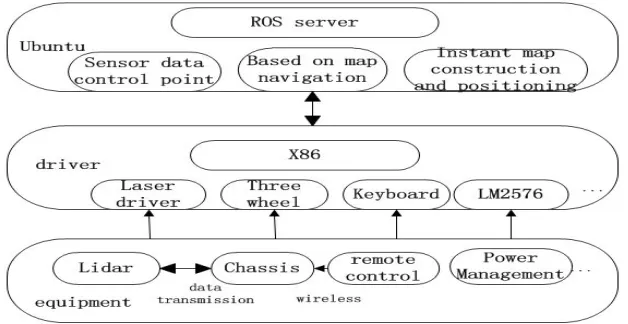
Hardware of service robot mainly include: Three wheeled omnidirectional mobile chassis, F4 laser radar (At this stage, the service robots for catering are mainly guided by the laying of the magnet wire, which has a high cost, affects the restaurant aesthetics and the fixed route leads to the low efficiency of the meal delivery, but the optional laser radar has a flexible route without additional auxiliary equipment), RK3288, MPU6050 gyroscope, ultrasonic sensor, etc [5]. Based on it, hard block diagram shown in figure 2 is designed.
[image:3.612.183.440.571.685.2]Software Frame
[image:4.612.163.477.220.382.2]What used in this topic is linux operating system, which is control center of robot platform, integrates robot control, sensor data reception, immediate location and map, navigation based on map into elated functional module, operates for PC terminal of X86 architecture, it makes equipment transmit data by USB terminal through respective drive. Environment information collected by the robot is sent to the server and processed by the complex algorithm. The control commands are issued through the operating mechanism of the robot operating system, and the corresponding functions are completed [6]. The software framework of indoor autonomous mobile robot is shown in Figure 3, and the whole software framework is divided into three layers in figure: hardware layer, driving layer and application layer.
Figure 3. Software frame of robot for catering service.
1) Hardware layer: mainly for robot body and corresponding sensor, providing reliable information access assurance for scheduled function by mutual coordination among sensors.
2) Driving layer: it is related to corresponding sensors driving in hardware layer, to make sensors work normally by driving layer.
3) Application layer: related application functions are finished based on previous layers, and mutual data transmit for three layers can improve reliability of application function.
Application of A-Star Algorithm in Self-designed Service Robot
Autonomous mobile robot for catering service was built up by above software and hardware frames. In a restaurant setting, there are static obstacles such as dinner tables and dynamic obstacles such as pedestrians. Therefore, whether path planning under static obstacles and dynamic obstacles with pedestrian of robot for catering service effective or not was tested by A-Star Algorithm. In this paper, grid map was established by laser radar to position navigation and avoid obstacles and general path planning was made by A-star algorithm. Path planning figures for static and dynamic path are as figure 4 and 5.
bypassed three landmarks to reach target B point, without touching the collision object. When testing dynamic obstacles, in premise of taking existing twelve landmarks as static obstacles, one pedestrian was added as dynamic obstacle. It can be seen from figure 5 that the robot can avoid obstacles automatically, when the robot was on the way to point B, and detected the dynamic obstacle, the robot responded promptly and re-planed a shortest path avoiding the dynamic obstacle to reach the target point B. In figure 4 and figure 5 above, red line was optimized path planned by service robot.
[image:5.612.125.485.172.353.2]
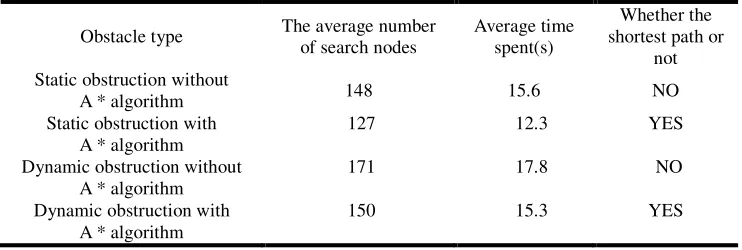
What’s more, in order to further verify the feasibility of the A-star algorithm, the experiment was performed for twenty times, and the search points and the time taken from the starting point A to the ending point B are recorded. Finally, we respectively calculated the average of the search points and the time. As shown in Table 1, The average number of search points and time spent on both static and dynamic obstacles were greater than the number and time of using A star algorithm, which showed the effectiveness of service robot for catering in using A star algorithm.
Table 1. Comparison of search points and time under different obstacles.
Obstacle type The average number
of search nodes
Average time spent(s)
Whether the shortest path or
not Static obstruction without
A * algorithm 148 15.6 NO
Static obstruction with A * algorithm
127 12.3 YES
Dynamic obstruction without A * algorithm
171 17.8 NO
Dynamic obstruction with A * algorithm
150 15.3 YES
Conclusion
In this paper, software and hardware architecture of robot for catering service was designed based on ROS and precise and efficient general path planning was provided for service robot by A-Star Algorithm. Path planning under static and dynamic obstacles for service robot was tested in restaurant setting. Even under human disturbance, service robot can avoid the optimal path planning of the next step immediately after detecting the obstacle. Therefore, A star algorithm is very efficient in robot for catering.
Figure 4 General path planning under static obstacles.
Figure 5. General path planning under dynamic obstacles.
pedestrian
A
B
A
[image:5.612.121.492.473.598.2]Acknowledgement
This work was partially supported by Sichuan Youth Science and Technology Innovation Research Team (2017TD0028).Also was supported by the Fundamental
Research Funds for Central University, Southwest Minzu University
(2017NZYQN45), and the SMU students’ innovative training program
(S201710656005).
Reference
[1] Wang Yuanhua, Li Yibin, Tang Xiao. Mobile Robot Positioning and Map Construction Based on Laser Radar [J], Microcomputer Information, 2009 (5):228-229.
[2] Yu Jinxia. Research on the Uncertainty of Mobile Robot Positioning [D], Central South University, 2015-6-1:18-21.
[3] Yang Jia. Improved SLAM algorithm research and implementation based on raster map. [D] 2015-5.31-33.
[4]Tan Yanying, Li Yang. Reconstruction of UAV Path Based on A *Algorithm in Complicated Environment. [J]. Systems Engineering and Electronics 2017 (3); 1269-1273.
[5] Generic trajectory representation and trajectory following for wheeled robots. Morten K, Nils A, Ole R. Proceedings of the 2014 IEEE International Conference on Robotics and Automation. 2014.