2017 2nd International Conference on Artificial Intelligence: Techniques and Applications (AITA 2017) ISBN: 978-1-60595-491-2
Finite Element Analysis of Temperature Field of Motor Coil and
Carbon Brush Couple
Tao DING
*, Yang
ZHOU and Hai-yang LUO
School of Mechanical Engineering, Hubei Engineering University, Xiaogan 432000, China
*Corresponding author
Keywords: Motor, Temperature field, Finite element analysis, Wear.
Abstract. The RS775 DC motor was chosen to analyze its performance of temperature field by finite element analysis software of ANSYS workbench. The result indicates that the temperature of carbon brush and the coil rises sharply in the process of the motor coil sliding against carbon brush when the machine works in rated voltage. The main cause of the motor damage is the abrasion wear and oxidative wear due to temperature rise of contact couple. Moreover, the temperature rise of carbon brush is higher than that of the coil. The carbon brush of motor is the most vulnerable parts. The replacing carbon brush and regular maintenance should be applied to reduce the wear due to high temperature in order to extend the service life of the motor.
Introduction
With rapid development of scientific and technological innovation, all kinds of products are becoming more and more rigorous in mechanical requirements. As an important component of mechanical system, the electric motor is very important to improve the service life of motor coil and carbon brush contact in high temperature. When the motor is running, it is inevitable that some kinetic energy and electric energy will be converted into heat energy. During long period high-speed operation, a lot of heat energy will be collected. As a result, the temperature rise of the contact couple will significant rise in the running process. The accumulated heat affects the normal work of the motor, especially damages the internal structure of the motor [1, 2]. In recent years, a large number of scholars have studied and analyzed effect of the temperature field on performances of the motor [3-5]. Their studies showed that more than 70% damage of the motor is caused by heat, which generated mostly from the motor coil rubbing against carbon brush. For contact couple, temperature rise results in uneven distribution of thermal stress. When the thermal stress is very high, the abrasive damage of motor component occurs in high-speed sliding process. In the same time, the contact materials of contact couple will be oxidized in high temperature. Oxidative wear and abrasive wear have influence on the service life of the motor duet to materials wear [6-8].
In this paper, the motor model is simplified according to the principle of heat transfer. The analyses of temperature field of the motor coil and carbon brush are carried out on the ANSYS workbench 16.0 software. Under the rated voltage, the steady and transient temperature fields of motor coil and carbon brush couple are analyzed and discussed.
Simulating Preparation
Modeling
(1. motor enclosure, 2. permanent magnet, 3. rotary bearing, 4. rotor core, 5. rotor coil, 6. commutator, 7. cooling fan, 8. carbon brush, 9. top cover)
Figure 1. Three-dimensional split diagram of the motor.
[image:2.612.172.439.294.437.2]The motor model used by the Pro/ENGINEER software. After the model into finite element analysis software, the material properties are defined. Figure 2 shows the structure model of motor in ANSYS workbench 16.0.
Figure 2. Structure model of motor.
Material Parameters
In order to analyze the temperature field of motor coil and carbon brush contact couple, the property parameters of the motor are defined at room temperature, as shown in table 1.
Table 1. Main material parameters of motor at room temperature.
Copper Carbon 45 # steel
Elastic modulus/GPa 103 20 206
Density/(kg/m³) 8900 2400 7800
Poisson's ratio 0.3 0.3 0.3
Resistivity/(Ω· m) 1.75e-8 9.78e-8 8.5e-8
Meshing
[image:2.612.110.502.523.594.2]Figure 3. The setting of the initial temperature of the motor.
Results and Discussion
Analysis of Steady-state Temperature Field
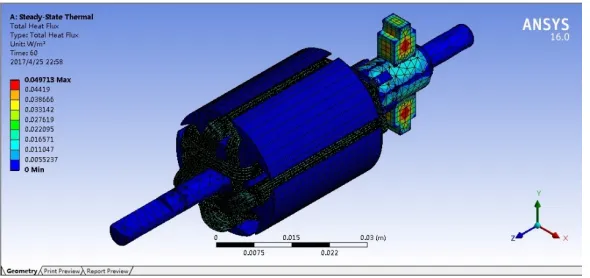
Figure 4 shows the steady temperature field of motor when the motor works 60 seconds during no-load normal. It indicates that the highest temperature of the motor occurs to the carbon brush. The carbon brush rubs against commutator in the process of high-speed sliding. The frictional heat gives rise to a local high temperature. The high temperature accumulates in carbon brush/motor coil contact couple. During high-speed rotation, the rotor coil has an air cooling effect the rotor coil is the lowest. However, the carbon brush is fixed and the temperature accumulation cannot be cooled very quickly. So the temperature of carbon brush center is the highest temperature. The main reason is that the working current flows through the contact surface when carbon brush relatively slides against the motor coil. The common action of Joule heat and frictional heat leads to sharp temperature rises of the contact couple in the process of high-speed sliding. The contact surface of the carbon brush will happens to soften at high temperature. As material performance of carbon brush become weak, shearing stress due to heat accumulation accelerated abrasive wear during high-speed sliding. At the same time, the high temperate give rise to oxidation of the carbon brush and coil couple. Oxidative wear have influence on the behaviors of contact couple. Therefore, it is useful to replace the self-lubricating carbon brush material in order to reduce wear and extend service life of carbon brush.
Figure 4. Steady temperature field of motor working 60 seconds during no-load normal.
Analysis of Transient Temperature Field
[image:3.612.160.455.492.631.2]
(a)t=0.44s (b) t=0.88s
[image:4.612.148.466.64.256.2]
(c) t=1.55s (d) t=2.00s
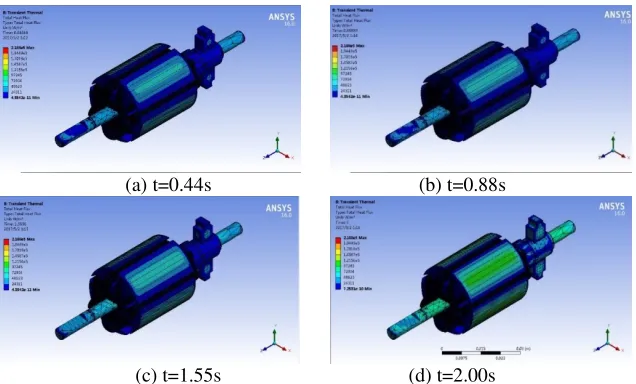
Figure 5. Transient temperature field of motor in the process of startup.
Conclusions
Based on the simulation analysis of the temperature field of the motor coil and carbon brush contact, the following conclusions are drawn:
(1) In the process of the motor coil sliding against carbon brush, the temperature of carbon brush is higher than the coil. The carbon brush of motor is the most vulnerable parts.
(2) The temperature of the motor rises quickly when the motor starts due to frictional heat and Joule heat. Abrasive wear and oxidative wear to temperature rise is main cause of material damage of contact couple.
(3) Service life of the motor will be extended by the methods of regular maintenance of motor and replacing carbon brush.
Acknowledgments
The authors gratefully acknowledge the financial supports from the Youth Fund project of Hubei provincial science and technology department (NO. 2015CFB369).
References
[1] JRR Ruiz, JA Rosero, AG Espinosa, L Romeral, Detection of demagnetization faults in permanent-magnet synchronous motors under nonstationary conditions, IEEE Transactions on Magnetics, 2009, 45(7): 2961-2969.
[2] J Mroz, Temperature field of a double squirrel-cage motor during startup, IEEE proceedings: Electric Power Applications, 2015, 52(6):1531-1538.
[3] M Akar, I Cankaya, Broken rotor bar fault detection in inverter-fed squirrel cage induction motors using stator current analysis and fuzzy logic, Turkish Journal of Electrical Engineering & Conference, 2012, 20: 1077-1089.
[4] M Akar, M Eker, Demagnetization fault diagnosis in Permanent Magnet Synchronous Motors, Przeglad Elektrotechniczny, 2013, 89(2): 229-233.
[6] J Antonino-Daviu, M Riera-Guasp, J Pons-Llinares, et al, Detection of broken outer-cage bars for double-cage induction motors under the startup transient, IEEE International Symposium on Diagnostics for Electric Machines, 2011, 48(5): 1-8.
[7] I Chernyavska, O Vitek, Analysis of broken rotor bar fault in a squirrel-cage induction motor by means of stator current and stray flux measurement, IEEE International Power Electronics & Motion Conference, 2016: 532-537.