2017 International Conference on Computer, Electronics and Communication Engineering (CECE 2017) ISBN: 978-1-60595-476-9
Network Security Log Analysis System Based on ELK
Chun-jing LU
1,2, Heng ZENG
1,2, Jian-yi LIU
1,2, Ru ZHANG
1,2,
Yuan-kun CHEN
1,2and Yuan-gang YAO
31Information Security Center, Beijing University of Posts and Telecommunications, Beijing, China
2National Engineering Laboratory for Disaster and Recovery, Beijing University of Posts and Telecommunications, Beijing, China
3China Information Technology Security Evaluation Center
Keywords: ELK, Network security log, PCA, One-class SVM, Log management analysis.
Abstract. In view of the increasingly prominent problem of network space security, the management and analysis of network security log is a very important defense means in the security field. Aiming at the practical problems of network security log management analysis system, with the log management and analysis system as the main object of the research, combined with the problems of log system and the current research status of log analysis algorithm, this paper designs the management and analysis system of network security log based on ELK, used to manage and analyze large amounts of logs. The results show that the proposed method enhances the system's functions of crawling and analyzing, especially the log retrieval ability, and combines with the large data storage technology, improving the performance of the whole system.
Introduction
Since the advent of the Internet in the last century, cyber security issues on the follow. Network security log is an information set used by computers to record their own running state [1]. Collecting logs reasonably, accurately and efficiently is of great significance to the timely detection of network security exceptions.
The processing mode of the solutions in use is to collect and manage logs on a single device. With the increasing of the number of equipment and the service items, the total amounts of logs in actual production has reached the limit of the performance of traditional solutions. The upgrade is usually to update the hardware, which is useless on the problem of big data [2]. For traditional solutions, it is difficult for relational database to carry out full-text retrieval for unstructured data, visualization is also difficult to meet the increasingly complex needs.
The appearance of the ELK technology stack effectively solves the problems of the traditional log system. All the data are stored in each node by the distributed cluster, and have great horizontal expansion ability. Adding new node in the cluster can solve the problem of performance bottleneck and improve the overall robustness of the system.
Aiming at the practical problems of network security log management analysis system, combined with the problems of the log system and the current research status of the log analysis algorithm, this paper designs the management and analysis system of network security log based on ELK. In the context of large quantities of logs, we combined our system with PCA and one-class SVM algorithm to carry out analysis of logs.
Related Works
As an important defense method in the field of security, the log analysis system develops rapidly in recent years, there have been many excellent log systems at home and abroad [3].
Splunk is too high to popularize the technology and product. ELK technology stack learned some advantages of Splunk, and summed up the current lack of competitive products, introduced the open source log tools include Elaticsearch, Logstash and Kibana. It has been widely used in the world, and has become the preferred log system for all major companies.
As to log analysis algorithm, the researchers at home and abroad have developed many traditional detection algorithms, such as Markov model, particle swarm algorithm and neural network algorithm [4]. These algorithms have a good result in detection and analysis, but lack of flexibility and adaptability. Support vector machine (SVM), as a new type method of machine learning, uses the principle of minimization to solve the issues such as small samples, nonlinearity and high dimension. SVM is to deal with the data without reducing the dimension, which affects the real-time and accuracy of detection. There combines the PCA with SVM, acts as a key technology in the analysis module to meet the needs of log analysis.
System Design
The System Architecture
The traditional log systems mainly consist of three parts, collection module, processing module and storage module. When the order of magnitude of log reaches a certain extent, the management of the log will face great pressure. Meanwhile in the face of unstructured log, the traditional log systems are very difficult to carry out effective data management and analysis.
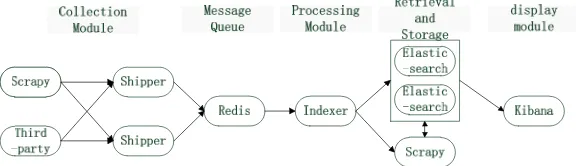
[image:2.612.161.449.353.436.2]ELK-based network security log analysis system consists of six modules, as shown in Figure 1.
Figure 1. System architecture.
It is based on the traditional log analysis system used in the actual production, combined with the ELK, the Scrapy reptile framework and HDFS storage media in Hadoop, and using Redis as a message queue to build a highly available log management and analysis platform, which can expand the basic functions effectively to achieve the log data collection, processing, retrieval and other work of specific data source, to facilitate the subsequent analysis.
The system carries out the data collection by the log collection module, then processing module analyze the log data, and search by field and persistence into storage system. There uses the ElasticSearch to retrieve all the log processing to standardize all data, and through the chart to summarize the historical records to manage and analyze the data index of all times.
Collection Module
The main data source includes two parts. One part is the security information released by specific platform, which through Scrapy with the database for active data capture. The other part is the IDS alarm log provided by the third party, where the Logstash is Shipper mode, and collect log information once the data appears on the server.
Processing Module
The logs crawled by Scrapy are stored by fields, but the logs collected by shipper may exist missing, redundancy, and noise. Processing module mainly realize the analysis and cleaning for data.
We carry out the segmentation of fields by types, the correct conversion of field values and the addition and deletion of the field of the logs collected by shipper through the filter plugin. After parsed, Shipper will add the information it originally added, which can help to make an additional interpretation of the information, providing more options for the following field analysis.
Retrieval Module
With the increasing size of all kinds of network, the logs generated by various types of equipment are increasing explosively. When its scale reaches a certain order of magnitude, the analysis is difficult to carry out. It is necessary to index the log information to improve the analyzing performance. The module is responsible to retrieve the log information pushed by processing module, and index for each field. The powerful real-time search and analysis ability of ElasticSearch enables complex queries to massive data.
After pushed to ElasticSearch, processed data will be indexed, and stored on different devices according to the principle of fragment and copy. And through a cluster way, we improve the availability and ability of disaster recovery of the module.
Storage Module
The storage module is combined with the key technology of the big data, aiming at the storage bottleneck of log system working in standalone mode, it uses ElasticSearch cluster to store the index file, and make the original data persist on HDFS to solve the problem of large amount of log data.
It is mainly divided into two parts. One part is the stored data ElasticSearch made its own after it indexed data. The other is the persisted of data by HDFS, which means there is the data backup for all the source data. As to ElasticSearch configuration, the cycle of the data is set as 7 days. We back up all the data to HDFS, and clear the cluster of data every 7 days.
Display Module
Visual analysis has become a common means of data analysis, which can display intuitive data by various vivid images and explain the results better. In traditional log system, the design of visualization is relatively weak part, where the graphics are simple, and the types are relatively limited, which cannot provide Intuitive impressions. With the rise of ELK technology stack, relying on visualization capabilities of kibana4, combined with ElasticSearch, we can do complex query of the ElasticSearch index file on the web side, and show the results by intuitive charts. This module supports a single index query, aggregation and other inquiries. As for charts, it supports line chart, pie chart, bar chart, hot map and other charts.
Analysis and Alarm Module
The analysis module in the system using a combined algorithm based on principal component analysis and support vector machine to realize the log anomaly data detection function, including abnormal data detection and platform monitoring and alarm. The process of log analysis mainly consists of the selection of data set, the preprocessing of data set and the analysis of data set analysis, among which the last two parts are the core [5].
Dimension Reduction Algorithm
PCA is a commonly algorithm used on dimension reduction, it can re-projected the feature vector information of multiple dimensions of the object into a new coordinate space with less dimension, which makes the subsequent analysis more efficient. The variance of data should be as great as possible after mapping, and the selected index should reflect the difference of samples.
the total variance. Through the filter of the cumulative contribution rate, we finally get the new principal component variables of the original dimension data after PCA dimension reduction.
Classification Model Algorithm
The one-class SVM algorithm mainly deals with the case of only one class of training data [6], with the goal of testing whether the new data is similar to it. The main principle is to train a given set of samples, separating all data points from the origin in the feature space and maximizing the distance from the hyperplane to the origin [7]. The data in the input space is distributed at different probability densities in the region, and the data of the small probability density region is treated as abnormal data.
The purpose of log analysis is to classify the normal data and abnormal data from the massive log.
By model the data reduced dimensionality by PCA algorithm, we can analyze and judge the accuracy of the data and confirm whether there are abnormal data in the log information, and alarm timely.
Alarm Module
The alarm module is to monitor the operation of the system. When problems arise in the system, such as downtime, the alarm module will send information to the administrator to prompt. When the data is found to be in conformity with the black list record made in advance, it also sends alarm. The module is mainly monitor the entire platform by the official monitoring product Watcher, including cluster status monitoring, memory usage, CPU usage, node downtime and so on.
Experiments
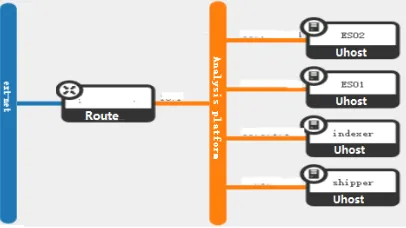
The environment of the system mainly consists of two servers and one laptop. The four virtual machines (VM) are set up on one of the servers. VM 1-Shipper is equipped with the Scrapy reptile and Logstash configured as shipper, which is responsible for the collection of log information. On the VM 2-Indexer is equipped with the indexer version of Redis, Logstash and an ElasticSearch node to handle the processing and retrieval of the log, and realize the message queue function. On the VM 3-ES01 and 4-ES02, an ElasticSearch node is arranged, making the VM 2, 3, and 4 constitute an ElasticSearch cluster. The operating system of VM is the Ubuntu. Another server is equipped with Hadoop, mainly used for HDFS storage.
[image:4.612.205.408.497.611.2]The virtual cloud platform is set up on the server and the system is deployed on the cloud platform. The actual topology of the project is shown in Figure 2.
Figure 2. Testing system topology display interface.
Table 1. Algorithm detection rate results. Table 2. Algorithm comparison results.
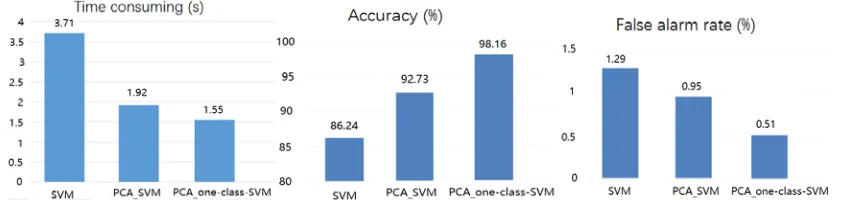
[image:5.612.95.517.293.393.2]Compared with the traditional SVM algorithm and PCA-SVM algorithm, we can see that the one-class SVM algorithm is better in data detection. There select three parameters as the performance indicators of the algorithm. The time consumption is the time required for the calculation of the sample set, and data detection means the percentage of the detected abnormal data in total data. The detection false alarm rate is the percentage of normal data marked as the abnormal data in total data. The result is shown in Table 2. From the comparison in Figure 3, 4 and 5, we can see the algorithm is time-consuming and low false alarm rate, which can effectively meet the requirement of abnormal data detection in the log analysis module.
Figure 3. Test time-consuming comparison. Figure 4. Accuracy comparison. Figure 5. False alarm rate comparison.
Conclusion
Aiming at the practical problems of network security log management analysis system, with the log management and analysis system as the main object of the research, combined with the problems the log system is facing and current research status of the log analysis algorithm, this paper designs the management and analysis system of network security log based on ELK, the limitation of the traditional log system to big data and unstructured data is solved, and it realizes the function of complex visual analysis of massive log data. From the concept of big data, by the data analysis of the PCA and one-class SVM combination algorithm we realize real-time monitoring and timely alarm of the log.
Acknowledgements
The author thanks the editor and reviewers for their suggestions to improve the quality of paper. This work was supported by The National Key Research and Development Program of China under Grant 2016YFB0800903, the NSF of China (U1636112,U1636212) and NSF of China (U1536118).
References
[1] Song Chen, Guangwei Wang, Xinzi Liu, etc. Research on information system security evaluation [J]. Communication Technology, 2012, O1: 128-130.
[3] Chenlin Rao. Authority guide of ELK stack [M]. Beijing: Machinery Industry Press, 2015: 70-335.
[4] Mingyu Qi, Ming Liu, Yanming Fu. Research on SVM network intrusion detection based on PCA [J]. Information Network Security, 2015, (2): 15-18.
[5] JolliHe I.J. Principal Component Analysis [M]. New York: Springer, 1986.
[6] P. Winter, E. Hermann and M. Zeilinger. Inductive intrusion detection in flowbased network data using one-class support vector machines [A]. 4th IFIP International Conference on New Technologies, Mobility and Security [C]. Piscataway: IEEE Press, 2011: 1-5.