University of Huddersfield Repository
Tahera, Khadija, Eckert, Claudia and Earl, Chris
Highlighting the importance of testing in the product development process
Original Citation
Tahera, Khadija, Eckert, Claudia and Earl, Chris (2015) Highlighting the importance of testing in
the product development process. In: Proceedings of the 20th International Conference on
Engineering Design (ICED 15). Design Society, 021030. ISBN 9781904670698
This version is available at http://eprints.hud.ac.uk/id/eprint/24328/
The University Repository is a digital collection of the research output of the
University, available on Open Access. Copyright and Moral Rights for the items
on this site are retained by the individual author and/or other copyright owners.
Users may access full items free of charge; copies of full text items generally
can be reproduced, displayed or performed and given to third parties in any
format or medium for personal research or study, educational or notforprofit
purposes without prior permission or charge, provided:
•
The authors, title and full bibliographic details is credited in any copy;
•
A hyperlink and/or URL is included for the original metadata page; and
•
The content is not changed in any way.
For more information, including our policy and submission procedure, please
contact the Repository Team at: [email protected].
1 INTRODUCTION
Companies use different product development processes (PDPs) in designing their products. PDPs prescribe core activities and outputs that need to be achieved at certain points in product development. They are used to plan, schedule, resource and monitor product development. Often these PDPs represent a structure of broadly specified tasks rather than a sequence of specific activities. One of the areas where this is most obvious is in testing. In generic PDP models, such as waterfall, spiral or V-model, testing activities are represented as a part of a validation stage towards the end of the process. This paper argues that testing can occur throughout the product development process preceding and overlapping many of the design and analysis activities without being presented explicitly in these prescriptive PDPs. To reflect better the actual processes occurring in industry it is necessary to present both design and testing activities as core elements of PDP models. Further, as tests can cause iterations in design, PDP models can become more resilient if product design and testing are integrated throughout the process.
A core study by Unger and Eppinger (2011) analyse how appropriate design processes improve response to market, technical, and regulatory risks. By contrast this study examines the internal structure of product development processes and identifies that testing comprises a set of critical activities, which have strong interactions with related design activities. These testing activities do not stand-alone at a distinct stage towards the end of a PDP but they run in parallel to the design activities throughout most of a PDP. This paper proposes a framework that highlights these critical interactions between design and testing activities.
This paper first presents a critical review of the literature, highlighting a gap in the literature on the detailed relationship between design and testing activities. The paper ppresents a conceptual model to bridge the gap based on case studies that provide validation for a new PDP structure.
2 LITERATURE REVIEW
The PDP is more than just the set of design activities; it also includes a set of 'integrated' testing activities both physical and virtual. Unger and Eppinger (2011) identify product development processes (PDPs) as the procedures and methods that companies employ to design their products. PDPs should therefore highlight which methods and activities are critical and how they interact. Several types of PDP can be found in the literature. Unger and Eppinger (2011) have analysed PDPs in a wide range of applications, dealing mainly with two common PDPs: stage-gate and spiral. Stage gate has a controlled and rigid process structure while spiral process is more flexible, incorporating iterations across different phases of design. Variants lying between these two extremes are compared by Unger (2003), such as the modified waterfall, evolutionary prototyping, evolutionary delivery, and design to schedule/budget processes. The findings of Unger and Eppinger (2006) indicate that software companies who face rapid changes in market, generally perform quick iterations and tests, and therefore apply more flexible PDPs. But manufacturing companies that face integration problems and technical risks are likely to employ more rigid PDPs. They stressed how to customise these PDPs to address the risk profile of individual companies. Subsequent papers by Unger and Eppinger (2009, 2011) deal with improving PDPs to manage risk as well as creating effective iterations.
In this following section, three well-known PDPs are analysed to investigate how testing activities are included in them. It identifies that existing PDPs are limited in this respect and indicates how to effectively integrate testing activities in engineering product development processes.
2.1 Testing in the generic PDPs
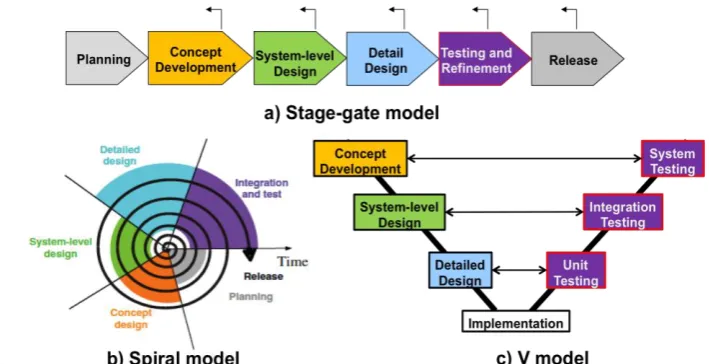
For the purposes of this paper, three PDPs: Stage gate, Spiral and V-model, are analysed. These are often used in industry to inform discussions on engineering design processes. The emphasis of this analysis lies on highlighting the test activities in these different models, rather than describing the processes in detail.
2011). The spiral model (Boehm 1998) is illustrated in Figure 1(b) and repeats the sequence of steps: concept design, system-level design, detailed design, and integration and testing. This process is flexible; the number and span of loops can vary in companies. This model has a structure with integration and testing phases positioned at the end of each iteration in the spiral. The essential intention of this spiral model is to minimise risks by the repeated use of prototypes. With each loop of the spiral, the customer evaluates the work in progress and suggestions are made for its improvement (Boehm 1998). This model can be applied effectively in software development but for complex engineering products, several iterations of building prototypes can raise the development cost significantly.
Figure 1 Models of product development process (a and b are adapted from Unger and Eppinger 2011)
The V-model (Forsberg and Harold 1999) (Figure 1(c)) is a PDP, which is widely applied in systems engineering. The “V” is an acronym for both verification and validation. The V-Model shown in Figure 1(c) shows the relationships between each phase of the product development and its associated phase of testing. Design and testing are both ordered activities in time sequence, which complement one another across the „V‟. So, for example, the system test is carried out on the basis of the results of concept development phase. However, this model also implicitly places the testing towards the end of the process by elaborating design activities in the left-hand side of the model and testing to the right-hand side.
These well-known product development process structures, i.e. stage-gate, spiral and V-model, do not always reflect the importance of the role of testing appropriately. All of these PDPs are limited in following ways;
1. the testing activities start late after detailed design phase,
2. the link between test, redesign and change tasks during the process is not clear,
3. the interconnection between the various testing stages (in spiral model) and the types of tests used is not clear.
2.2 An overview of testing in engineering design research
Although the importance of testing is widely recognised in research and industry practice, testing is mostly discussed in the academic literature in terms of specific techniques. These techniques describe methods, procedures and equipment for tests, how to configure a test or how to improve a test. In design research, there has been limited attention to the area of testing. Several researchers have highlighted this including O'Connor (2001), Engel (2010), and Lévárdy et al. (2004). Although carried out in most product development projects, testing activities are seldom done in an optimal manner (Shabi and Reich 2012).
design and testing domains is often insufficient for an effective product development process (Lévárdy et al. 2004). The value of the information exchange between these domains of design and testing is important (Unger and Eppinger 2011, Yassine et al. 2008). Also, due to the pressure of producing a quality product with limited time and cost, many tasks cannot afford to wait until all the required information input has arrived. This necessitates close coordination with other interdependent activities, e.g. prototype testing and concept verification in the design stages (Terwiesch et al. 2002). Loch et al. (2001) and Thomke and Bell (2001) studied testing with particular attention to the issues in test planning.
3 RESEARCH METHOD
This study draws on a main case study with a large diesel engine manufacturing company supplemented by a second study in a company that designs and manufactures forklift trucks. This research seeks to answer a key question, when does testing occur within the product development process?
In the diesel engine company, eighteen interviews were carried out from 28th February 2011 to 21st February 2014 building on a previous series of interviews, in the same company on system architecture reported by Wyatt et al. (2009). Eight engineers including a senior engineer, a development engineer, a business manager, a verification and validation manager and a validation team leader were interviewed.
The first interview, with a senior engineer, provided an overall view of testing in product development as well as an idea of the expenditure that is incurred around testing. The Engineer mentioned that,
“to develop the Tier4 engines can cost R&D alone an excess of over X million, I would break it down to design and engineering is probably 15%, material is probably around 30%, and actually testing around performance is rest- around 55%. So most of the money in R&D is goes into testing for performance and durability”.
The verification and validation manager and the validation team leader were interviewed to investigate how testing really happens on component, subsystem and system levels. Several interviews involved the verification and validation team who are responsible for product validation and testing. To investigate the relation between the verification and validation phases and the design phase, the meetings included development engineers as well as the validation engineers. When required, staffs from other departments were involved in the interviews.
The second study in a forklift company was based upon two semi-structured interviews with (a) the Test and Validation leader and (b) a mathematical modelling and simulation engineer. In addition there were several informal discussions with the mathematical modelling and simulation engineer. Both companies‟ testing processes were initially modelled to recognise exactly where testing occurs in the product development process and these provided better scope of analysis and where improvement might be made. These models were refined and developed through further discussions with engineers.
4 PRODUCT DEVELOPMENT PROCESSES IN CASE STUDY COMPANIES
Stage gate processes are used by both case study companies. The details of these stage gate processes are described and analysed in this section. Particular attention is given to the relation between computer aided engineering (CAE) applied as a type of virtual testing and Design.
4.1 Diesel engine manufacturing company
The company offers a wide range of diesel and gas engines and power packages from 8.2 kW to 1886kW and has the capacity to produce up to 800,000 units per year. These engines are used in many „off-road‟ applications such as agriculture, construction, material handling, marine, general industrial and electric power. A key challenge for the company is to comply with new tiers of environmental legislation. This has led to considerable technological changes accompanied by a significant decrease in product development time.
Introduction (NTI) takes place as a general research and development exercise, before the NPI process starts.
Figure 2 An outline of the company's Stage-gate NPI process (adopted from company’s PDP)
Most of the design and testing activities occur between stages 2 and stage 4, i.e., from Gateway 1 (GW1) to Gateway 4 (GW4), and often until Gateway 5 (GW5). Therefore, this research focuses on these three main phases of the PD process, namely stages 2, 3 and 4.
Typically, development testing starts between GW1 to GW2 when the technology has been identified and continues till GW4, after which the engine is released to production. Testing in the company falls into these three stages and serves a different purpose in each stage: (a) Concept/System Demonstration (SD), (b) Design Verification (DV) and (3) Product Validation (PV).
Concept/system demonstration (SD) testingis primarily to demonstrate „performance capability‟.
It shows that the technology can deliver the required performance. Alternative concepts are analysed and evaluated. Combinations of old and new parts are built into an engine called a MULE. This MULE engine is tested to verify the performance of new parts. As new parts arrive the old parts are replaced and testing continues. The product specifications evolve as more design decisions are taken during this phase. It is assumed that by GW2, the concept will be selected, the component will be specified and the whole engine will be built with at-least some production parts, will be ready to be tested for Design Verification (DV).
Design verification (DV) is primarily to develop optimal performance and validate hardware at
the optimised performance. The aim is to ensure that design outputs meet the given requirements under different use conditions. At this stage, testing focuses on the verification of a chosen design, through detailed analysis and testing of stress, strength, heat transfer and thermodynamics etc. This stage validates the hardware prior to commitment to expensive production tooling.
Product validation (PV) checks the effect of production variability on performance and any
remaining hardware variation. This phase performs hardware testing which is limited to late design changes and emissions conformance testing. In this phase, detailed testing for reliability and durability occurs and the intended product is validated. The mandatory tests required for regulatory compliance usually occur during the PV phase.
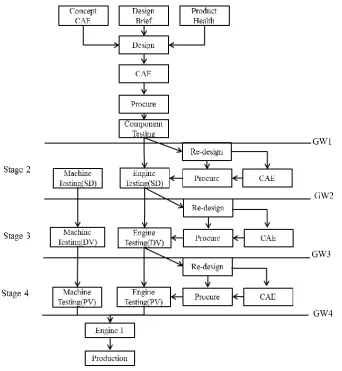
some are individually conducted. The company‟s product development process is heavily involved in testing activities from the start of the project.
Figure 3 Flow diagram of testing and related activities in the diesel engine company (modelled from the company’s actual workflow diagram)
4.2 Forklift truck manufacturing company
To broaden the understanding, the findings from the diesel engine company were compared with another company which design and manufacture counterbalanced forklifts. This company was established in 2011, under the brand of a parent corporate company.
These forklift trucks are designed to meet the needs of light to medium duty operating environments. Compared to engines, a forklift truck is relatively simple product with straightforward functionality. The regulations related to safe use and operations of the fork trucks are the driving factors for new product development.
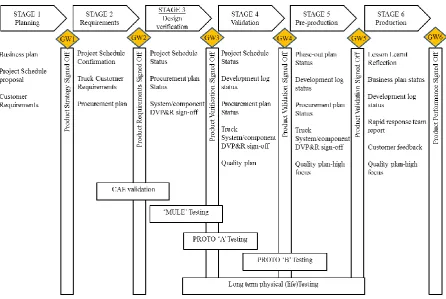
This company also uses a stage-gate PDP that has the six-stages shown in Figure 4. It is called a „review gate process‟ within the company. Figure 4 shows how testing is performed throughout the product development process. This company also starts physical testing at the early stages of the PDP and there are at least three iterations of prototype testing during the product development.
Figure 4 PDP of the forklift company and testing activities outlined
4.3 CAE a different mode of physical testing
Computer Aided Engineering (CAE) is playing an increasingly significant role in the design process of both case study companies. An engineer in the diesel engine company commented:
“CAE is becoming increasingly important to the companies to minimise the effort and expense involved in product development”.
Also, the modelling and simulation engineer in the forklift truck company commented:
“there might be 20/30 variations of one product, we can‟t build and test all of those, we may build three or four variants, if we can validate CAE or FEA against those physical trucks we have built, then we can sign off the entire range”
Some CAE analyses (1-D modelling and simulation) start even before the design itself is begun and help to create the design briefs based on requirements. Further, developments of these CAE analyses are performed in parallel and iteratively with design to define the scope of the design activity. Finally advanced types of CAEs, which are referred to here as virtual testing, are performed once the initial design is completed and design data and information are released to suppliers for procurement. These types of CAE examine whether a design meets the specifications and requirements and serves the same purpose as the physical testing. It complements and assists physical testing.
5 EFFECTS OF TESTING ON THE PRODUCT DEVELOPMENT PROCESS
5.1 Iterative nature of testing and design
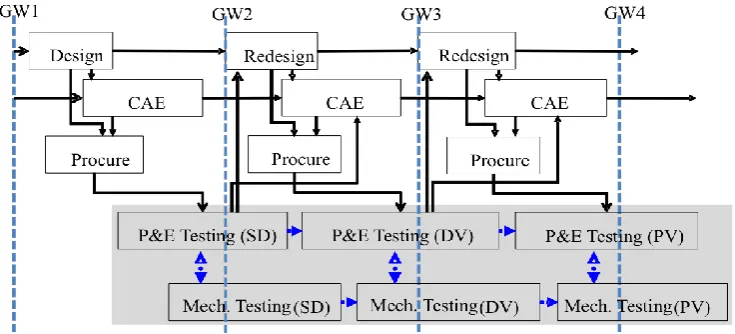
[image:8.595.101.469.169.336.2]Sections 4.1 and 4.2 illustrated how products are designed and tested in sequence for system demonstration (SD), then design verification (DV) and finally product validation (PV) in practice. Testing in one phase can identify design issues and lead to re-design in the next phase. For instance, if testing in the SD phase identifies a failure or mismatches with specification, then in the next DV phase, engineers focus on both redesign to overcome those issues as well as further detailed design for design verification. Therefore, Figure 5 is essentially iterative and one (re)test leads to the iteration of (re)design and vice versa.
Figure 5 A schematic of the product development activities from GW2 to GW4 (SD = System Demonstration, DV = Design Verification, PV = Product Validation, P&E =
Performance and Emission)
Emerging design changes can lead to re-testing and changes in future testing plans. As every part of an engine has complex connections with other parts, design changes in one part can cause changes to its connected parts which might effects at sub-system or system level. Therefore, a design changes can propagate, which nullifies some of the existing testing, introduces more testing and questions whether previous testing was adequate or was performed in a right way. For example, if a component fails to perform according to specification in the DV phase, engineers will improve the design of that component while analysing how those changes might affect other components or the performance of the whole engine. The validation manager will require testing to be planned both for that particular component and for affected components. Engineers might not necessarily perform the same testing activities as in a previous stage but incorporate new testing parameters. Re-testing might happen in different mode, for instance, CAE analysis might be enough to verify a design change and physical testing might not be necessary. However, major changes in design require new system level physical testing and this can delay product development.
5.2 Overlapping between testing and design
Ideally testing of one phase should be finished before design of the next phase can be started. When the company fails to maintain the planned schedule in stages, engineers decide to accelerate the process by concurrent execution of activities. In Figure 5, it is prominent that design activities are starting before finishing the testing of previous stage and this is happening during every stage, hence two sequential stages are overlapped to maintain the gateway schedules. Companies might also overlap lengthy physical testing activities to minimise the total duration of testing. Frequently, lengthy physical testing and long procurement times are the causes of overlapping. This study found that such overlapping results in many uncertainties in the process and can cause overall process delay. Given the delivery time pressures, companies have no choice but to overlap design tasks with testing, as a design proposal can initiate another, often lengthy, procurement process.
6 PROPOSED MODEL OF PDP
increasing role in reducing the number of physical tests, increasing the scope of the scenarios that can be covered by test and reducing the risks arising from the overlap between design and testing (Tahera, et al. 2013).
In this following section, a conceptual model is presented based on two case study companies, which leads to a different way of thinking about the role of testing in design processes. This model has not been applied in other companies. It is not intended as a prescriptive model for practice, rather than as a means to shift in thinking about the role of testing in the product development process.
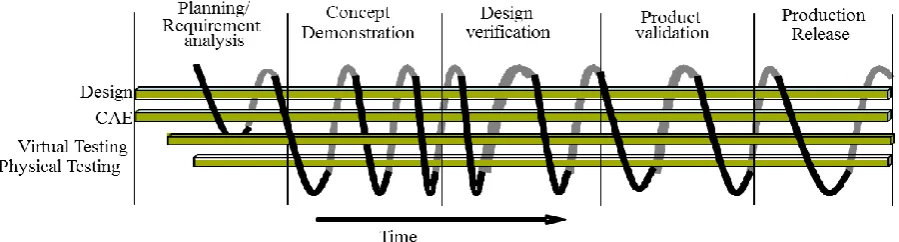
[image:9.595.92.542.206.327.2]The proposed conceptual iterative model of design processes is presented in Figure 6, which illustrates the sequence of activities from design to analysis to virtual testing and physical testing. It shows that these activities are on-going but with a different focus. The black thick line can be seen as the progress of the design throughout a design process.
Figure 6 Product development integrating iterations between Design, CAE, virtual and physical testing at each stage
Unger and Eppinger (2006) have discussed that PDP can be characterised by iteration and review and showed that most of the iteration cycles do not cross review gates, but stay in one phase. This was also observed in this study, and is reflected by the tight spirals in a same stage in Figure 6. The PDP in both companies follows rigid review at gateway stages as engineers are not allowed to continue until each deliverable meets established criteria. The PDPs in both companies exhibit a number of design and test iterations. These iterations are not necessarily repetition or rework of the same activities but progression of the same activities to make improvement.
During these iterations, emerging factors are considered and often activities are merged. The concerns that lead to the iteration are incorporated into the scheduled activities. If significant rework is required, new resources are reallocated to maintain schedules. Iterations that return to earlier stages would constitute a major problem and jeopardize the delivery schedule. As companies cannot risk this, they often develop alternatives of a design for high risk elements in parallel. When required and they can use these alternative designs or can adopt as tried and testing solutions in a future development project.
This PDP structure developed above is significantly different to that found in the literature in two ways. First, design and testing in this structure are essentially iterative with testing activities closely interlinked with design. Second, physical testing activities start very early in the product development process. It is also noticeable that in the both companies there is no single testing stage; instead testing activities are distributed throughout the stages of the PDP.
7 CONCLUSION
REFERENCE
Boehm, B. W. 1998, "A spiral model of software development and enhancement" Computer, vol. 21, no. 5, pp. 61-72.
Cooper, R.G. 1990, "Stage-gate systems: a new tool for managing new products", Business horizons, vol. 33, no. 3, pp 44-54.
Engel, A. 2010, Verification, validation, and testing of engineered systems, John Wiley & Sons, vol. 84. Forsberg, K., and Harold, M. 1999, "4 System Engineering for Faster, Cheaper, Better." In INCOSE
International Symposium, vol. 9, no. 1, pp. 924-932.
Lévárdy, V., Hoppe, M. and Browning, T.R. 2004, "Adaptive Test Process: An Integrated Modeling Approach for Test and Design Activities in the Product Development Process", In ASME 2004 International Design
Engineering Technical Conferences and Computers and Information in Engineering Conference, pp.
241-250, American Society of Mechanical Engineers.
Loch, C.H., Terwiesch, C. and Thomke, S. 2001, "Parallel and sequential testing of design alternatives",
Management Science, pp. 663-678.
O'Connor, P. 2001, "Test engineering: a concise guide to cost-effective design, development and manufacture", Chichester: Wiley .
Shabi, J. and Reich, Y. 2012, "Developing an analytical model for planning systems verification, validation and testing processes", Advanced Engineering Informatics, vol.26, no. 2, pp 429-438.
Tahera, K., Earl, C., and Eckert, C. 2013, August, Improving overlapping between testing and design in engineering product development processes. In ASME 2013 International Design Engineering Technical
Conferences and Computers and Information in Engineering Conference (pp.
V005T06A038-V005T06A038). American Society of Mechanical Engineers.
Terwiesch, C., Loch, C.H. and De Meyer, A. 2002, "Exchanging preliminary information in concurrent engineering: Alternative coordination strategies", Organization Science, pp 402-419.
Thomke, S. and Bell, D.E. 2001, "Sequential testing in product development", Management Science, pp 308-323.
Unger, D.W. and Eppinger, S.D. 2011, "Improving product development process design: a method for managing information flows, risks, and iterations", Journal of Engineering Design, vol. 22, no. 10, pp 689-699. Unger, D.W. and Eppinger, S.D. 2009, "Comparing product development processes and managing risk",
International Journal of Product Development, vol. 8, no. 4, pp 382-402.
Unger, D.W. and Eppinger, S.D. 2006, "Improving product development processes to manage development risk", MIT Sloan Working Paper 4568-06.
Unger, D.W. 2003, Product development process design: improving development response to market, technical,
and regulatory risks, PhD diss., Massachusetts Institute of Technology.
Wyatt, D.F., Eckert, C.M. and Clarkson, P.J. 2009, "Design of Product Architectures in Incrementally Developed Complex Products", In Proceedings of the 17th International Conference on Engineering
Design'ICED'09, vol. 4, pp. 4-167, The Design Society.