Thesis by
Michael Alan Kosecof:f
In Partial Fulfillment of the Requiren~ents for the Degree of
Doctor of Philosophy
California Institute of Technology Pas adena, California
1975
-i~.
-ACKNOWLEDGEMENTS
I wish to thank Professor Herb~rt B. Keller for suggesting the problems and for his valuable guidance in their pursuance. I an-:. also indebted to Professors DonaldS. Cohen, Edward L. Reiss, Charles D. Babcock, and Paco A. La~erstrom; discussion~:; with each of them have proven useful at some point in this work. Mrs. Karen Cheetham and Mrs. Virginia Conner undertook the task of typing this symbol-ridden manuscript in a rather brief period of time, and I truly appreciate their labors. Finally, to my wife, Jackie, I owe more than can fit into this short space.
ABSTRACT
Two separate problems are discus sed: axisymrnetric eqt::.ili -brium configurations of a circu.la:c n1err1b!"ane under pres sure and
subject to thrust along its edge, and the buckling of a circular cylindrical shell,
An ordinary differential eqt.;.ation governing the circular men1-brane is imbedded in a family of n-dimensional nonlinear equations. Phase plane methods are used to examine the nurnber of solutions corresponding to a parameter which generalizes the thrust, as well as other parameters determining the shape of the nonlinearity and the undeformed shape of the membrane, It is found that in any nurnber of dimensions there exists a value of the· generalized thrust for which a countable jnfinity of solutions exist if son1.e of the re1naining parameters are made sufficiently large. Criteria describing the number of
solutions in other cases are also given.
Donnell-type equations are used to model a circular cylindrical shell, The s.tatic problem of bifurcation of buckled modes from
Poisson expansion is analyzed using an iteration scheme and pertubation methods. Analysis shows that although buckling loads are usually
simple eigenvalues, they may have arbitrarily large but finite multi-plicity when the ratio of the shell's length and circumference is rational. A numerical study of the critical buckling load for simple eigenvalues indicates that the number of waves along the axis of the deformed shell is roughly proportional to the length of the shell, suggesting the possi-bility of a "characteristic length. " Further numerical work indicates
-)·
v-may increase or decrease. It is shown that either a sheet of solutions or two distinct branches bifurcate from a double eigenvalue. Further-more, a shell may be subject to a uniform torque, even though one is not prescribed at the ends of the shell, th1:ough the interaction of two modes with the same number of circumferential waves. Finally, !nultiple time scale techniques are used to study the dynamic buckling of a rectangular plate as well as a circular cylindrical shell; transition to a new steady state amplitude determined by the nonlinearity is
Chapter 0 l 2 3 4
TABLE OF CONTENTS Title
Introduction
Part I: Circular Men1.branes Initially flat mernbrane s
Preliminaries The case n
>
2 The case n=
2 The case n=
l Initially curved membranesPreliminaries
Small amplitude pertubations, 0 <
lA
I
<< 1Large amplitude pertubations,
.
lA
I>>
lInfinite multiplicities
Part II: Circular Cylindrical Shells The static problem
Preliminaries
Decomposition of the Airy stress function
Symmetric solutions
Poisson expansion and bifurcation Multiplicity of the eigenvalues The buckling mode
Bifurcation for simple eigenvalues Bifurcation for double eigenvalues The dynamic problem
Premliminarie s
The rectangular plate
The circular cylindrical shell
Chapter
A B
c
-vi-TABLE OF CONTENTS (cont1d) Title
Appendices
Derivation of shell equations Some calculations for Chapter 4 Notes on the membrane equations
References
INTRODUCTION
This study is concerned with two separate problems. The first is motivated by equations which n-wdel the behavior of a circular
rnern-brane. The resulting equation is imbedded in a class of equations, anu
the existence of multiple solutions is analyzed fo::.- this class. The
second problem is to study the static and dynamic buckling of a circular
cylindrical shell under axial loading.
F'or the first problem, we are concerned with studying the
possibility of multiple equilibriu1n configurations of a circular shallow
elastic n1embrane whose surface is subject to an axisymmetric
pres-sure. A radial thrust is specified along the membrane 1 s edge, and tJ::.e
edge is restrained from deforming normal to its midplane. Only
axi-symmetric deformations of the membrane are considered.
In chapter 1 we study the case of an initially flat membrane
under a variable pressure. The situation of a flat membrane under
constant pressure has been studied by A, Callegari, E. Reiss, and
H. Keller [2]. In chapter 2 we consider a membrane which is not
initially flat and is subjected to a variable pressure,
The reader is referred to the references [1, 2] for a derivation
of the membrane theory. Notes on the final formulation of the problem
are given in Appendix C. The resulting equation is
(C. 6)
The boundary conditions are
du
-2-u(l) = 0 (C. ?b}
When G{r) and ~(r) are of the form to be prescribed in chapters
1 and 2, it is found that equation (C. 6) can be transformed into a
second o1·der autonomous system which is amenable to phase pla:ne
analysis. This method was first used by Gel' fand [ 4] to study solution multiplicity in certain problerns arising in the theory of :::hemical
reactors, viz.
1 d n-1 du u
(
)
+
A en-1
dr r drr
du __
0 at r dr
u(l) = 0
=
0 n ·- 1, 2, 3=
0He found that there exists a value A . ,,._ .
>
0 such that there are (a) no solutions when A > A>:, (n = 1, 2, 3)(b) one solution when A
=
A._ >,. (n=
1, 2, 3) (c) two solutions when 0<
A < A,:< (n = l, 2)l
j
(0. l)(d) a countable infinity of solutions when A
= A"'
=
2 and n -· 3 (e) a finite but large number of solutions when n=
3 andI
A - A"'I
is small.A. Callegari, E. Reiss, and H. Keller [2] applied this method to study an initially flat circular membrane under constant pressure,
modeled by
=
0Here the differential operator is a Laplacian in four dimensions (n
=
4).Joseph and Lundgren [8] studied (O.l) and
l d l n-1 du)
+ '('
)l-13 0-n-1 dr ,r dr 1\. i -au = (0. 2)
r
for arbitrary positive integers n and for ~
>
1, a>
0. For (0. l) theyfound that (a) and (b) hold for n;;:: 1, that (d) and {e) hold for 2 < n < 10
with A
=
n(n-2 ), and that for n :2: l 0 there exists one soluEonfo:::-co
A< 2(n-2). For (0. 2) they found (a) and (b) hold for n :2: 1, (d) and (e)
hold when n-2 < f(l3 ), and for n-2 :2: f(l3) there is only one solution in
0 < A < A,... ..,, Here
f(P.)
=
4~:..!J
+
4
'!FT"
t-'13'
y 13"
(Note: [8] also includes a similar study for
a<
0 and 13 < 1).In chapters 1 and 2 of this study we find that equation (C. 6 ),
for appropriate functions G and
rp,
is of the type_I ~ ( n-1 du) + Al3 !.l(l )1-13 _ A.A 2+(1J.+2)/!3
n-ldr r dr r -au - ~r (0. 3)
r
with 13
>
1 and af.
0. We investigate solutions of (0. 3) for all realA,
thereby generalizing the results of [8]. Of particular interest is the
result that for a > 0 there exist values ~L':' (for n :2: 1) and A
0
(for n ~ 3)such that if 1-l
>
!.l':' or A>
A0 , then the situation may be described by(a), (b), (d), and {e) with appropriate A
00• (The cases of A large and
n
=
l, 2 are not investigated here.) From this we see that the possi-bility of an infinity of solutions persists in all dimension~. We
summarize our results below.
For A
=
0 there exist A,:, and !.l':' such that, for n ~ 1, there are{a) no solutions for aA!3
(b) one solution for a\.13
13
> a:\ ... > 0
.
.
·-·'%:'-(c) finitely many solutions for 0 < aAP <
D.'A
,
,,,~
if f-L s: fl.,:,(d) a countable infinity of solutions when A
=
;,.::o
if f-t>
fl.,:,(e) a finite but large number of solutions if
I)
,
-
A eol
f-
0 is srnallHere fl.':' is such that .P(fl->!<+ 2)
=
0, where(1. 23}
For A /: 0 we restrict !3 to integral values and take n > 2. When !A I
<<
1 the situation is the same as for A=
0, except that fl.':' depends onA. For !A
l
sufficiently large we find(a}
!3
odd, A> 0,a> 0: For
A> 0 there exist A eo and A_,_ .. ~ .. as above.For A.
<
0 either there exists one solution for all A. orA.; exists such that no solutions exist for A. < A::;~ and
finitely many exist for A.,;
<
A. < 0.(b)
!3
odd, A<
0, a>
0: For A. > 0, A..,_ exists but there is no A.~ ro
and hence there are only finitely many solutions. For
A.
<
0, there exists one solution for all A..(c)
!3
even, A >. 0, a > 0: A::;<' A.'Xl, and A.,; as above all exist. (d)!3
even, A > 0, a<
0: For A. > 0 either there exists onesolution for all A. or A... .~ ,~ exists but A. CCI does not. For A. < 0
there exists one solution for all A..
The cases omitted may be found by transforming a -+ -a, A. -+ -A. for
!3
odd and A -+ -A, A. -+ -A. for!3
even.For the second problem, we are concerned with studying the
L""l chapter 3 we consider the static problem. The classical solution
known .as Poisson expansion is introduced, and the problen1 of the bifurcation of equilibrium states from this solution is fornmlatecl. We analyze the :multiplicity (i.e., the number of independent
eigen-functions) o£ eigenvalues or buckling loads and find that although they are typically simple, an arbitrarily large albeit finite multiplicity j s
possible when the ratio of the shell's circumference and length is rational. A numerical study is made of the mode corresponding to the
critical buckling load, and it is found that the number of waves along the axis of the shell is roughly proportional to the length of the shell,
suggesting the possibility of a "characteristic length" over which buckling occurs. An iteration scheme developed by H. Keller and
W. Langford [13] is utilized
to
calculate the initial post-buckling curve for simple eigenvalues. We find that the load may increase or decrease, but regardless, the load-deflection curve is usually very steep. Apertubation scheme is used to study the number of bifurcating branches when the buckling load is a double eigenvalue. Several possibilities occur: there may exist a one or two-parameter "sheet" of solutions, or else there exist precisely two branches of solutions. A final calcu-lation shows that, through the interaction of two modes with the sarne number of circumferential waves, the shell may be subjected to non-vanishing uniform torque even though no torque is prescribed at the ends of the shell.
Chapter 4 treats the dynamic problem when the load is such that Poisson. expansion is unstable. The load is taken to be a "sn"lall
-6-multiple time scales is '..ltilized. This rnethod was first used by
B. Matkowsky[l4]. We first apply it to the dynamic buckling of a
rectangular plate, and the results are compared to those of a study by
Reiss and Matkowsky[l5] of the buckling of rods. The equation
governing the amplitude of the unstable mode is found to be a second
order autonomous equation in the absence of damping. However, the
equilibrium points depend on the initial conditions, which contradicts
the fact that equilibrium configurations satisfy the time -independent
steady state equations. When damping is present, the terms depending
on the initial conditions vanish exponentially, and bounded solutions
are shown to be asymptotic to the critical points of a reduced
auton-omous system. A similar discussion applies to the problem of a.
circular cylindrical shell. Qualitatively the two problems differ in
that the reduced system for a plate is two dimensional, but that of a
cyLindrical shell is four dimensional. Also the plate has two physically
distinct stable equilibrium configurations, but the cylindri~al shell has
only one. (For both problems we assume that the critical eigenvalue
CHAPTER 1: INITIALLY FLAT MElviBR.<\NES
In this chapter we will analyze the number of equilibrium configurations of an initially flat n1.embrane subject to a pressure
distribution of the forrn
for c ~ 0. Substituting this into the formulae given in equations (C. l) results in
G(r) p
=
r=
j.L
+
3 2where we have set f-l = 2c. A flat tnembrane 1s descr1bed by ~(r) - 0; hence equation (C. 6) becomes
d2 u 3 du
+
,
3 ri-L+
r dr A -- 0dr2 (l-u)2
subject to boundary conditions (C. 7 ). d2 3 d
Recognizing -d 2
+-
-d as a spherically syrnn1.etric Laplacian r r rin four dimensions motivates the following simple generalization of the
membrane problem:
( l. l)
l' lmr ...
o
I
.!.
r duI
<
cx:-dr (l. 2)
u(l) = 0 (l. 3)
-8-the nonlinearity will play a strategic role in certain of -8-the argu.ments
to follow.
We seek a solution u E: C2 (0, 1 ), so equation (1. l) implies that
1-au(r)
-J
0 for 0 < r < 1. u(l) = 0 and contim1ity then imply that I -au > 0in (0, l
J.
We extend this a.nd requirel-au(r) > 0 (l. 4)
Elementary considerations using t.he theor·y of l,ie ]ead to the following
change of variables:
where
x == log r
v(x)
=
(l -cm)r Yy
=
-(~+2)/!3(l. 5)
{1. 6)
{ l. 7)
Note that y
<
0. These new variables transform. equation (1.1) intothe equivalent a'~tonornous equation
(Zy +2 -·n):
+
y (Y + 2 -n)v - a\!3 vl-!3=
0or
dv !3 1 -!3
(y +e) dx
+
y 8v-aA. v :: 0 (1. 8)where we have defined 8
=
y- (n-2) ( 1. 9 jBoundary conditions (1. 2) and (1. 3) become respectively
1. 1mx_. -a:> e -(y+2)x ·
I
dv dx - y vI
<<X (1. 10)and
v = l at x = 0 (1.11)
Remark also that condition (1. 4) implies
v -.
+
a:> as x -t -a:> (1. 12)-9-Although it is possible to study equation (l. 8) in the phase plane
directly, one last change of variables proves to greatly sim.plify the
analysis. Set
y(x)
=
aJ..f-lv -(j1 dv
z(x)
= -:;;
dxWe find that equation (1. 8) is equivalent to the system
(!.13)
(l. 14)
.
y
=
-f>yz=
f(y, z) (l. 15a)z
=
y- {.z-y)(z-8)=
g(y, z) (1. 15h)where differentiation with respect to x is indicated hy a dot. The
boundary conditions become
-(v+2)x
I
~--l;'P..lim e ' ( z -·y) y ~--' x-+ -co .
<
c:cy(O)
=
a! .. f>Furthern~ore, (1.12), {l. l3) and the hypothesis
p
> l irnplyy-+0 as x -+ -ex
In making the transformation (1. 13) we have tacitly assum~d that
(1. i6)
(1.17)
(1.18)
A.
f.
0. When A.= 0 it is easily verified that equations (1. 1), (1. 2) and(1. 3) have the unique solution
u(r) == 0
for n
>
0. In the remainder of the chapter a/...f>/=
0 will be presumed.Depending on the dimension, three cases arise in the phase
plane analysis, namely: n
>
2, n=
2 and n=
1.The case n > 2
Frotn (1. 9) we see that 8 < y < 0. System (1. 15) has three
-10-P2:
y =
o,
z= e
P3 : y
=
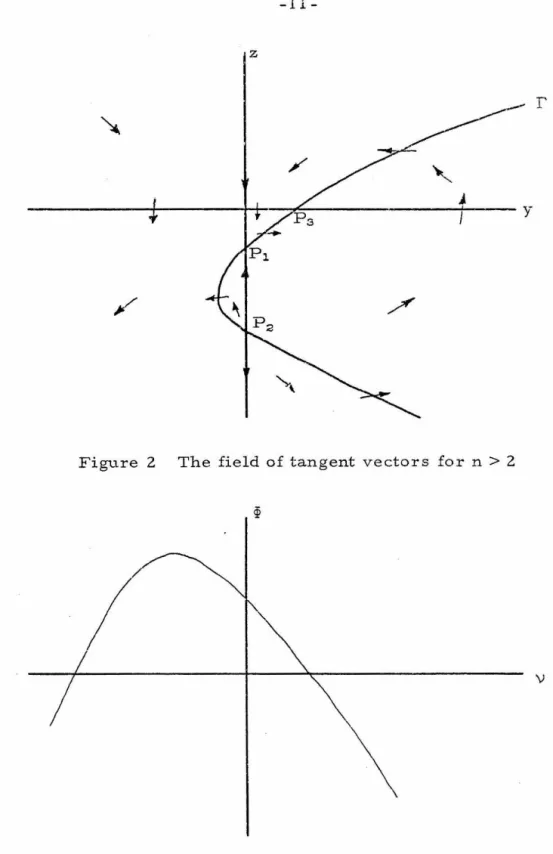
y8, z=
0In figure 2 we indicate the field of tangent vectors corresponding to
system (1. 15), including the locus
r
where~= g(y, z)=
0. Note thaty == 0, ;.; ~ -(z-y)(z-'8) provides three exact solutions wnose trajectories
completely cover the z axis; consequently no trajectory can cross the
z axis.
Next consicier the local behavior about each critical point. 'Ne
readily compute f y = -[3z, f = -{3y, g = 1, g
=
-2z + y + 8 and so thez y z
equation for the characteristic exponent 1- at the critical point (y0 , z0 ) j_s
-{3zo
-.e
=
0 (1.19)l -2.zo +y+8 -J',
For P1, y0
=
0, zo=
y and (1.'19) becomes--{3y-£ 0
=
01
8-v-£
which has roots £ = ..21
=
-{3y and£=
£2= 8-y
Now -{3y=
!J-+2 > 0 and8 -Y = -(n-2)
<
0 for n>
2. Consequently P1 is always a saddle point.For P2 , y0
=
0, z0=
8 and the roots are £1 = -{38 and £2=
y-8.{3
>
1 and 8 < 0 mean £,1>
0. y-6=
n-2>
0 for n>
2 mean £2>
0.Consequently, P2 is an unstable node. Furthermore,
p
> 1 and n>
2imply that P2 is an in~proper node, for recalling the definitions of y
and ewe find
£1 - -{38
=
-{3y + p(n-2)=
(!J-+2)+ p(n-2)>
n-2=
y -9=
£2To de scribe the behavior near P2 in more detail, set
z
_ r
Figure 2 The field of tangent vectors for n > 2
\)
.. ~.
2-vre obtain the linea.rized form of equations (1. 15)
which has solutions
{; -(3 8x
.., = ae
C
=
b e(n-2)x a. e -f36x[38
+
n-2l
j
(1. 20)Since P2 is an unstable node, trajectories approach P2 for
x -+
-=.
This, and the relation -[3 S > n-2 > 0 imply that trajectoriesare tangent to the
C
\or z} axis unless b = 0, in which case there existtwo trajectories tangent to the line
£
+ ((36
+
n-2)s = 0.For P3 , y0 = y9, z0
=
0 and the characteristic equation iswhich has roots
(1.21)
Now 4(3y8 = -4(f.L+2)9
>
0 so that the real parts of.t
1 and.t
2 always havethe same sign; consequently P3 is always an attractor (i.e., a spiral
point or a node). Furthermore, y+9
<
0 so that P3 is a stable attractor.Consider first when P3 is a spiral point, i.e.,
This relation is equivalent to the following inequality in t,erms of the
original parameters [3, f.L and n:
( 1. 22)
where
Figure 3 shc·ws the qualitative behavior of <f>(\i} for
f3
>I,
n > 2. In theregion
v
> 0, <ii decreases n1onotonically, so for givenf3
and n, we havea spiral for all i-l ~ fl.':' i£ and only i£ i.P(!-l-':'+2) < 0. In particular, P3 is a
spiral point for all fl. :<: 0 if i.P(2)
<
0, and this can be shown to beequivalent to
f3
2(n-2)(n-10} + 8[3(n-4) +16 < 0 (1. 24)
For the membrane problem origin.ally proposec4 n
=
4 andf3
=
3; it isa simple matter to verify that (1. 24) is indeed satisfied for these values
of the parameters. lvfore generally, for given values of n
>
2 andp
> 1there exists a value fl.':' such that for all fl. >fl.':', P3 is a spiral point.
Next we consider the structure of the phase plane near P3 ·when
it is a node. (It will turn out that the local structure about P3 critically
determines the number of equilibrium· solutions of the membrane
proble1n.) Set y
=
ye+
L
z=
C;
the linearized form of equations {1. 15)is now
(~)
=(~
-f3y8) Y+
e
(~)
c
Eigenfunctions
(~)
satisfy
-f3y8 )
(Cl) _
(0)
y+G-~ c2 0
or c1
=
[~-(y+8)]c2
• Note from equations (I. 21) that~ -(y+8) = -~2
The linearized theory in the neighborhood of P3 thus provides the
-14-(~)
for some constants a, b for a given trajectory. Since
.
e
2<
.t1<
0, wecan conclude fron'l this that in a neighborh.ood of P3 all trajectories are
tangent to the line y - y 8
+ /.,
2 z=
0, except for one pair of t raj e cto rie swhich is tangent to the line y- y8
+
1.,1 z=
0.In the special case that /.,2 = 1.,1
<
0, there is only oneeigen--vector, and the general theory for critical points shows that P3 is
again an improper node with all trajectories tangent to the same line.
In figure 4 we summarize the above results about the behavior
of trajectories in a neighborhood of each of the finite critical points.
Some reference to figure 2 may also be helpful. We note in passing
that the tangent line to r at P3 is y - y8 + (Y+8 )z = 0. A justific3.tion
that the linearized theory does in fact accurately de scribe the behavior
of the solutions of the full nonlinear equations in neighborhoods oi each
of the critical points can be found in a standard reference, such as
Coddington and Levinson [3].
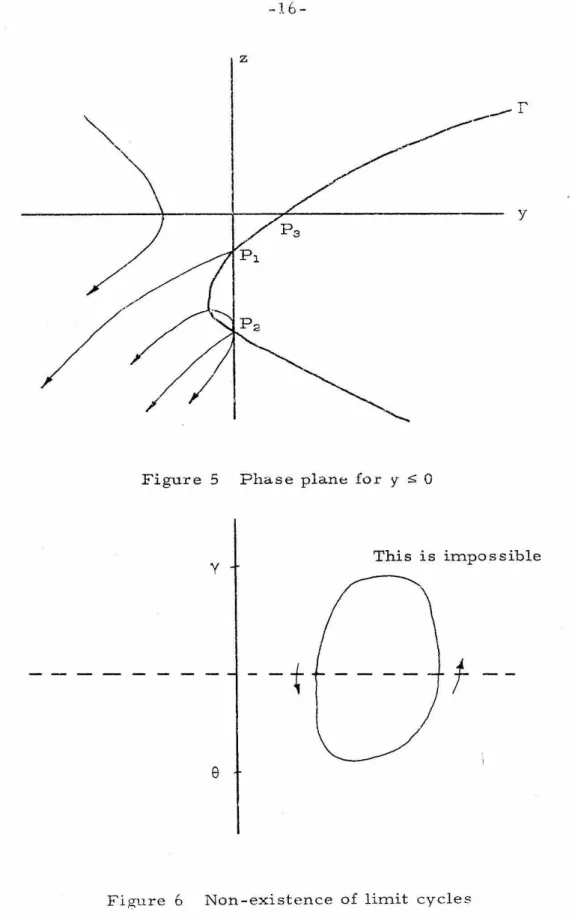
By combining the results of figures 2, 4a, and 4b we can
ascertain that the phase plane for y ~ 0 has the qualitative form of
figure 5, regardless of the behavior at P3 • vVe now concentrate on
completing the phase plane for y > 0. First we show that no limit cycles
exist. Introduce T] = log y and compute
ri
=
yjy
=
-(3z=
F(n, z) }(1. 25)
z
= y - ( z -y )( z - 8 ) = e Tl - ( z -y )( z -8 )=
G( T) z )z
(a) near P1
~r
/
(b) near P 2
"
\
(c) near P3 , spiral case
(d) near P3 , node with distinct eigenvalues
(e) near P3 , node with a double eigenvalue
-16-z
T '
.---
_..-ly
/
//
Figure 5 Phase plane for y s: 0
y This is impossible
--t
f
--e
closed curve, say C, inclosing an area S. Vfe calculate, integrating
over one period in x:
0
=
r
(·n.~-;-n)dx ==r
(~dz-~dTi}.JC ' "C 'I •
=
J
8 'Y('!l. z) • (F, G)dnclz
=
J
(-2z+y+8)dT)dzs
=
J
(Fdz -GdTJ)c
(using Green1 s theorem)
Consequently the lim.it cycle -:annat lie wholly above nor wholly below the line z
=
-t{y+8). (This is true in either phase plane, since T) ismerely a rescaling of the y axis.) However frotn either equation (1. 15) or figure 2 we conclude that
z
> 0 along the half-line y > 0, z=
-t{y+8). This means that a trajectory can only cross this line in one sense (Cf. figure 6 ). It follows that no limit cycles exist.Now consider the (unique) trajectory eminating from the saddle point P1 into the region y > 0. From the vector fielci we see that
y
>
0,z
> 0 initially. Now either this trajectory intersects they axis in somefinite x, or else z < z0 s: 0 for all x, in which case z -+ z0 as x 4 +a:>.
But then we must also have ~ -+ 0 and y -+ +a:>. This is inconsistent with
.
z
=
y- (z -y)(z -8 ), so in fact this trajectory must inter sect the y axis at a finite point (necessarily to the right of the spiral point P3 ). Fromthe vector field (cf. figure 2) we can see that the trajectory then move s upward to the left, intersects
r
in the region 0 < z, continues downward to the left, intersects they axis in 0 < y < y8, and then continues down-ward to the right, intersecting I' in the region y < z < 0. Finally, the trajectory again moves upward to the right. We can now argue that the trajectory is bounded and, in the absence of limit cycles, necessarily
-18-If we take any point on
r
in the region y>
0, z<
8 a:::td follow thetrajectory through such a point as x -+
+Q,
exactly analogous ar~-un1.entsapply. If we follow such a trajectory for x -+ -"', the vector field force3
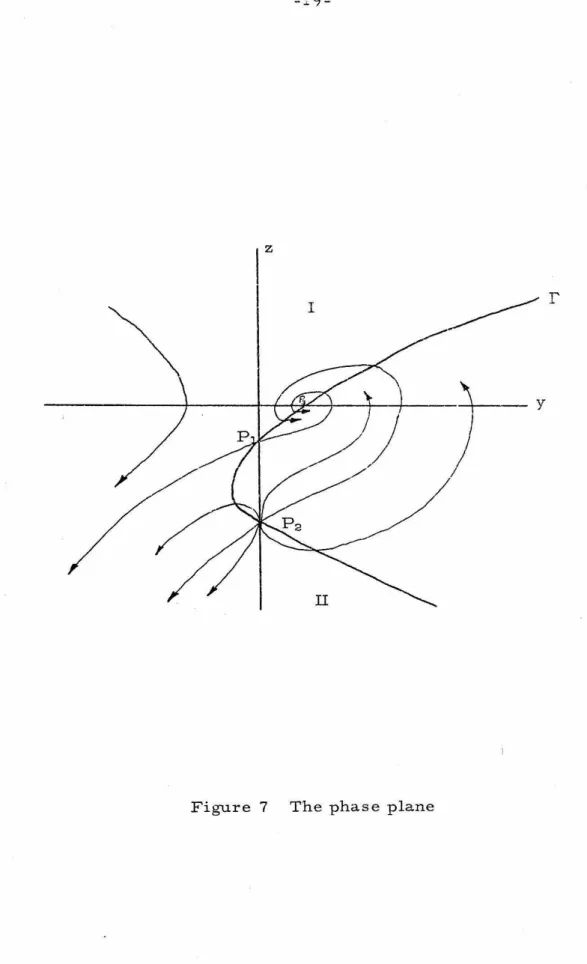
it directly into the unstable node P2 • Thi::; discussion and the results
illustrated in figures 2 and 4 permit us to construct the phase plane
illustrated in figure 7 when P3 is the spiral point. Vlhen P3 is a node,
the plane remains qualitatively the same except in the neighborhood of
P3 , where trajectories either tend directly into the critical point or
spiral about it at most a finite number of times before tending into it.
Two possible families of trajectories tnay exist which have not
yet been discussed, their locations are indicated in figure 7 by region I
and region II. First we consider a point in region I. Necessarily as
x-+
+o.l
the trajectory through such a point tends to P3 • We have notargued, however, that such a trajectory intersects the curve
r
(in theregion y > 0, z > 0) as x -+ -:co. If this does not occur, then y -+ -f-c:> and
z -+
+cr
as x -+-co
Similarly, the trajectory through a point in region IImust tend to P2 as x -+ -co. vVe have not argued that such a trajectory
intersects
r
(in the region y > 0, z < 8) as x -++<X).
Should this notoccur, then y -+ +o:> and z -+ -co as x -+ +o:>. Fortunately, it will turn out
that these two possibilities are irrelevant to the boundary value problem
posed, and so further investigation is unnecessary.
We now search for trajectories in the full plane satisfying
boundary conditions (1. 16) and (1. 17), as well as the derived condition
(1.18). Consider first (1.18), viz. y(-o:>)
=
0. This eliminates alltrajectories except the two eminating from the saddle point P1 and
-19-y
-20-elin:tinates the possit?le trajecto2.·ies in region I mentioned above.
Consider trajectories tending to P2 as x--. -c:c. Along thern
z - y __. 8 - y
f
0, so rneeting boundary condition (1. 16) is equivalent to-x(y+2)1 ~-l/[3
satisfying e y. · <"" as x __. -CXl. We derived in equation
(1. 20) the asymptotic relaticn y = ;'"""ae-f3Gx near P2 • The trajectories
satisfying a = 0 locally are, in fact, segments of the z axis withy= 0;
hence they cannot satisfy (1.17). Near P2 boundary condition (1.16)
thus reduces to
-(y+2)':( -R8x)-l/P -(y+2)x+8x
e e ~""'
=
e=
e -(y+2)x + (y-n+2)x = e -nx < ::::> as x __. -c::>But this is not possible for n > 2, so that no trajectory tending to P2
as x--. -c:c can satisfy (1. 16). In particular, this also eliminates the
possible trajectories in region II described above.
Our only hope for a solution, then, lies with the two trajectories
emanating from the saddle point P1 • With y =
£,
z = y+
C
thelinear-ized equations for (~,
0
are~ = -r:>Y s = <!J.+2)s
C =
s
+
(8-y)C =£
-(n-2)Cwith solutions
s
= ae(!J.+Z)x = ae-f3yx( =be -(n-2 )x+ ~ e (!J.+2)x
- !J.+n
In the parameter domain n > 2 trajectories tending to
£
=
(
=
0 asx --. -oo must have b
=
0. Thus as x --. -ooand
-(y+2)x 1 ,-1/13 1 I -(y+2)x yx (fJ.+2)x fJ.X <
e y z-y ~ e e e
=
e co,as x-+ -oo for fJ. ~ 0. Thus these two trajectories do indeed satisfy the boundary condition at x
=
-oo (corre spending to r=
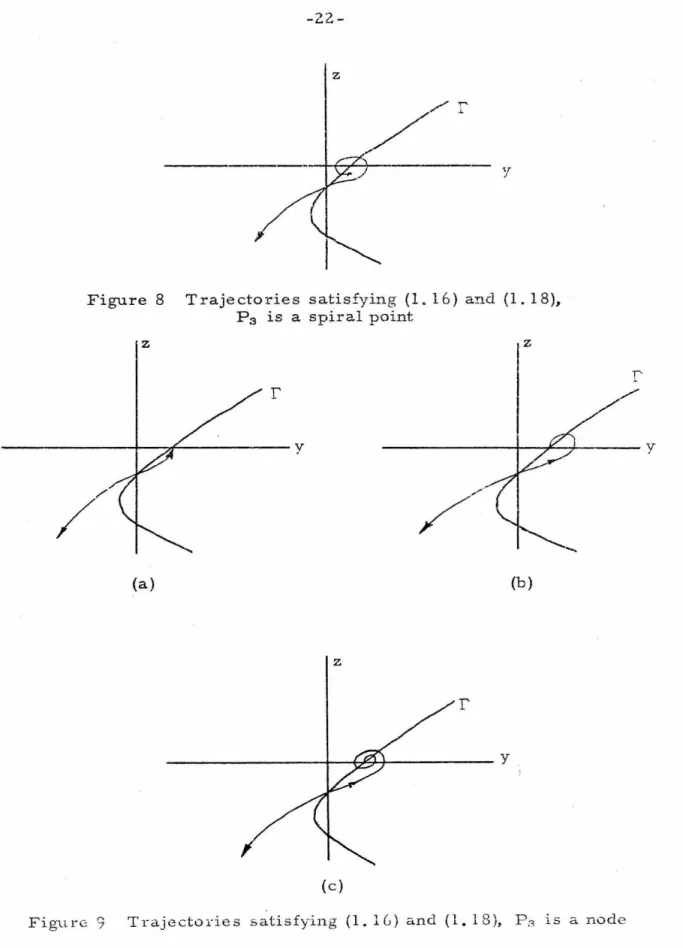
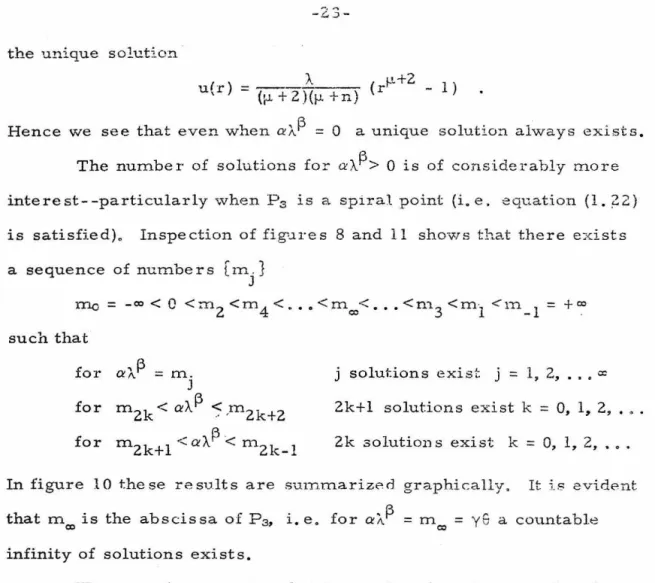
0),In figure 8 we graph these two trajectories when P3 1s a spiral point. In figures 9 a, b, and c, we graph some typical examples when P3 is a node. In these latter cases the trajectory in the right half-plane may tend directly into P3 or may spiral about (at rnost) a finite number of times before tending into P3 • The analysis presented here is insufficient to determine precisely how 1nany times P3 is encircled in the case of a node.
The remaining boundary conditio~ (1. 17), is trivial to satisfy; it merely requires that the solution trajectory intersect the line y
=
a1-J
3 when x=
0. If a trajectory intersects the line y=
a;\!3,
then the trans-lation invariance of the autGnomous system ( l. 15) implies that asolution exists for which x
=
0 at the point of intersection.The question of the number of solutions to equation (l. 1) with boundary conditions (1. 2) and (1. 3) is thus reduced to counting the number of intersections of the trajectories emanating from P1 with the line y = a;\!3 (each distinct point of intersection corresponds to a different transfonnation back to the independent variable 0 ::;; r ::;; l and hence a distinct solution).
Regardless of whether P3 is a spiral point or a node, precisely
one solution exists for every value of aA.f3 < 0. We noted earlier in the chapter that 'Nhen A.
=
0 the unique solution u(r)=
0 exists. It is-22
-z
y
Figure 8 Trajectories satisfying (1. 16) and (1. 18),
Ps is a spiral point
z z
I'
r
/ /
y y
//
/
/
(a) (b)
z
(c)
u(r)
=
A(rf-
~+
2-
l) ((!+
2 )(}J.+
n)Hence we see that even when a\!3
=
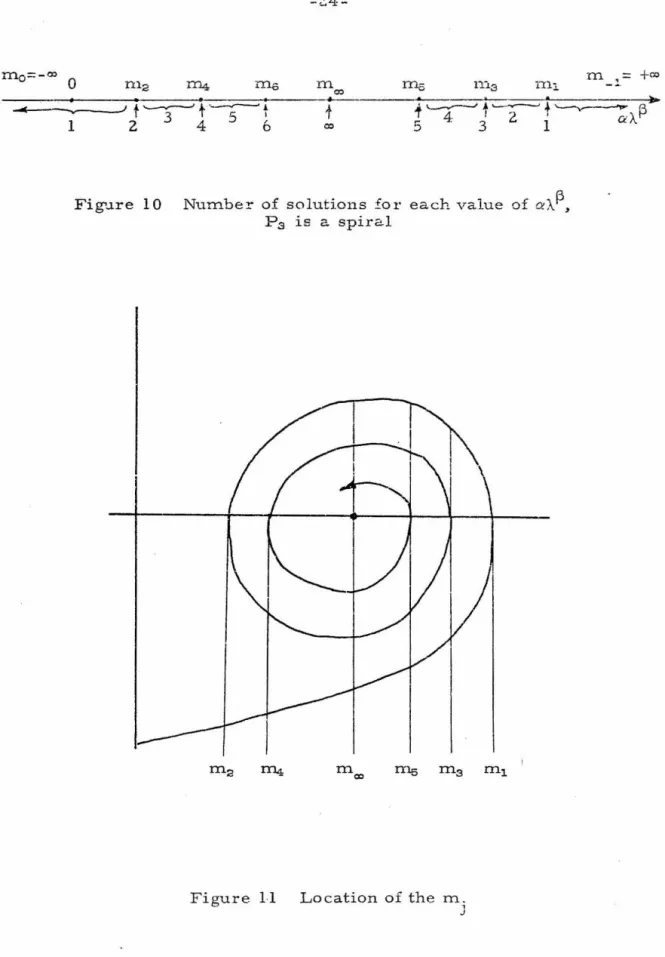
0 a unique solution always exists.The number of solutions for a\!3> 0 is of considerably more interest--particularly when P3 is a spiral point (i.e. equation (l. ~2)
is satisfied). Inspection of fig..1re s 8 and ll shows that there exists
a sequence of numbers [ 1n.} J
rna
=
-co<
0<
:n 2 < rn 4 < ••• < m co< •••<
n1.3 < m
t
< 1n _1=
+
co such thatfor j solutions exist j = l, 2, ~
for 2k+l solutions exist k = 0, l~ 2,
for Zk solutions exist k
=
0, 1, 2, . •.In figure 10 these results are su1nmariz~o graphically. It 1.s evid~nt
that rnco is the abscissa of P3 , i.e. for a\!3
=
m00=
y6 a countableinfinity of solutions exists.
We remark in passing that it was found earlier that for the
flat membrane P3 is a spiral point for all values of f.l· Consequently,
figure 10 depicts the distribution of equilibrium configurations ior
various edge thrusts and pres sure distributions.
When P3 is a node the situation for aA.P> 0 is son1ewhat less
dramatic and, unfortunately, more vague. As can be seen from
figures 9a, b, and c, the separatrix connecting P1 and P3 can tend
directly into P3 without any spiral behavior, or it can spiral a finite
number of times before tending into P3 • Consequently, a similar
sequence of m . can be constructed, with the difference that only a
J .
finite number of 111. exist and the nun1.ber of solutions for arbitrary
mo=-co
""
-24-0 n12 U4 ms m
me
111.3 Hll m '=
+ooIX)
~
---
~~ J
t'
3
.
t
.
___...,.--...
~
t
.,...__.__...
t
'--;--'
t
~~13
1 2 4 5
6
co 5 4: 3 2 1 c.\Fig->.1re 10 Number of solutions for each value of
aJ..
?,
P3 is a spiralvahu~
s of a\13 is bounded for given values of!3,
n,. anr: iJ··The case n = 2
In this case 8
=
y<
0 (cf. equation (1. 9/) ar.d the critical points P 1 an::l P2 coale see into a single point, say P ':', with coordinatesy
=
0, z=
y. The characteristic exponents at P '-!< are 11=
1-'·+
2> 0 and12
=
0; since one of the exponents vanishes P * is not an elernentarycritical point and a special analysis will be necessary.
The characteristic exponents at P3 are given by equations (l.. 21)
with
e
=
y;
this yieldsSince
-13+1
< 0, P3 is always a spiral point, unlike the case n > 2, Theprevious argument that no limit cycles exist is still valid.
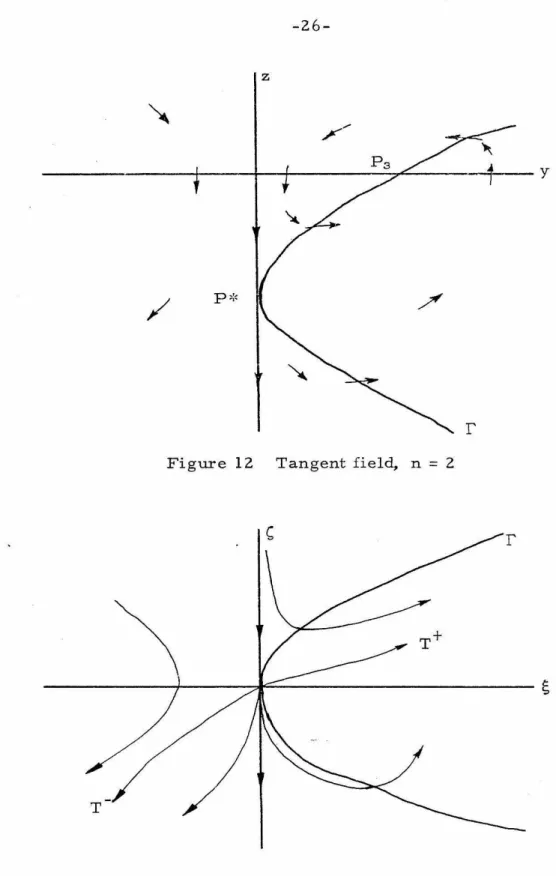
The tangent field is illustrated in figure 12. To discuss the
behavior near P ':' set y
=
~, z=
y+C.
Thens
=
-!3:vs
!3s c
' =
s
-
'2
} (1.26)
It is convenient to introduce local polar coordinates
s
=
r cosrp
(;
=
r sinrp
in terms of which (1. 26) becomesr
=
r(-j3ycos2p+cos~sinp)+
r2 (-j3cos2psinp -sin3p)- r R(p)
+
r2 p(p)(1.27)
.
rp
=
(cos2rp
+ !3Y
cosrp
sin rp)+
r
(!3 -1
)(sin2rp
cos p)- S(rp)
+
r cr(p)The
C
axis is covered by two trajectories satisfyings
= 0,
s
=
-~2,so that all other trajectories lie entirely within either the half-plane
-26-z
/
Figure 12 Tangent field, n
=
2x-+
±
·
.:o.
It is a standard result (e.g, see Hartm.an [.5]) that a.s r(x}-+ 0 eitherI
~(x)I
-+ oc or else p(x) -+P
c
,
wheref&o
is a solution of S(¢0 }=
0.The first alternative, that a trajectory spirals into p >:', is impossible
since no traJectory can cross the
G
axis. To find two possible anglesof approach we solve
0 = S(p0 ) = cosp0 (cosp0 +[3y sinp0 )
to conclude either
cosp
0 = 0 or tanp
0 = -1/f:JY = 1/(1-L +2). The firstpossibility yields
95
0 =±rr/2.
We have already observed that thepositive
C
axis is covered by a trajectory tending to p ,:, as x -++-:o
along
p
0=
TJ/2, and the negativeG
axis is covered by a trajectorytending to P ':' as x -+ -co along ~0
=
-TT/2.It is also a standard result that at least one trajectory exists which approaches P >:< along'/> = p0 if, in addition to S(~10 ) = 0, it is true that S'(p0 )
f.
0. Suppose that tanp0 = -l/f3Y and in addition0
=
S'(po)=
-2 cosposinp0 + [3ycos2p0or tan 2p0
=
[3y. The trigonometric identitytan 2a
=
2 tan a / (l-tan2 a)yields
which is impossible for 0
<
-l/f3Y = 1/(fJ-+2)<
1. Consequently, takinginto account the directions of the tangent field, we can conclude that
there exists at least one trajectory T+ in the half-plane ~ > 0 and at
+
least one trajectory T in ~
<
0 such that T- tends to p ,:, along theline tanj&0
=
1/(f.l+2) as x -+-oo.+
-28-257). Consider the system for x(tj, y(t)
x
=
kx.+
f(x, y)y
=
g(x, y)where k
f
0. If the origin is an isolated singular point of this system,iff, g e
C
in a neighborhood of the origin, and if in addition£=
g=
£X
=
fy=
~=
gy=
0 at the origin, then there exist two and only twotrajectories with equations y
=
y(x) defined to the right and to the left ofx
=
0, respectively, tangent to the x axis at the origin. It is simpleto show that equations (1. 26) satisfy the hypotheses of this theorem
under the transformation
X
=
s
'
y
=
s
+
13YC
where the x axis corresponds to the line
s
+13YC
=
0.We are now in a position to construct the local phase portrait
about P>!< shown in figure 13. A solution trajectory must satisfy (1.16),
(1.17), and (1. 18). Equation (1.18) implies that the trajectory
eman-ates from P >:'. Consider first trajectories tangent to
,P
= -n/2 as x-+ -cc. Set,P
=
-n/2 +,P>:'. As x-+ -cc, ,P>~ -+ 0; hence cos,P"',p
'
:'
andsin,P "' -1. From equation (1. 27) we get asymptotically
• ,/. 2
r"'rY'* + r
.
,P
>:' "'-13
Y
,P
':
'
Equation ( 1. 2 8b) implie s
p
>:'
"'
e-13yx
as x -+ -cc(1. 28a)
(l. 28b)
(1. 29)
Substituting this into (1. 28a) we get the further asymptotic relation
(1.30)
which implies
-1 I
1-1
The result that r decays algebraically is consistent with the assump-tion that
which was made in deriving (1. 30) from (1. 28a). Also
£
= r cosrj>"'
r r/>>!<C
=
r sinr/> ,..._ -rWe can now use equations (1. 29) and (1. 31) to check whether
or not trajectories tangent tor/>
=
-n/2 as x _. -~ sati.sfy (1. 16).e -(y+2)x (z-y)
l
y~-1/~
=
e -(y+2)xC
l
£
~-1/~
,.... e - ( y+
2 )x r ( r r/> *) -1 /p
"'e -(y+2)x r(~-1)/~ e yx
Thus such trajectories do not satisfy boundary condition (1. 16 ).
+
Next consider trajec::tories T- which are tangent to the line
s
=
-~yC as r _. 0. Equations (1. 26) yield.
s--
-~Ys
+ s
2/Y
--
-~Ys.
C
,...,
-~YC -¢!
,..,
-~YCwhich imply
t -~yx r -~yx (f.1 +2)x ., ,...,e , , "'e
=
eChecking equation (1. 16 ), we calculate
-30-+
for i-l ;;:: 0. Thus trajectories T- meet this boundary condition.
We can now see that the case n ::2, for all values of f3 > 1
and fl. ;;:: 0, is identical with the case n
>
2 when P.;. is a spiral pointand can be summarized by figure 10.
The case n = 1
In this case 8 = y
+ 1 and
there are three subcases to consider,depending on whether 8 < 0 (y < -1), 8> 0 (-1 < y < 0), ore= 0 (y
=
-l).In the first two cases there exist three distinct critical points (the
same notation as before will be used); in the third case points P2 and
P3 coale see into P with coordinates y
=
z=
0. Only the salient featuresof the discussion will be mentioned since most of the details are
similar to arguments used for n ;;:: 2.
For all three subcase s, P::. (y
=
0, z=
y) is an unstable impropernode with characteristic exponents £1 = -f3y = fl +2 > 0 and £ 2 = 8 -Y = l.
All trajectories except one pair are tangent to the z axis as they
approach P1. Only the pair of trajectories tangent to the line
y =(fl. +l)(z-y) satisfy boundary condition (1.16). Now consider the
· subcase 8 < 0. Note that this is equivalent to 0 < -f38 = -f3(y + 1) or
Critical point P2 (y= 0, z =8) has characteristic exponents £1 = -f38 > 0
and ~ = y- 8 = -1 and is a saddle point. The separatrice s are tangent
to the lines y = (l-f38)(z-8) andy
=
0 respectively. P3(y
=
y8, z=
0)is either a stable node or a stable spiral point, depending on the sign
of the function 11(!-L +2) (evaluated with n = 1). Just as for the case
n > 2, there exists a value of fl.
=
fl.':' such that for fl. > fl.':< P3 is alwaysplane portrait, only with the labels for the points P1 and P2 exchanged.
Existence and multiplicity are completely analogous to the case n > 2. Next consider the subcase 8
>
0 (!3 ~ tJ. + 2). Then the charac-teristic exponents of P2 are 11=
-!36<
0 and 1 2= -1, so it is
a stable node. The characteristic exponents of P3 are1+ =
~(
y
+ 8)+~
f(y
+8)2 + 48(t.J. + 2}>
0t_
=
~(y+
e
) -~r'<y+8)
2+4
8
(t.J.+2)
<o
since 8(t.J. + 2)
>
0. Hence P3 is a saddle point. From an earlierdiscussion we know th2.t the separatrix corresponding to J,+ is tangent to the line (y -y8) + 1_ z
= 0
and the separatrix corresponding to J~ _ is tangent to the line (y -y8) + t+z=
0. Taking into account the tangent field, we are in a position to construct the phase plane portrait in figure 14a. In figure 14b we have isolated the two trajectories that satisfy conditions (1.16) and (1. 18). Note that for aA.(3~
0 precisely one solution exists, and that there exists a number m1 > 0 such that for 0
<
aA.!3~
m1 two solutions exist, for aA.!3
=
m 1, one solution exists, and for aA.!3>
m1 no solutions exist.
Finally, consider the limiting case 8
=
0 (t.J. + 2=
(3). Critical"'
points P2 and P3 coalesce into P withy
= z
=
0. Since this is not anelementary critical point, we introduce polar coordinates y
= r cos
rp
z = r sinrp
and find that equations (1. 15) become
i.-
= r(cos
rp
sinrp + y sin2p)- r2 (!3 cos2p sinp + sin3 p}- r R(~}
+
r2 p(.~)rp
=
(co s2rp
+ y cosp
sinp)
+
r (!3 -1) sin2p
cosp
-
32-z
(a) The phase plane
z
y
(b) Solution separatrices only
-35-~
The z axis is covered by three trajectories, so P cannot be a spiral point. The possible angles oi approach satisfying S(p0 )
=
0 are1 -
-'-'T'T/?-po - - .. - and tan ~o = -l / Y
=
J.Using arguments sirnilar to those for n
=
2, it is possible to show that "trajectories exist which tend to P for all four angles of approach, and
"
that any trajectory which tends toP as x _.-~ does not satisfy bound-ary condition {1.16). In figure 15a we construct the phase plane portrait, taking the tangent field into consideratiorJ; in figure 15b we isolate the two trajectories satisfying (1.16) and (1.18). Note that the multiplicity of solutions is qualitatively the same as for the subcase
8
>
0.Remark that for n = 1 and fixed [3, there always exists a value 1-1* such that for all 1-1 > 1-l':< a countable infinity of solutions exists for
-34-y
(a) The phase plane
z
..,r
y
(b) Solution separatrices only
CHAPTER 2: INITIALLY CURVED MEMBRANES
Recall from the introduction that the symmetric deformation of
a circular membrane can be de scribed by
d dr
3 du
r
-dr == \ Br
rp
2
(C. 6)
In chapter 1 we considered the situation when t:he membrane IS initially
flat,
p
=
0, and is subjected to a pres sure of the form p == p r'rl/2, max · . . - 3 d 3 duRecognizing r dr (r dr) as a spherically symmetric Laplacian, we
generalized the problem to
1 d
~1 dr
r
n-1 r
for 1-1. ;;,: 0,
13
> 1, a /: 0.du
dr ( 1, 1 )
We next consider the situation in which the pressure distribution
remains the same, but the initial configuration of the membrane is
given by
p
=arb, b~
0. The natural generalization of equation (C. 6) 1s1 d 1 d a 1 R 'Ar2b+l 2(b+l )-n
~1
dr rn-d~
+A.~-'rl-1(1-au) -~"'=
I\ n-1 = \Ar (2. 1)r r
with A = Ba2 •
The analysis of chapter 1 was possible because the
transfor-mations
with
x =log r
v(x) = (1-au)r y
y
=
-<~-~.+
2)/13
(1. 5)
(I. 6)
(1. 7)
yield a second order automonous equation. This is still true when the
membrane is initially curved if the exponent b satisfies
-36-Note that for the memb!"ane problem n -- A -r, [3
=
3, a.nd sob
=
((J.+
2 )/ 6 > 0Consequently p(O)
=
0 and the mernbrane is indeed flat at its apex. Theresponse of the curved membrane is governed by
dv
!3
l-!3
- (y+9) dx + y8v -aA. v +al-..A
=
0To facilitate analysis in the phase plane we introduce
w = 'A./v
l dv z
=
v dzThen equation (2. 2) is equivalent to the system
.
(2. 2)
(2. 3)
(2. 4)
w
=
-wz=
i(w, z) (2. Sa)z
=av.-·!3
-aAw-(z-y)(z-9)=
g(w, z) (2. Sb)where differentiation with respect to xis indicated by a dot. The
boundary and regularity conditions (1.10), (l.ll), and (1. 12) become
- < y
+
2>x
-1I
I
<
e w z -Y ex>
w = A. at X = 0
w-+0 asx-+-o:>
as x-+ -ex> (2. 6)
(2. 7)
(2. 8)
In this chapter A /: 0 so that the membrane is indeed curved, and a
f:
0so that the problem is truly nonlinear. Equation (2. l) can be solved
exactly for a unique solution satisfying the appropriate boundary
conditions when A.
=
0, so we will also assume ).._j:.
0.In chapter l we found that the cases n = l and n = 2 required
special analysis, although the results were not startlingly different
than for n
>
2. In this chapter we will limit ourselves to the casen > 2 insofar as the introduction of the new parameter A provides a
e
=
y - (n-2) < y < 0will always hold. Finally, to sir.nplify the discussion, we will restrict
[3 to integer values.
Consider the critical points of system (2. 5). As before there
exist points P1 and P2 given by w = 0, z = y and w ::: 0, z = 8
respec-tively. Any remaining critical point is of the form w
=
W, z = 0where W is a root of
p(w) - aw[3- aAw- y8
=
0 (2. 9)Although it is not possible, in general, to give explicit formulae for
such roots, we can derive much qualitative information graphically.
First note that p(O)
=
-y8 < 0 always. Suppose 0 = p 1 "' "'p, -1(w)
=
a[3wt-' -aAor
v.,f3-l
=
A/[3 (2. 10)
If [3 is even there always exists precisely one point where p'
=
0. If[3 is odd, there exist two values of
w
(equal in magnitude but oppositein 'sign) where p'
=
0 when A > 0 and no suchw
when A < 0. Finally,p"
=
0 only at w=
0, but p'(O)f.
0 so there exist no inflection points.Using these simple facts we readily construct the various
possible graphs of p(w) in figures 16. Note that when [3 is even we consider only A > 0, and when [3 is odd we consider only a > 0. This
is sufficient to give the qualitative behavior of the phase plane in all
possible cases, because system (2. 5) is invarient under
(w, z, a, A) _. ( -w, z, a, -A)
when [3 is even and
(w, z, a, A) _. ( -w, z, -a, A)
-38-·
\
p---j~---·---
w~ .
/ '
\
(a)
13
even, A>
0, a>
0 (b}13
even, l >> A>
0, 0!<
0p p
I
(c)
13
even, A >> 1, a<
0 (d)13
odd, A<
0, a > 0(e)
13
odd, 1 >>A > 0, a > 0 (£)13
odd, A >> 1, a > 0one, or two roots, depending on whether the 1naximurn of p is negative,
zero, or positive, respectively. Con~bining (2. 9) and (2. 10), the
condition for two roots is
a(A/[3)13/(13-l) -aA(A/13)l/([3-l)_ y8 > 0
or simplifying
A >A>:<
=
13[y8/a(l-f3)](13-l)/[3 (2. 11)Likewise, for A =A':< one root exists, and for 0 <A <A::< no roots
exist.
Similarly, for f3 odd, A > 0 and a
>
0 there may exist one, two,or three roots, depending on the sign of the local maximun~ of p. The
local maximum occurs at
w
=
-(A/13)l/(f3-l) and an analogous calcula-tion shows that for
A> A>:< three roots exist
two roots exist
one root exists
where A::< is again defined by (2. l l ).
Next consider the behavior locally about P1 and P2 • Near P 1
we may set w
=
£,
z=
y+C to obtain the linearized equationss
=
-Ys
C
=
-aA£ -(y-8)C=
-aAs -(n-2)\:with solutions
yx -(n-2)x -yx
s
=
a e- , C=
be + a1ewhere a1
=
-aaA/(n-2-y)=
aaA/8. Since -y > 0 and -(n-2) < 0, thisis a saddle point.
-40-We de signatc the trajectory emanating from P1 into w > 0 by T + and
by T for w <0. If, near P;a, We set w
=
£,
z=
e
+{;and linearize,we obtain
with solutions
where
s
=
-8£
C
=
-aA£ -C(8-y)=
-aA£+
(n-2)<;;:-ex
£
=a ea1
=
aaA/(n-2+8)=
aaAjySince -8
>
0 and n-2>
0, P2 is an unstable node.8x
C/s
=
(b/a)e + aA/yGraphs of the phase plane in a neighborhood of P1 and P2 are
sumtnar-ized in figure 1 7.
To study the behavior in the neighborhood of a critical point
w = W, z
=
0 (should one exist) we examine the characteristic exponents.t which satisfy
0
=
or
f
-1-w f z
y -.t
z
-.t
=
f3
-1af)W -aA
Using p(W)
=
0 we simplify this to;,2 -(y + 8).1, + ([3-l )aAW +[3y9 = 0
which yields the characteristic exponents
-W
y+e-..e
.t+
=
~(y+8)
±~f(y+8)
2 -4[([3-l)aAW +[3y8] (2.12)To analyze this in more detail, we shall consider the cases of small
amplitude and large amplitude initial configurations. First, however,
z-y
~z
-Y
T
~~
f
T+
I~//
I)
1
/
w-7-
\VI'~+
T-
A
)
I
T
(a) Near P1 , aA > 0 (b) Near P1 , aA < 0
z-8 z-8
(c) Near P2 , aA
>
0 (d) Near P2 , o:A < 0
-42-Just a.s in the case of the initially flat membrane, the z axis is
completely covered by trajectories satisfying
z
= -
(z - y)(z - 8)Consequently, no trajectory can cross the z axis. In particular, if
any limit cycles exist, they r.nust lie entirely within the rignt half-plane
or the left. By making the transformation T] = log w, an argument
completely analogous to that of chapter l shows that any lirnit cycle
must necessarily intersect the line z
=
!(.Y+
8).Arguments regarding the boundary conditions are also similar
to those of chapter l and will not be repeated. Condition (2. 8) requires
that a solution trajectory en1anate from P1 or P2 • Condition (2. 6)
further requires that the solution trajectory be a separatrix emanating
+
.
-from the saddle point P1, viz. T or T . Condition (2. 7) requires
that we choose the separatrix in the right half-plane for A > 0 and in
the left half-plane for A < 0.
Small amplitude pertubations, 0
<
!A
I
<
<
1Case 1: f3 even, A > 0, a > 0
From figure 16a it is clear that there exist two roots to p(w)
and hence two critical points on the w axis. If W is one such root,
expand
and substitute into (2. 9) to get
awof3 -y8
=
0or
W0
=
±
(y8/a)l/f3W1
=
.!..
(a/y8)(f3-2)/f3 >o
f3
Thus to leading order in A
(2. 13)
(2. 14a)
(2. l5a)
i.e., the result is the same as for the unperturbed case: either a
stable spiral or a stable node. In the special case that (y + 8)2-4f3y8 - 0~
we have
.R,±
=
~(y+8)±
f
-(f3-l)aAW0 (2.15b)so that the unperturbed critical point, a node, becon1.es a spiral in the
right half-plane and rem.ains a node in the left half--plane.
Each intersection of a separatrix from P1 with the line w
=
Acorresponds to a distinct solution of the boundary value problem. In
the unperturbed problem there was no difference between A. and -A. In
the perturbed problem, when the critical points are spirals, for
example, there still exist values A+ and A- such that there exist a
00 00
countable infinity of solutions when A. attains either of these values,
but it is no longer true that
A~
=
-A-:a.
However, forI
AI
small therestill exists a unique solution to the boundary value problem, and for
I
AI
large no solution exists. In the special case that (y + 8)2 -4f3y8=
0,an arbitrarily high multiplicity of solutions is possible only for A> 0;
for A
<
0 the multiplicity is bounded for given values of [3, n, a, f-L, andA. We note in passing that there cannot be a limit cycle about either
of the critical points because, as is clear from the tangent field, the
separatrice s from P 1 bound the critical points away from the line
z
=
t<Y
+ 8). This
will be true in all cases to be considered, for A>> 1and for 0 <
lA
I<< 1, so no further comment regarding the nonexistenceof limit cycles will be made. In figure 18 the phase plane portrait is
given. The locus of points where
w
=
f(w, z)=
0 is merely the w and
-44-I
r
Figure 18 Phase plane for (3 even, 1
>>
A>
0, a>
0z
/
w
T
has been included for clarity. We can also invert g(w, z) = 0 to get
z
=
~
(y + 8)±
~-v(y
+
8)2+
4p(w) (2. 16) Refe renee to figure 16 and the fact that z=
y or z= 8
when w= 0
make it easy to sketch
T'.
Recall that z+
=
0 when p=
0. Case 2:13
even, A> 0, a< 0Refer to figure 16b. p(w) has no roots,
r
is a simple closed curve enclosing the region of the phase plane where g > 0 and we can construct the phase plane portrait of figure 19. It is clear that precise-ly one solution exists for all values of A..Case 3:
13
odd, A<
0, a > 0From figure 16d we see that p has one root. This root may be given to leading order by (2. 14a), except that it must be positive.
Wo
=
(y9/a)1/13
> 0 (2. 17)As in case l, the nature of the corresponding critical point is unchanged from that for the unperturbed systerr~ except when (y
+
8 )2 - 413y6=
0.However, even in this instance we find that the point remains a stable node (Cf. equation (2. 15b)). The phase plane is given in figure 20.
For all A.:::;; 0, a unique solution exists. In fact, there exist numbers m
1
>
m2>
0 such that for A. < m2 a unique solution exists, and for A.> m1 no solutions exist. The situation for m2::;; A.:::;; m 1 depends on whether (w, 0) is a spiral or a node. Depending on this, the appropriate discussion of chapter 1 applies (e. g. Cf. figure 10).
Case 4:
l3
odd, A > 0, a > 0
-46-z
r
w
T
Figure 20 Phase plane for [3 odd, A < 0, a > 0
z
T
(2. 1 7). Although the phase plane, shown in figu.:ce 21, is slightly
altered, the trajectories T+ and T-, the nature of the critical point
(w, 0 ), and the possible number of solutions for a given \ are qual
ita-tively the san"le as for case 3. The only exception is that when
(y
+
8)2 - 4j3y8 = 0, the unperturbed critical point (W, 0) is a nocie, butfor A > 0 it becomes a spiral point (and hence there exist A with
arbitrarily many solutions).
Large amplitude pertubations,
I
AI
>> lCase 1:
i3
odd, A > 0, a > 0From figure 16£ we see that p(w) has three roots, say vV~<, W-,
+
and W where
Because p'(O)
=
-aA-+ -oo as A-++~ we expect W>i<-+ 0. The localextrema of p occur at w
=
±
(A/f))l/(!3-l) (C£. equation (2. 10)) which+
tend to ± oo as A -+ + oo; consequently W -+ + oo and W -+ -co
To find the roots W we substitute
W
=
U A l/(f3-l) (2.18)into equation (2. 9) to get
uf3 - u
=
<y e
1
a>
e
(2. 19)where
-f3/(f3-l)
e
=
A (2. 20)and 0 < e: << l for A >> 1. We now expand
U
=
Uo+
e U1
+
(2. 21 )and substitute to get
f3
.
U0 - U0 = 0 (2. 22a)
-48-(2. 22a) yields solutions U0
=
+
1, - 1, and 0 . The first two provide us withw+"'
Al/(f3-l) (2. 23)w
-A l/(f3-l) (2. 24)If we take U0 = 0 and substitute into (2. 22b) we get
and hence
(2. 25) The characteristic exponents for each critical point are given by equation (2. 12). If we substitute the values from (2. 23), (2. 24), and (2. 25), we get, to leading order:
at
cvl,
0)at (W-, 0)
at (W':', 0)
t±
=
~(y+8)
±
i~l)aAf3/(f3-l)
t±
=~<y+e>
±V<f3-l)aAf3/<f3-
1>t±
=
~(y+
8) ± t(Y- 9)=
y or 9(2. 26) (2. 2 7) (2. 28)
Consequently, (W+, 0) is a stable spiral, (W-, 0) is a saddle point, and
(W>!<,.O) is a stable improper node. In figures 22 abc the three
compat-ible phase planes are illustrated. They differ in that the separatrix T may tend into (W-, 0 ), it may tend into (
w:',
0 ), or it may beunbounded. For clarity, only T+ is shown in the right half-plane.
Note that the locus
r
where g(w, z) = 0 consists of two branches: aclosed curve to the left and a parabolic-like curve to the right. If we
only consider the vector field, it is conceivable that T+ tends to
infinity in the fourth quadrant without ever intersecting
r.
Were this not to occur, T+ could not spiral into (W+, 0) as shown.-49-z
I'
w
(a)
z
(b)
(c)
-50-first introduced by Poincar.; and may be found in the references [6],
[7]. A point (w, z) in the plane can be represented in projective
COOrdinateS by (W, z, 1 ), or IDOrC generally, by
(w,
~.V)
wherew'v
f=
w"'/"'
z v=
zv
1-
o.
Points with
v
=
0 lie on the circle at infinity. If we takev
=
1,equations (2. 5) can be rewritten as
.
(W\
rv)
=
f(~
-
"'
(~)
,V"
"
Poincare introduces
£>!<
=
~-=
- V.'ZB
w
""
=
V'' g( "',~
)(2. 29a)
(2. 29b)
(2. 30a)
(2.30b)
,...,(3 ...,..(3-l ....ed3-2
d3
_A_l=
aw -aAwv -z v -yev +(y+8)ZV"'where f is a polynomial of degree 2 and g is a polynomial of degree (3.
Equations (2. 5) can be imbedded in the equation
0
=
dw
w
A_2
i f £>:<
which, when expanded, is
dz
g*
dv
0
"'[ ... (3 ,..._ d3-l --..e-(3-2 d3 B-1 ~
-v aw -aAw v -z v -y8 v + (y+8)Z'}" J dw -v d3-l,_.,...,d""' wz z
=
0(2. 31 )
(2. 311)
Critical points are characterized by the simultaneous vanishing of the
5
determined above with
v
=
l, we find points on the circle at infinity by setting v=
0. By examining the coefficient of dv, we conclude there isonly one such point, viz.
(w,
-z,
v)=
(o, 1, o)We introduce coordinates
w
=v:
;z:,
v
=v
;-z,
·z-
=
1Note that points (w, z, l) with w
>
0, z < 0 corresponds to pointsCW,
V)with W
<
0, V<
0, and that (W, V) = (0, 0) corresponds to infinity in the(w, z) plane.
With
z
=
1, equation (2. 31') is equivalent to the systemW
=
awl3-l_aAW2vl3-l_y8WVI3+ (y+8)WVI3-l (2. 32a)V
= awl3+l_aAvl3w-vl3-l_y8VI3+l+(y+8}VI3 (2.32b)We wish to study behavior in the neighborhood of the origin. Note that
• R_l R+l R • R+l
W
=
0, V=
-V~-' -y8V~-' + (y+8)V~-' and V=
0, W=
aW~-' provideexact solutions which compietely cover the v and waxes, respectively.
In particular, this implies that trajectories in the quadrant W < 0, V < 0
can only leave this quadrant by tending to the origin (infinity in the w-z
plane), by tending to infinity (which means crossing the line z
=
0 inthe w-z plane), or by tending to one of the other finite critical points (which all correspond to finite critical points in the w-z plane).
Since
13
>
1, the origin is not an eletnentary critical point ofequations (2. 32 ). To study the behavior of trajectories, we introduce
polar coordinates
-52-r =
-rl3-lsinj3¢·+ (y+8)rl3sinl3-l.¢+
rj3+l(acosj3~-
aA cos¢sinl3-l¢- y8sinf3¢')~
=
-rl3-
2cos~
sinj3-lp(2. 33a)
(2. 33b)
Since trajectories cannot cross theW axis and the V axis, and hen.ce
cannot spiral into the origin, they must approach the origin along
angles
Po
satisfying,/.
.
13
-1 ,/.cos )"osln )"O = 0
This leaves only
po
= 0, n/2, TT, 3TT/2, so that a trajectory can onlyapproach the origin tangent to one of the axes.
Now consider a trajectory through a point in the quadrant W < 0,
V < 0. There TT <
.¢
< 3n/2 so cosp < 0. Since pis odd, sinj3-l¢">
0.Consequently,
p