2017 2nd International Conference on Information Technology and Management Engineering (ITME 2017) ISBN: 978-1-60595-415-8
Adaptive Compressive Tracking Based on Perceptual Hash Algorithm
Lei ZHANG, Zheng-guang XIE
*and Hong-jun LI
School of Electronic Information, Nantong University, Nantong 226019, China
*Corresponding author
Keywords: Compressive Tracking, Perceptual Hash Algorithm, Real-time Performance.
Abstract. As the compressive tracking algorithm is easily failed to track target due to the classifier learning rate is fixed when appearances and lightings of target get seriously changed and completely loses the target after heavy occlusion, we propose adaptive compressive tracking algorithm based on perceptual hash algorithm. It makes the compressive tracking algorithm more adaptive to the change of target appearances by adjusting the learning rate of classifier in real time according to the Hamming distance between the hash fingerprints of current target and the original one. Experimental results show that the method can quickly and accurately track the target in the case of the object appearances change and the object is occluded. Our tracker accuracy and robustness have been improved and real-time performance.
Introduction
In recent years, with the development of computer video processing technology, computer vision has become a hot research topic [1]. As an extremely important part of computer vision, moving object detection and tracking technology has been widely studied and applied to video surveillance, image processing, artificial intelligence and so on[2-3]. Compared to the early target tracking algorithms, such as mean filtering, particle filtering, optical flow and template matching method, scholars have put forward a lot of effective target tracking algorithms that have made a great breakthrough. However, the object tracking is still challenging because of the change of target pose, motion blur, the change of illumination and especially heavy occlusion.
Proposed Method
The deficiency of the discriminative algorithm, such as compressive tracking algorithm, is that the update rate of classifier fixed. It doesn’t know whether or not the current tracking target is true. The target template will be incorrectly updated with background when the target is obscured, which leads to drift or loss of target and tracking failure after long occlusion. In this paper, we combine the compressive tracking with perceptual hash algorithm to improve its performance for occlusion.
The pHash algorithm is mainly used in similar image search. It generates a fingerprint string for each image to determine whether the images are similar by comparing Hamming distance between fingerprints. The pHash Algorithm procedure is as follows:
1) Resize the dimension of target image to 32*32;
2) Use discrete cosine transformation (DCT) on the gray image to get the DCT coefficient matrix with the size 32*32;
3) Preserve the 8*8 matrix of the upper left corner and calculate the mean value of DCT matrix;
4) Set values of the 8*8 matrix which are greater than or equal to the mean value to 1 and others to 0. The compositor of the matrix makes up a 64 it integer, which is the fingerprint of the image.
As long as the overall structure of the image remains unchanged, the fingerprint is unchanged. The different bits, i.e. the Hamming distance d between two strings shows the similarity degree of
two images. d=0means two images are very similar while d>10 means the difference of two
images are more than fifty percent, which is verified massive experiments. The tracking algorithm is able to determine whether the current target is the target of interest and adjust the update rate λ
of classifier real-time in Eq. 1 to keep the target template correct.
1 2
, 5
, 5 1 0
1 , 1 0
d d d λ λ λ <
= ≤ <
≥
(1)
The classifier stops updating while heavy occlusion occurring (d >10), which makes it possible to locate the real object after occlusion, and updates quickly when target changes slowly (d<5). This method effectively improves the accuracy of target tracking with occlusion. Our algorithm are summarized as follows:
Input: t-th video frame
1) Calculate and save the hash fingerprint Ht-1 of the target at the (t-1)-th frame.
2) Sample a set of image patches, Dγ=
{
z l z l||| ( )−t−1||<γ
}
where lt−1is the tracking location atthe (t-1)-th frame, and extract the features with low dimensionality.
3) Use trained classifier to each feature vector v z( ) and find the tracking location lt with the maximal classifier response.
4) Calculate and save the hash fingerprint Ht of the current target.
5) Adjust Hamming distance d between Ht-1 and Ht, and λ as (1).
6) Sample two sets of image patches Dα=
{
z l z||| ( )−lt||<α
}
and Dζ β, ={
z|ζ
<|| ( )l z −lt||<β
}
with α<ζ <β .
7) Extract the features with these two sets of samples and update the classifier. Output: Tracking location lt, learning rate λ and classifier parameters.
Experimental Results
effectiveness and rubustness of the proposed algorithm in tracking with heavy occlusion. The search radius for drawing positive samples is set to α=4 which generates 45 positive samples. The inner and outer radii for the set Xζ,β that generates negative samples are set to ζ=8 and β=30,
respectively. We randomly select 50 negative samples from set Xζ,β. The search radius for set
Dγ to detect the object location is set to γ=20 and about 1100 samples are generated. And the
learning rate λ1 is set to 0.35 and λ2 is set to 0.85. The computer is configured to Intel Core i3-2120 processor, 2GB ram, Win7 32 operating system, and the software environment is MATLAB 2011b.
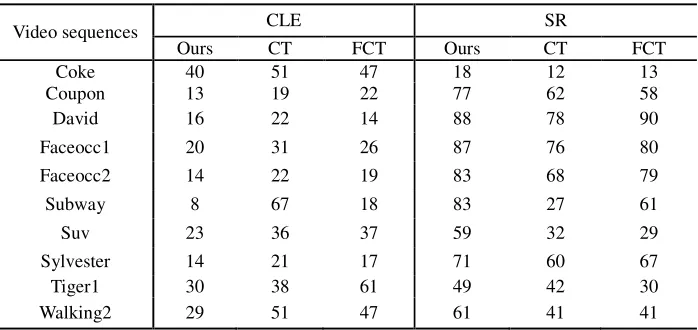
In order to objectively compare the tracking performance of three tracking algorithms, the success rate (SR) and center location error (CLE) are used to evaluate the tracking results. Center error represents the mean value of the Euclidean distance between the position center of tracking and the center of the actual target location. The success rate is defined
as: ( )
( )
T G
T G
area ROI ROI score
area ROI ROI
= ∩
∪ where ROIT means the tracked region of current frame and
G
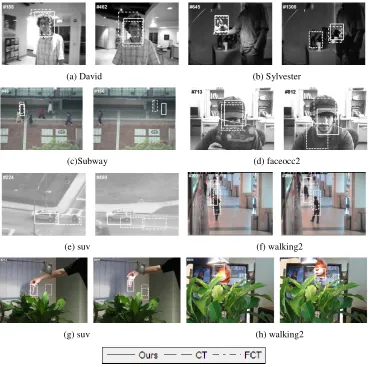
ROI means the actual region. The tracking of current frame is successful while score≥0.5. The average results of 50 times simulation are shown in Table 1. Bold fonts indicate the best performance. It’s easy to find that the performance of our algorithm has improved significantly in tracking possible to locate the true object after heavy occlusion according to the result that shown in Figure 1.
Conclusion
In this paper, a simple and efficient method based on perceptual hash algorithm is proposed for object tracking when occlusion occurs frequently. The performance of the compressive tracking algorithm in tracking that the object is obscured or lost is evidently improved by adjusting the learning rate of classifier in real time, which makes the target template more adaptive and proper. We have successfully achieved the results that the method works quickly and accurately when target is occluded or lost and is able to locate the real object after heavy occlusion. Robustness is significantly improved.
Acknowledgments
[image:3.612.132.481.573.738.2]This work was supported by the National Natural Science Foundation of China (NO. 61171077, the University Science Research Project of Jiangsu Province (NO. 16KJB510036), the Science and Technology Program of Nantong (NO. MS12016025), Nantong University Undergraduate Training Program for Innovation (NO. 2016069).
Table 1. Center location error (in pixels) and success rate(%).
Video sequences CLE SR
Ours CT FCT Ours CT FCT
Coke 40 51 47 18 12 13
Coupon 13 19 22 77 62 58
David 16 22 14 88 78 90
Faceocc1 20 31 26 87 76 80
Faceocc2 14 22 19 83 68 79
Subway 8 67 18 83 27 61
Suv 23 36 37 59 32 29
Sylvester 14 21 17 71 60 67
Tiger1 30 38 61 49 42 30
(a) David (b) Sylvester
(c)Subway (d) faceocc2
(e) suv (f) walking2
[image:4.612.122.492.64.431.2](g) suv (h) walking2
Figure 1. Screenshots of some sampled tracking results.
References
[1] Wu Yi, Lim J, Yang Ming-hsuan. Online Object Tracking, A Benchmark[C]//Conference on Computer Vision and Pattern Recognition. IEEE, 2013:2411-2418.
[2] Hongjun Li, Ching Y. Suen. A novel Non-local means image denoising method based on grey theory[J]. Pattern Recognition, 2016, 49(1):237-248.
[3] Hongjun Li, Ching Y. Suen. Robust face recognition based on dynamic rank representation[J]. Pattern Recognition, 2016, 60(12):13-24.
[4] Alt N, Hinterstoisser S, Navab N. Rapid selection of reliable templates for visual tracking[C]//Conference on Computer Vision and Pattern Recognition. IEEE, 2010:1355-1362.
[5] Grabner H, Grabner M, Bischof H. Real-Time Tracking via On-line Boosting[C]//British Machine Vision Conference. 2006:47-56.
[6] Babenko B, Yang Ming-hsuan, Belongie S. Visual tracking with online Multiple Instance Learning[C]// Conference on Computer Vision and Pattern Recognition. IEEE, 2009:983-990.
[7] Zhang Kai-hua, Zhang Lei, Yang Ming-hsuan. Real-time object tracking via online discriminative feature selection[J]. IEEE Transactions on Image Processing, 2013, 22(12):4664-77.
[9] Zhang Kai-hua, Zhang Lei, Yang Ming-hsuan. Real-time compressive tracking[C]//12th European Conference on Computer Vision. Springer-Verlag, 2012:864-877.