A Meta-model for
Software Protections and Reverse Engineering Attacks : an
instance of the meta-model
C. Basilea, D. Canavesea, L. Reganoa, P. Falcarinb,∗, B. De Sutterc
aDipartimento di Automatica e Informatica, Politecnico di Torino, Italy bDepartment of Computing and Engineering, University of East London, United Kingdom cComputer Systems Lab, Department of Electronics and Information Systems, Ghent University, Belgium
Abstract
This supplementary document presents an additional use case analysis on top of the paper titled “A Meta-model for Software Protections and Reverse Engineering Attacks” by the same authors, in the form of an instance of the meta-model filled in with the data from the risk analysis and mitigation of an open source software application.
1. Introduction
Identifying the threats against a software application is an indispensable task to mitigate the risk that attackers are able to compromise the assets therein. Automating this task would have an tremendous impact in helping software developers, who usually have limited or no competence in software protection, to achieve a reasonable level of protection of their assets. However, such an automation is impossible without a proper formalization of the knowledge needed to perform this activity.
We have proposed a meta-model able to describe all the entities involved in the risk analysis and mitigation. The meta-model allows describing all the relevant parts of an application (data, functions, pieces of code), the assets, the attacks against each application part and the protections that mitigate these attacks [1]. The meta-model also describes solutions, which describe how a combination of protections can be applied on each application part that deserves to be protected. This meta-model has been designed to be the foundation of a knowledge base that allows reasoning about the risk analysis and mitigation process.
The following sections present an instance of the meta-model built on data from the risk analysis and mitigation of Sumatra1. This document presents the data that can be
∗Corresponding author: Paolo Falcarin
Email addresses:[email protected](C. Basile),
[email protected](D. Canavese),[email protected](L. Regano),
[email protected](P. Falcarin),[email protected](B. De Sutter)
represented by the meta-model and serves as validation of the meta-model effectiveness in representing the data needed for risk analysis and mitigation.
This document is structured as follows. Section 2 presents more information about the application we have protected and how we have selected it. Section 2 presents the risk analysis and mitigation work flow we have executed to instantiate the meta-model. Section 4 describes the application parts in the Sumatra application and the assets we have selected. Section 5 presents the attacks that threaten the selected assets. Section 6 illustrates the protections that can be used to mitigate the risks against the assets and block/delay the identified attacks. Finally, Section 7 draws conclusions.
2. The use case
In the following sections we are going to present an instance of the meta-model for the protection of the Sumatra application, a C console application used to compare DNA sequences. Sumatra can be used either to compare all the sequences contained in a single dataset, or to perform a pairwise comparison of sequences contained in two datasets. While Sumatra is an open-source application, we have simulated its protection like it was a commercial software, whose comparison algorithm must be safeguarded against reverse engineering.
The DNA comparison is performed in four consecutive phases. First, the applica-tion parses the command line arguments, and depending on them calls the appropriate functions to compare the given DNA sequences. Then, the latter are parsed and stored in various data structures. These data structures are then used by the core algorithms to perform the actual comparison of the sequences. Finally, the results of the comparison are returned to the user.
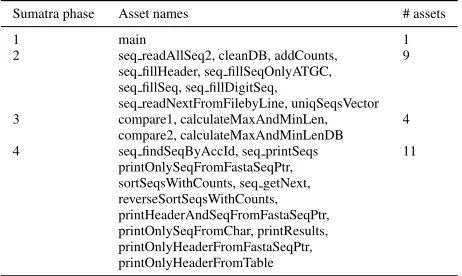
We have identified in total 25 functions as assets. Table 1 lists them per phase. To show how the meta-model can be useful in protecting the application, we aim to safeguard all the assets from attacks against their confidentiality and integrity.
Full details about the meta-model instantiation we are going to present in the fol-lowing sections is available as an ontology file2, written in the Web Ontology Language 2 (OWL2).
2https://github.com/SPDSS/Software-Protection-Meta-Model/blob/master/
Sumatra phase Asset names # assets
1 main 1
2 seq readAllSeq2, cleanDB, addCounts, 9
seq fillHeader, seq fillSeqOnlyATGC, seq fillSeq, seq fillDigitSeq,
seq readNextFromFilebyLine, uniqSeqsVector
3 compare1, calculateMaxAndMinLen, 4
compare2, calculateMaxAndMinLenDB
4 seq findSeqByAccId, seq printSeqs 11
[image:3.612.191.422.125.263.2]printOnlySeqFromFastaSeqPtr, sortSeqsWithCounts, seq getNext, reverseSortSeqsWithCounts, printHeaderAndSeqFromFastaSeqPtr, printOnlySeqFromChar, printResults, printOnlyHeaderFromFastaSeqPtr, printOnlyHeaderFromTable
Table 1: Functions marked as assets, grouped by Sumatra phases.
3. Work flow for risk analysis and mitigation of software application
The meta-model instance we will analyse in the following sections has been pop-ulated in a semi-automated way, by using a tool chain and corresponding work flow developed to assist a software developer in protecting their applications. In particular, the tools used include:
1. a parser of the application source code;
2. an automatic attack discovery tool;
3. an automatic protection discovery tool;
4. an tool that estimates of software metrics after the application of protections to the source code;
5. a tool to hide the protected assets.
First, the application source code is parsed with a tool based on the Eclipse C Development Toolkit (CDT)3, in order to add to the meta-model instance information about the application source code structure, such as the functions and their parameters, the call graph, the local and global variables.
The user can manually annotate the source code to select the functions (or parts of their code bodies) and variables that constitute the assets that must be protected, and the related security requirements, such as confidentiality and integrity. These annotations are automatically parsed by the tool and to fill in the meta-model instance.
Then, an automatic attack discovery tool [2, 3], written in Java, uses the informa-tion added to the instance by the parser in order to infer the possible attacks able to
endanger the user-defined security requirements of the application’s assets. The at-tacks are inferred via an automated reasoning based on a knowledge base of Prolog rules, obtaining for each security requirement of each asset the set of attack paths able to endanger that requirement.
For each attack path, a set of inference rules is used to the find the protections that can be applied to the endangered asset in order to block the attack. Also, for each proposed application of a protection to an asset, the software metrics of the latter after deploying the protection is estimated using a set of neural networks [4]. In this way, the user may evaluate the protection effectiveness in defending the asset, e.g., by using the potency proposed by Collberg [5].
Then, the user can select some of the proposed protections and combine them into a single solution. Also, a tool can automatically refine the latter by adding additional protections on code areas not sensitive from a security point of view but nonetheless good candidates for undergoing protective transformations in order to hide the applica-tion’s assets [6]. Otherwise the difference in structure between transformed and non-transformed code fragments would reveal the location of the assets in the whole pro-gram to an attacker. The additional protections are inferred by automatically generating and solving (using the IBM ILOG CPLEX4solver) a mixed-integer linear problem, in order to maximize the amount of code that must be analysed by an attacker to find the application’s assets [6].
In the following sections, we will show how running this work flow on Sumatra is able to infer all the information needed to protect the application. For the sake of brevity, we are going to concentrate on one specific asset, the functioncompare1in the sumatra.csource code file, containing one of Sumatra’s core algorithms, specifically the one responsible for the comparison between all the DNA sequences in a single dataset. As already said before, we want to preserve the confidentiality and integrity of such asset.
It is worth noting that the ontology reports full information about all the assets we have annotated in the Sumatra application.
4. The application meta-model
In this section, we describe the application’s instantiation of the application meta-model of Section 3.2 of the meta-meta-model paper [1]. In this and later sections, numbered instances are taken directly from the ontology file mentioned in Section 2.
The automatic parser is able to automatically add the information about the source code structure of the application in the meta-model instance. We have manually anno-tated the assets listed in Table 1: such annotations are automatically parsed, resulting in instances of theAssetclass. Classes instantiated by the parser are reported in Table 2.
Looking at thecompare1function insumatra.c, since we have annotated its body as an asset in the source code, from the parsing we obtain in the ontology file:
4https://www.ibm.com/analytics/data-science/prescriptive-analytics/
Class name File ApplicationPart Asset Datum Code Call DatumItem
[image:5.612.159.455.197.223.2]# instances 12 1159 25 909 225 708 1551
Table 2: Classes automatically instantiated by the parser.
DatumType parameter genericVariable integerArrayDatum integerDatum
#Datuminstances 6 9 2 6
Table 3:Datuminstances representing parameters and local variables ofcompare1.
1. aFileinstance, with the source path ofsumatra.cas an attribute;
2. anApplicationPartinstance namedapplicationPart.714, with the function name as an attribute;
3. anAssetinstance namedapplicationPart.738, contained inapplicationPart.714, with twohasRequirementrelationships with respectively theconfidentiality andintegrity elements of theSecurityRequirementenumeration.
Furthermore, applicationPart.714containsDatuminstances representing its parame-ters (fromapplicationPart.715toapplicationPart.720) and local variables (from application-Part.721toapplicationPart.737). Information about variables’ type is modelled using an hasTypeassociation with the appropriateDatumTypeenumeration element, as shown in Table 3.
The meta-model represents functions calls, such as the one made by themain func-tion insumatra.c tocompare1 in the same file. TheapplicationPart.946 instance repre-senting themainfunction has ahasCallassociation with thecall.2930instance of theCall class. The latter has ahasCalleeassociation withapplicationPart.714 representing com-pare1. Furthermore, we can look at the first parameter of this call: themainfunction passes tocompare1as first parameter the variable nameddb1, represented in the on-tology with theapplicationPart.959instance, obviously contained inapplicationPart.946. Consequently, call.2930has a startsWithassociation with the DatumItem instance datu-mItem.2930.0, which in turn has arefersToassociation with theapplicationPart.959instance representing the passeddb1variable.
5. The attack meta-model
In this section, we describe the instantiation of the attack meta-model of Section 3.4 of the meta-model paper [1] for the Sumatra application.
Required AttackStepType ImplementingAttackToolType AttackerExpertise
dynamicStructureAndDataAnalysis debugger geek
dynamicTampering debugger geek
staticStructuralCodeAndDataRecovery disassembler,procedureMatchingTool,decompiler amateur
[image:6.612.155.459.228.295.2]staticTampering staticTamperingTool amateur
Table 4: Instances of classAttackStepTypein the ontology.
Minimum required AttackToolType #AttackToolinstances Examples ofAttackTool AttackerExpertise
debugger 7 gdb,ollyDbg amateur
decompiler 3 boomerang,smartDec geek
disassembler 7 hopperv3,viviset amateur
procedureMatchingTool 4 peiD,unstrip amateur staticTamperingTool 5 peTools,metasm amateur
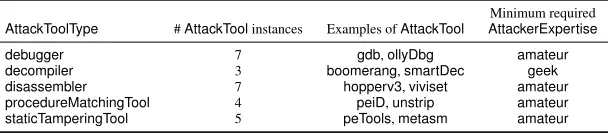
Table 5: Instances of classAttackToolin the ontology.
Furthermore, anAttackStepTypecan be performed by an attacker by using anAttackTool of the appropriateAttackToolType, if the attacker has the requiredAttackerExpertise. For example, even a non-professional attacker may be able to attach a debugger to the ap-plication and do some dynamic tampering, such as modifying the value of a variable at runtime: therefore, theAttackStepType dynamicTamperinghas arequireExpertise relation-ship with thegeekelement of theAttackerExpertiseenumeration. ThedynamicTampering AttackStepTypeis related with thedebugger AttackToolType: however, some debugger are really easy to use while some requires a great expertise from the attacker. For example, thearmDSTREAM AttackerToolhas arequireExpertiserelationship with theexpert Attacker-Expertise, since Arm DSTREAM5is an expensive, professional hardware debugger for Arm System-on-Chips that can be very difficult to use for a non-professional attacker. Attack step types in the ontology, with the implementing attack tool types are summa-rized in Table 4, while information about attack tools in the ontology is available in Table 5.
We have run the automatic attack discovery tool on Sumatra, in order to automati-cally instantiate all the classes needed to represent the possible attacks against the man-ually annotated assets in Sumatra source code. General statistics about the instances of the aforementioned classes are available in Table 6.
For example, an attacker may breach the integrity of the compare1asset by exe-cuting the application with a debugger attached and running a comparison between DNA sequences in the same dataset in order to run thecompare1, in order to locate and change the latter using the debugger. In the ontology, this attack is modelled by the attackPath.18instance of theAttackPathclass. Such instance has astartsWithwith the At-tackStepItem atAt-tackStepItem18.0, which in turn has arefersToassociation withattackStep.23,
Class AttackPath AttackStepItem AttackStep AttackTarget
# instances 162 353 150 50
Table 6: Instances of automatically instantiated classes in the ontology representing attacks to the application.
representing the first attack step of the path, i.e. the execution of thecompare1function. ThisAttackStepinstance has ahasTargetrelationship with theattackTarget.4 AttackTarget instance of theAttackTargetclass that has athreatensrelationship with the asset applica-tionPart.738. The same instance has noaffectsrelationships with anySecurityRequirement instance, since executing the function does not breach any security requirement and is only a preliminary step for the attack. Furthermore, theattackStepItem18.0has a is-FollowedByrelationship withattackStepItem18.1, the second step in the attack, which in has aisFollowedByrelationship withattackStepItem18.2, the last step in the attack. Tak-ing a closer look to the final step, we may see as the relativeAttackStepIteminstance has noisFollowedByassociation since it is the last step in the attack path; also, it has arefersToassociation with theattackStep.25, representing the alteration of thecompare1 function logic by means of a debugger. Therefore, theattackStep.25has ahasTarget rela-tionship with theattackTarget.5, which in turn has athreatensrelationship with the asset applicationPart.738and aaffectsrelationship with theintegrity SecurityRequirementelement. Furthermore, theattackStep.25is related to its type with ahasTyperelationship with the dynamicTamperingelement of theAttackStepTypeenumeration. From the latter, generic information about the attack (possible attack tool used, required attacker expertise, po-tential mitigations of the attack) can be taken into account when analysing a specific attack step. For example, we can infer thatattackStep.25 can be executed even by a non-professional attacker, since the attack step is related to its typedynamicTampering which in turn has arequiresExpertiseassociation with thegeek AttackerExpertise.
6. The protection meta-model
In this section, we describe the instantiation of the protection meta-model of Sec-tion 3.3 of the meta-model paper [1] for the Sumatra applicaSec-tion.
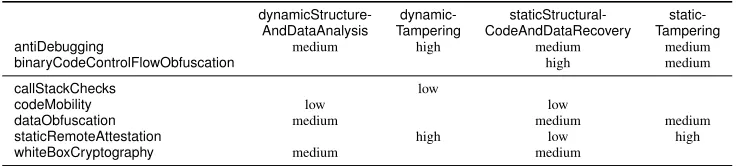
Information about available protections is independent from the analysed applica-tion. TheProtectionclass instances describe general protection types, while application of such protections with specific tools are modelled by using theProtectionInstanceclass. More precisely, ProtectionInstance instances describe a protection applied by means of the toolXexecuted with a precise set of tool-specific parameters that drive its deploy-ments. Available protections in the ontology are summarized in Table 7. Furthermore, protections are able to mitigate variousAttackStepTypeinstances with different efficacy levels, expressed withLevelenumeration. This concept is expressed in the meta-model by using theMitigationclass, and instances of the latter in the ontology are reported in Table 8.
Protection #ProtectionInstance
antiDebugging 1
binaryCodeControlFlowObfuscation 9
callStackChecks 1
codeMobility 1
dataObfuscation 3
staticRemoteAttestation 1
[image:8.612.204.408.124.199.2]whiteBoxCryptography 1
Table 7: Instances of classProtectionInstancein the ontology.
dynamicStructure- dynamic- staticStructural- static-AndDataAnalysis Tampering CodeAndDataRecovery Tampering
antiDebugging medium high medium medium
binaryCodeControlFlowObfuscation high medium
callStackChecks low
codeMobility low low
dataObfuscation medium medium medium
staticRemoteAttestation high low high
whiteBoxCryptography medium medium
Table 8: Instances of classMitigationin the ontology, with relatedLevel.
found with the automatic attack discovery tool, we obtain 299 instances of the Applied-ProtectionInstanceclass. The protection discovery tool found at least one AppliedProtec-tionInstanceable to harden eachAttackPath, i.e., able to block or make harder at least oneAttackStepconstituting theAttackPath. For example, to mitigate the aforementioned attackPath.18, the tool suggests two protections that can be applied to the assetcompare1, anti-debugging (appliedProtectionInstance.47) and/or static remote attestation ( appliedPro-tectionInstance.64), since the relativeProtectionare both related to aMitigationwith ahigh Levelagainst thedynamicTampering AttackStepType, which is the type of the lastAttackStep in the examined attack path.
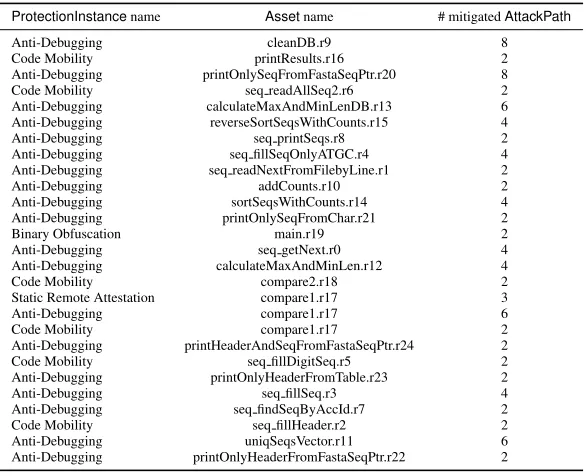
We have then manually combined a selection of the suggested AppliedProtectionIn-stanceinto a Solution instance (solution.1in the ontology). Based on our experience, the protection in that solution are able to safeguard the security requirements of the application’s asset effectively. Note that the model is able to represent different pro-tection applied to the same asset: for example, in our solution thecompare1.r17asset is protected with 3 different protections: static remote attestation (appliedProtection-Instance.104), anti-debugging (appliedProtectionInstance.47) and code mobility (ap-pliedProtectionInstance.102).
[image:8.612.122.490.243.326.2]ProtectionInstancename Assetname # mitigatedAttackPath
Anti-Debugging cleanDB.r9 8
Code Mobility printResults.r16 2
Anti-Debugging printOnlySeqFromFastaSeqPtr.r20 8
Code Mobility seq readAllSeq2.r6 2
Anti-Debugging calculateMaxAndMinLenDB.r13 6
Anti-Debugging reverseSortSeqsWithCounts.r15 4
Anti-Debugging seq printSeqs.r8 2
Anti-Debugging seq fillSeqOnlyATGC.r4 4
Anti-Debugging seq readNextFromFilebyLine.r1 2
Anti-Debugging addCounts.r10 2
Anti-Debugging sortSeqsWithCounts.r14 4
Anti-Debugging printOnlySeqFromChar.r21 2
Binary Obfuscation main.r19 2
Anti-Debugging seq getNext.r0 4
Anti-Debugging calculateMaxAndMinLen.r12 4
Code Mobility compare2.r18 2
Static Remote Attestation compare1.r17 3
Anti-Debugging compare1.r17 6
Code Mobility compare1.r17 2
Anti-Debugging printHeaderAndSeqFromFastaSeqPtr.r24 2
Code Mobility seq fillDigitSeq.r5 2
Anti-Debugging printOnlyHeaderFromTable.r23 2
Anti-Debugging seq fillSeq.r3 4
Anti-Debugging seq findSeqByAccId.r7 2
Code Mobility seq fillHeader.r2 2
Anti-Debugging uniqSeqsVector.r11 6
Anti-Debugging printOnlyHeaderFromFastaSeqPtr.r22 2
Table 9:AppliedProtectionInstanceconstituting our manually generated solution.
# originalApplied- # additionalApplied- # Applied-ProtectionInstancename ProtectionInstance ProtectionInstance #ProtectionInstance
Anti-Debugging 19 20 39
Binary Obfuscation 1 25 26
Code Mobility 6 0 6
Remote Attestation 1 0 1
[image:9.612.160.453.166.404.2]Total 27 45 72
7. Conclusions
This data in brief paper has illustrated, with precise examples from the risk analysis and mitigation of a single asset in the Sumatra application, the descriptive abilities of the meta-model developed to represent information about identifying threats and protecting assets in software applications.
Acknowledgements
This research is supported by the European Union Seventh Framework Programme (FP7/2007-2013), project ASPIRE (Advanced Software Protection: Integration, Re-search, and Exploitation), under grant agreement no. 609734.
References
[1] C. Basile, D. Cavanese, L. Regano, P. Falcarin, B. De Sutter, A meta-model for software protections and reverse engineering attacks, Journal of Systems and Soft-wareUnder submission.
[2] C. Basile, D. Canavese, J. D’Annoville, B. De Sutter, F. Valenza, Automatic discovery of software attacks via backward reasoning, in: Software Protection (SPRO), 2015 IEEE/ACM 1st International Workshop on, 2015, pp. 52–58.
[3] L. Regano, D. Canavese, C. Basile, A. Viticchi´e, A. Lioy, Towards automatic risk analysis and mitigation of software applications, in: Information Security Theory and Practice, Springer International Publishing, 2016, pp. 120–135.
[4] D. Canavese, L. Regano, C. Basile, A. Viticchi´e, Estimating software obfusca-tion potency with artificial neural networks, in: Security and Trust Management, Springer International Publishing, 2017, pp. 193–202.
[5] C. Collberg, C. Thomborson, D. Low, A taxonomy of obfuscating transformations, Tech. rep., Department of Computer Science, The University of Auckland, New Zealand (1997).