2017 2nd International Conference on Computer, Mechatronics and Electronic Engineering (CMEE 2017) ISBN: 978-1-60595-532-2
A Lane Detection Algorithm under Complex Scenes
Chun-yang CHENG
1, Min LI
1,*, Xue-wu ZHANG
1, Yu-bo XIE
1,
Yan XIANG
2and Jin-bao SHENG
21
College of Internet of Things Engineering, Hohai University Changzhou, China
2
Nanjing Hydraulic Research Institute, China
*Corresponding author
Keywords: Lane detection, Temporal blur, Tan-Gamma correction, B-spline.
Abstract. A lane detection algorithm under complex road conditions is proposed in this paper, which will be helpful to improve the accuracy and stability of lane detection. In the image preprocessing stage, a rapid temporal blur algorithm is employed to connect the dashed lanes. Besides, based on the traditional gamma correction method, a new specific method combined with the tangent function is designed to achieve a good threshold segmentation effect in all pixel of the image. In the lane detection period, the detection algorithm based on Hough transform and heuristic search is applied to the straight lane and curved lane respectively, and then the two parts are fitted by B-spline into a smooth curve. Experimental results show that the lane detection algorithm under complex road condition proposed by this paper has a good performance of real-time capability and robustness.
Introduction
With the increase of vehicle quantity, the death rate caused by traffic accidents has been increasing year by year. Improving the traffic safety has become an urgent problem and important research area. Lane detection is not only the core component of the driver assistance system, but also an important part of the autopilot system. A lane detection system which can adapt to the complex traffic conditions, such as the shadow and illumination changes, complex traffic conditions and bad weather can effectively guarantee the road traffic safety and has an important application value.
Lane markings are usually regular dashed lines or curved lines, and the color is white or yellow. Therefore, edge feature is widely used in feature based detection algorithm. The CHEVP algorithm proposed in [1] uses Canny operator for edge detection, and Hough transform to extract lane. But the result largely depends on the edge detection threshold, and the environment noise such as illumination is not considered. In [2], a lane detection algorithm based on Steerage filter is proposed, which has good detection performance for straight lane. Because the method adopted linear model, it don’t have a good detection result for curved lane. The color feature is also applied such as [3], but it is highly sensitive to the illumination.
This paper will put forward some reasonable and feasible solutions for eliminating the influence of illumination, broken lanes, and curved lines. A method is proposed for connecting the dashed or broken lanes. For the low contrast of input frames caused by illumination, this paper proposes a novel algorithm to enhance the contrast between lanes and road background. In lane detection module, based on the vanishing point and vanishing line the region of road is determined, and the detection of straight lanes is realized by using Hough transform. Aiming at the particularity of curved lane, this paper proposes a curve lane detection algorithm based on heuristic search. With the help of B-spline, a smooth lane marking is determined.
Image Pretreatment Step
Temporal Blur
consecutive frames, the lane offset in the lateral direction can be neglected. Therefore, by averaging the successive frames by using temporal blur algorithm, the dashed lane is able to approximately be connected, as shown in Fig. 1. However, it is time-consuming to average a few continuous frames. This paper proposes a rapid temporal blur improved algorithm based on [4], as shown in Eq. 1.
( )
(
)
1(
)
(
)
( )
1 1 .
α β α − β αβ β
= − + − + …+ − +
t t
I i I i t I i t I i I i
(1)
I(i) represents the ith frame, I( )i is the ith average and t is the number of previous frames. The
parameter α and β are the weight coefficients. Choosing appropriate α and β makes the two
consecutive frames with similar weight coefficient and the frames more far from the ith frame with smaller weight, so the influence of the more foregone frame is reduced. An approximate average image with finite numbers is obtained, as shown in Fig. 2.
[image:2.612.90.285.551.706.2]
Figure 1. Schematic of temporal blur. Figure 2. Result of temporal blur.
Tan-Gamma Correction
For enhancing the contrast between lane markings and road background, this paper proposes a correction algorithm named Tan-Gamma. In lane detection stage, what should be taken into consideration is only enhancing the lane feature without worrying about the destruction of other information and details. Therefore, the algorithm improves the contrast between lanes and road background by sacrificing the detail and sharpness of the image. For the grayscale image, the basic form of Gamma correction is described in Eq. 2.
2 5 5 .
2 5 5
γ
= ×
x
y (2)
The variable x is the grayscale value before transformation, y is the gray value of the pixel after
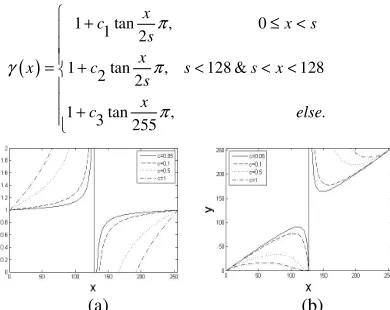
processing, and γ is the power. A piecewise nonlinear function is described in Eq. 3. c1, c2 and c3 are
used to constrain the range of three piecewise functions. The threshold s which is determined by the Otsu threshold selection method divides the lane and road background [5]. The pixel which gray value is lower than s is considered to be the road background area, and the greater one is considered as the lane area, as the relationship depicted in Fig. 3. Fig. 4 shows the effect of the Tan-Gamma correction algorithm used in this paper.
( )
1 1tan , 0 2
1 2tan , 128 & 128
2
1 3tan , . 255
x
c x s
s x
x c s s x
s x
c else
π
γ π
π
+ ≤ <
= + < < <
+
(3)
[image:2.612.92.535.558.707.2]
(a) (b) (a) (b)
Lane Detection
The edge feature has a unique advantage compared to color and gradient in the process of lane detection. The straight lane in the edge image is located by Hough transform borrowing from the CHEVP algorithm [1]. But this method cannot deal with the curved lane. Drawn lesson from the thought of intelligent search algorithm, this paper proposes a curved lane detection algorithm based on heuristic search. The main flow is shown in Fig. 5.
Canny edge
detection Hough transform
Road area detection
Heuristic search based on tangent
Curved lane Preprocessed
frame
Straight lane
Lane fitting Complete lane
[image:3.612.131.481.156.260.2]Far field of view Near field of view
Figure 5. The flow chart of lane detection.
Road Area Detection
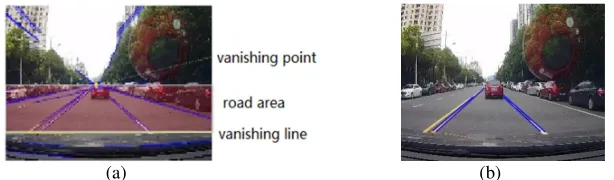
Determining an exact road area is the key step to detect the lane. In the perspective image, parallel straight lines will intersect at one point, called the vanishing point. And the upper bound of the road area can be determined. The vanishing line is fitted by the end point of all straight lines below the vanishing point, which is the lower bound of the road area, as shown in Fig. 6(a). Once the vanishing point has been determined, these lines which are not cross it can be regarded as noise. Moreover, these lines which do not finish at the lower boundary always are not lane markings. Therefore, the interference lines can be filtered out.
Straight Lane Detection
No matter lane markings are straight or curved, the lane in the near view can always be considered as an approximate straight line, and the far view can be regarded as an approximate curved line [6]. Therefore, Hough transform is able to detect the straight line in the edge image, and the lane position can be located according to the prior knowledge and vanishing line and vanishing point.
In the perspective image, the slope of the left line is always greater than zero, while the right is always less than zero, and the lane which is closer to the middle has a greater absolute slope. Based on the above prior knowledge, the correct location of lane can be determined, as shown in Fig. 6(b).
(a) (b)
Figure 6. Straight lane detection (a) Vanishing point and vanishing line (b) Detection result.
Curved Lane Detection
This paper proposes a curved lane detection algorithm based on heuristic search [7]. If the lane is a continuous curve, the tangent of a certain point on the curve will equal to the slope between this point and its neighbor. Therefore, based on pixels gotten by straight lane detection, the next point on curve lane can be searched along the tangent direction of the current until there is no point in the tangent direction.
[image:3.612.154.461.512.602.2]edge of the lane. Conversely, if the gray value of the left pixel is close to 255, and the right is close to 0, the left pixel is considered to be the point on the right edge of the lane.
[image:4.612.135.483.96.185.2]
Figure 7. The templates of lane. Figure 8. Heuristic search.
As shown in Fig. 8, the dark region indicates the road area, and the yellow grid represents the lane that has been detected, and the white area is the point on the curved lane. The search is started from the pixel S. The pixel in the tangent direction of the pixel S is pixel 1, but the pixel 2 which is in the tangent direction of pixel 1 does not conform to the left edge feature of the lane. At this point the search stops. It can be found that if the range of search is limited to the tangent direction, it is easy to cause the search to stop halfway and cannot effectively detect all lane edge information. Therefore, for improving the robustness of the search and ensuring that all lane edge information can be effectively detected, the neighborhood of the pixel should be included.
Lane Fitting
The straight lane and the discrete points in the curved lane have been detected. The next step should be done is fitting those points into a smooth curve. The fitting method used in this paper is based on B-spline curves. Straight lane is detected by Hough transform, which all the points on the straight lane. The curved lane is obtained by the tangent direction information, which all the points are not in a smooth curve. Therefore, the B-spline curve is one of the best ways.
Using B-spline curve is proposed to fit the curve has nothing to do with the number of data points and control points, and low order of B-spline curve is able to fitting complex curve. At the same time, B-spline curve with low order has less computational complexity, so the quadratic B-spline curve is adopted in this paper. In order to keep the shape of the original lane lines, equidistant sampling is adopted which can maintain the distribution characteristics of the data and the local shape of the curve.
Results
A vehicle-mounted lane detection system is designed mainly to realize lane detection under the complex traffic in the city roads and highways. The design of the system is divided into two parts: hardware platform and software platform. The hardware platform is responsible for the collection and display of video signals and the operation of the security software. The software platform is responsible for the implementation of algorithms and data processing. The embedded Linux operating system is running on the R-Car M3 evaluation board. The image processing algorithm uses the OpenCV image processing library which has a large number of image processing operators and The C and C++ programming language are adopted.
In order to test the accuracy and stability of the lane detection algorithm proposed in this paper, the experiment including the city roads and highways is designed, and the experimental results are analyzed, as show in Fig. 9 and Table. 1.
[image:4.612.82.521.634.703.2]Table 1. Performance comparison between different road conditions.
Road Type Correct[%] Incorrect[%] Misses[%]
Urban Roads
95.45 2.85 1.70 96.05 2.70 1.25 97.10 1.60 1.30 90.95 1.35 7.70 94.20 0.65 5.15
Highways
98.40 0.70 0.90 98.35 0.65 1.00 98.15 1.10 0.75 95.40 0.85 3.75 94.30 0.80 4.90
Comparing with the lane detection algorithm only based on Hough transform, such as [8], the advantage of this algorithm is that the detection algorithm based on Hough transform can only deal with the straight line in near field, but the curved lane in far have no way to detect. The lane detection algorithm based on the model, for example [6], depends on the accuracy of the parameters, and because of the complex calculation, it is difficult to meet the requirement of real-time. But this paper with fewer amounts of calculation and high efficiency can be real-time.
Acknowledgment
This paper is supported by: the Fundamental Research Funds for the Central Universities(2015B252 14, Y716019, Y716015, Y716011, 51679151); National Natural Science Foundation of China(6167 1202, 61573128, 61273170); National Key Research Program of China(2016YFC0401606, 2016YF C0401605).
Reference
[1] Wang, Yue, Eam Khwang Teoh, and Dinggang Shen. Lane detection and tracking using B-Snake. Image and Vision computing 22.4 (2004): 269-280.
[2] J. C. McCall and M. M. Trivedi, An integrated, robust approach to lane marking detection and lane tracking, IEEE Intelligent Vehicles Symposium, 2004, 2004, pp. 533-537.
[3] Sun, T.Y., S.J. Tsai and V. Chan. HSI color model based lane-marking detection. in IEEE Intelligent Transportation Systems Conference. 2006.
[4] R. F. Berriel, E. de Aguiar, V. V. d. S. Filho and T. Oliveira-Santos, A Particle Filter-Based Lane Marker Tracking Approach Using a Cubic Spline Model, 2015 28th SIBGRAPI Conference on Graphics, Patterns and Images, Salvador, 2015, pp. 149-156.
[5] Otsu N. A threshold selection method from gray-level histograms [J]. Automatica, 1975, 11(285-296): 23-27.
[6] C. R. Jung and C. R. Kelber, A lane departure warning system based on a linear-parabolic lane model, IEEE Intelligent Vehicles Symposium, 2004, 2004, pp. 891-895.
[7] Ju Han Yoo, Dong Hwan Kim and Sung-Kee Park, A new lane detection method based on vanishing point estimation with probabilistic voting, 2015 IEEE International Conference on Consumer Electronics (ICCE), Las Vegas, NV, 2015, pp. 204-205.