2017 2nd International Conference on Computer, Mechatronics and Electronic Engineering (CMEE 2017) ISBN: 978-1-60595-532-2
Experimental Research on 3D Ultraviolet Laser Precision Marking
Processing Technology
Hai-bing XIAO
*, Yong-quan ZHOU and Ming-jun LIU
Mechanical & Electrical School, Shenzhen Institute of Information Technology, Shenzhen, 518172, Guangdong, China
*Corresponding author
Keywords: Ultraviolet laser, 3D laser marking, Laser processing technology, 3D Texture mapping.
Abstract. In this paper, in view of the complexity of the 3D laser marking, 3D ultraviolet laser precision machining process test is described. Firstly, the principle of ultraviolet laser processing technology and 3D surface texture mapping method were studied for laser marking of 3D surface. Second, through 3D ultraviolet laser test bench, with nonmetallic material as test object, test method and 3D ultraviolet laser marking processing was designed comparing with the 1064nm infrared laser marking. Experimental researches show that the precision of 3D ultraviolet laser marking is higher than infrared laser marking for three-dimensional parts.
Introduction
The two-dimensional ultraviolet laser marking has been unable to meet the needs of the society, the enterprise needs more individuality, more exquisite logo and indelible. Part of the surface logo on the market can be achieved by two-dimensional ultraviolet laser marking, but the deformation of the logo is unavoidable.335nm ultraviolet laser has widely used medical treatment, laser display, and study the solid-state restricting the efficient in the 335nm quasi continuous ultraviolet laser output is four times the frequency of the efficiency problem in theory and experiment [1-2]. The theory model and experiment results of UV laser ablation on the semiconductor is summarized, including photo chemical model and heat conduction model[3-4]. Literature studies correction of field distortion of laser marking system using surface compensation function, progress of ultraviolet Laser Interaction with Semiconductors, experimental research on high power UV laser cutting Cu membrane.[5-7]. 12W UV laser based on air-cooled double-end-pumped intra-cavity and the influence of ultraviolet laser frequency on characters of micro -hole in absorbing glass was studied[8-9].
Based on this, this paper studies the mechanism of ultraviolet laser processing, and proposes 3d ultraviolet laser surface machining. The ultraviolet laser technology was studied to optimize the parameters of 3d surface ultraviolet laser and to achieve better ultraviolet laser precision identification. It can be used for the ultraviolet laser marking and etching of 3d curved surface, the ultraviolet laser marking and engraving of 3d curved surface of large and medium-sized products, and the leading technology level in China.
Principle of Ultraviolet Laser Processing Technology
Ultraviolet LaserProcessing Model
Ultraviolet laser precision machining principle is photochemical processing, due to the wavelength of ultraviolet laser is short; The energy of single photon energy in laser beam is greater than that of the material. The absorption of laser energy by the material continuously vaporizes by using the photon energy of the laser to directly destroy the chemical bonds of the materials; the material is expelled in small particles or gaseous forms, forming holes.
Because of its characteristic of small processing heat effect, it is often referred to as "cold light source". Meanwhile, it can also get the focus light below 20µm. Energy conservation function is described below:
in R A out
E =E +E +E
(1) WhereEin is reflected from the surface of the material, ER is reflected from the surface of the
material, EAis the energy absorbed by the material,Eoutis the energy of through the material. When the wavelength is very short, the high-energy photons are more easily absorbed by a large number of delimited electrons. The reflectivity is very low and the surface absorption of the material increases.
4.9
hv ev
ξ= =
(2) Where ξ is ultraviolet photon energy, his the Planck constant, vis the frequency.
When the wavelength of the ultraviolet photon is small enough that the single photon energy exceeds the bond of the material, the laser may directly interrupt the molecular bond of the crystal and destroy the molecular structure of the crystal.
Assuming that radiation material body absorbs a photon number density is greater than the density of material atoms, and the photon energy is greater than the binding energy between atoms EB, the photochemical quantitative model radiation of the threshold can be expressed as follows[10]:
min
( ) a( )
p a
hv n E
M n n
S α
×
= = >
(3)
WhereMis radiation of the ultraviolet laser threshold, nais material refractive index, the energy of photon energy is large, and the molecular binding energy of some polymer polymers is comparable. The polymer polymers are mainly composed of H, C, O and N, and the C-H bond can only have 3.5ev. Therefore ultraviolet laser action on this kind of material may be directly to break the intermolecular combination keys, rely on the so-called photochemical role in achieving this kind of material manufacture, high polymer in the N-N, C-N bond energy than ultraviolet photons energy, ultraviolet laser processing polymer is actually exist two photolysis and pyrolysis process.
Three-dimensional Texture Mapping
3D laser galvanometer consists of z axis zoom module and two-dimensional vibrating mirror two parts, the 3 d laser galvanometer system increased the z axis mobile galvanometer, constitute the three axis CNC system, according to the height of the surface is to be features (the z axis coordinates), automatically adjust the focal length of laser, keep the laser focus squarely on the 3 d surface. According to the preset 3d texture vector mathematical model, the motion trajectory of the laser focal point is edited and controlled, and the three-dimensional surface is clear and continuous etching and etching is achieved. Because the beam focus occurs before the incident X and Y mirror, the 3D mirror belongs to the large-front focusing structure, without the need of the post-focusing structure F-theta mirror. The Z-axis module is usually an inverted galilean telescope, which is driven by the vibrating mirror servo motor, which can adjust the distance between the eyepiece and the objective lens to achieve the zoom.
removed, which is the mathematical vector model of 3D texture used for laser processing. The system processing software of the 3D vibrating mirror laser can read the three-dimensional texture vector and convert it to the scanning path coordinate of the mirror and make the three-dimensional processing of the texture. The geometry path of laser machining is generated by a specified software package called texture mapping in order to transfer a specified 2D texture to a part’s 3D surface.
Figure 1. Three-dimensional texture generation flow (a1). Three-dimensional surface model, (a2) plane of the horse original mode; (b1), (b2) The model after the texture mapping;
(c1), (c2) The plane of the horse after the texture mapping.
Ultraviolet Laser Marking Experiment
Ultraviolet Laser Marking System
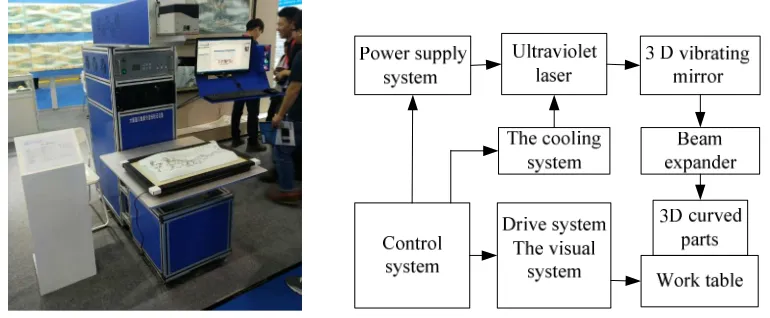
Photograph of 3D Ultraviolet laser marking system is shown in Fig.2. Schematic diagram of 3D Ultraviolet laser marking is shown in Fig.3. The 3D ultraviolet laser marking system is composed of ultraviolet laser, 3D vibrating mirror, optical path system, control system and workbench. The 3D vibrating mirror is used to compensate the optical path of the optical system of the 3D mirror optical system by the motion of the z-axis module. The galvanometer scanning range is 120mm×120mm.The mapping position of texture and the characteristics of the three-dimensional surface are required.
Figure 2. Photograph of 3D Ultraviolet laser marking. Figure 3. Schematic diagram of 3D Ultraviolet laser marking.
[image:3.612.113.498.488.647.2]The experimental parameters are shown in table 1.
Table 1. Uv laser processing technology and infrared laser marking parameters.
Uv laser parameters Infrared laser parameters
Wavelength 355nm Wavelength 1064nm
Pulse length <30ns(100kHz) Pulse length <30ns(100kHz) Focus diameter 20µ m Focus diameter 40µ m Bed dimension 460mm * 460mm Bed dimension 460mm * 460mm
Power 12W Power 20W
photon energy 4.9ev photon energy 1.16ev
The galvanometer
scanning range 120mm×120mm
The galvanometer
scanning range 120mm×120mm
Experiment Results
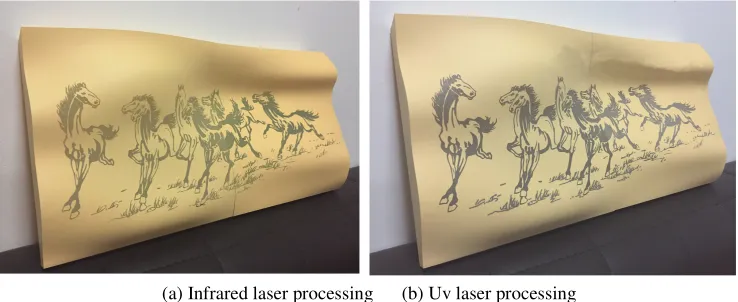
[image:4.612.121.490.406.557.2]The experiment results that comparison of the processing effect of microscope graph is shown in Fig.4. Fig. 4 (a) is infrared laser marking processing, Fig. 4 (a) ultraviolet laser marking processing. Five points were selected, and the average value was magnified 600 times as the precision microscope of the logo, and the infrared laser marking accuracy was 0.030 mm; the accuracy of ultraviolet laser marking is 0.024mm. The precision of 3D ultraviolet laser marking is higher than infrared laser for three-dimensional parts. On the base of cold processing, the effect of processed product materials will be better. From the analysis on the laser, by using ultraviolet laser processing are often able to fine processing, and will not happen because processing material appeared in the process of "hot" reaction caused by carbide materials seriously affect the desired effect, because the ultraviolet is "cold" processing, use the "cold" light corrosion treatment technology of machining of parts with smooth edges and minimal coking. Moreover, the characteristics of ultraviolet short-wave length itself have advantages for mechanical microtreatment of metals and polymers.
(a) Infrared laser processing (b) Uv laser processing
Figure 4. Contrast of uv laser processing and infrared laser processing effect.
Summary
3D ultraviolet laser precision machining process test is described and is verified by contrast experiment. The accuracy of 3D ultraviolet laser marking for 3D surface reaches sub-micron scale, and the area of thermal influence is very small. Ultraviolet laser marking with less than 20 microns line width, marking side is smooth and no obvious phenomenon, which has lower thermal stress and thermal effect comparing it to infrared laser marking. So, the precision of 3D ultraviolet laser marking is higher than infrared laser for three-dimensional parts.
Acknowledgements
Guangdong Higher Education Excellent Youth Teacher Training Plan (YQ2014124), Guangdong Science and Technology Innovation Project of University Student (pdjh2017a0722) in China.
Reference
[1] Jean-Daniel Boissonnat, Kan-Le Shi, Jane Tournois and Mariette Yvinec. Anisotropic Delaunay meshes of surfaces, ACM Trans. Graph, 266(2014) 102-112.
[2] Duley W.W UV Lasers Effects and Applications in Material Science. Cambridge University Press, 1996.
[3] Anisimov, S I, Khokhlov, et al. Instabilities in Laser-Mater interaction [M].Boca Raton,Fla.: CRC Press, C 1995
[4] Mingfei Chen, Yupin Chen, Wentse Hsiao. Correction of field distortion of laser marking system using surface compensation function [J]. Optics and Lasers in Engineering, 27(2009):84-89
[5] Liu Chen-xing, Zhang Da-yong. Research Progress of Ultraviolet Laser Interaction with Semiconductors [J].Electro-optic Technology Application, 27 (2012)21-26
[6] Zhou Yuchao, Zhou Yongquan, Zhao Shengyu, Song Yuli. Double-end Pump 12 W Air-cooled UV Laser Generator based on CFD [J]. Manufacturing and Materials Science, 36(2016)337-340.
[7] Li NA, Zhang Qiu–hui. The influence of ultraviolet laser frequency on characters of micro -hole in absorbing glass [J]. Laser Journal, 34(2013)43-44(In Chinese).
[8] Jiang Ming. Research on control and simulation for laser flying marking system and laser processing robot. Dissertation of Huazhong University of Science and Technology, 2011(In Chinese).
[9] Wang Huiqing, Shi Yusheng, Huang Shuhuai. The control arithmetic of laser galvanometer scanning system with 3D and its application [J]. Huazhong University of Sci. & Tech. (Nature Science Edition). 31 (2003)70-72.