2221 ISSN: 2278 – 7798 All Rights Reserved © 2015 IJSETR
EEEOR: Duty Cycle using Energy Efficient
Extremely Opportunistic Routing Protocol in
MANET
S.VELMURUGAN PG scholar
Department of Electronics and Communication Engineering, Manakula Vinayagar Institute of Technology, Pondicherry
.
Abstract-
Opportunistic routing has increased the network throughput. It’s based on higher priority forward the packet and then lower priority will discarding the packet. In this paper, I propose based on metrics saving an Energy Efficient Extremely Opportunistic Routing Protocol using duty cycle to asynchronous sleep-wake scheduling is an effective mechanism to reduce energy consumption by appropriately arranging nodes to sleep, to maximize the network lifetime. We present an energy efficient extremely opportunistic routing strategy, denoted as EEEOR. Our extensive simulations in NS2 show that our protocol EEEOR performs better than the ASSORT [1] and ExOR [2] protocols.
KEYWORDS- Ad hoc networks, Opportunistic routing (OR),
Wireless Networks, Energy Efficient Extremely Opportunistic Routing.
I. INTRODUCTION
Energy consumption in MANET is one of the important issues in this research. Reliable data delivery in MANET consumes lot of energy. There will be many retransmissions and the data need to be propagated to the destination node. The nodes will have limited energy resources and this retransmissions etc., will consume lot of energy compared to
energy available to the MANET node. Routing
protocol scheme for wireless networks are support by two
essential requirements, minimize energy metrics or
maximize network throughput. The traditional routing protocols in wireless networks select the simplest sequence
of nodes between the source and destination, and
forward every packet through that sequence. The
many routing protocols designed for multihop wireless networks have usually followed this convention, as well
as those multi-path routing protocols. However,
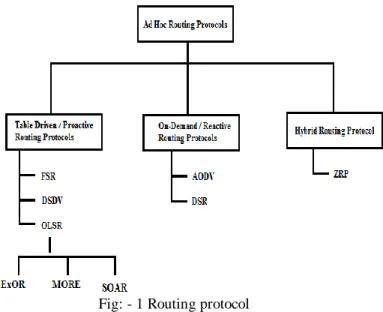
this didn't take blessings advantages of the broadcast nature of wireless communications, a node’s transmission can be detected by any node within its transmission range. ExOR, MORE and SOAR [7] is Table-driven (proactive) link state routing protocol. Every node sporadically measures and distributes link quality in terms of ETX. Based on this information, a source node selects the default path and a list of (next-hop) forwarding nodes that are allowed for forwarding the data. It then broadcasts a data packet consists of this information. Nodes closer to the destination use a smaller timer and forward the packet earlier. When it knows transmission, other nodes will eliminate the corresponding packet from their queues to avoid duplicate transmissions.
ExOR, MORE [7] and SOAR showed that this
type of opportunistic routing strategy will improve the wireless network’s performance. In this paper, we tend to study a way to choose and prioritize the forwarding list to minimize the total energy metrics of forwarding data to the destination node in a wireless ad hoc network. It shows that the energy consumption of routing exploitation EEEOR is considerably less than ASSORT [1] and ExOR [2] with random forwarder list and traditional distance vector routing protocols.
Fig: - 1 Routing protocol
II. RELATED WORK
EEEOR apply to send data by giving priority to the data and users. EEEOR in our implementation is performed by assigning priority to the packet so that the packets can reach the destination in different paths. If the packet is having low priority then the node will route the packet in different direction than the shortest path. It can eliminate the unnecessary consumption of energy. EEEOR routing will consume less energy using duty cycle in the source node than the direct communication in the case where the destination node is located in a long metrics as communication to the node would require high transmission power, and will also decrease the idle listening time in the node by sending the nodes to sleep state. EEEOR routing can reduce total energy consumption because although the number hops increases the metrics between the nodes decreases. MAC is a protocol which is developed for duty-cycled MANET by sending Mobile ad hoc to sleep in regular interval of time. By using
ISSN: 2278 – 7798 All Rights Reserved © 2015 IJSETR
2222 MAC, we can save the energy in non receiving nodes and
avoid overhearing problems by sending short preambles with the target node address, and also the target node can send ACK immediately which will not only decrease energy but also per hop latency. In our work we know locations of all mobile ad hoc nodes so signal strength is important factor that consumes more energy so the energy required to transmit a packet should be adjusted based on the metrics to the destination node. For example, if the destination node is close, use less transmission power.
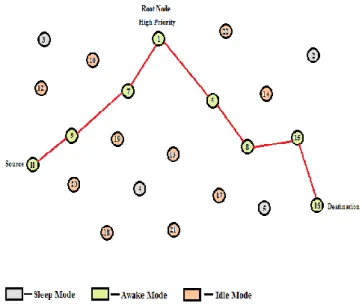
Fig: - 2 High Priorities Based on Duty Cycle
III. MEDIUM ACCESS CONTROL
EEEOR is used in MANET in the following ways. MAC is another type of protocol which is performing routing with EEEOR in the form of trees, by taking EEEOR metrics, energy resource on each path and priority level of each packet into consideration. There are two types of approaches used in MAC layer to save energy exchanging the sleep and wake period time, and extended preamble and low power listening. MAC negotiates the time schedules by using a SYNC message. When the receiver wants to send data it will wait until the receiver wakes up. When sending long messages MAC will divide the message into number of frames and send it, which will decrease the communication overhead by making the node to access the medium for very long time.
Fig:- 3 RTS-CTS handshake
This is also a disadvantage for MAC because the nodes with short packets must wait for very long time until the medium is free. When a node want to talk to the other node it will wait until the receiver start listening and send a RTS packet and the receiver will be allowed to use the medium since the fig 3 RTS CTS handshake is completed successfully. After the transmission is completed the sender will go to sleep to save its energy. It main aim is to decrease latency by adjusting the duty cycle based receivers sleep period.
IV. DUTY CYCLE
A duty cycle is the percentage of one period in which a signal is active. A period is the time it takes for a signal to complete an on-and-off cycle. As a formula, a duty cycle may be expressed as:
Where is the duty cycle, is the time the signal is active, and is the total period of the signal. Thus, a 60% duty cycle means the signal is on 60% of the time but off 40% of the time. The "on time" for a 60% duty cycle could be a fraction of a second, a day, or even a week, depending on the length of the period.
V. ASYNCHRONOUS DUTY CYCLING
A visual representation of asynchronous low power listening (LPL) using duty cycling is shown in the below section of Figure 4.When a node has data to send, it first transmits an extended preamble, and then sends the data packet. All other nodes maintain their own unsynchronized sleep schedules. When the receiver awakens, it samples the medium. If a preamble is detected, the receiver remains awake for the remainder of the long preamble, and then determines if it is the target. After receiving the full preamble, if the receiver is not the target, it goes back to sleep.
Fig:- 4 MAC's short preamble is better than low power listening (LPL)
2223 ISSN: 2278 – 7798 All Rights Reserved © 2015 IJSETR
We can see in Figure that there is a lower amount of energy consumption by using short preamble where nodes go to sleep very soon than extended preamble. By the time that LPL sender was able to finish the sending of long preamble, MAC was able to send data also, so the rest of the time was saved and the node can go to sleep early. On the receiver side the node was able to read the preamble very fast and send ACK immediately so the sender will receive the early ACK. We can see in the time of extended wait time the node was able to receive the data as well. Preamble: - It consists of one or more bytes of a pre-defined pattern to synchronize the sender and receiver.
VI. PRIORITY OF EEEOR
In this project, Fig 5 used the type of EEEOR called prioritization by inserting priority in the header field so based on that priority the node will select which route to take. If the priority is 1 then it will select the first node in the routing table to send packet. After the nodes are selected in the transmission range which is close to destination than the original node, the nodes are sorted based on the metrics from destination in ascending order. The node that is closer to destination and in the transmission range of the original node will be the first node in the routing table. If priority is 2 then it will select the second node and so on etc.
Fig: - 5 Root Node 1 has Highest Priority from Source to Destination
VII. ENEREGY CONSUMPTION
Energy consumption can be reduced by making the nodes to sleep in a regular interval of time so that there is a need of handshaking to check whether the node is in sleep state or not. Every time when a node went to sleep or idle, time will be calculated and added to the previous sleep or idle time. For every transmission of preamble, acknowledgment and data packets, node will calculate the energy individually. The signal strength required to send to a particular node will be calculated based on the metrics to the node. For example if ‘node a' is sender and 'node b' is receiver then 'node a' will calculate the power required to transmit the packet to that particular node as follows.
P_tx = power delivered to transmit the packet to M (metrics)
M is the metrics between node a and node b. The power received by the destination using FRII’S transmission equation is
P_rx = P_tx * (λ/(4 * π *M))2,
λ is path length.
The power required to transmit to destination node with Metrics M is
P_tx = P_threshold * ((4 * π *M)/λ)
P_tx = the power required to transmit
P_threshold =The minimum required receiving power. The energy required to transmit preamble will be
Ptx * Tpt,
Tpt = Time taken to send preamble.
The energy required to transmit acknowledgment will be Ptx
* Tat,
Tat = Time taken to send acknowledgment.
The energy required to transmit data will be Ptx * Tdt,
Tdt = Time taken to send data.
Let us assume that the
P= Send Preamble, A= Send Acknowledgment, Da= Send data.
S= Sleeps time I= Idle time.
Total energy spent by a node with sleeping schedule is Es = P + A + Da + (S*Ps)+(I*Pi)
Ps = Power taken to sleep
Pi = Power taken to idle or listening. Then the total energy spent by a node idle or listening schedule is
Ei = Da + ((S+I)*Pi), Results shown that Ei > Es.
VIII. OUTPUT GRAPHS
ISSN: 2278 – 7798 All Rights Reserved © 2015 IJSETR
2224 Where comparing Number of nodes verses energy
consumption in milliJoules. Get 20% sleep state with low power and energy were saved. Then on 40% sleep state we consumption medium energy. Likewise in 60% energy consumptions more energy was used, so it’s not sufficient in 60% duty cycle is used.
We get less energy in 20% in Energy Efficient Extremely Opportunistic Routing Protocols while comparing to Asynchronous sleep-wake scheduling and Opportunistic Routing and with Extremely Opportunistic Routing Protocols.
b) No.of.Nodes vs Packet Delivery Ratio (%)
We plotted the number of packets received by the destination node and the packet delivery ratio (PDR) in Figures (b). The packet delivery ratio is the ratio between the numbers of received packets to the number of sent packets in the network. The higher value of EEEOR means the network has better packet delivery efficiency. Although at the simulation the ASSORT protocol achieves a much better to compare to ExOR protocol the packet delivery ratio, the value then drops drastically below 10%. On the other hand, the EEEOR protocol still achieves roughly twice as much PDR value than that of the ASSORT and ExOR protocol during simulation time.
c) Sleep Time(ms) vs Duty cycle per Node (%)
To evaluate the duty cycle performance of MAC with the adaptive optimization, we conduct a series of 1-hop experiments under two given traffic rates. For all subjects we measure the average duty cycle of the sender and receiver nodes on a large set of sleep periods. The adaptive variant of MAC initially sets its sleep period to the given value, and is allowed to adjust between 220 ms and 2300 ms. we test two traffic rates: 1 packet per second. For the first test we send 60. These values were selected in order to ensure that each test ran for approximately 10 minutes.
Additionally, we only turn on the radio of the sender when it needs to transmit packets in order to fairly focus the results on the amount of energy needed to send and receive a packet. The results of this experiment are shown in Figures (c).
2225 ISSN: 2278 – 7798 All Rights Reserved © 2015 IJSETR
d) Sleep Time(ms) vs Duty cycle per Node (%)
To evaluate the duty cycle performance of MAC with the adaptive optimization, we conduct a series of 1-hop experiments under two given traffic rates. For all subjects we measure the average duty cycle of the sender and receiver nodes on a large set of sleep periods. The adaptive variant of MAC initially sets its sleep period to the given value, and is allowed to adjust between 220 ms and 2300 ms. we test two traffic rates: 2 packets per second. For the second test we send 600 packets. These values were selected in order to ensure that each test ran for approximately 10 minutes.
Additionally, we only turn on the radio of the sender when it needs to transmit packets in order to fairly focus the results on the amount of energy needed to send and receive a packet. The results of this experiment are shown in Figures (d).
e) FIG : No.of.Nodes vs End to End Delay (ms)
Fig.(e) reports the end-to-end delay under different node densities. EEEOR achieves shorter end-to-end delivery delay than that of ASSORT and ExOR. This is because
ASSORT and ExOR follows the maximum single-hop packet progress relay priority rule. It is shown that ExOR is influenced by different node densities, and its end-to-end delay is much higher than others. The reason is that using multiple paths introduces more channel contentions which significantly degrades end-to-end delay performance. Note that only the successful end-to-end transmissions are counted in the results. ASSORT will yield worse result if the retransmission limit is increased to achieve the comparable reliability to other protocols. We also observe that the end-to-end delay of EEEOR and ASSORT, ExOR does not change much as the node density increases. This is partly because the node density setting is high, and there are enough forwarding candidates at each hop.
f) Mobility of Nodes (ms) vs Energy consumption (mJ) Energy consumption in path discovery is purely dependent on the overheads and transmission range maximum value. Fig.(f) is drawn by varying the number of nodes and keeping the node mobility as constant at a value of 3.5 m/s. By varying the node speed and keeping the nodes as 100. It is evident from the following Fig that more energy is spent for finding the reliable paths in path discovery process in the proposed work. Though ASSORT, ExOR and EEEOR are proceeding almost with the same approach, EEEOR energy consumption in path discovery is lesser compared to ASSORT and ExOR. The reason for this is that EEEOR is using transmit power control.
IX. CONCLUSION
Using a Energy Efficient Extremely Opportunistic Routing Protocol, Provided seamless communication such that maximum data transfer and energy consumption occurs than the previous mentioned protocols. To overcome the defects to move on MAC independent Opportunistic Routing (MORE).
X. REFERENCES
[1] Chih; Ming; Shi; Cheng, ‘Joint Design of
ISSN: 2278 – 7798 All Rights Reserved © 2015 IJSETR
2226 Routing in Wireless Sensor Networks’, Computers, IEEE
Trans on, Vol: 63, Issue: 7, pp-0018-9340, July 2014. [2] S.Biswas and R.Morrisa,: ‘ExOR: Opportunistic Multi-hop Routing for Wireless Networks’, in Proceedings of ACM SICGOMM, 133-144, Feb 2014.
[3] Z. Wang, Y. Chen, and C. Li; ‘PSR: Light weight proactive source routing protocol in manet’, IEEE . Areas Vehicular Technology., vol. 63, no. 2, pp. 859–868, FEBRUARY. 2014.
[4] Xufei; Shaojie; Xiahua; Xiang; Huadong,
‘Energy-Efficient Opportunistic Routing in Wireless Sensor Networks, Parallel and Distributed Sys, IEEE Trans on, Vol: 22, Issue: 11, pp-1934 – 1942, Nov. 2011.
[5] Jing;Chen; Hung; Soon; Lie; Hanzo, ‘Cross-Layer
Aided Energy-Efficient Opportunistic Routing in Ad Hoc Networks’ ,Commu, IEEE Trans on,Vol:62 , Issue: 2, 522 – 535, Feb 2014.
[6] Chen; Chen; Pingyi; Ben, ‘AsOR: An Energy Efficient Multi-Hop Opportunistic Routing Protocol for Wireless Sensor Networks over Rayleigh Fading Channels’ Wireless Commu, IEEE Trans on ,Vol:8, Issue: 5,pp-2452 – 2463,May 2009.
[7] Szymon; Michael; Sachin; Dina, ‘MORE: Trading Structure for Randomness in Wireless Opportunistic Routing’ Wireless Commu, IEEE Trans on , Vol:2, Issue: 3,pp-345 – 415, June 2013.
XI. BIOGRAPHIES
VELMURUGAN.S
Received the Bachelor degree in
Electronics and Communication
Engineering from Sri Manakula
Vinayagar Engineering College affiliated to Pondicherry University in 2009, and currently a final year M.Tech student at the Electronics and Communication Engineering of Manakula Vnayagar Institute of Technology affiliated to Pondicherry University. He research interests include Ad hoc Networks & Network Security.