University of South Carolina
Scholar Commons
Theses and Dissertations
2014
An Analysis of Convertible Bond Issuance: Design
Features, Market Conditions and Private Placement
Ashleigh Poindexter
University of South Carolina - Columbia
Follow this and additional works at:https://scholarcommons.sc.edu/etd
Part of theBusiness Administration, Management, and Operations Commons
This Open Access Thesis is brought to you by Scholar Commons. It has been accepted for inclusion in Theses and Dissertations by an authorized administrator of Scholar Commons. For more information, please [email protected].
Recommended Citation
An Analysis of Convertible Bond Issuance:
Design Features, Market Conditions and Private Placement
By
Ashleigh Poindexter
Bachelor of Science University of Michigan, 2010
Submitted in Partial Fulfillment of the Requirements
For the Degree of Master of Science in
Business Administration
Darla Moore School of Business
2014
Accepted by:
Jean Helwege, Director of Thesis
Tanakorn Makaew, Reader
Abstract
Over the last two decades convertible debt issues have been steadily increasing in
both frequency and magnitude and several high volume issuance periods. Although
convertible debt issuance is inherently influenced by debt and equity market volatilities,
the convertible market has been shown to have an independent presence in terms of
issuance volume, issue design and market participants.Are concerns of asset substitution,
risk uncertainty, or asymmetric information the primary factors in convertible debt design,
timing and placement? This paper aims to examine how the design of convertible bonds
and the characteristics of convertible issuers shift over time and under different market
conditions. I find that design features of convertible issues are not chosen independent to
broader convertible debt markets conditions or firm-specific financial constraints. I also
identify a strong relationship between private-placement activity and convertible debt
Table of Contents
Abstract . . . ii
List of Tables . . . iv
List of Figures . . . v
Chapter 1: Introduction . . . 1
Chapter 2: Literature Review . . . 3
Theories of Convertible Bond Issuance . . . 3
Convertible Bond Design . . . 5
Issuance Timing and Market Reactions . . . 7
Chapter 3: Hypothesis Development . . . 9
Chapter 4: Data and Sample Construction . . . 11
Chapter 5: Methodology . . . 15
Identifying debt-like, hedge-like, and equity-like issues . . . 15
Identifying hot convertible debt markets . . . 16
Identifying issuer need . . . 16
Chapter 6: Analysis and Results . . . 22
List of Tables
Table 4.1: U.S. Non-Financial Security Issues: 1970-2013 . . . 13
Table 4.2: Placement of Convertible Debts, 1970-2013 . . . 14
Table 5.1: Hot Convertible Debt Markets: 1970-2013 . . . 17
Table 5.2: Convertible Debt Issues by Design . . . 18
Table 6.1: Analysis of Convertible Design and Financing Need . . . 25
List of Figures
Figure 4.1: Plot of Summary Statistics by Security Type . . . 15
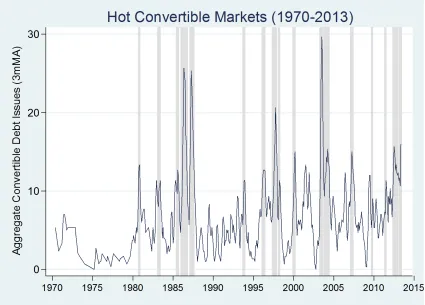
Figure 5.1: Hot Markets for Convertible Debt Issues . . . 19
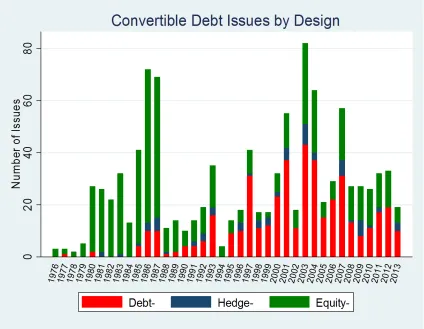
Figure 5.2: Convertible Debt Issues by Design . . . 20
Chapter 1: Introduction
Over the last two decades convertible debt issues have been steadily increasing in both
frequency and magnitude and have endured several high volume issuance periods.
Although convertible debt are inherently influenced by both debt and equity market
volatility, the convertible debt market has been shown to have an independent presence in
term of issuance volume, issue design and market participants (Dutordoir and Van de
Gucht 2007; Lewis,Rogalski, and Seward 1999; Choi, Getmansky, Henderson and Tookes
2010).
This paper aims to examine how the design of convertible bonds and the characteristics of
convertible issuers shift over time and under different market conditions. Are concerns of
asset substitution, risk uncertainty, or asymmetric information the primary factors in
convertible debt design, timing and placement? Specifically, I test the hypotheses that
equity-like issues are more likely to occur during hot convertible markets, that a firm’s
need for external financing influences their likelihood to issue convertible debt designed as
debt-like,hedge-like, or equity-like and that the private placement of convertible debt is
prevalent and significant, regardless of the debt-,hedge-, or equity-like convertible design.
Convertible bonds are a hybrid security with debt and equity attributes. These securities
contain a conversion provision which allows the owner to convert the original bond into
shares of the issuers’ stock when that stock reaches a predetermined price. Convertible
bonds maintain coupon payments until maturity but if converted to equity the holder
would be entitled to shareholder returns like dividends and repurchases. Thus the
conversion option is valuable and this value is typically discounted from the initial bonds’
coupon rate, though the conversion option discount may not be a permanent. If
of share dilution. Convertible bonds may also contain a call provision giving the issuer the
right to recall outstanding bonds under terms disclosed in the initial contract. These
unique features allow the issuers of convertible debt a range of flexibility to tailor their
Chapter 2: Literature Review
Theories of Convertible Bond Issuance
The literature addressing why convertible bonds exist suggest that convertibles may serve
as an alternative to common equity, a mechanism to curb agency problems of managerial
over-investment, bondholder expropriation, or as a primary financing tool when firm risk
is uncertain.
Stein (1992) presents the theoretical argument that due to information asymmetry
problems, medium quality firms with positive prospects will issue callable convertible
bonds as a least costly method to increase equity holdings. Stein’s “back-door equity”
hypothesis has been generally supported in empirical studies and is most evident in
Davidson, Glascock and Schwarz (1995) and Lewis,Rogalski, and Seward (1999). Within
a sample of 118 convertible bonds issued between 1980-1985 Davidson et al (1995)
analyzed whether conversion prices (ratios) were perceived by the market as a credible
signal of future earnings. It took roughly 1.5 years for their sample’s stocks to reach the
conversion price. This relatively quick stock price improvement is consistent with the
back-door equity hypothesis. Lewis et al (1999) examine 203 convertible debt issues, 259
straight debt issues, and 182 common equity issues between 1977-1984 to primarily
assess the backdoor-equity and risk-shifting hypothesis. They document significant
variation in market reaction to new convertible debt issues depending on whether investors
expect the motivation for issuance to be asset substitution (back-door equity) or
asymmetric information (risk-shifting). Their results suggest that both motives explain the
use and design of convertible debt. Stein (1992) is also supported in the comprehensive
concentrated on the motivating factors considered by managers who issue(ed) convertible
bonds conducted by Dong, Dutordoir and Veld (2013 working paper) does not find that
managers incentives are aligned with the back-door equity hypothesis .
Mayers (1998) argues that firms with uncertain future investment opportunities will issue
convertibles to mitigate potential agency problems, between managers and all
stakeholders, of over-investment (Jensen 1986). Under this “sequential financing”
hypothesis when an investment opportunity is deemed valuable the firm will use it’s call
option to force the bonds conversion and reduce it’s leverage (distress risk). Otherwise
conversion will not occur and managers will be liable to repay the outstanding bonds,
averting the potential to waste the cash. Mayers (1998) examines the investment
expenditures that lag 289 convertible calls between 1971-1990 and finds a positive
relationship between the time of the call and changes in capital expenditures.The
sequential financing hypothesis has received mixed empirical support from Chang, Chen
and Liu1(2004) and Lewis et al. (1999) and weak survey support from Dong et al. (2013).
Green (1984) developed a theoretical “risk-shifting” model in which the conversion option
embedded in convertible bonds serves to mitigate shareholder/bondholder agency
problems that exist within straight bonds. On the basis that shareholders in firms with
straight debt are less liable for losses from risky projects, the dilution potential of the
conversion option should be a sufficient mechanism to curb shareholder risk taking.
Conversely, Brennan and Schwartz (1988) argue that convertible bonds are relatively
insensitive to firm risk because of their hybrid nature. Higher risk will reduce the value of
the debt portion of the convertible but this effect is offset by appreciation in the equity
option due to the firms’ riskier activity. In this regard, convertible bonds can mitigate debt
undervaluation problems that ensue from different assessments of firm risk between
managers and outsiders.
Brennan and Kraus (1987) develop a “risk-estimation” hypothesis in which investment
1Chang, Chen and Liu (2004) directly test the sequential financing hypothesis for 109 convertible bonds
inefficiencies due to information asymmetry about the firms current and future risk are
mitigated by the use of convertible bonds. In their model a firms decision to issue
convertible bonds, junior bonds or bonds with warrants effectively signals their riskier
type and resolves adverse selection. The literature yields limited direct empirical support
for the risk-estimation hypothesis within U.S. corporations2. However, survey evidence
from Dong et al. (2013) is consistent with the Brennan and Kruas (1987) model as only
financially constrained participants reported their rational to issue convertibles was
motivated by necessity and not cost of capital or timing concerns.
Convertible Bond Design
If the primary theories of convertible debt issuance are accurate they should manifest in
the design features chosen by the issuers of convertible securities (e.g. time to maturity,
conversion price, call provision). In this regard, a branch of empirical literature focuses on
the intent and reception of different convertible debt designs.
Lewis, Rogalski, and Seward (2003) classified convertible debt issuers as being equity-,
hedge-, or debt-like based on the design characteristics of their convertible offers and a
measure of their likelihood to convert the issue into equity. Using a sample of 588
convertible offers issued between 1978-1992. They thoroughly examined issuer3, issue
and industry specific attributes as well as market reactions to each issuer category.With the
implicit assumption that firms (managers) strategically select the terms of their convertible
issues, the design categories reflect distinct underlying combinations of high debt- and/or
2Dutordoir and Van de Dutch (2007) suggest that risk-shifting may be a factor in the convertible issues by
Western European firms
3Lewis, Rogalski, and Seward (2003) show that debt-like issuers were larger firms with highly volatile
equity-related costs of external finance (e.g. market-to-book ratios, investment
opportunity levels and probability of execution). More directly, firms trying to combat
concerns of asset substitution or over-investment issue debt-like convertibles; firms
dealing with asymmetric information issues and concerns of risk uncertainty issue
hedge-like convertibles; and firms trying to combat adverse selection and high equity
financing cost issued equity-like convertibles.
Specifically, Lewis et al measured the impact of investment-related performance variables
as well as debt- and equity-related financing variables on excess returns for a two-day
window around the convertible issue announcement date. For debt-like issuers investor
reactions were significantly influenced by the financing-related variables only .
Fluctuations in debt-like issuer’s debt-related external financing followed expected trends
for changes in profitability and stock price volatility. Yet high levels of financial slack, a
measure of internal cash flows and a equity-related cost of external finance, positively
impacted investor reactions. Noting that debt-like issuers likely face adverse selection
barriers to equity-issuance, this positive result suggest that investors perceive convertible
issues as good news when the announcements comes from debt-like issuers. For
hedge-like issuers investor reactions were significantly influenced by both
investment-related performance variables as well as financing-related variables. Since
hedge-like issuers were highly-leveraged firms, the results suggest that designing
hedge-like convertible issues did not full mitigate investors concerns about risk and
adverse selection. For equity-like issuers investor reactions were significantly influenced
by investment-related performance variables and moderately influenced by the
equity-related internal slack variable. The explanatory investment and financing-related
variables were industry-adjusted so informed investors could discern the firms motivations
and intents (i.e. reactions to firms with more profitable investment opportunities were
positive). Consistent with Stein (1992), these results indicate that equity-like issuers do
Korkeamaki and Moore (2004) concentrate on the call provision design feature to
determine a firm’s potential for sequential financing needs. They categorize the issuer
determined call provisions into four categories no protection, soft protection, hard
protection, absolute protection. These classifications are used to assess the strength of an
issuers intent to follow the sequential financing hypothesis. Korkeamaki and Moore
(2004) find that convertibles with weak (no) call protections are offered by firms who
increase investment activities shortly after the convertible issue. These results can be
slightly more generalized to say that firms with weak (no) call protections are more likely
to force(call) equity conversions before the security can reach the conversion price or
maturity.
Issuance Timing and Market Reactions
Given the hybrid nature of convertible bonds some, interaction between the market
movement of pure debt and equity securities should be expected and several studies have
examined the extent of these interactions. Billingsley, Lamy, and Thompson (1998) found
that only equity market forecast influenced firm-level decisions to issue convertible debt
and Mann, Moore and Ramanlal (1999) found that a significant amount of convertible
issues were linked to aggregate equity market volatility. More recently, Dutordoir and Van
de Gucht (2007) tested the influence of aggregate debt, equity, and convertible issue
volumes on the level of convertible debt-related financing cost. They applied Bayless and
Chaplinsky’s (1996) market timing theory and identification strategy and found that,
similar to debt and equity securities, hot and cold convertible market windows exist. More
importantly, Dutordoir and Van de Gucht (2007) show that stock price reactions to
oppose to hot equity4or hot debt markets.The notion of stand alone hot(not-hot)
convertible debt markets is substantiated by Choi, Getmansky, Henderson and Tookes
(2010) who detail the role of convertible bond arbitrage hedge funds as the primary
suppliers of capital to convertible debt issuers. Choi et al (2010) show that arbitrage
hedge-funds uniquely affect convertible debt markets as capital suppliers who compliment
demand-side issuance factors (i.e. financial and investment constraints which are tied to
debt and equity markets).
Throughout the empirical literature it has been well established that stock price reactions
to convertible bond issues are less volatile than reactions to pure equity issues but more
negative than reactions to straight bond issues (Dan and Mikkelson, 1984; Mikkelson and
Partch, 1986; Lewis, Rogalski and Seward,1999). Consistent with this trend, market
reactions to privately placed convertible debts have been much less volatile than reactions
to publicly placed convertible debts as well as privately placed equity issues (Fields and
Mais, 1991). If private placement signals the true or better quality of a firm, these patterns
in market reaction volatility mimic theoretical expectations of asymmetric information
and type-revelation.
4Within broader debt and equity markets,hot equity markets are unique periods when investor’s are less
Chapter 3: Hypothesis Development
The following hypothesis are presented in order of intuitive logic and are built upon the
extent empirical literature on convertible debt design, timing and market reaction.
ln the examination of market reactions to the investment opportunities and external
finance cost of debt-, hedge- and equity-like issuers, Lewis et al (2003) found that the
most volatile market reactions were for the investment-related performance variables of
firms offering equity-like issues. This suggests that issuers of equity-like offers may
experience the highest convertible-debt related financing cost. Dutordoir and Van de
Gucht (2007) show that hot convertible debt markets represent periods with lower
convertible debt-related financing cost. Consistent with Bayless and Chaplinsky’s (1997)
analysis of investor behavior during hot equity markets, Dutordoir and Van de Gucht
(2007) suspect investors are less scrutinous of both issuer characteristics and issue design
during hot convertible markets. This set of literature suggest that firms with high
convertible debt-related financing cost, i.e. firms with high asymmetric information
problems that issue equity-like convertible debts, stand to benefit the most by timing their
equity-like convertible offer during a hot convertible debt market.
H1: Equity-like issues are more likely to occur during hot convertible markets.
The survey and empirical analysis in the Dong, Dutordoir and Veld (2013 working paper)
notes that firms whose convertible principal issue amount constituted a large fraction of
strategically select the terms of their convertible debt issues in order to mitigate firm
specific financing and investment-related costs. If the ratio of convertible principal issue
amounts to total assets reflects a firm’s need for external financing, firms with different
levels of external financing needs will choose to issue convertible debts with different
design features. A firm’s level of external financing needs should be evident in its amount
of internal equity slack. Slack reflects adverse selection cost and is typically used as a
measure of internal cash flows and equity-related cost of external finance. A firm with
high external financing needs ( “high-need”) may have low internal slack or low
equity-related financing cost which is an attribute Lewis et al (2003) show persist for
issuers of debt-like convertible offers . Conversely, firms with low external financing
needs may have high slack or high equity-related financing cost which Lewis et al (2003)
show persist for issuers of equity-like convertible offers.
H2: A firm’s need for external financing influences their likelihood to issue convertible
debt designed as debt-like,hedge-like, or equity-like
The literature discussing convertible debts and private placement activity or market
reactions is very limited. Primary evidence from the single analysis by (Fields and Mais,
1991) shows that investors have significant positive reactions to the private placement of
convertible debts. To the extent that we expect the design of debt-, hedge- and equity-like
convertible issue to mitigate respective market imperfections, private placement activity
should occur for convertible issues from each design subset. Similar logic can be extended
to the external financing need level of a firm issuing convertible debt.
H3: Private Placement of convertible debt is prevalent and significant, regardless of the
Chapter 4: Data & Sample Construction
Straight and convertible bond issue data, excluding mortgage related, seasoned equity and
preferred stock securities, were obtained from the Securities Database Corporation (SDC)
for the sample period of January 1, 1970 and June 30, 2013. Issues were manually
categorized as bonds, notes, debentures, other, convertible -bonds, -notes, -debentures,
-preferred stock, or - other based on their ’Type Of Security’ descriptions provided by
SDC. U.S. non-financial and non-utility related firms issued 4,146 convertible securities
(bonds,notes, debentures, preferred stock and other) between Jan 1970 and June 2013.
Following the assignment of SDC data used by de Jong, Duca and Dutordoir5(2013),
convertible bonds, notes and debentures constitute the sample of convertible debts used
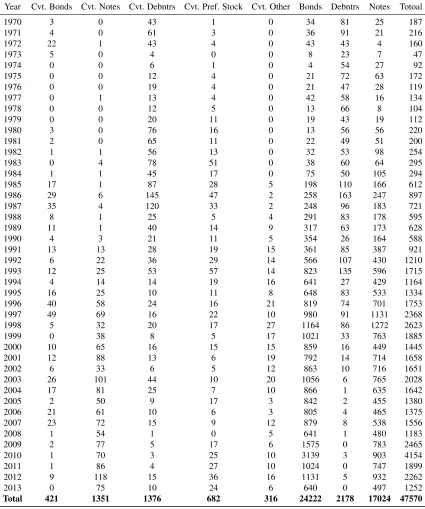
throughout this paper (3,148 observations). Table 4.1 details annual security issues
(J1970-Jn2013), Figure 4.1 and displays trends in principal amounts, coupons, time to
maturity and conversion prices for securities issued between Jan1970 and Jun2013. Table
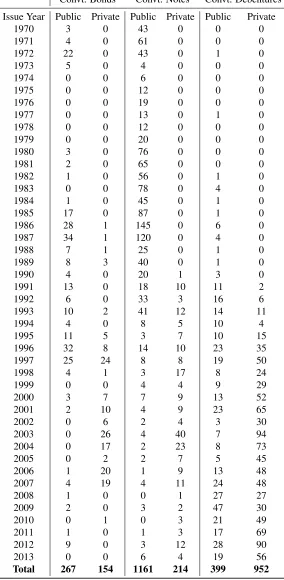
4.2 details annual convertible debt placement by security type, on aggregate 1,320
convertible debts were privately placed.
Monthly stock related data for the period Jan,1,1970- June,30,2013 was obtained through
the Center for Research in Security Prices database (CRSP). Convertible debt observations
were matched to the CRSP data set by firm 6-digit cusip-ids. The sample set was reduced
to maintain CRSP data for 9 months (at least 270 days) preceding the issue date of each
convertible security (per issuer). Annual firm financials were obtained from the S&P
Compustat database. Observations were matched by 6-digit cusip-ids and the year
5de Jong, Duca and Dutordoir (2013) use the SDC database to select a sample of 1,512 convertible debts
corresponding to the issue date -per security, -per issuer). 1,429 unique convertible debt
issues remained after merging the SDC issuance data with CRSP stock data and
Table 4.1: U.S. Non-Financial Security Issues: 1970-2013
Year Cvt. Bonds Cvt. Notes Cvt. Debntrs Cvt. Pref. Stock Cvt. Other Bonds Debntrs Notes Totoal
1970 3 0 43 1 0 34 81 25 187
1971 4 0 61 3 0 36 91 21 216
1972 22 1 43 4 0 43 43 4 160
1973 5 0 4 0 0 8 23 7 47
1974 0 0 6 1 0 4 54 27 92
1975 0 0 12 4 0 21 72 63 172
1976 0 0 19 4 0 21 47 28 119
1977 0 1 13 4 0 42 58 16 134
1978 0 0 12 5 0 13 66 8 104
1979 0 0 20 11 0 19 43 19 112
1980 3 0 76 16 0 13 56 56 220
1981 2 0 65 11 0 22 49 51 200
1982 1 1 56 13 0 32 53 98 254
1983 0 4 78 51 0 38 60 64 295
1984 1 1 45 17 0 75 50 105 294
1985 17 1 87 28 5 198 110 166 612
1986 29 6 145 47 2 258 163 247 897
1987 35 4 120 33 2 248 96 183 721
1988 8 1 25 5 4 291 83 178 595
1989 11 1 40 14 9 317 63 173 628
1990 4 3 21 11 5 354 26 164 588
1991 13 13 28 19 15 361 85 387 921
1992 6 22 36 29 14 566 107 430 1210
1993 12 25 53 57 14 823 135 596 1715
1994 4 14 14 19 16 641 27 429 1164
1995 16 25 10 11 8 648 83 533 1334
1996 40 58 24 16 21 819 74 701 1753
1997 49 69 16 22 10 980 91 1131 2368
1998 5 32 20 17 27 1164 86 1272 2623
1999 0 38 8 5 17 1021 33 763 1885
2000 10 65 16 15 15 859 16 449 1445
2001 12 88 13 6 19 792 14 714 1658
2002 6 33 6 5 12 863 10 716 1651
2003 26 101 44 10 20 1056 6 765 2028
2004 17 81 25 7 10 866 1 635 1642
2005 2 50 9 17 3 842 2 455 1380
2006 21 61 10 6 3 805 4 465 1375
2007 23 72 15 9 12 879 8 538 1556
2008 1 54 1 0 5 641 1 480 1183
2009 2 77 5 17 6 1575 0 783 2465
2010 1 70 3 25 10 3139 3 903 4154
2011 1 86 4 27 10 1024 0 747 1899
2012 9 118 15 36 16 1131 5 932 2262
2013 0 75 10 24 6 640 0 497 1252
Table 4.2: Placement of Convertible Debts, 1970-2013
Convt. Bonds Convt. Notes Convt. Debentures
Issue Year Public Private Public Private Public Private
1970 3 0 43 0 0 0
1971 4 0 61 0 0 0
1972 22 0 43 0 1 0
1973 5 0 4 0 0 0
1974 0 0 6 0 0 0
1975 0 0 12 0 0 0
1976 0 0 19 0 0 0
1977 0 0 13 0 1 0
1978 0 0 12 0 0 0
1979 0 0 20 0 0 0
1980 3 0 76 0 0 0
1981 2 0 65 0 0 0
1982 1 0 56 0 1 0
1983 0 0 78 0 4 0
1984 1 0 45 0 1 0
1985 17 0 87 0 1 0
1986 28 1 145 0 6 0
1987 34 1 120 0 4 0
1988 7 1 25 0 1 0
1989 8 3 40 0 1 0
1990 4 0 20 1 3 0
1991 13 0 18 10 11 2
1992 6 0 33 3 16 6
1993 10 2 41 12 14 11
1994 4 0 8 5 10 4
1995 11 5 3 7 10 15
1996 32 8 14 10 23 35
1997 25 24 8 8 19 50
1998 4 1 3 17 8 24
1999 0 0 4 4 9 29
2000 3 7 7 9 13 52
2001 2 10 4 9 23 65
2002 0 6 2 4 3 30
2003 0 26 4 40 7 94
2004 0 17 2 23 8 73
2005 0 2 2 7 5 45
2006 1 20 1 9 13 48
2007 4 19 4 11 24 48
2008 1 0 0 1 27 27
2009 2 0 3 2 47 30
2010 0 1 0 3 21 49
2011 1 0 1 3 17 69
2012 9 0 3 12 28 90
2013 0 0 6 4 19 56
0
100
200
300
400
1970 1980 1990 2000 2010 1970 1980 1990 2000 2010
Convertible Debts Straight Debts
Mean/Year: Principal Amount Issued (mil)
IssueYear
Graphs by ncs
0
5
10
15
1970 1980 1990 2000 2010 1970 1980 1990 2000 2010
Convertible Debts Straight Debts
Mean/Year:Coupon %
IssueYear
Graphs by ncs
0
50
100
150
1970 1980 1990 2000 2010
Convertible Debts
Mean/Year: Conversion Price
IssueYear
Graphs by CD
5
10
15
20
25
1970 1980 1990 2000 2010 1970 1980 1990 2000 2010
Convertible Debts Straight Debts
Mean/Year: Years to Maturity
IssueYear
Graphs by ncs
Plot of Summary Statistics by Security Type
Chapter 5: Methodology
Identifying debt-like, hedge-like, and equity-like issues
On the premise that firms select the design features of their convertible debts (i.e. maturity
date, conversion ratio, coupon rate, and call provisions) they are effectively choosing how
debt-, hedge- or equity-like the security will be. Since each feature affects the ultimate
design of the security each component must be considered during characterization.
Following Lewis, Rogalski and Seward (2003) convertible issues are classified as debt-,
hedge- or equity-like based on the likelihood that the debt will be converted to equity at
maturity. This probability simultaneously reflects the various design features of each
security in the form of a single measure. A bond is classified as “debt-like” if the
probability of conversion is less than 40%; as hedge like if the probability of conversion is
between 40% and 60%; and as “equity-like” if the probability of conversion is greater than
60%. Assuming that the underlying stocks follow a Brownian motion diffusion process,
each securities conversion probability value (measured from the issue date) is estimated
under a standard normal distribution functionN(d2).WhereN(·) is the cumulative
probability and
d2 = ln(S/X) + (r−div−σ
2/2)T
σ √
T
where, S is the current price of underlying common stock; X is the conversion price ; r is
the continuously compounded yield estimated from a 10-Year U.S. Treasury Bond on the
year-end immediately before the offer date;σ is the standard deviation of the continuously
compounded common equity return estimated over the period -240 to -40 trading days
prior to the issue date; and T is the number of years until maturity for the convertible bond.
Identifying hot convertible debt markets
Aggregate convertible debt volume and the criteria for hot market periods are constructed
in the framework of Bayless and Chaplinsky (1996) and consistent with Dutordoir et al
(2007). Aggregate convertible debt volume is calculated as a 3-month lagged moving
average of the number of convertible issues offered by U.S. non-financial firms. Hot
convertible markets are identified by at least three contiguous months with aggregate
issuance volumes that exceed the upper quartile of the 3-month moving average of
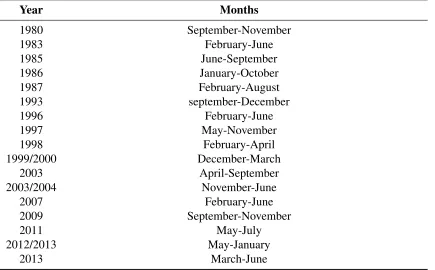
aggregate convertible issue volumes calculated between January 1970-June 2013. Table
5.1 list the hot convertible markets identified within the sample set
Identifying issuer need
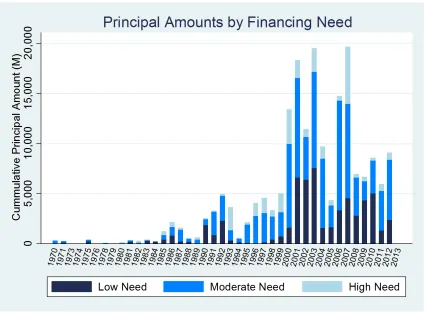
Extending Dong, Dutordoir and Veld (2013 working paper), the need for external capital
classified as the ratio between the amount of annual convertible principal issues and
annual total assets. A firm is categorized as having a “high-need” for external capital if the
principal/total assets ratio is greater than the 80th percentile of the sample ratios(0.499); a
firm is classified as having a “moderate-need” for external capital if the principal/total
assets ratio is between 20th and 80th percentile; and a firm is classified as having a
“low-need” for external capital if the principal/total assets ratio is less than the 20th
Table 5.1: Hot Convertible Debt Markets: 1970-2013
Year Months
1980 September-November
1983 February-June
1985 June-September
1986 January-October
1987 February-August
1993 september-December
1996 February-June
1997 May-November
1998 February-April
1999/2000 December-March
2003 April-September
2003/2004 November-June
2007 February-June
2009 September-November
2011 May-July
2012/2013 May-January
2013 March-June
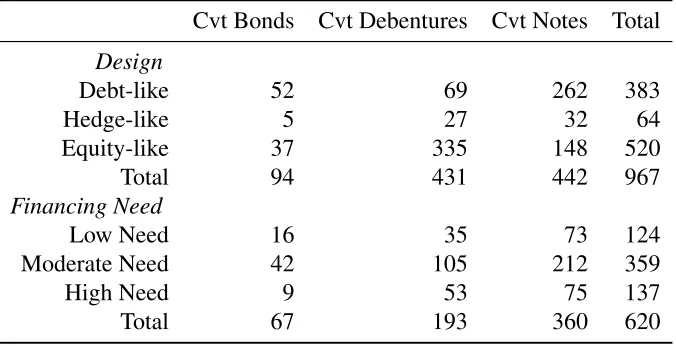
Table 5.2: Convertible Debts by Design and Financing Need
Cvt Bonds Cvt Debentures Cvt Notes Total
Design
Debt-like 52 69 262 383
Hedge-like 5 27 32 64
Equity-like 37 335 148 520
Total 94 431 442 967
Financing Need
Low Need 16 35 73 124
Moderate Need 42 105 212 359
High Need 9 53 75 137
Chapter 6: Analysis & Discussion
Logit models and Pearson’sχ2test are used to test the three hypothesis. Note that the full
sample consist of straight and convertible debt issues. In the logit analysis straight debt
issue events are the 0 base and debt-, hedge-, or equity-like convertible issues are the 1
event. The Pearsonχ2test is appropriate to evaluate the first hypothesis, that firms with
the highest expected cost for new convertible debt issuance will try to mitigate their
expenses by timing their issue announcement during a hot convertible debt market
window. Theχ2test for this sample of convertible debt issues and hot market windows
fails to reject the null hypothesis that convertible issue designs are independent of hot
(not-hot) convertible debt markets. This lack of evidence that convertible issue designs are
dependent upon hot (not-hot) convertible debt markets is consistent with the Pearsonχ2
test between convertible design and equity market conditions reported in Lewis et al
(2003).
Information revealed about the prevalence of private-placement activity regardless of
aggregate market conditions make this result a little unsatisfactory. Choi et al. (2009) note
that, unlike publicly placed issues, the terms of privately placed convertibles may be
negotiated or modified. In this light firms or arbitrage hedge funds may have strong
incentives to tailor issue designs as needed. This potentially raises the question of how the
composition of market participants might influence the final design features chosen.
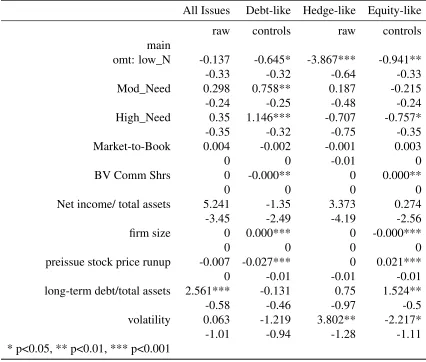
Table 6.1 reports the test of hypothesis two, that a firm’s need for external financing
influences their likelihood to issue convertible debt designed as debt-like, hedge-like, or
equity-like. The independent factor variable coefficients represent conditional
probabilities for the event that the issuer has a high-, moderate-, or (base) low-need for
classifications. The estimates suggest that both high and low-need firms are likely to issue
debt-like convertibles but high-need issuers are more than 3.5 as likely to issue debt-like
convertibles than low-need issuers. The moderate and high financing need categorical
variables were not significant predictors for hedge-like or equity-like design decisions.
At first glance these results appear counter intuitive. If firms have high financial need, by
definition at least half of their annual assets are raised through the convertible offer, we
would expect them to pursue an equity-like design with the goal of conversion and
capitalization. Yet the coefficient for equity-like design features by high-need firms is
negative and significant at the 5% level. This theoretically conflicting result is likely due
to a misspecification of financial need and blurred distinction between design features.
The measure of financing need, annual convertible principals/annual assets, not only
captures a firms willingness or desire to raise capital but it also reflects the time-sensitive
availability or supply of capital. The regressions in Table 6 .1 do not include the market
condition control of aggregate annual convertible issuance, this misspecification fails to
eliminate the possibility that a firms estimated need is inflated by excess supply. Further,
the fundamental motivations to select debt-like features, concerns of asset-substitution or
over-investment, are very closely aligned with the motivations to issue straight debt
securities. All in all the combination of a misspecified measure of financially constrained
firms that choose to design debt-like issues may be simultaneously identifying issues of
moral hazard and information asymmetry.
Hypothesis 3, private placement of convertible debt is prevalent and significant, regardless
of the debt-,hedge-, or equity-like convertible design , is also tested using categorical
(factor) logit models. The analysis is extended to the financing need and hot market factor
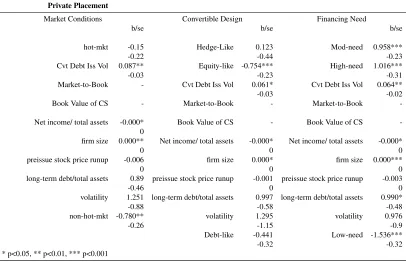
variables. Table 6.2 shows that private placements are only statistically significant for
equity-like issues but are persistent across different financing need levels. Additionally,
private placements are only significant during non-hot markets (not significant during
These results support the notion that overcoming asymmetric information is a primary
factor in choosing, if a choice exist, to privately place a new convertible issue. The
literature has established that investors are less critical of asymmetric information during
hot equity, straight debt, and convertible debt markets. The result suggest that private
placements are not necessary for opaque issuers during relaxed hot market windows but
are critical to issuers during normal or cold market periods.
This analysis considers the trends and motivations of convertible debt issuance and
placement. I find that design features of convertible issues are not chosen independent to
broader convertible debt markets conditions or firm-specific financial constraints. I also
identify a strong relationship between private-placement activity and convertible debt
issues designed with more equity-issuance characteristics. The unique features of
convertible debt securities give issuers a range of flexibility to tailor their securities in a
manner that mitigates or resolves firm specific concerns of asymmetric information, risk
Table 6.1: Analysis of Convertible Design and Financing Need
All Issues Debt-like Hedge-like Equity-like
raw controls raw controls
main
omt: low_N -0.137 -0.645* -3.867*** -0.941**
-0.33 -0.32 -0.64 -0.33
Mod_Need 0.298 0.758** 0.187 -0.215
-0.24 -0.25 -0.48 -0.24
High_Need 0.35 1.146*** -0.707 -0.757*
-0.35 -0.32 -0.75 -0.35
Market-to-Book 0.004 -0.002 -0.001 0.003
0 0 -0.01 0
BV Comm Shrs 0 -0.000** 0 0.000**
0 0 0 0
Net income/ total assets 5.241 -1.35 3.373 0.274
-3.45 -2.49 -4.19 -2.56
firm size 0 0.000*** 0 -0.000***
0 0 0 0
preissue stock price runup -0.007 -0.027*** 0 0.021***
0 -0.01 -0.01 -0.01
long-term debt/total assets 2.561*** -0.131 0.75 1.524**
-0.58 -0.46 -0.97 -0.5
volatility 0.063 -1.219 3.802** -2.217*
-1.01 -0.94 -1.28 -1.11
Table 6.2: Analysis of Private Placement on Need,Design and Market Conditions Private Placement
Market Conditions Convertible Design Financing Need
b/se b/se b/se
hot-mkt -0.15 Hedge-Like 0.123 Mod-need 0.958***
-0.22 -0.44 -0.23
Cvt Debt Iss Vol 0.087** Equity-like -0.754*** High-need 1.016***
-0.03 -0.23 -0.31
Market-to-Book - Cvt Debt Iss Vol 0.061* Cvt Debt Iss Vol 0.064**
-0.03 -0.02
Book Value of CS - Market-to-Book - Market-to-Book
-Net income/ total assets -0.000* Book Value of CS - Book Value of CS
-0
firm size 0.000** Net income/ total assets -0.000* Net income/ total assets -0.000*
0 0 0
preissue stock price runup -0.006 firm size 0.000* firm size 0.000***
0 0 0
long-term debt/total assets 0.89 preissue stock price runup -0.001 preissue stock price runup -0.003
-0.46 0 0
volatility 1.251 long-term debt/total assets 0.997 long-term debt/total assets 0.990*
-0.88 -0.58 -0.48
non-hot-mkt -0.780** volatility 1.295 volatility 0.976
-0.26 -1.15 -0.9
Debt-like -0.441 Low-need -1.536***
-0.32 -0.32
References
1. Abhyankar, A., Dunning, A., 1999. Wealth effects of convertible bond and
convertible preference share issues: An empirical analysis of the UK market.
Journal of Banking & Finance 23, 1043–1065.
2. Alexander, G.J., Stover, R.D., Kuhnau, D.B., 1979. Market Timing Strategies in
Convertible Debt Financing. Journal of Finance 34, 143–155.
3. Ammann, M., Fehr, M., Seiz, R., 2006. New evidence on the announcement effect
of convertible and exchangeable bonds. Journal of Multinational Financial
Management 16, 43–63.
4. Bayless, M., Chaplinsky, S., 1996. Is There a Window of Opportunity for Seasoned
Equity Issuance? The Journal of Finance 51, 253–278.
5. Billingsley, R.S., Smith, D.M., 1996. Why do firms issue convertible debt? FM: The
Journal of the Financial Management Association 25, 93.
6. Burlacu, R., 2000. New evidence on the pecking order hypothesis: the case of
French convertible bonds. Journal of Multinational Financial Management 10,
439–459.
7. Chang, S.-C., Chen, S.-S., Liu, Y., 2004b. Why firms use convertibles: A further
test of the sequential-financing hypothesis. Journal of Banking & Finance 28,
1163–1183.
8. Chaplinsky, S., Ramchand, L., 2004. The Impact of SEC Rule 144A on Corporate
9. Choi, D., Getmansky, M., Tookes, H., 2009. Convertible bond arbitrage, liquidity
externalities, and stock prices. Journal of Financial Economics 91, 227–251.
10. Christensen, D.G., Faria, H.J., Kwok, C.C.Y., Bremer, M., 1996. Does the Japanese
stock market react differently to public security offering announcements than the
US stock market? Japan and the World Economy 8, 99–119.
11. Davidson III, W.N., Glascock, J.L., Schwarz, T.V., 1995. Signaling with Convertible
Debt. Journal of Financial & Quantitative Analysis 30, 425–440.
12. De Jong, A., Duca, E., Dutordoir, M., 2013. Do Convertible Bond Issuers Cater to
Investor Demand? Financial Management (Blackwell Publishing Limited) 42,
41–78.
13. De Roon, F., Veld, C., 1998. Announcement effects of convertible bond loans and
warrant-bond loans: An empirical analysis for the Dutch market. Journal of
Banking & Finance 22, 1481–1506.
14. Dong, M., Dutordoir, M., Veld, C., 2011. Why Do Firms Issue Convertible Bonds?
Evidence from the Field (SSRN Scholarly Paper No. ID 1908476). Social Science
Research Network, Rochester, NY.
15. Dorion, C., Francois, P., Grass, G., Jeanneret, A., 2012. Convertible Debt and
Shareholder Incentives (SSRN Scholarly Paper No. ID 2159478). Social Science
Research Network, Rochester, NY.
16. Dutordoir, M., Van de Gucht, L., 2007. Are there windows of opportunity for
convertible debt issuance? Evidence for Western Europe. Journal of Banking &
Finance 31, 2828–2846.
17. Jun-Koo Kang, Lee, Y.W., 1996. The pricing of convertible debt offerings. Journal
18. How different is Japanese corporate finance? An investigation of the information
content of new security issues. Rev. Financ. Stud. 9, 109–139.
19. Korkeamaki, T.P., Moore, W.T., 2004. Convertible Bond Design and Capital
Investment: The Role of Call Provisions. Journal of Finance 59, 391–405.
20. La Porta, R., Lopez-De-Silanes, F., Shleifer, A., 2006. What Works in Securities
Laws? The Journal of Finance 61, 1–32.
21. Lewis, C.M., Rogalski, R.J., Seward, J.K., 1999. Is Convertible Debt a Substitute
for Straight Debt or for Common Equity? FM: The Journal of the Financial
Management Association 28, 5–27.
22. Lewis, C.M., Rogalski, R.J., Seward, J.K., 2001. The long-run performance of firms
that issue convertible debt: an empirical analysis of operating characteristics and
analyst forecasts. Journal of Corporate Finance 7, 447–474.
23. Lewis, C.M., Rogalski, R.J., Seward, J.K., 2003. Industry conditions, growth
opportunities and market reactions to convertible debt financing decisions. Journal
of Banking & Finance 27, 153–181.
24. Loncarski, I., Horst, T., Jenke, Veld, C., 2006. Why do Companies Issue
Convertible Bonds? A Review of Theory and Empirical Evidence (SSRN Scholarly
Paper No. ID 837184). Social Science Research Network, Rochester, NY.
25. Magennis, D., Watts, E., Wright, S., 1998. Convertible notes: the debt versus equity
classification problem. Journal of Multinational Financial Management 8, 303–315.
26. Mann, S.V., Moore, W.T., Ramanlal, P., 1999. Timing of Convertible Debt Issues.
Journal of Business Research 45, 101–105.
27. Mayers, D., 1998. Why firms issue convertible bonds: the matching of financial and
28. Stein, J.C., 1992. Convertible bonds as backdoor equity financing. Journal of