Journal of Multidisciplinary Healthcare
Dove
press
O r i g i n a l r e s e a r c H
open access to scientific and medical research
Open access Full Text article
The impact of elearning on health professional
educators’ attitudes to information
and communication technology
Victoria neville1
Mary lam2
christopher J gordon3
1Faculty of science, Medicine and Health, The University of Wollongong, Wollongong, nsW, australia; 2Faculty of Health science, 3sydney nursing school, The University of sydney, sydney, nsW, australia
correspondence: Victoria neville Faculty of science, Medicine and Health, The University of Wollongong, Wollongong, nsW 2522, australia Tel +61 2 4221 3469
Fax +61 2 4221 3137 email [email protected]
christopher J gordon sydney nursing school M02, The University of sydney, sydney, nsW 2006 australia
email [email protected]
Background: The use of information and communication technology (ICT) in health profes-sional education is increasing rapidly. Health profesprofes-sional educators need to be responsive to health professionals’ information and communication technological needs; however, there is a paucity of information about educators’ attitudes to, and capabilities with, ICT.
Methods: Fifty-two health professional educators, enrolled in health professional education postgraduate studies, participated in an online subject with specific eLearning components requiring the use of ICT. They completed a pre- and postquestionnaire pertaining to ICT atti-tudes, confidence, and usage.
Results: Participants reported significant increases in overall ICT confidence during the
subject despite it being high at baseline (mean: 7.0 out of 10; P=0.02). Even with increased
ICT confidence, there were decreases in the participants’ sense of ICT control when related to
health professional education (P=0.002); whereas, the amount of time participants engaged
with ICT devices was negatively correlated with the sense of ICT control (P=0.002). The
effect of age and health discipline on ICT attitudes and confidence was not significant
(P.0.05).
Conclusion: This study reports that health professional educators have perceptual deficits toward ICT. The impact of eLearning increased confidence in ICT but caused a reduction in participants’ sense of control of ICT. Health professional educators require more ICT training and support to facilitate better ICT integration in health professional education settings.
Keywords: confidence, sense of control
Introduction
eLearning is concerned with the learning activities, resource access, communication, and assessment undertaken in an online environment. This type of learning environ-ment normally uses a range of information and communication technologies (ICTs) accessible via computer or mobile devices. The purpose of this study was to explore the attitudes of health professional educators (HPEs) toward their use of ICT, in general, and within their educational practice, in particular. The term “ICT,” within this paper, refers to the technologies used in eLearning,
HPEs are health care practitioners who undertake the role of teacher for their profes-sional peers, students in preregistration courses, or patients. HPEs facilitate learning for practice, from practice, and in practice within clinical, community, professional organization, or higher education contexts. A key role of HPEs, in facilitating learn-ing and professional development, is their modellearn-ing of good professional practice1
including using ICT.2,3
Journal of Multidisciplinary Healthcare downloaded from https://www.dovepress.com/ by 118.70.13.36 on 24-Aug-2020
For personal use only.
Number of times this article has been viewed
This article was published in the following Dove Press journal: Journal of Multidisciplinary Healthcare
Dovepress
neville et al
Systematic reviews of research literature on eLearning and web-based learning in health professional education reveal a focus on the strategies and tools of eLearning used by HPEs and learning outcomes achieved through eLearning.4,5
Button et al’s6 recent review of the literature of eLearning
and ICT in nursing education identified issues relevant to eLearning for nursing educators. These issues, however, emphasized knowledge or skill development, rather than attitudes, which were of concern to educators, such as the time for eLearning resource development and facilitation and the need for eLearning ICT skills training.
Studies that address the affective areas of eLearning in health professional education tend to focus on participants’ attitudes to ICT7–11 or their satisfaction with the eLearning
experience.12,13 Childs et al14 conducted a systematic review
of the health professional education literature to identify the barriers and solutions to eLearning for health profes-sionals and students. The findings of this review identified institutional, management, learner, and HPE issues. The attitudinal issues of HPEs to eLearning included resistance to change, poor motivation, fear, anxiety, and low confi-dence with computers.
Confidence in being able to successfully complete learn-ing tasks has an important role in learner achievement.15 We
might expect, therefore, that HPEs learning to use ICT within eLearning will also depend on their sense of confidence with ICT. Cooper’s16 study found that intrinsic motivation and
satisfaction with eLearning were the primary incentives for educators in higher education. This internal source of motiva-tion suggests that an internal locus of control supports HPEs’ confidence in learning to use ICT within eLearning.
In this sense, locus of control refers to the extent to which people believe that they are in control of events that occur in their environment.17 People with an internal locus
of control are more likely to believe that their own actions can affect environmental events, including their learning achievement.18 Conversely, people with an external locus
of control are more likely to feel acted upon or controlled by their environment. Wishart and Ward19 found that a
feel-ing of befeel-ing in control of ICT, rather than befeel-ing controlled by it, was linked with nursing students being less fearful of the technology. This suggests that the role of locus on control in an eLearning environment may also apply to HPEs who grapple with their motivation and confidence with eLearning ICT.
The influence of educator attitudes toward the use of ICT in eLearning on learner satisfaction with eLearning is dem-onstrated by previous studies.20–23 This signifies the important
role that HPEs play in enabling opportunities for learner development, through eLearning, of thinking skills and self-efficacy with ICT that are transferable to professional practice settings.24,25 The relationship between attitudes and
behav-iors has long been recognized as complex.26 Nevertheless,
encouraging HPEs to adopt the desired behaviors of using ICT in their educational practice requires that they develop their intention to act in the desired way.7 This intention to
act is influenced by the attitudes toward the use of ICT in eLearning practice that HPEs develop.
HPEs differ from many of their peers by being both clini-cal practitioners and educators. Therefore, HPEs’ attitudes to ICT for educational practice might be influenced by their exposure to, and expected use of, ICT in their professional contexts with different ICT requirements, such as educational or clinical contexts.27 Accordingly, we sought information
to identify factors and their degree of influence, which may contribute to HPE attitudes toward to ICT in eLearning.
Methods
This study was conducted at a major metropolitan Australian university that has a diverse range of undergraduate and postgraduate health professional disciplinary degrees. Health professional education, a major postgraduate degree stream, enrolled HPEs from a variety of health disciplines. The postgraduate health professional education course consisted of four mandatory subjects, two of which were delivered using online learning with a suite of elective subjects. Each subject equated to approximately 120 hours of learning, and the mandatory subjects were conducted within the same year prior to the elective components. The content of each subject offered via eLearning was related to health professional education pedagogy (clinical teaching and supervision and simulation-based learning for HPEs) with an emphasis on the incorporation of ICT into health professional education. Students enrolled in these subjects were required to complete a range of online learning activities and assignments which necessitated substantial engagement with ICT. These eLearn-ing activities included vieweLearn-ing online videos and documents, sharing ideas by communicating in discussion forums, cre-ating blended media online presentations, and submitting written assignments online. Students were encouraged to use a range of ICT devices including computers, smart phones, and tablets to get access to and complete the eLearning activities. In this way, all students enrolled in these two subjects were exposed to learning about health professional education within ICT-rich eLearning environments. Prior to undertaking the study, we determined the sample size on the
Journal of Multidisciplinary Healthcare downloaded from https://www.dovepress.com/ by 118.70.13.36 on 24-Aug-2020
Dovepress Health professional educators’ attitudes to icT
assumption that the study would provide 80% power with a type one error of 5%, an attrition rate of 5%, and 5% for the adjustment for covariates. This revealed that a sample size of 52 participants was required.
Participants
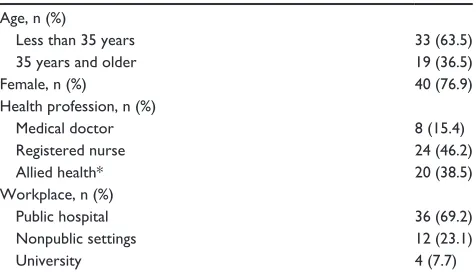
Participants were HPEs enrolled in the health professional education postgraduate course. Fifty-six HPEs were recruited into the study. All participants were enrolled at different stages of their degrees; however, all had completed at least two subjects which were conducted in face-to-face modal-ity prior to undertaking the subject via eLearning. We only included participants without prior eLearning exposure during their studies to ascertain the effect of eLearning with the subjects. If participants completed both online subjects, data were analyzed only from the first subject studied by the participants. Due to incomplete surveys and students withdrawing from the subject, n=52 participants completed the study (Table 1).
ethical approval
Ethical approval was granted by the Human Research Ethics Committee of the university, and all participants consented to the study prior to the commencement of the subjects.
Procedures
Participants completed a questionnaire related to ICT atti-tudes, experiences, and knowledge and confidence with ICT. The questionnaire was administered twice, prior to and on completion of the subject. It was undertaken in an electronic format following consent. All participants were deidentified. Participants were required to complete the prequestionnaires within the first 2 weeks of the semester and the postquestion-naires within 2 weeks of subject completion. All questions needed to be completed before submission.
instruments
Participants completed a questionnaire about attitudes to ICT. The Information Technology Attitude Scales for Health (ITASH)28 was developed previously to ascertain health
professionals’ attitudes toward ICT. The questionnaire was validated in 151 health professionals, but none were identi-fied as HPEs. It consists of three subscales, efficiency of care (A); education, training, and development (B); and the control scale (C), which show robust reliability (Cronbach’s alpha scores: 0.88, 0.70, 0.77 for the three subscales, respec-tively) and construct validity established previously.28 The
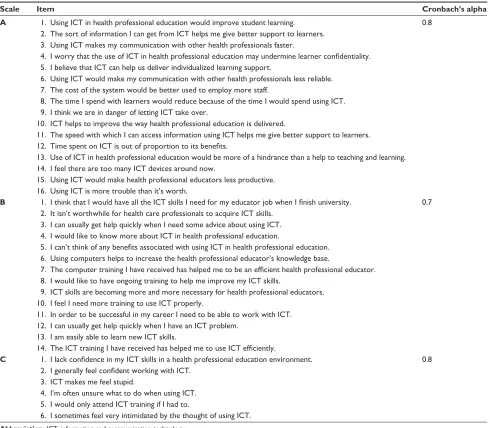
efficiency of care subscale explored health professionals’ attitudes to ICT improving health care while the education, training, and development subscale related to the amount and quality of ICT education and training the health profes-sional received; and the control subscale was indicative of the health professionals sense of control over ICT. The control subscale addressed the extent to which HPEs felt that they were in control of their own ability to use ICT. We modified the ITASH subscales to match the needs of the participant cohort. The subscales were contextualized for the HPE and the health professional education domain (Table 2).
Data analysis
All descriptive statistics were reported as means, standard deviations, and ranges, where applicable. Cronbach’s alphas were calculated to quantify internal consistency, with scores 0.7 considered satisfactory.29 When
con-sidering the entire data set, the pre-, postsubject ITASH subscale aggregated scores (efficiency of care [A]; educa-tion, training, and development [B]; and control scale [C]) were analyzed using paired Student’s t-tests. As this study was exploratory, we sought to determine if relationships between the independent variables (age groups, health professional discipline, hours of ICT usage, and time) and the dependent variables (change in ITASH subscales and self-reported confidence) existed. This was based on previous research, which has shown age and discipline to impact on health professionals attitudes to ICT.11,30,31
Student t-tests were used to determine the effect of age (,35 years and 35 years) and time (pre-, postsubject), and one-way analysis of variance to compare the differ-ent health professional disciplines (medical, nursing, and other disciplines combined) on changes in attitude and self-reported confidence. Pearson’s correlation was used to analyze the relationship between hours of usage of ICT and attitudes and self-reported confidence at baseline. Statisti-cal significance was set at alpha ,0.05 for all analyses.
Table 1 Participant demographics (n=52)
age, n (%)
less than 35 years 33 (63.5)
35 years and older 19 (36.5)
Female, n (%) 40 (76.9)
Health profession, n (%)
Medical doctor 8 (15.4)
registered nurse 24 (46.2)
allied health* 20 (38.5)
Workplace, n (%)
Public hospital 36 (69.2)
nonpublic settings 12 (23.1)
University 4 (7.7)
Note: *allied health profession comprises medical radiation practitioner, occupational therapist, physiotherapist, and speech therapist.
Journal of Multidisciplinary Healthcare downloaded from https://www.dovepress.com/ by 118.70.13.36 on 24-Aug-2020
Dovepress
neville et al
Table 2 The internal consistency of Information Technology Attitude Scales for Health subscales of efficiency of care (A); education, training, and development (B); and the control scale (C)
Scale Item Cronbach’s alpha
A 1. Using icT in health professional education would improve student learning. 0.8
2. The sort of information i can get from icT helps me give better support to learners. 3. Using icT makes my communication with other health professionals faster.
4. I worry that the use of ICT in health professional education may undermine learner confidentiality. 5. i believe that icT can help us deliver individualized learning support.
6. Using icT would make my communication with other health professionals less reliable. 7. The cost of the system would be better used to employ more staff.
8. The time i spend with learners would reduce because of the time i would spend using icT. 9. i think we are in danger of letting icT take over.
10. icT helps to improve the way health professional education is delivered.
11. The speed with which i can access information using icT helps me give better support to learners. 12. Time spent on ICT is out of proportion to its benefits.
13. Use of icT in health professional education would be more of a hindrance than a help to teaching and learning. 14. i feel there are too many icT devices around now.
15. Using icT would make health professional educators less productive. 16. Using icT is more trouble than it’s worth.
B 1. I think that I would have all the ICT skills I need for my educator job when I finish university. 0.7 2. it isn’t worthwhile for health care professionals to acquire icT skills.
3. i can usually get help quickly when i need some advice about using icT. 4. i would like to know more about icT in health professional education.
5. I can’t think of any benefits associated with using ICT in health professional education. 6. Using computers helps to increase the health professional educator’s knowledge base.
7. The computer training I have received has helped me to be an efficient health professional educator. 8. i would like to have ongoing training to help me improve my icT skills.
9. icT skills are becoming more and more necessary for health professional educators. 10. i feel i need more training to use icT properly.
11. in order to be successful in my career i need to be able to work with icT. 12. i can usually get help quickly when i have an icT problem.
13. i am easily able to learn new icT skills.
14. The ICT training I have received has helped me to use ICT efficiently.
C 1. I lack confidence in my ICT skills in a health professional education environment. 0.8 2. I generally feel confident working with ICT.
3. icT makes me feel stupid.
4. i’m often unsure what to do when using icT. 5. i would only attend icT training if i had to.
6. i sometimes feel very intimidated by the thought of using icT.
Abbreviation: icT, information and communication technology.
Results
The participant cohort was derived from two separate manda-tory online subjects, and our analysis determined that there were no significant differences between the two subject groups for age groups, health discipline, ICT usage, or mean scores for the ITASH subscales and self-reported confidence (P.0.05). Accordingly, we combined the two participant groups for all subsequent analyses.
The Cronbach’s alpha for the ITASH subscales A, B, and C were 0.7, 0.7, and 0.8, respectively, indicating that the scale had strong internal consistency (Table 2). These were similar to those reported by the original tool validation.
The percentage of participants with ICT devices are shown in Figure 1. Generally, desktop or laptop computers
were the most prevalent, with over 75% of participants regu-larly using a smartphone.
Participants reported significant increases in overall confi-dence during the online subject (P,0.05) (Table 3). There were no significant differences in the ITASH efficiency of health professional education (A) and education, training, and develop-ment (B) subscales during the subject (P.0.05) (Table 3). How-ever, ITASH control (C) subscale, indicative of the participant’s sense of ICT control, significantly declined during the subject, suggesting that despite an increase in overall ICT confidence, the participants did not feel that they were in control of ICT when related to health professional education (P=0.002).
There were no statistical differences between the indepen-dent variable of age groups and different health disciplines
Journal of Multidisciplinary Healthcare downloaded from https://www.dovepress.com/ by 118.70.13.36 on 24-Aug-2020
Dovepress Health professional educators’ attitudes to icT
0 20.0
Computer
Smartphone mp3 player mp4 playerSimple phone eReader Tablet computer
40.0 60.0 80.0 100.0
Participants with device (%)
Devices
Figure 1 The percentage of participants with different information and communi cation technology devices.
Table 3 The change in information Technology attitude scales for Health subscales and self-reported overall confidence scores during the online subject
Variable Mean difference (95% CI)
Paired t-test
iTasH subscale a post – pre
-0.69 (-1.81 to 0.44) t=-1.23, df =44, P=0.224
iTasH subscale B post – pre
-0.38 (-1.45 to 0.70) t=-0.71, df =44, P=0.482
iTasH subscale c post – pre
-0.96 (-1.55 to -0.36) t=-3.22, df =44, P=0.002*
Confidence post – pre
0.50 (0.08 to 0.92) t=2.40, df =45, P=0.020*
Notes: Subscale A, efficiency of care; subscale B, education, training, and development; and subscale C, control. *Represents significant difference.
Abbreviations: CI, confidence interval; ITASH, Information Technology Attitude scales for Health.
and the dependent variables (ITASH subscale change and self-reported overall confidence; P.0.05).
There were significant negative correlations between the amount of time engaged with ICT devices and ITASH control (C) subscale and positive correlations for self-reported overall confidence (P=0.002 and P=0.001, respec-tively) (Table 4).
Discussion
The main findings from the study reveal that HPEs do not feel in control of ICT educational capacity despite report-ing an increase in confidence in ICT usage. These are novel findings for two reasons. First, health care professionals are increasingly required to engage in ICT within health care settings, and HPEs need to be confident and in control in their ICT usage to support their educational endeavors. This study demonstrates that when HPEs engage in eLearning related to health professional pedagogy, they feel less in control.
Second, confidence per se does not assist with improving attitudes to ICT, especially as related to usage and value of ICT for eLearning.
The improvement in HPEs’ confidence in using ICT as a result of their learning experience is consistent with research into the effects of training on ICT user confidence.32,33 The
concurrent decrease in the sense of user control of ICT suggests that HPEs’ confidence in using ICT for their own learning may not necessarily result in the integration of ICT into their pedagogical practices. Attitudes toward learning to use ICT, in general, and attitudes toward using ICT within health professional education practice appear to be distinct issues. Further research is required to shed light on how both of these attitudinal areas may need to be addressed in the preparation of HPEs.
This study found that there were no significant differ-ences in attitudes between age groups or between health care discipline groups. This contrasts with others explor-ing the attitudes of health care professionals to ICT.11,30,31
This may be because different health care disciplines may have different needs in their use of ICT for professional health care practice.34 Health professional roles, therefore,
direct how ICT is used to perform those roles. In contrast, the educational roles of planning, resource development, implementation, and facilitation of learning, assessment of learning, and program evaluation are common to all educa-tional environments, regardless of the health care discipline. Consequently, there is likely to be less difference in attitudes toward ICT for educational purposes across HPEs from dif-ferent disciplines.
We found that the time spent engaging with ICT devices was related to ICT confidence and a decrease in user control. The ownership and confidence in using ICT devices of the participants in this study were similar to previous research,35
demonstrating that our cohort was representative of health professionals (Figure 1). HPEs’ increased confidence in using ICT appears to be a logical consequence of the more time they spent using ICT devices. However, ICT device engage-ment was negatively correlated with HPEs’ sense of control of ICT in general, not just with ICT devices. This suggests that exposing HPEs to more ICT devices may not be sufficient for HPEs to improve their sense of control over ICT. Instead, HPEs may need to develop a better general understanding of ICT and explore fewer devices in depth, particularly in terms of their use for learning and teaching. This is also recommended by Skiba et al.3 Developing a better general
understanding of ICT for eLearning may improve their sense of control of ICT for eLearning.
Journal of Multidisciplinary Healthcare downloaded from https://www.dovepress.com/ by 118.70.13.36 on 24-Aug-2020
Dovepress
neville et al
Table 4 correlations between the amount of time spent engaged with icT devices and information Technology attitude scales for Health subscales and self-reported overall confidence at baseline
Baseline ITASH subscale A
Baseline ITASH subscale B
Baseline ITASH subscale C
Self-reported overall confidence
amount of time spent engaged with icT devices
r -0.184 -0.165 -0.415 0.451
Pvalue 0.193 0.243 0.002* 0.001*
n 52 52 52 52
Notes: Subscale A, efficiency of care; subscale B, education, training, and development; and subscale C, control. *Represents significant difference.
Abbreviations: icT, information and communication technology; iTasH, information Technology attitude scales for Health.
HPEs are usually considered to have greater clinical expertise than those they teach. The “HPE as expert” self-concept may be undermined by a low sense of ICT control. Consequently, HPEs may not engage with ICT for eLearning. Our study found that this was common across the health care disciplines. This suggests that a sense of ICT control may be related to individual intrinsic properties rather than discipline-specific engagement.
The HPEs in this study experienced the use of ICT to learn content related to the design and practice of clinical teaching and supervision and clinical simulation, including embedding ICT into their eLearning practices. The difference in confi-dence with using ICT and the sense of user control of ICT as a result of the learning experience suggests that HPEs may not have been able to manage the cognitive load36 required by
the content and learning experience. Consequently, HPEs may have responded by adopting a multifaceted approach to learn-ing,37 implementing a deeper approach to learning of subject
content and a more surface approach to the eLearning use of ICT. Further research is required to explore the relationships between cognitive load, approach to learning, and attitudes to ICT adopted by HPEs within similar ICT-embedded eLearning environments. In this way, HPEs may have expe-rience in incorporating ICT into their educational repertoire and improve their sense of ICT control.
Metacognition is a significant component of the cogni-tive load requirements for HPEs engaged in the eLearning environments within this study.38 Thinking about how their
own ICT-embedded eLearning experience assisted them to develop the declarative and procedural knowledge39 of the
subject content may enable HPEs to synthesize better their knowledge and attitudes toward the use of ICT within health care professional education. To date, exploration of the relationships between metacognitive ability and attitudinal development of HPEs in relation to the use of ICT in health care professional education has not been examined and war-rants further study.
limitations
We undertook a power analysis and determined sample size prior to the study. The distribution of different health professional disciplines, however, may have had an impact on the findings despite the numerical distribution of disci-plines indicative of clinical environments. Participants in this study were HPEs enrolled in subjects concerned with educational practice relevant to health care professional education. Participants were engaged in their student role throughout this study. This may have an impact on the external validity of the current findings to HPEs in nonstudent roles.
Conclusion
This study shows that HPEs’ attitudes to ICT for eLearn-ing are improved in terms of their confidence with ICT, but not their sense of control, when exposed to an eLearning environment specifically designed to address ICT-embedded pedagogy for learning about health care professional educa-tional issues. Further research is needed to investigate issues, such as cognitive load and metacognition, which may have an impact on HPEs’ sense of control in their use of ICT in their educator roles.
Disclosure
The authors report no conflicts of interest in this work.
References
1. Schumacher DJ, Englander R, Carraccio C. Developing the master learner: applying learning theory to the learner, the teacher, and the learning environment. Acad Med. 2013;88(11):1635–1645.
2. Axley L. The integration of technology into nursing curricula: supporting faculty via the technology fellowship program. Online Journal of Issues
in Nursing. 2008;13(3).
3. Skiba DJ, Connors HR, Jeffries PR. Information technologies and the trans-formation of nursing education. Nurs Outlook. 2008;56(5):225–230. 4. Cook DA, Levinson AJ, Garside S, Dupras DM, Erwin PJ, Montori VM.
Instructional design variations in internet-based learning for health pro-fessions education: a systematic review and meta-analysis. Acad Med. 2010;85(5):909–922.
Journal of Multidisciplinary Healthcare downloaded from https://www.dovepress.com/ by 118.70.13.36 on 24-Aug-2020
Journal of Multidisciplinary Healthcare
Publish your work in this journal
Submit your manuscript here: http://www.dovepress.com/journalofmultidisciplinaryhealthcarejournal
The Journal of Multidisciplinary Healthcare is an international, peer-reviewed open-access journal that aims to represent and publish research in healthcare areas delivered by practitioners of different disciplines. This includes studies and reviews conducted by multidisciplinary teams as well as research which evaluates the results or conduct of such teams or
healthcare processes in general. The journal covers a wide range of areas and welcomes submissions from practitioners at all levels, from all over the world. The manuscript management system is completely online and includes a very quick and fair peer-review system. Visit http://www.dove-press.com/testimonials.php to read real quotes from published authors.
Dovepress
Dove
press
Health professional educators’ attitudes to icT
5. Lahti M, Hätönen H, Välimäki M. Impact of e-learning on nurses’ and student nurses knowledge, skills, and satisfaction: a systematic review and meta-analysis. Int J Nurs Stud. 2014;51(1):136–149.
6. Button D, Harrington A, Belan I. E-learning and information com-munication technology (ICT) in nursing education: A review of the literature. Nurse Educ Today. 2014;34(10):1311–1323.
7. Aggelidis VP, Chatzoglou PD. Using a modified technology acceptance model in hospitals. Int J Med Inform. 2009;78(2):115–126.
8. Dawidowski AR, Toselli L, Luna DR, Oberti PF, Soto MA, de Quirós FG. [Changes in physicians’ attitudes to computerized ambulatory medical record systems: a longitudinal qualitative study]. Gac Sanit. 2007;21(5):384–389. Spanish.
9. Eley R, Soar J, Buikstra E, Fallon T, Hegney D. Attitudes of Australian nurses to information technology in the workplace: a national survey.
Comput Inform Nurs. 2009;27(2):114–121.
10. Flores-Mir C, Palmer NG, Northcott HC, Khurshed F, Major PW. Perceptions and attitudes of Canadian dentists toward digital and electronic technologies. J Can Dent Assoc. 2006;72(3):243.
11. Huryk LA. Factors influencing nurses’ attitudes towards healthcare information technology. J Nurs Manag. 2010;18(5):606–612. 12. McVey G, Gusella J, Tweed S, Ferrari M. A controlled evaluation of
web-based training for teachers and public health practitioners on the prevention of eating disorders. Eat Disord. 2009;17(1):1–26. 13. Tsai SL, Tsai WW, Chai SK, Sung WH, Doong JL, Fung CP. Evaluation
of computer-assisted multimedia instruction in intravenous injection.
Int J Nurs Stud. 2004;41(2):191–198.
14. Childs S, Blenkinsopp E, Hall A, Walton G. Effective e-learning for health professionals and students – barriers and their solutions. A systematic review of the literature – findings from the HeXL project.
Health Info Libr J. 2005;22(Suppl 2):20–32.
15. Bandura A. A social cognitive theory of action. In: Forgas JP, Innes MJ, editors. Recent Advances in Social Psychology: An International
Perspective. North Holland: Elsevier; 1989:127–138.
16. Cooper C. A study of faculty attitudes, perceptions, resistance and expectations toward teaching web-based learning courses in higher education. In: McFerrin K, Weber R, Carlsen R, Willis DA, editors. Society for Information Technology and Teacher Education Interna-tional Conference. 2008; Las Vegas, Nevada, USA: AACE; 2008. 17. Kormanik MB, Rocco TS. Internal versus external control of
reinforcement: a review of the locus of control construct. Human
Resource Development Review. 2009;8(4):463–483.
18. Fazey DMA, Fazey JA. The potential for autonomy in learning: perceptions of competence, motivation and locus of control in first-year undergraduate students. Stud High Educ. 2001;26(3):345–361. 19. Wishart J, Ward R. Individual differences in nurse and teacher training
students’ attitudes toward and use of information technology. Nurse
Educ Today. 2002;22(3):231–240.
20. Piccoli G, Ahmad R, Ives B. Web-based virtual learning environments: a research framework and a preliminary assessment of effectiveness in basic IT skills training. MIS Quarterly. 2001;25(4):401–426. 21. Smeets E. Does ICT contribute to powerful learning environments in
primary education? Comput Educ. 2005;44:343–355.
22. Sun PC, Tsai RJ, Finger G, Chen YY, Yeh D. What drives a successful e-Learning? An empirical investigation of the critical factors influencing learner satisfaction. Comput Educ. 2008;50(4):1183–1202.
23. Webster J, Hackley P. Teaching effectiveness in technology-mediated distance learning. Acad Manage J. 1997;40(6):1282–1309.
24. Bembridge E, Levett-Jones T, Jeong SY. The transferability of information and communication technology skills from university to the workplace: a qualitative descriptive study. Nurse Educ Today. 2011;31(3):245–252.
25. Jensen R, Meyer L, Sternberger C. Three technological enhancements in nursing education: informatics instruction, personal response systems, and human patient simulation. Nurse Educ Pract. 2009;9(2):86–90. 26. Ajzen I, Fishbein M. Understanding Attitudes and Predicting Social
Behavior. Englewood Cliffs, NJ: Prentice-Hall; 1980.
27. Sword TS. The transition to online teaching as experienced by nurse educators. Nurs Educ Perspect. 2012;33(4):269–271.
28. Ward R, Pollard K, Glogowska M, Moule P. Information Technology
Attitude Scales for Health (ITASH): Project Report. Bristol: Faculty
of Health and Social Care, University of the West of England; 2006. Available from: http://hsc.uwe.ac.uk/net/research/Data/Sites/1/ GalleryImages/Research/ITASH%20Report(1).PDF. Accessed June 15, 2011.
29. Streiner DL, Norman GR. Health Measurement Scales: A Practical
Guide to Their Development and Use. 3rd ed. Oxford: Oxford University
Press; 2003.
30. Darr A, Harrison MI, Shakked L, Shalom N. Physicians’ and nurses’ reactions to electronic medical records. Managerial and occupational implications. J Health Organ Manag. 2003;17(5):349–359.
31. Jacko JA, Sears A, Sorensen SJ. Framework for usability: healthcare professionals and the Internet. Ergonomics. 2001;44(11):989–1007. 32. Kuiper R. Metacognitive factors that impact student nurse use of point
of care technology in clinical settings. Int J Nurs Educ Scholarsh. 2010;7:Article5.
33. Zdanuk S, Gimpel J, Uhanova J, Kaita KD, Minuk GY. The impact of medical informatics on the confidence of rural physicians caring for patients with chronic hepatitis C viral infections. Fam Pract. 2001;18(6):602–604.
34. Ammenwerth E, Mansmann U, Iller C, Eichstädter R. Factors affecting and affected by user acceptance of computer-based nursing documentation: results of a two-year study. J Am Med Inform Assoc. 2003;10(1):69–84.
35. Eley R, Fallon T, Soar J, Buikstra E, Hegney D. Nurses’ confidence and experience in using information technology. Aust J Adv Nurs. 2008;25(3):23–35.
36. Sweller J. Cognitive load theory, learning difficulty and instructional design. Learn Instr. 1994;4:295–312.
37. Entwistle N. Approach to learning and forms of understanding. In: Dart BC, Boulton-Lewis G, editors. Teaching and Learning in Higher
Education. Melbourne, Australia: ACER Press; 1998:72–101.
38. Wilson NS, Bai H. The relationships and impact of teachers’ metacog-nitive knowledge and pedagogical understandings of metacognition.
Metacognition and Learning. 2010;5(3):269–288.
39. Eraut M. Developing Professional Knowledge and Competence. London: Routledge Falmer; 1994.
Journal of Multidisciplinary Healthcare downloaded from https://www.dovepress.com/ by 118.70.13.36 on 24-Aug-2020