75
International Journal in Management and Social Science http://ijmr.net.in, Email: [email protected] PERCEPTIONS OF PARENTS TOWARDSRAJIV VIDHYA MISSION (SSA) PROGRAMME
K.V.Srinivasulu Reddy
Research Scholar Department of Education Andhra University Visakhapatnam
Prof.Nimma Venkata Rao
Department of Education Andhra University Visakhapatnam
Abstract:
The present study is intended to find out the perceptions of parents towards Rajiv
Vidhya Mission (SSA). The study consists of a sample of 35 male and 40 female parents
living in Guntur district, Andhra Pradesh. The researcher had taken up a random sample of 75
parents. The researcher has developed a questionnaire to collect the opinions. The data collected was subjected to statistical analysis such as Mean, S.D. and “t” values. The results
were discussed.
Keywords: Rajiv Vidjya Mission, SSA, Parents
Introduction:
India is the world‟s second most populous and comparatively young democratic country on
this globe having diversity in terms of caste, language, religion and economic status. In spite
of such a large diversity, the indications so far suggest that we have been successfully moving
towards greater liberalization and globalization. It is a universal truth for all the human
beings because the concept of human resource development lies in it. Human resource
development plays a vital role in imparting the quality of life. Human development is the
integrated development of any Nation.
Societies and nations need continuous human resource development. Education is
regarded as a potential instrument of individual development as well as social upliftment. It is
a common world trend that reform is an important task to ensure the improvement of the
quality of education. Those who have been renamed as backward and underprivileged over
years can be empowered by education to assert their rights and to fulfill their places in the
society. Education is also found to be a powerful means of removing disparities,
76
International Journal in Management and Social Science http://ijmr.net.in, Email: [email protected]In the developing countries like India education up to primary stage is considered
very essential for every citizen. It needs constitutional support. Article 45 outlines the general
principle for guiding and government that shall endeavour to provide free and compulsory
education for all children until they attain the age of 14 years irrespective of caste, creed, sex
and religion. This target should be achieved within a period of 10 years from the day of
commencement of the constitution 1950, January 26. This constitutional, obligation has been
time and again defined successively to 1970, 1980, 1990 and then to 2000. 86th Amendment to the Constitution of India in 2002 inserted in Article 21(A) primary education becomes
fundamental right. Hence, it has become the moral and social responsibility of the country.
At this juncture Sarva Shikha Abhiyan, a flagship programme of Government of
India was launched in 2001 following the District Primary Education Programme (DPEP)
(1994-2001), close to the levels of SSA the government enacted the Right to Education Act
(RTE) which was notified and came into being in 2009. Both these signaled and the
determination of the government to make Universal Elementary Education (UEE) as a right
that single child could realize. But there exists a mix of progress and problems in every fact
of educational development in India today and the development in quality aspects of
schooling has not kept with access which may impede the development made so far.
The objectives of Education for All:
According to Annual Report, 1997-98 by Ministry of Human Resource
Development, the following are the goals of this prestigious program.
1. Access: Universal enrollment of all children, including girls and persons belonging to
scheduled castes and scheduled tribes; provision of primary schools for all children within
one kilometer of walking distance and of non-formal education; and improvement of ratio of
primary to upper primary school to at least 1:2. Various schemes were introduced to improve
the enrollment, one of the prominent one was the mid-day meal.
2. Retention: Reduction of dropout rates between I to V and VI to VIII; and improvement of
school facilities by revamped Operation Black Board, to be extended to upper primary level
also. Policy of no detention up to the Grade was introduced.
3. Achievement: Achievement of minimum levels of learning by approximately all children
77
International Journal in Management and Social Science http://ijmr.net.in, Email: [email protected] 4. Monitoring: Local level committee, with due representation to women and teachers, toassist in the working of primary education to oversee its functioning, and to improvement of
the monitoring system for Universalisation of Elementary Education was initiated.
Review of Literate Literature:
Manjula P. Rao, G, Viswanadappa and A.C.Joshy (2000) conducted a research on “Compulsory Primary Education in Andhra Pradesh - A Policy”. The impact of SOPT
(special orientation for Primary teachers) training programme on the class room practice of
teachers in Karnataka State. Five centers were identified as the representative samples of the
study where the SOPT training was carried out. A total number centers in Mangalore and
Chikmangalore districts constituted the sample of the study. Data was collected in two
phases. Phase-I from the administration of AAQ (Academic Awareness Questionnaire) to the
teachers and Phase-II involved the observation of classroom practices of some of the teachers
who underwent the SOPT training programme. From the findings it is inferred that the
training programmes needed to improve in certain aspects, which the paper highlights
through a detailed analysis and discussion.
Renuka Shewkani and R.R. Motwani (2003) have done a study on “Quality in education”. In
the study they noticed in present system of education, problem of wastage and stagnation is
high. This implies that we need to pay more attention of quality of education. A better quality
in education will produce productive and responsible citizen. Each institution should identify
its own ways to improve its effectiveness, efficiency, productivity and quality of service.
Managing quality of education will enable it to cope with external & internal changes in a
constructive manner. There are various measures of assessing quality in industrial
organization. However, those measures may not be completely valid for educational
institutions but few can enhance the quality of education.
Chakraborty, T. and Khanna (2008) conducted a study on “different interventions for out of school children in the state of Rajasthan” and the study revealed that in every village of
Rajasthan at least one primary school has been established. Gender gap has reduced from
23.9 per cent in 2001-02 to 10.7 per cent in 2005-06. Dropout of students and teachers
78
International Journal in Management and Social Science http://ijmr.net.in, Email: [email protected]groups, disparity between male and female literacy in rural areas and SC and ST groups were
some of the areas of concern. There is a need to make child tracking system more effective.
Shamima Ansari and Geeta Rai (2018) conducted a research on “Teachers Working
and Awareness towards Sarva Shiksha Abhiyan: A Study of Madarsa in Varanasi City”. The
main objective of the study is to examine the awareness of prospective teachers towards Sarva
Shiksha Abhiyan with the respect of following variables- Gender, Inhabitation, Stream,
Category and level of education. Descriptive survey method of investigation was used in the
study. A sample of 100 teachers (male & female) selected randomly from Madarsa of
Varanasi district. Questionnaire was used to collect data (developed by-Miss Nimisha Ojh) for
knowing the awareness of Madarsa teachers towards Sarva Shiksha Abhiyan. The collected
data was analyzed with the help of statistical techniques of mean, S.D and t-test. Hypotheses
were tested on 0.05 level of significance. Findings of the study revealed that there is no
significance difference among prospective teachers towards quality and access of Sarva
Shiksha Abhiyan with the respect to gender (male and female). The difference between the
mean of male is 12.68 and female is 13.44 respondent was not found significant. It is evident
that the t-value is 1.22, which is not significant at 0.05 level of significance with df = 98. It
indicates that awareness among prospective teachers towards quality and access of Sarva
Shiksha Abhiyan with the respect to male and female do not differ significantly and stream
(science and humanities). The t-value for stream is 0.83, which is not significant with df = 98.
It indicates that awareness among prospective teachers towards quality and access of Sarva
Shiksha Abhiyan with the respect to stream- Science and Humanities do not differ
significantly. But significant difference among prospective teachers towards quality and
access of Sarva Shiksha Abhiyan exist with the respect to inhabitation (rural & urban). The
t-value for inhabitation is 2.30 which is significant at 0.05 level of level of significance with df
= 98. It indicated that the Awareness among prospective teachers towards quality and access
of Sarva Shiksha Abhiyan with the respect to level of Inhabitation- Rural and Urban do differs
significantly and level of education (graduate & undergraduate). The t-value for level of
education is 2.62 which is significant at 0.05 level of level of significance with df = 98. It
indicated that the Awareness among prospective teachers towards quality and access of Sarva
Shiksha Abhiyan with the respect to level of education- Undergraduate and Postgraduate
79
International Journal in Management and Social Science http://ijmr.net.in, Email: [email protected] Objectives:1. To find out the influence of following variables on the perceptions of parents towards the
Impact of Rajiv Vidya Mission (SSA) Programme on imparting quality education:
a) Gender b) Age c) Locality
Hypotheses:
1.There is no significant difference between male and female parents perception towards
Rajiv Vidya Mission (SSA) Programme on imparting quality education.
2.There is no significant difference between rural and urban parents perception towards Rajiv
Vidya Mission (SSA) Programme on imparting quality education.
3.There is no significant difference between above 30y and below 30y age parents‟
perception towards Rajiv Vidya Mission (SSA) Programme on imparting quality
education.
Variables:
a) Gender : Male / Female
c) Locality : Rural / Urban
d) Age : Above 30 / Below 30
Sample of the study:
In the present study parents from rural, urban of Guntur district are taken as
population. The scholar adopted stratified random sampling technique to obtain the sample.
Schools were selected on the basis of simple random sampling procedure. Altogether 120
schools from five Educational divisions of Guntur, Tenali, Narsaraopet, Bapatla, Sattenapalli
were randomly selected for the study. Sample comprised of 75 parents selected from various
schools of Guntur district.
Distribution of the sample:
S.No. Variable Categories Sample Total
1.
Gender
Male Female
35 40
75
2. Locality Rural
Urban
30 45
75
3.
Age Above 30y Below 30y
55 20
80
International Journal in Management and Social Science http://ijmr.net.in, Email: [email protected] Tools used in the study:The present investigation is intended to study the Impact of Rajiv Vidya Mission
(SSA) Programme for quality education in Primary Schools of Guntur District in Andhra Pradesh state. The researcher constructed the „opinionnaire‟ to find out the opinions of
Teachers.
Scoring procedure:
The schedules contain a total of 22 items for Teachers. The respondents were required
to indicate their opinion by marking one of the following five alternative responses given
against the statements. The five alternative responses were Strongly Agree (SA), Agree (A),
Undecided (UD), Disagree (D) and Strongly Disagree (SD). Each scale (alternative) was
coded as 1, 2, 3, 4 and 5. Accordingly, Strongly Agree (SA) =1; Agree (A) = 2; Undecided
(UD) =3, Disagree (D) =4 and Strongly Disagree (SD) = 5; were used. The alternative
responses of negative items are credited with 5, 4, 3, 2, 1 points respectively from
unfavorable end to favorable end. The weighted scores were tabulated for each individual and
his/her total score was calculated for each. The reliability coefficient of the tools was
calculated using split half method and found to be 0.61
Statistical Techniques Used:
The Descriptive statistics such as Mean, Standard Deviation, and the inferential statistical
techniques such as t-test are employed to test different hypotheses.
Analysis and Interpretation of Data:
1.There is no significant difference between male and female parents perception towards
Rajiv Vidya Mission (SSA) Programme on imparting quality education.
Gender Total Mean SD S.Ed ‘t’
Male 35 52.07 10.01 2.33 1.231
female 40 54.94 10.19
NS: Not Significant at 0.05 or
0.01 level
From the above table it is observed that, the mean opinion scores of female parents (54.94) is higher than that of male parents (52.07). The „t‟ value is found to be 1.231 which is
81
International Journal in Management and Social Science http://ijmr.net.in, Email: [email protected]male and female parents towards the Impact of Rajiv Vidya Mission (SSA) programme on
imparting quality education in primary schools of Guntur District in Andhra Pradesh state.
Hence, the null hypothesis is accepted.
2.There is no significant difference between rural and urban parents perception towards Rajiv
Vidya Mission (SSA) Programme on imparting quality education.
Locality No Mean SD S.Ed ‘t’
Rural 30 51.04 10.46 2.45 1.55
Urban 45 54.85 10.41
NS: Not Significant at 0.05 or
0.01 level
From the above table it is observed that, the mean opinion scores of urban parents
(54.85) is higher than that of rural parents (51.04). The „t‟ value is found to be 1.55 which is
not significant. This shows that there is no significant difference between the opinions of
rural and urban parents towards the Impact of Rajiv Vidya Mission (SSA) programme on
imparting quality education in primary schools of Guntur District in Andhra Pradesh state.
Hence, the null hypothesis is accepted.
3.There is no significant difference between above 30y and below 30y parents perception
towards Rajiv Vidya Mission (SSA) Programme on imparting quality education.
Age No Mean SD S.Ed ‘t’
Above30 y 55 54.74 10.06 2.61 1.06
Below 30 y 20 51.94 10.02
Not Significant at 0.05 or 0.01 level
From the above table it is observed that, the mean opinion scores of parents above 30y (54.74) is higher than that of below 30y teachers (51.94). The „t‟ value is found to be 1.06
which is not significant. This shows that there is a significant difference between the opinions
of above 30y and below 30y age group of parents towards the Impact of Rajiv Vidya Mission
(SSA) programme on imparting quality education in primary schools of Guntur District in
82
International Journal in Management and Social Science http://ijmr.net.in, Email: [email protected] Findings of the study:1. There is no significant difference between male and female parents towards the opinion of
Rajiv Vidya Mission (SSA) Programme on imparting quality education.
2. There is no significant difference between rural and urban paretns towards the opinion of
Rajiv Vidya Mission (SSA) Programme on imparting quality education.
3. There is a significant difference between above 30y and below 30y parents towards the
opinion of Rajiv Vidya Mission (SSA) Programme on imparting quality education.
Suggestions:
1. The government has to establish new schools where there is no school and establish new
classrooms where requirement exists.
2. The government should recruit qualified teachers in all schools to provide quality
education.
3. School curriculum should be revised according to the needs and deeds of the students.
Bibliography:
1.Anil, K. 2008. Evaluation of Sarva Shiksha Abhiyan Programme Launched in Himachal
Pradesh with Respect to Quality Improvement at Elementary Stage, Ph.D.Thesis. Department
of Education, Himachal Pradesh University.
2.Ojha. N. 2010. Awareness towards the quality & Access of Sarv Shiksha Abhiyan
through the lens of prospective teachers; An unpublished dissertation; Faculty of Education,
BHU.
3.Meriam, A.A. ad Anardhy, A. 2015. Sarva Shiksha Abhiyan And its Impact on Enrolment
in Elementary Education in India: A Comparative Study, International journal of Economic
and Business Review, 3(11): 102-105.
4.Singh, S.P. 2005. Sarva Shiksha Abhiyan, Yojna, 49.
5.Zachariah, J. 2005. Universal Elementary Education, Yojna, 15-21.
A STUDY ON THE JOB SATISFACTION AND INSTITUTIONAL COMMITMENT
AMONG SCHOOL TEACHERS IN KERALA WITH SPECIAL REFERENCE TO
MALAPPURAM DISTRICT.
Lipin Raj
83
International Journal in Management and Social Science http://ijmr.net.in, Email: [email protected]Dr Josheena Jose
Assistant Professor , PG Department of commerce, Christ College (Autonomous) Irinjalakuda
Abstract
Teachers are pillars our nation. Teacher plays an important role in developing the knowledge
and skill of youth. This study aims at investigating the job satisfaction and institutional
commitment among school teachers in Malappuram district. 30 respondents from government
school, 30 respondents from aided schools and 30 respondents from private school were
taken for the purpose of the study. Data collected was analysed with both descriptive and
inferential statistics using spss version 21. Independent sample t-test and chi-square test has
been used in this study to analyse the job satisfaction and institutional commitment level
among male and female teachers and government, aided and private school teachers. On
comparing the job satisfaction level and institutional commitment between government and
aided and public school teachers. Job satisfaction influences job commitment towards the
institution
Key words: job satisfaction, Institutional commitment, organisational climate,
government school, private school, aided school, gender
1.1 Introduction
High quality teaching staff is the cornerstone of a successful educational system.
Teachers are both the largest human capital resource of an educational system,
particularly at the school level. Attracting and retaining high quality teachers is thus a
primary necessity for educational institution. However, good teachers are difficult to
recruit and almost impossible to retain if the rewards of teaching do not outweigh the
possible frustrations on account of poor job conditions. Job satisfaction has always been a
flash point of discussion among the researchers and scholars since along. This critical
issue has gained enthusiastic attention of researchers all around the world after the
begging of industrialization, but now it is applied to each and every organisation. The
education system is also being changed in to an organisation. In the field of education
measuring the job satisfaction of teachers has become a prime focuses of attention for
researchers to make it a dynamic and efficient one. The job satisfaction teachers
84
International Journal in Management and Social Science http://ijmr.net.in, Email: [email protected]undeniable; it is very important to provide teachers with the utmost facilities so that they
must be satisfied with the status of their job. The highlighted topic is very serious issue
due to the importance of secondary education which is central stage of the whole pyramid
of education system in the world. A better performance only possible if the job fulfils the
basic needs of teachers like terms of salary and better status as explained by Khan(1999), “salary or emoluments caters the material needs of the employees in allowing a sense of status and importance”. Performance from a teacher can only be expected if they are
satisfied with their job. Job satisfaction is an individual attributes and it is outcome of the
fulfilment of the individual needs which vary greatly from one person to another.
Institutional commitment is the most imperative trait of a teacher. The term can be
used in a verity of ways to label various teacher behaviours and fact beyond the dimensions of organizational commitment. A teacher‟s work is not limited to the class room only, but his
work is set with in the structure and environments of organisation, such as schools and
educational system. Therefore, professional commitment could be discussed in terms of
organisation dimensions of affective, continuance and normative commitment
(Meyer&Allen, 1991). The profession of teaching is unique profession and involves a
multifaceted and rich amalgamation of working relationship with not only the organisation,
but with a number of other participants, such as the parents, students and colleges. Therefore,
professional commitment is persuasive for both teachers and the educational system.
According to Arya (2012), professional commitment of the teachers is to deviate personal
time and dedicated towards his profession. Dave (1998) mentioned five areas towards which
teachers should be committed. There are (1) commitment to be a learner (2) commitment to
the society (3) commitment to the profession (4) commitment to achieve excellence and (5)
commitment to basic human values. The role of a teacher is very complicated because of
various new demands on him.
As teachers are very important in any educational institution it is vital to track on their performance, attitude and feelings. Every management feel believes that “satisfied teachers
can bring their institution success “so it is very important for every management to identify
whether their employees are really satisfied or not? And job satisfaction survey is a tool to
check whether a person is happy with his job or not. it is important for every institution to
85
International Journal in Management and Social Science http://ijmr.net.in, Email: [email protected]individual element of one‟s job, like as salary, growth prospect, physical environment,
working hours, so on and so forth. Thus the research work is directed towards understanding
the job satisfaction and institutional commitment among school teachers in Malappuram
district.
1.2 Statement of the problem
Job satisfaction is good not only for employer but employee‟s too. It increase
productivity and decrease the turnover. These two aspects are important in education. Job
satisfaction is the combination of psychological and environmental circumstances that cause a person to truthfully say “I am satisfied with my job”. It is the end feeling of a
person after performing a task. employee job satisfaction is very complex, influenced by
many factors like pay, work promotion, recognition, working condition, benefit etc.
Hence this study is aimed in measuring the job satisfaction level of the teachers in Kerala
with special focus on Malappuram District
1.3 Scope and significance
The scope of the research is job satisfaction and institutional commitment among school
teachers in Malappuram District. This study is highly significant and useful to know the
satisfaction and institutional commitment level of the school teachers in malappuram district.
1.4 Objectives of the study
1 To study the factors affecting job satisfaction of teachers in Kerala.
2 To compare the job satisfaction of teachers working in government, aided and
unaided schools.
3 To compare the institutional commitment of teachers working in government, aided
and unaided schools.
1.5Hypotheses of the Study
1 There is significant association between job satisfaction and type of management.
2 There is difference in the commitment of teachers working in government, aided
and unaided schools towards their work assignment.
86
International Journal in Management and Social Science http://ijmr.net.in, Email: [email protected]The present study is descriptive in nature. The study examines the job satisfaction,
school climate and institutional commitment of teachers with respect to different locations,
managements and schools in Kerala. It also analyses the impact of school climate on
institutional commitment and overall job satisfaction of teachers in Kerala. The present study
uses primary data. Due to the special nature of the study the qualitative data has also been
used in the present study.
1.7 Sample design
1.7.1 Population The study is conducted on job satisfaction and institutional commitment
among school teachers in Malappuram district.
1.7.1 Sample frame to study the whole population and in order to arrive at conclusion
would be impractical, since it is not practical to include all school teachers in Malappuram
district in the area of data collection. It was considered to draw the sample. The sampling
method is used in this study is purposive sampling under the non-probability sampling
method. Three schools in malappuram district viz, H.S Vannery, GHSS Maranchery, and
KMM perumpadapu selected for the purpose of selecting sample respondents.
1.7.2 Sample size
30 respondents from government school, 30 respondents from aided schools and 30
respondents from private school were taken for the purpose of the study. Therefore 90
respondents were selected to constitute the sample size for the study. Among 90
samples 42 samples respondents are male and 48 are females.
1.7 Tools for analysis
A questionnaire was designed for the purpose of achieving the research
objectives. In order to analyze the impact of school climate on institutional
commitment and overall job satisfaction of teachers in Kerala. The statistical
tools used for the analysis of primary data consist of frequencies
cross-tabulation, descriptive statistics like arithmetic mean, percentages, etc. The
analytical tools used for establishing and analyzing the relation and dependence
between variables include: statistical methods used for hypotheses testing, such
as Factor analysis, Chi-square test and ANOVA
Part II
87
International Journal in Management and Social Science http://ijmr.net.in, Email: [email protected] Sinemaydogdu and barisasikgil(AYDOGDU, 2011)They conduct a study on a topic “An Empirical study on the relationship among job satisfaction, organizational commitment and turnover intention”. The study conducted on 100
employees from production sector. The relationship among job satisfaction, organizational
commitment and turnover intention are investigated to determine statistically significant
relation .the result of the study support the hypothesis. Job satisfaction as a significant and
positive relationship with three dimensions of organizational commitment and turn over
intention has a significant and negative relationship with job satisfaction and organizational
commitment.
Lynn mcfarlane and harry j. martin (McFarlane, 1989)
They studied the differential Association of job satisfaction and organizational commitment
have with job performance and turnover intentions were studied in a sample of bank tellers
and hospital professionals. Result showed that organizational commitment was more strongly
related than job satisfaction with turn over intentions for the tellers but not for the
professionals
Dr.saminanawab(Nawab, 2010)
He conducted on a study topic on “job satisfaction and organizational commitment of university teachers in public sector of Pakistan”. The study aimed to exploring to what extent
these teachers are committed to their universities and satisfied withdifferent dimensions of
their job. The study based on descriptive research design was used. The study was carried on
teaching faculty working in two public sector universities of Pakistan. Regression analysis
and one sample t-test were used to confirming the research hypothesis.
Bola adekola(Adekola, 2012)
He study topic on the” impact of organizational commitment on job satisfaction: As a study of employees at Nigerian universities”. He tested in the private and public university system
ascertains the veracity of this hypothesis. Data were collected from 150 employees consisting
88
International Journal in Management and Social Science http://ijmr.net.in, Email: [email protected]universities. The result revealed that employees in public universities have greater degree of
organisational commitment in comparison to private universities.
Dr.lalitamishra(Lalitamishra, 2018)
He conducted a study topic on “A study of employee satisfaction and organizational
commitment of the teaching and non-teaching staff”. The study is descriptive and empirical
nature and purposive sampling technique is used to select management colleges. The study is
based on primary data, which has been collected through structural questionnaire, filled by
teaching and non-teaching staff members stake 150 respondents of teaching and non-teaching
staff of different colleges (10 management colleges) of Gwalior has been selected on random
sampling basis.
Based on literature, the major concepts that guided this study consist
of Job Satisfaction developed by Spector (1997), School Climate developed by Hoy
et.al (2002) and Organizational Commitment developed by Mowday et al (1982).
School climate viz, type of management effects on institutional commitment and the
overall job satisfaction of teachers.
Part III
The third section of this paper analyse the School climate viz, type of management
effects on institutional commitment and the overall job satisfaction of teachers. Institutional
commitment or organisational commitment denotes the employees‟ attachment or loyalty to
the organisation. It is concerned with the degree to which people are involved with their
organisation and are interested to remain with them. A highly committed person has the
feeling that he is working for himself and not for somebody else. The success of the
school system is basically determined by the level of commitment on the part of teachers
Factor analysis is performed as a data reduction technique. Factor Analysis is performed on
the ten statements to reduce the variables in to four correlated components or factors.
Table 3.1 Communalities Extracted for the Evaluation of Institutional
Commitment
Sl.
No.
89
International Journal in Management and Social Science http://ijmr.net.in, Email: [email protected]1 I am proud to tell others that I am part of
this school
1.000 .696
2 I identify My values and school values are
similar
1.000 .260
3 I spend more time in my school 1.000 .891 4 I speak\talk up this school to my friends as a
great school to work for
1.000 .732
5 I really try to increase image in this school 1.000 .776 6 I really care about the fate and image of this
school
1.000 .829
7 The school really inspires the very best in
me in the way of job performance
1.000 .598
8 I have security in my job 1.000 .796 9 I would accept almost any type of job
assignment in order to keep working for the
school
1.000 .826
10 I am willing to put in a great deal of effort
beyond that normally expected in order to
help this school be successful
1.000 .836
Source: SPSS output
Since all communalities are fairly large (greater than .5) except the factor IC 2 it is
supposed to be a good set of variables. The Principal Components Extraction followed by
varimax rotation is reported in the following Table.
Table 3.2Total Variance Explained on the Variables for the Evaluation of
Institutional Commitment
90
International Journal in Management and Social Science http://ijmr.net.in, Email: [email protected]Compone
nt
Initial Eigenvalues Extraction Sums of
Squared Loadings
Rotation Sums of
Squared Loadings Tota l % of Varian ce Cumulati ve % Tota l % of Varian ce Cumulati ve % Tota l % of Varian ce Cumulati ve %
1 2.93
9
29.385 29.385 2.93
9
29.385 29.385 2.30
1
23.007 23.007
2 1.89
5
18.952 48.337 1.89
5
18.952 48.337 2.08
1
20.805 43.812
3 1.32
5
13.248 61.585 1.32
5
13.248 61.585 1.75
7
17.573 61.385
4 1.08
0
10.804 72.389 1.08
0
10.804 72.389 1.10
0
11.004 72.389
5 .870 8.695 81.084
6 .644 6.436 87.520
7 .460 4.599 92.119
8 .309 3.086 95.204
9 .259 2.589 97.794
10 .221 2.206 100.000
Source: SPSS output
Extraction Method: Principal Component Analysis.
It is a general practice in Factor Analysis to consider as many factors as there are Eigen
values greater than one (Eigen Values are variances of the factors). Using this procedure,
three factors are identified as dominant with 72.389 per cent of explanation of total
91
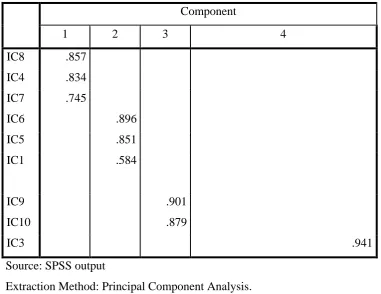
International Journal in Management and Social Science http://ijmr.net.in, Email: [email protected] Table 3.3 Rotated Component Matrixes for the Evaluation of InstitutionalCommitment
From this matrix using factor loadings, the following factors were developed for further analysis
in this study overall commitment is constituted by four important factors such as (1)
commitment towards Work Assignment, (2) Image Building Activities, and (3) Commitment
towards Institution (4) sense of belongingness.
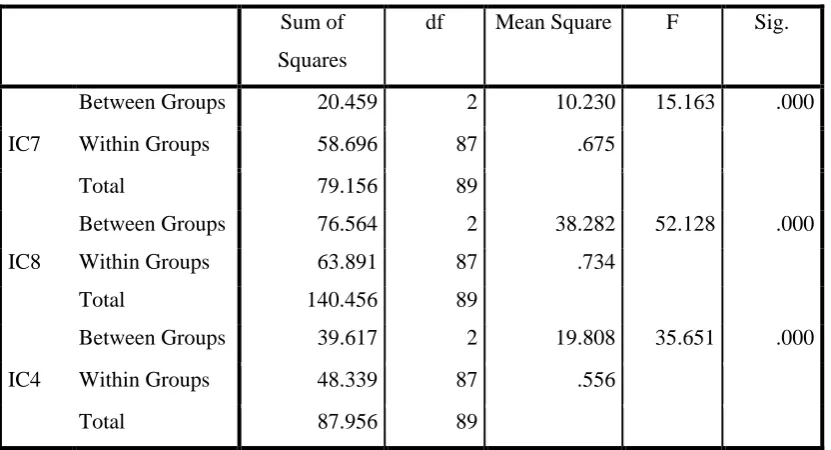
This section deals with analysis of the four factors of institutional commitment and
evaluation of variation in teachers perception with respect to these factors based on type of
school management. Analysis is made with the help of ANOVA. Component
1 2 3 4
IC8 .857
IC4 .834
IC7 .745
IC6 .896
IC5 .851
IC1 .584
IC9 .901
IC10 .879
IC3 .941
Source: SPSS output
Extraction Method: Principal Component Analysis.
92
International Journal in Management and Social Science http://ijmr.net.in, Email: [email protected] Table 3.4 ANOVAcommitment towards Work AssignmentSum of
Squares
df Mean Square F Sig.
IC7
Between Groups 20.459 2 10.230 15.163 .000
Within Groups 58.696 87 .675
Total 79.156 89
IC8
Between Groups 76.564 2 38.282 52.128 .000
Within Groups 63.891 87 .734
Total 140.456 89
IC4
Between Groups 39.617 2 19.808 35.651 .000
Within Groups 48.339 87 .556
Total 87.956 89
Source: SPSS output
Table 3.5 ANOVAImage Building Activities
Sum of
Squares
df Mean Square F Sig.
IC6
Between Groups 1.635 2 .817 1.246 .293
Within Groups 57.087 87 .656
Total 58.722 89
IC5
Between Groups 1.592 2 .796 1.101 .337
Within Groups 62.864 87 .723
Total 64.456 89
IC1
Between Groups 16.287 2 8.143 11.396 .000
Within Groups 62.169 87 .715
Total 78.456 89
93
International Journal in Management and Social Science http://ijmr.net.in, Email: [email protected]Table 3.6 ANOVACommitment towards Institution
Sum of
Squares
df Mean Square F Sig.
IC9
Between Groups .628 2 .314 .565 .571
Within Groups 48.361 87 .556
Total 48.989 89
IC10
Between Groups 2.272 2 1.136 2.516 .087
Within Groups 38.829 86 .452
Total 41.101 88
Source: SPSS output
Table 3.7 ANOVA Sense of belongingness.
IC3
Sum of
Squares
df Mean Square F Sig.
Between Groups 2.175 2 1.088 3.269 .043
Within Groups 28.947 87 .333
Total 31.122 89
Source: SPSS output
From Tables 3 . 4 , 3.5, 3.6 and 3.7 it is evident that teachers perception with
respect to Institutional commitment varies considerably according to the type of
management. Management-wise mean variation is also statistically significant at 5 per cent
level of significance in commitment towards work assignment. Under the image Building
Activities mean variation is statistically significant in unaided sector only while in the Govt.
94
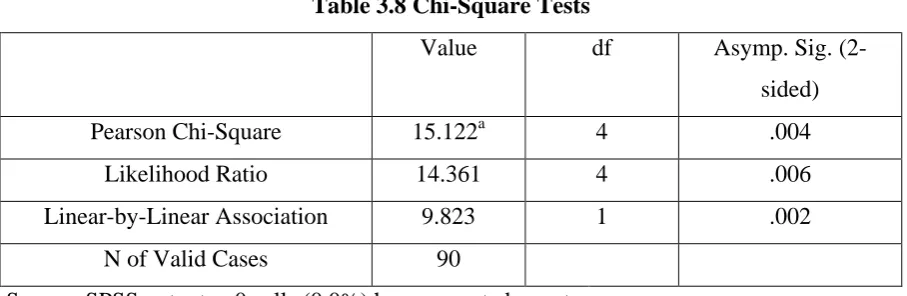
International Journal in Management and Social Science http://ijmr.net.in, Email: [email protected]Karl Pearson chi-square came out to be 15.122 and the significant value as 0.004. This
value being less than .05 (level of significance), clearly indicates that there is significant
difference in job satisfaction level of teachers working in government, aided and unaided
schools.
Conclusion
Satisfaction level of the teachers with respect to different dimensions of job satisfaction
such as pay, promotion, supervision, rewards, peer groups, nature of work and
communication shows significant variations among different management systems. The
overall job satisfaction significantly influences teachers‟ work assignment, commitment
towards image building activities and commitment towards their institution.
References:
Adekola, B. (2012). The impact of organisational commitmnt o job satisfaction :A study of employees at nigerian universities. international journal of human resources studies, 2.
adhikary, s. a. (2015). research article on "Astudy on job satrisfaction and perfomance of management guru's of management colleges-with reference to odisha. the international journal of indian
psychology, 4(1).
Alamelu, d. n. (2018). job satisfaction among school teachers. international journal of pure anr
applied mathematics, 119(7).
AYDOGDU, s. (2011). Ab Emperical study of the relationship among job satisfaction organizational commitment and turnover intention. Internationl review of management and marketing, 43-53.
Table 3.8 Chi-Square Tests
Value df Asymp. Sig.
(2-sided)
Pearson Chi-Square 15.122a 4 .004
Likelihood Ratio 14.361 4 .006
Linear-by-Linear Association 9.823 1 .002
N of Valid Cases 90
Source: SPSS output a. 0 cells (0.0%) have expected count
95
International Journal in Management and Social Science http://ijmr.net.in, Email: [email protected] Bashir, L. (2017). job satisfaction of teachers in relation to professional commitment. Theinternational journal of indian psychology, 4(4).
bhat, a. a. (2018, 01 18). job satisfaction among high school teachers. the international journal of
indian psychology, 6(1).
Busra, M. s. (2016). Effect of leadership behaviour on the organisational commitment and jobsatisfaction:A public sector research. journal of entrepreneurship&Organisational
management.
gjfyr. (4353). tyure (Vols. 456-7554). jgfd.
Lalitamishra, D. (2018, 1). A study of employees satisfaction and organisational commitment of the teaching and non teaching staff. international journal of engeering research and application, 8, 35-39.
McFarlane, L. (1989). Job satisfaction and organisational commitment in relation to work perfomance and turnover intentions. Human Relations, 42, 625-638.
Nawab, D. S. (2010). job satisfaction and organisational commitment of university teachers in public sector of pakistan. intrnational journal of bussines management, 5, 6.
Nyamubi, G. J. (2017). Determinats of secondary school teachers job satisfaction in tanzania.
Hindawi educational research international, 7.
Shafi. (2016). Job satisfaction in college teachers: A study based study of goverment colleges of hyderabad,pakistan. journal of hotel & business management.
srivastava, D. s. (2013). job satisfaction and organisational commitment relationship:Effect of personality variables. Vison -journal of business perspective, 21-30.