19
International Journal in Management and Social Science http://ijmr.net.in, Email: [email protected]PROBLEM AND PROSPECTS OF BAMBOO INDUSTRIES IN MADHYA PRADESH
Preeti Chadar
Researach Scholar, Rani Durgawati vishvidyalaya
Jabalpur, M.P.
Abstract
Bamboo is one of the fastest growing plant species is extremely. Traditionally the
industrial use of bamboo has been in the paper and pulp industry. Application of modern
technology and industrial processing has catapulted bamboo into a new global limelight. at
present there is huge demand of bamboo based raw material viz., timber plywood, bamboo
flooring, edible bamboo shoots, etc. in the international market of bamboo is captured by china.
In India, most of the bamboo raw material comes from natural forest. To capture the emerging
bamboo market we have to increase the bamboo cultivation outside the forest under different
bamboo based agro forestry system. A part from this, the industrial products from bamboo
essentially comprises of converting into fuel or electricity through gasification. Bamboo has
many advantages over trees such as short rotation maturity, ability to provide building materials
as strong as teak pole and other economically important produces. No other woody components
compares with versatility of bamboo use which outmatches most tree species and environmental
conservation. Thus bamboo based agroforestry system can be beneficial to increase the bamboo
cover outside the forest to achieve the global demand of bamboo in the present scenario.
The Aim of this research paper discusses the versatile uses of bamboo grass plant.
Bamboo plants have some useful properties and having lot of beneficiary uses; these are using as
pillar, fencing, housing, house hold products, raw materials of crafts, pulp, paper, boards, fabrics
industry, fuel, fodder etc.
Key Words- Bambaoo, Problems and Prospects, importance, food value
Introduction-
India has maximum area under Bamboo in the world approx 11,361 km2 and China has
20
International Journal in Management and Social Science http://ijmr.net.in, Email: [email protected]china. The domestic demand mainly arises from use of bamboo in handicrafts industry, for
construction purpose, paper and pulp industry, bamboo flooring, furniture etc. There are huge
supply side constraints mainly due to the presence of various convoluted forest laws in the
country.
Bamboos are inseparable part of the culture of rural people due to its multifarious uses
like food, fodder, fuel, fencing, pulp and paper, house construction, cottage industries etc. These
multiple uses meet the basic needs of the villagers/farmers/rural poor. Bamboo is an enduring
and versatile natural resource. The great diversity of species makes bamboo adaptable to many
environments. Bamboo grows very fast and has a short growth cycle. Bamboo not only grows
much faster than wood, it also needs relatively little water. Bamboo prevents soil erosion. Its anti
erosion properties create an effective watershed, stitching the soil together along fragile river
banks, deforested area, and in places prone to earthquake and mud slides.
Bamboo is a critical element of the economy. Bamboo and its related industries provide
income, food, and housing to over 2.2 billion people worldwide. There is a 3-5 year return on
investment for a new bamboo plantation. It has been used in ancient medicine. Bamboo has for
centuries been Ayurveda and chinese acupuncture. It is used internally to treat asthma, cough
and can be used an aphrodisiac. It grows on marginal and degraded land, elevated ground, along
field bunds and river banks. it adapts to most climatic conditions and soil types, acting as a soil
stabilizer, an ancient medicine, a food source, a critical element of the economy , integrally
involved in culture and arts, an excellent alternative to wood and effective carbon sink and thus
helping to counter the green house effect.
India, China and Myanmar have 19.8 million hectares of bamboo reserve-80 percent of
the word's bamboo forests. Out of the India's share is 45 percent, with nearly 130 different
species of the plant, but only 4 percent of its global market. The government likes to see its
bamboo industry, concentrated in the northeast of country, take 27 percent of the word market by
2015. Bamboo occurs almost ubiquitously in the country, except in Kashmir and cover about
12.8 per cent of the forest area occupying over 9.57 million ha. Areas particularly rich in bamboo
21
International Journal in Management and Social Science http://ijmr.net.in, Email: [email protected]have been reported (Sharma, 1987). Sixty six percent of the growing stock of the bamboo is
available in the northeastern states and balance in rest of the country. Clump forming bamboos
are 67.5 percent of the growing stock. Of all clump forming bamboo, Dendrocalamus strictus is
45 percent, bambusa bambos 13 percent, D. hamiltonii 7 percent, Bambusa tulda 5 percent,
B.pallida 4 percent and all other species put together 6 percent of the total growing stock.
Melocanna bambusa, a non-clump forming bamboo, accounts for 20 percent of the growing
stock and found mostly in the north-eastern states. D. strictus is the most widely distributed
bamboo occurring in most part of the country. Bambusa bambos is equally distributed widely in
most deciduous forest and cultivated by the farmers in northern India. Arundinaria and
Chimnobambusa are two genera found in high altitude in the hills of the western Ghat and outer
Himalayas. Ochlandra travancorica in Kerala and Oxytenanthera spp in coastal Karnataka, Goa,
and Maharastra are the other commercially important species.
Objective of the study-
1. To find out the opportunity and problems faced by the entrepreneurs in production of
Bamboo product;
2. To identify the determine factors influencing Bamboo Industry in Madhya Pradesh;
3. To give some suggestion for the betterment of Bamboo industry;
4. To find out the impact of Indian economy.
Area of the study-
This study relied on a sample of randomly selected Bamboo industries in the
Jabalpur, Bhopal, Mandla, Balaghat District is very rich in forest wealth. Teak, Sal, Bamboo and
22
International Journal in Management and Social Science http://ijmr.net.in, Email: [email protected]ANALYSIS OF RESULTS
TABLE – 1
PROBLEMS FACED BY SHGs
Source- based on Primary data
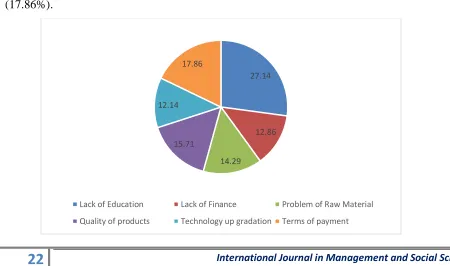
Table 1 shows that the nature of problems faced by SHGs. The major problem are
faced in Education (27.14%), Lack of Finance (12.86%), Problem of Raw Material (14.29%),
Quality of products (15.71%), Technology up gradation (12.14%), and Terms of payment
(17.86%).
27.14
12.86
14.29 15.71
12.14 17.86
Lack of Education Lack of Finance Problem of Raw Material
Quality of products Technology up gradation Terms of payment
Particular Frequency percentage
Lack of Education 38 27.14
Lack of Finance 18 12.86
Problem of Raw Material 20 14.29
Quality of products 22 15.71
Technology up gradation 17 12.14
Terms of payment 25 17.86
23
International Journal in Management and Social Science http://ijmr.net.in, Email: [email protected]Source- Based on Table 1
TABLE 2 Income Status
Monthly Income Frequency Percentage
Below 10000 20 14.3
10000-20000 43 30.7
20000-30000 18 12.8
30000-40000 12 8.6
40000-50000 47 33.6
Total 140 100
Source- Based on survey Method
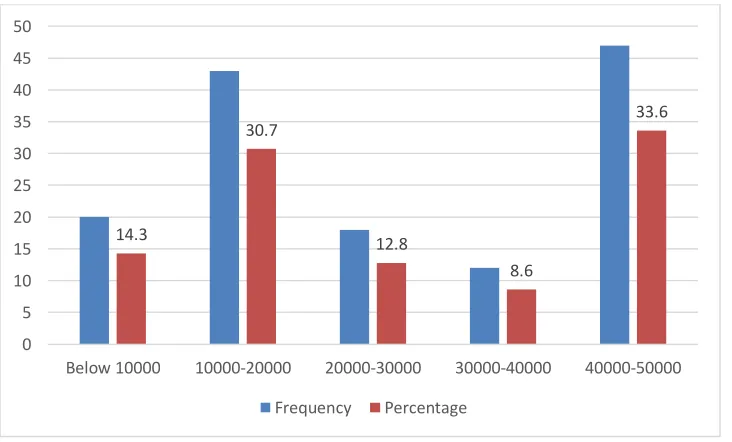
The table shows that almost 14.3 percent of the respondents are in the income below
10,000 per month and 30.7 percent of the respondent are in 10-20 thousand, 33.6 percent of the
total respondents had fall on the very high income(40-50 thousand).
Source- Based on Table 2
14.3
30.7
12.8
8.6
33.6
0 5 10 15 20 25 30 35 40 45 50
Below 10000 10000-20000 20000-30000 30000-40000 40000-50000
24
International Journal in Management and Social Science http://ijmr.net.in, Email: [email protected]TABLE 3 Family Support to the Respondents
particulars Frequency Percentage
Full Support 28 20.0
Support 45 32.1
Neutral 20 14.3
Uncertain 25 17.9
Not supportive 22 15.7
Total 140 100
Source- Based on survey Method
Table 3 shows the family support to the Respondents. Highly 32.1 family support the
Respondents and lowest 14.3% were Neutrsl support to the respondents home and working area.
but 15.7% of the respondents were working to not support their families.
Source- Based on Table 3
20
32.1 14.3
17.9
15.7
25
International Journal in Management and Social Science http://ijmr.net.in, Email: [email protected]PROBLEMS OF ENTREPRENEURSHIP - There are several problems, some of them are
listed below-
1. Problem of Finance
2. Scarcity of Raw Material
3. Stiff Competition
4. Family Ties
5. Lack of Education
6. Male-Dominated Society
7. Low Risk-Bearing Ability
Conclusion
Bamboo has been an important part of the human history, leaving its impact across cultures from
thousands of years. The Chinese consider it a symbol of fertility, while it’s a symbol of
friendship for the Indians. All in all, this extremely tall grass has quite a cultural significance for
many cultures all over the world. However, it is interesting to note that bamboo is no longer
considered a poor man’s timber. While it was traditionally used as a low-cost material for house
construction, tools, vegetable and ornamentation, it has now an established commercial value as
a dependable substitute for timber while also being useful as an engineered product. Bamboo is
also a source of bio-energy because it is a clean and renewable energy alternative. Commercially,
bamboo can be used to make furniture as well as building and roofing materials. You can easily
find fencing poles, floor tiles, walls and ceiling panels, scaffolding, frames for doors and
windows as well as window blinds. Bamboo also serves the paper and pulp industry. It can be
turned into toilet paper and also cardboard, helping conserve the world’s finite resource of trees.
The textile, chemical and eatables industries convert bamboo into fabrics, biochemicals, wine,
vinegar, and pharmaceuticals. Land availability is a big problem to the farmers especially for
raising 1 or 2 hectare plantations. Bamboo plantation schemes may be formulated for small area
and financial benefits may be provided to such small holding farmers based on number of
clumps planted. This is one of the most important reasons why bamboo has not come up to its
26
International Journal in Management and Social Science http://ijmr.net.in, Email: [email protected]bamboo clumps, he does not know whom to approach. There are no nurseries where planting
materials can be easily available.
Bibliography
Anon. 1980. Field Inventory Report of Various Districts of Madhya Pradesh, Forest Survey of India, Dehra Dun.
Anon. 1990. Assessment of Forest produces supply in Nistar. Government of M.P. Research and Working Plan/89-90/91, Bhopal.
Anon., 1995. Four decades of forestry. M.P. Forest Department. Chief Conservator of Forests Working Plan, Satpura Bhawan, Bhopal.
Anon. 1996. IPPTA Convention Issue, Prepared by Joint Committee of Industry, 1996.
Anon. 1999. Timber trade bulletin of ICFRE. March 95 to June 99.
Dhruva Narayana, V. V. (1993) Soil and Water Conservation Research in India. Publications andInformation Division, Indian Council of Agricultural Research, Krishi Anusandhan Bhavan,Pusa, New Delhi.
Datta, J. J. and Tomar, M.S. 1964. Bamboo forest of Madhya Pradesh. Bulletin no. 8, Government of Madhya Pradesh Forest Department.
HDR, 1998 Madhya Pradesh Human Development Report. Government of Madhya Pradesh. Directorate of Institutional Finance. MP HDR, Bhopal
Lakshmana, AC. 1990, A new approach to the management of bamboo stands, bamboo current research, proceedings of international bamboo workshop Nov., 1988 Cochin pp 128-132.)
Rai, S.N. and Chauhan, K.V.S. 1998. Distribution and growing stock of bamboos in India. "Indian Forester" volume 124 No. 2.
Shankhwar, H.O. 1999. Report on bamboo rates in Balaghat market, 15.2.1999