Australian gay men’s satisfaction with sexual agreements: The roles of relationship quality, jealousy, and monogamy attitudes
Warwick Hosking1,2, PhD
1Psychology Discipline, College of Arts, Victoria University, Melbourne, Australia 2To whom correspondence should be address at College of Arts, Victoria University, P.O.
Box 14428, Melbourne, Victoria 8001, Australia; Tel: +61 (0)3 9919 2620; Fax: +61 (0)3 9919 2218; email: [email protected]
ABSTRACT
This study examined whether relationship quality, dispositional jealousy, and attitudes towards monogamy are associated with gay men’s satisfaction with the agreements they have in their relationships about extra-dyadic sex. Three types of sexual agreement were
examined: closed (no extra-dyadic sex is allowed), monogamish (extra-dyadic sex is allowed only when both members of the couple are present), and open (extra-dyadic sex is allowed). Results from a 2010 survey of 772 gay men in relationships indicated that sexual agreement satisfaction was positively associated with levels of intimacy and commitment for all three types of sexual agreement, but was differentially associated with sexual satisfaction within the relationship, jealousy, and monogamy attitudes as a function of sexual agreement type. Mean levels of sexual satisfaction, jealousy, and monogamy attitudes also differed between types of agreement. These findings provide preliminary evidence that sexual agreement satisfaction may be influenced by different factors depending on the type of agreement, which has useful implications for professionals with gay male clients experiencing dissatisfaction with their agreement, or with their relationship more generally.
KEY WORDS: Sexual agreements; gay men; relationship quality; jealousy; monogamy
INTRODUCTION
There has long been interest in the literature regarding sexual agreements in gay men’s relationships; that is, agreements between partners about whether or not extra-dyadic sex is permitted. Research has typically focused on whether monogamous or “closed” agreements (i.e., extra-dyadic sex is not permitted) and non-monogamous or “open” agreements (i.e., extra-dyadic sex is permitted) differ in relationship quality. Most studies report no differences in relationship satisfaction (Blasband & Peplau, 1985; Bonello, 2009; Bricker & Horne, 2007; Hoff, Beougher, Chakravarty, Darbes, & Neilands, 2010; Kurdek, 1988; Ramirez & Brown, 2010), or in other factors such as dyadic adjustment (LaSala, 2004a; Wagner, Remien, & Carballo-Diéguez, 2000) and commitment (Blasband & Peplau, 1985; Hosking, 2013). In recent years, research efforts have progressed to examining motivations and other factors associated with establishing sexual agreements (Coelho, 2011; Hoff & Beougher, 2010; Hoff et al., 2010; Mitchell, 2013; Mitchell, Harvey, Champeau, Moskowitz, & Seal, 2012; Pawlicki & Larson, 2011), rules associated with open agreements (Coelho, 2011; Gass, Hoff, Stephenson, & Sullivan, 2012; Hickson, Davies, Hunt, & Weatherburn, 1992; LaSala, 2004b; Mitchell, 2013), and associations between breaking agreement rules and low
relationship quality (Gomez et al., 2012; Hoff & Beougher, 2010; Hosking, 2013; Mitchell, Harvey, et al., 2012).
more frequent rule breaking. Although it cannot be ascertained from these findings whether lower agreement satisfaction precedes or follows broken agreements, being dissatisfied with a sexual agreement arguably puts individuals at risk of breaking it. As broken agreements potentially result in relationship conflict (Hoff & Beougher, 2010), it is important to identify factors that are associated with sexual agreement satisfaction, and whether these associations differ between agreement types. Such knowledge may assist counsellors and other
professionals with gay male clients experiencing problems relating to their sexual
agreements, including low satisfaction. There may also be public health implications of this knowledge, as previous research suggests lower agreement satisfaction or investment is associated with more risky sexual behaviour (Gass et al., 2012; Mitchell, Champeau, & Harvey, 2012), which may perpetuate the spread of HIV and other infections.
The present study draws on the triangular theory of love (Sternberg, 1986, 1997), which describes three independent dimensions of love: intimacy (emotional attachment between partners, mutual trust, and self-disclosure), commitment (the resolve to remain in the relationship), and passion (the intensity of sexual attraction to, and the drive to be with, the relationship partner). Although passion may involve elements that are not purely sexual in nature, such as romance, Sternberg (1986) argued that passion is predominantly underpinned by sexual needs. The choice of the triangular theory follows a recent study in which passion, but not intimacy and commitment, was lower among open agreements than closed and “threesome-only” agreements (Hosking, 2013). The latter, whereby outside sex is only allowed when both members of the couple are present, is hereafter referred to as
“monogamish” (Parsons, Starks, DuBois, Grov, & Golub, 2011; Parsons, Starks, Gamarel, & Grov, 2012).
The three Sternberg variables and sexual agreement satisfaction may all be related
with each other. However, passion may be differentially associated with sexual agreement satisfaction depending on the type of agreement. In finding that passion was lower among open agreements, Hosking (2013) argued this may be because men with these agreements can fulfil their sexual needs with casual partners, and therefore may be less motivated to sustain passion with their primary partner. Thus, if passion is relatively unimportant among open agreements, it may be only weakly, if at all, associated with sexual agreement satisfaction. In contrast, men with closed or monogamish agreements are only “allowed” to experience passion with each other, or, in the case of monogamish agreements, with the addition of a third party. Therefore, passion may be more strongly related to satisfaction with these types of agreements.
If passion is a drive which is underpinned mainly by sexual needs, Hosking’s (2013) finding of lower passion among open agreements may have been due to a relative lack of sexual satisfaction within those relationships. Other previous research has found no
differences between agreement types in sexual satisfaction (Parsons et al., 2012); however, differences may still occur in other samples and manifest as differences in passion. If so, the above arguments concerning the association between passion and sexual agreement
satisfaction may apply equally to the role of sexual satisfaction within the relationship. Indeed, associations involving passion may not be evident once controlling for those involving sexual satisfaction. It is important to test this possibility.
Individual difference factors may also relate to sexual agreement satisfaction in different ways depending on the type of agreement. One potential candidate is dispositional jealousy. Research suggests that some men prefer closed agreements because the idea of their partner having sex with other men makes them feel too jealous (LaSala, 2001, 2004b). Indeed, sexual jealousy appears to be higher among closed agreements compared with other kinds of
agreements (Parsons et al., 2012). However, there are other reasons besides jealousy why some men prefer a closed agreement, such as the belief that it is inextricably linked with intimacy and commitment (LaSala, 2004b), or concerns about transmitting HIV and other infections (Hoff et al., 2010; LaSala, 2004b; Prestage et al., 2008). Thus, although jealousy may be higher among closed agreements overall, it may not be strongly related to satisfaction with those agreements. In other words, jealous men may be satisfied with a closed agreement because it helps to guard against triggers of jealous feelings, but less jealous men may also be satisfied with closed agreements for other reasons. In monogamish agreements, requiring both members of the couple to be present in group sex means that each partner can always see, and participate in, the other’s sexual encounters with outside partners. This may act as a buffer against potential feelings of jealousy, which, as with closed agreements, may be only weakly related to satisfaction with monogamish agreements.
In contrast, jealousy may play an important role in satisfaction with open agreements. Some men with open agreements may still struggle with feelings of jealousy (Coelho, 2011; LaSala, 2004b), even if they feel comfortable having sex with other men themselves. In such cases, men may experience tension or negative affect in association with their open
sacrifice (Schmookler & Bursik, 2007). Endorsement of monogamy as relationship-enhancing is associated with beliefs that it builds intimacy and strengthens bonds between partners. In contrast, endorsement of monogamy as a sacrifice is associated with beliefs that monogamy blocks natural drives and involves subordinating one’s needs for diversity (Schmookler & Bursik, 2007). Gay men who more strongly endorse monogamy-enhancing attitudes are likely to be more satisfied with a closed or monogamish agreement than an open one, whereas the inverse is likely to be true for men who more strongly endorse monogamy-sacrifice attitudes. Men with sexual agreements that do not align with their attitudes,
however, may experience cognitive dissonance as a result of behaving in a counter-attitudinal fashion (Festinger, 1957; Festinger & Carlsmith, 1959), and therefore feel less satisfied with their agreement.
In summary, this study aimed to investigate whether Sternberg’s (1986) relationship quality variables (i.e., passion, intimacy, and commitment), jealousy, and monogamy attitudes are associated with sexual agreement satisfaction, and whether these associations differ between sexual agreement types. Intimacy, passion, and commitment were all expected to be positively associated with sexual agreement satisfaction. The association involving passion was expected to be stronger for closed and monogamish agreements than for open agreements. However, the possibility that sexual satisfaction may exert effects similar to, if not stronger than, passion was also tested. Dispositional jealousy was expected to be negatively associated with sexual agreement satisfaction among open agreements only. Monogamy-enhancing attitudes were expected to be positively associated with sexual
agreement satisfaction among closed and monogamish agreements, but negatively associated among open agreements. The inverse pattern of associations was expected for monogamy-sacrifice attitudes.
Participants
The results reported in this paper come from a larger survey of Australian gay men in relationships, which was conducted in 2010. Of the 3494 men who began the survey, 772 completed all measures relevant to the present study, a completion rate of approximately 22.1%. Analyses involving other variables measured in the larger project have been reported elsewhere (Hosking, 2012).
Recruitment of participants involved placing advertisements containing the URL for the online survey in GLBT community newspapers in Melbourne and Sydney, and on GLBT community websites (www.samesame.com.au and gaynewsnetwork.com.au) which contained a direct link to the survey. The print advertisements invited gay men in relationships to fill in a survey examining “factors, including personality, attitudes, and sex life, that may contribute towards satisfaction, closeness, and commitment in gay men’s relationships”. The online banner advertisements simply invited gay men in relationships to take part in a survey on relationships.
Due to an initially low response rate from men in relationships with open agreements, advertisements targeting this population were subsequently placed on Manhunt
(www.manhunt.net), a popular gay men’s social networking and dating website. These advertisements invited gay men in open relationships to take part in a survey looking at “factors that make these relationships work”. The term “open relationships” was not further defined in these advertisements, on the assumption that the term is relatively well understood among the gay male community. A message advertising the study was also sent to all
Upon accessing the online survey, participants were informed that they must identify as homosexual or gay (not bisexual), have been in their current relationship at least 6 months, be at least 18 years of age, and be an Australian citizen or permanent resident, to be eligible for participation. Participants ranged from 18 to 83 years of age (M = 37.25, SD = 11.31). The majority were from the eastern states of Australia (32.5% New South Wales, 28.0% Victoria, 15.0% Queensland), with the remainder coming from other Australian states (6.5% Western Australia, 4.4% South Australia, 1.4% Australian Capital Territory, 1.7% Tasmania, and 10.5% did not specify). All participants were in an ongoing romantic relationship, 73.7% of which were cohabiting. Relationships ranged from 0.5 to 43.5 years (M = 7.72, SD = 6.80) in duration. Most participants were White or Caucasian (87.7%); others were East Asian (6.0%), Latino/Hispanic (1.6%), or South Asian (1.3%). The remaining 3.4% were of various other racial/ethnic backgrounds. Approximately two-thirds (67.4%) of the participants had a partner of the same racial/ethnic background as their own.
Measures
Participants first provided demographic information about themselves and their partner: age, racial/ethnic background (free response which was later coded by the author),
throughout this article. There was no “other” response option for this question; however, an optional free response question allowed participants to provide further details or
qualifications regarding their agreement. Answers to this question tended to relate to agreement rules and the circumstances leading to their establishment. Importantly, no
participants selected one type of agreement in response to the categorization question only to describe a fundamentally different kind of agreement in answer to the free response question. This indicated the categorization scheme was a reliable and valid measure of sexual
agreement.
Participants indicated whether they had had their agreement since the beginning of the relationship or for a shorter period of time. Those indicating the latter provided an estimate of this time period in months or years. Participants then indicated whether the agreement was unspoken or had been reached through explicit discussion.
Participants indicated on a 5-point scale (1 = strongly disagree; 5 = strongly agree) how much they agreed with 5 items assessing sexual agreement satisfaction (e.g., “I am happy with my current sexual agreement”; Cronbach’s α = .85). Responses to these items were averaged to obtain total sexual agreement satisfaction scores. These items were created for this study by the author (see Hosking, 2012, for the full list of items). It is noted that the “Sexual Agreement Investment Scale” (Neilands et al., 2010), which also measures sexual agreement satisfaction, was not used because it was not publicly available when data were collected for the present study.
communication with my partner”; Cronbach’s α = .95), a further 15 items measure passion (e.g., “Just seeing my partner excites me”, “I find my partner very attractive physically”; Cronbach’s α = .95); and the remaining 15 items measure commitment (e.g., “I am committed to maintaining my relationship with my partner”, “I can’t imagine ending my relationship with my partner”; Cronbach’s α = .96). Subscale totals are obtained by averaging the relevant items. Note that the passion items do not specifically ask about the physical act of sex, and are not event-specific. Rather, they relate to an enduring state of attraction to and longing to be with the partner, which are purportedly underpinned by sexual needs
(Sternberg, 1986).
Participants indicated on a 5-point scale how often they currently have sex with their relationship partner (1 = never; 5 = very often). Those who gave a response of at least 2 (occasionally) were presented with three items, created by the author, measuring sexual satisfaction with the relationship partner (e.g., “My sex life with my relationship partner is satisfying”; see Hosking, 2012, for all the items). Participants used a 5-point scale (1 = strongly disagree; 5 = strongly agree) to indicate their level of agreement with each item. Total scores were obtained by averaging the items, and internal consistency was high (Cronbach’s α = .92). Note that the present sample of 772 does not include 56 men who completed all other measures but indicated they never have sex with their relationship partner. These men did not differ from the rest of the sample on any demographic characteristics.
know”). Participants indicate how upset they would be in response to each scenario, using a 5-point scale (1 = not at all upset; 5 = extremely upset; Cronbach’s α = .93). Total scores are obtained by averaging the responses to all items.
Finally, Schmookler and Bursik’s (2007) Monogamy Views Scale was used to assess attitudes towards monogamy as enhancing a relationship (monogamy-enhancing attitudes) and attitudes towards monogamy as a sacrifice for a relationship (monogamy-sacrifice attitudes). Each subscale consists of 8 statements with which participants indicate their level of agreement, using a 7-point scale (1 = strongly disagree; 7 = strongly agree). Two
statements measuring monogamy-sacrifice attitudes assume the participant is currently in a relationship with a closed agreement. As this could not be assumed in the present study, these items were excluded from analysis, leaving a total of 6 items measuring monogamy-sacrifice attitudes. Subscale totals are calculated by averaging responses to each item, and both
demonstrated high internal consistency (monogamy-enhancing, Cronbach’s α = .94; monogamy-sacrifice, Cronbach’s α = .83).
Procedure
Ethics approval to conduct this research was obtained from the Victoria University Human Research Ethics Committee. Upon accessing the survey, participants read a brief description of the study aims, definitions of key terms, information about confidentiality of responses, and a statement about the eligibility requirements. Participants checked a box indicating they consented to participate in the study and that they met the eligibility requirements, and then proceeded to the main part of the survey.
Data Analysis
least-significant-difference (LSD) post-hoc tests were conducted to compare the three sexual agreement types on relationship quality variables (including sexual satisfaction), jealousy, monogamy attitudes, and sexual agreement satisfaction.
Associations between these variables were initially examined using bivariate
correlations. To test the hypotheses of the study, hierarchical multiple regression analysis was used to assess the independent contributions of the predictor variables towards the variance in sexual agreement satisfaction, and to examine whether these associations were moderated by sexual agreement type. Following standard procedure, all variables were centred prior to entry into the regression model (Aiken & West, 1991). In addition, sexual agreement type was recoded into two binary moderator variables. For the first of these, monogamish
agreements were assigned a value of 1 and open and closed agreements were assigned a value of 0. For the second, open agreements were assigned a value of 1 and monogamish and closed agreements were assigned a value of 0. Thus, closed agreements served as the reference category in this analysis.
Variables were entered into the regression analyses in four steps: the relationship quality variables were entered in Step 1; jealousy and monogamy attitudes were entered in Step 2; the two sexual agreement moderator variables were entered in Step 3; and their interactions with the variables from the first two steps were entered in Step 4. For each significant interaction, simple slope analysis was performed to test whether the slopes for each agreement type differed significantly from zero.
RESULTS
Descriptive Summary
longer for open agreements (M = 8.00, SD = 6.40) than for monogamish (M = 7.06, SD = 6.39) or closed (M = 5.79 SD = 5.77) agreements, F(2, 769) = 10.29, p < .001, ηp2 = .03. Men with open agreements were also significantly older (M = 38.86, SD = 10.93) than those with either monogamish (M = 36.36, SD = 10.81) or closed (M = 34.81, SD = 11.79) agreements, F(2, 769) = 9.47, p < .001, ηp2 = .02. However, the differences in relationship duration remained significant after controlling for age, F(2, 768) = 3.40, p = .034, ηp2 = .01.
Most men (63.6%) reported having had their agreement since the beginning of the relationship, but men with closed agreements (95.3%) were more likely to indicate this than those with either open agreements (52.3%) or monogamish agreements (42.1%), χ2(2, N = 772) = 147.74, p < .001. For those who indicated their agreement was established at some point during their relationship, their estimate of how long the agreement had been in place was converted into a proportion of overall relationship length. On average, this was 0.67 (SD = 0.34) for closed agreements, 0.49 (SD = 0.26) for monogamish agreements, and 0.54 (SD = 0.26) for open agreements. Most men (79.1%) indicated they had discussed the agreement openly with their partner, but this was less common among closed (62.1%) than monogamish (91.7%) and open (85.0%) agreements, χ2(2, N = 772) = 61.20, p < .001.
Differences in Relationship Quality, Jealousy, Monogamy Attitudes, and Sexual
Agreement Satisfaction as a Function of Sexual Agreement Type
Table 1 displays the means and standard deviations of the relationship quality variables, jealousy, monogamy attitudes, and sexual agreement satisfaction. Significant differences between agreement types were found for all variables assessed, except intimacy. Passion was significantly lower among open agreements than among monogamish, but not closed,
the relationship partner, which was highest among monogamish agreements, followed by closed agreements, and finally by open agreements.
Men with closed agreements reported significantly higher dispositional jealousy than those with monogamish agreements, who in turn reported significantly higher jealousy than those with open agreements. All three groups significantly differed from each other on both monogamy attitude variables. Men with closed agreements most strongly endorsed
monogamy-enhancing attitudes, followed by men with monogamish agreements, and finally by those with open agreements. The reverse pattern was found for monogamy-sacrifice attitudes; men with open agreements endorsed these attitudes most strongly, followed in order by men with monogamish agreements and those with closed agreements. Finally, men with open agreements were significantly less satisfied with their agreements than those with closed, but not monogamish, agreements.
Associations Between Jealousy, Monogamy Attitudes, Relationship Quality, and Sexual
Agreement Satisfaction
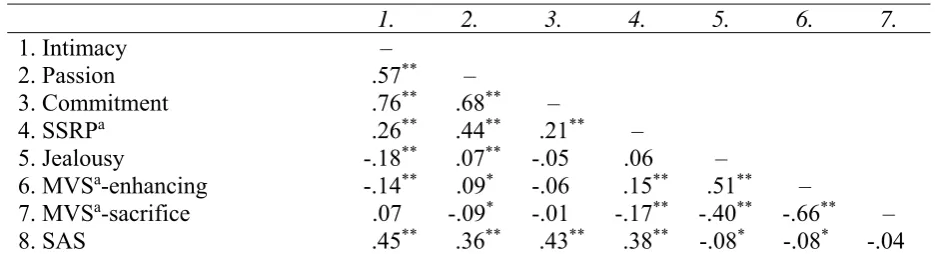
Table 2 shows the correlations between the variables. All variables except monogamy-sacrifice attitudes were significantly correlated with sexual agreement satisfaction, although the correlations involving jealousy and monogamy-enhancing attitudes were only very weak.
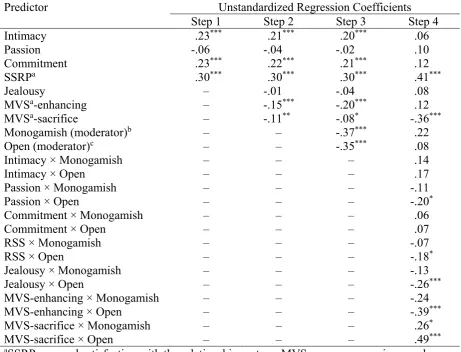
The results of the hierarchical regression analysis with sexual agreement satisfaction as the outcome variable are shown in Table 3. In Step 1, intimacy, commitment, and sexual satisfaction, but not passion, were significant positive predictors of agreement satisfaction. Together they accounted for 29.7% of the variance, F(4, 767) = 80.94, p < .001. Jealousy and monogamy attitudes in Step 2 together only accounted for a further 1.3% of the variance in agreement satisfaction, but this was significant, Fchange(3, 764) = 4.92, p = .002. Both kinds of monogamy attitude were significant negative predictors of agreement satisfaction, but
In Step 3, both of the agreement type moderator variables were significant negative predictors of sexual agreement satisfaction. Together they accounted for a further small but significant 1.8% of the variance, Fchange(2, 762) = 10.27, p < .001. However, the inclusion of the interaction terms in Step 4 accounted for a substantial and significant additional 13.3% of the variance, Fchange(14, 748) = 13.14, p < .001. The final model accounted for a total of 46.1% of the variance, F(23, 748) = 27.79, p < .001. In this model, intimacy and commitment were no longer significant predictors of sexual agreement satisfaction, but neither were their interactions with agreement type. This is likely due to the multicollinearity of the main effect and interaction terms involving intimacy and commitment. Passion was also not a significant predictor of agreement satisfaction; however, there was a significant interaction of passion with agreement type. Sexual satisfaction and monogamy-sacrifice attitudes were strong independent predictors of agreement satisfaction, but both associations were moderated by agreement type, as was that between monogamy-enhancing attitudes and agreement satisfaction.
The nature of the significant interactions is as follows. The association between passion and agreement satisfaction was negative for open and monogamish agreements, and positive for closed agreements. However, simple slope analyses indicated that none of these
association between monogamy-sacrifice attitudes and agreement satisfaction was negative for both closed and monogamish agreements, and positive for open agreements. However, it was only significant for closed agreements, t(748) = -5.12, p < .001, and for open agreements. t(748) = 2.88, p < .005.
Auxiliary Analyses
It was of interest to see whether any of the mean level differences in passion reported earlier still held after controlling for sexual satisfaction, given both variables were strongly correlated with each other, and the expected moderating effect was found for sexual satisfaction but not for passion. It was also of interest to examine whether the unexpected differences between agreement types in commitment and sexual agreement satisfaction may be explained by variations in sexual satisfaction. Analyses of covariance (ANCOVAs) were therefore conducted on passion, commitment, and sexual agreement satisfaction with agreement type as the independent variable and sexual satisfaction as the covariate.
Consistent with the bivariate correlations, sexual satisfaction significantly covaried with each dependent variable, all Fs > 31.60, all ps < .001. However, the main effect of agreement type was not significant in any of these analyses, all Fs < 1.84, all ps > .05. This indicated that passion, commitment, and sexual agreement satisfaction did not differ between types of agreement after controlling for sexual satisfaction.
DISCUSSION
Bivariate analyses showed that intimacy, passion, commitment, and sexual satisfaction with the relationship partner were all positively associated with sexual agreement satisfaction, as expected. This is likely because these variables, though independent of each other, are all components of a superordinate judgment of relationship quality. This is also consistent with previous research showing a suite of relationship quality variables to be associated with sexual agreement investment (Neilands et al., 2010).
Consistent with predictions, multivariate analyses showed that associations of intimacy and commitment with sexual agreement satisfaction did not differ between agreement types. Intimacy levels, on average, also did not vary between types of agreement, a finding reported in some prior research (Hosking, 2013), though not all (Hoff et al., 2010). The finding that overall levels of commitment and sexual agreement satisfaction did not differ between agreement types after controlling for sexual satisfaction also confirms previous research findings.
Although the association between passion and agreement satisfaction was moderated by agreement type, it was not significant for any individual type of agreement. In contrast, there was much stronger evidence for the predicted role of sexual satisfaction. Overall, men who were more sexually satisfied with their relationship partner were also more satisfied with their agreement, but this association was weakest for open agreements. Further, although both passion and sexual satisfaction were lower among open agreements, the differences in
two types. Passion may still differ between agreement types, as reported by Hosking (2013), but a more basic difference in sexual fulfilment may underlie this.
There are two possible explanations as to why men with open agreements appear to be relatively less sexually satisfied with their relationship partner. First, it may be driven by the belief that sexual needs cannot be met by a single sexual partner, which may be the reason for adopting an open agreement in the first place. This idea is supported by some qualitative research on open agreements which emphasizes men’s needs for sexual variety (Coelho, 2011; LaSala, 2004b; Pawlicki & Larson, 2011). Second, once an open agreement is in place, the sexual freedom and diversity it affords may somewhat reduce (though by no means eliminate) the motivation to sustain a fulfilling sex life with the relationship partner. This would account for the many men in this study who indicated that their open agreement had been in place since the beginning of their relationship. Whatever the cause, lower sexual satisfaction in open agreements need not signify a problem or deficiency with this kind of agreement. For one thing, it is evidently less important for agreement satisfaction in open agreements than it is in other types. Moreover, once controlling for sexual satisfaction level, all types of agreement appear to be equivalent in other relationship quality factors, consistent with several previous studies (Blasband & Peplau, 1985; Bonello, 2009; Bricker & Horne, 2007; LaSala, 2004a; Ramirez & Brown, 2010).
As predicted, jealousy and sexual agreement satisfaction were negatively associated among open agreements, and were not significantly associated among monogamish or closed agreements. Average jealousy levels among men with open agreements were also
open agreement. This idea is consistent with previous findings that some men, being aware of their jealous tendencies, prefer closed agreements (LaSala, 2001, 2004b). It is also partially consistent with Parsons et al.’s (2012) finding that open couples reported significantly less sexual jealousy than closed, though not monogamish, couples. Whether naturally low levels of jealousy lead to a predilection for open agreements, or whether men with open agreements generally become less jealous after learning that extra-dyadic sex does not pose a threat to their relationship, is an empirical question worth exploring.
Associations between monogamy attitudes and sexual agreement satisfaction were largely consistent with predictions. More positively valuing monogamy appeared to reduce agreement satisfaction among men with open agreements and increase satisfaction among those with closed agreements. In contrast, believing more strongly that monogamy is a personal sacrifice and blocks natural drives had the inverse effect. Neither kind of attitude was significantly associated with sexual agreement satisfaction among monogamish agreements; however, this may be due to low statistical power, as men with this agreement constituted the smallest of the three groups. Overall, though, it seems that men adopting (or assuming) a sexual agreement that goes against their attitudes regarding the enhancing qualities, or sacrificing nature, of monogamy reduces their satisfaction with that agreement. This is likely the result of cognitive dissonance.
agreement through pressure from the other, but later come to enjoy participating in extra-dyadic sex himself (LaSala, 2001). This kind of change may be associated with a shift in monogamy attitudes, such as disavowing the previously held view that monogamy enhances a relationship. However, longitudinal research is needed to address whether attitudes predate or ensue from sexual agreements.
Limitations and Implications
A number of limitations should be kept in mind when interpreting the present findings. First, the somewhat restricted nature of the sample (i.e., mainly white Australian gay men recruited via a social and/or sexual networking website) limits the generalizability of the findings. The factors examined in this study may relate to sexual agreement satisfaction in different ways in different socio-cultural contexts, and among gay men who do not have profiles on websites such as Manhunt. Thus, future research in this area should recruit gay men from the broader community.
Second, only individuals rather than couples participated in this study. Research on gay male couples has found that partners do not always concur on aspects of their sexual
Further limitations relate to some of the measures used. First, in the context of the triangular theory, passion refers to drives that are largely (though not entirely) underpinned by sexual needs. However, the scale developed by Sternberg (1997) does not relate
specifically to the act of sex. Arguably, it concerns the more “romantic” aspects of passion which might not be relevant in the context of sexual agreements. This may explain the very weak effects of passion in this study. It would be worthwhile investigating whether the experience and expression of passion during sex itself, rather than a more abstract drive, relate more strongly to sexual agreement satisfaction.
Second, the jealousy measures were taken from a scale which is over two decades old. However, quite similar items appear in other scales, such as the Multidimensional Jealousy Scale (Pfeiffer & Wong, 1989) which was recently validated in Australian samples
(Elphinston, Feeney, & Noller, 2011). Thus, the jealousy measures used in this study are probably still relevant for a contemporary sample. Perhaps more importantly, future research could examine whether a more specific measure of sexual jealousy, such as the Sexual Jealousy Scale (Buunk, 1984), yields similar effects to those obtained for jealousy more broadly in this study. Finally, jealousy may be a contextual phenomenon, and actual sexual practices and events may trigger jealous feelings in ways not captured by a measure of dispositional jealousy. Future research could investigate associations between actual behaviors, sexual agreements, jealousy, and relational outcomes such as satisfaction.
Notwithstanding these limitations, the present findings contribute to the growing
with it because of low levels of sexual satisfaction within the relationship. In an open agreement, one partner may be dissatisfied because of uncontrollable feelings of jealousy or an enduring belief in the relationship-enhancing properties of monogamy. Identifying the root of low sexual agreement satisfaction may thus guide practitioners’ counselling or therapeutic efforts, either to resolve the cause of the dissatisfaction, or to help the couple negotiate and transition into a different sexual agreement that better suits their needs. In addition, there are public health implications of understanding the factors associated with agreement
ACKNOWLEDGMENTS
REFERENCES
Aiken, L., & West, S. (1991). Multiple regression: Testing and interpreting interactions. Thousand Oaks, CA: Sage Publications Inc.
Blasband, D., & Peplau, L. A. (1985). Sexual exclusivity versus openness in gay male couples. Archives of Sexual Behavior, 14, 395-412. doi: 10.1007/bf01542001
Bonello, K. (2009). Gay monogamy and extra-dyadic sex: A critical review of the theoretical and empirical literature. Counselling Psychology Review, 24, 51-65.
Bricker, M. E., & Horne, S. G. (2007). Gay men in long-term relationships: The impact of monogamy and non-monogamy on relational health. Journal of Couple &
Relationship Therapy: Innovations in Clinical and Educational Interventions, 6, 27-47. doi: 10.1300/J398v06n04_02
Bringle, R., Roach, S., Andier, C., & Evenbeck, S. (1979). Measuring the intensity of jealous reactions. Catalog of Selected Documents in Psychology, 9, 23-24.
Buunk, B. (1984). Jealousy as related to attributions for the partner's behavior. Social Psychology Quarterly, 47, 107-112. doi: 10.2307/3033894
Coelho, T. (2011). Hearts, groins and the intricacies of gay male open relationships: Sexual desire and liberation revisited. Sexualities, 14, 653-668. doi:
10.1177/1363460711422306
Elphinston, R. A., Feeney, J. A., & Noller, P. (2011). Measuring romantic jealousy:
Validation of the Multidimensional Jealousy Scale in Australian samples. Australian Journal of Psychology, 63, 243-251. doi: 10.1111/j.1742-9536.2011.00026.x
Festinger, L. (1957). A theory of cognitive dissonance: Stanford University Press.
Gass, K., Hoff, C. C., Stephenson, R., & Sullivan, P. S. (2012). Sexual agreements in the partnerships of internet-using men who have sex with men. AIDS Care, 24, 1255-1263. doi: 10.1080/09540121.2012.656571
Gomez, A. M., Beougher, S. C., Chakravarty, D., Neilands, T. B., Mandic, C. G., Darbes, L. A., et al. (2012). Relationship dynamics as predictors of broken agreements about outside sexual partners: Implications for HIV prevention among gay couples. AIDS and Behavior, 16, 1584-1588. doi: 10.1007/s10461-011-0074-0
Hickson, F. C., Davies, P. M., Hunt, A. J., & Weatherburn, P. (1992). Maintenance of open gay relationships: Some strategies for protection against HIV. AIDS Care, 4, 409-419. doi: 10.1080/09540129208253112
Hoff, C. C., & Beougher, S. C. (2010). Sexual agreements among gay male couples. Archives of Sexual Behavior, 39, 774-787. doi: 10.1007/s10508-008-9393-2
Hoff, C. C., Beougher, S. C., Chakravarty, D., Darbes, L. A., & Neilands, T. B. (2010). Relationship characteristics and motivations behind agreements among gay male couples: Differences by agreement type and couple serostatus. AIDS Care, 22, 827-835. doi: 10.1080/09540120903443384
Hosking, W. (2012). Satisfaction with open sexual agreements in Australian gay men's relationships: The role of perceived discrepancies in benefit. Archives of Sexual Behavior. doi: 10.1007/s10508-012-0005-9
Hosking, W. (2013). Agreements about extra-dyadic sex in gay men’s relationships: Exploring differences in relationship quality by agreement type and rule breaking behaviour. Journal of Homosexuality, 60, 711-733. doi:
10.1080/00918369.2013.773819
LaSala, M. C. (2001). Monogamous or not: Understanding and counseling gay male couples. Families in Society, 82, 605-611.
LaSala, M. C. (2004a). Extradyadic sex and gay male couples: Comparing monogamous and nonmonogamous relationships. Families in Society, 85, 405-412.
LaSala, M. C. (2004b). Monogamy of the heart: Extradyadic sex and gay male couples. Journal of Gay & Lesbian Social Services: Issues in Practice, Policy & Research, 17, 1-24. doi: 10.1300/J041v17n03_01
Mitchell, J. W. (2013). Characteristics and allowed behaviors of gay male couples' sexual agreements. Journal of Sex Research. doi: 10.1080/00224499.2012.727915 Mitchell, J. W., Champeau, D., & Harvey, S. M. (2012). Actor-partner effects of
demographic and relationship factors associated with HIV risk within gay male couples. Archives of Sexual Behavior. doi: 10.1007/s10508-012-9985-8
Mitchell, J. W., Harvey, S. M., Champeau, D., Moskowitz, D. A., & Seal, D. W. (2012). Relationship factors associated with gay male couples’ concordance on aspects of their sexual agreements: Establishment, type, and adherence. AIDS and Behavior, 16, 1560-1569. doi: 10.1007/s10461-011-0064-2
Neilands, T. B., Chakravarty, D., Darbes, L. A., Beougher, S. C., & Hoff, C. C. (2010). Development and validation of the Sexual Agreement Investment Scale. Journal of Sex Research, 47, 24-37. doi: 10.1080/00224490902916017
Parsons, J. T., Starks, T. J., DuBois, S., Grov, C., & Golub, S. A. (2011). Alternatives to monogamy among gay male couples in a community survey: Implications for mental health and sexual risk. Archives of Sexual Behavior. doi: 10.1007/s10508-011-9885-3 Parsons, J. T., Starks, T. J., Gamarel, K. E., & Grov, C. (2012). Non-monogamy and sexual
Pawlicki, P., & Larson, P. (2011). The dynamics and conceptualizations of non-exclusive relationships in gay male couples. Sexual and Relationship Therapy, 26, 48-60. doi: 10.1080/14681994.2010.516247
Pfeiffer, S. M., & Wong, P. T. (1989). Multidimensional jealousy. Journal of Social and Personal Relationships, 6, 181-196. doi: 10.1177/026540758900600203
Prestage, G., Jin, F., Zablotska, I., Grulich, A., Imrie, J., Kaldor, J., ... Kippax, S. (2008). Trends in agreements between regular partners among gay men in Sydney, Melbourne and Brisbane, Australia. AIDS and Behavior, 12, 513-520. doi: 10.1007/s10461-007-9351-3
Ramirez, O. M., & Brown, J. (2010). Attachment style, rules regarding sex, and couple satisfaction: A study of gay male couples. Australian and New Zealand Journal of Family Therapy, 31, 202-213. doi: 10.1375/anft.31.2.202
Schmookler, T., & Bursik, K. (2007). The value of monogamy in emerging adulthood: A gendered perspective. Journal of Social and Personal Relationships, 24, 819-835. doi: 10.1177/0265407507084185
Sternberg, R. (1986). A triangular theory of love. Psychological Review, 93, 119-135. Sternberg, R. (1997). Construct validation of a triangular love scale. European Journal of
Social Psychology, 27, 313-335.
Wagner, G. J., Remien, R. H., & Carballo-Diéguez, A. (2000). Prevalence of extradyadic sex in male couples of mixed HIV status and its relationship to psychological distress and relationship quality. Journal of Homosexuality, 39, 31-46. doi:
Table 1
Means and Standard Deviations of Relationship Quality Variables, Jealousy, Monogamy Attitudes, and Sexual Agreement Satisfaction as a
Function of Sexual Agreement Type
Criterion variable Sexual agreement type Test statistic
Closed (n = 232)
Monogamish (n = 121)
Open (n = 419)
M SD M SD M SD
Intimacy 6.18 0.89 6.38 0.74 6.30 0.89 F(2, 769) = 2.46, p = .086
Passion 5.37 1.24 5.59a 1.00 5.27a 1.23 F(2, 769) = 3.39, p = .034, ηp2 = .01
Commitment 6.06a 1.10 6.34ab 0.76 6.03b 1.12 F(2, 769) = 4.08, p = .017, ηp2 = .01
SSRPa
3.74a 0.99 4.05a 0.84 3.46a 1.09 F(2, 769) = 17.73, p < .001, ηp2 = .04
Jealousy 2.68a 0.76 2.40a 0.76 1.80a 0.60 F(2, 769) = 135.77, p < .001, ηp2 = .26
MVSa-enhancing 5.53a 1.10 4.30a 1.34 3.46a 1.44 F(2, 769) = 180.21, p < .001, ηp2 = .32
MVSa-sacrifice
3.19a 1.21 4.07a 1.31 4.78a 1.18 F(2, 769) = 128.97, p < .001, ηp2 = .25
SASa 3.91a 0.94 3.85 0.82 3.73a 0.93 F(2, 769) = 3.04, p = .048, ηp2 = .01
Note: Means sharing subscripts within the same row are significantly different from each other.
Table 2
Correlations Between Relationship Quality Variables, Jealousy, Monogamy Attitudes, and Sexual Agreement Satisfaction
1. 2. 3. 4. 5. 6. 7.
1. Intimacy –
2. Passion .57** –
3. Commitment .76** .68** –
4. SSRPa .26** .44** .21** –
5. Jealousy -.18** .07** -.05 .06 –
6. MVSa-enhancing -.14** .09* -.06 .15** .51** – 7. MVSa-sacrifice .07 -.09* -.01 -.17** -.40** -.66** – 8. SAS .45** .36** .43** .38** -.08* -.08* -.04 aSSRP = sexual satisfaction with the relationship partner; MVS = monogamy views scale;
Table 3
Unstandardized Coefficients from the Hierarchical Regression Model Predicting Sexual Agreement Satisfaction from Relationship Quality Variables, Jealousy, and Monogamy
Attitudes, and their Interactions with Sexual Agreement Type
Predictor Unstandardized Regression Coefficients
Step 1 Step 2 Step 3 Step 4
Intimacy .23*** .21*** .20*** .06
Passion -.06 -.04 -.02 .10
Commitment .23*** .22*** .21*** .12
SSRPa .30*** .30*** .30*** .41***
Jealousy – -.01 -.04 .08
MVSa-enhancing – -.15*** -.20*** .12
MVSa-sacrifice – -.11** -.08* -.36***
Monogamish (moderator)b – – -.37*** .22
Open (moderator)c – – -.35*** .08
Intimacy × Monogamish – – – .14
Intimacy × Open – – – .17
Passion × Monogamish – – – -.11
Passion × Open – – – -.20*
Commitment × Monogamish – – – .06
Commitment × Open – – – .07
RSS × Monogamish – – – -.07
RSS × Open – – – -.18*
Jealousy × Monogamish – – – -.13
Jealousy × Open – – – -.26***
MVS-enhancing × Monogamish – – – -.24
MVS-enhancing × Open – – – -.39***
MVS-sacrifice × Monogamish – – – .26*
MVS-sacrifice × Open – – – .49***
aSSRP = sexual satisfaction with the relationship partner; MVS = monogamy views scale. bModerator coding variable where 1 = monogamish agreement, 0 = other.
cModerator coding variable where 1 = open agreement, 0 = other. *p < .05, **p < .01, ***p < .001