A Strategy-Based Model for Low Carbon Cities Valid Hasyimi1, Hossny Azizalrahman2
1,2 Department of Urban and Regional Planning, King Abdulaziz University, Jeddah, KSA Email: [email protected] and [email protected]
Abstract
Low carbon cities are increasingly forming a distinct strand of sustainability literature. Models have been developed to measure the performance of low carbon cities. The purpose of this paper is to formulate a strategy-based model to evaluate current performance and predict future conditions of low carbon cities. It examines the dynamic interrelationships between key performance indicators (KPIs), induces changes to city plan targets and then instantly predicts the outcome of these changes. Designed generic and flexible, the proposed model shows how low carbon targets could be used to guide the transformation of low carbon cities under four strategies: (1) passive intervention, (2) problem solving, (3) trend modifying and (4) opportunity seeking. Further, the model has been applied to 17 cities and then tested on 5 cities: London, New York, Barcelona, Dubai and Istanbul. The paper concludes with policy implications to realign city plans and support low carbon innovation.
Keywords: climate change; carbon emissions; low carbon city; sustainability; strategy-based model; SLCM
1 Introduction
Climate change is recognized as a threat to the environment because of its impacts: increasing temperatures, rising sea levels, extreme weather change and changing rainfall patterns. Although cities are major drivers of economic and social development, they are nonetheless responsible for 76% of total carbon emissions worldwide arising primarily from the consumption of fossil fuel (GEF - World Bank, 2018). Concerted global efforts to mitigate climate change were initiated by IPCC in 1989, followed by the establishment of UNFCCC together with Rio 20+ in 1992 and Kyoto Protocol in 1994 which became the world’s first greenhouse gas (GHG) reduction treaty (IPCC, 1992). Two decades later, the Paris Agreement was concluded featuring the 2nd impacts assessment of IPCC that became the essential guideline for GHG reduction (IPCC, 2014).
Likewise, efforts to reduce carbon emissions were initiated, such as impact studies of urbanization, economic growth, transportation, and energy. Various models have been formulated to measure carbon emissions: STIRPAT, EKC, STELLA, DPSIR, Fuzzy Delphi Method, GMLC, and USDM1 to mention but a few. These models tend to be general or specific, global or local, theoretical or practical, flexible or rigid, simple or extensive, descriptive or analytical, evaluative or predictive, static or dynamic. Therefore, the purpose of this paper is to build a strategy based low model (SLCM) to evaluate and predict the impacts of low carbon indicators that could influence city plan and development. It attempts to introduce an innovative thinking framework to supplement conventional low carbon city development strategies. Designed flexible and generic, the proposed SLCM model could be applied to any city. It analyses the dynamic interrelationships between key performance indicators (KPIs), induces changes to city plans and policies and then predicts the outcome of these changes. SLCM has been applied to touristic cities for which there are abundant sustainability
1STIRPAT (Martínez-zarzoso et al., 2008); EKC (Yang et al., 2017); STELLA (Feng et al., 2013); DPSIR (G. Zhou et al., 2015); Fuzzy
Delphi Method (Zhang, 2017);USDM (Azizalrahman and Hasyimi, 2019); GMLC (Azizalrahman and Hasyimi, 2018)
indicators. Moreover, the contribution of tourism appears to be underestimated, though it accounts for 10% of the total world GDP and 8% of global GHG emissions (Lenzen et al., 2018).
The paper introduces SLCM by defining its characteristics, addresses criteria and benchmarks, evaluates city performance and models low carbon impacts. First, by using a cumulative score method pilot cities were categorized as sustainable cities or not. Second, by reference to a benchmark, the proposed model was used to forecast the performance of 5 cities: London, New York, Barcelona, Dubai and Istanbul. Two versions of SLCM model were formulated, one evaluative and the other predictive. The evaluative model is static or conventional in that it canvasses the continuation of current city conditions, sets out criteria and indicators, evaluates city performance and then obtains results. By contrast, the predictive model is dynamic in that it forecasts future city conditions under four strategies: passive intervention, problem-solving, trend modifying, and opportunity seeking. These strategies are designed to identify drivers of change, reveal implications of current trajectories and inform urban policies. To achieve low carbon city performance, SLCM’s results can be controlled by inducing changes to criteria. For instance, if a city falls below environmental benchmarks and municipal authorities intend to realign city plans, changes can be introduced by the model to forecast low carbon status.
2 Literature Review
There is abundant literature on low carbon cities, the majority of which deals with impact studies, modelling and performance measurement to mention but a few. Models have been formulated to advance theoretical and analytical frameworks and test models applicability against real conditions. In fact, IPAT, STIRPAT, and EKC are common models to measure the impact of urbanization on carbon emissions. These were supplemented by USDM to offer a breakdown of urban sector drivers of carbon emissions. Multi-criteria evaluation models were built to measure low carbon using entropy weight coefficient method (Qi et al., 2010; Tan et al., 2015; Han et al., 2016). A Generic multi-criteria evaluation model (GMEM) was also developed to quickly identify whether a city is low carbon or not (Azizalrahman and Hasyimi, 2018).
Purpose built models, or specific models were constructed by, amongst others, Martínez-Zarzoso and Maruotti (2011) and Zhang et al. (2015) to examine the impact of urban activities on carbon emissions in China. Likewise, Yang et al. (2015) and Sadorsky (2014) measured the contribution of economic growth to carbon emissions. Similarly, Horng et al. (2012); Shahbaz et al. (2017); Yeh and Liao (2017) examined the impact of energy on carbon emissions.
Scenario based models were formulated by Herbert Kahn in 1976 to forecast future qualitative and quantitative projections operating under different assumptions. Scenarios were conceived as hypothetical sequences of events constructed to focus attention on casual processes and decision. One common scenario refers to the expected continuation of current trajectories (Peterson, et al. 2003). Another scenario comes from probable variations by reason of changes and assumptions. For example, the differences between the climatic scenarios of the IPCC are determined by assumptions of demography, social, economic, technical, and environmental development (Swart, et al. 2004).
Within low carbon city context, the utilization of scenario-based planning has been applied by leading researchers. Turnpenny et al. (2005) built a model for climate change adaptation and mitigation by adopting the idea of back casting. Through four scenarios, the method was simulated on a regional scale and applied to the west of England. Shimada et al. (2007) refined their model by estimating socio-economic indicators and carbon emissions under three different scenarios in Shiga prefecture, Japan. Gomi et al. (2010) built a model to deal with the uncertainty of socio-economic factors by capturing quantitative and assertive future condition. Peterson et al. (2003) developed a scenario planning consisting of six sequent stages: Identification of focal issue, assessment, identification of alternatives, building scenarios, testing scenarios, and policy screening.
2017). Likewise, multivariate data analysis and multi-dimensional decision analysis were reformed and applied by Akgun et al. (2012) to evaluate sustainable development. The composite indicator method was also developed to assess sustainability, human development and economic affluence (Becker et al., 2017). Using an index, it evaluates and forecasts certain condition by measuring probability distribution of mutually exclusive and events (Jose, Nau and Winkler, 2008). Recently, Xing (2018) constructed a model to achieve higher accuracy in evaluating low carbon performance. Using rough set (RS) and support vector machine (SVM), he neatly summed up the comprehensive evaluation of low-carbon into six categories: low-carbon, medium-low carbon, medium-carbon, medium-high carbon, high-carbon and ultra-high-carbon.
DPSIR and LCA have emerged as analytical tools to facilitate SLCM model formulation. DPSIR is a conceptual framework that is used to analyse the cause-effect relationship between society and the environment and to support decisions in response to environmental issues (OECD, 2013). Further, the DPSIR framework considers driving forces such as human activities that exert pressure on the environment leading to ecological changes (Spano et al., 2017). Life Cycle Assessment (LCA), on the other hand, is a comprehensive framework designed to describe activities and environmental impacts in a correlation method between input and output (Padilla-Rivera et al., 2018). LCA consists of four phases: goal and scope definition, inventory analysis, impact assessment, and interpretation. In the proposed SLCM model, both DPSIR and LCA were useful to link KPIs to their effects and strategies to policies and consequently revealed drivers of change and trajectories of current conditions.
3 Methods
3.1 Model Building process
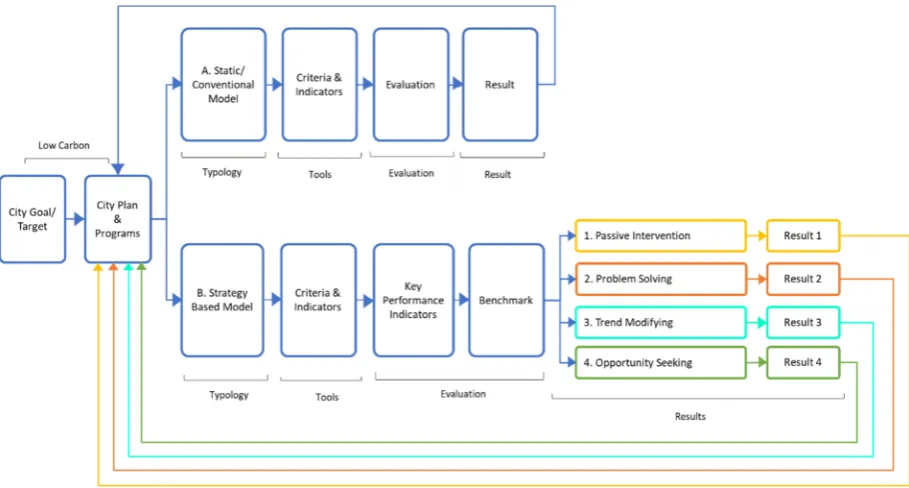
The proposed model SLCM builds on the framework of Gomi et al. (2010) who modelled the potential to reduce carbon emissions in Kyoto by 2030 and the generic model of low carbon cities, GMLC of Azizalrahman and Hasyimi (2018). By reformulating both the generic and specific models, the proposed model, SLCM is capable of evaluating and predicting low carbon city performance. It attempts to examine sustainability by two different methods: First, a static model (A) featuring direct input-output evaluation. Second, a dynamic model (B) exhibiting an input with multiple outputs that are formulated according to strategies (Figure 1).
SLCM model consists of four phases: typology, tools, evaluation and results driven by four strategies: passive intervention, problem solving, trend modifying and opportunity seeking. These strategies are escalating in terms of intervention and achievement of low carbon targets. The passive intervention merely forecast current condition without any intervention in terms of policies and programs. A more common approach is the problem-solving strategy that tackles evident problems. By introducing fundamental changes to current condition that might have positive or negative impacts, the trend modifying approach attempts to realign policies and programs. Being a normative approach, the opportunity seeking strategy endeavours to build on potential sectors (economy, social and environmental) leading to the highest city performance, thereby realizing city goals. Scenarios of high and low growth rates were also used to forecast the best result of this strategy.
3.2 Score Calculation
Based on a review of the literature and best practices, the authors developed a set of criteria and key performance indicators (KPIs). An excel-based tool consisting of score calculator was developed to facilitate the evaluation of low carbon city pe. A cumulative score is thus attained, allowing city’s performance to be directly measured against benchmarks, current performance (model A), and future performance (model B).
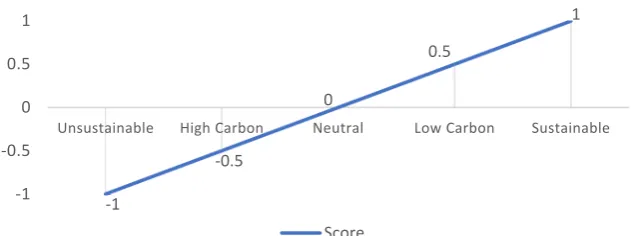
The process to calculate a generic model score is initiated with a modified data normalization technique of Azizalrahman and Hasyimi (2018) in two stages. First, a cumulative index score was derived from all KPIs to determine whether a city is low carbon or not. Denoting worst to best performance, the model’s score ranges from (-1) to (1). Second, the relative value of each key performance indicator was measured, thus direct evaluation of future policy development in a city plan could be obtained. The equation of data normalization is set out in Eq. 1 and 2.
𝑦
𝑦
Figure 1 Strategy-based modelling framework.
(1)
Where 𝑦 denotes normalized data of assessed object on 𝑖 indicator, 𝑥 is original value of the object on 𝑖 indicator, max {𝑥} is the highest value in 𝑖 indicator, 𝑥 is benchmark value of 𝑖 indicator. While Eq.1 is used for indicators with positive effects on carbon emissions, Eq.2 is used for indicators with negative effects.
The calculation of the proposed evaluation model SLCM is shown in Eq. 3.
𝑆 𝑆 𝑤
6
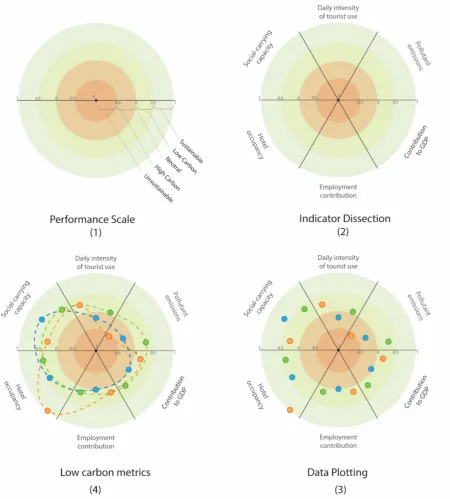
Where 𝑆 denotes the total score of assessed city, 𝑤 is the weight factor of c category, and 𝑆 is total score of 𝑦 in 𝑐 category. To obtain a cumulative SLCM index score, an equal weight is assigned to six KPIs, the result of which features a low carbon city scale from: unsustainable (1 to -0.49); high carbon (-0.5 to 0.99); low carbon (0 to -0.49); and sustainable (0.5 to 1) as illustrated in Figure 2.
Figure 2 Low carbon city scale.
3.3 Model Application
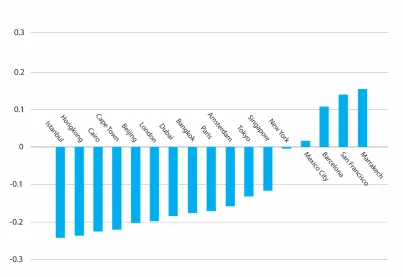
The authors applied SLCM model on tourism sector because of its growing recognition as a major contributor to carbon emissions. Based on WTTC (2017a), 17 high performance touristic cities were selected as pilot cities. SLCM was tested under the static model (A) to extrapolate current conditions and then under the dynamic model (B) to show future trajectories. It calculated the current score of each target sector: economic, environmental, and social to show which sector is under or over performing. An annual growth of 3% is assumed in keeping with WTTC (2017b) study. Six key performance indicators (KPIs) were selected and benchmarks were calculated (Table 1).
Table 1 key performance indicators and benchmarks.
Indicators Symbol Effect Parameter Benchmark Source
Daily intensity of tourist uses
I1 + Total tourists per unit area 89.41
tourist/km/day
(WTTC, 2017a)
Pollutant emissions I2 - Level of CO2 2.19 ton/capita (N. Zhou et al.,
2015)
-1
-0.5
0
0.5
1
-1 -0.5 0 0.5 1
Unsustainable High Carbon Neutral Low Carbon Sustainable
Contribution of tourism to GDP
I3 + Percentage of GDP attributable to the
activities of Hotels and Restaurants
10.4 % (UNEP-WTO,
2005)
Employment contribution
I4 + Percentage of employees in the
tourism sector with respect to the total volume of employment in the city
9.9 % (ILO, 2017)
Hotel occupancy I5 + % average of room usage 71.23 % (WTTC, 2017a) Social-carrying
capacity
I6 - Ratio of tourist to locals 4.5 % (WTTC, 2017a)
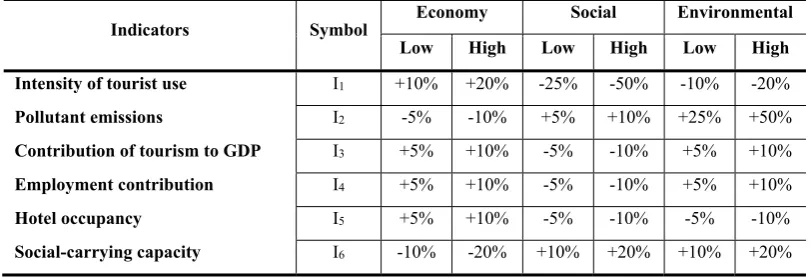
Moreover, six scenarios were built to address the opportunity seeking strategy for low and high growth rates under three major sectors: economy, social and environmental (Table 2).
Table 2 Effect of key performance indicators in economy, social and environmental sectors.
Indicators Symbol Economy Social Environmental
Low High Low High Low High
Intensity of tourist use I1 +10% +20% -25% -50% -10% -20%
Pollutant emissions I2 -5% -10% +5% +10% +25% +50%
Contribution of tourism to GDP I3 +5% +10% -5% -10% +5% +10%
Employment contribution I4 +5% +10% -5% -10% +5% +10%
Hotel occupancy I5 +5% +10% -5% -10% -5% -10%
Social-carrying capacity I6 -10% -20% +10% +20% +10% +20%
Source: Fong (2009), Vaz et al. (2012) and Fang et al. (2018).
4 Results 4.1 Static Model
Figure 3 The result of static model of low carbon city.
4.2 Strategy Based Model
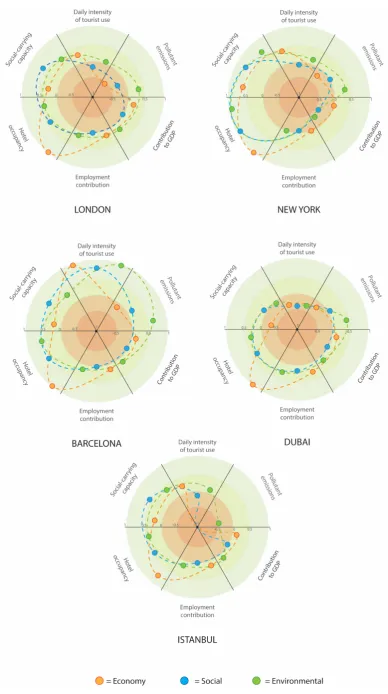
Figure 4. The result of SLCM model (B).
5 Discussion
The authors have formulated a generic low carbon model, SLCM and applied it in 17 touristic cities. They have also constructed low carbon metrics for touristic cities that could be used by decision makers to realign development policies. By rotating the low carbon city scale around its axis, four zones are constructed: high carbon, neutral, low carbon and sustainable. Zones were then dissected into six sectors representing key performance indicators. Scores were plotted and connected leading to low carbon city metrics (Figure 5).
Benchmark Benchmark
Benchmark Benchmark
Figure 5. Low carbon metrics for touristic cities.
5.1 Policy Implications
Measured against key performance indicators in SLCM model, touristic cities could foresee probable impacts, reconsider policies and realign city plans to achieve low carbon targets. The implications could be economic, environmental or social.
5.1.1 Economy
One of the main purposes of applying low carbon model to touristic cities is to ensure that the long-term economic operations are viable and evenly handed to stakeholders. Benefits could take many forms, stable employment, minimum economy leakage, poverty alleviation and the like. It is important that policies ensure economic returns accrue from tour operators, food producers, transport services, guides, etc. By recognizing the needs of multiple occupations, land use distribution in low carbon touristic city can be clustered to maximize mobility. Recently, MICE (meetings, incentives, conferences, and exhibitions) is getting popular in sustainable development initiatives. For instance, London has established a specific strategy to create green financing and new clean tech hub to promote inclusive and sustainable economic growth (Hodson et al., 2013).
5.1.2 Social
The social carrying capacity indicator of SLCM model attempts to measure sustainable tourism development from a social perspective by preserving the tradition, socio-cultural authenticity of local communities, the living heritage and respecting inter-cultural understanding. To seek a widespread and fair distribution of socio-economic benefits from tourism throughout the recipient community, the most important agenda should include jobs and services to the poor. It is imperative to raise public awareness, involve communities in the planning process and disseminate information on city development. It means that decisions can be made about tourism development at lowest level of governance. Thus, stakeholders should be able to address the specific position of indigenous and traditional communities in socio-economic development.
5.1.3 Environmental
Within low carbon city concept, natural environmental deals issues such as conservation, biodiversity, over-exploitation and pollution. It is also essential to maintain the aesthetic quality and appearance of the environment because of its long-term impact on tourism. Policies and control may seek to minimize physical degradation caused by construction and waste disposal. Environmental policies should address the scale and intensity of development. The key is having policy and instruments in place at a local level that influence the location and nature of new development. The attention of development should not only be paid to the building of touristic facilities, but also to supporting infrastructures such as airports, roads, harbours, etc. Further, transportation sector plays a key role in low-carbon emission zone that seek to respond to sustainable development goals, the Ultra-Low Emission Zones (ULEZ) initiative is a case in point (tfl.gov.uk).
6 Conclusion
high carbon cities were used to test SLCM: London, New York, Barcelona, Dubai and Istanbul under four strategies, passive intervention, problem-solving, trend modifying and opportunity seeking. The result shows that these cities can be promoted to be sustainable touristic cities. The authors hope that this approach enriches knowledge on policy-making and supports the discussion to set out or amend sustainable city targets. SLCM is a basic model that could be further refined and tested to increase its reliability, bridge the gap between theoretical and practical studies and contribute to low carbon innovation.
7 Reference
Akgun, A. A., Leeuwen, E. Van and Nijkamp, P. (2012) ‘A multi-actor multi-criteria scenario analysis of regional sustainable resource policy’, Ecological Economics. Elsevier B.V., 78, pp. 19–28. doi:
10.1016/j.ecolecon.2012.02.026.
Azizalrahman, H. and Hasyimi, V. (2019) ‘A model for urban sector drivers of carbon emissions’, Sustainable Cities and Society. Elsevier, 44(October 2018), pp. 46–55. doi: 10.1016/j.scs.2018.09.035.
Azizalrahman, H. and Hasyimi, V. (2018) ‘Towards a generic multi-criteria evaluation model for low carbon cities’, Sustainable Cities and Society. doi: 10.1016/j.scs.2018.02.026.
Becker, W. et al. (2017) ‘Weights and importance in composite indicators: Closing the gap’, Ecological Indicators, 80(March), pp. 12–22. doi: 10.1016/j.ecolind.2017.03.056.
Fang, D. et al. (2018) ‘A novel method for carbon dioxide emission forecasting based on improved Gaussian processes regression’, Journal of Cleaner Production. Elsevier Ltd, 173, pp. 143–150. doi:
10.1016/j.jclepro.2017.05.102.
Feng, Y. Y., Chen, S. Q. and Zhang, L. X. (2013) ‘System dynamics modeling for urban energy consumption and CO2emissions: A case study of Beijing, China’, Ecological Modelling. Elsevier B.V., 252(1), pp. 44–52. doi: 10.1016/j.ecolmodel.2012.09.008.
Fong, W., Matsumoto, H. and Lun, Y. (2009) ‘Application of System Dynamics model as decision making tool in urban planning process toward stabilizing carbon dioxide emissions from cities’, Building and Environment. Elsevier Ltd, 44(7), pp. 1528–1537. doi: 10.1016/j.buildenv.2008.07.010.
Freeman, R. and Yearworth, M. (2017) ‘Climate change and cities: problem structuring methods and critical perspectives on low-carbon districts’, Energy Research & Social Science. Elsevier Ltd, 25, pp. 48–64. doi: 10.1016/j.erss.2016.11.009.
GEF - World Bank (2018) Urban Sustainability Framework. Washington DC. Available at:
http://documents.worldbank.org/curated/en/339851517836894370/pdf/123149-Urban-Sustainability-Framework.pdf.
Gomi, K., Shimada, K. and Matsuoka, Y. (2010) ‘A low-carbon scenario creation method for a local-scale economy and its application in Kyoto city’, Energy Policy. Elsevier, 38(9), pp. 4783–4796. doi:
10.1016/j.enpol.2009.07.026.
Han, R. et al. (2016) ‘Integrated weighting approach to carbon emission quotas: An application case of Beijing-Tianjin-Hebei region’, Journal of Cleaner Production. Elsevier Ltd, 131, pp. 448–459. doi:
10.1016/j.jclepro.2016.05.001.
Hodson, M., Marvin, S. and Bulkeley, H. (2013) ‘The Intermediary Organisation of Low Carbon Cities: A Comparative Analysis of Transitions in Greater London and Greater Manchester’, Urban Studies, 50(7), pp. 1403–1422. doi: 10.1177/0042098013480967.
Horng, J. et al. (2012) ‘Energy saving and carbon reduction management indicators for natural attractions : a case study in Taiwan’, 9582. doi: 10.1080/09669582.2012.663380.
ILO (2017) ILO guidelines on decent work and socially responsable tourism. Geneva: International Labour Office.
Sumaries and 1992 IPCC suplement, Nature. doi: 10.1038/360292e0.
IPCC (2014) Synthesis Report, Climate Change 2014: Synthesis Report. Contribution of Working Groups I, II and III to the Fifth Assessment Report of the Intergovernmental Panel on Climate Change. doi:
10.1017/CBO9781107415324.
Jose, V. R. R., Nau, R. F. and Winkler, R. L. (2008) ‘Scoring Rules, Generalized Entropy, and Utility Maximization’, Operations Research, 56(5), pp. 1146–1157. doi: 10.1287/opre.1070.0498.
Kocabas, A. (2013) ‘The transition to low carbon urbanization in Turkey: Emerging policies and initial action’,
Habitat International. Elsevier Ltd, 37, pp. 80–87. doi: 10.1016/j.habitatint.2011.12.016.
Lenzen, M. et al. (2018) ‘The carbon footprint of global tourism’, Nature Climate Change, 8(6), pp. 522–528. doi: 10.1038/s41558-018-0141-x.
Martínez-zarzoso, I., Eni, F. and Mattei, E. (2008) ‘The Impact of Urbanization on CO2 Emissions : Evidence from Developing Countries’, (I).
Martínez-Zarzoso, I. and Maruotti, A. (2011) ‘The impact of urbanization on CO2 emissions: Evidence from developing countries’, Ecological Economics. Elsevier B.V., 70(7), pp. 1344–1353. doi:
10.1016/j.ecolecon.2011.02.009.
OECD (2013) Green Growth in Stockholm, Sweden. doi: 10.1787/9789264195158-en.
Padilla-Rivera, A., Amor, B. and Blanchet, P. (2018) ‘Evaluating the Link between Low Carbon Reductions Strategies and Its Performance in the Context of Climate Change: A Carbon Footprint of a Wood-Frame Residential Building in Quebec, Canada’, Sustainability, 10(8), p. 20. doi: 10.3390/su10082715.
Peterson, G. D., Cumming, G. S. and Carpenter, S. R. (2003) ‘Scenario Planning: a Tool for Conservation in an Uncertain World’, Essay 358 Conservation Biology Conservation Biology, 17(2), pp. 358–366. doi:
10.1046/j.1523-1739.2003.01491.x.
Qi, Y. et al. (2010) ‘A fuzzy comprehensive evaluation and entropy weight decision-making based method for power network structure assessment’, International Journal of Engineering, Science and Technology, 2(5), pp. 92–99. doi: 10.4314/ijest.v2i5.60126.
Sadorsky, P. (2014) ‘The effect of urbanization on CO2emissions in emerging economies’, Energy Economics. Elsevier B.V., 41, pp. 147–153. doi: 10.1016/j.eneco.2013.11.007.
Shahbaz, M., Chaudhary, A. R. and Ozturk, I. (2017) ‘Does urbanization cause increasing energy demand in Pakistan ? Empirical evidence from STIRPAT model’, Energy. Elsevier Ltd, 122, pp. 83–93. doi:
10.1016/j.energy.2017.01.080.
Shimada, K. et al. (2007) ‘Developing a long-term local society design methodology towards a low-carbon economy: An application to Shiga Prefecture in Japan’, Energy Policy, 35(9), pp. 4688–4703. doi:
10.1016/j.enpol.2007.03.025.
Spano, M. et al. (2017) ‘The DPSIR framework in support of green infrastructure planning: A case study in Southern Italy’, Land Use Policy. Elsevier Ltd, 61, pp. 242–250. doi: 10.1016/j.landusepol.2016.10.051. Swart, R. J., Raskin, P. and Robinson, J. (2004) ‘The problem of the future : sustainability science and scenario analysis’, Global Environmental Change, 14, pp. 137–146. doi: 10.1016/j.gloenvcha.2003.10.002.
Tan, S. et al. (2015) ‘A holistic low carbon city indicator framework for sustainable development’, Applied Energy. Elsevier Ltd, 185, pp. 1919–1930. doi: 10.1016/j.apenergy.2016.03.041.
Turnpenny, J., O’Riordan, T. and Haxeltine, A. (2005) ‘Developing regional and local scenarios for climate change mitigation and adaptation’, Tyndall Centre for Climate Research, 67.
UNEP-WTO (2005) ‘Making tourism more sustainable. A guide for policy makers’, Environment, 54(2), p. 222. doi: 92-807-2507-6.
WTTC (2017a) CITY TRAVEL & TOURISM IMPACT 2017 EXECUTIVE SUMMARY. WTTC (2017b) Travel & Tourism: global economic impact & issue 2018. Available at:
https://www.statista.com/statistics/233223/travel-and-tourism--total-economic-contribution-worldwide/. Xing, Z. (2018) ‘Low-carbon Cities Evaluation Model Based on RS and SVM’, Journal of Applied Science and Engineering Innovation, 5(2), pp. 51–54. doi: 2331-9070.
Yang, G. et al. (2015) ‘Modeling the nexus between carbon dioxide emissions and economic growth’, Energy Policy. Elsevier, 86, pp. 104–117. doi: 10.1016/j.enpol.2015.06.031.
Yang, X. et al. (2017) ‘Study of the relationship between greenhouse gas emissions and the economic growth of Russia based on the Environmental Kuznets Curve’, Applied Energy. Elsevier Ltd, 193, pp. 162–173. doi: 10.1016/j.apenergy.2017.02.034.
Yeh, J. and Liao, C. (2017) ‘Impact of population and economic growth on carbon emissions in Taiwan using an analytic tool STIRPAT’, Sustainable Environment Research. Elsevier Ltd, 27(1), pp. 41–48. doi:
10.1016/j.serj.2016.10.001.
Zhang, J. (2017) ‘Evaluating regional low-carbon tourism strategies using the fuzzy Delphi- analytic network process approach’, Journal of Cleaner Production. Elsevier Ltd, 141, pp. 409–419. doi:
10.1016/j.jclepro.2016.09.122.
Zhang, Y., Yi, W. and Li, B. (2015) ‘The impact of urbanization on carbon emission : empirical evidence in Beijing’, Energy Procedia. Elsevier B.V., 75, pp. 2963–2968. doi: 10.1016/j.egypro.2015.07.601.
Zhou, G. et al. (2015) ‘Evaluating low-carbon city initiatives from the DPSIR framework perspective’, Habitat International, 50, pp. 289–299. doi: 10.1016/j.habitatint.2015.09.001.
Zhou, N. et al. (2015) ‘ELITE cities: A low-carbon eco-city evaluation tool for China’, Ecological Indicators. Elsevier Ltd, 48, pp. 448–456. doi: 10.1016/j.ecolind.2014.09.018.