University of South Carolina
Scholar Commons
Theses and Dissertations
2018
A Quasi-Experimental Analysis Of School-Based
Situational Crime Prevention Measures
Gary Zhang
University of South Carolina
Follow this and additional works at:https://scholarcommons.sc.edu/etd
Part of theCriminology and Criminal Justice Commons
This Open Access Dissertation is brought to you by Scholar Commons. It has been accepted for inclusion in Theses and Dissertations by an authorized administrator of Scholar Commons. For more information, please [email protected].
Recommended Citation
A
Q
UASI-E
XPERIMENTALA
NALYSIS OFS
CHOOL-B
ASEDS
ITUATIONALC
RIMEP
REVENTIONM
EASURESby
Gary Zhang
Bachelor of Arts
North Carolina State University, 2011
Master of Science
Michigan State University, 2013
Submitted in Partial Fulfillment of the Requirements
For the Degree of Doctor of Philosophy in
Criminology and Criminal Justice
College of Arts and Sciences
University of South Carolina
2018
Accepted by:
Robert J. Kaminski, Major Professor
John D. Burrow, Committee Member
Hayden P. Smith, Committee Member
Eric L. Sevigny, Committee Member
ii
iii
A
CKNOWLEDGEMENTSI would like to acknowledge and thank the members of my dissertation committee
for agreeing to serve on the committee and providing their guidance, feedback, and
advice throughout this project. I thank Professor Bob Kaminski for agreeing to serve as
the committee chair, helping me obtain the data for this study, and working hard to
ensure that I would have the opportunity to graduate from the doctoral program. I thank
Professor John Burrow for providing his knowledge of school crime and his detailed
revision suggestions on the literature review. I thank Professor Hayden Smith for his
comments on improving the theoretical parts of the paper as well as his words of
encouragement. Lastly, I thank Professor Eric Sevigny for serving as the external
member and taking the time to provide guidance on the methodological parts of the
iv
A
BSTRACTIn recent years, there has been an expansion of situational crime prevention (SCP)
measures in K-12 schools, including physical controls, law enforcement personnel, and
security policies that are designed to prevent crime by modifying the situational features
of school environments. Although SCP measures are now increasingly commonplace in
schools, there is inadequate research demonstrating the need for SCP measures and their
impacts on school crime. In particular, there is contradictory and inconclusive evidence
of their effectiveness and research has largely been limited to examining aggregate
outcomes through the use non-experimental, correlational designs. This dissertation aims
to address these gaps in the literature by analyzing a nationally representative,
cross-sectional sample of 2,648 schools to explore whether school-based SCP measures causes
changes in the incidence of seven measures of school crime and whether the effects of
SCP measures differ by the type of crime. A quasi-experimental, propensity-score
weighting approach is used to reduce the threat of selection bias resulting from the lack
of random assignment in observational data and therefore allow for stronger causal
inferences than prior studies. Findings indicate that many SCP measures were observed
to have no impact regardless of the crime outcome. However, some SCP measures were
reported to have deterrent effects but these effects vary by the type of crime being
targeted. Furthermore, several of the measures were found to consistently increase the
incidence of crime, suggestive of detection or crime-inducing effects. Explanations for
v
T
ABLE OFC
ONTENTSACKNOWLEDGEMENTS ... iii
ABSTRACT ... iv
LIST OF TABLES ... vii
LIST OF FIGURES ...x
LIST OF ABBREVIATIONS ... xi
CHAPTER 1:INTRODUCTION ...1
1.1STATEMENT OF THE PROBLEM ...2
1.2PURPOSE AND SIGNIFICANCE OF THE STUDY ...5
CHAPTER 2:REVIEW OF THE LITERATURE AND RELATED RESEARCH ...6
2.1SOCIAL STRUCTURAL AND SOCIAL PROCESS CORRELATES OF SCHOOL CRIME ...8
2.2OPPORTUNITY AND SCHOOL CRIME:ROUTINE ACTIVITIES AND LIFESTYLES ...21
2.3THEORETICAL FRAMEWORK:SITUATIONAL CRIME PREVENTION ...25
2.4EMPIRICAL RESEARCH ON SCHOOL-BASED SCPMEASURES ...28
2.5LIMITATIONS OF PREVIOUS RESEARCH ...46
2.6THE PRESENT STUDY ...47
CHAPTER 3:METHODOLOGY ...48
3.1DATA AND SAMPLE ...48
3.2MEASURES ...52
vi
CHAPTER 4:RESULTS ...75
4.1DESCRIPTIVE STATISTICS ...75
4.2DISTRIBUTIONS OF PROPENSITY SCORES ...79
4.3COVARIATE BALANCE ANALYSIS ...90
4.4AVERAGE TREATMENT EFFECTS ...110
CHAPTER 5:DISCUSSION AND CONCLUSION ...120
5.1IMPLICATIONS FOR POLICY AND PRACTICE ...129
5.2LIMITATIONS AND DIRECTIONS FOR FUTURE RESEARCH ...133
vii
L
IST OFT
ABLESTable 2.1 Summary of studies for SCP category: Increase the effort ...29
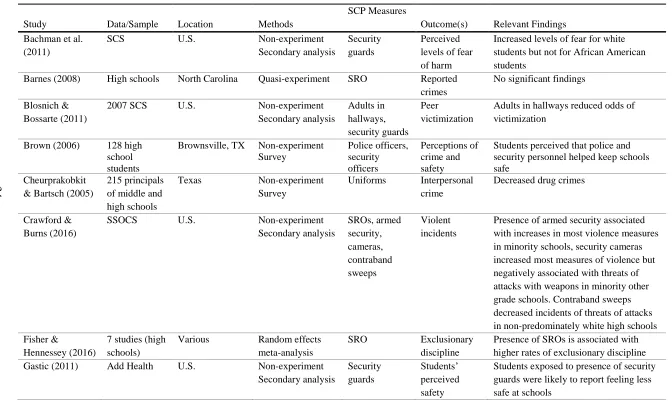
Table 2.2 Summary of studies for SCP category: Increase the risks ...34
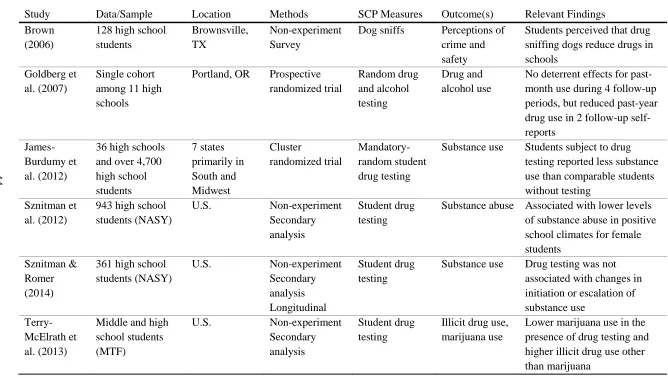
Table 2.3 Summary of studies for SCP category: Remove excuses ...44
Table 3.1 School-based situational crime prevention measures ...54
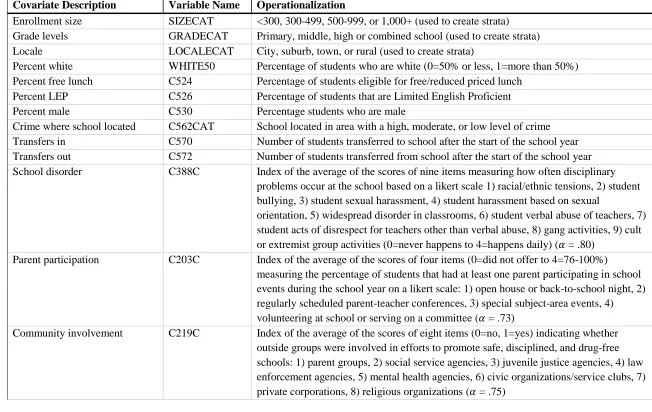
Table 3.2 Covariate definitions ...58
Table 4.1 Sample outcome variable descriptive statistics ...75
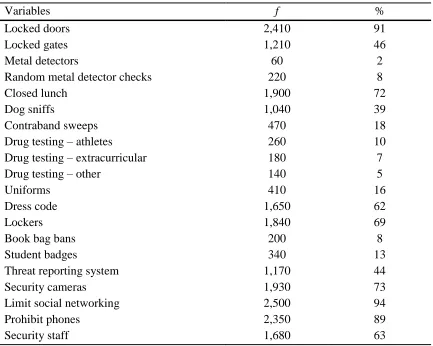
Table 4.2 Sample descriptive statistics for SCP measures ...76
Table 4.3 Sample descriptive statistics for covariates ...78
Table 4.4 Covariate balance summary, locked doors ...92
Table 4.5 Covariate balance summary, locked gates ...93
Table 4.6 Covariate balance summary, random metal detector checks ...94
Table 4.7 Covariate balance summary, closed lunch ...95
Table 4.8 Covariate balance summary, dog sniffs ...96
Table 4.9 Covariate balance summary, contraband sweeps ...97
Table 4.10 Covariate balance summary, drug testing athletes ...98
Table 4.11 Covariate balance summary, drug testing any other ...99
Table 4.12 Covariate balance summary, uniforms ...100
Table 4.13 Covariate balance summary, dress code ...101
Table 4.14 Covariate balance summary, lockers ...102
viii
Table 4.16 Covariate balance summary, student badges ...104
Table 4.17 Covariate balance summary, threat reporting system ...105
Table 4.18 Covariate balance summary, security cameras ...106
Table 4.19 Covariate balance summary, limit social networking ...107
Table 4.20 Covariate balance summary, prohibit phones ...108
Table 4.21 Covariate balance summary, security staff ...109
Table 4.22 Average treatment effects, locked doors ...114
Table 4.23 Average treatment effects, locked gates ...114
Table 4.24 Average treatment effects, random metal detector checks ...114
Table 4.25 Average treatment effects, closed lunch ...115
Table 4.26 Average treatment effects, dog sniffs ...115
Table 4.27 Average treatment effects, contraband sweeps ...115
Table 4.28 Average treatment effects, drug testing athletes ...116
Table 4.29 Average treatment effects, drug testing any other ...116
Table 4.30 Average treatment effects, uniforms ...116
Table 4.31 Average treatment effects, dress code ...117
Table 4.32 Average treatment effects, lockers ...117
Table 4.33 Average treatment effects, book bag bans ...117
Table 4.34 Average treatment effects, student badges ...118
Table 4.35 Average treatment effects, threat reporting system ...118
Table 4.36 Average treatment effects, security cameras ...118
Table 4.37 Average treatment effects, limit social networking ...119
ix
Table 4.39 Average treatment effects, security staff ...119
x
L
IST OFF
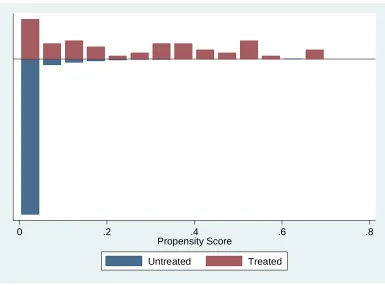
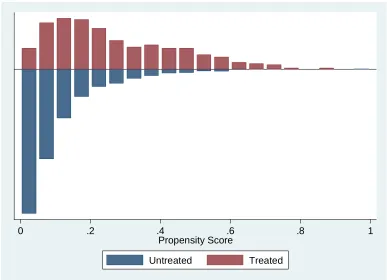
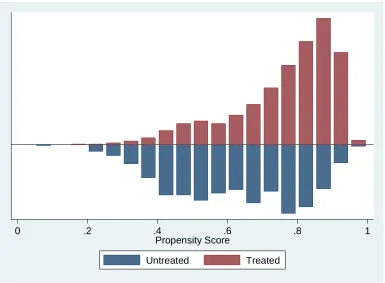
IGURESFigure 4.1 Distribution of propensity scores, locked doors ...80
Figure 4.2 Distribution of propensity scores, locked gates ...80
Figure 4.3 Distribution of propensity scores, metal detectors ...81
Figure 4.4 Distribution of propensity scores, random metal detector checks ...81
Figure 4.5 Distribution of propensity scores, closed lunch ...82
Figure 4.6 Distribution of propensity scores, dog sniffs ...82
Figure 4.7 Distribution of propensity scores, contraband sweeps ...83
Figure 4.8 Distribution of propensity scores, drug testing athletes ...83
Figure 4.9 Distribution of propensity scores, drug testing extracurricular ...84
Figure 4.10 Distribution of propensity scores, drug testing any other ...84
Figure 4.11 Distribution of propensity scores, uniforms ...85
Figure 4.12 Distribution of propensity scores, dress code ...85
Figure 4.13 Distribution of propensity scores, lockers ...86
Figure 4.14 Distribution of propensity scores, book bag bans ...86
Figure 4.15 Distribution of propensity scores, student badges ...87
Figure 4.16 Distribution of propensity scores, threat reporting system ...87
Figure 4.17 Distribution of propensity scores, security cameras ...88
Figure 4.18 Distribution of propensity scores, limit social networking ...88
Figure 4.19 Distribution of propensity scores, prohibit phones ...89
xi
L
IST OFA
BBREVIATIONSATE ... Average Treatment Effect in the Population
ATET ... Average Treatment Effect on the Treated
ATT ... Average Treatment Effect on the Treated
CIA ... Conditional Independence Assumption
CCD ... Common Core of Data
FTE ... Full-Time Equivalent
IES... Institute of Education Sciences
IPTW ... Inverse-Probability of Treatment Weighting
IPW ... Inverse-Probability Weighting
IPWRA ... Inverse-Probability Weighting with Regression Adjustment
LEP ... Limited English Proficiency
MTF ... Monitoring the Future
NASY ... National Annenberg Survey of Youth
NCES ... National Center for Education Statistics
NCVS ... National Crime Victimization Survey
NHES-SSD ...National Household and Education Survey, School Safety and Discipline
PSU ... Primary Sampling Unit
RA ... Regression Adjustment
SCP ... Situational Crime Prevention
SCS ... School Crime Supplement
xii
SSOCS ... School Survey on Crime and Safety
SUTVA ... Stable Unit Treatment Value Assumption
U.S. ... United States
1
CHAPTER
1
I
NTRODUCTIONSchool crime has been experiencing a steady decline for years. According to the
most recent statistics, between 1992 and 2014 the total victimization rate (including theft
and violent victimization) at K-12 schools declined 82 percent, from 181 victimizations
per 1,000 students in 1992 to 33 victimizations per 1,000 students in 2014 (Zhang,
Musu-Gillette, & Oudekerk, 2016). Between 1995 and 2013, the percentage of students ages
12-18 who reported being victimized at school during the previous 6 months decreased
overall (from 10 to 3 percent), as did the percentages of students who reported theft (from
7 to 2 percent), violent victimization (from 3 to 1 percent), and serious violent
victimization. Moreover, the percentage of students who reported being threatened or
injured with a weapon on school property has decreased over the last decade, from 9
percent in 2003 to 7 percent in 2013 and the percentage of students in grades 9-12 who
reported that illegal drugs were made available to them on school property decreased
from 32 percent in 1995 to 22 percent in 2013 (Zhang et al., 2016).
Although statistics suggest that schools are becoming safer, local school districts
have increasingly implemented various situational crime prevention (SCP) techniques in
response to school crime that are designed to modify situational features of the school
environment. These include physical controls (e.g. metal detectors, locked doors, security
cameras), personnel-based measures (e.g., school police officers), and school policies
2
from the National Center for Education Statistics, from 1999-2000 to 2013-14 the
percentage of public schools reporting the use of security cameras increased from 19
percent to 75 percent. Similarly, the percentage of public schools reporting that they
controlled access to school buildings increased from 75 percent to 93 percent during this
time (Zhang et al., 2016). Most students nationally now report the use of specific security
measures, practices, and policies in their schools, including visitor sign-in requirements,
hallway supervisors, security cameras, locked school access, security guards/officers,
uniform policies, book bag bans, and locker checks (Carlton, 2017; Zhang et al., 2016).
For the 2013-14 school year, nearly all students ages 12-18 reported that their schools
had a written code of student conduct and a requirement that visitors sign in (96 percent
each). Approximately 90 percent of students reported the presence of school staff (other
than security guards or assigned police officers) or other adults supervising the hallway,
and 77 percent reported the presence of one or more security cameras to monitor the
school. About 76 percent of students ages 12-18 reported observing locked entrance or
exit doors during the day in 2013, representing an increase from 38 percent in 1999
(Zhang et al., 2016). Similar trends in school safety and security measures have also been
reported in specific states, such as Alabama (Stevenson, 2011), Massachusetts
(Rich-Shea, 2010), North Carolina (Barnes, 2008), and Texas (Cheuprakobkit & Bartsch,
2005).
1.1 STATEMENT OF THE PROBLEM
In order to justify the increasing use of school-based situational crime prevention
measures, research should examine the effects of these measures on outcomes of school
3
research demonstrating the need for many SCP techniques, as well as their impact on a
variety of school crimes. Furthermore, some studies suggest that practices such as using
metal detectors, security staff, and video surveillance are associated with a decrease in
students’ feelings and perceptions of safety (e.g., Booren & Handy, 2009;
Perumean-Chaney & Sutton, 2013).
While the increased securitization of schools has been followed by numerous
studies examining the impacts of a variety of school-based SCP techniques on outcomes
of school crime and safety, the current state of research on the effectiveness of school
safety and security interventions focused on reducing school crime and disorder remains
relatively sparse and inconclusive. Limited research exists on how school safety policies,
personnel, and measures impact actual school safety outcomes, with many studies
tending to focus on perceived safety, particularly for structural school safety measures
such as metal detectors, security personnel, and surveillance cameras (e.g., Brown, 2006;
Chrusciel, Wolfe, Hansen, Rojek, & Kaminski, 2015; Garcia, 2003; Gastic, 2011; Mayer
& Leone, 1999). Furthermore, research on actual school crime outcomes have yet to
examine the effects of these techniques by specific offense types, such as fights involving
a weapon, thefts, drug possession, and vandalism. Previous research has been limited to
composite crime measures (e.g., violent crime, property crime) (e.g., O’Neill & McGloin,
2007; Jennings, Khey, Maskaly, & Donner, 2011; Maskaly, Donner, Lanterman, &
Jennings, 2011). However, these measures do not provide a sufficient level of detail for
examination of the effects of SCP techniques for specific offenses. It is possible that the
effects of situational crime prevention measures may be different for certain types of
4
contraband may have different effects for crimes involving a weapon and crimes that do
not. Therefore, the examination of school SCP techniques on disaggregated crime
outcomes would likely produce more nuanced findings and improve the targeting of SCP
techniques in schools.
Several methodological issues also plague the existing state of research on
situational crime prevention and school crime. The literature on both perceived and actual
effectiveness of safety measures reveals mixed and inconclusive findings. Although some
studies have found evidence of effectiveness for certain measures, many studies have
found null and opposite effects. Studies reporting significant findings consistent with
theoretical perspectives are unable to determine whether situational crime prevention
techniques caused a decline in crime or whether a decline in crime preceded the
implementation of SCP techniques (e.g., Crawford & Burns, 2015, 2016; Jennings et al.,
2011; Maskaly et al., 2011). Studies reporting opposite effects are unable to determine
whether the use of school-based SCP techniques are more likely to increase the detection
of crimes therefore increasing the number of crimes recorded, or whether schools with
more crime are more likely to implement security measures (e.g., Lesneskie & Block,
2016; O’Neill & McGloin, 2007). Furthermore, most studies use observational data but
do not construct a counterfactual inference. Therefore, they are unable to account for
confounding factors such as school-level poverty or the location of the school that are
known to affect both the implementation of SCP measures (Carlton, 2017) and the
incidence of school crime (Cook, Gottfredson, & Na, 2010). These issues may be
attributed to the reliance of many studies on correlational designs, particularly at the
5
This limitation indicates the need for future studies to utilize longitudinal,
quasi-experimental, or experimental research designs to establish temporal ordering and
causation (Na & Gottfredson, 2011; Reingle et al., 2016).
1.2 PURPOSE AND SIGNIFICANCE OF THE STUDY
The purpose of this study is to examine the effects of school-based situational
crime prevention measures on multiple measures of school crime in a nationally
representative sample of schools. Specifically, this research will: (1) examine data on the
incidence of specific types of school crime in a sample of public elementary and
secondary schools, (2) measure the quantitative impact of school-based SCP measures on
the incidence of crime using a quasi-experimental non-equivalent control group design,
and (3) examine whether the effects of situational crime prevention techniques differ by
type of crime.
Results of this study will be relevant for school personnel, parents and students. In
addition, this research product would be particularly useful to school policymakers and
administrators wanting to adopt evidence-based practices and improve the effectiveness
of crime prevention policies as well as target specific forms of school crime and violence.
The insight garnered from this study is important for a more complete body of research
regarding the use of SCP in schools. This study will serve as a basis for future studies
6
CHAPTER
2
R
EVIEW OFT
HEL
ITERATURE ANDR
ELATEDR
ESEARCHThe National Center for Education Statistics defines school crime as “any
criminal activity that is committed on school property” (Zhang et al., 2016, p. 214).
However, no standardized definition of the term exists. According to McCord, Widom,
Bamba, and Crowell (2000), definitions of school crime vary and can differ in terms of
the types of crimes, location, time, and perpetrator or victim. For instance, the definition
of school crime can range from considering any threat or theft as a crime to considering
only violent attacks that are reported to the police as crimes. School violence specifically
has been defined as acts of aggression and violence occurring on school grounds, while
traveling to and from school, or during school-sponsored events (Greene, 2005).
Definitions of school crime may also differ depending on whether crimes committed
against children on their way to school or on school playgrounds are considered acts of
school crime in addition to crimes committed within school buildings. Furthermore,
studies have incorporated definitions which include only crimes during school hours, as
well as crimes occurring before and after school (e.g., Na & Gottfredson, 2011). The term
may also refer to crimes committed by or against school students and personnel, although
some definitions may include any victim on school property (McCord et al., 2000).
There have been attempts to develop standardized definitions of school crime. For
instance, the Crime, Violence, and Discipline Task Force created by the National Forum
7
that occur on school grounds, on school transportation, or at off-campus
school-sponsored events; incidents involving alcohol, drugs, or weapons; incidents involving a
gang; hate-crime motivated incidents; and all incidents reported to law enforcement
agencies (McCord et al., 2000; Minogue, Kingery, & Murphy, 1999). Definitions and
measures of school crime have also tended to focus on crimes occurring at primary and
secondary educational institutions and on school-aged youth in those institutions as
perpetrators and/or victims, although teachers are also threatened by crime in schools
(Cook et al., 2010). For instance, the School Crime Supplement (SCS) to the National
Crime Victimization Survey (NCVS) sponsored by the Bureau of Justice Statistics and
National Center for Education Statistics surveys students ages 12 to 18 enrolled in public
and private schools during the school year. This measure of school crime focuses on
youth in middle and high schools. In addition, the School Survey on Crime and Safety
(SSOCS) gathers information from public school principals about crimes occurring
during school hours and consists of a sample of public elementary, middle, and high
schools. Another nationally representative sample is the Youth Risk Behavior
Surveillance System (YRBSS) which consists of students enrolled in grades 9 through 12
in public and private schools (Cook et al., 2010; Zhang et al., 2016). In a systematic
review of the school crime literature, Cook et al. (2010) identified studies examining
samples of primary and secondary schools or school-aged youth in those schools. In sum,
although school crime has no standard definition, definitions and measures of school
crime have largely focused on institutions of primary and secondary education (i.e., K-12
8
The literature on school crime has drawn upon several major theoretical
perspectives to explain the incidence and prevention of school crime at both the macro-
and micro-levels, including social disorganization, general strain theory, control theories,
theories rooted in the classical school of criminology, including deterrence, rational
choice, situational crime prevention, routine activity, and lifestyle-exposure theories. The
empirical research on school crime causation, prevention, and control has been largely
informed by these theories. In addition, policy implications have been developed from
these criminological theories to guide efforts for preventing and reducing school crime
and research has examined the effects of these policies and practices on school crime and
victimization outcomes. Some studies claim to directly test the ability of these theories to
explain school crime while others do not claim to be complete test of a theory but rather
examine how relevant indicators identified by a theory are correlated with school crime
and victimization.
2.1 SOCIAL STRUCTURAL AND SOCIAL PROCESS CORRELATES OF SCHOOL CRIME
Although a thorough discussion of theories of school crime is beyond the scope of
this study, it is useful to begin with a review of the key correlates of school crime
identified by major theoretical perspectives. Much of the school crime literature examines
social structure and social process explanations, including characteristics of schools such
as enrollment size, demographic characteristics of students, school organizational
structure, school culture, discipline management, and school programming to reduce
violence (e.g., Bryk & Driscoll, 1988; Cook et al., 2010; Felson, Liska, South, &
McNulty, 1994; Gottfredson & Gottfredson, 1985; Lesneskie & Block, 2016; Nickerson
9
Peng, 1993; Welsh, Greene, & Jenkins, 1999). Studies have recognized a number of these
variables as being associated with school crime and they are often used as independent
control variables in studies of school-based SCP measures.
School Structure Characteristics
Low economic status is strongly correlated with school crime. Violence is higher
in schools with higher percentages of disadvantaged students (i.e., composite percentage
of students in single-parent families, percent of minorities, and percent students receiving
free lunch) (Weishew & Peng, 1993), and school-level SES (i.e., proportion of students
receiving free lunch) is significantly associated with weapon carrying in schools (Wilcox
& Clayton, 2001). Moreover, community poverty is significantly related to teacher
victimization rates (Gottfredson & Gottfredson, 1985) and school disorder (Welsh et al.,
1999, Welsh, Stokes, & Greene, 2000), and schools in areas of concentrated poverty have
higher levels of both student delinquency and teacher victimization (Gottfredson,
Gottfredson, Payne, & Gottfredson, 2005).
The racial/ethnic composition of schools is also related to school crime outcomes.
Violence is higher in schools in which students are assigned to achieve a desired ethnic
composition (Weishew & Peng, 1993) and schools with higher levels of ethnic
heterogeneity have higher levels of school crime and disruption, and violent crime
(Jennings et al., 2011; Nickerson & Martens, 2008). In addition, racial heterogeneity
predicts the level of student victimization rates (Gottfredson & Gottfredson, 1985). In
contrast, Eitle and Eitle (2004) reported that schools composed of greater percentages of
advantaged students (i.e., white) rather than disadvantaged students (i.e., non-white) had
10
Studies have also examined how measures of student transience are correlated
with crime outcomes in school. Student mobility has been found to be positively
correlated with crime rates. Chen (2008) found that student transience or mobility (as
measured by the number of transfers in and transfers out of school) was significantly
positively correlated with the number of criminal incidents in schools in a national
sample. Similarly, Eitle and Eitle (2004) reported that the school dropout rate was
positively associated with substance incident rates in public middle and high schools in
Florida.
In sum, research examining indicators such as measures of low economic status,
ethnic heterogeneity, and student transiency have found that they are significantly
positively related to school crime (Chen, 2008; Gottfredson et al., 1985, 2005; Welsh et
al., 1999). These findings are consistent with the key tenets of social disorganization
theory, which holds that social structural factors including poverty, residential mobility,
ethnic heterogeneity, and family disruption leads to social disorganization, or the inability
of a community’s residents to exercise informal social control, which in turn leads to
crime (Frailing & Harper, 2013; Sampson, 2011).
School Culture
A development of social disorganization theory is collective efficacy, which
refers to the ability of residents of a neighborhood to maintain order by exercising
informal social control when needed. Collective efficacy reduces crime by improving the
ability of residents to exercise informal social control (Sampson et al., 1997). This ability
to exercise informal social control is rooted in mutual trust and support among residents
11
families and used when necessary to maintain order in the neighborhood. Collective
efficacy serves to mediate concentrated disadvantage in neighborhoods, comprised of
poverty, race, and age characteristics and family disruption, therefore reducing crime
(Sampson, Raudenbush, & Earls, 1997). Therefore, when collective efficacy is high,
crime will be low and vice versa. In contrast to social disorganization theory, collective
efficacy theory relaxes the traditional disorganization assumption that the ideal contextual
setting for social control is necessarily one that is characterized by dense, intimate, and
strong neighborhood ties. While collective efficacy may depend on some level of
working trust and social interaction, institutional mechanisms may be sufficient.
Moreover, a neighborhood’s efficacy exists relative to specific tasks and is embedded in
conditions of mutual trust and social cohesion (Sampson, 2011).
Research has examined the role of informal social control in explaining school
crime (Welsh et al., 1999). For instance, Payne et al. (2003) examined the relationship
between school communal organization (i.e., collective efficacy) and school disorder and
found that schools that were more communally organized, as measured by having
supportive and collaborative relations and common goals and norms, experienced lower
levels of student delinquency, a measure that included the number of violent crimes
committed by the student during the school year such as hitting other students and
teachers. Moreover, increased parental involvement (e.g., parental volunteering and
participation in subject area events) in schools has been reported to be associated with
less violence (Lesneskie & Block, 2016) and school-related assaults
(Granberg-Rademacker, Bumgarner, & Johnson, 2007). In addition, schools that partnered with
12
schools that did not (Lesneskie & Block, 2016). These findings may suggest that greater
parental involvement in schools increases the ability of schools to exercise informal
social control and thus increase collective efficacy. Conversely, the inability of schools to
control minor infractions such as disciplinary problems has been shown to be indicative
of a crime-prone environment, suggesting that school disorder is a precursor to school
crime (Miller, as cited in Neiman, Murphy, Thomas, & Hansen, 2015). This finding is
also consistent with the propositions of broken windows theory, which argues that the
inability to exercise formal and informal social control over minor incidents such as
disorder leads to more serious crime (Frailing & Harper, 2013; Sampson, 2011).
Other aspects of school culture, such as attitudes, beliefs, and behaviors of
students, and students’ affective bonds such as student attachment to school and
communal social organization have been reported to be associated with school crime
(e.g., Jenkins, 1997; Payne, 2008; Welsh et al., 1999). Jenkins (1997) examined
components of the school social bond, including commitment and attachment to school,
school involvement and belief in school rules and found that certain elements of the
school social bond have more impact than others in controlling for school delinquency, as
measured by indexes of school crime, school misconduct, and school nonattendance.
Commitment to school and belief in the fairness and consistent enforcement of school
rules were the most important predictors of school crime. This finding is consistent with
prior research indicating that academic values were strongly negatively correlated with
values regarding violence at the aggregate level, and that students who were committed to
academics were less likely to engage in delinquency (Felson et al., 1994). In examining
13
disorder, Welsh et al. (1999) found that school effort was the strongest predictor although
belief in rules and having positive peer associations also negatively predicted student
misconduct. In another study, Welsh (2001) reported that school involvement, positive
peer associations, and belief in school rules predicted offending and misconduct in school
more strongly than other types of school disorder, to include victimization. These results
were also consistent with previous findings that dimensions of school bonding (e.g.,
attachment, commitment) are related to school disorder (Gottfredson & Gottfredson,
1985), student misconduct (Jenkins, 1997), and delinquency (Payne, 2008).
Concerning the relationship between elements of the social bond and student
victimization, Gottfredson and Gottfredson (1985) found that students with strong bonds
of commitment to school were likely to experience less victimization. Tillyer, Fisher, and
Wilcox (2011) reported that attachment to school and peers served as protective factors
against violent victimization at school. In contrast, Wynne and Joo (2011) found that
younger students who participated in extracurricular activities were found to be more
likely to experience criminal types of victimization at school, possibly due to a greater
likelihood of hazing. This finding is consistent with research which has found that
involvement in school activities is positively related to victimization (Burrow & Apel,
2008; Welsh, 2001; Wilcox, Tillyer & Fisher, 2009), possibly since students are more
exposed to motivated offenders. In sum, while there has been strong support found for
commitment to school and belief in the clarity and fairness of rules as protective factors
to victimization, there is much weaker evidence for involvement in school activities
(Tillyer et al., 2011), which has been reported to be positively associated with
14
these studies are largely consistent with the predictions of social control theory, which
argues that strong bonds to social institutions and entities, such as families, school, and
other individuals serve to restrain people from committing crime, and that conversely
when these bonds are weak or broken, individuals are freer to commit criminal acts
(Hirschi, 1969).
Social control theory implicates the school and suggests the involvement of
children in prosocial programs run by or in conjunction with schools to prevent crime and
delinquency. Research on social control theory has also examined the effectiveness of
practices designed to strengthen elements of the social bond. For instance, in an
evaluation of the Social Development Model (SDM) intended to strengthen bonds to
family and to school as well as facilitate the learning of prosocial skills and attitudes,
researchers compared participants to non-participants at ages 10 and 18, finding mixed
support for the model (Hawkins, Catalano, Kosterman, Abbott, & Hill, 1999). Those who
participated in SDM performed better in school and were more attached to the school
than those who did not. In addition, the treatment group had less self-reported violence
and less heavy drinking, although no difference was found between participants and
non-participants on arrests, self-reported nonviolent delinquency, drinking and drug use.
However, further research on SDM has reported evidence of effectiveness across
different populations, suggesting the utility of the model in strengthening bonds and
reducing involvement in delinquency in school (Sullivan & Hirschfield, 2011).
Research on the relationship between student behaviors and school crime is
focused on the impacts of self-control, or the extent to which people are susceptible to
15
Augustine, Wilcox, Ousey, and Clayton (2002) and Wilcox et al. (2009) found a strong
positive relationship between low self-control and violent and property crime
victimization. Consistent with these findings, Tillyer et al. (2011) also reported that
impulsivity significantly increased the risk of violent victimization among seventh grade
students. These findings may indicate that students with low self-control are seen by
offenders as more suitable victims due to their impulsivity, which is seen as antagonistic
(Tillyer et al., 2011). Findings from these studies are supportive of the tenets of
self-control theory, which holds that people with a high level of self-self-control can hold off or
delay tempting situations while those with low self-control are more likely to give into
temptations, and that low self-control in conjunction with criminal opportunity is
necessary for crime to occur (Gottfredson & Hirschi, 1990).
Psychosocial, Psychoeducational, and Peer-led Programs
Many studies have examined the effects of various school-based psychosocial,
psychoeducational, and peer-led programs focused on violence prevention, such as
mentoring, tutoring, and counseling, behavioral modification and instructional methods,
prevention curriculums, and classroom interventions (Barnes, Leite, & Smith, 2015;
Boxer & Dubow, 2002; Durant, Treiber, Getts, McCloud, Linder, & Woods, 1996;
Espelage, Low, Polanin, & Brown, 2013; Farrell, Mayer, & White, 2001; Grossman,
Neckerman, Koepsell, Liu, Asher, & Rivara, 1997; Swearer, Espelage, Vaillancourt, &
Hymel, 2010; Wilson et al., 2001). A study by Durant et al. (1996) found that male
students in two middle schools receiving either a violence prevention curriculum or a
conflict resolution curriculum reported significant decreases in their self-reported use of
16
frequency of physical fights in past 30 days, and that the conflict resolution approach was
more successful in reducing the frequency of more severe physical fights requiring
medical treatment. Similarly, Grossman et al. (1997) reported that physically aggressive
behavior decreased significantly more and neutral or prosocial behavior increased
significantly more among children receiving a commonly used violence prevention
curriculum, Second Step, compared with children in the control group not receiving the
treatment, with most effects persisting 6 months later.
Other studies of violence prevention programming have shown more mixed
results. A study by Farrell et al. (2001) examining the effects of a seventh-grade violence
prevention program emphasizing conflict resolution, Responding in Positive and Peaceful
Ways (RIPP-7),reported that students who participated in the program had fewer
disciplinary code violations for violent offenses during the following school year
compared to students in the control group (Farrell et al., 2001). However, significant
main effects were not found on self-report measures of physical aggression. Although a
study by Espelage et al. (2013) found that intervention schools with the Second Step:
Student Success Through PreventionMiddle School Program classroom intervention
were 42% less likely to self-report physical aggression (fighting) than students in control
schools, no significant intervention effects were found for verbal/relational bully
perpetration and sexual violence. Research has also found that peer mediation and peer
counseling programs are ineffective at reducing aggressive behavior (Gottfredson, 2001;
Greene, 2005).
When individual components of violence prevention programs are examined,
17
outcomes, yet recent studies also have found conflicting evidence and opposite effects
(Barnes et al., 2015). Barnes et al. (2015) analyzed schoolwide violence prevention
programs using data from the School Survey on Crime and Safety and found mostly null
and opposite effects. Providing students with prevention or behavioral curriculum,
instruction, or training was not related to aggression and violence outcomes. Moreover,
the effects of offering counseling, social work, psychological, or therapeutic activity for
students, and programs to promote sense of community/social integration were also
reported to be null (Barnes et al., 2015).
Some individual components of violence programs have been found to have
opposite effects. For instance, Granberg-Rademacker et al. (2007) found that the use of
school counselors was associated with increased deaths and sexual attacks. Barnes et al.
(2015) reported that involvement in resolving student conduct problems was related to
higher rates of reported violent incidents, suggesting involving students in resolving
conduct problems likely resulted in students being more comfortable in reporting violent
acts. Moreover, providing recreational, enrichment, or leisure activities for students was
related to higher frequencies of reported student bullying, suggesting that these activities
provide more opportunities for student bullying. Only one component, individual
attention, mentoring, tutoring, and/or coaching to students by students or adults was
significantly related to lower frequencies of student bullying (Barnes et al., 2015). In
sum, violence prevention programs have demonstrated evidence of effectiveness,
although research has also found mixed evidence regarding different outcomes (Greene,
18
of certain violence prevention programs, the evidence is weaker when individual
components and all types of violence outcomes are examined.
Research on psychosocial, psychoeducational, and peer-led programs is consistent
with the implications of General Strain Theory, which holds that there are three major
types or sources of strain: the inability to achieve positively valued goals, the removal of
positively valued stimuli, and the presentation of negatively valued stimuli (Agnew,
1992, 2001). Hundreds of individual strains may fall under these categories. These strains
together lead to negative emotions, particularly anger, which leads to criminal coping
(Agnew, 1992). Anger is the central negative emotion because it reduces the ability to
engage in effective problem solving, reduces awareness of and concern for costs of
crime, creates a desire for revenge, fosters the belief that crime is justified, and energizes
the individual for action (Agnew, 2001). In sum, psychoeducational, psychosocial, and
peer-led programs are focused on the idea that school crime will be reduced by reducing
strain; the events or conditions disliked by individuals (Agnew, 1992).
Some studies have examined the impacts of key variables identified by GST on
school crime. For instance, Brezina, Piquero, and Mazerolle (2001) examined the effect
of anger, commitment to school, academic goals, and approval of aggression on
aggressive/disruptive behaviors using data from a national sample of public high schools.
Student anger was associated with school-level differences in student-to-student
aggression (i.e., frequency with which students report fights with other students),
controlling for social disorganization and subcultural deviance variables, including race,
family stability, residential mobility, SES, and size of school. However, student anger
19
included aggression toward teachers (i.e., arguing with teachers) and therefore exhibited
only a behavior-specific effect (Brezina et al., 2001).
School Discipline Management
Studies examining factors related to authoritative discipline has consistently
demonstrated convincing evidence of the ability of these factors to explain crime and
victimization in school (Gerlinger & Wo, 2016; Gottfredson et al., 2005; Welsh, 2000,
2001). Many school violence practices are rooted in the concept of authoritative school
discipline, based on the combination of structure and support in schools. Structure refers
to the consistent and fair enforcement of school rules while support refers to the care and
attention provided by adults (Gerlinger & Wo, 2016). Research on authoritative
discipline has found that schools with more structure and support (i.e., experiences of fair
and consistently enforced rules and perceptions of staff as caring and helpful) have less
student victimization and bullying (Gregory, Cornell, Fan, Sheras, Shih, & Huang, 2010).
Studies examining school structure have reported that students who perceive that
school rules are strictly enforced are much less likely to experience victimization (Wynne
& Joo, 2011), and that schools where students believed that discipline was fair had less
misbehavior, including physical conflicts (Weishew & Peng, 1993). Similarly, schools in
which students perceived greater fairness of rules, authority figures (e.g., principals), and
rule enforcement (i.e., equal punishment for every student) had less delinquent behavior
and less student victimization (Gottfredson et al., 2005) and that students who have
strong beliefs that school officials fairly and efficiently enforced discipline are likely to
experience less victimization (Gottfredson & Gottfredson, 1985). Reis, Trockel, and
20
and rules reported lower rates of aggressive behavior (i.e., a composite variable
comprised of the frequency of hitting others, being mean to others, and getting into a
fight). Welsh (2000) reported that respect for students and fairness of rules were highly
relevant in explaining student offending and misconduct.
The perception of injustice of school rules by students is associated with increased
victimization. For instance, Schreck, Miller, and Gibson (2003) found that the belief that
school rules were unfair was positively associated with student victimization, suggesting
that students who believed in the injustice of school rules were less inclined to seek the
help of school authorities. In addition, schools in which the rules are not perceived by
students as fair had higher levels of teacher victimization, consistent with findings from
individual-level victimization research (Gottfredson & Gottfredson, 1985). Furthermore,
students are likely to reject values of the school if they do not believe in the legitimacy of
the disciplinary actions or feel teachers are not respectful of students (Stewart, 2003).
These findings may suggest that students who do not perceive that school authorities are
being fair or respectful towards students are less likely to believe there are reasons to
obey authorities or seek their help.
Several studies have examined the effects of both school security measures and
authoritative school discipline (Gerlinger & Wo, 2016; Mayer & Leon, 1999). For
instance, a recent study by Gerlinger and Wo (2016) compared two approaches to school
bullying prevention: security measures and a method emphasizing authoritative school
discipline (i.e., consistent rules, fairness, and respect) and found that the significant
relationship between school security measures and reported physical and verbal bullying
21
suggesting that the authoritative school discipline strategy was associated with both lower
physical and verbal bullying victimization. These findings are consistent with findings
from the study by Mayer and Leone (1999), which reported that more disorder was
present in school when attempts to secure schools were through physical or
personnel-based security measures while schools that emphasized and consistently enforced rules
had less school disorder. Ultimately, findings from research on authoritative discipline
are largely consistent with the tenets of procedural justice theory, which holds that
fairness in the processes of resolving disputes and problems increases the legitimacy of
authorities and therefore leads to compliance with the law (Tyler, 1997, 2007).
2.2 OPPORTUNITY AND SCHOOL CRIME:ROUTINE ACTIVITIES AND LIFESTYLES
In contrast to criminological theories that focus on how social structures and
social processes contribute to crime, routine activity and lifestyle-exposure theories focus
on explaining the occurrence of criminal events and why people become victims of crime
(Cohen & Felson, 1979; Hindelang, Gottfredson, & Garafalo, 1978). Routine activity and
lifestyle theories may be considered as subsets of a more general opportunity model
(Cohen et al., as cited in Sampson & Wooldredge, 1987). These theories argue that the
non-random convergence of three elements in the same time and space are necessary for
crime to occur: a motivated offender, a suitable target, and the absence of capable
guardianship (Cohen & Felson, 1979). Routine activity theory holds that the convergence
of these factors lead to an increase in crime independent of the structural conditions that
motivate individuals to engage in crime, such as poverty and employment (Cohen &
Felson, 1979; Sampson & Wooldredge, 1987). A suitable target may be a person, object,
22
discourages crime from taking place, and can be formal and informal. Capable guardians
serve to prevent crime when motivated offenders encounter suitable targets in the same
time and place. Crime is therefore more likely when a motivated offender encounters a
suitable target in the absence of capable guardianship in the same time and space.
Routine activity theory assumes that criminals are motivated and does not focus on the
dispositions of motivated offenders or what caused them to become motivated in the first
place (Cohen & Felson, 1979).
The lifestyle-exposure theory of victimization holds that variations in lifestyle, or
the characteristic way individuals allocate their time between work and leisure activities,
can account for variations in rates of personal victimization across various subgroups.
Hindelang et al. (1978) argue that variations in lifestyle cause differential probabilities of
being in certain places at certain times and encountering others who possess certain
characteristics. Since criminal victimization is not randomly distributed across time and
space and because potential offenders are not representative of the general population but
are instead concentrated in high risk times and places, peoples’ lifestyle differences are
associated with differences in exposure to high risk situations. The theory holds that some
people’s lifestyles put them at little to no risk for victimization, and others’ lifestyles put
them at a great risk for victimization (Maxfield, 1987). In sum, routine activity/lifestyle
exposure theories consider the spatial and temporal distributions of crime and the features
of everyday life that may constitute opportunities for criminal victimization and provide
built-in guidelines for decreasing that risk of victimization.
Research on school crime and victimization has found support for victimization
23
Schreck et al., 2003; Tillyer et al., 2011). Indicators from these perspectives, such as
measures of proximity, exposure to motivated offenders, target suitability, and/or capable
guardianship have been found to be correlated with school crime and victimization
outcomes. For instance, studies examining school-level indicators of opportunity have
found that exposure to crime or crime proximity, including the presence of gangs, drugs,
and guns, as well as overall rates of student weapon carrying are positively associated
with students’ victimization (Burrow & Apel, 2008; Schreck et al., 2003).
Individual-level exposure to crime and motivated offenders increases student risk
of victimization. For instance, studies have found that experiences with bullying,
participation in extracurricular activities, out-of-school victimization, and having
difficulty walking away from a fight have been reported to significantly increase the
likelihood of criminal victimization and bullying victimization (DeVoe, Kaffenberger, &
Chandler, 2005; Fitzpatrick, 1999; Gerlinger & Wo, 2016; Schreck et al., 2003; Wynne &
Joo, 2011). In addition, exposure to offenders in the form of a criminal lifestyle increases
risk of victimization at school. Studies also have found that peer associations and
committing delinquent acts are positively related to student victimization, indicating that
these risky behaviors increase students’ exposure to motivated offenders and heighten the
likelihood of violent victimization (Schreck et al., 2003; Tillyer et al., 2011; Wilcox et
al., 2009). These findings also support the macro-level routine activity thesis that
proximity to offenders bring risk.
The role of target suitability has also been examined in the research. Studies
indicate that several demographic factors including age and family income are associated
24
victimization than older students as their youth may make them more of a suitable target
(Augustine et al., 2002; Burrow & Apel, 2008; Gerlinger & Wo, 2016; Welsh, 2001;
Wilcox et al., 2009). Wynne and Joo (2011) found that students with a higher household
income were more likely to be criminally victimized, consistent with findings from
several earlier studies (Burrow & Apel, 2008; Wilcox et al., 2009). This finding suggests
that households have more property (i.e., suitable targets) other students might want to
steal. Some research has examined the role of self-control, finding a strong, positive
effect of low self-control on both violent and property victimization (Augustine et al.,
2002; Wilcox et al., 2009), suggesting that students with low self-control are more
suitable targets due to their impulsive nature (Tillyer et al., 2011).
Lastly, the concept of capable guardianship has also been examined in the
research on school victimization. For instance, Burrow and Apel (2008) reported that
students who have long commutes to school are more likely to be at risk for school-based
assault, suggesting that these students may spend a greater proportion of commuting time
in the absence of guardianship, and traverse high-crime areas that increase victimization
risk. Blosnich and Bossarte (2011) found that having adults or staff supervising hallways
is associated with a significant reduction in the odds of being physically bullied and
having property vandalized, indicating that capable guardianship reduces the risk of
victimization. Some research has also examined the role of social control theory in
explaining the relationship between guardianship and victimization. Schreck et al. (2003)
reported that student belief that school rules were unfair was positively associated with
student victimization, arguing that schools that believed in the injustice of school rules
25
Similarly, several studies have reported strong bonds to school strengthen guardianship
and reduce the likelihood of victimization (Anderman & Kimweli, 1997; Burrow & Apel,
2008; Welsh, 2001; Wilcox et al., 2009). In contrast to research on individual-level
guardianship, school-level guardianship has shown less effectiveness in lowering
students’ risk of victimization. Studies have found that school security policies,
personnel, and measures are largely ineffective in reducing student victimization risk
(Burrow & Apel 2008; Schreck et al., 2003; Wynne & Joo, 2011).
2.3 THEORETICAL FRAMEWORK:SITUATIONAL CRIME PREVENTION
Theories within the deterrence paradigm of criminology start with the assumption
that individuals have free will and consider the potential costs of punishment and benefits
of committing a crime, acting when the benefits outweigh the costs (Tibbetts, 2011).
Classic deterrence theory holds that punishment reduces criminal behavior when it is
certain, severe (but proportional to the crime committed), and swift (Beccaria, 1986).
Deterrence refers to an instance where an individual considers but refrains from a
criminal act due to the fear of punishment and may be general or specific. General
deterrence is the notion that punishment deters offending among the general population
of all potential offenders; as punishments are more certain and severe, they should lead to
lower crime rates in society. Specific deterrence is the notion that punishment will reduce
criminal involvement for those who experience punishment; those who have been
punished should have a greater fear of punishment and be deterred from crime (Beccaria,
1986). However, general and specific deterrence can operate together and some people
may be subject to both types (Stafford & Warr, 1993). Ultimately, not only has
26
used to justify the use of strict school sanctions for student delinquent and criminal
conduct (Cook et al., 2010).
As an extension of deterrence, rational choice theory argues that individuals make
rational choices designed to maximize their benefits and minimize their costs (Cornish &
Clarke, 1986). Before committing a criminal act, potential offenders make a decision to
be involved in crime. They then decide the specific crime to commit by weighing the
costs and benefits of doing so, and act when the benefits outweigh the costs. Rational
choice theory extends on deterrence theory in that it considers variety of potential costs
and benefits of crime. For instance, the costs of crime are not limited to formal sanctions.
Factors that are considered may include the amount of effort, time, and skill needed to
commit a crime, amount of reward, certainty of punishment, and moral costs (Cornish &
Clarke, 1986). However, rational choice theory also differs from deterrence theory in that
it does not assume that people act rationally all the time, but may act within a bound or
limited rationality. Some individuals may not be perfectly rational when making the
decision to commit a specific crime (Cornish & Clarke, 1986). For instance, they may be
intoxicated, have low intelligence or have limited time to make a decision. Therefore,
they are limited in their ability to act rationally, a concept known as bounded rationality
(Simon, 1956, 1991). Rational choice theory also acknowledges that there are
background factors that may influence the decision to engage in crime, such as
associating with delinquent peers and having low self-control.
The increased securitization of schools is based on the practical implications of
deterrence-based theories, particularly situational crime prevention. Situational crime
27
theories to elucidate how features of the everyday environment can be manipulated to
prevent crime. SCP can be defined as the practice of modifying situations to reduce the
opportunity for crime. The focus of this approach is to alter situations so that the costs of
committing crime will be perceived by the offender to outweigh the benefits. Modern
examples of reducing the opportunities for crime include requiring swipe cards to enter
building doors and placing security tags on merchandise in stores (Clarke, 1997). The
SCP framework is comprised of twenty-five techniques within five broad categories of
techniques (Cornish & Clarke, 2003). These categories include (1) increasing the effort
needed to complete a crime (target harden, control access to facilities, screen exits,
deflect offenders, and control tools/weapons), (2) increasing the risks of committing a
crime (extend guardianship, assist natural surveillance, reduce anonymity, utilize place
managers, and strengthen formal surveillance), (3) reducing the rewards of crime
(conceal targets, remove targets, identify property, disrupt markets, and deny benefits) (4)
reducing provocations to crime (reduce frustrations, avoid disputes, reduce emotional
arousal, neutralize peer pressure, and discourage imitation), and (5) removing excuses for
doing crime (set rules, post instructions, alert conscience, assist compliance, and control
drugs) (Brantingham, Brantingham, & Taylor, 2005; Cornish & Clarke, 2003).
The framework of SCP provides guidelines for how ordinary individuals can
prevent crime. Moreover, SCP offers relatively simple and practical measures that are not
concerned with addressing the root causes of crime, such as increasing a person’s level of
self-control or providing a young person with prosocial peers. In sum, unlike traditional
28
victimization risk, SCP seeks to eliminate situation-specific crime precipitators that
create opportunities for illegal activity (Clarke, 1983, 1997).
2.4 EMPIRICAL RESEARCH ON SCHOOL-BASED SCPMEASURES
A large body of research in the school crime literature examines policies and
measures based on the theory and practice of situational crime prevention (e.g., Blosnich
& Bossarte, 2011; Hankin, Hertz, & Simon, 2011; Jennings et al., 2011; O’Neill &
McGloin, 2007; Sevigny & Zhang, 2016). Much of the school crime research on SCP
examining measures designed to increase the effort of committing crime have focused on
two techniques: controlling access to facilities (e.g., metal detectors, locked doors), and
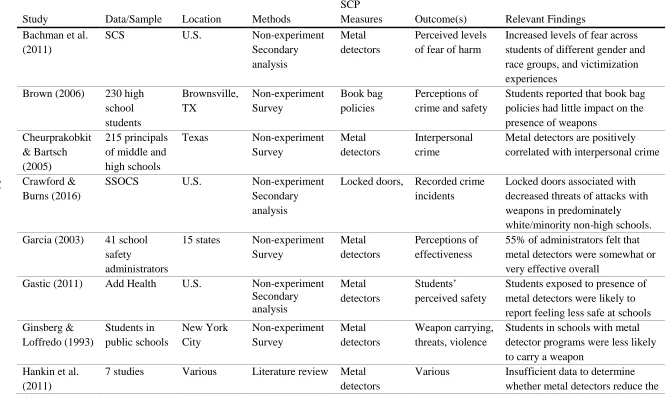
controlling tools and weapons (e.g., book bag bans). Table 2.1 presents studies that
examined techniques designed to increase the effort of crime. A wealth of the literature
on controlling access to facilities has focused on the effects of metal detectors on both
perceived and actual safety outcomes. There is some evidence which suggests that the use
of weapon detection systems in general (e.g. metal detectors, surveillance cameras, strict
dress code) are associated with less violent incidents (Jennings et al., 2011). However,
research examining the effects of metal detectors specifically on violent crime reveal
mostly null effects (Ginsberg & Loffredo, 1993; Schreck et al., 2003; Tillyer et al., 2011),
and more recent research suggests that there is insufficient data to determine whether
they reduce the risk of violent behavior among students and violent victimization among
students (Hankin et al., 2011). Specifically, studies have reported that students in schools
with metal detector programs were not less likely experience threats or violence
compared to students at schools without metal detector programs (Ginsberg & Loffredo,
29
Table 2.1 Summary of studies for SCP category: Increase the Effort
Study Data/Sample Location Methods
SCP
Measures Outcome(s) Relevant Findings Bachman et al.
(2011)
SCS U.S. Non-experiment Secondary analysis
Metal detectors
Perceived levels of fear of harm
Increased levels of fear across students of different gender and race groups, and victimization experiences
Brown (2006) 230 high school students Brownsville, TX Non-experiment Survey Book bag policies Perceptions of crime and safety
Students reported that book bag policies had little impact on the presence of weapons
Cheurprakobkit & Bartsch (2005)
215 principals of middle and high schools
Texas Non-experiment Survey
Metal detectors
Interpersonal crime
Metal detectors are positively correlated with interpersonal crime Crawford &
Burns (2016)
SSOCS U.S. Non-experiment Secondary analysis
Locked doors, Recorded crime incidents
Locked doors associated with decreased threats of attacks with weapons in predominately white/minority non-high schools. Garcia (2003) 41 school
safety
administrators
15 states Non-experiment Survey
Metal detectors
Perceptions of effectiveness
55% of administrators felt that metal detectors were somewhat or very effective overall
Gastic (2011) Add Health U.S. Non-experiment Secondary analysis Metal detectors Students’ perceived safety
Students exposed to presence of metal detectors were likely to report feeling less safe at schools Ginsberg & Loffredo (1993) Students in public schools New York City Non-experiment Survey Metal detectors Weapon carrying, threats, violence
Students in schools with metal detector programs were less likely to carry a weapon
Hankin et al. (2011)
7 studies Various Literature review Metal detectors
30
risk of violent behavior and violent victimization among students, and metal detectors may detrimentally impact student perceptions of safety
Lesneskie & Block (2016)
SSOCS U.S. Non-experiment Secondary analysis
Clear book bags
Violent incidents Clear book bags associated with increase in violence
O’Neill & McGloin (2007)
SSOCS U.S. Non-experiment Secondary analysis Locked doors, Closed lunch Violent crime, property crime
Locked doors decreased property crime, closed lunch increased property crime
Perumean-Chaney et al. (2013)
Add Health U.S. Non-experiment Secondary analysis Longitudinal Metal detectors Student perception of school safety
Associated with a decrease in students’ sense of safety
Reingle et al. (2016)
32 studies Various Meta-review Metal detectors Access controls
Various Metal detectors are inversely associated with perceived school safety
Tillyer et al. (2011)
2,644 seventh grade students nested within 58 schools
Kentucky Non-experiment Survey
Metal detectors
Victimization, risk perception, fear of violence
31
and that student’s risk of physical assault (Schreck et al., 2003). One study found that
metal detectors were correlated with more interpersonal crime, a composite measure
which includes possession of illegal weapons, assaults, and sexual assaults
(Cheurprakobkit & Bartsch, 2005). The crime reducing effect of metal detectors may be
more suited to deterring weapon possessions on school grounds. For instance, Ginsberg
and Loffredo (1993) found that schools with metal detectors were half as likely to carry a
weapon to school as students in schools without metal detectors. The few studies that do
find that metal detectors are effective at reducing violent crime focus on perceptions of
violence rather than the actual incidence of violence (Brown, 2006; Garcia, 2003).
Much research has examined the effects of metal detectors on perceptions of
school safety and fear of crime. Although one study based on a non-nationally
representative sample of seventh graders from Kentucky found students in schools with
metal detectors were less likely to be fearful of serious violence (Tillyer et al., 2011),
other studies indicate that metal detectors decrease perceptions of safety or have a
fear-inducing effect (Bachman, Randolph, & Brown, 2011; Gastic, 2011; Perumean-Chaney
& Sutton, 2013; Reingle, Jetelina, & Jennings, 2016). For instance, one study reported
that metal detectors and the number of visible security measures used in school were
found to be associated with a decrease in students’ sense of safety (Perumean-Chaney &
Sutton, 2013). Bachman et al. (2011) found that the presence of metal detectors increased
levels of fear across students of different gender and race groups, and victimization
experiences. Gastic (2011) reported that metal detectors are negatively correlated with
students' sense of safety at school, controlling for the level of violence at school. More
32
student perceived safety (Reingle et al., 2016). In sum, research on the effects of metal
detectors on violent crime has revealed generally null and opposite effects. These
findings suggest that not only are metal detectors ineffective, but that it is likely schools
with higher violence are more likely to use metal detectors (Wynne & Joo, 2011).
Another area of research on controlling access to facilities has examined the
effects of having locked doors and closing school campus during lunch. Having locked
doors in schools has been found to be associated with decreased incidents of property
crime, including thefts and vandalism (O’Neill & McGloin, 2007). However, in contrast
to what situational crime prevention predicts, closing campus during lunchtime is
associated with an increase in property crime (O’Neill & McGloin, 2007). This finding
suggests that when more people are together in an enclosed space (i.e., school), the
likelihood of property crimes is greater. Furthermore, at least one school characteristic,
the number of classroom changes, has been found to be positively associated with
property crime (O’Neill & McGloin, 2007). However, when distinguishing the racial
composition and grade levels of schools, the effects of certain SCP tactics has shown
evidence of effectiveness. For instance, a recent study by Crawford and Burns (2016)
found that access controlled doors were correlated with decreased incidents of threats of
attacks with weapons in both predominately white and minority schools, though not
including high-schools.
Research on the effects of tactics intended to control tools/weapons have focused
policies that ban book bags or require the use of clear book bags, as well as requiring
sweeps for contraband. Brown (2006) found that book bag policies had little impact on