A Survey of Digital Audio Watermarking
Techniques
Sakriti Dutt1 1
Department of Computer Science and Engineering, Guru Nanak Dev University, Amritsar, Punjab, India
Abstract-Recently, researchers have shifted their attention towards the capability of the audio files to hide the data. This capability of audio has act as a saviour of the recording industry. The identity of the owner of the audio file can be hidden in the audio file which is called Watermark. Therefore, digital audio watermarking is the process of hiding some information into the audio file in such a way that the quality and the audibility of the audio is not affected. In this paper, various methods of audio-watermarking has been discussed.
Keywords:DCT, DWT, SVD, GA,Tabu Search
I. INTRODUCTION
With the rapid development in computer technology, large number of medias are being converted to digital form and with the use of internet technology it has become very easy to access the unauthorized digital or multimedia information. According to IFPI, recording industry is loosing billions of dollars every year because of the illegal copying and distribution of audio files. Therefore, for the protection of multimedia, digital watermarking technique is used. Here is where, audio watermarking comes to rescue. Watermarking is a technique through which the secure information is carried without hampering the quality of the original signal.
II. REQUIREMENTS FOR AUDIO WATERMARKING
1. Perceptual transparency: Watermarks which are embedded in audio files can be of two types. They can either be perceptible or imperceptible. Imperceptible watermarks are preferred in of audio files because of their better robustness. [2][11]
2. Robustness: watermarks must be able to handle all sorts of attacks whether it is conversion, compression, Noise or any other form of attack. [2][11]
3. Capacity: The data stored in the audio file should be large enough so as to give the adequate information about the owner of the digital media.
III. PERFORMANCE EVALUATION MEASURES
For the evaluation of the performance of different watermarking scheme, various parameters can be used. There can be subjective tests which can be used to check the imperceptibility , where the listeners are made to listen the watermarked audio file in order to identify the similarities and dissimilarities between the original and the watermarked audio file. This is done using ITU-R grade, which is a 5-grade impairment scale in which the Mean Opinion Score(MOS) is calculated [13][19]. Diffgrade scale[21], also can be used for evaluating the
imperceptibility of the watermarked audio. Objective tests are also performed to evaluate the performance. Bit Error Rate (BER)[23] is used to evaluate the robustness of the algorithm. Higher the BER lower will be the robustness. To measure the perceptual quality of the audio signal, Signal to Noise Ratio (SNR)[13] and Peak Signal to Noise Ratio(PSNR)[19] can also be calculated. These parameters are used to amount of data that has been corrupted because of the noise[24]. Error is the difference between calculated value and the actual value. To measure the error in the watermarked audio file, Mean squared Error (MSE) is used. It is the average of square of ‘errors’. Certain similarity tests are also performed to evaluate the amount of similarity present between the watermark extracted and the actual watermark used. Normalised Cross-Correlation(NCC) is used to measure the same. Sim function[12] has the similar role as NCC.
IV. LITERATURE REVIEW
Yan yang et al.[1] in 2009 gave a novel audio watermarking algorithm. This Algorithm uses DCT transform. The digital audio signal after subjection is transformed using DCT transform. Simultaneously, binary image is reduced dimensionally and passed through pseudo-random compositor. The converted image is embedded into the transformed audio signal whereby which Inverse DCT algorithm is applied and watermarked audio signal is obtained. In the extraction process, the audio signal is decomposed and extraction is performed on the 3rd AC coefficient of the signal and after recovering the watermarked, it is subjected to the pseudo-random back tracking to obtain the actual 2-d image. The similarity b/w the recovered and the actual image is compared and along with that various attacks like filtering, Additive white Gaussian noise are applied to check the robustness of the algorithm. This blind audio watermarking technique given in this respective paper is robust against most of the attacks.
dilemma about the level on which the wavelet decomposition has been done.
In 2012, Elshazly et al.[4] proposed an algorithm which uses DWT along with mean quantization. After transforming the segmented audio signal using DWT and selecting the low energy coefficients, mean optimization is applied on it. The binary image ,which has been encrypted and reduced in dimensions, is embedded into the audio signal and then segmented audio signal is reconstructed and IWDT is applied to obtain the watermarked audio signal. In the recovery mechanism, the watermarked audio signal is segmented and transformed using DWT and after applying the mean quantization on this signal, watermarked image is recovered, reshaped and decrypted to obtain the original watermark. The performance evaluation for this algorithm has been done using SNR, PSNR, NCC and BER. It has been concluded that use of low-frequency coefficient increases the performance. This algorithm is highly robust against common attacks for example low pass filtering, compression, echo, resampling etc.,
Ghobadi et al.[5] gave an algorithm which uses LSB method. It is a blind audio watermarking technique tamper detection and prevention technique. Initially, audio file is converted to the vector which is then normalized and converted to matrix form. After calculating the mean of each column separately, it is embedded by using LSB method. And then reverse of the above process is performed. In the extraction methodology, the tamper detection is done to be if any tampering is done and if yes then the location of the respective tamper. BER and SNR have been evaluated to find the robustness of the algorithm and it has been concluded that DCT, FFT and DWT can be more robust than this fragile watermarking algorithm. In 2013, Lalitha et al.[6] proposed a DWT-Arnold transform based audio watermarking algorithm. After sampling and partitioning the audio signal, DWT is applied on the original audio signal to produces details and approximation sub-bands. After applying Arnold transform along with DWT on the image, it is embedded into the transformed audio signal. After this, inverse DWT is applied to obtain watermarked audio frame. In the extraction algorithm, the sampled and portioned audio signal is transformed using DWT to obtain the respective coefficients and then the watermark is extracted and Arnold transform is applied again to obtain the image. The subjective evaluation is done to know the Mean Opinion Score. This is done to check the impartibility of the watermarked audio signal. Then objective evaluation is done as well by calculating MSE, PSNR etc., After various subjective and objective test, it has been concluded that this technique is quite robust against many attacks and quality of the audio is preserved as well.
Lalitha et. al.[7],in 2011, proposed an algorithm which uses DWT-SVD technique of audio-watermarking. The DCT-SVD has been compared with DWT-DCT-SVD as well. The DWT-SVD algorithm proves to be more robust than DCT-SVD algorithm.
Nikmehr et. al.[8] proposed a method of audio watermarking which uses both DWT and DCT. The segments produced as a result of the segmentation of the
original audio signal further are divided into two sections. The synchronization bits are embedded into DWT coefficients of the first section whereas the watermark bits are embedded into the DCT coefficients of the second section The DCT coefficients are produced after performing DWT on the second section. This algorithm shows a very good resistance to the attacks.
In 2009, Wang et al.[9] proposed a blind watermarking algorithm which proves to be quite robust against the attacks which can be both common signal processing attacks and de-synchronization attacks. The effectiveness of the proposed system is due to the audio statistics characteristics as well as synchronization code which is made possible by a three step process—segmentation of audio signals and further segmentation of audio segments into two segments, embedding of synchronization code in first segment and then finally performing DWT on the two sections cut out of second segment. Barker code is used to help detect the position where the watermark has been embedded. The watermark scrambling algorithm is used to make this process more robust.
Wei FOO et. al.[10] gave an adaptive algorithm for audio watermarking which uses echo hiding method. The algorithm has been divided into two parts—encoder design and decoder design. In the encoder section, segmentation is performed on the original audio signal. After which mask computation and echo hiding is done and watermark information along with the kernel parameters are embedded into the audio signal. The segments are processed and watermark checking is performed to obtain the data about the watermark position and finally after recombining the segments, watermark audio signal is obtained. In the decoder design part of the algorithm, first the audio segmentation is performed on the watermarked audio signal. If two channels are obtained then peal detection is performed on the left and right channels and the respective results are compared and if consistent bits are obtained then the bits are combined and then watermark is used to identify the owner. Various attacks were made to check the robustness of the technique used and it has been concluded that the robustness against filtering is less.
the attacks like random noise, filtering, cropping. This algorithm shows fair robustness.
An adaptive audio watermarking algorithm using DWT and SVD has been given by Bhat et al.[13] in 2010. Sometimes detection of watermark becomes difficult because of the de-synchronization attacks. In that case de-synchronization code can be used along with watermark to construct a binary sequence. In the embedding section, the original audio is divided into two parts. On the 1st part, DWT followed by segmentation is applied to create a matrix. SVD is performed on the matrix hence obtained. After embedding the watermark, inverse SVD is applied. The steps from formation of matrix and inverse SVD are followed until last segment is obtained. After this segment reconstruction is done followed by Inverse DWT. This output is embedded along with the synchronization code to create a watermarked audio. In the extraction part, the synchronization part is searched for after which DWT and segmentation is applied to extract the watermark.
Tsai et al.[14] in 2003 proposed an intelligent audio watermarking algorithm which is depends on the properties of Human Auditory System(HAS). It uses the methods present in Neural networks as well and works in DCT domain. This is a blind audio watermarking technique. The neural network is used to remember the relationship present between actual audio file and the watermarked audio file. The audio masking capability of the human ears has been put to good use here to hide the watermark into the audio signal. The experimental results show that this algorithm given has a fair robustness against copy right attacks. Cvejic et al [15] gave a algorithm in 2003 which is also based on the wavelet domain. Audio signal is inputted into the filter to obtain the wavelet coefficients. Simultaneously, it is passed on for masking analysis as well to determine where the embedding of the watermark can be done. A secret key generator is used to create a pseudo-random sequence to randomly select a sub-band. After embedding has been performed inverse DWT is performed to obtain the watermarked audio signal. In the extraction methodology, the again the random selection of the sub-band is done. If the square of test statistics factor is more as compared to the threshold value then the watermark has been detected. After performing the listening tests and the attacks to check the robustness, it has been concluded by the authors that this algorithm shows high robustness Vaitheki et al.[16] gave an algorithm for audio water marking in which multiple-scrambling is done during the embedding stage. This algorithm mainly concentrates upon copyright protection. Each and every scrambling stage requires a key which is not known to anyone except for the owner of the audio file. After segmenting the audio signal, that component of audio signal is selected, which has the minimum amount of threshold value. After converting the image into coded data, the very first scrambling operation is applied. Randomly selected frames are chosen for embedding the encrypted image. In the extraction method, the watermarked audio is framed and spectral analysis is performed to obtain the original image. Experimentally, the proposed algorithm proves to be quite robust.
Sriyingyong et al.[17] gave an algorithm which uses DWT along with Adaptive Tabu Search(ATS). ATS keeps logs of all the steps starting from search to solution. It even has capability of doing backtracking. Binary image is transformed into 1-d matrix and then encrypted. Audio signal is decomposed. Using Db4 and approximation sub-band so obtained is segmented. After calculating average, each bit of watermark is embedded with the audio signal. Calculation of embedding intensity is done using ATS and at the end Inverse DWT is applied. In the detection algorithm, 5 level DWT has been applied and from coarse approximation coefficient mean value is calculated.
Swanson et al[18] in 1998 gave a data embedding algorithm which has the capability to resolve the ownership issues i.e., the problem of deadlock. The deadlock has been resolved by the author by using pseudo-random generator which uses two keys—one which depends on the author and other depends on the signal. The dual watermark scheme has been used. First watermark embedded needs the original file for the detection while the other watermark is independent of the original watermark. The watermark embedding algorithm, given in this paper, uses the both the temporal and frequency masking capability of the Human ears. To check the robustness of the algorithm, various attacks like multiple watermarks, resampling, noise etc., have been applied.
Ercelebi et al.[19] in 2008 put forward an algorithm for audio watermarking in which watermark is embedded in the low frequency component of the audio signal. In this lifting based implementation of DWT has been used. The watermark is embedded in low frequency approximation coefficients which correspond to high energy. Pseudorandom code is used to provide further security. Watermark comes out to be undetectable in audio signal. Method shows robustness to some of the attacks except for MP3 compression.
Fallahpour et al.[20] proposed a blind audio watermarking algorithm which embeds watermark in last high frequency band of 2nd level of wavelet decomposition. The division of this band is done and its average is used as key value. It has high data capacity and acceptable SNR. This shows robustness against attacks like noise, compression and echo.
Seok et al.[21] has discussed the basic requirements needed for audio watermarking algorithm. An algorithm using Direct Sequence Spread Spectrum (DSSS) has been discussed. This algorithm takes advantage of the masking capability of HAS. This extraction is blind method which uses whitening procedure. Robustness of watermarked audio is checked using attacks like mix down, amplitude and data compression.
After computation of the watermarked vector, amplification factor is obtained and then finally reconstruction of the original image is done. Imperceptibility of the algorithm has been checked using SNR and robustness of the proposed algorithm has been evaluated as well to check the performance of the algorithm against various attacks. Janardhanan et al.[23] put forward a work in which performance analysis of DWT technique was done. The evaluation was done using Indian classical songs as the subject. An algorithm has been presented containing the embedding and extraction section. Evaluation of various performance parameters have been performed using both subjective and objective tests. The similarity between the extracted and the original watermark has been detected and it has been concluded that the better results are seen A-8 sub-band.
Navjot kaur et al.[24] proposed an algorithm in 2013 in which audio watermarking was performed using DCT-DWT along with the Arnold transformation. Various applications of audio watermarking has been explained first of all. Then the detailed embedding and extraction process are given. After dividing the original audio signal, DCT-DWT transform is applied to transform the signal. At the
same time, the binary image which is to be used as watermark is transformed using Arnold cat map method and then embedded into the selected coefficient of the audio signal. A random private key is applied to enhance the level of the security. At the end, the regrouping is done. In the extraction process, the reverse process as that of embedding is applied to obtain the original audio signal. Then the subjective and objective tests lie MSE, SNR and NCC are performed to check the robustness of the algorithm. This algorithm is robust against the common attacks.
Michael Arnold[25] has explained the general signal processing properties and security properties of the audio signal watermarking. Various applications of audio signal watermarking have been explained for example copyright protection, monitoring, fingerprinting, etc., Along with this a general statistical algorithm of audio watermarking technique has been proposed and the properties shown have been discussed and evaluated. Quality, security and robustness of the proposed algorithm has been evaluated. Overall robustness shown by this algorithm turns out to be quite satisfactory.
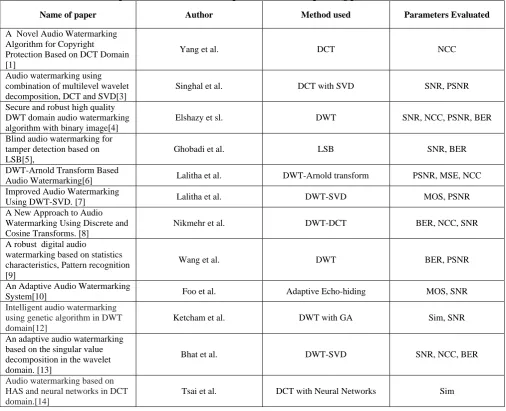
Table 1. Comparison of different techniques and the corresponding parameters evaluated
Name of paper Author Method used Parameters Evaluated
A Novel Audio Watermarking Algorithm for Copyright
Protection Based on DCT Domain [1]
Yang et al. DCT NCC
Audio watermarking using combination of multilevel wavelet decomposition, DCT and SVD[3]
Singhal et al. DCT with SVD SNR, PSNR
Secure and robust high quality DWT domain audio watermarking algorithm with binary image[4]
Elshazy et sl. DWT SNR, NCC, PSNR, BER
Blind audio watermarking for tamper detection based on LSB[5],
Ghobadi et al. LSB SNR, BER
DWT-Arnold Transform Based
Audio Watermarking[6] Lalitha et al. DWT-Arnold transform PSNR, MSE, NCC
Improved Audio Watermarking
Using DWT-SVD. [7] Lalitha et al. DWT-SVD MOS, PSNR
A New Approach to Audio Watermarking Using Discrete and Cosine Transforms. [8]
Nikmehr et al. DWT-DCT BER, NCC, SNR
A robust digital audio
watermarking based on statistics characteristics, Pattern recognition [9]
Wang et al. DWT BER, PSNR
An Adaptive Audio Watermarking
System[10] Foo et al. Adaptive Echo-hiding MOS, SNR
Intelligent audio watermarking using genetic algorithm in DWT domain[12]
Ketcham et al. DWT with GA Sim, SNR
An adaptive audio watermarking based on the singular value decomposition in the wavelet domain. [13]
Bhat et al. DWT-SVD SNR, NCC, BER
Audio watermarking based on HAS and neural networks in DCT domain.[14]
Name of paper Author Method used Parameters Evaluated
Robust audio watermarking in wavelet domain using frequency hopping and patchwork method. [15]
Cvejic et al. Patchwork method MOS, BER
A Havoc Proof For Secure And Robust Audio Watermarking.. [16]
Vaitheki et al. DC watermarking with multiple
scrambling BER
Wavelet-based audio
watermarking using adaptive tabu search. [17]
Sriyingyong et al. DWT with Adaptive Tabu
Search SNR, Sim
Robust audio watermarking using
perceptual masking. [18] Swanson et al. FFT with frequency masking MOS, Sim
Audio watermarking scheme based on embedding strategy in low frequency components with a binary image. [19]
Erçelebi et al. Lifting based DWT SNR, BER MOS
High capacity audio watermarking using the high frequency band of the wavelet domain. [20]
Fallahpour et al. DWT SNR, BER
A novel audio watermarking algorithm for copyright protection of digital audio. [21]
Seok et al. Direct Sequence Spread
Spectrum BER, Diffgrade
DWT-based audio watermarking.
[22] Al-Haj et al. DWT SNR, MOS, Sim
Performance Analysis of Discrete Wavelet Transform based Audio Watermarking on Indian Classical Songs[23]
Janardhanan et al. DWT MSE, PSNR, BER, NCC
Audio Watermarking using Arnold transformation with DWT-DCT[24]
Navjot kaur et al DWT-DCT with Arnold
function MSE, BER, SNR, NCC
V. CONCLUSIONS
Audio watermarking is new domain in the area of watermarking. It is much more cumbersome as compared to the image watermarking. This is because of the fact that the Human ears are way more sensitive as compared to the Human eyes. In this paper, various techniques for audio watermarking have been discussed. Some of the techniques are able to satisfy most of the requirements for the audio watermarking technique. But there is still a need for such an algorithm which can satisfy the every mentioned requirement for the audio watermarking with the flying colours.
REFERENCES
[1] Yang, Yan, Rong Huang, and Mintao Xu. "A Novel Audio Watermarking Algorithm for Copyright Protection Based on DCT Domain." Electronic Commerce and Security, 2009. ISECS'09. Second International Symposium on. Vol. 1. IEEE, 2009
[2] Mat Kiah, M. L., et al(2011). "A review of audio based steganography and digital watermarking." International Journal of Physical Sciences Vol. 6 No. 16 pp: 3837-3850.
[3] Singhal, Achintya, Anurag Narayan Chaubey, and Chandra Prakash. "Audio watermarking using combination of multilevel wavelet decomposition, DCT and SVD." Emerging Trends in Networks and Computer Communications (ETNCC), 2011 International Conference on. IEEE, 2011
[4] Elshazly, A. R., M. M. Fouad, and M. E. Nasr. "Secure and robust high quality DWT domain audio watermarking algorithm with binary image." Computer Engineering & Systems (ICCES), 2012 Seventh International Conference on. IEEE, 2012
[5] Ghobadi, Alireza, et al. "Blind audio watermarking for tamper detection based on LSB." Advanced Communication Technology (ICACT), 2013 15th International Conference on. IEEE, 2013 [6] N.V.Lalitha, Ch.Srinivasa Rao, P.V.Y.JayaSree. “DWT-Arnold
Transform Based Audio Watermarking.” Asia Pacific Conference on Postgraduate Research in Microelectronics and Electronics (PrimeAsia). IEEE, 2013
[7] N.V. Lalitha, G. Suresh, Dr. V. Sailiaja (2011). “Improved Audio Watermarking Using DWT-SVD.” International Journal of Scientific & Engineering Research, vol. 2 No.6. pp: 1-6
[8] Hooman Nikmehr, Sina Tayefeh Hashemy. “A New Approach to Audio Watermarking Using Discrete and Cosine Transforms.” International Conference on Communication Engineering, December 2010.
[9] X.-Y. Wang, et al., A robust digital audio watermarking based on statistics characteristics, Pattern recognition (2009), doi:10.1016/j.patcog. 2009.01.015
[10] FOO, S.W., Yeo, T.H., & Huang, D.Y.(2001) “An Adaptive Audio Watermarking System”. Proceedings of IEEE Region 10 International Conference on TENCON, (pp. 509-513)
[11] Kaur, Harleen. "STUDY ON AUDIO AND VIDEO
WATERMARKING. "International Journal of Communication Network Security” ISSN: 2231-1882
[12] Ketcham, M., & Vongpradhip, S. (2007). “Intelligent audio watermarking using genetic algorithm in DWT domain”. International Journal Of Intelligent Technology, Vol.2 No.2, pp:135-140.
[13] Bhat, Vivekananda, Indranil Sengupta, and Abhijit Das(2010). "An adaptive audio watermarking based on the singular value decomposition in the wavelet domain." Digital Signal Processing Vol. 20 No.6 pp : 1547-1558.
domain." EURASIP Journal on Advances in Signal Processing Vol.2003 No.3 pp: 764030.
[15] Cvejic, Nedeljko, and Tapio Seppanen. "Robust audio watermarking in wavelet domain using frequency hopping and patchwork method." Image and Signal Processing and Analysis, 2003. ISPA 2003. Proceedings of the 3rd International Symposium on. Vol. 1. IEEE, 2003.
[16] Vaitheki, K., and R. Tamijetchelvy(2010). "A Havoc Proof For Secure And Robust Audio Watermarking." International Journal of Computer Science and Security (IJCSS) Vol.3 No.6 pp: 536. [17] Sriyingyong, N., and K. Attakitmongcol. "Wavelet-based audio
watermarking using adaptive tabu search." Wireless Pervasive Computing, 2006 1st International Symposium on. IEEE, 2006. [18] Swanson, Mitchell D., et al(1998). "Robust audio watermarking
using perceptual masking." Signal processing Vol. 66 No.3 pp: 337-355.
[19] Erçelebi, Ergun, and Leyla Batakçı(2009). "Audio watermarking scheme based on embedding strategy in low frequency components with a binary image." Digital Signal Processing Vol.19 No.2 pp: 265-277.
[20] Fallahpour, Mehdi, and David Megías(2011). "High capacity audio watermarking using the high frequency band of the wavelet domain." Multimedia tools and Applications Vol.5 No.2-3 pp:485-498.
[21] Seok, Jongwon, Jinwoo Hong, and Jinwoong Kim(2002):. "A novel audio watermarking algorithm for copyright protection of digital audio." etri Journal Vol.2 No.3 pp:181-189.
[22] Al-Haj, Ali, Ahmad A. Mohammad, and Lama Bata(2011) "DWT-based audio watermarking." Int. Arab J. Inf. Technol. Vol. 8 No.3, pp :326-333.
[23] Janardhanan, C. M., and C. Sathish Kumar(2013). "Performance Analysis of Discrete Wavelet Transform based Audio Watermarking on Indian Classical Songs."International Journal of Computer Applications, Vol. 73, No. 6