Basic Stages in Developing an Adaptive E-Learning
Scenario
Todorka Terzieva1, Asen Rahnev2
1 Department of Software Technologies, Faculty of Mathematics and Informatics, Plovdiv University “Paisii Hilendarski”
Plovdiv, 4027, 236 Bulgaria Blvd, Bulgaria
2 Department of Computer Technologies, Faculty of Mathematics and Informatics, Plovdiv University “Paisii Hilendarski”
Plovdiv, 4027, 236 Bulgaria Blvd, Bulgaria
Abstract
The aim of this study is to present the main stages in the development and implementation of adaptive e-learning through the DisPeL platform. Adaptation is presented as a two-way process - on the one hand adapting the educational environment to the personality of the learner. On the other hand, the student is actively involved in the design and construction of an individual educational trajectory. The modelling of adaptive e-learning is done by individualizing the learning process based on the creation of e-courses, taking into account the learner's individual characteristics, the level of the initial knowledge, the levels of perception, the individual objectives and the tasks of the training. The purpose of adapting eLearning systems is to ensure effective training by providing an opportunity for learners to communicate with an environment that meets their needs, behaviors and knowledge.
Keywords: Adaptive e-learning, Adaptive learning system, Adaptability and individualization in learning, DisPeL platform.
1. Introduction
The aim of adaptive e-learning is to give an opportunity for the student to master the materials prepared for studying and to provide additional material, depending on its interests and opportunities. Generally supplied the adapted educational material needs to achieve the objectives assigned to the learning process. As noted above, the purpose of the adaptive e-learning is seemingly one - to absorb the teaching learning material to the maximum, but the purpose of education is more complex. The reason for the introduction of adaptive e-learning is conditioned in order to have an effective learning process, some training materials are required. These materials are to be tailored to the different characteristics of the learner as specific objectives, preferences, knowledge, learning style and more, and on this basis to use appropriate pedagogical strategy [2].
The adaptive e-learning systems better determine the level of initial training and give information for the current status of the knowledge and skills of every student. This allows to choose the appropriate course materials, assignments and exercises to increase training effectiveness rationally. Insufficient awareness of the actual level of knowledge of students as well as the natural differences in their ability to learn knowledge and competencies are a major reason for the emergence of adaptive e-learning systems.
2. Didactic stages in the implementation of
adaptive e-learning
Under adaptability in the training in modern scientific concept means individualization of the learning process on the basis of creation of electronic courses, taking into account individual characteristics of students, including psychological characteristics, level of initial knowledge levels of perception, as an individual goals and training tasks. Adaptation can be seen as adaptive planning (static adaptation) and adaptive interaction or dynamic adaptation. The implementation of adaptive planning in students’ education allows to implement an adaptation as for a group of students, so for a separate student who studies or develops different skills and knowledge that relate to specific useful competencies. In the process of information interaction in the dynamic adaptation is performed as modifying the content and the forms and ways of presenting educational and methodological materials and the overall management of the adaptability of the system for each student [4].
planning of the educational trajectory and the creation of a complex model for the assessment of the student. Most of the adaptive applications apply a substantially adaptive approach only from the point of view of measuring the learner's knowledge, without being able to diagnose the cognitive level, the nature of thought processes, employability, degree of cognitive and practical independence and activity, etc. An example of such a poorly adaptive approach is the test, according to the results of which the adaptive e-system determines what learning content to be offered to the student further [8]. In this approach, almost no personalization is provided and no individual profile is created (knowledge extraction from large volumes of data). The creation of a model for assessing the cognitive qualities and abilities of a student is related to a number of problems of technological nature. From the point of view of pedagogical diagnosis, it is extremely important to define the most accurate criteria for assessing the results achieved. These criteria must be consistent with the taxonomies of cognitive processes of thinking.
2.1 Self-formation of an educational trajectory
One of the most important problems with the implementation of adaptive e-learning is related to the self-formation of educational trajectory in accordance with personal desires and abilities including level and quality of initial training. Solving this problem requires passing through the following didactic stages:
2.1.1. Diagnosis of the educational objectives
These are the goals that are related to the specific learning outcomes set by the learner. They include the students’ aspiration of what knowledge, skills and competencies he or she has to learn, what experience he or she needs to gain. These diagnostic objectives are different from the teacher's goals - the knowledge to be taught, which is characteristic of the traditional teaching methodology [9]. The task of constructing a scheme for structuring the educational objectives was undertaken for the first time in the USA. In 1956 Benjamin Bloom published his taxonomy of the educational objectives for cognitive activities, which proved to be extremely valuable for the diagnostics of the results from educational work [3]. This theory bears the idea that the objectives and the outcomes of education are not the same. Many cognitive psychologists work on the development of more precise and adequate taxonomy for the basic cognitive conceptions and level of thinking. In 2001 Anderson and Krathwohl [1] specify and develop the taxonomy suggested by Bloom, emphasizing more on the
creative paradigm, in which the intellectual development is studied as a change of the thinking pattern of the trainees. The major differences lie in the more useful and comprehensive additions of how the taxonomy intersects and acts upon different types and levels of knowledge - factual, conceptual, procedural and metacognitive. This melding can be charted to see how one is teaching at both knowledge and cognitive process levels. The new taxonomy makes distinction between knowledge on what “contains the cognitive activity” and knowledge on how, i.e. the procedures used for solving problems. The skill to combine elements in order to obtain something new suggests creative activity for the creation of new schemes and structures [6].
2.1.2. Gradual reflection of the student and the
teacher
The self-formation of an educational trajectory is necessarily connected with a gradual reflection of both the student and the teacher. At each stage of the training a correlation of the achieved results with the preliminary planned, evaluation and self-assessment of the achieved temporary results is necessary. If there is a significant discrepancy between the achieved and planned learning outcomes, a correction is needed to overcome the differences. The concept of reflective practice has found wide application in the field of e-learning both for learners and the teachers. When students are engaged in reflection, they are thinking about how their work meets established criteria; they analyze the effectiveness of their efforts, and plan for improvement. Reflection is linked to elements that are fundamental to meaningful learning and cognitive development: the development of metacognition – the capacity for students to improve their ability to think about their thinking; the ability to self-evaluate - the capacity for students to judge the quality of their work based on evidence and explicit criteria for the purpose of doing better work; the development of critical thinking, problem-solving, and decision-making; and the enhancement of teacher understanding of the learner.
broader understanding would accept that it also involves questioning the organizational, social and political context in which the teaching takes place [7]. As Larrivee note when teachers become reflective practitioners, they move beyond a knowledge base of discrete skills to a stage where they integrate and modify skills to fit specific contexts, and eventually, to a point where the skills are internalized enabling them to invent new strategies. They develop the necessary sense of self-efficacy to create personal solutions to problems.
2.2. Criteria for diagnostics of learning results
One of the major problems of both the theory and practice of the didactic testing is the determination of the objectives and the tasks of the educational work, the achievement of which is diagnosed by tests. Defining the objectives is an important stage of the overall planning, conducting and evaluation of the education. According to the definition adopted by the European Qualification Framework (EQF), the learning outcome is defined as an indicator of what the trainee knows, understands and is able to do in completing the learning process. Therefore, the emphasis is on the learning results, which are specified in three categories – knowledge, skills and competence. Within the context of EQF, competence means a proved ability to use knowledge, skills and personal, social and/or methodological abilities in the work to study situations and to achieve professional and personal development. The term competence is broader and typically refers to the ability of a person to face new situations successfully using and applying knowledge and skills in an independent and self-directed way [10].
For example, the initial teaching of informatics and information technologies must form not only the basic concepts, skills and habits to work with computer, but also to provide development of certain style of thinking. Thinking development in the learning process means the forming and the perfecting of all types, forms and operations of thinking, development of skills and habits of applying the laws of thought in the cognitive and learning activities, as well as habits to transfer the intellectual activity methods from one area of knowledge to another. Most generally, the schematic and intellectual development of the student may be described and understood through the categories of the knowledge – thinking – ability and the motivation of the mental self-development [6]. The main questions, which must be answered, are related to whether the objectives are achieved, what is the efficiency of the learning work, how good is developed the educational environment and technology of teaching, etc.
3. Adaptive learning scenario through DisPeL
3.1 Implementation of adaptive learning through
DisPeL
DisPeL (Distributed Platform for e-Learning) is an integrated software system for automating the management, administration and implementation of the learning process. The platform can be used in any institution where there is a need to provide and use electronic services in the field of education - universities, schools, private companies, public organizations and others. The model components and services provided DisPeL are detailed in [5]. The main services provided by DisPeL are: administration of the educational process; Web audiences; adaptive learning content - adaptive electronic textbook; electronic testing and evaluation; electronic services to support traditional proof test and measurement and others. The distributed platform allows interaction with other software systems, regardless of the technologies that have been implemented. This allows for future expansion and integration of the system. DisPeL can improve the learning process by offering the following electronic services:
• automate the process of administration; • maintenance of adaptive educational content; • electronic testing and evaluation;
• supporting traditional proof test and evaluation. DisPeL achieves adaptability through:
Continuous testing. At the end of every chapter of the
learning content, the learner is put to a test on the covered materials. The system assesses the answers and presents the learner with a summary of identified lapses in his knowledge. Then, the learner can quickly navigate to the related part of the content to improve his knowledge on these areas. A unique learning flow through the material is created for every learner.
Personalization: learners can personalize the learning
content. Personalization elements are private for learners, meaning these notes and highlights are visible only to the learner who created them. This enhances the personal experience for every learner. Personalization includes:
• Add notes. Notes are free textual content which can be embedded into the e-learning content. • Emphasize content. Emphasis enables learners to
put a visual mark on some part of the text, which can draw their visual attention quickly next time they are processing the text.
• Customize presentation of text. People’s
change the font, base size of the font, line spacing, and background and foreground colors.
3.2 Adaptive learning scenario
Platform DisPeL enables you to make various reports on different aspects of the learning process, the time that every student is using for learning on a specific topic from the curriculum, the number of wrong and right answers for each student and for the whole group of students who were trained in a given period of time. The approaches to achieve adaptive e-learning content in DisPeL comprise repeating testing and monitoring of progress, personalization of content and adaptive presentation.
The educational content is presented strictly linear, in this way the construction of a unique way of learning for each student is achieved mainly through test questions. At the end of each lesson from the educational content of textbooks students sit for a test on the material which are studied and only in successfully solving this test is given access to educational content to the next lesson.
Fig. 1 Statistical summary for each student
DisPeL give evaluate the responses and provide information with the presumed absence of knowledge for the every particular student. In creating tests into e-textbook it was set the objective of each student to receive a unique test questions on material from this lesson, regardless how many returns there are to this material. This requires a sufficient number of test questions, the creation of which is laborious and takes considerable time [5]. The system provides a possibility for creating a student profile. For each student, who uses the electronic textbook, it can be traced which subjects are read over, the length of time that is allocated for self-study, as well as statistics on intermediate and final tests that are the conducted independently or by the teacher.
Figure 1 shows a sample of information about statistical summary for each student.
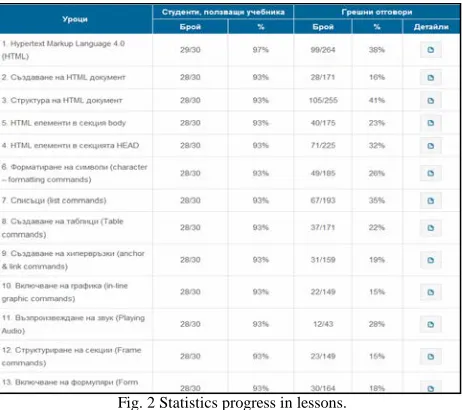
From Fig. 1 is seen the big difference between the results of the testing of each student, which confirms the need for personalized learning with individual pace and a private path. After completing the test, the system outputs a list of wrong answers given by each student and correct answers to each question. The wrong answers are displayed on a red background. Also, the system displays the number of test questions and the number of correct answers given by a student. This allows students to see their mistakes and gain real insight into the performance of the test. Figure 2 shows a sample of information about progress in lessons.
Fig. 2 Statistics progress in lessons.
One of the possibilities that the system provides is statistics information for the conducted exams so far. In this way, the teacher can make personal summaries for a particular student or group of students with them to conclude how well is the teaching material assimilated of different topics dealt with in a given discipline. Also the teacher can easily make comparisons of test scores in certain subjects in different years. Thus it can be followed to what extent the change in the methodology of teaching and various teaching strategies affects the absorption of knowledge and skills of students.
4. Conclusions
• Planning the learning process and creating an individual trajectory of learning;
• Adaptation from the point of view of the content of the teaching materials;
• Adaptation to the level of acquired and assessed knowledge.
The task of adaptive learning systems is to optimize the learning process by providing the learner with educational material in the most preferred form. The result of this approach is to improve the quality and effectiveness of the learning process. Adaptive e-learning has a number of advantages over traditional forms of learning, such as: building a flexible individualized learning path and an individual pace of learning; planning the course of learning by learners themselves; diagnostic control of the trajectory of training and correction in accordance with individual feature.
Acknowledgments
Parts of this work are supported by a project SP17-FMI-011 of the Scientific Research Fund of Plovdiv University “Paisii Hilendarski”, Bulgaria.
References
[1] L. Anderson and D. R. Krathwohl. A Taxonomy for learning, teaching, and assessing. New York: Longman, 2001. [2]. V. Arnaudova, V., Terzieva, T. and A. Rahnev. A
methodological approach for implementation of adaptive e-learning. CBU International Conference Proceedings, Prague, Czech Republic, v.4, 2016, 480-487.
[3] B. Bloom. Taxonomy of educational objectives: The classification of educational goals: Handbook I, Cognitive domain. New York: Longmans, 1956.
[4]. P. Brusilovsky. Adaptive Hypermedia for Education and Training. In: Adaptive Technologies for Training and Education, Cambridge University Press, Cambridge, UK, 2012, pp. 46–68.
[5] A. Rahnev, N. Pavlov and V. Kyurkchiev. Distributed Platform for e-Learning – DisPeL, European International Journal of Science and Technology (EIJST), Vol. 3, No. 1, 2014, pp. 95–109.
[6] S. Grozdev and T. Terzieva. A didactic model for developmental training in computer science, Journal of Modern Education Review, Academic Star Publishing Company, Vol. 5, Num. 5, May 2015, New York, USA, pp. 470 - 480.
[7].B. Larrivee. Transforming teaching practice: becoming the critically reflective teacher. Reflective Practice: International and Multidisciplinary Perspectives. 1 (3): 2000, 293–307.
[8]. A. Malinova, O. Rahneva and A. Golev. Automatic Generation of English Language Test Questions on Parts of Speech, IJPAM , Vol. 111, No. 3, 2016, pp. 525-534. [9]. T. Terzieva, E. Angelova and V. Arnaudova. Didactic
problems in implementation of adaptive e-learning. Scientific Works of the Union of Scientists in Bulgaria - Plovdiv, Series С. Teсhnics and technologies, Vol. XIV, 2017, 47-52. [10].ESCO, European Skills, Competences, Qualifications and
Occupations (ESCO) (Online) 2013,
https://ec.europa.eu/esco/web/guest/escopedia/-/escopedia/ Competence (available - 16.10.18)
First Author Assoc. Prof. Todorka Terzieva, PhD in Pedagogy of Education in Informatics and Information Technologies, Head of Software Technologies Department, Faculty of Mathematics and Informatics, Plovdiv University “Paisii Hilendarski“, Bulgaria. Assoc. Prof. Terzieva has more than 60 scientific publications and over 30 reports of scientific conferences. Prof. Terzieva is author and co-author of more than 10 textbooks for students in the field of computer science and information technology (including electronic).
Second Author Professor Asen Rahnev, PhD in Mathematics, Assoc. Prof. in Computer Sciences and Professor in Pedagogy of Education in Informatics and Information Technologies, Department of Computer Technologies, Dean of Faculty of Mathematics and Informatics, Plovdiv University “Paisii Hilendarski“, Bulgaria.