Differential Power Analysis on ZUC Algorithm TANG Ming1,2, CHENG PingPan2 ,QIU ZhenLong2
1State Key Lab. of AIS & TC, Ministry of Education, Wuhan University, Wuhan 430072, China;
2
School of Computers, Wuhan University, Wuhan 430072, China;
Abstract. Stream cipher ZUC plays a crucial role in the next generation of mobile
communication as it has already been included by the 3GPP LTE-Advanced, which is
a candidate standard for the 4G network. Through a long-time evaluation program,
ZUC algorithm is thought to be robust enough to resist many existing cryptanalyses,
but not for DPA, one of the most powerful threat of SCAs(Side Channel Analysis).Up
to the present, almost all the work on DPA is for block ciphers, such as DES and AES,
a very few work has been done on stream ciphers, such as ZUC algorithm, for
particular reasons that would be illustrated in the later section. In this paper, we
generally study the security of unprotected ZUC hardware implementation against
DPA. Our theoretical analysis and experimental results show that ZUC algorithm is
potentially vulnerable to this kind of attack. Furthermore, kinds of common
countermeasures are discussed when we try to apply them to ZUC hardware
implementations, both the security and tradeoffs are considered. The experiments are
given in the last section to verify our conclusions, which would undoubtedly provide
some guidance to the corresponding designers.
Key words: SCA, DPA, Stream Cipher, ZUC algorithm
1 Introduction
In the field of telecommunications, the world is stepping into 4th Generation (4G for
short) standard. During the last few years, the 3rd Generation Partnership Project
(3GPP) has submitted Long Term Evaluation Advanced(LTE-Advanced) [1], which is
the enhancement of the LTEstandard, as a candidate for the 4G network. Particularly
and integrity algorithmset to guarantee its security.The latest algorithm set isthe
128-EEA3 (EEA is short for the Encryption Algorithm)[2] and the 128-EIA3(EIA is
short for the Integrity Algorithm) [2].Both of the two algorithmsare based on a
proposedstream cipher algorithm ZUC [3] with an internal state of 496 bits initialized
from a 128-bit secret key and a 128-bit initialization vector (IV for short).
To ensure the security of the proposed ZUC algorithm, it was agreed that a robust,
three–phase evaluation program would be needed, including the evaluations by an
ETSI SAGE task force, the evaluation by two funded teams of academic experts, and
a public evaluation phase.Having experienced such a long-time evaluation program,
up to the present, ZUC algorithm is thought to be robust enough to resist against many
existing cryptanalyses such asWeak Key Attacks, Guess-and-Determine Attacks,
Algebraic Attacks, Timing Attacks, etc.[4]. However, whether the algorithm is
vulnerable to Power Analysis (PA) [5], one of the most effective SCAs(SCA is short
for side channel analysis)[5,6,7] to recover secret keys in numerous cryptosystems, is
not known yet.One point should be noted is that in terms of Power Analysis, we
usually distinguish between Simple Power Analysis (SPA) [5] and the other more
powerful analysis methods, such as Differential Power Analysis (DPA for short) [5],
Correlation Power Analysis (CPA for short) [8], .etc. However, throughout this paper,
we study more particularly about DPA, since it does not depend on the leakage
function and has a better practicability than other PAs.
In [5] P. Kocher et al. firstproposed DPA, which performs a statistical analysisof
the power consumptionfora smart card and finally retrieve the secret key. The attack
exploits the fact that the power consumption of a cryptographic device is dependent
on the intermediate values operated during the encryption, and it has been shown to
be a practical threat to the security of cryptosystems.
In this paper, we generally studied the security of the unprotected ZUC algorithm
againstDPA. Furthermore, kinds of effective countermeasureswerediscussed to protect
the hardware implementations of ZUCalgorithm from DPA. Experimental results are
1.1Related Work
1) DifferentialPower Analysis.During the last decade, sidechannel analysishas been shown to be a major threat towards the cryptographic implementations, regardless of
software and hardware.Among SCAs, DPA is one of the most commontechniques for
its high efficiency, good applicabilityand convenient performance compared with
other methods. However, almost all the work on DPA is for block ciphers (e.g.
DESand AES) and public key algorithms (e.g. RSA), there is a very few researches on
stream ciphers. The difficulty for DPA against stream ciphers lies in the fact thatthe
key steam generated by a stream cipher is independent from the plaintext and the
ciphertext,so the prerequisites of DPA attacks are not present, because we cannot use
the known values (i.e. the plaintext or the ciphertext) and the guessed values (i.e. a
part of the secret key needed to be recovered) to determine the intermediate result
during the encryptions.
2) DPA on Stream Ciphers. However,Joseph Lanoet al. [9] point out that, in real applications, for the purpose to keep synchronization between the sender and the
receiver, stream cipher usually needs to be frequently resynchronized. In this situation,
the initial state of the stream cipher is frequently changed with different IVs while the
secret key(the secret key here is actually our attacking target in DPA, it was used to
initial the internal state of ZUC algorithm combined with the IV) is identical. So, we
can just treat the initial value as the plaintext in DPA while regard the generated key
stream as the ciphertext, and use the IV and the guessed key together to determine the
intermediate value of stream ciphers. So, DPA is still possible to attack stream
ciphers.In this paper, actually, our DPA strategy is based on this thought.
From another perspective, Sanjay Burman et al. proposed a PA based SCA
method to attack LFSR-based stream ciphers, which can precisely recover the state of
an n-bit LFSR through collecting the power of the LFSR in each clock period over
consecutive periods linear in n [10].And in [11], with a similar strategy, the authors
use DPA successfully break down the Grain-80 stream cipher and recover the secret
cipher’s power and the switching activity of the state bits of FSR.
3) DPA countermeasures. As the serious threat brought by DPA, lots of efforts have already been dedicated towards the development of the corresponding
countermeasures on block ciphers [12, 13, 14, 15, 16, 17], all these countermeasures
are supposed to be able to be applied on stream ciphers as well [11].One subject of
research has been on algorithmic countermeasures that try to randomize all the
intermediate results during the processes. Thiskind of countermeasure isusually called
masking [12,13, 14], which can be applied either at algorithm level or at gate level.
However in practice, masking strategy is usually very specific and requires additional
cost of reduced performance, so we often combine this kind of countermeasure and
othercountermeasures for better performance. Hardware countermeasures try to make
the power consumption of a device independent of the data being processed by the
device. Typical examples are noise generatorsand the insertion of random delays [15,
16],logic styles with data-independent power consumption [17, 18], etc. Among
which, in the real applications, the insertion of random delays is the most popular
countermeasure for its simplicity while logic styles with data-independent power
consumption are the most efficient ones for its best performance.
There are also some countermeasures specifically targeting at protecting stream
ciphers. To our best knowledge, in order to counteract the potential threat of power
analysis methods in [10], the author in this paper first proposed an architecture level
countermeasure specifically targeting at LFSR-based stream ciphers. And in
COSADE 2012,Shohreh Sharif Mansouri et al. [11] proposed another architectural
countermeasure against power analysis for FSR-based stream ciphers, which can
resist against DPA, MIA and several more complex power attacks.
1.2 Our Contribution
This is the first paper trying to perform DPA on ZUC algorithm. There havealready
been a few publications towards the security of the ZUC algorithm from traditional
evaluation of the ZUC algorithm on the resistance against several cryptanalytic
attacks, weak key attacks, guess-and-determine attacks, algebraic attacks, timing
attacks, etc. ChunfangZhou et al. extend the differentialpropertiesof the initialization
stage of ZUC algorithmfrom 20 roundsto four more rounds and shows that ZUC can
still resist against chosen-IV attacks [19]. However, whether ZUC can resist against
DPA is rather unknown.In this paper, this topic is generally studied.Ourfinal analysis
results show that ZUC algorithm is to some extent vulnerable to DPA.
Since DPA is a potential serious threat of ZUC algorithm,it is necessaryfor
designers to add theeffective countermeasures to the ZUC implementation to
guarantee its security in real applications.However, all the countermeasures proposed
in [10, 11] specifically targeting at stream ciphers cannot resist our DPA strategy
proposed in this paper, because our attacking point is not the state of FSR or LFSR
but the outputs of S-box in ZUC stream cipher. Thus, these kinds of countermeasures
which decrease the correlation between the power of FSR and the total power of
cipher cannot work on our attack. In this paper, we generally apply several of the
countermeasures which are initially designed for block ciphers but still working on
stream ciphers to the implementations of ZUC algorithm, and study the ability of
protected ZUC algorithm against DPA.We generally take the tradeoffs and security
into consideration, which wouldundoubtedly provide some guidance to the designers.
1.3 Organization of This Paper
The remainder of this paper is organized as follows. Section 2 presents the
introduction ofthe hardware implementation of ZUC algorithm and the general steps
of DPA [5]. Our detailed DPA strategy on ZUC algorithm is described in Section 3.In
Section 4,we discussthree kinds of countermeasures trying to protect ZUC
implementations from DPA. Our experiments resultsare in Section 5 and finally, we
2 Preliminaries
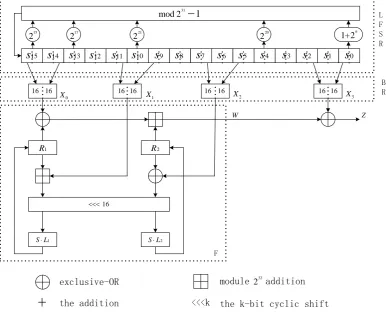
2.1 The Definition of ZUC Algorithm
15
s s14 s13 s12 s11 s10 s9 s8 s7 s6 s5 s4 s3 s2 s1 s0 15
2 217 221 220 1+26
31
mod 2 1
16 16 16 16 16 16 16 16
0
X X1 X2 X3
1
R R2
16
1
S L S L 2
W Z
L F S R
B R
F
exclusive-OR module 32
2 addition
the addition
+
<<<k the k-bit cyclic shiftFig 2-1the structure of ZUC Algorithm
In this section, we briefly introduce the latest ZUC algorithm, for detailed phase
please refer to [2]. The new stream cipher ZUC is a world–orientedstream cipher [ ],
taking a 128-bit secret key and a 128-bit IVas input, and outputs a keystream of 32-bit
words, which is used to encrypt or decrypt the data.According to the official ZUC
specification [3], ZUC is composed of three logical layers, among whichthe top layer
is a linear feedback shift register (LFSR for short) of 16 cells, the middle layer is the
bit-reorganization (BR for short) operation, and the bottom layer is a nonlinear
function F. The structure of ZUC is illustrated in Fig 2-1.
2.1.1 The Linear Feedback Shift Register (LFSR)
register cell Si(0 i 15) is restricted to take values from the following set:
31
{1, 2,3, . . ., 2 1}. The LFSR has two modes of operations: the initialization mode
and working mode. The initialization mode works as Algorithm 1 shown.
Algorithm 1. LFSRWithInitialisationMode u( ){
1. 13 10 4
15 17 21 20 8 31
15
2 2 2 2 (1 2 ) mod(2 1)
v s s s s ;
2. 31
16 ( ) mod(2 1)
s uv ;
3. If s16 0, then set s16 2311;
4. ( ,s s1 2,...,s15,s16)( , ,s s0 1 ,s14,s15). }
In the working mode, the LFSR does not receive any input, and it works as Algorithm
2 shown.
Algorithm 2. LFSRWithWorkMode(){
1. 15 17 21 20 8 31
15 13 10 4
2 2 2 2 (1 2 ) mod(2 1)
v s s s s ; 2. If s16 0, then set 31
16 2 1
s ; 3. ( ,s s1 2,...,s15,s16)( , ,s s0 1 ,s14,s15). }
2.1.2 The Bit-Reorganization
The middle layer of ZUC is the bit-reorganization (BR) procedure. It extracts 128 bits
from the cells of the LFSR and form four32-bit words, where the first three words will
in producing the key stream. Assuming thats2,s5,s7,s9,s11,s14,ands15are eight cells
of LFSR as in section 2.1.1. Then the bit-reorganizationforms 4 of 32-bit wordsX0,
1
X , X2andX3from the above cells as Algorithm 3.
Algorithm 3. Bitreorganization(){
1. X0s15H ||s14L;
2. X1s11L||s9H; 3. X2 s7L||s5H;
4. X3 s2L||s0H. }
2.1.3 The Nonlinear Function F
There are two 32-bit memory cells,R1andR2, in the nonlinear functionF. The input
of F isX0,X1,X2, which are the first three words ofoutput of the BR procedure,
and it outputs a 32-bit word W. The detailed processof the nonlinear function Fis
described in Algorithm 4, where S is a 32 × 32 S-box.
Algorithm 4. F X X X( 0, 1, 2){
1. W=(X0 ⨁ X1⊞)R21; 2. W1=R1⊞ 𝑋1;
3. W2 R2X2;
4. R1S L W( (1 1L||W2H));
5. R2 S L W( 2( 2L||W1H)).
Both L1andL2 are linear transforms from 32-bit words, and are defined as
follows:
32 32 32 32
1
32 32 32 32
2
( ) ( 2) ( 10) ( 18) ( 24)
( ) ( 8) ( 14) ( 22) ( 30)
L X X X X X X
L X X X X X X
.
2.1.5 The Key Loading
The key loading procedure will expand the initial key and the initial vector into 16
31-bit integers as the initial state of the LFSR. Let the 128-bit initial key kand the
128-bit initial vector iv be k k0||k1||k2|| ... ||k15 and iviv0||iv1||iv2|| ... ||iv15
separately, wherekiandivi,0 i 15, are all bytes. Then kiandiviare loaded into the
cellsSiassi ki||di||ivi, where di is a known constant.
2.1.6 The Execution of ZUC
The execution of ZUC is composed of two stages: the initialization stage and working
stage. During the initialization stage, the cipher algorithm runs the following
operations 32 times to finish the initialization:
1.Bitreorganization();
2.WF X( 0,X X1, 2);
3.LFSRWithInitialisationMode w( 1).
After the initialization stage, the algorithm moves into the working stage. At the
beginning of this stage, the algorithm executes the following operations once, and
discards the outputWof nonlinear functionF :
1.Bitreorganization();
2.F X( 0,X X1, 2);
Then the algorithm goes into the stage of producing keystream, i.e., for eachiteration,
the following operations are executed once, and a 32-bit word Z is produced as an
output:
1.Bitreorganization();
2.Z F X( 0,X X1, 2)X3;
3.LFSRWithInitialisationMode().
2.2 Implementation in Hardware
0
LFSR
f (linear)
15 13 10 4 0
BR
1514 11 9 7 5 2
F (nonlinear)
>>1 +
M U X
W Z
Fig 2-2implementation of ZUC Algorithm in Hardware
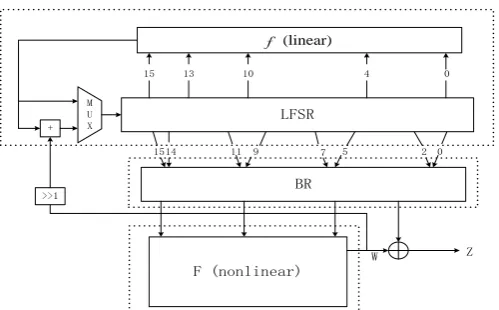
Thestructure of the hardware implementation of ZUC algorithm is illustrated in Fig
2-2. It is mainly made up of the following parts:
- a LFSR of 16 cells s0,s1, …, s15;
- acombinatorial logic blockBR, implementing the bit-reorganizationoperation;
- a combinatorial logic blockF , implementing the nonlinear function F;
- a combinatorial logic block f, implementing mod(2311) addition operation;
- some extra XORs and other logic operations.
2.3 The Differential Power Analysis Attacks
Over the past ten years, there have been some new DPA attacks, but the main
other SCAs, DPAs are composed of two phases: the first is data collection, and the
other is statistical analyzing. The following steps provide an example of a DPA
processes proposed by Kocher:
1) Attackers choose a key-dependent selection function D. In this case, the selection
function would have the form D C b k( i, , s);
2) Attackers could observe mencryption operations and capture two kinds of
information as following:
- Ci represents cipher text which is corresponding to one power trace;
- ksamplings are collected and each sampling is related to a certain time point.
3) Statistically analyzing to get ks:
- Firstly, to get the value of T ji[ ]for a certain power sampling, iis the ith
power sampling and j represents the jthsampling point;
- Secondly, to compute the value of differential power based on function (1),
and only Ciand T ji[ ]are variable;
1 1
1 1
( , , ) [ ] (1 ( , , )) [ ]
[ ]
( , , ) (1 ( , , ))
m m
s i s i
i i i i m m s s i i i i
D C b k T j D C b k T j D j
D C b k D C b k
(1)- Eventually, if ksis incorrect,lim [ ] 0 m
D j
; adversely if ks is correct, the
computed value ofD j[ ]will not be zero and show spikes in regions where
Dis correlated to the values being processed. This conclusion has been
proofed by Kocher[5].
While the effects of a single transistor switching would be normally be
impossible to identify from direct observations of a device's power consumption, the
statistical operations used in DPA are able to reliably identify extraordinarily slight
differences in power consumption.
3 DPA attacks on the ZUC Algorithm
applications, it is possible for attackers to obtain a huge number of power traces of a
stream cipher using different initial values but the same secret key. In this case, we
can choose a selection function D combined with the IV and the guessed key to
determine the intermediate value of the algorithm.
This section presentsour DPA strategyonZUC algorithm.
3.1 Overview
The main stages of the attack are as follows, we generally recover the secret key bytes
by bytes:
1) Data collection stage: collect power consumptions;
2) Use DPA against the first round of the initialization stage to recover k9andk5.
The value ofR1and R2registers and the state of the 16 LFSR cells derived in the
first round are used in the second round of the initialization stage, to recover k10
andk6;
3) Use the same strategy in the next few rounds, and determine the correct key
informationk11, k7, k12, k8, and k13 separately;
4) Performthe DPA in the sixth round of the initialization stage to make an
exhaustive search ofk15,k14,k4,k0 and recover them;
5) Use the same strategy as step 4) to get the values ofk11and k1 in the next round
of the initialization stage;
6) Finally, determine the only left byte of the secret key k2 in the eighth round.
The attack details are given in the next section and the experiment results are
presented in Section 5.
3.2 Attack Details
Collecting the power traces covering the first eight rounds of ZUC algorithm, the
initialization and key-loading operations of EEA3-128 algorithm should be also
covered.
Step 2: Use DPA to recover k9andk5. In the first round of the initialization stage of ZUC algorithm, the inputs of eachS-box are solely related to the correct key
information k9ork5. Therefore, for each byte of the secret key,the DPA can perform
an 8-bit exhaustive search over the bits, and use one bit of the outputs of the
corresponding S-box as the partition bit to recover the correct information.The data
flow related with the secret key bitsof k9 andk5in each operationis as follows:
1
R R2
|| ||
0
X X1
1
W W2
1
S L S L 2
L F S R
B R
F
11
S S10 S9 S7 S6 S5
9
k k5
9
k k5
only rely on
the unknown k9
only rely on
the unknown k5
Fig3-1the data flow related to the secret k9 andk5in DPA
- KeyLoading IV d KEY( , i, ).This operation makes each cell s0, …,s14, s15of the
LFSR solely related with the correct informationk0, …, k14, k15respectively,
- Bitreorganization(). Afterthe combinations in this step:
1 0[30 : 23] 5
X k
1[15 : 8] 9 X k
2[15 : 8] 5 X k
,
whereX A B[ : ] represents the highest[A:B] bits of X ( AB ). We do not
consider X3 in our attacks for it does not involve in the nonlinear function
F(our attacking operation) operation of initialization stage.
- WF X X X( 0, 1, 2).The analysis of the nonlinear function Fdisplays the most
crucial part of the total attacks.X0, X1, andX2 derived in the above processes
are needed in this step:
1) In the first three functionsofthe Ffunction(seeSection 2.1.3), since the initial state of R1 and R2 are both zero, it is easy to find that the
topeight-bit of W is identical with the secretkeyinformation in X0, while
1
W andW2 cover the same correctkey information with that in X1and X2,
respectively.This relationship can be expressed as:
1[15 : 8] 9 W k
2[15 : 8] 5 W k ;
2) Thus, the inputs of the fourth function of the FfunctionW1L||W2H are
solely related tok9, and the inputs of the fifth function W2L||W1H are only
related tok5. The two selection functions in these twice DPAs to recover k9
and k5 can be represented in the following forms:
1 1( i, 9) b D IV k
2 2( i, 5) b D IV k ,
where b1 and b2 are one-bit of the outputs of the corresponding S-boxes;
i
parts of the only unknown secret key;
3) It is easy to acquire the corresponding values of R1andR2, which will be
used in the following attacks.
- LFSRWithInitializationMode W
1
. The value of W derived in the abovestep is the input of this operation. After the first two functions of this step, we
could get the results as follows:
13 10 4
15 17 21 20 8 31
15
2 2 2 2 (1 2 ) mod(2 1)
v s s s s
31
16 ( ) mod(2 1)
s uv
,
where the generated s16covers the correct key information of k15,k13,k10,k4,
and k0;Then, the next two functions are used to update the 16 cells of LFSR,
and the leftmost cell of LFSR is updated with the value ofs16.
Note:It should be noted that the S-box Scontains 4 8 8 S-boxes, namely S0,
1
S ,S2,S3,whereS1 S3,S0 S2. Actually, we can either choose the outputs of the
S-box S or the outputs of one amongthe 4 S-boxes as the attacking point for there
always exists a S-box whose one-bit output covers the whole correct key information
of k9ork5; Moreover, the specialtyof the analysis on the first round lies in the fact
that the initial values ofR1 and R2 are both zeros, thus they would not affect the
inputs of the S-box(that is the values of W1 and W2). So typically, we further
analyze the attacking details on the second round of the initialization stage.
Step 3:Use DPA to recover k10andk6. Similar with the analysis of the first round, the DPA on the second round can also choose one bit in the outputs of the S-boxes as
the partition bit to recover the correct key. But there exists a slight difference for some
special operations and the values of R1 and R2 are not zero any longer. The data
flow related to k10andk6 in the DPA is just like the Fig 3-1.
results:
1 1[15 : 8] 0 X k
6 2[15 : 8] X k ,
In fact, the differences lie in the analysis of nonlinear function F:
- After the middle twofunctions of W1=R1⊞ 𝑋1andW2 R2X2 ,W1 covers the correct key information ofk10. More precisely, if the outgoing
carry bit of R1X1 is not zero,thenW1[16 : 8] covers the information of k10.
On the other hand, W1[15 : 8] will cover this information; and it is obvious
that W2[15 : 8] will cover the correct informationk6.
- Inthe last two functions, the result of W1L||W2His solely related with the
secretk10, we can use DPA to recover it; with the same way, k6 can be
retrieved in the next step. However, it should be noted that in the process to
recoverk6, the result of W2L||W1H maybe rely on bothk6andk10, for the
existence of the carry bitofR1X1. Since k10 is retrieved in the former step,
this does not have influence on our attacks.
The final operation will update the LFSR, and we use S16' to represent the new
16 S .
Step 4:Usethe same strategies as in Step 3, we are capable to recover k11 and k7 in the third round, k12 and k8 in the fourth round, k13 and k9 (in fact, k9 has
already been retrieved in the first round) in the fifth round. So far, 72 bits out of the
108 bits secret information have already been recovered in the previous processes.
Step 5: Use DPA to recoverk0,k4, and k15. In the sixth round of the initialization stage of ZUC algorithm, the attacks become more difficult, for S16generated in the
More precisely, S16 covers more correctkey informationthan that in the other
cells, whichinvolves 32-bit correct key information ofk15 ,k13 ,k10 ,k4, and k0 .
Fortunately, k13 andk10 have already been recovered in the previous analyses,
moreover,onlyk0,k4,k15 are still unknown. S16makesX1 cover much more correct
key information than that in the bit-reorganization operationof the previous rounds,
which is 32 bits (besides the correct information inS16, it also covers the secretk14).
So the adversary has to perform the32-bit exhaustive search over the bits, which is
still reasonable.
Step 6:Use DPA to recoverk11andk1 in the seventh round.The operations in the seventh round of the current stage involves S16' (only covers the correctkey
information of k11 andk1) generated in the second round.Like the analysis towards
the sixth round, DPA is capable to retrieve the values with the16-bit exhaustive
searches.
Step 7:After the DPA on the first seven rounds, there only leaves k2 uncovered. It is easy to determine the value in the next round, and we do not give the details.
The overall attacks need 10 times of 8-bit exhaustive search, a 32-bit exhaustive
search, and a 16-bit exhaustive search. So the time complexity is 8 32 16
(2 10 2 +2 ).
It should be noted that, since our attacking point is the outputs of the S-box in the
nonlinear function F, which can only be implemented by looking up tables and cannot
be implemented by logics, our DPA strategy actually do not rely on the specific ZUC
hardware implementations, such as the three optimized implementations proposed in
[21].
4 The Probably Secure Hardware Implementations of ZUC Algorithm
implementations. However, in real applications, countermeasures are usually added to
the hardware implementations of the algorithm to guarantee its security. So, studying
the effectiveness of different common countermeasures is of great value for it can
provide some imperative guidance for the hardware implementations of ZUC
algorithm in applications.
In this section, three kinds of popular countermeasures, the insertion of random
delays, WDDL, masking respectively, are discussed as different countermeasures in
hardware implementations of ZUC algorithm.DPAs results on protected circuits are
given in Section 5.
4.1The Insertion of Random Delays
One of the most classic countermeasures against DPA in the real world applications is
the insertion of random delays. With the insertion of random delays, instead of
executing all the operations sequentially, the CPU interleaves the code’s execution
with that of dummy instructions so that the corresponding operation cycles do not
match because of time shifts[15].
Such countermeasures are effective because all the intermediate results are no
longer computed at a fixed instance. It rather occurs at a set of different time instants
with probability distribution, thus we cannot use DPA to attack a fixed point. This
kind of countermeasure is simple, and very convenient to implement with limited
hardware resource increase.
So far, several strategies for this kind of countermeasure have already been
proposed [22, 23, 24]. From [23] and [24], it is clear that the complexity of a DPA
attack grows quadratically or linearly with the standard deviation of the trace
displacement in the attacking point. Among theexisting methods based on this idea,
the method proposed in [24]gets the best performance for achieving a relatively
higher standard deviation of the trace displacement with reasonable resource. In our
corresponding experiment, we implement the strategy for random delaygeneration
generally study the ability of the protected circuits to resist DPA.
4.2Wave Dynamic Differential Logic
Using logic styles with data-independent power consumption in hardware
implementations is a rather common hardware countermeasure. Such technologies
have been proposed trying to keep the power of the whole circuits at a constant value
to prevent DPA attacks, andwave dynamic differential logic (WDDL for short)first
proposed in [25]is a typical logic of this kind of countermeasures.The circuits using
WDDL [25, 26, 27] have the following characteristics: whenever an operation is
performed in hardware, a complementary operation should be performed on a
dummyelement to assure that the total power consumption of the unit remains
balanced. The WDDL logics have shown almost the constant power value, thus it
canresist DPA fundamentally. While at the same time, this kind of countermeasure
will definitely increase hardware resources at least three times[17].
In the experiments, based on WDDL principles, the original ZUC circuits are
disintegrated. More precisely, the design uses input signals to replace NOT gates and
logic inverters, and replaces the complicated logics (i.e. NOR gates and NAND gates)
with simple logics (i.e. AND gates and OR gates). And then, built in complementary
principle, the AND gates are added with OR gates while the OR gates are added with
AND gates. After these operations, the overall circuits would be capable to resist
DPA for the power of each operation keeps balanced. Experiment results are shown in
Section 5 to confirm the analysis.
4.3Masking
The masking technique [12, 13, 14] is the most widely used countermeasure against
power analysis. In a masking design, for every execution of the algorithm a new mask
is randomly generated and applied to the input data and to the secret key. All internal
computations are masked from then on and the final resultsare unmasked after the last
in running and the actual power curves. If the masking scheme is implemented
properly, it has shown that this kind of countermeasure can render DPA rather
complicated or even impossible [13, 14].
However, the existing masking strategies almost allconcentrate on block ciphers
and each cipher usually needs a specific masking scheme.We find it hard to propose a
proper masking strategy for the steam cipher ZUC.There are several distinct reasons:
Firstly,in a masking scheme, the nonlinear operations are generally the most
resource-consuming parts. Particularly for the implementation of ZUC algorithm,
thenonlinear operations - thetwo 8 8 LUTs (LUT is short for look up table) are just
too large to implement in a rather limited hardware resource;More importantly,the
worst cases for a specific masking scheme are the algorithms that repeatedly require
switching between different masking types, such as additive masking to multiplicative
masking or arithmetic masking. Taking the AES masking schemes for example,
Mehdi-Laurent Akkar et al.proposed a masking implementation in [12] and Johannes
Blomeret al. introduced a probably secure masking strategy in [28], both of which
require switching between different kinds of masking types. They were believed to be
secure for a period. However, it was shown in later research that both of these two
strategies are not secure enough to resist DPA for the existence of zero-value attacks
caused by the switching [13, 29].Unfortunately, ZUC algorithm is this kind of
algorithm for it involves several different kinds of operations which needs frequent
switching.
So, we do not apply this kind of countermeasure to the implementations of ZUC
algorithm.
5 Experiments
In this section, two kinds of experiments are conducted to verify our
conclusions:the attacks on the original ZUC hardware implementation, and the attacks
on the protected hardware implementations of ZUC algorithm, respectively. The test
- CPU: Pentium(R)Dual-Core 2.60GHz
- Memory: 2.0GB RAM
- OS: Windows 7
- Simulation database: TSMC 0.18 μm database
- EDA compiler: Synopsys Design Compiler 2008.9
- Wave simulator: Modelsim SE 6.5b
- Power simulator: Synopsys PrimePower 2004.12
- Program Language: Visual C#
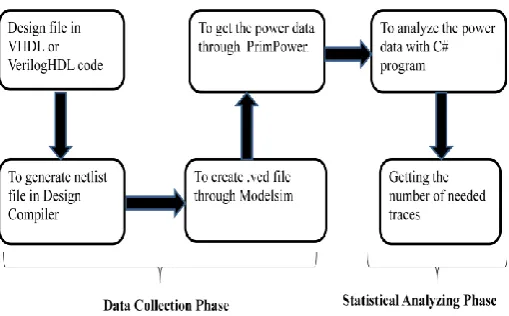
The flow of the whole experimentis illustrated asFig 5-1:
Fig 5-1the flow of our experiment
Asimplified descriptionof the process of our experiment is as follows:
Step1:In data collection phase, power measurements are performed for
N(typically 10000)samplings,each encryptedwith a randomly selected initial valueIV
and the same secret key.Then, use EDA simulation tools (i.e. Modersim, PrimePower)
to collect the power data;
Step2:Our attacking point is set at the first bit of outputs of the leftmost S-boxin the first round of ZUC algorithm in the initialization stage.
Note: Since the DPAfor each round are virtually the same and just differs at the
target bits of the secret key, it makes sensefor ustoonly attack the first round of the
9
k in the first roundas we described in Section 3.
Step3: Use power analyzerto collect certain information such as initial values
IVsand power T ji[ ]on line;
Step4: To put theguessksinto D function and compute value ofb.
Step5: To compute the differential power traces based on the power model proposed by Kocher [5],and judge whether the guessedksis correct by comparing all
the spikes for each hypothesisks.
The details for each experiment are presented in the following parts.
5.1 Attacks on Original ZUC Hardware Implementation
In the experiment,the correctkey is set “C15CB7421B980FD5438D2972F86BE0E4”,
and the guess key is randomly selected.In our hardware implementation, the clock
cycle is 20ns, and we collect the power each 1 ns.We use about 10 clock periods to
implement the first two rounds of the initialization stage of ZUC algorithm, so we
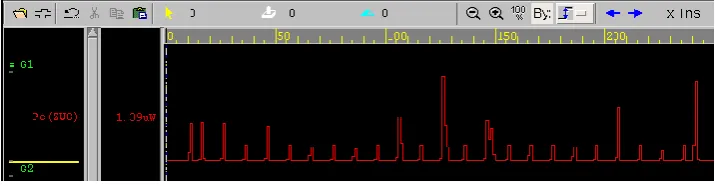
collect about 240 power points in each sampling. The power tracescollected
inPrimePowerare illustrated asFig 5-2, and the analysis results in thepower analyzer are shown inFig 5-3.
Fig 5-3thedifferential power traces to recoverk9
As shown inFig 5-3 b), the spike generated by the correct key is clearly visible when the sampling number is 5000, while in Fig 5-3a), the spike is not so obvious for the sampling number is not enough.Furthermore, we can see that the spike shows at
about time point of 130ns, which is exactly the point when the targeted S-box is
operated. Thus, we can successfully recover the secretk9. Just at the same way, we are
capable to recover the other bits of the secret key.
5.2Attacks on Protected ZUC Hardware Implementations
Experiment 1:In the ZUC hardware Implementation of the first experiment, we implement the strategy for random delaygeneration proposed in [ ].
The core idea of this strategy is to use a configurable switch matrix to control the
position of registers in between functional blocks of an algorithm. Since each register
causes a delay of one clock cycle, these randomly poisoning registers shift the code’s
executions and desynchronize attackers’ observations. And the number of possible
configurations depends on the number m of registers and n of functional blocks.
In our implementation, there are five functional blocks, and we use two registers: one
is between the bit-reorganization operation and the F function, and the other register
is ahead of the nonlinear operation S-box. The clock cycle is set 15ns, and we collect
power point each 1ns. As there are at most two registers in each round, it would take
120ns (i.e. 8 clock cycles, 6 among which implements the original ZUC circuits, and
2 among which implements the delays at most) to implement the first round of the
the first bit of the outputs ofS1. The analysis results in thepower analyzer are shown
inFig 5-4.
Fig 5-4differential power traces to recoverk9
As we can see in both Fig 5-4 a) and b), there is no obvious spikes in all the differential traces, and the spikes generated by the random key traces even cover the
spikes generated by the correct key traces. When the sampling number increases from
5000 (which is actually the number of samplings needed to break the original ZUC
hardware implementation in our design) to 10000, the trend is still not clear. The DPA
attacks failed when we use this kind of countermeasure.
Experiment 2:In this experiment, WDDL is used to protect ZUC hardware implementation from DPA.
WDDL is a rather resource-consuming countermeasure.It has been proved that
the nonlinear operations in an algorithm are the most crucial parts to resist DPA [], for
simplicity, it makes sense for us to only apply this kind of countermeasure to one of
the S-boxes of ZUC algorithm, and we chooseS1. As mentioned above, in our
implementation of WDDL, the original netlist of S1generated in Design Compiler is
disintegrated into simple circuit units,and each circuit unit is added with a
complementary unit to keep the total power balanced. The clock period is set 20ns,
and we collect the power each 0.1ms in the data collection phase.In the statistical
our power analyzer to attack the design. The analysis results in thepower analyzer are
shown inFig 5-4.
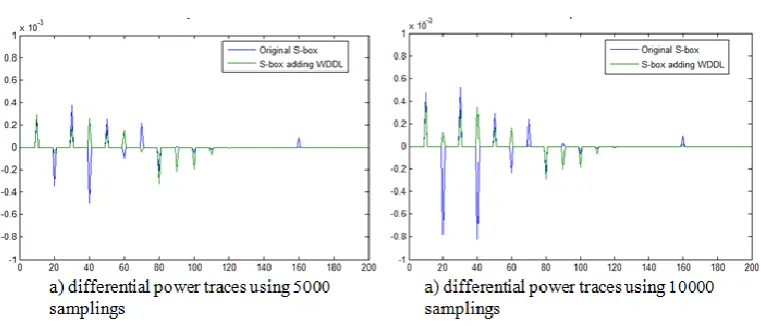
Fig 5-4 differential power traces to attack the S-boxes
As is shown in Fig 5-4 a), when the sampling number is 5000, the original S-box generates an obvious spike while the S-box added WDDL does not. It means DPA is
successfully implemented on the original S-box, but the attack on the S-box added
WDDL failed. When we increase the sampling number to 10000, as is shown in Fig 5-4 b),thespike generated by the original S-box is more clearly visible, while DPA on the S-box added WDDL is still unsuccessful for the corresponding trace does not
produce a visible spike yet. The results confirmed our analysis.
6 Conclusions
This is the first paper trying to perform DPA on the new proposed standardized
algorithm ZUC.Almost all the present DPA research is towards on block ciphers,
however, based on the frequentresynchronization of stream ciphers in real
applications, we showed that the stream cipher ZUC is still potentially vulnerable to
DPA. Kinds of effective countermeasures are also discussed trying to render the attack
more complicated,and we mounted stimulated DPA attacks to prove the effectiveness
of these countermeasures in our experiments. Our work would undoubtedly provide
some guidance to the hardware implementation designers of ZUC algorithm in real
applications.
complexity is in a reasonable level. However, we believe that some other techniques
might be used to reduce the DPA complexity to an even lower level. Additionally, as
hardware design techniques develop, more work could be done on the
countermeasures of ZUC algorithm to against DPA, especially masking. If properly
implemented, masking is undoubtedly one of the most efficient countermeasures
against DPA.
References
[1] 3rd Generation Partnership Project. Long Term Evaluation Release 10 and beyond
(LTE-Advanced). Proposed to ITU at 3GPP TSG RAN Meeting, Spain (2009)
[2] Specification of the 3GPP Confidentiality and Integrity Algorithms 128-EEA3 &
128-EIA3. Document 1: 128-EEA3 and 128-EIA3 Specification. ETSI/SAGE
Specification, Version: 1.5 (January 4, 2011)
[3] Specification of the 3GPP Confidentiality and Integrity Algorithms 128-EEA3 &
128-EIA3. Document 2: ZUC Specification. ETSI/SAGE Specification, Version: 1.5
(January 4, 2011)
[4] Specification of the 3GPP Confidentiality and Integrity Algorithms 128-EEA3 &
128-EIA3. Document 4: Design and Evaluation Report. ETSI/SAGE Specification,
Version: 2.0 (September 9, 2011)
[5] P.C. Kocher, J. Jaffe, and B. Jun. Differential Power Analysis. In Advances in
Cryptology – CRYPTO 1999, volume 1666 of Lecture Notes in Computer Science
(LNCS), pages 388–397. Springer, 1999
[6] D. Agrawal, B. Archambeault, J.R. Rao, and P.Rohatgi. The EM Side-channel(s).
In Cryptographic Hardware and Embedded Systems – CHES 2002, Lecture Notes in
Computer Science (LNCS). Springer, 2002
[7] P.C. Kocher. Timing Attacks on Implementations of Diffie-Hellman, RSA, DSS
and Related Attacks. In Advances in Cryptology – CRYPTO 1996, volume 1109 of
Lecture Notes in Computer Science(LNCS), pages 104–113. Springer, 1996
[8] E. Brier, C. Clavier, F. Olivier. Correlation Power Analysis with a Leakage Model,
Lecture Notes in Computer Science (LNCS), pages 16–29. Springer, 2004
[9] J. Lano, N. Mentens, B. Preneel, and I. Verbauwhede. Power Analysis of
Synchronous StreamCiphers with Resynchronization Mechanism. In The State of the
Art of StreamCiphers–SASC 2004, Workshop Record, pages 327–333
[10] S. Burman, D. Mukhopadhyay, and K. Veezhinathan. LFSR Based Stream
Ciphers Are Vulnerable to Power Attacks. In INDOCRYPT 2007, volume 4859 of
Lecture Notes in Computer Science(LNCS), pages 384–392. Springer, 2007
[11] S. S. Mansouri and E. Dubrova.An Architectural Countermeasure against Power
Analysis Attacks for FSR-Based Stream Ciphers. In COSADE 2012, volume 7275 of
Lecture Notes in Computer Science (LNCS), pages 54–68. Springer, 2012
[12] M.-L. Akkar and C. Giraud. An Implementation of DES and AES, Secure against
Some Attacks. In Cryptographic Hardware and Embedded Systems – CHES 2001,
volume 2162 of Lecture Notes in Computer Science (LNCS), pages 309–318.
Springer, 2001
[13] J. D. Goli´c and C. Tymen. Multiplicative Masking and Power Analysis of AES.
In Cryptographic Hardware and Embedded Systems – CHES 2002, volume 2535 of
Lecture Notes in Computer Science (LNCS), pages 198–212. Springer, 2003
[14] L. Genelle, E. Prouff and M. Quisquater.Thwarting Higher-Order Side Channel
Analysis with Additive and Multiplicative Maskings. In Cryptographic Hardware and
Embedded Systems – CHES 2011, volume 6917 of Lecture Notes in Computer
Science (LNCS), pages 240–255. Springer, 2011
[15] C. Clavier, J.-S.Coron, and N. Dabbous. Differential Power Analysis in the
Presence of Hardware Countermeasures. In Cryptographic Hardware and Embedded
Systems – CHES2000, volume 1965 of Lecture Notes in Computer Science (LNCS),
pages 252–263. Springer, 2000
[16] S. Mangard. Hardware Countermeasures against DPA – A Statistical Analysis of
Their Effectiveness. In Cryptology – CTRSA2004, The Cryptographers’ Track at the
RSA Conference 2004, volume 2964 of Lecture Notes inComputer Science (LNCS),
pages 222–235. Springer, 2004
Logic Level: Next Generation Smart Card Technology. In Cryptographic Hardware
and EmbeddedSystems – CHES 2003, volume 2779 of Lecture Notes in Computer
Science (LNCS), pages 137–151. Springer, 2003
[18] K. Tiri and I. Verbauwhede.A Logic Level Design Methodology for a Secure
DPA Resistant ASIC or FPGA Implementation. In 2004 Design, Automation andTest
in Europe Conference and Exposition (DATE 2004), 16-20 February 2004,Paris,
France, pages 246–251. IEEE Computer Society, 2004
[19] Chunfang Zhou, XiutaoFeng, and Dongdai Lin.The Initialization Stage Analysis
of ZUC v1.5*’**. In CANS 2011, volume 7092 of Lecture Notes in Computer
Science (LNCS), pages 40–53. Springer, 2011
[20] T. S. Messerges, E. A. Dabbish and R. H. Sloan.Investigations of Power Analysis
Attacks on Smart Cards.Usenix Workshop on Smartcard Technology, USA,
pages151-162,1999
[21] Lei Wang, Jiwu Jing, Zongbin Liu, Lingchen Zhang, and Wuqiong Pan.
Evaluating Optimized Implementations of Stream Cipher ZUC Algorithm on FPGA*.
In ICICS 2011, volume 7043 of Lecture Notes in Computer Science (LNCS), pages
202–215. Springer, 2011
[22] N. Mentens, B. Gierlichs, and I. Verbauwhede.Power and Fault Analysis
Resistance in Hardware through Dynamic Reconfiguration.In Cryptographic
Hardware and EmbeddedSystems – CHES 2008, volume 5154 ofLecture Notes in
Computer Science (LNCS), pages 346–362. Springer, 2008
[23]M.Tunstall, O.Benoit.Efficient Use of Random Delays in Embedded Software. In
WISTP 2007, volume 4462of Lecture Notes in Computer Science (LNCS), pages
27–38. Springer, 2007
[24] J.-S. Coron and I. Kizhvatov.An Efficient Method for Random Delay Generation
in Embedded Software. In Cryptographic Hardware and EmbeddedSystems – CHES
2009, volume 5747 ofLecture Notes in Computer Science (LNCS), pages 156–170.
Springer, 2009
[25] K. Tiri, and I. Verbauwhede.A Logic Level Design Methodology for a Secure
Europe, DATE’04. (2004) pages 246–251
[26] K. Tiri, and I. Verbauwhede.A VLSI Design Flow for Secure Side-Channel
Attack Resistant ICs. In: Design, Automation and Test in Europe, DATE’05. Vol. 3.
(2005) pages 58–63
[27] K. Tiri, and I. Verbauwhede.Place and Route for Secure Standard Cell Design. In:
6th International Conference on Smart Card Research and Advanced
Applications,CARDIS’04. (2004) pages 143–158
[28] J.Bl¨omer, J. G.Merchan, and V.Krummel. Provably SecureMasking of AES.
Cryptology ePrint Archive (http://eprint.iacr.org/), Report2004/101, 2004
[29] E. Oswald, S.Mangard, N.Pramstaller,and V.Rijmen. A Side-Channel Analysis
Resistant Descriptionof the AES S-Box*.In FSE 2005, volume 3557 ofLecture Notes