Attacks on Secure Ownership Transfer for multi-tag
multi-owner passive RFID environments
J. Munillaa, M. Burmesterb, A. Peinadoa
a
E.T.S.I. Telecomunicaci´on, Universidad de M´alaga, M´alaga (Spain) {jorge, alberto}@ic.uma.es
b
Department of Computer Science, Florida State University, Tallahassee, Florida (USA) [email protected]
Abstract
Sundaresan et al proposed recently a novel ownership transfer protocol for multi-tag multi-owner RFID environments that complies with the EPC Class1 Generation2 standard. The authors claim that this provides individual-owner privacy and prevents tracking attacks. In this paper we show that this pro-tocol falls short of its security objectives. We describe attacks that allow: a) an eavesdropper to trace a tag, b) the previous owner to obtain the private information that the tag shares with the new owner, and c) an adversary that has access to the data stored on a tag to link this tag to previous in-terrogations (forward-secrecy). We then analyze the security proof and show that while the first two cases can be solved with a more careful design, for lightweight RFID applications strong privacy remains an open problem.
Keywords: RFID, EPCC1G2, Ownership Transfer, Cryptanalysis
1. Introduction
of RFID, such as the vulnerabilities of the radio channel, power-constraints, low-cost, limited functionality, reply upon request, as well as resistance to the risks of RFID, such lack of privacy, malicious traceability and data cor-ruption. The increasing concern with security is evidenced by the inclusion of some optional cryptographic features in the recently ratified second version of the EPCglobal Gen2 specificiations [2].
Ownership Transfer Protocols (OTPs) allow the secure transfer of tag ownership from a current owner to a new owner. Three different entities are always present in an OTP: the tag T, whose rights are being transferred, the current owner, who has the initial control of T, and the new owner, who will get control of T when the protocol is completed. OTPs must incorpo-rate security requirements that protect the privacy of both the new and the previous owner of the tag. To prevent previous owners from accessing a tag once ownership has been transferred either a Trusted Third Party (TTP) is employed or an Isolated Environment (IsE). The first provides security for stronger adversarial scenarios while the second is more appropriate when tags belong to independent authorities.
For RFID applications privacy addresses anonymity that protects the identity of tags, and untraceability that protects past interrogations (partial or completed) of a tag being linked. Formal definitions for secure ownership and ownership transfer are provided by van Deursen et al [3] while several theoretical models have been proposed in the literature to address the privacy of RFID systems [4, 5, 6, 7]. The theoretical framework of Vaudenay [7] dis-tinguishes between strong and weak attackers. Privacy preserving protocols against strong adversaries support forward secrecy [8].
Molnar et al [9] and Saito et al [10] presented the first OTP for RFID applications in 2005. This was followed by several OTPs that address practi-cal scenarios. Recently Sundaresan et al[11] proposed an OTP for multi-tag multi-owner RFID environment that provides individual-owner-privacy. The protocol uses a TTP for secure management and an IsE for verifying own-ership transfer. This complies with the EPCglobal Gen2 specifications, with protection afforded by simple XOR and 128-bit PRNGs. The protocol is claimed to provide tag anonymity, tag location privacy, forward secrecy, and forward untraceability; while being resistant to replay, de-synchronization, server impersonation and active attacks. We shall show in this paper that this protocol falls short of these claims. In particular that it is subject to:
b) Traceability (tag location privacy) attacks: an eavesdropper can trace a tag (Theorems 2,3);
c) Impersonation attacks: a previous owner can compute the secret data that tags share with the new owner (Theorems 4,5);
d) Forward secrecy attacks: compromised tags can be linked to earlier interrogations (Theorem 6);
e) De-synchronization attacks: if the shared secrets are generated using a random non-deterministic process (Theorem 7).
The rest of the paper is organized as follows. Section 2 discusses the Sundaresan et al protocol and describes the phase that is cryptanalyzed. Section 3 describes the security flaws listed above. Section 4 analyzes the cryptographic causes of these weaknesses, and Section 5 concludes the paper.
2. The Sundaresan et al Ownership Transfer Protocol
This is a TTP-based scheme developed for multi-tag multi-owner RFID environments [11]. Two cases are considered: tags with multiple owners and owners with multiple tags.
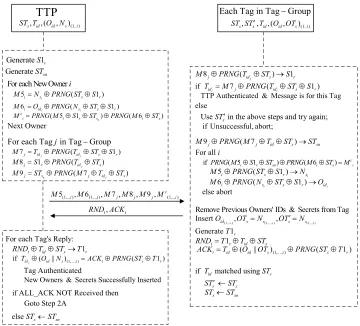
The OTP begins when an owner sends an OT request to the TTP. The protocol has two steps: Step 1 involves TTP and new owners while Step 2 involves the TTP and the tags in Tag-Group, and is designed to transfer new ownership ids and secret keys to the tags. In this paper we are only concerned with Step 2, since our analysis will focus on its weaknesses. The protocol is shown in Figure 1, and is briefly described below—full details are given in [11].
2.1. Step 2 of the Sundaresan et al OTP: TTP → Tag-Group → TTP
TTP uses the values: {STs, Tid,(Oid, Ns)(1..i)}, withSTs a secret shared with
Tag-Group, Tidj an identifier for tag j in Tag-Group, Oidj an identifier of owner of tag j, Nsi a new secret for each new owner i.
Each tag j in Tag-Group uses the values: {STs, STs0, Tid,(Oid, OTsi)(1..i)}, with ST0
s the value of STs used in the previous interaction (initially STs =
ST0
!"# $%&
' ((
) *
"+ , ", ""'$$%-" *
')../)01 # 2 *
, 3)
$"
'
) * + 4 "" "' " $"
5" 6 2 " " * % 7 '5 " ""'$ 6 7
$$ '
$" 6
# 8 2 2 " "!-9"+ , "' 8
-"
((
8 * " '
Figure 1: Step 2 of the Sundaresanet alprotocol.
Step 2A TTP generates a pseudorandom numberS1rand a new secretSTsn
to be shared with the tags in Tag-Group. Then TTP computes: for each new owner i,
M5i =Nsi⊕PRNG(STs⊕S1r),M6i =Oidi⊕PRNG(Nsi⊕STs⊕S1r) and Mic=PRNG(M5i ⊕S1r⊕STsn)⊕PRNG(M6i⊕STs),
and for each tag j,
M7j =Tidj⊕PRNG(Tidj⊕STs⊕S1r),M8j =S1r⊕PRNG(Tidj⊕STs), and M9j =STsn⊕PRNG(M7j⊕Tidj ⊕STs).
Then:
TTP → Tag-Group: MT G,
Step 2B Tag j checks if for all i: Tidi ?
= M7j ⊕PRNG(Tid⊕STs⊕S1r),
where S1r =M8j ⊕PRNG(Tid⊕STs). If this fails it uses STs0 instead
ofSTs. If both fail, it aborts. For the remainder of the protocol, either
STs orSTs0 is used, depending on which one returned a match.
Tagj checks if for alli: Mc i
?
=PRNG(M5i⊕S1r⊕ST sn)⊕PRNG(M6i
⊕STs), whereSTsn =M9j⊕PRNG(M7j⊕Tid⊕STs). If this fails for
some i, it aborts. Otherwise it computes Oidi = M6i⊕PRNG(Nsi ⊕
STs⊕S1r) andNsi =M5i⊕PRNG(STs⊕S1r), and replaces the previ-ous owner identifiers with Oidi, and the secret with OTs =OTs0 =Nsi, for every owner. Then:
Each tag in Tag-Group → TTP : (RNDt,AKCt)
whereRNDt =T1r⊕Tid⊕STs,ACKt =Tid⊕(Oid1||OTs1)⊕(Oid2||OTs2)
⊕. . .⊕(Oidi||OTsi)⊕PRNG(STs⊕T1r), with T1r a fresh pseudoran-dom number. If there was a match withSTsthe tag updates the shared
secrets: ST0
s ←STs and STs ←STsn. For convenience in Figure 1 the
expression (Oid||OTs)(1..i)represents: (Oid1||OTs1)⊕(Oid2||OTs2)⊕. . .⊕
(Oidi||OTsi), so ACKt =Tid⊕(Oid||OTs)(1..i)⊕PRNG(STs⊕T1r).
Step 2C TTP checks if ACKt ⊕PRNG(STs⊕T1r)⊕. . .⊕(Oidi||Nsi) ? =
Tidj ⊕ (Oid1||Ns1) ⊕ (Oid2||Ns2) ⊕ . . . ⊕ (Oidi||Nsi), for each tag re-ply, where T1r = RNDt ⊕Tidj ⊕STs. This is shown in Figure 1 as
Tidj ⊕(Oid||Ns)(1..i) =ACKt⊕PRNG(STs⊕T1r). If there is a match, the tag is authenticated and the new owners and their secrets have been successfully inserted in that tag. If TTP does not receive acknowledge-ments from all tags in Tag-Group, the protocol is restarted from the beginning of Step 2. Otherwise TTP updates STs←STsn and sends a
message to confirm the transfer to the previous owner. The new owner can verify that the transfer has been successful with the Ownership Test Protocol (not described here).
2.2. Security Claims of the Sundaresan et al Protocol [11].
– Tag/Reader Anonymity, Location Privacy, Forward Secrecy.
– Integrity, Tag/Reader Impersonation, Resistance against Replay Attacks.
3. Weaknesses of the Sundaresan et al protocol
To simplify our notation below, and when there is no ambiguity, we re-place Tidj, M7j, M8j, M9j by Tid, M7, M8, M9 respectively.
3.1. De-synchronization and/or Replay
Theorem 1. The Sundaresan et al protocol is subject to de-synchronization or replay attacks.
Proof. Suppose the protocol resists synchronization attacks. Then:
Lemma 1. Only an authorized TTP can cause a tag T to update its current
and previous secrets STs, STs0 (shared by TTP and Tag-Group).
Proof. Otherwise T and the TTP can get de-synchronized.
Lemma 2. If M7, M8 (Section 2.1) are accepted by tag T as valid at time
ta, then the same messages will be accepted by T at time tb, provided there
is no interaction between T and TTP during the interval [ta, tb].
Proof. LetST1 =ST
s,ST0 =STs0 be the current and previous secrets shared
by TTP and the tags in T’s Tag-Group. If M7, M8 are accepted at time ta
by T then either:
Tid =M7⊕PRNG(Tid⊕ST0⊕M8⊕PRNG(Tid⊕ST0), or
Tid =M7⊕PRNG(Tid⊕ST1⊕M8⊕PRNG(Tid⊕ST1).
In the first caseT will not update its secrets and by Lemma 1 the same values
ST1, ST0 will be stored on T until time tb. Then M7, M8 will be accepted
by T at time tb. In the second case T will update its secrets: STs ← ST2,
ST0
s ← ST1, where ST2 is the next value of the secret. As there is no
interaction with TTP, these values will not be updated (Lemma 1) during [ta, tb]. Then M7, M8 will be accepted at time tb if either:
Tid =M7⊕PRNG(Tid⊕ST1⊕M8⊕PRNG(Tid⊕ST1)), or
Tid =M7⊕PRNG(Tid⊕ST2⊕M8⊕PRNG(Tid⊕ST2)).
Since we are assuming that ST1 is used, the first equation holds. Therefore
M7, M8 are accepted.
Lemma 3. If tag T accepts the messages MT G (Section 2.1) as valid at
time ta, then T will accept a replay of MT G at time tb, provided there is no
interaction between T and TTP during [ta, tb].
Proof. By Lemma 2,M7, M8 will be accepted at timetb. We shall show that
Mc
MT G = (M5(1..i), M6(1..i), M7, M8, M9, M(1c..i)) will be accepted. The proof is similar to Lemma 2. Since M(1c..i) is accepted at time ta, either:
Mc
(1..i)=PRNG(M5(1..i)⊕S1r⊕STsn)⊕PRNG(M6(1..i)⊕ST0), withS1r=
M8⊕PRNG(Tid⊕ST0)), STsn=M9⊕PRNG(M7⊕Tid⊕ST0), or
Mc
(1..i)=PRNG(M5(1..i)⊕S1r⊕STsn)⊕PRNG(M6(1..i)⊕ST1), withS1r=
M8⊕PRNG(Tid⊕ST1)), STsn=M9⊕PRNG(M7⊕Tid⊕ST1).
In the first case T will not update the secrets and by Lemma 1 these values will remain stored on T. Then Mc
(1..i) will be accepted at time tb. In the
second case (ST1 is used) T updates its secrets: STs ← ST2, STs0 ← ST1,
where ST2 is the next value of the secret. Since there is no interaction with TTP, these values will not be updated during [ta, tb], so at timetb,M(1c..i) will
be accepted if either:
Mc
(1..i)=PRNG(M5(1..i)⊕S1r⊕STsn)⊕PRNG(M6(1..i)⊕ST1), withS1r=
M8⊕P RN G(Tid⊕ST1)), STsn =M9⊕PRNG(M7⊕Tid⊕ST1), or
Mc
(1..i)=PRNG(M5(1..i)⊕S1r⊕STsn)⊕PRNG(M6(1..i)⊕ST2), withS1r=
M8⊕PRNG(Tid⊕ST2)),STsn=M9⊕PRNG(M7⊕Tid⊕ST2).
The first case holds since we are assuming thatST1 is used. ThereforeMc
(1..i) and the other messages are accepted during [ta, tb].
We conclude the proof by observing that if an adversary A eavesdrops on a protocol execution between T and TTP with messages MT G and then
later replays MT G to T, T will accept these as valid by Lemma 3.
3.2. Traceability
Theorem 2. An adversaryAthat eavesdrops on the last successful execution
of the Sundaresan et al protocol between TTP and a group of tagsG can later
determine if a tag T belongs toG.
Proof. Let A be an eavesdropping adversary. Then:
Lemma 4. A can determine if the messages sent to T are accepted by T.
Proof. Tags only respond withRNDt,ACKt after checking that the received
messages MT G are correct; otherwise they abort. A only needs to check that
there is a response to determine if messages are accepted.
Proof. By Lemma 4, A knows that the messages MT G are accepted by a
tag T when T replies. Consequently A can determine when the protocol is successfully executed by checking that each tag in Tag-Group replies.
To conclude the proof suppose thatAeavesdrops on a successful execution of the protocol between TTP and Gto get the messages MT G for each tag j
inG (Lemmas 4,5). Later, A replays these toT for each j. T belongs to G
if any of these is accepted (Lemma 4).
Theorem 3. An adversary A that eavesdrops on a successful execution of
the Sundaresan et al protocol between TTP and a group of tags G can trace
any tag T that belongs toG. Traceability extends until T is transferred to a
new owner.
Proof. Let A be an eavesdropping adversary. Then:
Lemma 6. If A knows the last set of messages MT G that T accepted then
A can trace T, even if the protocol was not successful (e.g. if the response was not received by TTP).
Proof. If T accepted MT G in the last interaction then by Lemma 3 it must
again accept MT G. So A only needs to replay MT G to a tag and check if it
is accepted to determine if it is T (Lemma 4).
To traceT,A first determines if it belongs to groupG(Lemma 6). If so,
A stores the specific messages MT G that cause T to reply. Later A replays
MT G to determine if the tag is T. Traceability is possible while the values
STs and STs0 are not updated (until a new successful OTP is executed).
3.3. Previous owner attack
Theorem 4. A previous owner of tag T that eavesdrops on the ownership
transfer of T to a single owner in the Sundaresan et al protocol can compute
the identity of this owner and the secret that it shares with T.
Proof. We first show that:
Lemma 7. (Oid||OTs)(1..i) can be computed from the identification number
Tid of T used to generate the pair of known messages RNDt,ACKt.
Proof. (Oid||OTs)(1..i) =ACKt⊕Tid⊕PRNG(RNDt ⊕Tid).
The previous owner can apply Lemmma 7 to compute (Oid||OTs) by
eaves-dropping on the replies RNDt,ACKt of T with identifier Tid.
Proof. The previous owner by Theorem 4 can compute (Oid||OTs). Since
this is all the secret information a tag shares with its owner, the previous owner will be able to do whatever the new owner can do, including the test protocol.
3.4. Forward Secrecy
Theorem 6. The Sundaresan et al protocol does not guarantee forward secrecy.
Proof. Let A be an eavesdropping adversary. Then:
Lemma 8. Given the identifierTid of a tag T and the value (Oid||OTs)(1..i),
it is possible to determine with overwhelming probability that the messages
RNDt,ACKt were computed by T using (Oid||OTs)(1..i).
Proof. By Lemma 7 the value (Oid||OTs)0(1..i)corresponding toTid,RNDt,ACKt
can be computed. If this matches (Oid||OTs)(1..i) then the probability that it was generated by T is overwhelming (1−ε): indeed the probability that
RNDt,ACKtis generated by another tag with identifierTid0 using (Oid||OTs)0(1..i)
is negligible, sincePRNG(T0
id⊕RNDt) =ACKt⊕Tid0 ⊕(Oid||OTs)0(1..i)is
neg-ligible (ε).
We complete the proof. At timeta,Aeavesdrops on a successful execution
of the protocol between TTP and a tag T that responds with RNDt,ACKt.
Suppose at time tb > ta, A is given access to the secret information stored
onT: Tid,(Oid||OTs)(1..i), STs and STs0. Then A uses Lemma 8 to determine
whether the earlier response RNDt,ACKt was computed by T.
3.5. Non-deterministic secrets
The process of generating values Nsi (of owner i) and SOsn (to be shared between TTP and the owners) in Step 1A, and value STsn (to be shared
between TTP and Tag-Group) in Step 2A of the Sundaresan et al OTP is not explained in the description of the protocol. This could be deterministic (e.g.using aPRNG) or non-deterministic (e.g.using hardware randomness).
Theorem 7. The Sundaresan et al protocol can be de-synchronised by an
adversary A if the values of new secrets are non-deterministic.
Proof. This combines a man-in-the-middle with an impersonation/replay
attack. First A impersonates a tag T to get M1 = (M5(1..i), M6(1..i), M7j,
(Section 2.1). Then A replays M1 to T to get R1 = (RNDt,ACKt), using
STs, Tid, Oid, OTs, Nsi and T1r. T updates: ST
0
s←STs, STsn←STsn1 .
AimpersonatesT again to getM2 from TTP, usingSTsn2 , STs, Tid, Oid, Nsi and S12
r, with value STsn2 6=STsn1 (a non-deterministic procedure is used to
generate the values of STsn). A responds with R1. This will be accepted by
TTP, usingST1
snfrom the previous session. TTP then updatesSTsn ←STsn2 .
Now T (that stores STsn1 6=STsn2 ) and TTP are de-synchronized.
4. Cryptanalysis
In this section we analyze the causes for the weaknesses of the Sundaresan
et al protocol discussed in the previous section. Observe that the replay and
traceability attacks described in Sections 3.1, 3.2 exploit the fact that the messages M7j, M8j do not authenticate TTP (in contrast to the authors’s
claims). To explain this, we revisit the verification proof presented in [11]. This involves the messages M5i, M6i, Mic for owneriandM7j, M8j, M9j for
tag T (Section 2.1). The proof uses GNY logic formalization:
V9 Apply the being-told ruleT1: T / M5i, M6i, Mic, M7j, M8j, M9j.
V10 Apply thepossession ruleP1 to V9: T 3 M5i, M6i, Mic, M7j, M8j, M9j.
V11 Apply the freshness rule F1 to V9:
T |≡]M5i,]M6i, ]Mic, ]M7j, ]M8j, ]M9j.
V12 Use V11, the initial assumptions TTP 3 S1r (TTP possesses S1r)
and TPP |≡ TTP STs
←−→ T (TTP believes that STs is a suitable secret
to be shared with T), and the postulates I1, J1 and P2 to derive:
T |≡ TTP |∼ M5i, M6i, Mic, M7j, M8j, M9j (T believes that the
messages were actually sent by TTP).
The verification Step V11, and consequently Step V12 (derived from it), is incorrect because the freshness rule,
F1 : P |≡ ]X
P |≡ ](X, Y), P |≡ f(X)
requires that party P (T in our case) not only possesses the messages but also that the messages have been computed using a value that P believes to be fresh. This is not the case in the Sundaresan et alprotocol, and therefore the security proof is flawed.1 From this analysis we see that for TTP to be
authenticated, the messages used to authenticate TTP must include a value
that T believes to be fresh. This is commonly implemented by including a
random number generated by T for each session.
The attack described in Section 3.3 is due to a flawed implementation of the Blum-Micali encryption scheme [12], that simulates a one-time-pad to obfuscate data. This implementation should be replaced by a more careful design where the input data of thePRNGcannot be recovered by the previous owner; i.e., by knowing Tid.
The last attack in Section 3.4 is much harder to address. While the previous attacks can be prevented with more careful designs, a solution for forward privacy is particularly challenging. Indeed achieving forward privacy using only symmetric cryptography is still an open problem. Recently it has been shown that hash-based systems cannot achieve forward privacy in the Byzantine threat model [13], and that there is trade-off between privacy and availability. Some authors claim that one must use public-key cryptography for forward privacy [7].
5. Conclusions
The Sundaresanet alownership transfer protocol falls short of its security goals despite the fact it uses a Trusted Third Party to control/manage pri-vate information/keys. This protocol is subject to desynchronization and/or replay atatcks and impersonation, traceability and forward secrecy attacks.
We analysed these weaknesses and discussed possible fixes. We noted that forward privacy may not be achievable using only symmetric cryptography.
References
[1] K. Ashton, That ’Internet of Things’ Thing, RFID Journal.
URL http://www.rfidjournal.com/articles/view?4986
[2] EPC Global, UHF Air Interface Protocol Standard Generation2/ Version2, http://www.gs1.org/gsmp/kc/epcglobal/uhfc1g2.
[4] G. Avoine, Adversarial model for Radio Frequency Identification, IACR Cryptology ePrint Archive 2005 (2005) 49.
[5] A. Juels, S. A. Weis, Defining strong privacy for RFID, IACR Cryptol-ogy ePrint Archive 2006 (2006) 137.
[6] C. Y. Ng, W. Susilo, Y. Mu, R. Safavi-Naini, Rfid privacy models re-visited., in: S. Jajodia, J. Lpez (Eds.), ESORICS, Vol. 5283 of Lecture Notes in Computer Science, Springer, 2008, pp. 251–266.
[7] S. Vaudenay, On Privacy Models for RFID, in: K. Kurosawa (Ed.), ASIACRYPT, Vol. 4833 of Lecture Notes in Computer Science, Springer, 2007, pp. 68–87.
[8] M. Burmester, J. Munilla, Lightweight RFID Authentication with For-ward and BackFor-ward Security, ACM Trans. Inf. Syst. Secur. 14 (1) (2011).
[9] D. Molnar, A. Soppera, D. Wagner, A Scalable, Delegatable Pseudonym Protocol Enabling Ownership Transfer of RFID Tags, in: Workshop on RFID Security and Light-Weight Crypto, Graz, Austria, 2005, pp. 276– 290.
[10] J. Saito, K. Imamoto, K. Sakurai, Reassignment Scheme of an RFID Tag’s Key for Owner Transfer, in: T. Enokido, L. Yan, B. Xiao, D. Kim, Y.-S. Dai, L. T. Yang (Eds.), EUC Workshops, Vol. 3823 of Lecture Notes in Computer Science, Springer, 2005, pp. 1303–1312.
[11] S. Sundaresan, R. Doss, W. Zhou, S. Piramuthu, Secure ownership trans-fer for multi-tag multi-owner passive RFID environment with individual-owner privacy, Computer Communications In press (2014) 49.
[12] M. Blum, S. Micali, How to generate cryptographically strong sequences of pseudo-random bits, SIAM J. Comput. 13 (4) (1984) 850–864.