Financial Performance of Co- operative
Societies: A Comparative Study
(With Special Reference to Valsad District of Gujarat)
By
Patel Dilipkumar Chunilal
M.COM, B.ED RESEARCH SCHOLAR
PACIFIC ACADEMY OF HIGHER EDUCATION AND RESEARCH UNIVERSITY, UDAIPUR (RAJASTHAN)
Year: 2014
ABSTRACT:
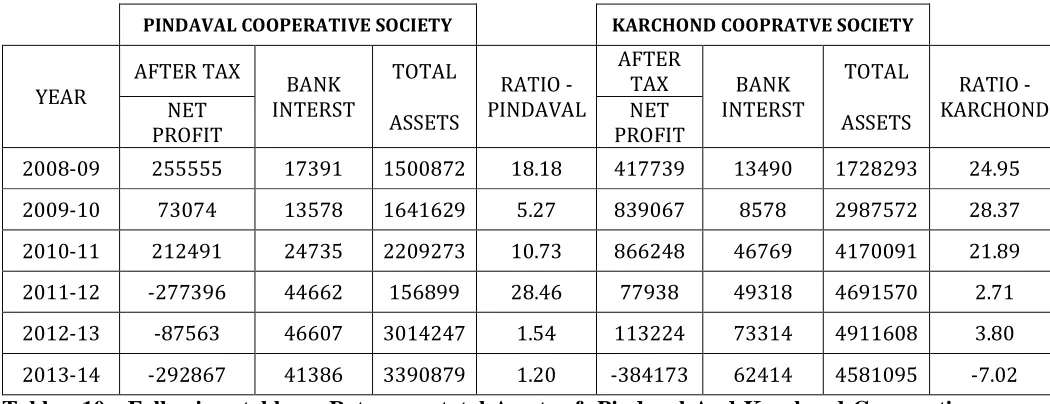
Financial analysis is the process of identifying the financial strengths and weakness of the firm from the available accounting data and financial statements. The focus of financial analysis is on key figures in the financial statements and the significant relationship that exists between them. The analysis of financial statements is a process of evaluating relationship between component parts of financial statements to obtain a better understanding of the firm’s position and performance. This study aims at analyzing the overall financial efficiency of the Pindaval Cooperative society And Karchond Cooperative Society in Valsad District in Gujrat state in India both selected Cooperative society has working same activity. by Researcher’s using various financial tools. The study has been undertaken for the period of 6 years from 2008-9 to 2013-14. In order to analyze financial efficiency in terms of Profitability, solvency, Activity and financial stability various accounting ratios have been used.
ACKNOWLEDGEMENT
I wish I could acknowledge my gratefulness to them all individually over the same. Grateful Acknowledgement of my heartily in debtedness for thoughts and ideas to Prof. Alkapatel of Accociate Professor of Arts And Commerce College,Motapondha ( Gujarat).
I Am extremely thankful to provide me Cooperative societies related some research book research book and guidance for project support Mr. Hiteshbhai Patel, Associate Professor, of Arts And Commerce college ,Motapondha Dist valsad in Gujrat.
I am extremely thankful to Provide me Cooperative socities, Annual Report And all confusion financial analysis regarding support Mr. Nathubhai Dalvi, Manager of Waroli Cooperative society., taluka kaprada ( Guj.) and And Dhruva- Bife Under Managed all Cooprative socities Financial Data provide me Officer’s And Accountant Name Mr. Amratbhai Gavit. & Jigneshbhai Patel And Shailesh Patel, Anandbhai, Maheshbhai,Devchanbhai in Dhruva Bife : of Taluka Kaprada Office in Gujarat.
I am thankful to all my beloved family members for encouraging me and providing all the necessary requirements; from financial support And motivation.
I express warm thanks to all who all have helped me a lot for my research work. Finally I shall consider myself thankful if this research study can comparatively lender greater sustainable benefits to those research scholars who may wish to use it and the entire country as a whole. However I have taken meticulous care mainly in avoiding printing mistakes.Criticisms as well as suggestion are always welcome through the e-mail address
[email protected] or [email protected] Or [email protected]
Author :
Patel DilipKumar
CHAPTER – 1
AN OVERVIEW OF COOPERATIVE
SOCIETIES
CHAPTER – 1 ( A)
( A.1 ) INTRODUCTION TO THE COOPERATIVE SOCIETY
(A.2) ADVANTAGE AND DISADVANTAGE OF COOPERATIVE SOCIETIES.
(A.3) POSITION OF COOPERATIVE SOCIETIES
INTERNATIONAL, NATIONAL AND STATE & DISTRICT
(A.4) VARIOUS AGENCIES WORKING FOR THE DEVLOPMENT COOPERATIVE
( A.1 ) INTRODUCTION TO THE COOPERATIVE SOCIETY :
In India the co-operative movement was started at the beginning of the present century. It was the result of the economic distress caused to the peasants during this period. Although the idea of forming co-operative societies was first suggested by Frederik Nicholson to solve the problem of rural indebtedness, a real beginning of the co-operative movement was made when the Co-operative Societies Act was passed in 1904. This was done with a view to encouraging thrift, self-help and co-operation amongst agriculturists, artisans and persons of limited means. Societies formed under the Act were given legal status and were authorised to raise funds and carry on business in a corporate capacity. They were classified as rural and urban; rural societies were bound to accept the principle of unlimited liability. This Act. however, was deficient in many respects.
The Act of 1912 was. therefore, passed to make good these deficiencies It regularised certain practices of doubtful legal validity and made provision for further expansion under proper safeguards. The distinction between rural and urban societies was removed and a more scientific classification based on limited or unlimited liability was adopted. Co-operative societies other than credit were allowed to be formed. Registration of unions and federal bodies like central banks was expressly legalised and a number of minor improvements were introduced. The simplicity and elasticity of the old Act were at the same time retained and a wide rule-making power was left to provinces to develop on their own lines.
• A co-operative society is an autonomous association of persons united voluntarily to meet their common economic, social and cultural needs and aspirations through a jointly-owned and democratically-controlled enterprise.
• A co-operative society is another means for forming a legal entity to conduct business besides forming a company. It pools together human resources in the spirit of self and mutual help with the object of providing services and support to members.
The history of operative movement in India is broadly divided into two phases. That means co-operative movement has passed into two phases. They are-
1) Co –operative movement in pre-independence era. 2) Co-operative movement in post–independence era. These two phases are briefly discussed below:
i) Co-operative Movement in pre-independence era:
The pages of Indian history cite many evidences of co-operative activities from earliest times. However, the first recorded activity began in 1904 when this movement was officially set up by the British Government. Before that in the year 1892, Derrick Nicholson, tried to find out ways and means to establish institutions so as to help the agricultural sector. He gave the suggestions for setting of co-operative societies. Within that decade, India faced a terrible famine in 1899.
The Government appointed the Second Famine Commission 1901 to suggest measures for the victims. The commission recommended for a number of development activities and setting up of new institution. The most important among them was the strong recommendation for organisation of co-operative societies. The Government had accepted many of the recommendations and in 1904 “co operative societies Act” were passed. The aim was to help the rural farmers and artisans by providing short term and long term loans.
These credit societies were organised on the basis of two models, one for rural area and other for urban area. For the former these were organised on Reinfusion Model while for the latter it was Schulze Delitzsch Bank Model. Due to this Act a number of Co-operative Societies grew up in rural area, but they could not function effectively. The major defects were.
i) There was no provision for setting up of Non credit Co-operative Societies in rural area.
iii) The division of the Credit Co-operative Societies into two types rural and urban stood as a barrier since no specific arrangements could be done for either due to the overlapping nature of such classification.
The year 1928 saw a world wide economic depression. The prices of agricultural commodities fell down to a great extent and unemployment along with other economic crisis grew up. The creditors had no way to repay the loan. This brought many co-operative societies in to a stand still position.
In year 1933, the Reserve Bank of India was set up. The bank took some initiative to recognise the co-operative movement. It had a separate department for a co-operative credit. It helped to keep the movement alive which was gradually decaying.
In 1937, the popular Congress Government came to power in several states. The popular leaders took much more initiative in organising and extending this movement. But much progress could not do due to outbreak of Second World War. During this time, the ministry resigned. It was left in the hands of British Government again. But the war itself gave a boost to co-operative societies. The war brought a sudden increase in the prices of agricultural products and other food grains.
The rural farmer got extra economic gains. Non credit societies grew up. The working capital of co-operative societies also increased. The number of different credit and non credit co-operatives increased rapidly. The co-operative movement gathered momentum. The all India Co-operative planning Committee in 1945 also worked al lot in this direction.
ii) Co-operative movement in Post independence Era:
After independence for the first 3 years i.e. up to no significant development could be made. It was mainly due to the problem created by partition and absence of concrete programme for national re-organisation. However, the leaders of free India could the importance of co-operative movement for a successful democracy importance was given to strengthen co-operative structure of country and various provisions were made through different Five Year Plan.
The First Plan also recommended for training of personnel's and setting up of Co-operative Marketing Societies.
The Second Plan laid down proposals for extending co operative activity into various fields. It gave special emphasis on the warehousing co operatives at the State and Central level.
The Third Plan brought still new areas under Co operative societies. The co operative society for sugarcane, cotton, spinning, milk supply was proposed. Some concrete steps were taken to train the personnel's. The co operative training College at Pune and many regional centers were established to train the workers.
The Fourth Plan emphasised for consolidation of co operative system. The new programme for high yielding crops was started. Different credit societies were organised to serve these programmes.
The Fifth Plan made special provisions for improvement of Central Banks and no viable primary agricultural societies, re organising marketing as well as consumer societies. It also recommended for establishment of Farmer’s Service Societies.
The Sixth Plan laid down a point programme for co-operative societies. It aimed at transforming the primary village societies to multipurpose societies.
i) To reconstruct the policies and of co-operative so that it can bring about economic development of people.
ii) To extend co-operative activities to the fields of food processing, poultry farming, dairy farming, fishery and many other related fields.
iii) To give necessary training and guidance for developing skilled the efficient personnel's.
The Seventh Plan has also given more importance on the growth and expansion of co operative societies to ensure public participation to achieve its main objective i.e. the movement towards social justice has to be faster and there must be a sharper focus on employment and poverty alleviation.
ADVANTAGES :
1. Easy to form:
It is very easy to form a co-operative society unlike the formation of some other types of business organizations like companies and partnerships which can be very complicated to form. With co-operative societies, the formation procedure is very simple. Any group of ten people or more can come together and pool their resources together to form a co-operative. All they need to do is register it. The legalities involved in registering and starting a co-operative society is like a walk in the park.
2. No obstruction for membership:
Unless and otherwise specifically debarred, the membership of cooperative society is open to everybody. Nobody is obstructed to join on the basis of religion, caste, creed, sex and colour etc. A person can become a member of a society at any time he likes and can leave the society when he does not like to continue as ; member.
3. Limited liability:
In most cases, the liabilities of the members of the society is limited to the extent of capital contributed by them. Hence, they are relieved from the fear of attachment of their private property, in case of the society suffers financial losses.
4. Service motive:
In Cooperative society members are provided with better good and services at reasonable prices. The society also provides financial help to its members < the concessional rates. It assists in setting up production units and marketing of produces c small business houses so also small farmers for their agricultural products.
The cooperative society is managed by the elected members from and among themselves. Every member has equal rights through its single vote but can take active part in' the formulation of the policies of the society. Thus all member are equally important for the society.
DISADVANTAGE :
Despite many an advantages, the cooperative society suffer from certain limitations c drawbacks. Some of these limitations, which a cooperative form of business has are as follows:
1. Limited resources:
Cooperative societies financial strength depend on the cap contributed by its members and loan raising capacity from state cooperative banks. The membership fee is limited for which they are unable to raise large amount of resources as their members belong to the lower and middle class. Thus, cooperative^ are not suitable for the large scale business which require huge capital.
2. Inefficient management:
A cooperative society is managed by the members only. They do not possess any managerial and special skills. This is considered as major drawback of this sector. Inefficiency of management may not bring success to the societies.
3. Lack of secrecy:
The cooperative society does not maintain any secrecy in business because the affairs of the society is openly discussed in the meetings. But secrecy is very important for the success of a business organisation. This paved the way for competitors to compete in more better manner.
The cooperative societies sell their products to outsiders only in cash. But, they are usually from the poor sections. These persons require to avail credit facilities which is not possible in the case of cooperatives. Hence, marketing is a shortcoming for the cooperatives.
5. Excessive Government interference:
Government put their nominee in the Board of management of cooperative society. They influence the decision of the Board which may or may not be favourable for the interest of the society. Excessive state regulation, interference with the flexibility of its operation affects adversely the efficiency of the management of the society.
6. Absence of motivation:
The members may not feel enthusiastic because the law governing the cooperatives put some restriction on the rate of return. Absence of relationship between work and reward discourage the members to put their maximum effort in the society.
7. Disputes and differences:
The management of the society constitutes the various types of personnel from different social, economical and academic background. Many a times they strongly differs from each other on many important issues. This becomes detrimental to the interest of the society. The different opinions and disputes may paralyses the effectiveness of the management.
(A.3) POSITION OF COOPERATIVE SOCIETY :
INTERNATIONAL :
The earliest record of a co-operative comes from Fenwick, Scotland where, in March 14, 1761, in a barely furnished cottage local weavers manhandled a sack of oatmeal into John Walker's whitewashed front room and began selling the contents at a discount, forming the Fenwick Weavers' Society.
Pioneers that are generally regarded as the prototype of the modern co-operative society and the founders of the Co-operative Movement in 1844.
In 1862 Friedrich Wilhelm Raiffeisen founded the first credit union and his work inspired the growth of financial co-operatives across the world.
The co-operative movement today
The principles that underpinned their way of doing business are still accepted today as the foundations upon which all co-operatives operate. These principles have been revised and updated, but remain essentially the same as those practiced by the Pioneers in 1844.
Today the sector is estimated to have around 1 billion members and account for more than 100 million jobs around the world.
The International Co-operative Alliance represents close to one billion individual members. These statistics are calculated from the subscription formula on ICA's 272 members from 94 countries (as of 20 October 2013). On this basis, the global representative body for co-operatives is one of the largest non-governmental organisations in the world today by the number of people it represents, according to available figures.
The country with the largest number of individual members indirectly represented by the ICA is the United States with 256 million members. There are nearly 30,000 co-operatives in the US.
The next countries are in Asia, with India following next behind the US with 93.7 million individual members. And then Japan with 77 million individual members.
The fourth largest number of members is in Iran with 36.9 million individual members. All in all, five of the top ten countries, by membership, that the ICA represents - are in Asia.
Italy is the first European country with 22.5 million individual co-operative members, represented through their organisations by the ICA.
Country Cooperative Country Cooperative Members
members
Asia-Pacific (Countries)
Europe ( Contries)____
India 93,755,144 Italy 12,555,533
Japan 77,034,387 UK 10,019,000
Iran 36,902,477 France 9,669,638
China 31,000,000 Poland 8,100,000
Indonesia 30,000,000 Russia 5,040,000
Bangladesh 30,000,000 Finland 4,211,781
Sri Lanka 12,100,000 Sweden 3,961,475
Thailand 10,552,839 Germany 3,327,727
Vietnam 6,500,000 Norway 2,329,378
Malaysia 5,819,170 Denmark 2,004,803
Korea 5,372,740 Portugal 2,000,006
Nepal 3,206,100 Belarus 1,500,000
Philippines 2,000,000 Turkey 1,446,802
Singapore 1,400,000 Cyprus 1,193,982
Myanmar 1,085,692 Czech Republic 722,205
Pakistan 921,999 Spain 589,848
New Zealand 600,000 Ukraine 482,700
Following Detail of Country Wise Cooperative Member :
Table : 2
Country
Cooperative
Country
Cooperative
Members
members
Africa (Countries)
Americas( Contries)____
Kenya 8,650,000 USA 225,901,137
Nigeria 5,490,825 Canada 18,620,000
Rwanda 1,624,032 Brazil 15,279,400
Rwanda 1,624,032 Argentina 4,894,400
Tanzania 1,380,000 Ecuador 2,962,000
Zambia 877,442 Mexico 2,479,900
Uganda 509,000 Colombia 2,436,002
Mauritius 150,000 Costa Rica 1,465,400
Lesotho 90,000 Guatemala 1,113,200
South Africa 56,000 Uruguay 909,598
Botswana 51,400 Paraguay 810,200
Zimbabwe 10,000 Puerto Rico 682,677
Guinea 772 Dominican Republic 118,900
( Source : international Cooperatives Alliance )
INTRODUCTION :
India is a developing country facing number of problems, such as the population explosion, low productivity, inequalities, low living standards, inflation and so on. India consisting of 16% of the world‟s population sustains only on 2.4% of land resource. Agriculture sector is the only livelihood to the two-third of its population which gives employment to the 57% of work force and is a source of row material to large number of industries. After 60 years of independence taking into concern these problems, the growth of the Indian economy is rather slow. For the solution and for rapid economic development, it was necessary to accept a mixed economy as an economic system for the balanced growth of public and private sector together with a major role for co-operative societies to contribute their nit in the process of economic development. In the context of globalization of rural development perspectives, the developing countries like India, needs to devote greater attention towards rural development. The country‟s economic structure is undergoing fundamental changes as a result of the policy of liberalization and de-regulation. The objectives of the new economic policy are to impart a new element of dynamism to agriculture, trade and industry, to encourage foreign investment and technologies for making Indian products competitive in the international market to improve the performance of public undertaking and to influence co-operatives, since co-operatives work as an essential part of the country‟s economic structure. It is hoped that the co-operative movement will respond to the changes and develop firm self-discipline.
Table : 3 following detail show cooperative society positions in india.
Number of Co-operative Societies (all level) 5,28,249
No. of Members 22.88 Crore Share Capital Rs. 16,649.51 Crore Working Capital Rs. 2,85,643.35 Crore
Reserves Rs. 22,796.28 Crore Deposits Rs. 1,44,179.50 Crore Coverage of Rural Household 67%
Villages covered by the Co-operatives 100%
( Source : Govt.of India Statastics Department )
GUJARAT STATE :
Gujarat is one of the most cooperatively advanced states in India. This was the State which made India self sufficient in milk and milk production through dairy cooperative movement. After bifurcation of the then Bombay state in the year 1960 into Gujarat and Maharashtra, it was a felt need to have an organisation, which can play pivotal role in cooperative propaganda, member education and strengthening of cooperative movement in the state. Therefore, the Union was formed in 1960 to provide cooperative
education, training, publicity, information and guide various cooperatives in the state. It acts as a federation of 19 District Cooperative Unions.
Most of population of the country habits in the villages,Agriculture is prime occupation in the villages.in the 19th century,money lenders of the villages satisfied on the mhigh rate of interest the financial need of compound interest.It was the only solution of the financial problem of the farmers if they avail required money on the cheap interest conveniently,for that object the lend improwment act 1883 and the loans for the farmers act,1884 were framed.
conditions then central government and the state government had made efforts to resolve the said issue. At that time, in Europe, Sir Refrigen started rural money lending societies on the co- operative base. Therefore the then government of Madras envisaged applying the concept of the co-operative system with a view to solve the financial problems of the rural areas of India and a result, Sir Federic Nicolsen was sent to the journey to Europe. Sir Nicolsen by making a deep and comprehensive study of the agricultural Financial firms run in Europe presented a detailed report. Essence of the report was Keeping in view the characteristics of the report that triggering the co-operative societies in the rural India like Europe would result into a fruitful and rapid economical progress in the rural areas, such type of co-operative societies were started in the several province of India. The sporadic efforts of creating such co-operative societies could not get fruitful result. Sir Adverd Law was appointed for the finding out the basis on which the law should be framed by examining this scheme across the country. Taking in account the finding and suggestions quoted by the Sir Adverd Law, “The co-operative money lending societies “ Act was passed in 1904. This law provided constitution the money lending societies for the purpose of money lending by creating finance on the co-operative base as well as urban co-operative societies for the urban areas. In this way, the operative activities formally began in 1904 in India. The base of co-operative activities has been founded in India by the government by passing a law. The Co-operative Societies’ Act, 1904 applied to the whole of country. Simultaneously, in the light of the spatial situation, the stat Governments, provincial Government were empowered to make required changes therein.
The said law of 1904 provided only the registration of the money lending societies. No provision was therein regarding any other co-operative activities then the said act was amended in 1912. As a result of Montfords revision in 1919 the co-operative activities became a subject of the provincial governments. The Mumbai Government, taking initiatives passed the Mumbai Co-operative Societies Act in 1925. on bifurcation of the Mumbai state in 1960, Gujarat became a separate state. After the constitution of the Gujarat state since 1/5/60. The Gujarat Co-operative Societies Act 1961 has come into force. The implementation of the act is made by the Co-operation Department of the state.
additional registrar, joint registrar, deputy registrar and the Assistant registrar performs various functions in the head office his control. While at the district level, The District registrar, of the district concerned perform the functions in this regards.
There are aggregate 25 district head in the state and every district head quarter has office of the district registrar of co-operative societies. For the purpose of implementation of money lending Act , the office of assistance district registrar, money lending is at the district of Vadodara, rajkot and Godhara. For the purpose of auditing of all the co-operative societies in the state the office of joint registrar, Co-operative societies, audit (divisional) are at the Divisional level Ahmedabad, Vadodara and rajkot. While the Audit structure at the district level is at the disposal of the district registrar , co-operative societies which performs the functions of auditing accounts of the co-operative societies of various nature in the state
Number of Co-operative Societies in Gujarat State As on 31st March-2013 Table : 4
Sr.No. Type of co-op. Societies No. of Societies
1 State Co-op.Bank 01
2 Central Co-op.Bank 18
3 State Co-op Land Devp. Bank 01 4 State Industrial Co-op Bank 01 5 Primary Agri. Credit Societies 8758
6 Nagrik Banks 250
7 Primary Non-agri. Credit Societies 5385 8 Marketing Societies 2008 9 Processing Societies 700
10 Milk & livestock 14136
11 Farming 854
12 Fisheries 580
13 Consumers 1955
14 Housing 17683
15 Labour Contract 3532
16 Forest labour 131
17 Irrigation 3871
18 Transport 122
20 Other Non-credit 4302
21 Union & institute 36
22 Sugar 17
cooperatives in the state celebrating centenary year. Almost all cooperatives organisations were involved in the celebration and lot of publicity materials have been used in this event. Series ofstatements/slogans made by eminent personalities like Mahatma Gandhi, Jawahar Lal Nehru, Sardar Patel, Vaikunth Bhai Mehta etc., were exclusively displayed on the banners, which were placed at important locations in the State. Some significant Cooperatives like Amul (GCMF), Bardoli Sugar (Largest Cooperative in India), KRIBHCO, IFFCO, etc., along with theiractivities & performance were projected during the celebration. A Souvenir on this occasion was also brought out where along with the contributions of cooperative movement in the state, eminent personalities contributed their thoughts and articles in this Souvenir.
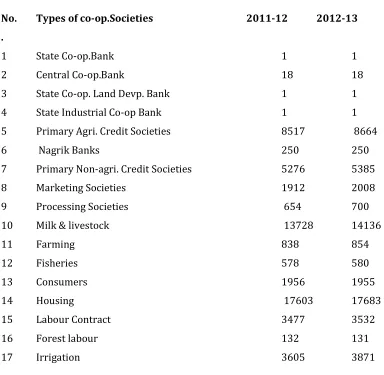
Typewise number of Co-operative Societies in Gujarat State by year :
Table : 5
No. Types of co-op.Societies 2011-12 2012-13
.
1 State Co-op.Bank 1 1
2 Central Co-op.Bank 18 18
3 State Co-op. Land Devp. Bank 1 1 4 State Industrial Co-op Bank 1 1 5 Primary Agri. Credit Societies 8517 8664
6 Nagrik Banks 250 250
7 Primary Non-agri. Credit Societies 5276 5385 8 Marketing Societies 1912 2008 9 Processing Societies 654 700 10 Milk & livestock 13728 14136
11 Farming 838 854
12 Fisheries 578 580
13 Consumers 1956 1955
14 Housing 17603 17683
15 Labour Contract 3477 3532
16 Forest labour 132 131
18 Transport 125 122
19 Electricity 4 3
20 Other Non-credit 3684 4302 21 Union & institute 38 36
22 Sugar 17 17
23 Industrial (P) 4573 4502
VALSAD DISTRICT : ( STUDY SELECTED AREA )
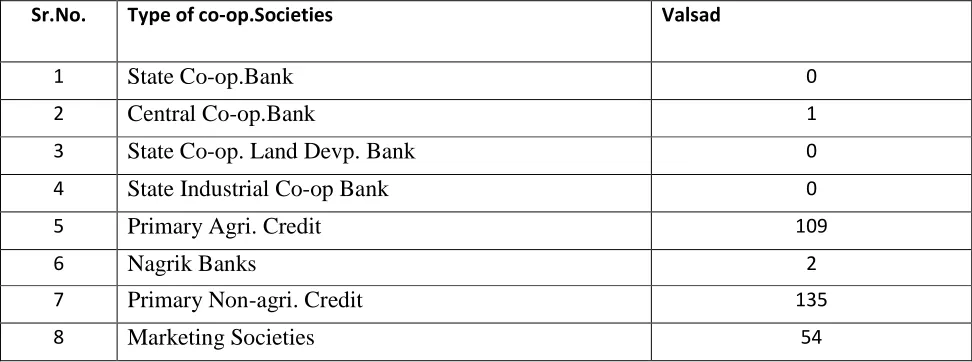
Different education level of five talukas of dist Valsad of Gujarat can be seen .Base on the education level of the people, a variety can be seen in their languages, culture, living standard etc has undergone a huge changes in last two decades to go. Different type Cooperative society hear Following table in Valsad Dist : Table : 7
Sr.No. Type of co-op.Societies Valsad
1 State Co-op.Bank 0
2 Central Co-op.Bank 1
3 State Co-op. Land Devp. Bank 0 4 State Industrial Co-op Bank 0
5 Primary Agri. Credit 109
6 Nagrik Banks 2
7 Primary Non-agri. Credit 135
Source : Valsad Statastics Department
(A.4) Various Agencies Working For the Devlopment of Cooperative Society in India :
1. National cooperative union of india Established : 1929, Members : 208 National level federation : 17 State level Fedration : 151
2. National Agriculture Cooperative Marketing Fedration of india Ltd. Established : 1958 ,Members : 839 Turn over : 20085.16 Milion 3. National Federation of Consumers Co operatives.
Established : 1965 Members : 141
9 Processing Societies 4
10 Milk & livestock 441
11 Farming 3
12 Fisheries 21
13 Consumers 17
14 Housing 874
15 Labour Contract 92
16 Forest labour 10
17 Irrigation 45
18 Transport 3
19 Electricity 1
20 Other Non-credit 252
21 Union & institute 5
22 Sugar 1
23 Industrial(p) 78
Turnover : 14645.54 Milion
4. Agriculture Federation of State cooperatives Banks.(NESCOB) Established : May -19-1964
Members : 31
5. Indian Farmers Fertilizer Cooperative Limited.( IFFCO) Established : 1967
6. Krishak Bharti Cooperative Ltd.(KRIBHCO) Established : 1980 Members : 7349
7. Tribal Cooperative Marketing Development Federation of india. Established : 1987 Members : 28
8. National Cooperatives Dairy Federation of india Ltd. Established : 1970 Members : 25
CHAPTER – 1 ( B)
UNDERSTANDING OF THE SELECTED
CO-OPERATIVE SOCIETY, INFORMATION
RELATED TO KAPARADA AND
DHARAMPUR TALUKA WORKING AND
FUNCTION OF THE SELECTED
CO-OPERATIVE SOCIETIES AND ITS
MANAGEMENT.
INTRODUCTION TO VALSAD DISTRICT : AND
KAPRADA TALUKA
VALSAD DISTRICT INFORMATION :
If we peep into historical background we shall not forget entry of parses at Sanjan port for for the first time in India. Parsee community spreed throughout India from sanjan with their famous religious place "Fire temple" at Udavada in Pardi taluka of Valsad district. There is an ancient Jain pilgrim place at Bagwada on National Highway No.8 near Udavada, where there is constant
"Khed Satyagrah" and grass agitation launched by late Ishwarbhai Desai in pardi taluka put it before the country and world. There is a largest industrial estate at Vapi in Pardi taluka.
There is a parnera mountain known as fort of chhatrapati maharaj situated at about 5-6 kms. from valsad to pardi of valsad taluka big fair is held on "aatham" during Navaratri. Thousands of Pilgrims bows down to chandrika mataji, kalika mataji, Hanumanji Temple, Shankar Bhagwan Temple on this mountain. Muslims also visit Dargah there. Valsad district was discussed at national and international level as it was birth place of the Great person shri morarji desai, Bharat Ratna and Ex.prime minister of India. A part from this valsad district is famous for valsadi aafus mangoes, world famous chemical factories at Atul, largest industrial estate at Vapi, famous valsadi teak-wood. Valsad district is situated on south of Gujarat. There is a Arabeen sea in west. There are series of sahyadri mountains in the east. Valsad district has population of 14,10,680 and has area of 2,947.49 sq.kms area. It has good facilities and life style is good. It is a head quarters of Railway Defense Force and has training centre. Railway administration at Valsad has important divisions like loco sheds, dispensary, area manager office and vast railway colonies there is a vast M.P.M.C. market for sales of agricultural
production manages and chikoos.
INTRODUCTION TO KAPRADA AND DHARAMPUR TALUKA :
Dharampur and kaparada taluka of valsad district are mostly tribal areas. They are in the lap of sahyadri mountain chain. Hill station of this district are comparable to any other hill stations in India. However, there are negligible accommodation for lodging and boarding on account of inaccessible areas however, the area has good potentiality of its development as tourist centers on account of flowing rivers and springs high mountains, dense forest and natural beauty. There is a "District" science centre at dharampur with modern scientific instruments exhibiting and demonstrating various rules of science, which has become the centre of attractions for science lovers not only from valsad district but also from maharashtra state and Dacha and Nagar Haveli union territories. Splendid temple of an idol of eight metals of Bhagwan "Bhav Bhaveshwar" constructed by maha mandaleshwar vidyanandji saraswati maharaj and its complex is emerging as a pilgrim place at Barumal "Sahayadri Srushti Centre Constructed by forests department. particularly under supervision of Shri P.S.Valvi, the then D.F.O. of Valsad south Division is a centre of tourists attraction for the passers by going from valsad to Nasik, where there is a treasure of innumerable herbs from natural sources. It is a wealth of trible forests. There are 2.50 types of trees and 225 types of medicinal herbs.
Kaprada Talukas Population is 202862. And 128 Villages.
Co-operative Society of Taluka Kaparada :
The Selected Cooperative Societies And Its Management :
Introduction and Background
Vansda in Maharashtra was a place with huge tracts of wastelands. However the irony was, despite good rainfall, water was scarce in non-monsoon months due to undulating nature of land; the tribal farmers though owning land, migrated to nearby mango orchards for work as nothing grew on their lands. To address these issues. Arvind Mafatlal invited Manibhai Desai, a renowned livelihood interventionist to the Vansda area.
Manibhai Desai, a Gandhian with a firm belief in peoples’ ability to make choices, started Bharatiya Agro Industries Foundation, BAIF, in 1967 in Pune. He was determined that technocrats and managers would run BAIF as a profitable, self-sustaining business. He conceptualized delivery system for services by taking up door to door service, and encouraged local youth to take up management of the processes.
Drawing on his Urulikanchan experience in soil conservation, production optimization and co-operative management, Manibhai Desai took up the task of formulating a multi-pronged approach to ‘Market-led Livelihood Intervention’ for the Vansda area under the banner of Dhruva. The Dhruva banner was based on the wadi [orchard] model for promotion of community-based organizations, which succeeded in linking individual tribal farmers to the market. As developing orchards required high investment, it was supported with grants, whereas marketing, a commercial activity, was carried out with the help of technocrats and management professionals. Both required the tribal farmers to achieve the goal of self-sufficiency.
Dhruva envisages a local economy based approach that aids production of goods that can be marketed locally as well as in the outside markets. It saw its work as building a local market network, interlinking groups of producers such as farmers, vermi-compost suppliers, sapling growers, and technical expertise with other service providers for their mutual benefit.
Organizational Structure
VASUNDHARA was promoted by BAIF in 1995 as an independent organization to take up marketing of the produce from the wadis. The set of organizations through which procurement, processing and marketing of the produce from the wadis is managed include:
BAIF/Dhruva, the promoting organization
The individual production units, the wadis or orchards owned by each tribal family, SHGs for women which take up vermi-composting inputs for the wadi, as well as marketing
The Ayojan Samitis, the informal village organizations which manage the processing
Their federations, the tribal co-operatives. VASUNDHARA, the mango and cashew marketing co-operative is one of them. The marketing co-operative has processing agencies for cashew and mango, for e.g. Kaprada for cashew and Vansda for mango pulping and pickling.
Production Process
The production process involves the following steps: 1. Wadi Production*
2. Collection by Ayojan Samiti
3. Decentralized primary processing centers 4. Finishing unit in the co-operative – VASUNDHARA, Kaprada
5. Federated marketing team.
The produce of the wadis in the form of mango and cashew is procured by the Ayojan
Samitis. The quantities of mango are notified wadi wise to the Ayojan Samiti, which fixes a
particular date and time for the produce to be brought for processing at the primary processing centers. This ensures that the fruit does not perish due to lack of facilities in the temporary premises, the village schools in this case, for processing of mango. On receipt of the
processed product the marketing co-operative routes the payment to the individual wadi owners, with an additional commission of one rupee per kilo to the Ayojan Samiti.
The Wadi IdeaWastelend Devlopment Activities
Tribals were migrating to work in nearby mango orchards, but the reality was, the tribal farmers aspired to own the orchard that they worked in. The farmers each typically owned 3-5 acres of wasteland. While some paddy was grown during the monsoon, water was a scarce resource in the non-monsoon months because of the undulating nature of the land. There was ample rain and the farmers had skill and experience in growing mango, but the challenge was to supply a working model that would transform the land of each farmer into a mango orchard
Dhruva coupled the skill of farmers with the agro-climatic suitability of the land to come up with the wadi idea. Dhruva had to raise the capital for supporting the activity of each wadi, as well as for fertilizers and pesticides for four years.
Manibhai’s credibility as an agriculture expert, his assurance that each tribal could own an orchard, and that BAIF/Dhruva would not take over their land, motivated some tribals into taking up the activity. Starting with the tried and tested soil and water conservation methods, Dhruva compensated farmers who took up soil conservation and pit digging activities on their own land. Before planting mango, Dhruva experimented with various different combinations of trees for maximizing returns and reducing risks. Mango varieties were chosen with the market in view, but grafted saplings were used to increase sturdiness and adaptability to the local terrain. An agricultural expert from KFW, Germany, did a survey and recommended that cashew should be included. Understanding the need for fodder in the cattle rearing area, fodder plants were planted around the border. Eventually the farmer moved into the orchard, and grew a kitchen garden for his family’s consumption.
marketing of agricultural produce of members mainly mango and cashew, operation of Agro Service Centres, mango graft trading, roof tiles trading, etc. Cashew processing remains the major activity of these cooperatives.
SUCCESSFULLY WORKING CO-OPERATIVE
SOCIETIES IN KAPRADA AND DHARAMPUR
TALUKA :
1
Mandava
2
Tutarkhed
3
Sutharpada
4
Dhamani
5
Karchondh
6
Karjun
7
Dixal
8
Pindaval
9
Gadi
Kaprada talukas selected Successful cooperative societies in Research Study :
Shree Pindaval Vibhag Bagayati sahkari Mandali ltd,Pindaval taluka : Dharampur Dist Valsad
Shree Karchond Vibhag Bagayati Sahkari Mandali Ltd. Karchond, Taluka Kaprada Dist Valsad
Above Selected Cooperative Socities Following Villages Covered area in Dharampur & Kaprada Taluka in Valsad District
1 Samarsingi 13 Madhuban
2 Vaghval 14 Dahikhed
3 Pangarbari 15 Varna
4 Ranveri 16 Hedalbari
5 Piprol 17 Burvad
6 Upalpada 18 Vadijangal
7 Ulaspidi 19 Fatehpur
8 Ambosi 20 Nagar
9 Pandavkhadak 21 Sukalbari
10 Bhanvad 22 Kaprada
11 Pindaval 23 Jirrval
CHAPTER – 2
LITERATURE REVIEW
Literature review
Literature review of co-operative societies operating at international level, in India and Gujarat.
Prof. Vijay S.Patel *; Prof.. Chandresh B. Mehta ( 2012) 1 in the article “A Financial Ratio Analysis
of Krishak Bharti Cooperative Ltd ”The Financial Statements are generally prepared for the
measurement of financial position of aparticular company for a particular period of time. The financial statements i.e. (i) Profit andloss account and (ii) Balancesheet provide useful information regarding financial situation of company. The information has its own value, but if some one wants to have better judgment of the concern, he has to analyse them. This paper provides the guidelines about analysis of profitability ratio of Krishak Bharati Co-operative Ltd. located at Kawas-Hazira in Surat District.
was Rs. 639483, which is six times more than original value, which is good sign for the company. Return on capital employed from
the year 2000-01 to 2008-09 lies between 2.04% to 13%. Except 2002-03, this ratio shows minor difference in it. The highest ratio was 13% in the year 2005-06, which shows the good sign of the company. Conclusions should be considered as guiding factors to determine how far the goals were deviated and what should be done to improve the existing financial position. The following recommendations are The company should increase the production vis-a-vis sales. The company should also concentrate on quality products. Looking to the total investment made, this is one of primary steps to strengthen the company. The gross profit ratio is satisfactory. However, net profit ratio is not in commensurate with gross profit ratio. Hence the post production expenses and financial charges need to be curbed.company has made the use of ownership capital. Since the rate of profit of the company is more than the rate of interest prevailing in the market on the
borrowed capital, the company can obtain borrowed capital in order to take the advantage of trading on equity and ultimately increase the earning per share. The credit policy for the debtor is not favorable the company does not receive collection from the debtor at the right time. The credit policy should be made effective so that collection from debtor can be received at the earliest.
Tejani Rachana (2011)2 in the research project “ Financial Inclusion and Performance of
Rural Co-operative Banks in Gujarat ” In an Index of Financial Inclusion, India has been ranked 50
There is lot of opportunity for the commercial banks to explore the rural unbanked areas. Though RRBs and PACS have good coverage but most of them are running into losses. Again, the number of kisan credit cards issued and the amount of credit granted under it is also showing a declining trend. Commercial banks should seize this opportunity rather than looking at it as a social obligation. Going with Mahajan and Laskar (2010), let us enable every Indian to conduct a financial transaction, a deposit or a withdrawal, a payment or a receipt, of up to Rs 1000, in a secure and convenient way, by going less than 1000 metres away from home or work place, at an all-in cost, including authentication, transaction authorisation, cash-in/cash-out and non-repudiation (using printed paper receipts), for less than 1000 paise, or Rs 10. At a transaction size of Rs 1000, this would be one percent. Let us all in the financial sector take a pledge to usher Universal Financial Inclusion for all Indians by 2020.
Dr. Baldev M .Patel ( 2013)3 in the article “ Social Services Provided by Selected Credit
Co-Operative Societies of North Gujarat ” Various social services are rendered for the welfare of the
members by credit co-op societies. These services include death benefit, support on acute Illness, facilities for the panel of the doctors, ambulance van, medical camp etc. The activities related to education include education loans, educational training, different competitions, awards and prizes. Thus they help in social development. Besides imparting educational trainings, awards etc, vocational training is provided to equip the beneficiaries for employment. Computer training, training classes for tailoring are also run. It also fulfills the social responsibilities related to marriage incentives, social upliftment, accident, natural calamity etc are considered vital. There are so many provisions for the members such as mediclaim, accident insurance, group insurance and member insurance policies. This research paper brings into light the various services rendered by the credit co-op societies.
Average 19% credit co-operative societies render healthrelated services, 23% credit societies render educational services, 32% credit societies provide social motivation, 32% credit societies provide insurance related services and 12% credit societies render retirement scheme benefits.
Accountan Jigna Trivedi*, P K Priyan** and Vinay Bhinde (2011)4 in their research “ The Role of Dairy
existing agricultural activity. Largely, rural women are engaged in this activity. These rural women, besides doing hard household chores, also undertake the taxing job of cattle rearing. They supply the milk to the well-established district cooperative dairies working successfully on the Anand model. The present paper is an effort to study the role of district cooperative dairies in helping the women to be self-reliant, self-employed, self-diligent, and empowered.
qualification and higher level of other noneconomic responsibilities. The research also indicated that women were not enthusiastic about the idea of support floated by ‘Madhur’ that the revenues generated from selling milk should be exclusively handled by women. They are still in the clutches of male-dominated society. The most preferred options by milk farmers to supply milk to Madhur was the availability of year-end bonus, uniform prices based on the quality of milk and regular money receipts. These healthy practices should be continued. On applying weighted average method for the statements pertaining to the support expected from the district cooperative milk union, it was found that women gave first preference to opportunities for educated women to work as employees of VCS/DCS. They also preferred encouraging women to participate in the meetings of VCS/DCS. They also suggested providing cattle loans, helping women to restart closed dairies, organizing seminars to educate women, reserving at least two seats for women in administration, and allowing two members from one family to become members of VCS/DCS. They gave least importance to the issue of whom to hand over the money generated by selling milk. ‘Madhur’ should address the burning problem of costly cattle feed. It should bring forth the issue to the notice of the government and try to arrange for subsidized cattle fodder. The one-time waiver of agricultural debt of farmers from banks provided by the government is not sufficient to help the farmers. Rather the government should set up a network to supply cattle feed at a subsidized rate to every district cooperative milk producing union, which in turn will supply the same to the milk farmers. This step would grant some relief to the milk farmers. ‘Madhur’ should also take initiatives to educate them about the healthy cattle rearing practices by which they can enhance the productivity of the milch animals and also maintain appropriate calving interval. Importantly, they should be encouraged to be empowered financially.
Dr. Ruchira Prasad And Dr. Ruchira Prasad ( 2013 ) 4 in the article “A Case Study of Amul
Cooperative in Indian in Relation to Organizationaldesign And Operational Efficiency ”
that the design of the basic structure is somewhat different as it believes in the federal form of structure each unit is independent of each other. It is a popular belief that co-operatives are a failure, but Amul with Co-operative Structure is a grand success. Amul has an appropriate blend of policy makers, technology and a support system to the milk producers without disturbing their agro-economic system and ploughing back the profits, by prudent use of men, materials and machines.
Looking back at the path traversed by AMUL, the following features make it a pattern and model for emulation elsewhere. Producing an appropriate blend of the policy makers, farmers board of management and the professionals, bringing the best of the technology to rural producers, providing a support system to the milk producers without their agro-economic system and plugging back the profits, by prudent use of men, material and machines. Even though growing with time and on scale, it has remained with the smallest producer members. AMUL is an example par excellence, of an intervention for rural change.
Deepali Kapoor Suri* and Shilpi Singhal ( 2013)5 in the article “ Comparative Analysis of
Financial Perfomance of Indian Farmers Feertilizers Cooperative Ltd (IFFCO) ” In today
globalized economy competition is found all over the world. To remain competitive and grow profitably, it is essential that every business entity achieve its financial goals. Financial analysis is mainly done to compare the growth, profitability and financial soundness of the respective company by diagnosing the information contained in the financial statement. The study is an attempt being made to identify the financial performance and how the performance is going on for the last five years, of Indian Farmers Fertiliser Co-operative Limited, popularly known as IFFCO, on the basis of establishing relationship between the items of balance sheet and profit &loss account. For establishing the relationship various types of ratios such as solvency, liquidity, activity and profitability are used. The period of study is taken from the year 2007-08 to 2011-12.
It can be concluded from the study of 5 financial periods of IFFCO that the maximum Financial Indicators of IFFCO are not at a very good position. From the analysis of main Financial Indicators it is clear that Operating Profit to Turnover Ratio, Fixed Assets Turnover Ratio, Debt Equity Ratio, Current Ratio, Liquidity Ratio, etc are at a desirable position. However, company’s Return on Capital Employed, Profit before tax to Turnover, etc were undesirable as compared to Previous Years.
Anil Kumar Soni and Dr. Harjinder Pal Singh Saluja ( 2012)6 in the article “ Role of
Cooperative Bank in Agricultural Credit : As Study Based on Cahhattisgarh ” The cooperative
reach to the rural India, through their huge network of credit societies in the institutional credit structure. The cooperative sector has played a key role in the economy of the country and always recognized as an integral part of our national economy. Cooperatives have ideological base, economic objects with social outlook and approach. The cooperative covers almost all cent percent villages in India. The cooperative form of organization is the Ideal Organization for economically weaker sections in the country. According to recent study by World Bank and National Council for Applied Economic Research, the Primary Agriculture Credit Societies (PACS) amount for about 30 percent of micro credit in India. This paper attempts to analyze the role of co-operative bank in agricultural credit.
Cooperative banks belong to the oldest forms of the collective action in India playing essential role in the realization of the agricultural and in local development. They serve both rural and urban population, and are main banks in India supporting development of agriculture and rural areas. Their key role is to give credits financing various rural based entrepreneurships. Agricultural credits play a number of significant functions of which the primary include the intensification and growth of the agricultural production. In a developing State like Chhattisgarh with huge deficits in terms of quality and quantity, the State has to shoulder the primary responsibility of providing cooperative credit. Considering the low living standards of common man, incomplete and imperfect markets, and other socio political considerations it is the primary duty of the government to ensure that its citizens have easy access to cooperative credit.
Dr. M. S. Ramananda And Dr. M. Jayaprakash ( 2012) 7 in the article “ Impact on
Vydhanadhan Committee Recomadations Of Wangaplly Primar Agricultural Cooperative Credit Society ” Cooperatives as an institution in India are more than a century old. With more than a lakh grass
government ventures for which the parameters of performance needs to be revisited. The study also found that as deposits grow in proportion to borrowings, the recovery performance is adversely affected. Prudential norms were applied to cooperatives after introduction of liberalization of economy, which were recognized as principal institutional agency for providing agricultural credit in India. The Cooperative sector was passing through a bad time. It continued to be fragile. It became imperative to assess the financial and other operational inputs required to revive them. The National Federation of state cooperative banks and National cooperative Agricultural Rural Development banks federation have approached the Government of India to strengthen the Cooperative Credit System (CCCS) „by infusion of additional capital as had been done for the weak nationalized commercial banks and Regional Rural Banks. The Government of India appointed a task force headed by Jagadish Kapoor Committee on revival and restructuring package on cooperative banks on the 9th April 1999. The terms I of this committee to review the functioning of the Cooperative Credit Structure and suggest measures to make them Member Driven, Professional Business Enterprises. The Primary Agricultural Cooperative Credit Society Ltd., Wangapally has been registered with Registration No. 120/TH in the jurisdiction of the Deputy Registrar of Coop. Societies, Bhongir of Nalgonda District.
revisited. The study also found that as deposits grow in proportion to borrowings, the recovery performance is adversely affected.
Prior to the restructurisation of the Credit Societies, there were totally (9) erstwhile PACSs in the Yadagirigutta Mandal, namely Yadagirigutta, Masaipet, Gowraipally, Mallapur, Kacharam, Wangapally, Motakandu, Chinna Kandukur and Pedda Kandukur. During the restructurisation, though all the societies were identified as non-viable societies, as such made focal points of (2) societies namely Yadagirigutta and Wangapally and as per the availability of geographical possibility the other societies were merged with these (2) societies as focal point societies as on 27-05-2005.
Kidane Mengistu And Dr.A Tamilarasu ( Jan2014)8 in the article “ Study on financial Stability
Analysis of Tukumma Agricultural Primary Multipurpose Cooperatives Horoguduru Wollegazone,Ormia Regional State Ethopia” Analyzing cooperatives financial statement is significant
for members, government, other non-governmental organizations and researchers to understand the strengths and weaknesses in their operational system. The study unit and area is selected purposely, based on the year of establishment and availability of financial statements for the five years (2008-2012). To attain the objectives of the study the researcher was considered five years audited report with regard quantitative data analysis by using the ratio analysis; over a period of 2008-2012 years; for showing the problem areas and for improving the financial stability by taking remedial action. study, it is concluded that the values of liquidity ratios such as quick ratio and net working capital ratio are above the standard. This indicates the cooperative financial position was good (or sound enough) to meet its current obligations, But current ratio, absolute liquid ratio and cash ratio of the cooperative are below the industry average, standard, that shows the financial position of the cooperative is not satisfactory to meet its short-term obligations. Finally, still there is a scope and hope for the betshort-terment to maintain the optimum level financial stability in future, if the cooperative operate the activity in efficient manner, try to maintain the optimum level of financial stability in future, there is no doubt, it is clear Cristal that it will get the great success among the public and other cooperatives also, the day is not for off.
Zafar Ullah Malik and Athar Iqbal ( May-2012)9 “A_ect of Working Capital Management
on Firms Pro_tability in Sugar Industry of Pakistan ” Management of working capital performs a
significantly affecting the profitability of the firms while Sales, Gearing Ratioand No of Days Account Receivables are insignificant in the research. Pearson Correlation and Multiple Linear Regression are used in this research to study the relationship between variables. Sugar sector which is the second biggest sector in manufacturing sector of Pakistan contributes to the economy significantly. Keeping in mind the importance of sugar sector in the economy of Pakistan objective of this research is to analyze the affect of working capital management on firm’s profitability in the sugar sector of Pakistan. To carry out the research data from 19 sugar mills which are currently listed at Karachi Stock Exchange is analyzed. The results shows that profitability of sugar mills are significantly affected by the efficient management of working capital and working capital management play a vital role in creating a value for the shareholders.
Boris Nenide & Robert W. Pricer and S. Michael Camp( 2012) 10 In the Article “The use of
Financial Ratios for Research: Problems Associated with and Recommendations for Using Large Databases ” A review of published research in the field of accounting and finance reveals that the use of
ratio calculations with multivariate analysis for predicting the performance of business firms is common. However, much of this research uses large database information without determining if needed sample assumptions can be met for reliable conclusions to be drawn by the researchers. This paper presents recommended adjustment techniques for researchers using large databases for ratio calculation to allow for confidence that the results of analysis will be meaningful and that inferences may be drawn from the data. Using a sample from the Kauffman Center for Entrepreneurial Leadership Financial Statement Database, Balance Sheet and Income Statement data of 250 firms is used to illustrate and explain techniques for data error identification, handling the problem of denominators being negative or approaching zero when calculating ratios, and effective techniques for transforming the data to achieve approximation of normal distributions. The application of these recommendations will allow researchers to use financial statement data samples that will meet required characteristics for the use of valid multivariate statistical analysis.
RESEARCH METHDOLOGY
(3.1)
NAME OF STUDY
(3.2)
RESEARCH AREA OF ORGANIZATION
(3.3)
SIGNIFICANCE OF THE STUDY
(3.4)
SCOPE OF THE STUDY
(3.5)
RESEARCH GAPE
(3.6)
OBJECTIVES OF PROPOSED STUDY
(3.7)
TOOLS OF DATA ANALYSIS &
SOURCE OF INFORMATION
(3.8)
LIMITATION OF THE STUDY
(3.9)
CHAPTERAIZATION
(3.1) Title of the Study :
Financial Performance of Co- operative Societies – A Comparative Study on ( With Special Reference to Valsad District of Gujarat )
(3.2) Area :
a) Shree Pindaval vibhag Bagayati Sahkari Mandali Ltd. Pindaval, Dist Valsad b) Shree Karchond Vibhag Bagayati Sahkari Mandali Ltd. Karchond, Dist Valsad
b) Details of the Selected Areas:
Brief of the area selected for the Study considered as a backward area falls under Valsad district of Gujarat State of India.
(3.3) Significance of the Study :
Today’s world had become very competitive. In each field thousand’s of competitors has entered the market. In the changing market scenario equipped with science and technology, they re struggling to survive in the market, whether it is a field of knowledge, business or any other Profession. Even the Indian economy is not free from the air of liberalization, privatization and globalization. The public sector has to become more active and should also take necessary measures to fit them in the changing economic scenario. With this objectives in mind the research on “Shree Pindaval Vibhag Bagayati Co-operative Society Ltd And Karchond Vibhag Bagayati sahkari Mandali Ltd. is undertaken. Where the financial performance of the same will be conducted keeping the current situation on the top. A study on the problem faced and its relevant solution, so that the people of these areas get good service from this co-operative society. This co-operative society can act as a role model to be followed by other society of the Kaparad Taluka. And Dharampur Other co-operative society can follow the management system for improving the financial position of the society.
A part from the selected co-operative societies, a similar study can be conducted for other co-operative societies of taluka of Kaparada And Dharampur They are as follow :
• Various service co-operative Society
• Credit Cooperative society
• Handicraft Industry
For the study purpose, researcher have selected (2) four similar activity Co-operative Societies of Valsad District of Gujarat state .There are lot of scope for any researched to conduct the study for above mentioned societies. The present study will focus only on financial analysis of the operative society; one can also conduct the study on same co-operative society, but from different angle like, marketing of the product falls under the preview of the society. Other opportunities can also be explore for the product. Identifying the problems face by the society or comparison between one or more co-operative society can be undertaken. Even comparison between one taluka co-operative society of same category can b done with similar type in some another taluka of same district or can also opportunities for some another district or state.
(3.5) Research Gap:
operative societies will also be done, so as to gather more information related to its activity and function.
(3.6) Objectives of the proposed study
To understand the working of Co-operative Societies in Valsad District in Gujarat To study the financial performance of selected Co-operative Societies.
To make comparative study of the selected Co-operative Societies.
To make suggestions for the betterment of the Co-operative Societies in general and selected co-operative societies in particular.
(3.7) Source of Information:
• Personal talk with the chairman of the selected co-operative society.
• Personal talk with the accountant of the selected co-operative society.
• Visit to the district industry center of Valsad district.
• Members of the co-operative society
• Other documents related to the study will be used: Newspaper
Monthly Magazine Gram Swaraj Magazine
Radio Programme related to the farmer Books/literature/research papers/articles etc Internet
Research conducted by other state co-operative society
• Tool of data analysis and methodology :
Ratio Analysis & Trend Analysis
• Balance sheet ratios:
• Profit & loss a/c ratio:
1. Gross profit ratio 2. Net profit ratio 3. Operating ratio
• Inter-statement ratios/composite/mixed ratios
1. Return on capital employed 2.Return of shareholders funds 3. Debtors turnover ratio
Classification by users
• Ratios for management
1. Operating ratio 2. Debtors turnover 3. Stock turnover 4. Return on capital
• Ratios for creditors
1. Fixed asset ratio 3. Creditor’s turnover
Classification by purpose/function
1. Liquidity 2. Solvency/stability 3. Activity/performance 4. Profitability
(3.8) LIMITATION OF THE STUDY
1. The study has been conducted over a limited period of eight years only. 2. The study is mainly based on secondary data.
3. The study is limited to a Four Selected Cooperative society only.
4. The study is based on consolidated financial statement, which may lead to some errors and assumptions.
(3.9) Chapterization :