any 4-bit S-box
Sebastian Kutzner1, Phuong Ha Nguyen2, and Axel Poschmann2. 1
Laboratory of Physical Analysis & Cryptographic Engineering (PACE) Temasek Laboratories @ NTU.
2
Division of Mathematical Sciences, School of Physical and Mathematical Sciences
Nanyang Technological University, Singapore
Abstract. Threshold Implementation (TI) is an elegant and widely ac-cepted countermeasure against 1-st order Differential Power Analysis (DPA) in Side Channel Attacks. The 3-share TI is the most efficient version of TI, but so far, it can only be applied to 50% of all 4-bit S-boxes. In this paper, we study the limitations of decomposition and introduce factorization to enable the 3-share TI for any optimal 4-bit S-box. We propose an algorithm which can decompose any optimal 4-bit S-box to quadratic vectorial boolean functions with a time complexity of 219. Furthermore, we use our new methodology in combination with decomposition to optimize ciphers utilizing many different S-boxes, and, to highlight the strength of our new methodology, we construct a 3-share Threshold Implementation of SERPENT which was believed to be not possible until now. Last, we show how to implemented all SERPENT S-boxes with only one mutual core.
1
Introduction
Side Channel Attacks (SCA) [4] were introduced in 1997 by Kocheret al.and ex-ploit the fact that while a device is processing data, information about this data is leaked through different channels, e.g., power consumption, electromagnetic emanation and so forth. DPA [5] is a more advanced technique using statisti-cal methods to analyze data collected from many measurements. It exploits the correlation between intermediate results, which depend on a small part of the secret, and the power consumption.
The number of shares required for a Threshold Implementation depends on the degreedof the non-linear function (S-box) and [11,12] have shown that it is at leastd+ 1. It implies that the higher the degree of the non-linear function, the more shares are required and the larger is the implementation. Since a degree of two is the minimal degree of a non-linear function, the optimal number of shares is three. Therefore, to apply a 3-share Threshold Implementation to a larger degree function, this function must be represented as a composition of quadratic functions [13].
Nowadays, 4-bit S-boxes are used in cryptographic algorithms due to their efficient hardware implementation. In [6], the authors define a set of 4-bit S-boxes, which fulfill certain cryptographic properties to resist linear and differ-ential cryptanalysis, as optimal S-boxes. The PRESENT S-box is an example for such an optimal 4-bit S-box for which, after decomposition to two quadratic boolean functions, the 3-share TI can be applied [13]. This motivates us to study which of these optimal S-boxes are suitable for the 3-share TI. In this paper, we show that all optimal 4-bit S-boxes which can be protected by the 3-share TI belong to the alternating groupA16 of the symmetric groupS161. This answer implies that we can not apply the 3-share TI to those S-boxes which do not belong to A16. Therefore, we introduce the Factorization structure. This new idea has two big contributions: first, it allows us to decompose any 4-bit S-box to quadratic vectorial boolean functions and hence, enabling us to apply the 3-share TI to any given 4-bit S-box. Second, it helps us to optimize hardware implementation of ciphers with different S-boxes by enabling sharing a mutual core between them. To support our claims we first show how our idea can be used to efficiently implement the SERPENT S-boxes and second, how to apply the 3-share TI to SERPENT, what, up to now, was believed to be not possible. Finding a decomposition or factorization of an arbitrary optimal S-box is not a trivial problem. Sometimes, the time complexity is more than 252and might be beyond our capacity. To solve this problem we first intensively study the struc-ture of optimal S-boxes. We derive an algorithm which can not only decompose any optimal S-box with a time complexity of 219 but also finds decompositions which are very efficient in terms of hardware costs.
The paper is organized as follows. In Section 2 the Threshold Implementation countermeasure and the results of the journal of cryptology paper are recalled. Section 3 studies the set of optimal 4-bit S-boxes for which the 3-share TI can be applied. In Section 4 theFactorization Structure is introduced. In Section 5 our new ideas are applied to the SERPENT cipher. Section 6 concludes the paper.
2
The Threshold Implementation Countermeasure
In this section we recall the preliminaries of the Threshold implementation coun-termeasure and revisit the results of [13] describing a 3-share TI of PRESENT.
2.1 Threshold Implementation Countermeasure
In [11], the Threshold Implementations(TI) was introduced as a side channel attack countermeasure. It is based on secret sharing and multiparty computation and provable secure against the 1-st order DPA, even in the presence of glitches. The method can be described as follows. The variablexis divided intosshares
xi, 1≤i≤s, such thatx=Lsi=1xi. Let
F(x, y, z, . . . ):GF(2)m→GF(2)n
be a vectorial boolean function which needs to be shared. Denote ¯xi = (x1,
. . . , xi−1, xi+1, . . . , xs), i.e, the vector ¯xidoes not contain the share xi. In order
to share F, a set of s vectorial boolean functions Fi is constructed and must
fulfill the following properties:
1. Non-completeness:All the functionFi must be independent to the input
variables x, y, z, . . ., i.e the inputs of Fi does not have xi, yi, zi, . . . or
Fi=Fi( ¯xi).
2. Correctness:F(x, y, z, . . . )=Ls
i=1 Fi(x¯i,y¯i,z¯i, . . . ).
According to the Theorem 2 and 3 of [11], if the inputs satisfy the following condition
P r(¯x= ¯X,y¯= ¯Y , . . .) =qP r(x=
s
M
i
Xi, y= s
M
i
Yi, . . .), (1)
where q is a constant, then the shared version of functionF can resist against the first order DPA in presence of glitches.
In general, the functionF is a S-box layer and the output of the previous round of the cipher is the input of the current round. Hence, we have a following property for the output of F. Assume that, the output ofFisu= (u1, u2, . . . , ui),
then we have the following property for output ofF:
Uniformity:P r(¯u= ¯U|u=Ls
iUi) is a constant.
If the function u = F(x) is invertible, then every vector ¯u is reached for exactly one input vector ¯x. In this paper, the functionF is a 4-bit S-box. Hence, its 3-share version is required to be 12-bit permutation.
The number of shares s depends on the degree of the original vectorial boolean function F(x, y, z, . . . ). Assume that the degree of F is d, then s is computed as follows:
Theorem 1. [12] The minimum number of shares required to implement a
prod-uct of dvariables satisfying Property 1 and 2 is given by
s≥1 +d
2.2 3-share TI for cubic 4-bit S-boxes
In [13] the authors describe how to apply the 3-share TI to PRESENT. Since the PRESENT S-box S(·) is a cubic 4-bit permutation, the minimum number of shares is 4 [12]. To apply TI with only 3 shares, the authors decomposed the S-box into two quadratic permutationsS(·) =F(G(·)) as shown in Figure 1.
4 g3
g2
g1 y3
y2
y1 f1
f2
f3 4
4
4
4
4 4
4
4
S2
S3 S1
G F 4 4 4 S
4 4
Fig. 1.Composition of PRESENT’s s-box [13]
3
TI-Decomposition
In the previous section we recalled how the authors of [13] used the decomposition of a cubic function into two quadratic ones to reduce the number of needed shares in a TI from 4 to 3. In this section we want to investigate the decomposability of optimal 4-bit S-boxes in a more general way. First, we recall the definition of optimal S-boxes and decompositions. Then we define all optimal 4-bit S-boxes which can be decomposed into quadratic boolean functions, i.e., belong toA16. In addition, we describe how to construct the decompositions for all these S-boxes with a time complexity of 219.
3.1 Optimal 4-bit S-boxes
Definition 1. Two sboxes S(x), S0(x)are linearly equivalent iff there exist two 4×4-bit invertible matrices A, B and two 4-bit vector c, dsuch that
S0(x) =A(S(Bx⊕c)⊕d),∀x∈ {0, . . . ,15}
An S-box is considered as optimal if it fulfills the following requirements [6]:
Definition 2. LetS:F4
2 →F24be an S-box. IfSfulfills the following conditions we call S an optimal S-box:
where Lin(S) and Diff(S) are the linearity and differentiality of S-box S. The reader is refered to [6] for the definitions of Lin(S) and Diff(S).
In addition the authors define 16 classes of linearly equivalent S-boxes inS16, i.e class 0, class 1, . . ., class 15. An optimal S-boxes belongs to a certain class and each class can be represented by using one its S-box.
For the sake for convenience, we follow the notations in [6]. We write the 4×4-bit matrixAin the hexadecimal, for example:
A=
1 0 1 0 0 1 0 0 1 0 0 0 1 0 1 1
= a 4 8 b
= 0xb84a
, (2)
By utilizing definition 1 we do not have to investigate allS0(·) but we can focus our investigations on one representative S(·) of each class, i.e., if S(·) belongs to class i, then all the results of S(·) can be transferred toS0(·), i = 0, . . . ,15.
3.2 Decomposition of Optimal 4-bit S-boxes
Definition 3. If a vectorial boolean functionS(·) can be written as a composi-tion of several lower degree vectorial boolean funccomposi-tionsF1(·), F2(·), . . . , Fn(·), i.e
S(·) =Fn(. . . F2(F1(·))), then F1(·), F2(·), . . . , Fn(·) is called the decomposition
of S(·).
We recall some properties of a permutation inS16.
Lemma 1. A16 is a subgroup of S16, i.e if p1(·) andp2(·) are permutations in
A16 then its composition permutation p3(·) =p1(p2(·))must be inA16 as well.
Lemma 2. All the linear and quadratic permutations inS16 are in A16. Proof. In [13], the author stated that there are around 226 quadratic permuta-tions. Since the number of the linear and quadratic permutations is not big, we can check the parity of all these permutations. If a permutation has a parity of +1, then it belongs toA16(i.e., it is an even permutation). If its parity equals -1, then it does not belong toA16(i.e., it is an odd permutation). All the considered permutations have the parity +1. It implies that these permutations belong to
A16.
Theorem 2. If a permutationp(·)is able to be represented as a composition of quadratic permutations, thenp(·) is inA16.
Proof. The theorem is directly derived from the Lemma 1 and Lemma 2.
Based on Note 1, if one S-box of a considered class can be decomposed, then all S-boxes of this class can be decomposed as well. After checking the parities of permutation of all 16 representative S-boxes, the decomposable classes are: 0, 1, 2, 4, 5, 7, 8, 13 because their representative have parity +1. For example, the PRESENT S-box can be described as a composition of quadratic permutations because it belongs to class 1.
As described in 2.2, after the decomposition into several 4-bit quadratic mutations we need to convert each of these 4-bit permutations into 12-bit per-mutations. These 12-bit quadratic permutations have to fulfill all 3 requirements for a Threshold Implementation [12], i.e., non- completeness, correctness and the uniformity property.
Definition 4. A 4-bit linear or quadratic permutation is called sharableif it can be converted to a 12-bit permutation which fulfills the following properties: cor-rectness, non-completeness and uniformity. All linear permutations are sharable [12].
Definition 5. A 4-bit permutation is called TI-decomposable if it can be de-scribed as a composition of several sharablepermutations.
Our aim is to prove that all S-boxes belonging to the 8 classes 0, 1, 2, 4, 5, 7, 8, 13 are TI-decomposable S-boxes. In order to prove this, we shall show that there exist one TI-decomposable S-box in each class - all S-boxes in one class can be constructed by applying only linear permutations 1 and all linear permutations are sharable 4.
For an arbitrary S-box to be TI-decomposable it must belong toA16 (note that the reverse condition is not necessarily true). Also, an S-box S(·) might not always be decomposable into two quadratic permutations F(G(·)), but one has to find a decomposition with at least three quadratic permutations F(·),
H(·),G(·) such thatS(·) =F(H(G(·))). Even if we know that an S-box can be decomposed into three quadratic permutations, the time complexity for finding a solution forF(·),H(·) and G(·) is not practical, i.e., more than 252 by using the method described in [13].
Therefore, we need a more efficient method to find a decomposition of arbi-trary optimal S-boxes inA16. We introduce the following lemma which not only solves this problem but also gives a deep insight into decomposition of S-boxes.
LetR be the following sharable permutation ,
R= [ 0, 4, 1, 5, 2, 15, 11, 6, 8, 12, 9, 13, 14, 3, 7, 10 ]. We introduce a special structure of a decomposition:
S(·) =AnF(An−1F(....A0(F(·))...)
, whereAn, . . . , A0are invertible matrices andS(·),F(·) are two vectorial boolean functions. We recall, based on 5, ifF(·) is a sharable permutation thenS(·) is a TI-decomposable S-box. We make the following observation:
2. ifA= 0x1248, thenS(·) =R(AR(·))∈class 1 3. ifA= 0x1259, thenS(·) =R(AR(·))∈class 2 4. ifA= 0x1295, thenS(·) =R(AR(·))∈class 8 5. ifA= 0x12e6, thenS(·) =R(AR(R(·)))∈class 4 6. ifA= 0x1843, thenS(·) =R(AR(R(·))) ∈class 7 7. ifA= 0x134b, thenS(·) =R(AR(R(·))) ∈class 13 8. ifA= 0x14a7, thenS(·) =R(AR(R(R(·))))∈class 5
With this idea we are able to construct a representative TI-decomposable S-box for all latter mentioned 8 classes. Hence, based on 1 and Note 1 we are able construct all possible optimal S-boxes belonging to these 8 classes by adaptingA,
B,candd. This way we can reduce the time complexity to find a decomposition for a given S-box to 219. Using this trick we derive the following lemma:
Lemma 3. Let Fi(·),1≤i≤4, be sharable permutations. Then,
1. For any optimal S-boxes S(·) in the classes 0, 1, 2, 8, there exist sharable permutationsF1(·)andF2(·)such that S(·) =F1(F2(·)).
2. For any optimal S-boxesS(·)in classes 4, 7, 13, there exist no sharable per-mutationsF1(·)and F2(·)such that S(·) =F1(F2(·))(proven by exhaustive search), but there existF1(·),F2(·),F3(·)such that S(·) =F1(F2(F3(·))). 3. For any optimal S-boxesS(·)in class 5, there exist no sharable permutations
F1(·) and F2(·) such that S(·) = F1(F2(·)) (proven by exhaustive search), but there existF1(·),F2(·), F3(·),F4(·)such that S(·) =F1(F2(F3(F4(·)))). Note that there might be a solution such thatS(·) = F1(F2(F3(·))) belongs to class 5, but due to the time complexity we could not find such a solution by exhaustive search. Anyway, here the only goal was to construct an S-box belonging to class 5 out of an arbitrary number of sharable decompositions.
Theorem 3. All S-boxes which belong to classes 0, 1, 2, 4, 5, 7, 8, 13 are TI-decomposable.
Proof. This theorem is directly derived from Lemma 3.
Out of the 16 classes there remain 8 classes which are not decomposable, i.e., all these S-boxes do not belong toA16. Hence, there is no method known so far on how to apply the 3-share TI to these S-boxes. In the next section, we shall introduce a new methodology to solve this open problem.
4
Factorization
In the previous section we were left with the representatives of the 8 remaining classes: 3, 6, 9, 10, 11, 12, 14 and 15. We know that these representatives are odd permutations, i.e., they do not belong toA16and hence can not be decomposed. In this section we will introduce a new methodology to solve this problem.
Lemma 4. The composition of an odd permutation and an even permutation is an odd permutation.
Proof. The following facts are well-known: the parity of a permutation equals the product of the parities of its decomposed permutations. The parity of an odd permutation is -1, the parity of an even permutation is +1. Hence, the parity of a composition of an odd permutation and an even permutation is -1, i.e., an odd permutation.
Lemma 5. The 4-bit cubic permutation α(x) = (x+ 1)%16, 0 ≤ x≤ 15, i.e
α(·)is modulo-addition over finite field F16, is an odd permutation.
Proof. The permutation parity of α(·) is -1. It implies thatα(·) is an odd per-mutation.
Denote Gi(·) [6] the representatives of class i and Hi(·) permutations such
that Gi(·) =α(Hi(·)),i= 3, 6, 9, 10, 11, 12, 14, 15. According to the Lemmas
4 and 5,Hi(·) must be an even permutation.
The way to our solution consists of two steps:
1. Prove that all Hi(·) are TI-decomposable.
2. Factorize α(·).
If we can solve both steps, we can apply TI for allGi(·) of the remaining 8
classes.
4.1 All Hi(·) are TI-decomposable
Lemma 6. For allHi(·)above, there exist no sharable permutationsF1(·),F2(·) such thatHi(·) =F1(F2(·)), but there existF1(·),F2(·),F3(·)such thatHi(·) =
F1(F2(F3(·))).
Proof. In Table 6 we provide the sharable permutations F1(·), F2(·),F3(·) with
F2(·) = F3(·) such that Hi(·) = F1(F2(F3(·))) for all Hi(·). The permutations
F1(·),F2(·)(F3(·)respectively) are written as a sequence of 16 hexadecimal dig-its. For example F1=de07f8213ba659c4 equals
F1 = [0xd, 0xe, 0x0, 0x7, 0xf, 0x8, 0x2, 0x1, 0x3, 0xb, 0xa, 0x6, 0x5, 0x9, 0xc, 0x4 ]
4.2 Factorize α(·)
We make the following observation: any given vectorial boolean function S(·) can be written as follows:
S(·) =U(·)⊕V(·),
where ⊕ is the bitwise XOR operation and U(·), V(·) are vectorial boolean function. We call this methodTI-Factorization.
Table 1. TheF1 andF2 (F3 respectively) for allHi
HiF1 F2
3 de07f8213ba659c4 8c04159d72fa63eb 6 fe70d812396a5b4c 8c04159d63eb72fa 9 163d47f52a98c0eb 04268cea7351bfd9 10 138eba279f4605dc 0d481c5937eb26fa 11 14a9de0523f8cb76 028aec64935fb17d 12 1a95d04e68b2f73c 039b128a5ed74fc6 14 1af5b04e862d79c3 038a129bf57ce46d 15 10fd287e9c35a4b6 0a1b38295647fdec
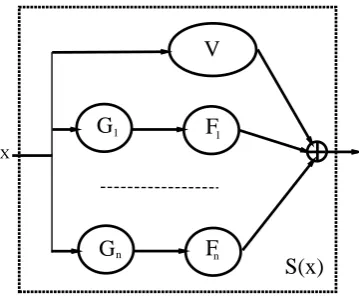
1. ConstructU(·) such that it contains all cubic terms of the ANF ofS(·). 2. Find two vectorial boolean functions such thatU(·) =F(G(·))
3. ComputeV(·) =S(·)⊕U(·)
V
G
F
X
S(x)
Fig. 2.Factorization Structure.
Note 2. To use the idea of factorization in the context of TI, the 3 properties of [11] - correctness, non-completeness and uniformity - have to be considered. For the properties to be fulfilled, G(·) must be a sharable permutation.
Definition 6. A 4-bit linear or quadratic vectorial boolean function is called sharableif it can be converted to a 12-bit vectorial boolean function which fulfills the following properties: correctness and non-completeness. All 4-bit vectorial boolean function are sharable.
Definition 7. A 4-bit permutation is called TI-factorizableif it can be described as a composition of several sharable vectorial boolean functions and its converted 12-bit vectorial boolean function is a 12-bit permutation.
Denote (α1, α2, α3, α4) =α(x, y, z, w), wherex,y,z,w,αi, 1≤i≤4, are in
F2. The ANF ofα(·) is
α1=x⊕yzw
α2=y⊕zw
α3=z⊕w
α4=w⊕1
Now, we show that the permutationα(·) is TI-factorizable. In order to fac-torize α(·) = F(G(·))⊕V(·), we use 3 sharable vectorial boolean functions (a, b, c, d) = G(x, y, z, w) (a sharable permutation), (A, B, C, D) = F(a, b, c, d) and (X, Y, Z, W) =V(x, y, z, w) as follows:
ANF ofG(·):
a=x⊕yz
b=y
c=z
d=w
ANF ofF(·):
A=ad
B= 0
C= 0
D= 0
and ANF ofV(·):
X =x⊕xw
Y =y⊕zw
Z =z⊕w
W =w⊕1
In the appendix we describe the construction of the 12-bit permutationα12(·) ofα(·). Sinceα12(·) is a 12-bit permutation,α(·) is TI-factorizable 7.
We now have solved both problems defined in the beginning of this chapter: we have proven that all Hi are TI-decomposable and α(·) is TI-factorizable.
From 3 it follows that all Gi(·) are also TI-factorizable and hence, the TI can
be applied to all of the remaining 8 classes. Based on our results we derive the following theorem.
Theorem 4. All 4-bit optimal S-boxes in the symmetric group S16 are
TI-factorizable. It implies that all these S-boxes can be protected by using the 3-share TI.
Note 5. We can generalize the factorization structure for 4-bit permutation as follows. It is always true that, there exists a set of quadratic vectorial boolean functions Fi, V and quadratic permutationGi, 1 ≤i ≤ n, such that, for any
4-bit S-boxS(·):
S(·) =
n
M
i=1
Fi(Gi(·))⊕V(·).
The Figure 4.2 describes the general idea. Hence, it may be possible to directly construct the 12-bit permutationS12(·) of a given 4-bit cubic S-boxS(·) without taking the detour usingα(·). We usedα(·) for the sake of clarity.
V
G
G
F
F
1 1
n n
X
S(x)
Fig. 3. General Factorization Structure.
5
Applications of TI-decomposable and TI-factorizable
S-boxes
costs. Unfortunately, it is not possible to share a core between different equivalent classes. We pick up this idea and show that by using our new methodologies we can overcome this shortcoming.
In particular, we want to highlight two major benefits of our methodologies. First, using different compositions of the same sharable permutation enables us to construct representatives of all classes inA16. We can use this fact to improve the idea of [6] and use the same core for all S-boxes inA16. By using factorization we can even extend this idea further to classes not inA16.
Second, since all these S-boxes, independent of their class, are now con-structed by only using linear and quadratic permutations and/or vectorial boolean functions, and can be used for a 3-share Threshold Implementation.
In the following we want to give an example of how to apply our methodolo-gies. We chose SERPENT because it has 8 different S-boxes of which 4 belong toA16and the other 4 do not belong toA16. This makes SERPENT the perfect example to show the application of our methodologies.
5.1 SERPENT
LetS∼S0 denoteS is linear equivalent toS0, and letGi be a representative of
classi. The equivalences of the 8 SERPENT S-boxes are as follows [6]:
S0∼G2
S1∼G0
S2∼S6∼G1
S3∼S7∼G9
S4∼S5∼G14
(3)
As we can see there are 5 equivalent classes, meaning by using the idea of [6] we need to implement 5 cores.
Let us recall some results from section 3.2. LetR be the following sharable permutation:
R= [ 0, 4, 1, 5, 2, 15, 11, 6, 8, 12, 9, 13, 14, 3, 7, 10 ].
1. ifA= 0x1249, thenS(·) =R(AR(·))∈class 0 2. ifA= 0x1248, thenS(·) =R(AR(·))∈class 1 3. ifA= 0x1259, thenS(·) =R(AR(·))∈class 2
Based on these results, instead of needing 3 coresG0, G1, G2 to construct the 4 S-boxesS0, S1, S2,S6, we only need to implementR(·) and the matrices 0x1249, 0x1248 and 0x1259 to construct 4 class representatives. Then, we con-struct the final 4 S-boxesS0,S1,S2 andS6 by applyingSi= ˆA(S( ˆBx⊕c)⊕d)
1 with the parameters provided in Table 2.
Table 2. The parameters ˆA, ˆB, ˆc, ˆdof the S-boxesS0,S1,S2,S6of SERPENT
ˆ
A Bˆ ˆc dˆ class SERPENTS0 [1] 0x4659 0x3f98 0xa 0x2 2 SERPENTS1 [1] 0xd597 0xc43a 0xf 0x8 0 SERPENTS2 [1] 0xbd87 0x2418 0xe 0x1 1 SERPENTS6 [1] 0x5978 0xce96 0x7 0xa 1
1. ifA= 0x1529, thenS(·) =R(AR(R(·))) ∼H9 2. ifA= 0x1c38, thenS(·) =R(AR(R(·))) ∼H14
Where Gi = (Hi+ 1)%16, i = 9, 14. Hence, we can construct H9 and H14 by only usingR(·), the matrices 0x1529, 0x1c38, and by applyingHi= ˜A(S( ˜Bx⊕
˜
c)⊕d˜) theR(·) with the parameters provided in Table 3. Recall thatHi is not
necessarily a representative of classibut is needed to construct the representative
Gi of classi.
Table 3. The parameters ˜A, ˜B, ˜c, ˜dofH9,H14of SERPENT ˜
A B˜ ˜c d˜
SERPENTH9 0x4896 0x62e3 0xe 0xd SERPENTH140xba4d 0xb8da 0xf 0x1
To construct the 4 remaining SERPENT S-boxesS3,S4,S5,S7, we now need to apply Si=A(α(Hi)(Bx⊕c)⊕d) with the parameters provided in Table 4.
Table 4. The parametersA, B,c,dand class of some S-boxes
A B c d class
SERPENTS3 [1] 0xfbc5 0xbaf6 0x9 0xe 9 SERPENTS4 [1] 0xa98d 0x8147 0xb 0x9 14 SERPENTS5 [1] 0xad89 0x124e 0x0 0x8 14 SERPENTS7 [1] 0x8947 0x427f 0x6 0x4 9
5.2 Generic algorithm to factorize S-boxes ∈/A16
To factorize a given optimal S-box S(·) which is not in A16 we perform the following steps:
1. Determine the class of the S-box S(·), i.e., findA,B,c,dsuch thatS(x) =
A(Gi(Bx⊕c)⊕d).
2. Look up the correspondingF andGin Table 6, i.e.,Gi(·) =α(F(G(·))).
3. The given S-boxS(x) is factorized as follows:
S(x) =A(α(F(G(Bx⊕c)))⊕d)
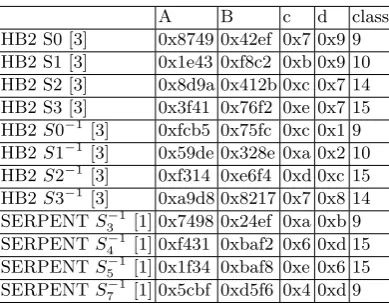
In Table 5 we provide some parameters for several 4-bit S-boxes which do not belong toA16.
6
Conclusion
The 3-share TI is an efficient and well-accepted countermeasure against DPA. Until now, it was only possible to apply this countermeasure to optimal 4-bit S-boxes which belong toA16(roughly 50 % of all optimal S-boxes).
First, we give a deep insight into the decomposition of optimal S-boxes and provide a methodology to share a mutual core between all S-boxes inA16. This technique allows for very efficient (in terms of size) hardware implementations. Based on this methodology, we present a new algorithm which can find a de-composition of any given S-box inA16with a time complexity of 219.
References
1. Eli Biham, Ross Anderson, and Lars Knudsen. Serpent: A new block cipher pro-posal. InIn Fast Software Encryption 98, pages 222–238. Springer-Verlag, 1998. 2. Jean-S´ebastien Coron and Louis Goubin. c. InProceedings of the Second
Interna-tional Workshop on Cryptographic Hardware and Embedded Systems, CHES, pages
231–237, London, UK, UK, 2000. Springer-Verlag.
3. Peter Schweitzer Daniel Engels, Markku-Juhani O. Saarinen and Eric M. Smith. The hummingbird-2 lightweight authenticated encryption algorithm.
4. Paul C. Kocher. Timing attacks on implementations of diffie-hellman, rsa, dss, and other systems. In Proceedings of the 16th Annual International Cryptology
Conference on Advances in Cryptology, CRYPTO ’96, pages 104–113, London,
UK, UK, 1996. Springer-Verlag.
5. Paul C. Kocher, Joshua Jaffe, and Benjamin Jun. Differential power analysis. In
Proceedings of the 19th Annual International Cryptology Conference on Advances
in Cryptology, CRYPTO ’99, pages 388–397, London, UK, UK, 1999.
Springer-Verlag.
6. G. Leander and A. Poschmann. On the classification of 4 bit s-boxes. InProceedings of the 1st international workshop on Arithmetic of Finite Fields, WAIFI ’07, pages 159–176, Berlin, Heidelberg, 2007. Springer-Verlag.
7. Stefan Mangard. Masked dual-rail pre-charge logic: Dpa-resistance without routing constraints. InSystems CHES 2005, 7th International Workshop, pages 172–186. Springer, 2005.
8. Stefan Mangard, Berndt M. Gammel, and Infineon Technolgies Ag. Side-channel leakage of masked cmos gates. In in Topics in Cryptology - CT-RSA 2005, The Cryptographers Track at the RSA Conference 2005, pages 351–365. Springer, 2005. 9. Stefan Mangard, Elisabeth Oswald, and Thomas Popp. Power Analysis Attacks: Revealing the Secrets of Smart Cards (Advances in Information Security). Springer-Verlag New York, Inc., Secaucus, NJ, USA, 2007.
10. Stefan Mangard, Norbert Pramstaller, and Elisabeth Oswald. Successfully attack-ing masked aes hardware implementations. InCHES 2005, pages 157–171, 2005. 11. Svetla Nikova, Christian Rechberger, and Vincent Rijmen. Threshold
implemen-tations against side-channel attacks and glitches. In Peng Ning, Sihan Qing, and Ninghui Li, editors, ICICS, volume 4307 of Lecture Notes in Computer Science, pages 529–545. Springer, 2006.
12. Svetla Nikova, Vincent Rijmen, and Martin Schl¨affer. Secure hardware implemen-tation of nonlinear functions in the presence of glitches. Journal of Cryptology, pages 292–321, October 2010.
13. Axel Poschmann, Amir Moradi, Khoongming Khoo, Chu-Wee Lim, Huaxiong Wang, and San Ling. Side-channel resistant crypto for less than 2,300 ge. J. Cryptol., 24(2):322–345, April 2011.
Appendix
In this section we will prove that α12(·) is 12-bit permutation. Based onF(·),
G(·),V(·), the 12-bit permutationα12(·) ofα(·) is constructed as follows: The 4-bit input x, y, z, w is split into 3 shares, i.e., x = x1⊕x2⊕x3,
The ANF of 12-bitG12(·) ofG(·) is:
a1=x2⊕y2z2⊕y2z3⊕y3z2
a2=x3⊕y3z3⊕y1z3⊕y3z1
a3=x1⊕y1z1⊕y1z2⊕y2z1
b1=y2
b2=y3
b3=y1
c1=z2
c2=z3
c3=z1
d1=w2
d2=w3
d3=w1
The ANF of 12-bitF12(·) ofF(·) is:
A1=a2d2⊕a2d3⊕a3d2
A2=a3d3⊕a1d3⊕a3d1
A3=a1d1⊕a1d2⊕a2d1
B1= 0
B2= 0
B3= 0
C1= 0
C2= 0
C3= 0
D1= 0
D2= 0
The ANF of 12-bitV12(·) ofV(·) is:
X1=x2⊕x3w3⊕x2w3⊕x3w2
X2=x3⊕x1w1⊕x1w3⊕x3w1
X3=x1⊕x2w2⊕x1w2⊕x2w1
Y1=y2⊕z3w3⊕z2w3⊕z3w2
Y2=y3⊕z1w1⊕z1w3⊕z3w1
Y3=y1⊕z2w2⊕z1w2⊕z2w1
Z1=z2⊕w2
Z2=z3⊕w3
Z3=z1⊕w1
W1=w2⊕1
W2=w3
W3=w1
Thenα12(·) =F12(G12(·))⊕V12(·) is a 12-bit permutation.
Table 5. The parametersA, B,c,dand class of some S-boxes
A B c d class
HB2 S0 [3] 0x8749 0x42ef 0x7 0x9 9 HB2 S1 [3] 0x1e43 0xf8c2 0xb 0x9 10 HB2 S2 [3] 0x8d9a 0x412b 0xc 0x7 14 HB2 S3 [3] 0x3f41 0x76f2 0xe 0x7 15 HB2S0−1 [3] 0xfcb5 0x75fc 0xc 0x1 9 HB2S1−1 [3] 0x59de 0x328e 0xa 0x2 10 HB2S2−1 [3] 0xf314 0xe6f4 0xd 0xc 15 HB2S3−1 [3] 0xa9d8 0x8217 0x7 0x8 14 SERPENT S3−1 [1] 0x7498 0x24ef 0xa 0xb 9 SERPENT S−1
![Fig. 1. Composition of PRESENT’s s-box [13]](https://thumb-us.123doks.com/thumbv2/123dok_us/7886606.1308566/4.595.180.440.216.281/fig-composition-of-present-s-s-box.webp)